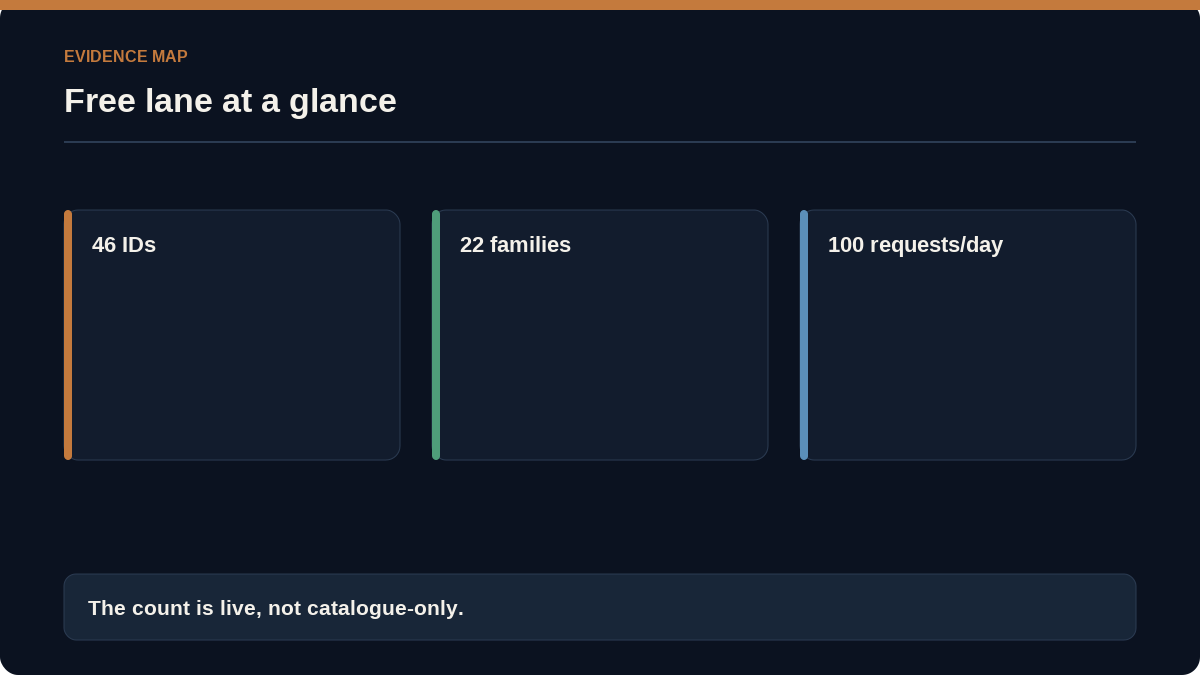
The free lane contains 46 live model IDs across 22 families, but it is an OpenAI-format lane. Use it through an OpenAI-format agent with one gateway key and the base URL https://api.oneaiapikey.com/v1. The IDs do not run inside Claude Code. Claude Code uses the Anthropic Messages format, and the four Claude IDs on that separate route were all unavailable on 2026-11-27. The practical opportunity is real: a Claude Code user can test other model families without buying another coding subscription. The boundary is equally real: this is a different agent architecture, not free Claude access.
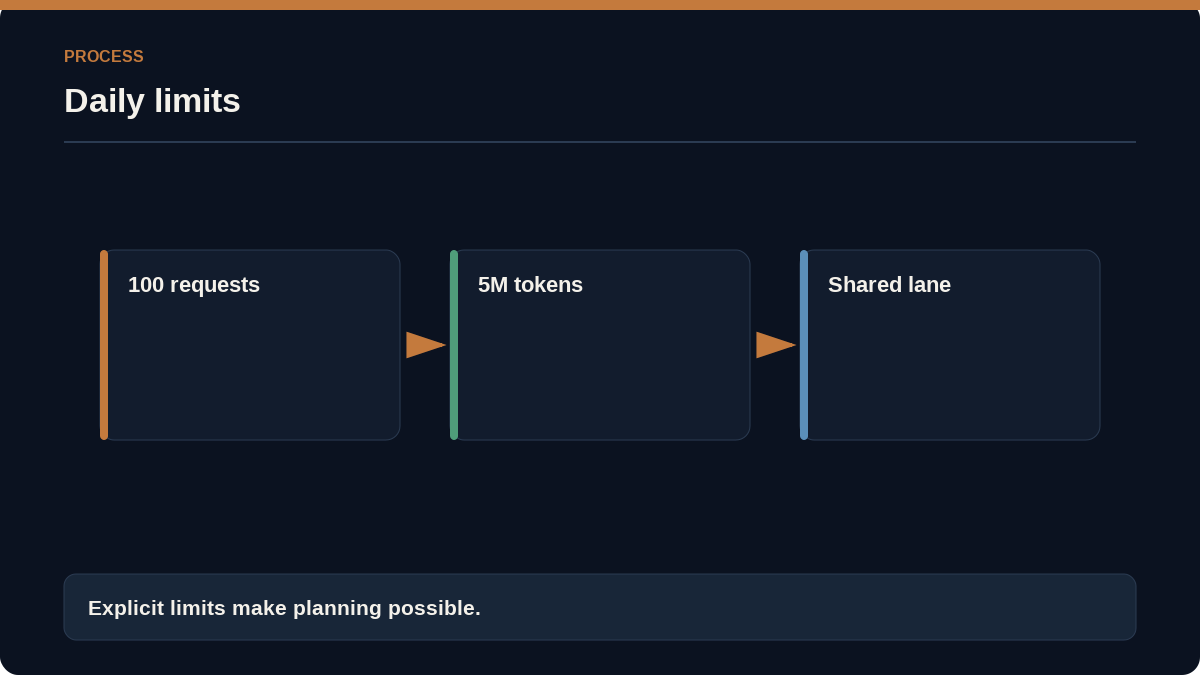
The lane also has explicit limits. It allows 100 requests and 5,000,000 tokens per day per account, shared across the 46 free IDs. The reset is 05:30 IST, which is 00:00 UTC. Accounts can have up to three keys, with one request in flight per key on free models, but extra keys do not create extra daily allowances. Those facts make the lane suitable for bounded experiments, small edits and comparison work. They do not make it unlimited or a drop-in replacement for every Claude Code session.
Free-lane count: what 46 means
Official: the model catalogue displayed 76 listed models on 2026-11-27, and the free page identified 46 available-now free IDs across 22 families. The distinction matters. A listed model is not necessarily callable, and an available-now ID is not necessarily suitable for every coding task. The live model catalogue is the place to check current status; the free lane page is the place to choose an ID for this route.
The number 46 is a count of IDs, not a count of independent providers or a quality ranking. Multiple IDs can belong to one family, and a family can expose models with different sizes, speeds or task fit. The frozen fact pack does not provide a benchmark table for the 46 IDs. It would be misleading to turn the count into a claim that every ID matches Claude Code or that the largest catalogue is automatically the best one for a repository.
A useful way to read the catalogue is by task. Pick one ID for a small code edit, one for a longer explanation and one for a tool-using task. Use the same inputs and expected results. Record which ID completed the work, how much review it needed and whether the agent could recover from a mistake. That produces evidence you can use. A screenshot of 46 names does not.
The concrete win is breadth. You can compare several model families through one key and one compatible agent. The concrete loss is evaluation time. More choice means more decisions, and a model that writes clear prose may still produce a weak diff. Treat the catalogue as a menu for a measured test, not a leaderboard.
Daily limits: plan around the shared pool
The free lane allows 100 requests and 5,000,000 tokens per day per account. Both numbers are shared across the 46 free IDs. Official: the daily reset is 05:30 IST, which is 00:00 UTC. The reset is not tied to the moment you create a key or start a session. If you work across midnight UTC, a task can cross the boundary and consume parts of two daily pools.
| Limit | Frozen value | Scope | Practical consequence |
|---|---|---|---|
| Requests | 100 per day | Per account, shared across free IDs | Many small calls can exhaust the pool quickly |
| Tokens | 5,000,000 per day | Per account, shared across free IDs | Long context and repeated tool output consume the same pool |
| Reset | 05:30 IST / 00:00 UTC | Daily account boundary | Schedule large experiments before the reset |
| Keys | Up to three | Per account | Separate projects, not separate allowances |
| Concurrency | One request in flight per key on free models | Per key | Parallel agents need deliberate key and request planning |
Requests and tokens measure different things. A short answer may use few tokens but still consume a request. A long agent loop may use relatively few calls while sending large context on each turn. If you only watch requests, a token-heavy workflow can surprise you. Watching only tokens, a chatty tool loop can still surprise you. Track both.
The three-key allowance is useful for project separation. It does not defeat the daily cap. Derived: because one request can be in flight per key on free models, three keys can permit up to three concurrent requests under that rule, while all of them still draw from the same account-level request and token pools. Do not present key rotation as a way to multiply free capacity.
A simple operating habit is to set a task budget before starting. For a comparison run, decide how many requests you will spend and what context size you will allow. Stop when the budget is reached, record the result and resume after reset if needed. The limit is predictable enough to plan around, but only if you treat it as a shared resource.
OpenAI-format requirement: why Claude Code cannot use these IDs
The free IDs use the OpenAI chat-completions format. An OpenAI-format agent sends requests to https://api.oneaiapikey.com/v1. Claude Code sends Anthropic Messages requests and uses a different endpoint convention. Official: all listed gateway models use the OpenAI format, and four also accept the Anthropic Messages format. The free IDs are OpenAI-format only.
Claude Code’s documented gateway base URL is https://api.oneaiapikey.com with no trailing /v1, because Claude Code appends /v1/messages. That route is separate from the free lane. The four Claude IDs were claude-sonnet-5-5, claude-sonnet-5, claude-opus-5-5 and claude-haiku-4-5, and all four were marked unavailable with no working upstream on 2026-11-27. They should not appear in a live setup guide.
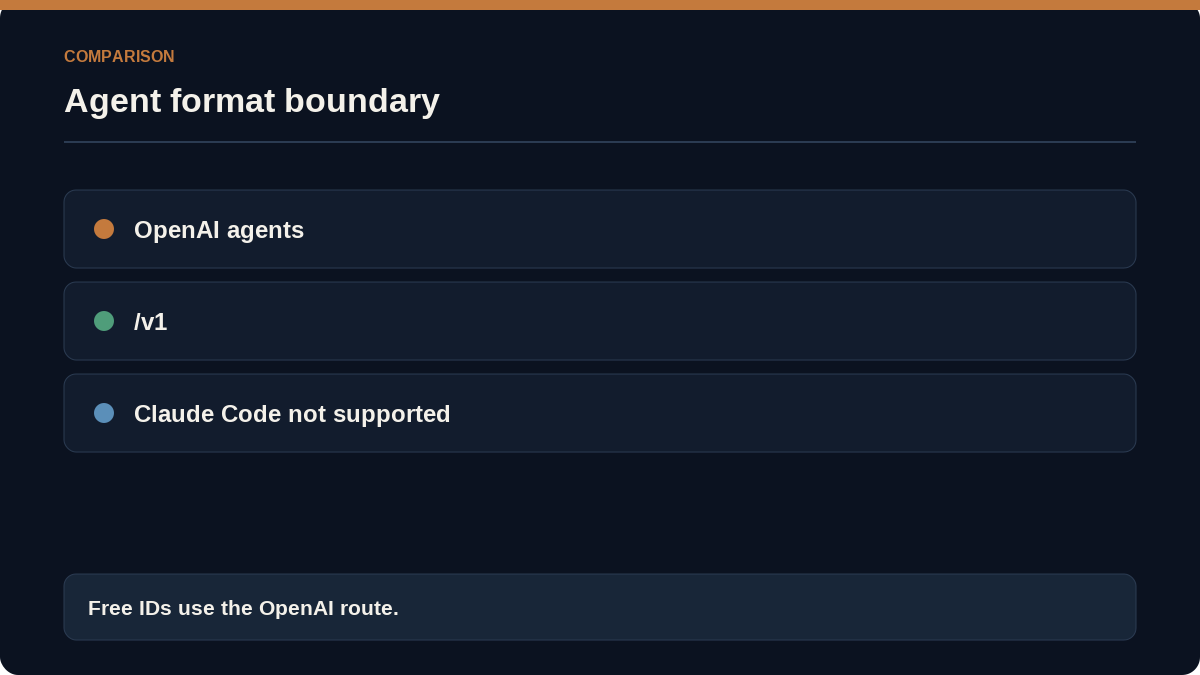
This is not a wording technicality. An OpenAI-format agent expects fields and response shapes that differ from the Anthropic Messages API. Pointing Claude Code at the OpenAI route does not convert the protocol. An OpenAI-format agent pointed at the Claude Code origin without /v1 can produce the wrong path. The client and route must match before model selection matters.
The OpenAI versus Anthropic API format guide explains the difference, and the coding-agent compatibility guide records the Claude route status. Use those references when configuring a client. The safe rule is simple: OpenAI-format agent plus /v1 for the free lane, Claude Code plus the Anthropic route only if a compatible Claude ID is actually available.
Model families: what the count does and does not tell you
The frozen fact pack confirms 22 families but does not enumerate all of them. The assigned family visual uses DeepSeek, Nemotron, Kimi, GLM and Gemma as example labels. Treat those labels as a map for browsing, not as a verified availability list. Confirm the current family and ID on the live free page before you configure an agent.
| Family label in the visual | What the frozen evidence establishes | Safe use of the label |
|---|---|---|
| DeepSeek | The fact pack confirms 22 families, not a full family inventory | Browse the live catalogue and select an available ID |
| Nemotron | Same evidence boundary | Compare one bounded task, not a presumed rank |
| Kimi | Same evidence boundary | Verify format, status and task fit |
| GLM | Same evidence boundary | Do not infer Claude compatibility from the family name |
| Gemma | Same evidence boundary | Check the exact live ID before use |
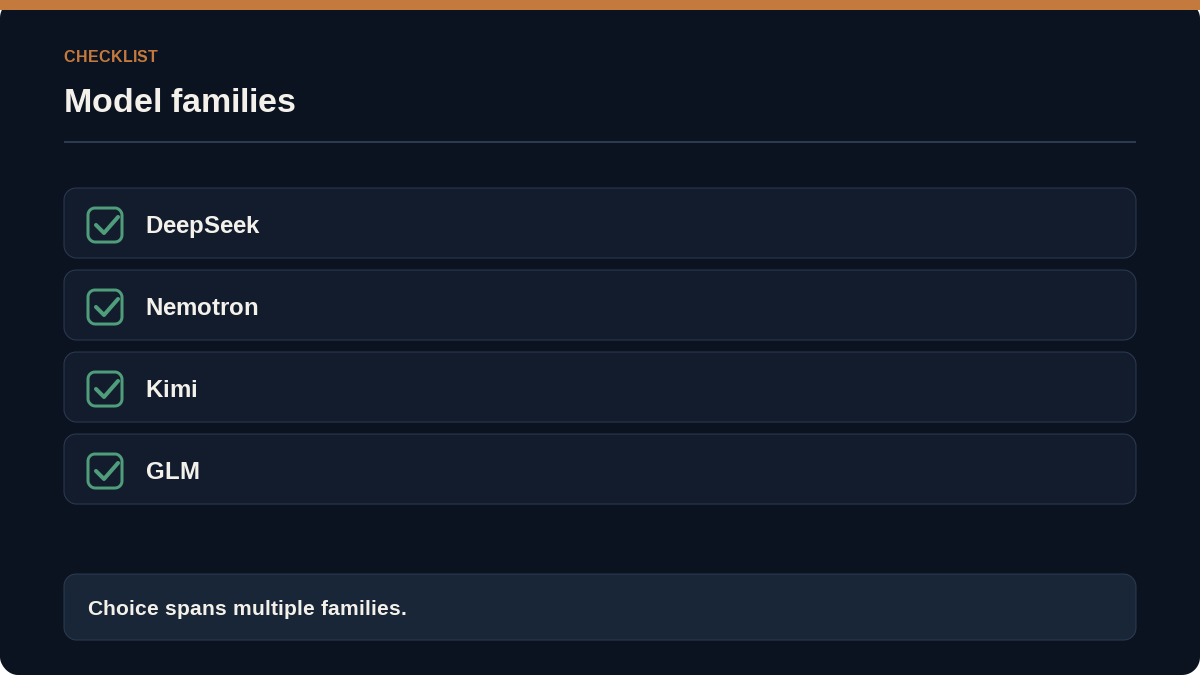
A family name is not a task guarantee. Models in the same family can differ in context handling, tool use and output style. The fact pack contains no controlled benchmark for these free IDs, so this article does not rank them. If you need a decision framework, use the model selection guide for coding agents, then validate the choice on your own repository.
Keep the comparison small. Use a bug with a known fix, a refactor with a targeted test and a short explanation task. Score the accepted result, review time and recovery from errors. That scorecard is more useful than a long list of family names because it measures the work you need done.
First-request checklist: key, base URL and live ID
The first request should prove three things: the key is accepted, the endpoint shape is correct and the selected ID is callable. Keep the key in an environment variable or the agent’s secret field. Do not paste it into a project file. Use an available ID from the free page rather than copying one from an old example.
| Check | Action | Expected evidence | If it fails |
|---|---|---|---|
| Key | Create or select a project key | Key appears in the console with controls | Check account and key status |
| Base URL | Set https://api.oneaiapikey.com/v1 |
Agent shows the exact value | Remove duplicate /v1 or wrong origin |
| Model ID | Choose an available-now free ID | Request log names the selected model | Return to the live free page |
| Format | Use OpenAI chat completions | Readable assistant response | Check client protocol and fields |
| Limits | Send one minimal request | Request and token usage are visible | Inspect daily pool and reset time |
| Tool path | Run one harmless command | Proposed command is visible and reviewable | Reduce permissions or fix tool format |
The quickstart provides the current request shape. The API reference documents per-key caps, expiry and allowed-model lists. Official: the console shows per-request model, token and cost logs. Use that log to confirm the route instead of assuming the agent used the model you intended.
After the minimal request, run one bounded repository task. Ask for a small edit, inspect the diff and run the targeted test. A successful connection is not proof of useful coding behavior. The proof-of-work packet gives a reusable way to ask for changed files, actual test output and an independently verified result.
Reading the request log
The request log is part of the evaluation, not an administrative afterthought. Official: the console shows per-request model, token and cost logs. After a task, check which model actually served the request. An agent can display one selection while using another default, and a retry can obscure the first failure if you only read the final response.
Record the request count and token totals for each task. A task that looks cheap because it produced a short answer may still have sent a large context. A task that looks expensive may have required several recovery turns. The log lets you separate those patterns without guessing. Keep the log free of secrets; model, token, cost and status fields are enough for most comparisons.
Use the log to set a stopping rule. If a task has already consumed its request budget without a verified result, pause and inspect the cause. Do not keep retrying because the model is free. The daily pool is shared, and an uncontrolled loop can consume the capacity needed for the next comparison. A bounded failure is useful evidence. An unbounded retry storm is just noise.
The per-project key and spend-limit guide explains why separate keys make this easier. A project key with a cap and expiry exposes one experiment without putting every other project at risk. The console keys and usage guide covers where to inspect the resulting activity.
A safe comparison routine
A comparison routine should be repeatable by someone who did not write the prompt. Start with a clean branch or disposable directory. Save the task brief, the expected result and the test command. Run the primary route once to establish a baseline, then run the alternative with the same inputs. Keep the agent version and model ID with the result.
Score the result in two passes. First, check correctness against the requirement. Second, review the diff for clarity, unnecessary changes and hidden side effects. This separates “did it work” from “was it easy to accept.” Both matter, but they are not the same measurement.
Repeat the task once after a short break. A model that succeeds only on the first attempt may be relying on a fragile pattern. A model that recovers cleanly from a small error may be more useful in a real repository. Record the recovery steps rather than only the final state.
Stop the comparison when the evidence is sufficient for the decision. More IDs do not automatically produce more confidence. Two or three models tested on the same bounded tasks can be more informative than twenty models tested on different prompts with no shared baseline.
Limitations: free does not mean unlimited or universal
The lane is bounded by daily requests, daily tokens and concurrency. It is also bounded by format. The free IDs do not work in Claude Code, and the four Claude IDs on the Anthropic route were unavailable at the audit time. A reader who needs Claude Code specifically should treat the free lane as an alternative agent workflow, not a configuration trick.
Quality is the second limitation. The fact pack provides no benchmark comparison for the 46 free IDs. Some may be strong for focused edits, others for explanation or longer context. The only honest way to choose is to run a small task set and record accepted results. Do not convert catalogue breadth into a quality claim.
Data handling is the third limitation. The gateway’s privacy policy says it does not train on prompts, files or outputs and does not sell them. It also says prompt and response bodies are not written to usage logs by default, with separate retention periods for troubleshooting captures, opt-in prompt logs, usage metadata and security logs. Those are first-party policy statements, not an independent audit. Upstream providers receive requests under their own terms.
Finally, the gateway is another dependency. A working free model is not reachable if the gateway or upstream is unavailable. The live status page belongs in your operating checklist. A second route reduces concentration risk only if you have tested it and understand its limits.
Honest loss: the free lane is a test bed, not a full replacement
The concrete win is inexpensive access to many model families through one compatible agent. The concrete loss is the work required to evaluate and integrate them. You need a client that supports the OpenAI format, a portable project setup, a review process and a way to live within the daily pool. None of that is automatic.
Claude Code’s integrated workflow may still be the better fit for a developer who values its specific tools and account features. The free lane does not reproduce that interface. It offers a different path for experimentation, bounded tasks and backup capacity. That is valuable, but it is a narrower promise than “free Claude Code.”
The evidence gap is just as important. The audit verifies counts, limits and format boundaries. It does not prove that every free ID is reliable for production, that one family is best for coding or that the lane will keep the same catalogue indefinitely. Update your configuration from the live pages, and keep your own task results.
Data gap and future update
This article freezes the free lane on 2026-11-27. The count, limits and Claude route status can change. A future update should recheck the live catalogue, the free page and the compatibility guide, then replace the numbers only with verified values. Until then, the 46-ID count is a dated fact, not a permanent promise.
The second gap is family coverage. The fact pack confirms 22 families but does not provide a complete inventory. The visual’s example labels should not be read as an exhaustive list. The third gap is quality: no controlled benchmark in the research set compares the 46 free IDs on a shared coding task set. That requires a separate evaluation with published inputs, settings and results.
Cluster guide
Use the cluster to decide whether the free lane solves the problem you actually have. The links below cover price, access, privacy, verification and migration.
- Cost: Claude Code free-tier entry price explains the paid floor for the primary workflow.
- Quota: Claude Code five-hour and weekly limits documents the quota behavior that may prompt a backup search.
- API math: Fable 5.2 agent-loop pricing math shows how agent context changes API cost.
- Billing: Ultra API credits versus Claude Code usage separates two balances.
- Value: Claude Code cost per verified change adds review and rework to the comparison.
- Account: Claude Code suspension notice gaps covers account-standing risk.
- Travel: Claude Code travel and regional ban risk explains location eligibility.
- Teams: Claude Code regional restrictions for teams extends the policy review to teams.
- Exception: Claude Ultra five-hour exception keeps the exception precise.
- Appeal: Claude Code appeal evidence packet prepares the official appeal route.
- Privacy: Claude Code privacy and retention rules compares consumer and commercial defaults.
- Retention: Claude Code zero-data-retention limits explains qualified Enterprise coverage.
- Legal: AI government-request policies keeps legal claims evidence-based.
- Secrets: Claude Code settings-file secret exposure shows why approval text needs secret scanning.
- Security: Claude Code harness security boundaries maps model, tool and host authority.
- Incident: Anthropic April 2026 Claude Code postmortem documents a dated model regression.
- Context: Claude Code context versus memory separates capacity from retained state.
- Compaction: Claude Code compaction retention test scores what survives a summary.
- Verification: Claude Code false-success verification tests the oracle behind a demo.
- Receipts: Claude Code proof-of-work packet defines receipts for completed work.
- Token use: Claude Code agent-team token overhead keeps the plan-mode condition attached to the estimate.
- Lock-in: Claude Code lock-in and exit costs inventories migration work.
- Credentials: Claude Code third-party harness rules explains credential restrictions without a blanket-ban claim.
- Migration: Claude Code context-portable migration preserves prompts, hooks and context files.
- Failure domains: Claude Code single points of failure maps quota, region, account and model risk.
- Setup: Multi-model OpenAI-agent setup shows the active architecture.
- Trial: $10 no-card gateway trial turns signup credit into a measured evaluation.
- Exit: Claude Code exit-plan checklist prepares a fallback before an incident.
- Architecture: Claude Code alternatives and model-layer ownership synthesizes the two-layer design.
Practical response: test one free ID before you scale
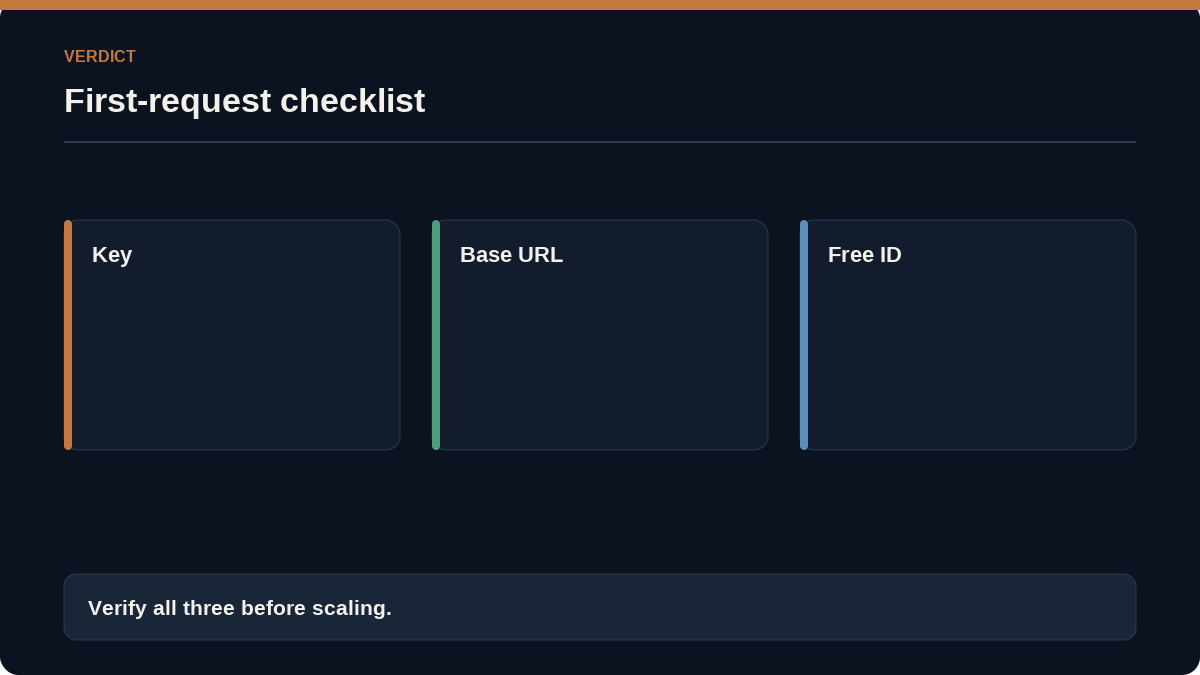
Choose one OpenAI-format agent, create one project key, set https://api.oneaiapikey.com/v1 and select one available free ID. Send a minimal request, inspect the request log, then run one bounded edit with a targeted test. Record the accepted result and the request and token usage.
One AI API Key’s active free lane is the OpenAI-format route with one key and the 46 live free model IDs. Start from the 46 live free model IDs, follow the quickstart and apply the per-key controls. The Claude Code route is documented but all four Claude IDs were unavailable on 2026-11-27. Never claim the free IDs work in Claude Code.
The win is a low-cost way to compare model families. The loss is the daily cap, the format boundary and the evaluation work. The practical implication is to use the lane for measured tasks, not as an unlimited subscription replacement.
FAQ
Are the 46 free model IDs free forever?
The frozen evidence verifies the lane on 2026-11-27. It does not promise a permanent catalogue or permanent pricing. Check the live free page before relying on a specific ID.
Can I use these IDs in Claude Code?
No. The free IDs use the OpenAI format. Claude Code uses the Anthropic Messages format, and the four Claude IDs on that route were unavailable on the audit date.
Do three keys give me 300 free requests per day?
No. The 100 requests and 5,000,000 tokens are shared per account across the free IDs. Three keys allow separate key management and one request in flight per key, not three daily allowances.
What time does the free lane reset?
The reset is 05:30 IST, which is 00:00 UTC. It is a daily account boundary, not a rolling 24-hour window from your first request.
Which free model is best for coding?
The frozen fact pack does not provide a benchmark ranking for the 46 IDs. Choose from the live catalogue and compare a small task set using accepted results, review time and error recovery.