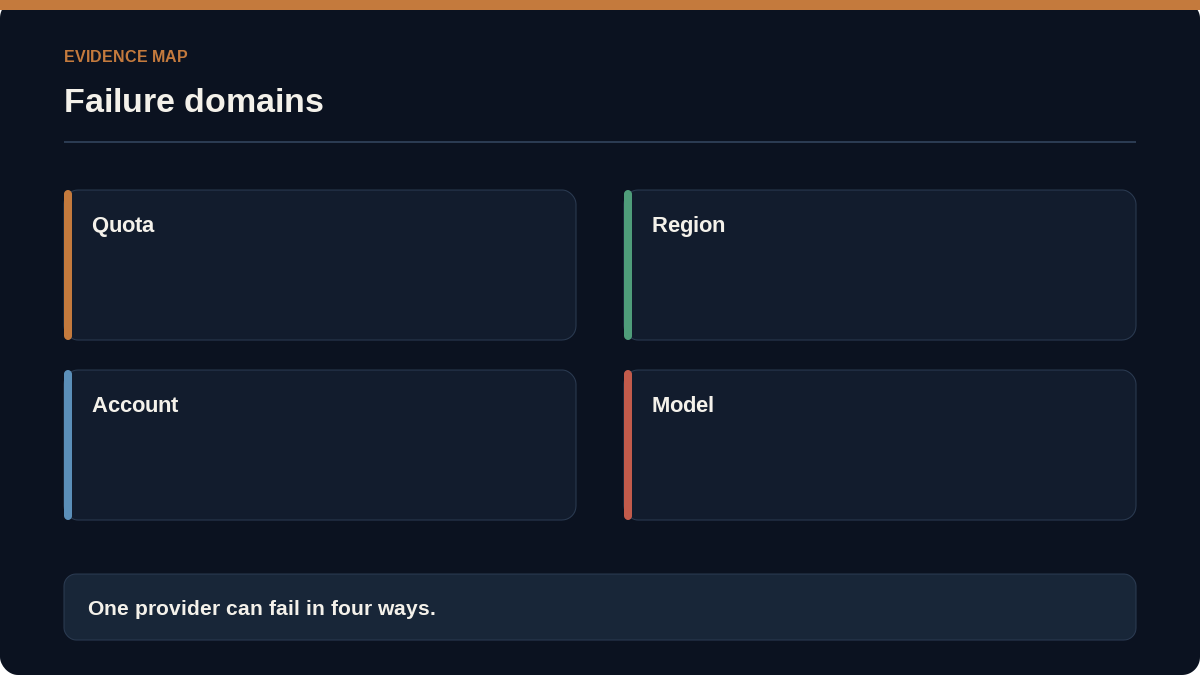
Claude Code has four distinct single points of failure: quota, regional eligibility, account standing and model behavior. A paid subscription does not make those risks disappear. It gives you access to one provider’s stack, so a weekly limit, a travel restriction, an account action or a model regression can each stop the same workflow. The practical response is not to declare Claude Code unreliable. It is to map each failure domain, decide which ones your work can tolerate, and test a second route before an incident. A gateway can widen model choice, but it cannot erase upstream outages, policy changes or data-handling obligations.
That distinction matters because “the API is down” is too vague to operate around. A quota wall needs a scheduling or capacity response. A regional restriction needs a policy review. An account lock needs an appeal and a backup identity. A model regression needs a pinned baseline and an independent test. Treating all four as one availability problem leads to weak backups: a second model behind the same account may fail at the same time, while a second provider with an untested client may fail when you need it most.
Why one provider creates four different outages
A coding agent is a chain. The interface accepts instructions, the account authorizes usage, the plan or balance supplies capacity, the model produces output, and the harness executes tools. Claude Code ties several of those links to one commercial relationship. Official: Claude Code is included in Pro, Max and Ultra, but not in the free Claude plan, according to the plan pricing page. Inclusion is not identical capacity. Pro costs $20 monthly or $17 per month with annual billing, Max costs $100 per month and Ultra costs $200 per month.
The same provider also sets the usage rules. The standard five-hour window begins with the first message and resets five hours later. Weekly limits reset at a fixed account time, and usage across claude.ai, Claude Code and Claude Desktop shares the same limit. Those are quota failures even when every server is healthy. The official limit documentation also identifies verified Ultra accounts as the exception to the standard five-hour cap, while keeping a weekly limit.
A resilient design starts by naming the failure you are planning for. “Keep a backup model” does not answer a regional restriction. “Upgrade the plan” does not solve an account suspension. “Add a gateway” does not prove that a fallback will fire. The table below separates the domains so each control can be tested against the event it is supposed to survive.
| Failure domain | What stops | Primary evidence | Useful control | Control that does not solve it |
|---|---|---|---|---|
| Quota | New sessions or further usage inside a limited window | Official limit mechanics | Schedule heavy work, track resets, keep a second capacity source | Buying a second key on the same limited account |
| Region | Access or eligibility based on physical location, entity location or control | Official supported-regions policy | Review locations, pause use where required, keep a compliant alternative | Assuming a VPN creates eligibility |
| Account | Login, appeals and billing access | Official termination grounds and appeal route | Export configuration, separate billing, prepare an evidence packet | Treating every suspension report as proof of a pattern |
| Model behavior | Output quality, latency or usage efficiency | Official postmortem for a dated regression | Pin versions, keep a baseline, compare a known task set | Assuming a different model name guarantees better output |
The win is visibility. Once the domains are separate, a team can spend money on the control that addresses the actual interruption. The loss is operational work: every additional route needs credentials, configuration, monitoring and a periodic test. Resilience is not a product feature you enable once. It is a property of the whole path.
Quota failure: healthy service, no room left
Quota exhaustion is the easiest failure to misunderstand because nothing looks broken. The client opens, the account is active and the model may still answer a small request. The interruption appears when a long task crosses a window or weekly boundary. Official: the five-hour window is fixed after the first message, not continuously rolling. That means a session started late in one window does not get a fresh five hours simply because the user keeps working.
Shared usage adds another edge. A developer who spends the morning in claude.ai can reduce the capacity available to Claude Code later that day. Desktop usage counts too. This is not a hidden bug; it is the documented shape of the allowance. The official usage guide is the source for the shared pool and reset behavior. Verified Ultra accounts do not have the standard five-hour cap, but they still have a weekly limit. Ultra is an exception, not an unlimited plan.
Independent reporting shows that quota exhaustion can become a visible workflow problem. The Register’s March 2026 report on Claude Code limits covered users running into limits. Independent: that report establishes that the issue received press attention. It does not establish a failure rate for all subscribers or prove that every limit is premature.
Community: a Hacker News discussion and a GitHub issue in the research set describe limits arriving sooner than some users expected. Those threads are useful for identifying symptoms, such as a long agent loop ending abruptly. They cannot tell you what percentage of sessions hit a wall or why a particular account consumed its allowance. Keep that boundary visible when you use community reports in a reliability review.
A practical quota control has two parts. First, record the account’s weekly reset time and avoid starting a non-urgent large task near the boundary. Second, decide what work can move to a second capacity source. A backup that shares the same account and the same weekly pool is not a capacity backup. It is only another interface to the same constraint.
Regional failure: eligibility is not a network setting
Regional risk comes from policy, not from a timeout. Official: the supported-regions policy is effective 2026-11-12 and covers physical location, entities headquartered in unsupported regions and certain ownership or control situations. Mainland China, Hong Kong, Macau, Russia, Belarus and Iran do not appear in the supported list. The supported-regions policy also says VPN use does not create eligibility. Location and control matter, not merely the IP address seen by a server.
That creates a different failure mode from quota. A developer may have an active subscription and a working laptop, yet be in a place where the policy does not permit use. A distributed team may also need to review contractor location and entity ownership rather than treating access as a per-device setting. The policy does not disclose every verification method or review timeline, so those details remain Unknown.
Community: travel threads in the research set collect complaints about access while traveling. A Reddit thread describes problems using Claude Code during travel, and GitHub issues mention VPN or location-related account actions. These reports show that users experience friction. They do not establish that every traveler is suspended, that a VPN causes a suspension, or that enforcement follows one consistent pattern.
The practical control is a pre-travel access review. Check the supported list, identify where work will physically happen, export the configuration you are allowed to export, and decide whether to pause use. Keep a compliant alternative available if your work cannot stop. Do not design the backup around evading the policy. A second provider also has its own terms, so the alternative needs the same review.
Account failure: access can stop for reasons outside the session
Account standing is a separate dependency because it controls login, billing and appeal access. Official: Anthropic’s termination grounds include repeated Usage Policy violations, account creation from an unsupported location and Terms of Service violations. The safeguards, warnings and appeals page says users can appeal by signing in at claude.ai and using the form linked from the restricted-account page. Anthropic also says appeal responses are slower than normal.
None of that tells you the cause of a specific suspension. A vague notice is not proof of a wrongful ban, and a community thread is not a population sample. Community: the research set includes reports involving signup, corporate VPNs, KYC and organization suspension. The safe conclusion is that these events are reported. The unsafe conclusion is a ban rate, a motive or a claim that every restriction is arbitrary.
Prepare the appeal packet before you need it. Keep the account email, plan receipt, approximate timeline, project names and any relevant support correspondence in a secure location. Do not store secrets in the packet. If an account is restricted, write a factual request for review and avoid claiming a cause you cannot prove. The official route is documented; reinstatement is not guaranteed.
A backup identity is not a request to create duplicate accounts against provider rules. It is a reason to separate billing, export portable configuration and keep another authorized provider ready. The goal is continuity without depending on one login. That distinction keeps the resilience plan aligned with the terms instead of treating account proliferation as a shortcut.
Model regression: the service can answer and still get worse
Model behavior is the fourth domain. A provider can be reachable, the account can be eligible and quota can remain, yet output quality can regress. The strongest evidence in this cluster is dated and specific. Official: Anthropic’s April 2026 postmortem describes three overlapping changes. The default reasoning effort moved from high to medium on 2026-03-04 and was reverted on 2026-04-07 after latency complaints. A caching bug on 2026-03-26 repeatedly cleared older reasoning after an idle condition, was fixed on 2026-04-10 and contributed to cache misses and faster usage consumption. A prompt change on 2026-04-16 limited verbosity, hurt coding quality and was reverted on 2026-04-20.
Anthropic says the fixes landed in v2.1.116 and usage limits were reset for all subscribers on 2026-04-23. That is a closed incident with documented fixes. It is not evidence that the bugs still exist. It is evidence that model behavior, caching and prompt defaults can change independently of account access.
A model-regression control needs a baseline. Keep a small task set with known expected results: a focused bug fix, a refactor with tests, a short explanation and a tool-using task. Run it after upgrades or when output feels different. Record the version, settings, test output and review time. Without that record, “quality dropped” becomes an argument instead of a measurement.
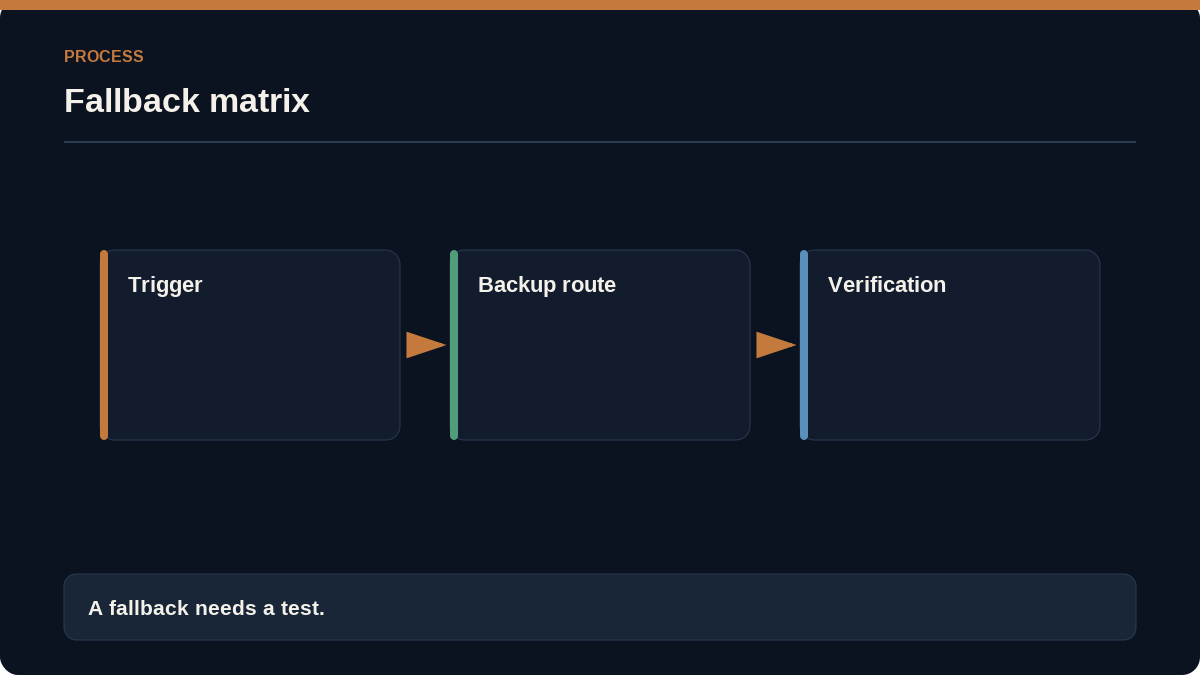
The honest loss is that a second model does not automatically preserve behavior. Different models have different strengths, tool-calling patterns and context habits. A fallback can keep work moving while introducing review cost. The reason is that the fallback matrix includes verification, not just an endpoint.
Fallback matrix: match the backup to the failure
A useful fallback names a trigger, a backup route and a verification step. The trigger should be observable. “When Claude seems off” is not observable. “Once the official limit page shows the weekly allowance exhausted” is. The backup should address the same domain. A second model on the same limited plan does not address quota. A second provider with a different account and billing path is closer to the requirement.
| Trigger | Primary action | Backup route | Verification before relying on it |
|---|---|---|---|
| Five-hour window exhausted | Pause non-urgent work or use remaining documented access | Second capacity source with independent limits | Send one small request and confirm the response |
| Weekly reset not yet reached | Move bounded tasks to the backup | OpenAI-format agent through a separate gateway route | Run the known task set and compare accepted results |
| Travel into an unsupported region | Stop use where policy requires it | Compliant provider reviewed for the same location | Confirm terms, account eligibility and network path |
| Account restricted | Submit the official appeal | Separate authorized provider and exported configuration | Restore a disposable project from the exported files |
| Output quality changes after an upgrade | Pin or revert where possible, open a reproducible issue | Alternate model for the same task | Compare tests, diff quality and review time |
| Upstream outage | Check official status and avoid retry storms | Second provider or model only if documented behavior supports it | Verify the route with a minimal request |
The matrix deliberately avoids promising automatic failover. The gateway’s routing documentation describes same-model retries and configurable fallback headers, while the gateway overview says the service does not answer with a different model. Official: those statements conflict. Until the behavior is resolved, treat fallback as something you configure and test, not a guarantee.
What a gateway can and cannot change
A gateway can separate the agent interface from the model endpoint. This gives a team more choices and can reduce dependence on one model family. Official: the gateway model catalogue showed 76 listed models and 46 available-now free IDs across 22 families on 2026-11-27. The free lane allows 100 requests and 5,000,000 tokens per day per account, shared across those IDs. Accounts can have up to three keys, with one request in flight per key on free models.
Those facts make a second route testable. They do not make it universal. The free IDs use the OpenAI format. They do not work in Claude Code’s Anthropic-format route. The four Claude IDs on the gateway were all marked unavailable on 2026-11-27. A reader who wants continuity for Claude Code specifically cannot treat those IDs as a live backup.
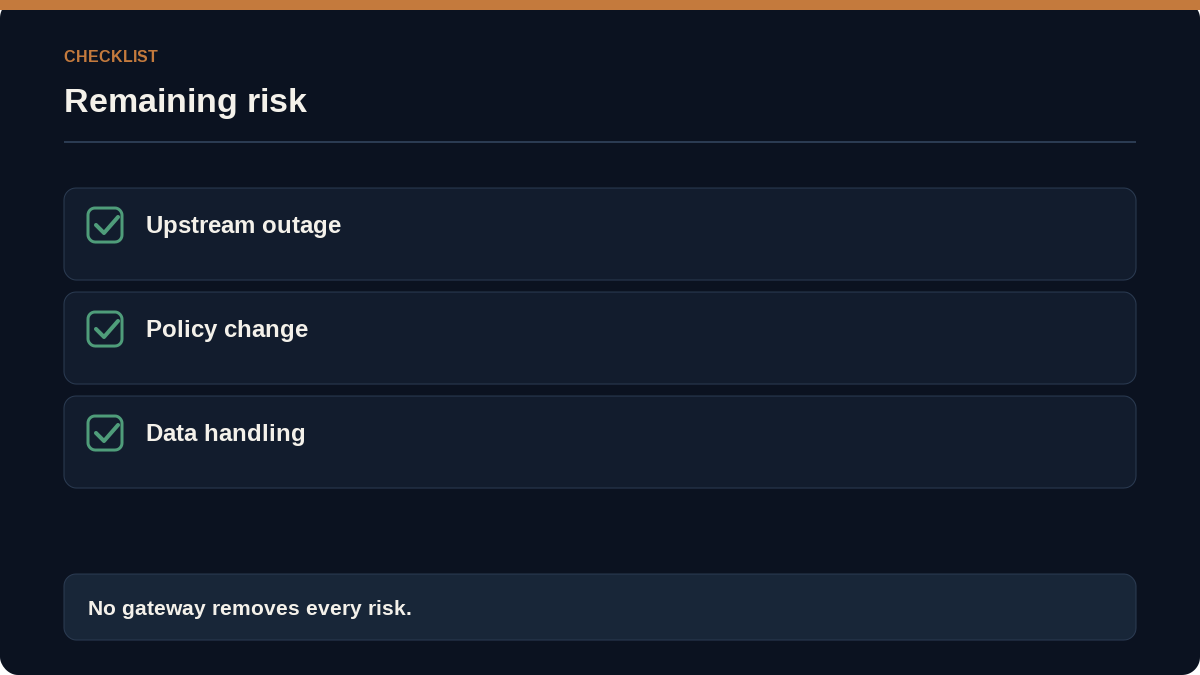
A gateway also introduces its own dependency. If the gateway is unavailable, a perfectly configured agent cannot reach a model through it. Where an upstream provider changes terms, the gateway’s catalogue can change. If data-handling requirements are strict, the gateway and its upstreams both belong in the review. The gateway privacy policy says prompts, files and outputs are not used for training or sold, but that is a first-party policy claim, not an independent audit.
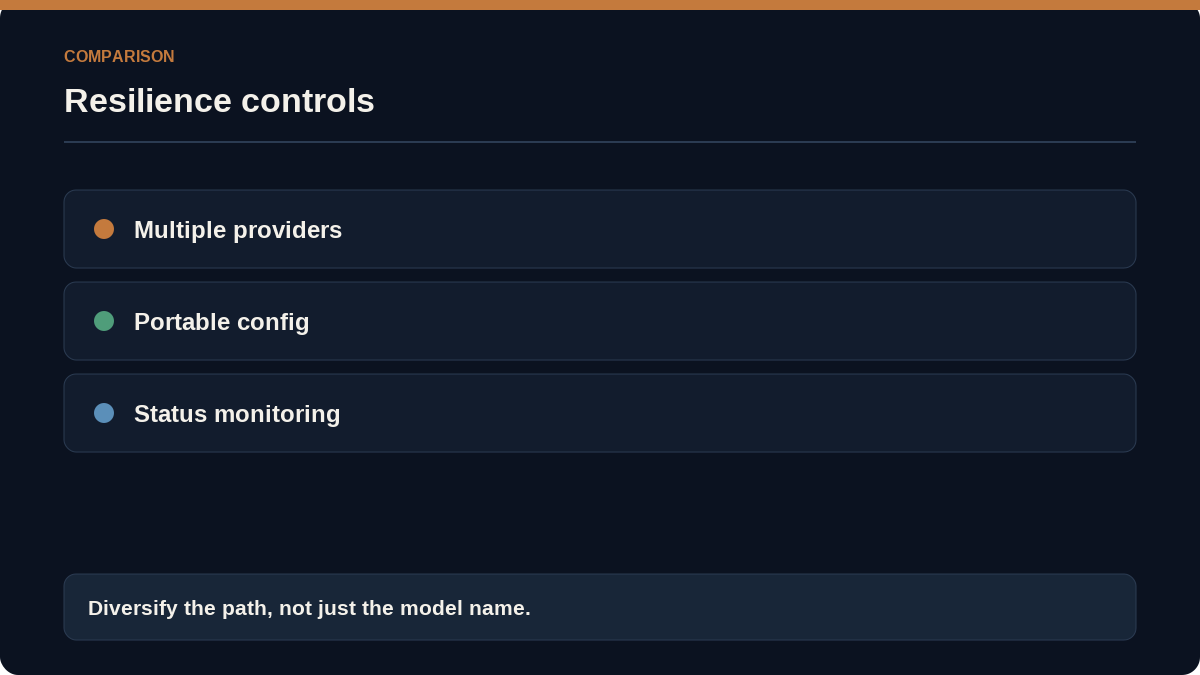
The practical implication is to diversify the path, not just the model name. Make agent configuration portable. Store project rules outside a single tool’s private state. Use per-project credentials where the provider supports them. Monitor the status of each route. Most importantly, run the same small task set through both routes and record where the outputs differ.
Worked example: a two-route week
Consider a five-day week with twelve bounded coding tasks. This is an illustrative planning example, not a benchmark. Derived: if four tasks require long agent loops and the remaining eight are short edits, the team can route the short tasks through a second capacity source while keeping the long tasks on the primary plan. The formula is simple: short tasks = total tasks - long-loop tasks, so 8 = 12 - 4.
Now add review. Suppose the primary route produces six accepted changes and the backup produces two accepted changes from four attempts. Derived: the acceptance rates are 6 / 10 = 60% for the primary route and 2 / 4 = 50% for the backup, assuming ten tasks went to the primary route. Those numbers are invented for the example and must be replaced with your own results. The point is the method: count accepted, verified changes rather than requests.
The example exposes a common mistake. A backup with lower acceptance may still be valuable if it prevents a complete stop, but it should not be described as equal quality. Record the extra review time and the tasks that failed. If the backup only handles short edits, say so. A narrow backup that works is more useful than a broad claim that collapses under the first real task.
A weekly review can be small. List the tasks, the route used, the result, the review time and any interruption. At the end of the week, compare the cost of the interruption with the cost of maintaining the backup. The comparison turns resilience from a vague preference into an operating decision.
Resilience checklist
The checklist below is intentionally repetitive. Reliability work should be boring enough to repeat. Each item has a visible artifact: a recorded reset time, an exported file, a test result or a named owner. If an item has no artifact, it is probably an intention rather than a control.
| Check | Evidence to keep | Owner action | Failure it addresses |
|---|---|---|---|
| Record quota resets | Account reset time and current allowance | Schedule long tasks away from boundaries | Quota exhaustion |
| Review regional eligibility | Location and entity review | Pause or switch before restricted travel | Regional policy |
| Export portable configuration | Project rules, prompts and tool settings | Test restore in a disposable directory | Account lock or tool change |
| Separate credentials and billing | Named project keys and billing owner | Revoke one key without stopping all work | Credential or account compromise |
| Keep a known task set | Inputs, expected results and test commands | Run after upgrades and quarterly | Model regression |
| Monitor each route | Status URL and last successful request | Record outages without guessing causes | Upstream or gateway failure |
| Test the backup | Minimal request plus one real task | Compare accepted output and review time | Untested fallback |
Honest loss: diversification is not free
The concrete win is a workflow that can survive more than one kind of interruption. The concrete loss is complexity. Two routes mean two sets of credentials, two catalogues, two failure patterns and two places to check when output changes. A small team may decide that one provider plus a manual fallback is enough. A larger team may need automated routing, separate billing and a regular drill.
Claude Code also has real advantages that a failure-domain analysis should not erase. A tight Anthropic workflow can reduce configuration work, keep familiar tools together and make iteration fast. The point is not that those benefits are false. The point is that they concentrate risk. A design that preserves the benefits while preparing a second path is stronger than one that pretends the trade does not exist.
The evidence also has limits. The fact pack does not quantify how often quota, region, account or model failures interrupt Claude Code users. It does not provide a controlled comparison of provider availability. Community reports cannot fill that gap. Treat the matrix as a preparedness tool, not a reliability score.
Data gap and future update
The largest open question is fallback behavior. The gateway’s routing guide and overview conflict on whether a request can be answered by a different model. This article does not resolve that conflict and does not promise automatic fallback. A future update should replace the cautious wording only after a documented test or corrected first-party specification establishes the behavior.
The second gap is comparative uptime. No source in the frozen research set provides a normalized availability comparison between Claude Code, an OpenAI-format agent and a gateway route. The third gap is the full regional enforcement picture. The policy is clear about eligibility, but verification methods and case timelines are not public in the research set. Update this article when official documentation changes, and keep community reports labeled as reports.
Cluster guide
The rest of the cluster separates the costs, policies and workflows behind these failure domains. Start with the interruption you are most likely to face, then follow the linked evidence and checklists.
- Cost: Claude Code free-tier entry price explains why the paid floor matters before you build a backup budget.
- Quota: Claude Code five-hour and weekly limits covers reset mechanics and shared usage.
- API math: Fable 5.2 agent-loop pricing math shows how repeated context changes API cost.
- Billing: Ultra API credits versus Claude Code usage separates two balances that are easy to confuse.
- Value: Claude Code cost per verified change adds review and rework to the bill.
- Account: Claude Code suspension notice gaps compares official grounds with user reports.
- Travel: Claude Code travel and regional ban risk turns the location policy into a pre-travel checklist.
- Teams: Claude Code regional restrictions for teams covers contractors, headquarters and ownership.
- Exception: Claude Ultra five-hour exception explains the verified exception without calling Ultra unlimited.
- Appeal: Claude Code appeal evidence packet gives the official route a practical structure.
- Privacy: Claude Code privacy and retention rules separates consumer and commercial defaults.
- Retention: Claude Code zero-data-retention limits explains the qualified Enterprise scope.
- Legal: AI government-request policies keeps legal-process claims proportional to evidence.
- Secrets: Claude Code settings-file secret exposure shows how saved approvals can leak literal credentials.
- Security: Claude Code harness security boundaries maps model, tool and host authority.
- Incident: Anthropic April 2026 Claude Code postmortem provides the dated regression timeline.
- Context: Claude Code context versus memory separates capacity from retained task state.
- Compaction: Claude Code compaction retention test gives a scorecard for what survives a summary.
- Verification: Claude Code false-success verification explains why passing tests can miss the real path.
- Receipts: Claude Code proof-of-work packet lists the receipts to request when work is called done.
- Token use: Claude Code agent-team token overhead keeps the plan-mode condition attached to the seven-times estimate.
- Lock-in: Claude Code lock-in and exit costs measures what must move when you change stacks.
- Credentials: Claude Code third-party harness rules explains the credential boundary without alleging a blanket ban.
- Migration: Claude Code context-portable migration preserves prompts, hooks and project knowledge.
- Setup: Multi-model OpenAI-agent setup shows the active architecture without using unavailable Claude IDs.
- Free lane: 46 free AI model IDs for OpenAI agents documents the free lane and its format boundary.
- Trial: $10 no-card gateway trial turns signup credit into a measured test.
- Exit: Claude Code exit-plan checklist prepares credentials, configuration and a fallback agent before an incident.
- Architecture: Claude Code alternatives and model-layer ownership synthesizes the cluster into a two-layer design.
Practical response: build a tested second route
Start with one interruption you can safely simulate: a quota boundary, an expired key in a disposable project or a model upgrade. Write down the expected result, run the primary route, switch to the backup and record the difference. If the backup cannot complete a real task, it is not ready.
For a working multi-model test, One AI API Key’s active route is an OpenAI-format agent such as OpenCode or Cline using https://api.oneaiapikey.com/v1, one key and the 46 live free model IDs. The 46 live free model IDs and OpenAI endpoint quickstart show the current path. Claude Code uses a different Anthropic-format route, but all four Claude IDs were unavailable on 2026-11-27. Never treat those IDs, or the free OpenAI-format IDs, as working inside Claude Code.
Limit the test. The free lane allows 100 requests and 5,000,000 tokens per day per account, shared across the free IDs. Use the per-key controls reference to limit exposure, and check the live gateway status before a drill. The win is a second path you have actually used. The loss is the maintenance it requires. The practical implication is simple: map the failure, test the backup and keep the evidence.
FAQ
Does a gateway remove Claude Code’s single points of failure?
No. It can add model choice and a separate route, but it introduces its own gateway and upstream dependencies. It does not change Claude’s quota, regional or account policies, and automatic fallback is not guaranteed by the current documentation.
Is Claude Code unreliable because it has usage limits?
Limits are a capacity rule, not proof of poor reliability. The five-hour window and weekly reset are documented. A workflow becomes fragile when it treats a limited plan as unlimited capacity or has no response for the boundary.
Can I use the 46 free IDs as a Claude Code backup?
Not inside Claude Code. The free IDs use the OpenAI format and work through OpenAI-format agents. Claude Code’s Anthropic-format gateway route used four Claude IDs, all of which were unavailable on 2026-11-27.
What is the first backup I should test?
Test the failure you can reproduce safely. A disposable project with an expired key is useful for credential recovery. A known task set is useful for model regression. A quota drill should use documented limits and avoid unnecessary usage.
How often should a backup be tested?
A quarterly drill is a reasonable operating choice, plus a test after a major agent, model or configuration change. The frequency is a recommendation, not a provider requirement. Record the result so the next drill has a baseline.
Sources
- Claude plan pricing and Claude Code inclusion
- Claude usage and length limits
- Claude supported regions policy
- Claude safeguards, warnings and appeals
- Anthropic April 2026 Claude Code postmortem
- The Register on Claude Code quota exhaustion
- Gateway model catalogue and live availability
- Gateway routing and fallback documentation