The strongest Claude Code alternative is an architecture, not a single replacement model. Separate the agent interface from the model layer, keep project knowledge portable and route requests through a layer you can change. The active gateway route is an OpenAI-format agent using https://api.oneaiapikey.com/v1, one key and the 46 live free model IDs. Claude Code’s own gateway route is documented, but all four Claude IDs were unavailable on 2026-11-27, and the free IDs do not work inside Claude Code.
Owning the model layer does not mean owning the models. It means your workflow does not depend on one provider’s account, quota and model behavior being the only path. You still depend on agents, gateways and upstreams. The difference is that those dependencies are visible, swappable and testable. That is a practical design choice, not a promise of zero lock-in or zero downtime.
The two-layer model: agent above, model access below
The first layer is the agent. It reads the repository, proposes edits, runs tools and presents a diff. The second layer is model access. It authenticates requests, selects a backend and records usage. Claude Code ties the experience closely to Anthropic. An alternative can keep the agent layer while changing the model-access layer beneath it.
| Layer | Responsibility | What to keep portable | What can still fail |
|---|---|---|---|
| Agent interface | Instructions, file edits, tool calls, review flow | Project brief, tests, permissions, reviewer checklist | Client bugs, tool-format changes, weak verification |
| Model-access layer | Endpoint, key, model selection, metering | Base URL, key controls, model inventory, usage records | Gateway outage, upstream outage, policy change |
| Model backend | Inference and model behavior | Task baseline, expected results, version notes | Quality regression, context limits, availability |
| Human review | Acceptance and risk decision | Definition of done, independent checks | Review fatigue, unclear ownership |
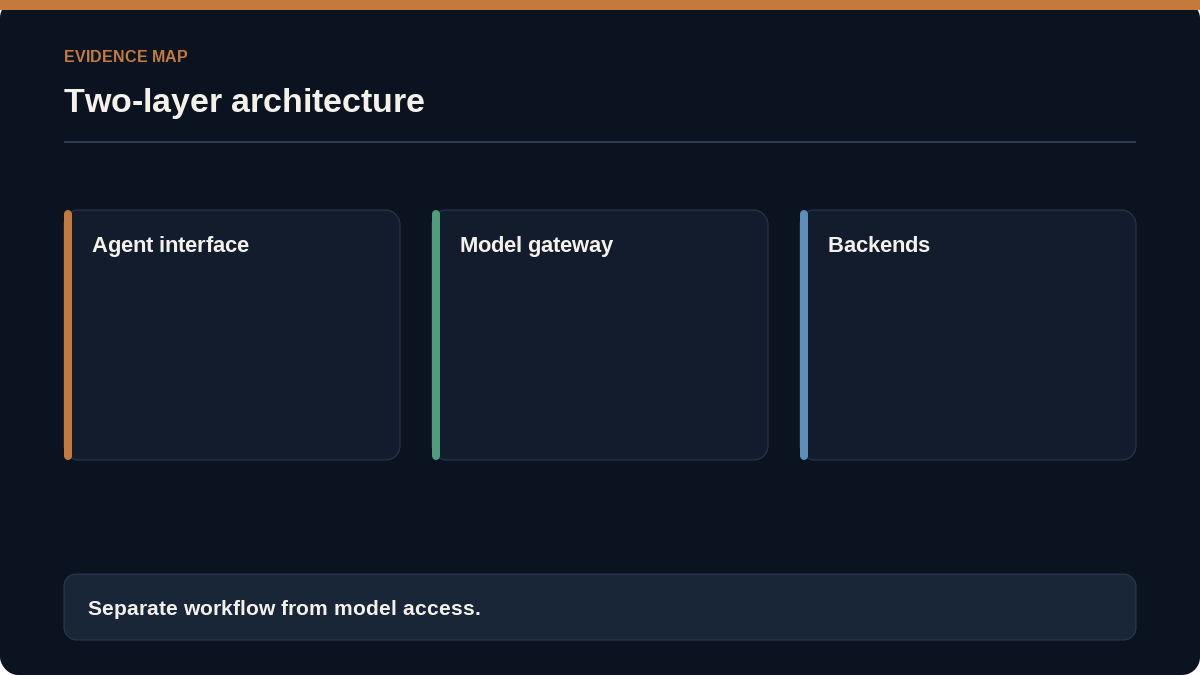
The win is control. A model change becomes a configuration and evaluation task instead of a complete workflow rebuild. The loss is that you must maintain the boundary. Portable project files, independent tests and clear credentials do not happen automatically. If every important instruction lives in a private session, the separation is cosmetic.
Claude Code’s tight integration remains a genuine advantage. Familiar tools, account features and a coherent workflow can reduce daily friction. The case for a two-layer design is not that those benefits are imaginary. It is that a single stack concentrates quota, regional, account and model risk. A deliberate second layer makes that concentration easier to manage.
Active gateway route: the lane that works today
Official: the gateway model catalogue displayed 76 listed models and 46 available-now free IDs across 22 families on 2026-11-27. The free lane allows 100 requests and 5,000,000 tokens per day per account, shared across the free IDs. The reset is 05:30 IST, which is 00:00 UTC. Accounts can have up to three keys, with one request in flight per key on free models.
All listed models use the OpenAI format, and four also accept the Anthropic Messages format. The free IDs are OpenAI-format only. The active conversion path is therefore an OpenAI-format agent, the /v1 endpoint, one gateway key and a live free ID. That path is documented in the quickstart and the API reference.
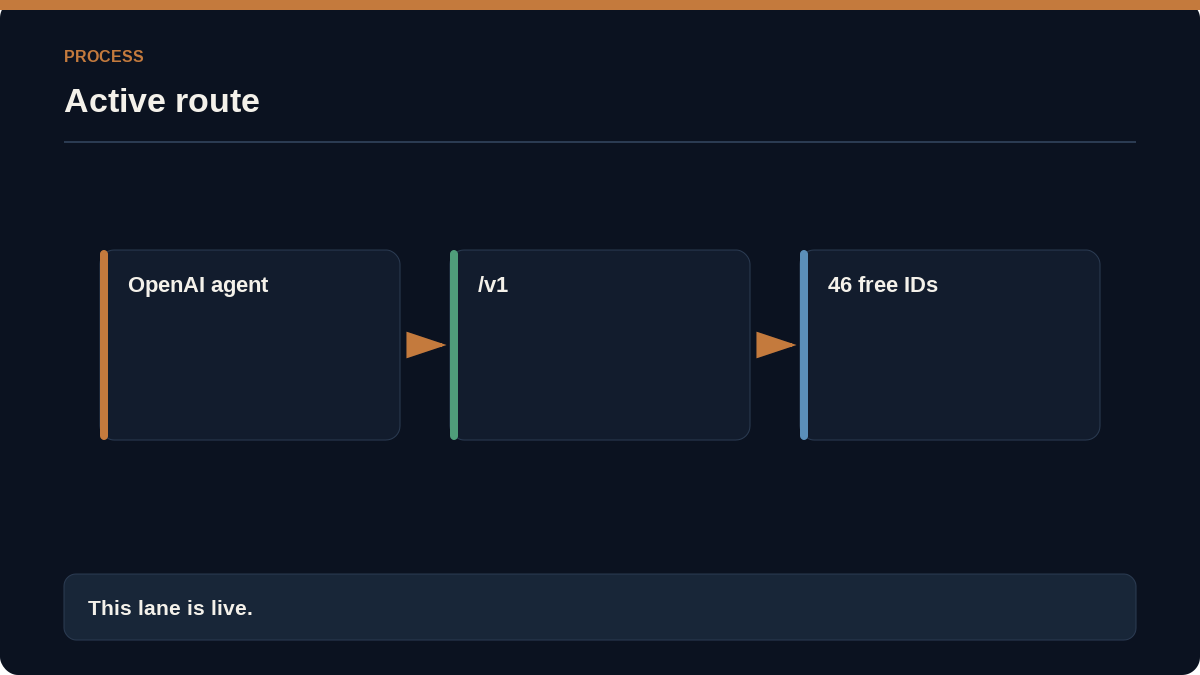
The route is useful because it is explicit. An agent either speaks the OpenAI format or it does not. A key either permits the selected model or it does not. A request either stays within the daily pool or it does not. Those boundaries make a trial measurable. Start with one live ID, one minimal request and one bounded repository task.
The free lane is not the only billing option. New accounts receive $10 of credit with no card, and billing is prepaid with no subscription or seat fee stated on the pricing page. Online checkout was closed at the audit time, with top-ups handled by email through support. Those facts matter for a longer evaluation, but they do not change the active format boundary.
Claude Code route status: documented, not live
Claude Code uses the Anthropic Messages format. Its documented gateway base URL is https://api.oneaiapikey.com with no trailing /v1, because the client appends /v1/messages. That is a different route from the OpenAI free lane. The four Claude IDs were claude-sonnet-5-5, claude-sonnet-5, claude-opus-5-5 and claude-haiku-4-5, and all four were marked unavailable with no working upstream on 2026-11-27.
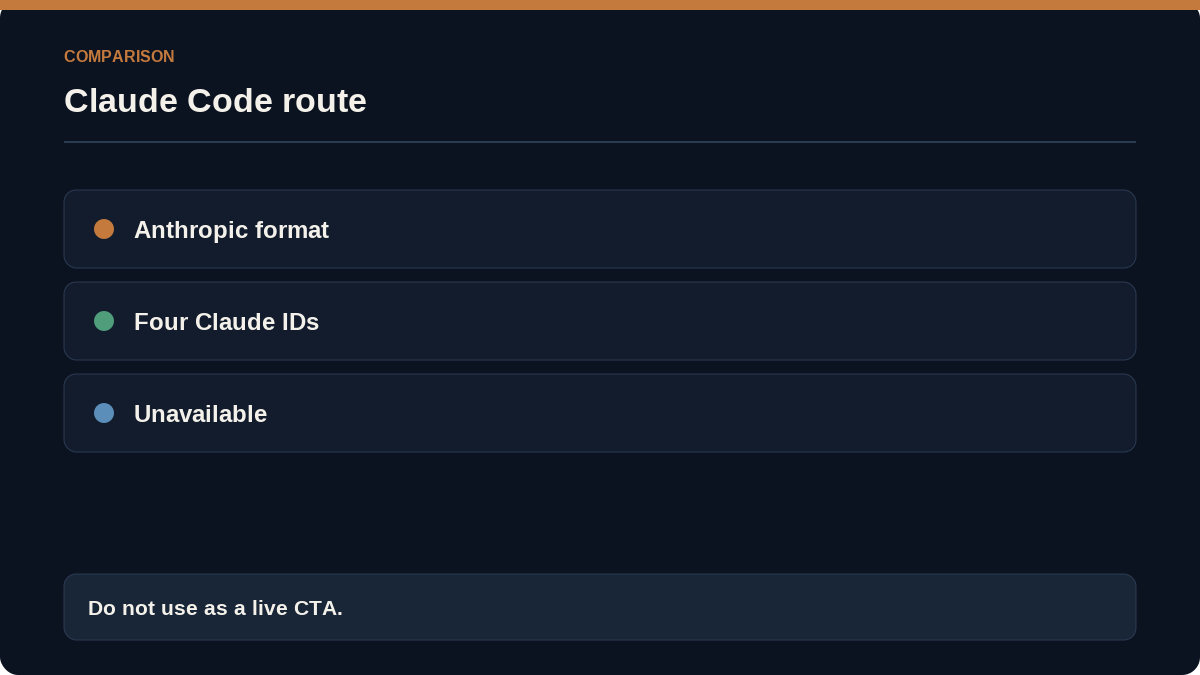
This boundary rules out two tempting shortcuts. The free IDs cannot be dropped into Claude Code because they use the OpenAI format. The four Claude IDs cannot be presented as a working backup because they were unavailable. A truthful alternative changes the agent or uses a different live route. It does not relabel an incompatible path as compatible.
The coding-agent compatibility guide records the Claude route status, and the OpenAI versus Anthropic format guide explains why the protocols are not interchangeable. Recheck the live catalogue before any future migration. A dated unavailable status can change, but it should change only with new evidence.
Architecture: keep the workflow, replace the dependency
A practical architecture starts with the repository, not the provider. Keep tests, project rules and review criteria in files that survive a tool change. Put the agent behind a thin configuration boundary: base URL, credential location, model selection and permission mode. Place the model-access layer behind a second boundary: key controls, usage logs and a live model inventory.
| Component | Recommended design | Why it matters | Verification |
|---|---|---|---|
| Project knowledge | Portable brief with constraints and known failures | Survives agent and account changes | Restore it in a disposable directory |
| Tests | Requirement-aware checks in the repository | Provides an independent oracle | Run after every accepted change |
| Agent configuration | Named fields for endpoint, key source and model | Makes route changes reviewable | Inspect effective settings before a task |
| Credentials | Per-project key with cap, expiry and allowlist | Limits blast radius | Retrieve and rotate in a drill |
| Model inventory | Live ID, format, date checked and task results | Prevents stale backups | Recheck before each drill |
| Usage record | Request, token and cost log | Supports cost and failure analysis | Review after each trial |
The per-project key and spend-limit guide explains credential separation. The monthly LLM API cost worksheet helps estimate usage without turning a subscription quota into a token price. The cost calculator is useful for priced-model scenarios, while the free lane has its own request and token limits.
Do not hide the model route behind a custom proxy unless you need one. Every extra layer adds headers, streaming behavior and error handling to maintain. The simplest architecture that passes the task set is usually easier to recover during an incident.
Migration sequence: inventory, parallel test, cutover
Migration is a sequence with gates. Inventory what must move, run both routes in parallel, compare accepted work and cut over only when the evidence supports it. A one-line base URL change skips the parts that usually fail: project context, tool conventions, permissions and verification.
| Stage | Work | Exit criterion | Rollback trigger |
|---|---|---|---|
| Inventory | List prompts, context files, hooks, tests and credentials | Every item marked portable, replaceable or provider-specific | Missing critical project knowledge |
| Prepare | Configure fallback agent, key and live model | Minimal request and one bounded task pass | Endpoint, credential or format failure |
| Parallel test | Run the same task set through both routes | Accepted results and review time recorded | Quality drop or unrecoverable tool gap |
| Limited cutover | Move one project or task class | Stable accepted work over an agreed period | Cost spike, quality regression or hidden side effect |
| Full cutover | Retire the primary route for that scope | Runbook, monitoring and rollback path current | Any rollback condition from the limited stage |
| Review | Compare cost, quality and operational load | Decision documented with evidence | Evidence no longer matches the workload |
The context-portable migration guide gives the detailed inventory and rollback checklist. The lock-in and exit-cost analysis explains why habits and quota belong in the worksheet. The exit-plan checklist turns the migration into a preparedness exercise rather than an emergency.
Keep the old route available during the parallel test. A backup that is deleted before the new route proves itself is not a backup. Define rollback triggers in writing: a quality drop, a tool failure, a cost spike or a missing requirement. The trigger should be observable and owned by a named person.
Verification: own the definition of done
A two-layer architecture makes verification more important, not less. When the model can change, the team needs a stable definition of done. That definition should include the expected result, the changed files, the test command, the actual output and one independent check. The agent’s summary is only one field in that packet.
The proof-of-work packet provides a reusable structure. The false-success verification guide explains how mocks and weak oracles can make incomplete work look finished. Use those ideas regardless of which model is behind the agent.
For automation, require machine-readable evidence: exit code, structured result and artifact checks. Do not let a non-zero exit code become a successful task because the final message sounds confident. A mocked integration must not stand in for a real side effect when the requirement is delivery to an external system.
Review the model route as well as the code. Confirm that the request log names the intended model, that token use is plausible and that the key’s allowlist did not silently redirect the task. A correct diff from an unexpected route may still indicate a configuration problem.
Route comparison: choose the path that matches the client
The route decision is mostly a compatibility decision. If the workflow requires Claude Code, the active free lane is not a substitute. Where the workflow can use an OpenAI-format agent, the free lane provides a live multi-model path with explicit limits. The table below keeps those choices separate.
| Route | Client | Endpoint | Status on 2026-11-27 | Appropriate use |
|---|---|---|---|---|
| OpenAI free lane | OpenAI-format agent | https://api.oneaiapikey.com/v1 |
46 live free IDs | Bounded trials, small tasks, model comparison |
| Claude Code gateway route | Claude Code | https://api.oneaiapikey.com |
Four Claude IDs unavailable | Not an active conversion route |
| Direct Anthropic access | Claude Code or Anthropic client | Anthropic endpoint | Separate provider relationship | Primary workflow when eligible and budgeted |
| Custom OpenAI script | Your code | https://api.oneaiapikey.com/v1 |
Uses the same live free lane | Automation with explicit request and error handling |
The direct Anthropic row is a reminder that a gateway is not required for every alternative. A team can keep Claude Code as the primary route and use the gateway as a tested secondary path. The goal is not to maximize the number of providers. It is to avoid a single unexamined dependency.
The Claude Code single-points-of-failure analysis maps quota, regional, account and model risk. Use it to decide which route belongs in the backup inventory. A second model on the same limited account does not solve quota. A second client on the same unavailable Claude IDs does not solve availability.
When to keep Claude Code as the primary route
A two-layer design does not require an immediate exit. Keep Claude Code as the primary route when its integrated workflow earns its cost, when the team’s tasks fit the plan limits and when the account and region are stable. Add the second layer as a tested backup rather than treating it as a mandatory replacement.
Keep the primary route when verification is already strong. If the team reviews diffs, runs independent tests and records accepted work, a model change is easier to evaluate. Where the current workflow has no stable definition of done, changing agents usually carries the same ambiguity into a new tool.
Keep the primary route when the alternative cannot meet a hard requirement. Claude Code compatibility is one example. A specific tool convention, account feature or approved data path may be another. The third-party harness rules and the privacy and retention analysis help identify requirements that a cheaper route may not satisfy.
Move more work to the second layer when the evidence supports it: accepted tasks are stable, review effort is acceptable, cost is bounded and the fallback drill succeeds. The decision should be scoped. One task class can move while another stays on the primary route. A gradual cutover produces better evidence than an all-or-nothing switch.
The goal is not ideological purity about vendors. It is a workflow with visible dependencies, a measured definition of done and a recovery path that has been used. Claude Code can remain part of that design.
Cost and quality review: compare the complete outcome
A model-layer review should include more than the invoice. Compare accepted work, review time, rework, errors and operational effort. A free route can be expensive in human attention if every diff needs a rewrite. A paid route can be poor value if it produces convincing output that fails the real integration.
Use the cost per verified change framework to keep the arithmetic honest. Count the subscription or API spend, add review and rework, then divide by accepted changes. Do not convert a plan quota into a token price without an official method. The monthly cost worksheet provides a structure for the usage side.
Make quality evidence reproducible. Record the task brief, repository state, agent version, model ID, settings, test command and result. A screenshot of a polished demo is not enough. The compaction retention test and the context versus memory analysis show why long tasks need explicit state checks rather than confidence alone.
Review the operational layer too. How long did credential retrieval take? Was the intended model allowed by the key? Did the request log match the selected route? Was the status page checked before retrying? These questions often explain more about reliability than the model name.
Finish the review with a scoped decision: keep, expand, limit or roll back. Attach the evidence and name the next review date. A model layer is owned when its performance and failure modes are measured, not when a dashboard displays many model names.
Honest loss: separation does not eliminate dependence
The concrete win is a workflow that can change models without changing its definition of done. The concrete loss is the engineering required to keep the layers separate. Portable files, tests, credentials and drills all need ownership. Without that work, “multi-model” is only a dropdown.
The gateway is also a provider with its own policies and failure modes. Its privacy policy says it does not train on prompts, files or outputs and does not sell them, but that is a first-party claim, not an independent audit. Upstream providers receive requests under their own terms. A model-layer decision is still a data-handling and procurement decision.
Finally, model quality is not interchangeable. The fact pack contains no controlled benchmark for the 46 free IDs and no universal ranking of OpenAI-format agents. A route can be live and still be wrong for a difficult task. Store the baseline, measure accepted work and preserve the option to change back.
Data gap and future update
The frozen evidence establishes route formats, counts, limits and audit-date availability. It does not establish a best agent, a best free model or a measured uptime advantage. It also leaves a conflict between the routing guide and gateway overview on automatic fallback. This article does not promise guaranteed fallback.
A future update should recheck the live catalogue, the free lane and the Claude compatibility page. Add a reproducible comparison only when it includes the date, agent version, model IDs, task set, settings and raw results. Until then, the architecture is a design recommendation, not a benchmark conclusion. Leave the dated facts dated, and replace them only when new first-party evidence or a verified endpoint supports the change.
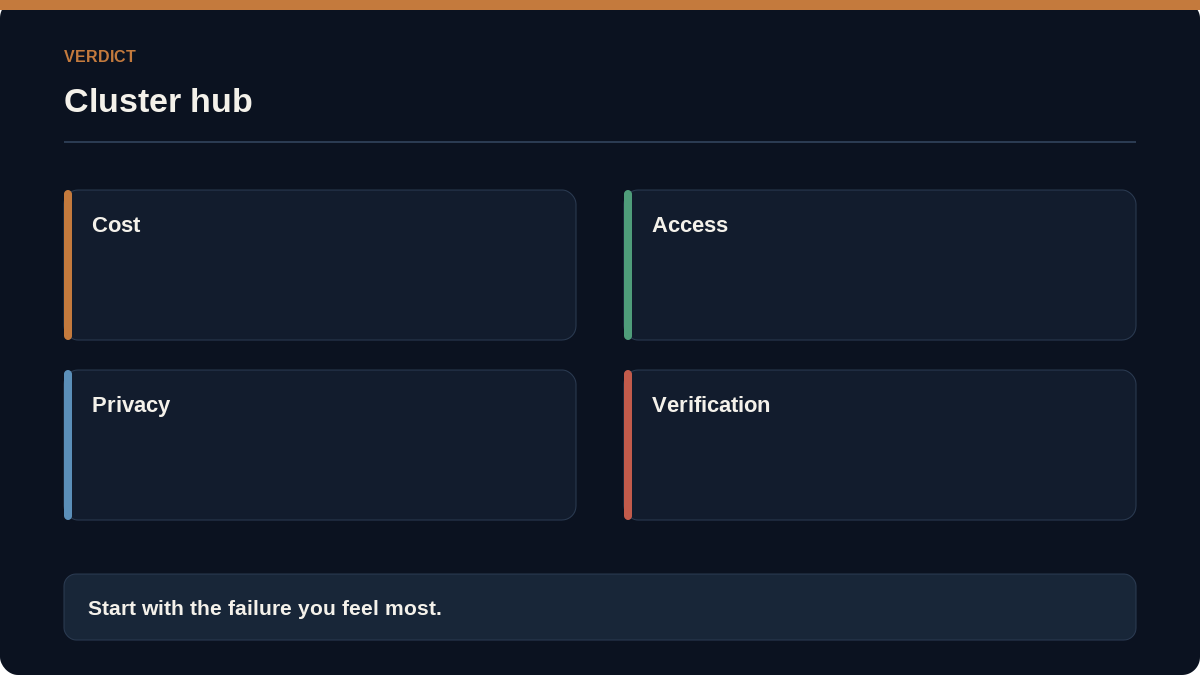
Cluster guide
This is the synthesis post for the cluster. Each supporting article answers a different failure, cost or migration question. Start with the pressure you feel most, then follow the evidence.
- Cost: Claude Code free-tier entry price explains the paid floor.
- Quota: Claude Code five-hour and weekly limits documents quota mechanics.
- API math: Fable 5.2 agent-loop pricing math shows repeated-context cost.
- Billing: Ultra API credits versus Claude Code usage separates balances.
- Value: Claude Code cost per verified change adds review and rework.
- Account: Claude Code suspension notice gaps covers account standing.
- Travel: Claude Code travel and regional ban risk explains location eligibility.
- Teams: Claude Code regional restrictions for teams extends the review to teams.
- Exception: Claude Ultra five-hour exception keeps the exception precise.
- Appeal: Claude Code appeal evidence packet prepares the official appeal route.
- Privacy: Claude Code privacy and retention rules compares data defaults.
- Retention: Claude Code zero-data-retention limits explains qualified Enterprise coverage.
- Legal: AI government-request policies keeps legal claims evidence-based.
- Secrets: Claude Code settings-file secret exposure shows why saved approvals need scanning.
- Security: Claude Code harness security boundaries maps tool authority.
- Incident: Anthropic April 2026 Claude Code postmortem documents a dated regression.
- Context: Claude Code context versus memory separates capacity from retained state.
- Compaction: Claude Code compaction retention test scores what survives a summary.
- Verification: Claude Code false-success verification tests the oracle behind a demo.
- Receipts: Claude Code proof-of-work packet defines receipts for completed work.
- Token use: Claude Code agent-team token overhead keeps the plan-mode condition attached to the estimate.
- Lock-in: Claude Code lock-in and exit costs inventories migration work.
- Credentials: Claude Code third-party harness rules explains credential restrictions.
- Migration: Claude Code context-portable migration preserves prompts, hooks and context.
- Failure domains: Claude Code single points of failure maps quota, region, account and model risk.
- Setup: Multi-model OpenAI-agent setup shows the active architecture.
- Free lane: 46 free AI model IDs for OpenAI agents documents the free lane and its limits.
- Trial: $10 no-card gateway trial turns signup credit into a measured test.
- Exit: Claude Code exit-plan checklist prepares a fallback before an incident.
Practical response: separate the layers, then test the route
Move project knowledge into a portable brief, keep tests in the repository, configure one OpenAI-format fallback agent and run the same bounded task set through both routes. Record accepted work, review time, errors and usage. Cut over only when the evidence supports it, and keep a rollback path.
One AI API Key’s active route is an OpenAI-format agent using https://api.oneaiapikey.com/v1, one key and the 46 live free model IDs. Use the 46 live free model IDs, the quickstart, the per-key controls and the live status page to build and test the second layer. Claude Code’s Anthropic-format route is documented, but all four Claude IDs were unavailable on 2026-11-27. Never claim the free IDs work in Claude Code.
The win is a model layer you can change. The loss is the work required to keep it portable and verified. The practical implication is to own the boundary, not the hype: keep the workflow, test the route and preserve the evidence.
FAQ
What does it mean to own the model layer?
It means separating agent behavior from model access so you can change endpoint, provider or model without rebuilding the entire workflow. It does not mean owning model weights or eliminating upstream dependence.
Can I use the free IDs inside Claude Code?
No. The free IDs use the OpenAI format. Claude Code uses the Anthropic Messages format, and the four Claude IDs on the gateway were unavailable on 2026-11-27.
Is an OpenAI-format agent a drop-in Claude Code replacement?
No. It is a different client with its own configuration, permissions and tool conventions. It can be a strong alternative when the workflow is portable and the output is independently verified.
Does multi-model routing guarantee fallback?
No. The gateway’s routing documentation and overview conflict on automatic fallback. Treat fallback as behavior to configure and test, not a guarantee.
What should I migrate first?
Start with project knowledge, tests and credentials. Then configure the fallback agent and run a parallel task set. Move one project or task class before attempting a full cutover.