Direct answer
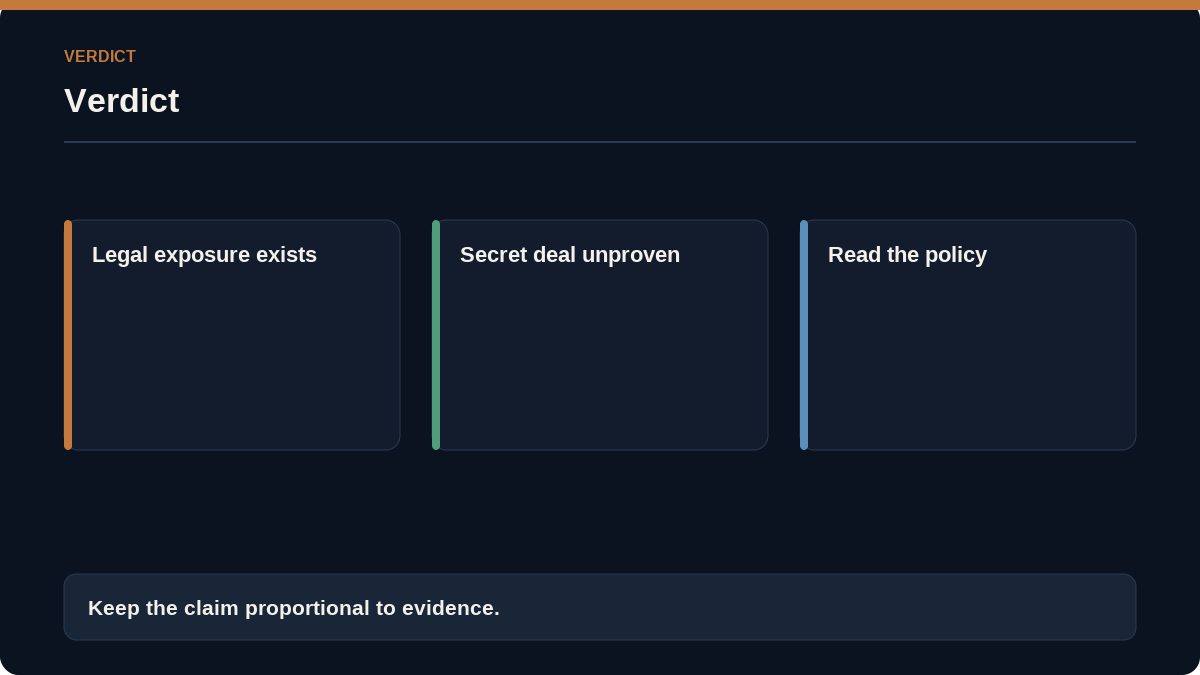
AI providers can receive valid legal requests for user data. That caveat does not disappear because a product is private, encrypted in transit, popular with developers or sold through a familiar subscription. The honest position is narrower: Anthropic says it discloses user data only through valid legal process, evaluates requests and ordinarily notifies users unless legally prohibited. Public contracts and policy pages do not prove a secret agreement requiring every prompt to be retained.
For a developer, the practical question is not whether legal exposure can be reduced to zero. It cannot. The useful questions are what data exists, who can receive it, which contract governs the account, what notice is possible and what evidence the provider publishes. A public prototype agreement is not a retention policy. A supply-chain statement is not proof of prompt access. Keep those categories separate.
Why the caveat matters
A coding agent handles more than chat messages. It can receive source code, terminal output, issue text, configuration snippets and tool results. Those inputs may contain customer records, credentials, internal architecture or personal data. Once a provider stores any of that material, a legal request becomes a realistic category of risk, even when the provider resists an overbroad request.
The mistake is to turn that risk into a story with no evidence. Saying a provider secretly keeps every prompt because it signed a public contract skips several steps: the contract’s scope, the provider’s retention rules, the legal process required for disclosure and the absence of any prompt-retention language in the announcement. A buyer who cannot explain those steps has replaced diligence with atmosphere.
This is also where account type matters. Consumer and commercial products have different training and retention defaults. The Claude Code privacy and retention rules separate those paths, while the zero-data-retention limits explain why qualified Enterprise coverage is not the same as a universal promise. Read those before treating a personal subscription as a corporate data-processing agreement.
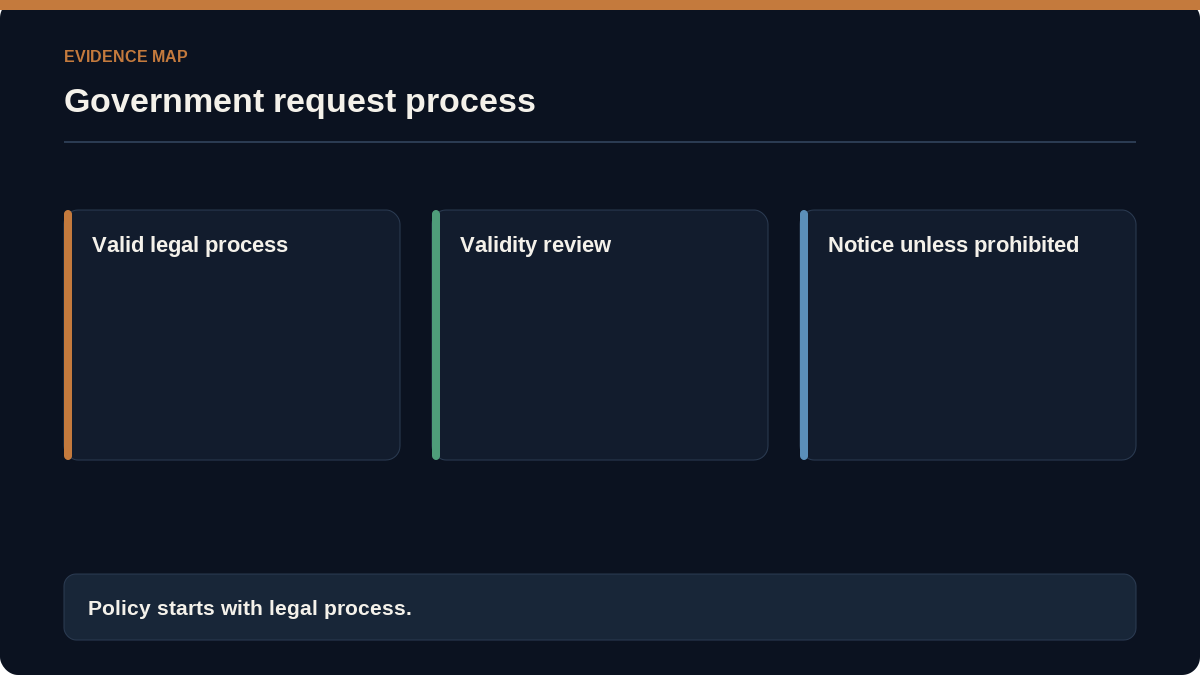
Valid legal process is the starting point
Official. Anthropic’s government-request policy says user data is disclosed only through valid legal process. The provider evaluates requests and ordinarily notifies users unless notification is legally prohibited. That wording matters. It describes a process, not a blanket refusal and not a blank check.
A useful review separates four stages. First, a request arrives. Second, the provider assesses its validity and scope. Third, the provider determines whether notice is permitted. Fourth, any disclosure is limited by the applicable process and contract. The policy does not publish enough detail to reconstruct every case, so a security review should not pretend that it can.
| Policy mechanic | What the official source supports | What a buyer still needs to ask |
|---|---|---|
| Legal process | Disclosure requires valid legal process | Which request types are accepted, challenged or rejected? |
| Scope review | Anthropic says it evaluates requests | How are overbroad requests narrowed? |
| User notice | Notice is ordinary unless legally prohibited | How is notice delivered when permitted? |
| Retention boundary | Data handling depends on product and account terms | What records exist at the time of a request? |
The commercial retention policy says standard commercial retention is 30 days. That is a retention rule, not a statement that no legal request can ever arrive. It does mean a buyer should ask what is retained after the standard period, what safety or abuse records remain and which subprocessors hold copies.
Notice and challenge are part of the control
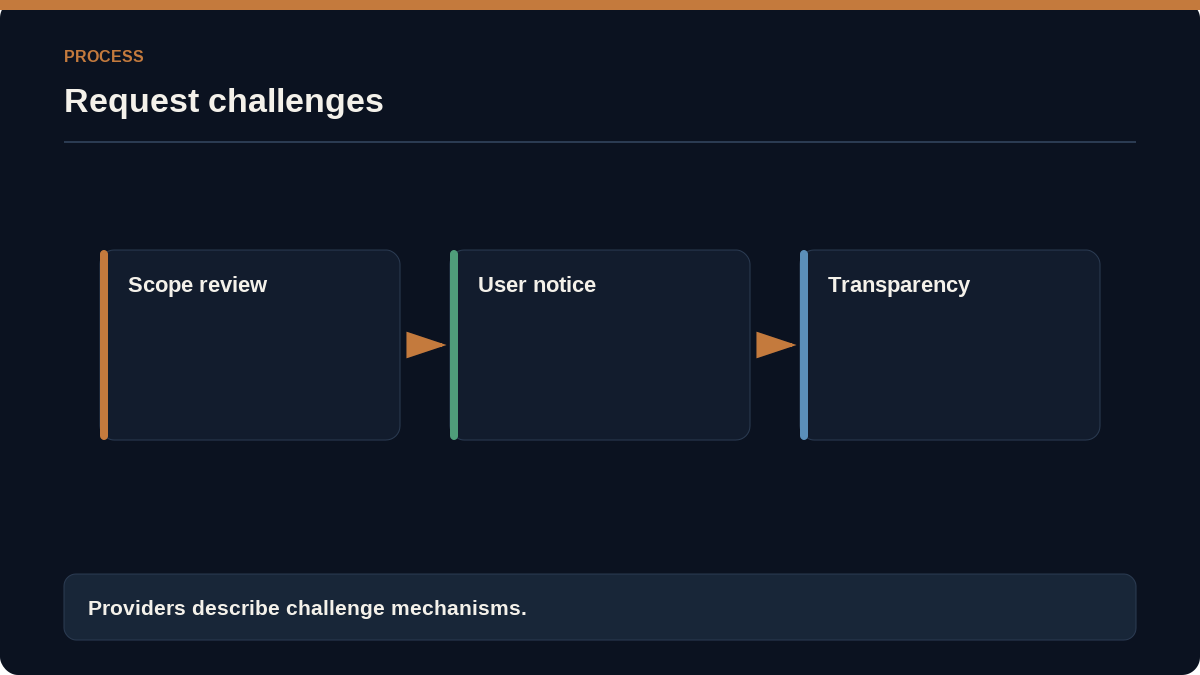
Notice gives a user or organization a chance to respond. It does not guarantee that a request will be withdrawn. A provider may be prohibited from notifying anyone, and a challenge can take time while the legal process continues. Still, a published notice policy is more useful than silence because it creates a reviewable commitment.
Anthropic says it ordinarily notifies users unless legally prohibited. It also says it evaluates requests. Those are the documented mechanisms. The public policy does not provide an appeal success rate, a median response time or a count of requests received. Any article that supplies those numbers without a source is inventing precision.
For a team, the operational response is to name an owner for provider notices. That owner needs access to the account email, the contract repository and the security incident channel. A notice sent to a former employee is not an effective control. The console keys, usage and billing guide is useful for understanding account administration, but legal notices need a separate escalation path.
A second control is minimization. If a workflow does not need production data, use synthetic data. If a prompt needs one function, do not attach the entire repository. The per-project API key controls help separate projects and spending, while the API format guide helps a team understand which client and endpoint carry the data. Neither control replaces a retention review, but both reduce the amount of material exposed to one route.
Public contracts are not retention policies
Two public items attract attention: a defense prototype agreement and a later supply-chain-risk statement. Both deserve precise reading.
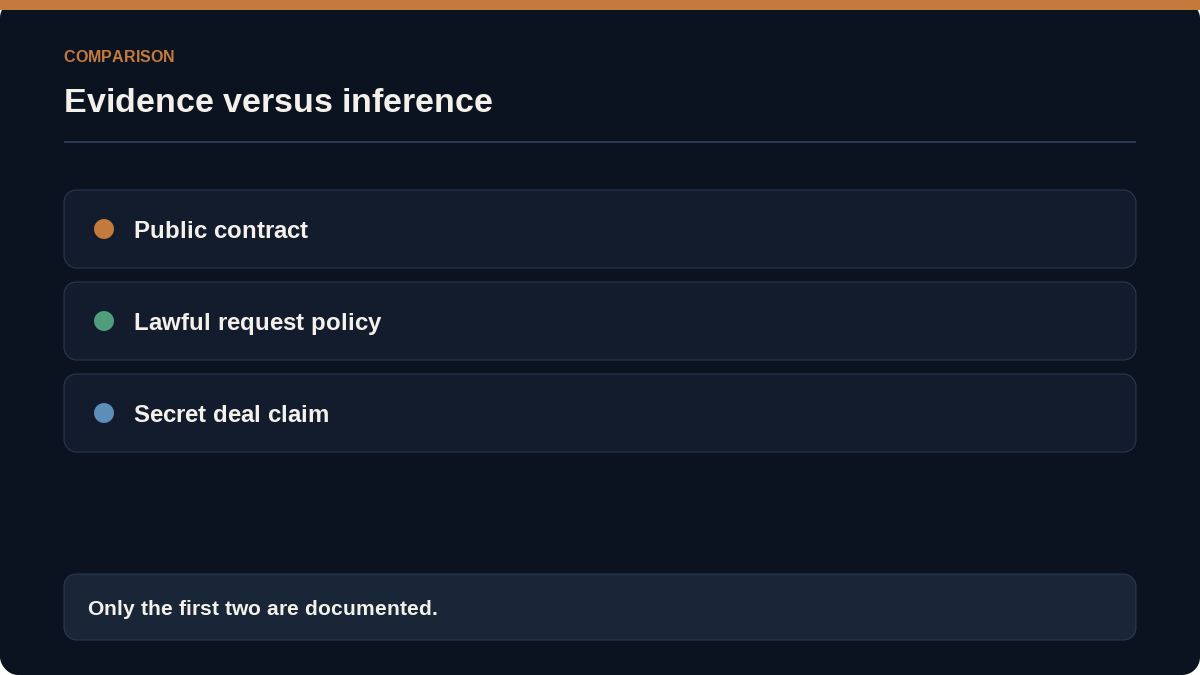
Official. The 2025 Department of Defense announcement describes a two-year prototype agreement with a $200 million ceiling. A ceiling is a maximum, not guaranteed spend. The announcement contains no prompt-retention language. It would be wrong to describe that document as proof that Anthropic agreed to retain every user prompt.
Official. Anthropic’s 2026 statement says the supply-chain-risk designation is narrow and applies to Claude use as a direct part of Department of War contracts. The statement does not mention user prompt retention. A policy statement about government contracting is not the same thing as a data-access clause in a consumer or enterprise agreement.
| Evidence item | What it establishes | What it does not establish |
|---|---|---|
| Government-request policy | Valid legal process, evaluation and ordinary notice | That every request is disclosed or that none are challenged |
| Defense prototype announcement | A two-year agreement with a $200 million ceiling | A secret prompt-retention obligation |
| Supply-chain statement | Anthropic’s description of a narrow designation | Routine government access to user prompts |
| Commercial retention policy | A standard 30-day retention period | Zero retention for every product or exception |
| Zero-data-retention coverage | Availability for qualified Enterprise accounts and eligible products | Universal zero retention for standard accounts |
The consumer terms and commercial documents should be read for the account actually in use. A personal Pro subscription, a Team workspace and an Enterprise agreement are not interchangeable. The Claude Code suspension notice gaps are a separate access issue, but they share a practical lesson: the public summary rarely answers every operational question.
What is not proven
Unknown. No credible source in the frozen research set proves a secret government deal requiring Anthropic to retain every prompt. That does not prove no such request has ever occurred. It means the claim is unsupported by the evidence available for this article.
The same discipline applies to frequency. The public policy does not say how many government requests Anthropic receives, how many it challenges or how often notice is delayed. A transparency report could answer part of that question. Until one is available in the research set, the frequency is unknown.
It is also unknown how a specific account would be handled in a specific jurisdiction. The supported-regions policy governs access eligibility, not the full law-enforcement process. Distributed teams need to review location, entity and ownership questions separately, as the regional restrictions for teams explains.
A provider can be truthful about legal process and still be a poor fit for sensitive data. This is the honest loss in this discussion. Policy language reduces ambiguity; it does not remove the need for contractual controls, data minimization or a second provider for work that cannot tolerate concentrated risk.
Read the policy at the right altitude
Provider review often fails because every document is treated as if it answers the same question. A marketing page describes a product. A policy page describes a general practice. A contract defines the relationship. A configuration setting controls one account. Confusing those layers produces confident but fragile conclusions.
Start with the product page only to identify what is being bought. Move to the policy for the general rule, then to the contract for the enforceable commitment. Finish with the account configuration to confirm that the intended setting is active. If the policy says training is optional, the configuration should show the choice. If the contract promises a retention period, the operational documentation should explain how that period is applied.
The layered reading matters for coding agents because the data path extends beyond the chat window. The settings-file secret exposure shows how a local convenience can put credentials into a repository. The agent harness security boundaries show why tool authority belongs in the same review. A provider policy cannot compensate for an unsafe client configuration.
Credential rules deserve their own layer. The third-party harness rules explain why the authentication route and client identity matter. A team should not assume that a compatible endpoint makes every use of a subscription credential acceptable. Record the client, the credential type and the billing route together.
Finally, connect the review to resilience. The single points of failure analysis separates quota, region, account and model failures. Legal and retention risk is another concentration to track, not a reason to claim that a second provider removes all exposure. The exit-plan checklist helps a team preserve configuration and context before an emergency.
A useful review record has four columns: document, version or date, account scope and unresolved question. The format forces the reviewer to say which product the evidence covers. It also makes updates easier when a policy changes. Without that record, a team may remember a promise from an old plan and apply it to a new account.
Vendor due-diligence questions
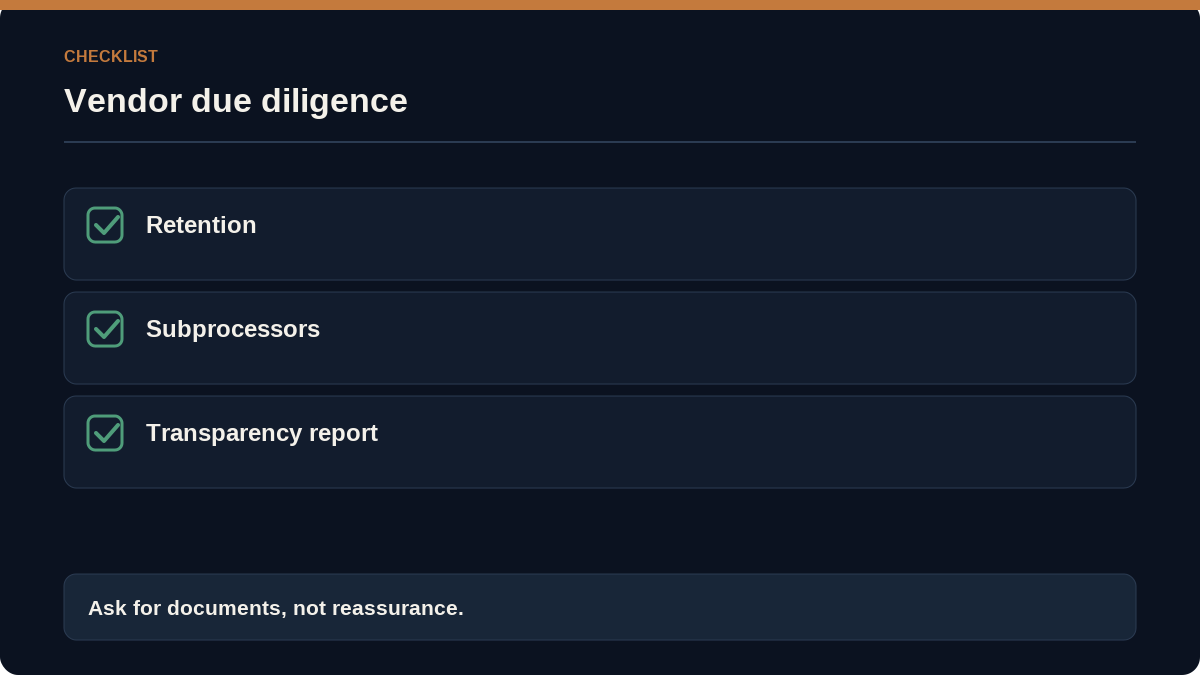
A useful review asks for documents, not reassurance. Send the same questions to every candidate provider and keep the answers with the contract. If an answer changes by product, record the product name and account tier.
| Due-diligence area | Question to send | Evidence to retain |
|---|---|---|
| Legal requests | What request types do you accept, and how do you challenge scope? | Published policy and contractual commitment |
| Notice | When do you notify users, and who receives the notice? | Notice clause and account contact record |
| Retention | What is retained after the standard period? | Retention schedule and exception list |
| Training | Is training optional, and does the setting apply to this product? | Account setting and policy version |
| Subprocessors | Which upstream providers receive prompts or files? | Current subprocessor list |
| Zero retention | Which accounts and products qualify, and what exceptions remain? | Executed agreement and scope appendix |
| Deletion | What happens after a deletion request? | Deletion procedure and confirmation record |
The privacy and retention policy on this site is an example of the kind of first-party document a buyer should inspect. It is not an independent audit. Treat every provider’s policy as a claim that needs contractual review, then compare it with the gateway status and incidents page for operational context.
Ask about upstream providers explicitly. A gateway can receive a request and then route work to another company under that company’s terms. The coding-agent API key compatibility guide explains route compatibility, while the current model catalogue shows availability. Neither page substitutes for a data-processing agreement.
Worked example: a request-readiness drill
Suppose a team uses a coding agent on a repository that contains customer identifiers. The goal is not to simulate a subpoena. The goal is to find out whether the team can answer basic questions without panic.
Account owner -> identify product and contract
Data owner    -> classify repository contents
Security lead -> list retained records and subprocessors
Legal contact -> confirm notice and challenge path
Operator      -> record provider policy version and date
Start with the account owner. Record whether the workspace is consumer, Team or Enterprise. Next, ask the data owner which fields are present and whether they can be removed before the task. Then list the records that may exist: prompts, responses, tool output, usage metadata and security logs. The exact set depends on the provider and product.
Now test the notice path. Send an internal drill message to the account email and confirm that the named owner receives it. Check that the contract repository is reachable by someone other than the primary developer. Finally, record the date of the policy you reviewed. This drill produces evidence about your readiness, not a prediction about a government request.
The cost calculator can help compare usage budgets, but it cannot price legal exposure. Keep the technical and legal reviews separate, then join them in the vendor decision. A cheaper route that cannot answer retention questions may be the wrong route for sensitive work.
Match the provider to the data class
Not every task needs the same review. A public toy repository and a production database deserve different controls. The mistake is to apply either extreme: treat all code as harmless or require an Enterprise contract for every experiment.
| Data class | Example | Minimum review | Reason |
|---|---|---|---|
| Public | Open-source sample with no private configuration | Confirm the account policy and avoid credentials | Exposure is lower, but secrets can still appear |
| Internal | Private repository, internal docs, non-production data | Review retention, training and subprocessors | The code can reveal architecture or business logic |
| Confidential | Customer records, production secrets, regulated data | Contract review, minimization and approved provider scope | Disclosure can create direct harm |
| Restricted | Data that cannot leave a defined environment | Use an approved isolated environment or do not send it | A general provider policy may be insufficient |
The model selection guide helps with capability, but capability is only one column. Add data class, account type and retention requirement before choosing a route. The monthly API cost worksheet can then compare the approved options without letting price dominate the security decision.
Keep key controls close to the review. The API reference documents expiry dates, spending caps and model allowlists. Those controls do not answer a legal request, but they reduce how long a credential remains useful if it is exposed. When a new project starts, the account creation route should be paired with a named owner and a recorded data class, not treated as the entire setup.
Practical response: test a portable route
If you want to reduce dependence on one provider, start with a small, non-sensitive task set and a client that matches the documented API format. One AI API Key lists 46 live free model IDs for OpenAI-format agents. The quickstart shows the /v1 base URL and a first request, and the prepaid pricing page explains the billing model.
The free lane is not a Claude Code route. Claude Code’s Anthropic-format endpoint is documented, but all four Claude IDs were unavailable on 2026-11-27. Do not point Claude Code at the free IDs or describe the Claude route as a working fallback. Use an OpenAI-format agent such as OpenCode or Cline for the active free lane, then verify the exact model and route before sending real data.
For a provider review, keep three artifacts: the policy version you read, the contract that applies to your account and the list of data classes you allow through the agent. Revisit them when the product, account tier or workflow changes. A portable setup helps with provider concentration, but it does not erase legal process or make every provider’s retention terms equivalent.
Apply the same review to the gateway before sending real data. Read the privacy and retention policy, inspect the per-key controls and check the live status page. Create a disposable account through the sign-up route, then run a synthetic task that contains no customer information. Record the client, endpoint, model and policy date in the review sheet. If the route cannot answer a retention or subprocessor question, leave that field open rather than filling it with an assumption.
A one-page decision record
A provider review should end with a decision that another person can understand. “We looked at the privacy page” is not a decision record. A useful record names the product, the account type, the data class, the unresolved questions and the person who accepted the remaining risk.
Start with scope. Write the exact product and plan, the client used to access it and the workflow under review. Add the date and the policy version. If the team uses more than one account type, create separate records. A consumer subscription used for a private side project should not inherit the conclusions of an Enterprise agreement used by another team.
Next, list the data classes that will be sent. Be specific: public source files, private repository code, terminal output, customer identifiers or production configuration. For each class, record whether it is allowed, allowed with minimization or prohibited. This is more useful than a broad statement that the provider is “private.”
Then summarize the evidence. Include the government-request policy, the retention schedule, the training default and the zero-data-retention scope if it applies. Note whether each item is official, contractual or unknown. Keep the public contract announcement in a separate line so it cannot be mistaken for a retention commitment.
Finish with actions and ownership. Name the person who receives legal notices, the owner of the account email, the date of the next review and the conditions that would trigger an earlier review. A plan change, a new data class or a revised policy should reopen the decision.
The record does not need to be long. One page is enough if it is specific and current. Its value is that it turns a vague concern into a set of testable statements. When a provider changes its terms, the team can compare the new document with the old record instead of reconstructing the decision from memory.
Reopen the review when the facts change
A provider decision has a shelf life. A new product, a new account tier, a new data class or a revised policy can invalidate the old record. Set a regular review date, but do not wait for it when one of those events occurs.
Treat a policy change as a signal to compare versions. Check whether the retention period, training default, notice language or zero-data-retention scope changed. Record the date of the new policy and the account types it covers. If the change is ambiguous, ask the provider for written clarification before sending new data classes.
The same rule applies to workflow changes. A prototype that uses public fixtures may move to private code. A personal account may become a team account. A gateway may add an upstream provider. Each change can alter the data path even when the client and model stay the same.
A portable configuration makes these reviews easier because the team can identify the client, endpoint and credential route without guessing. It does not make the review unnecessary. The purpose is to keep the decision aligned with the system that actually runs today.
Honest loss and data gap
The win is clarity. Official policies describe valid legal process, evaluation, ordinary notice and account-specific retention. The loss is equally important: those policies do not publish request counts, challenge outcomes or case-level detail, and no public contract in the research set proves a secret prompt-retention deal.
The record is also incomplete for future updates. A transparency report, a published request taxonomy or a contractual notice commitment would improve this analysis. Until then, mark frequency and case outcomes as unknown. Recheck the government-request policy, the commercial retention policy and the zero-data-retention scope before making a purchasing decision.
FAQ
Can an AI provider receive a government request for user data?
Yes. Anthropic says it discloses user data only through valid legal process, evaluates requests and ordinarily notifies users unless legally prohibited. This is a policy boundary, not a promise that no request will ever produce a disclosure.
Does the Department of Defense agreement prove prompt retention?
No. The public announcement describes a two-year prototype agreement with a $200 million ceiling and contains no prompt-retention language. A contract ceiling is not guaranteed spend, and the announcement is not a retention schedule.
Does zero data retention remove all legal risk?
No. Qualified Enterprise zero-data-retention coverage has a defined scope and exceptions. It can reduce retained data for eligible products, but it does not repeal legal process or cover every record a provider may hold.
What should a team ask before sending source code to an agent?
Ask which account terms apply, what is retained, whether training is optional, which subprocessors receive data, how notice works and which products qualify for zero retention. Keep the answers with the contract and minimize the data sent in the first place.