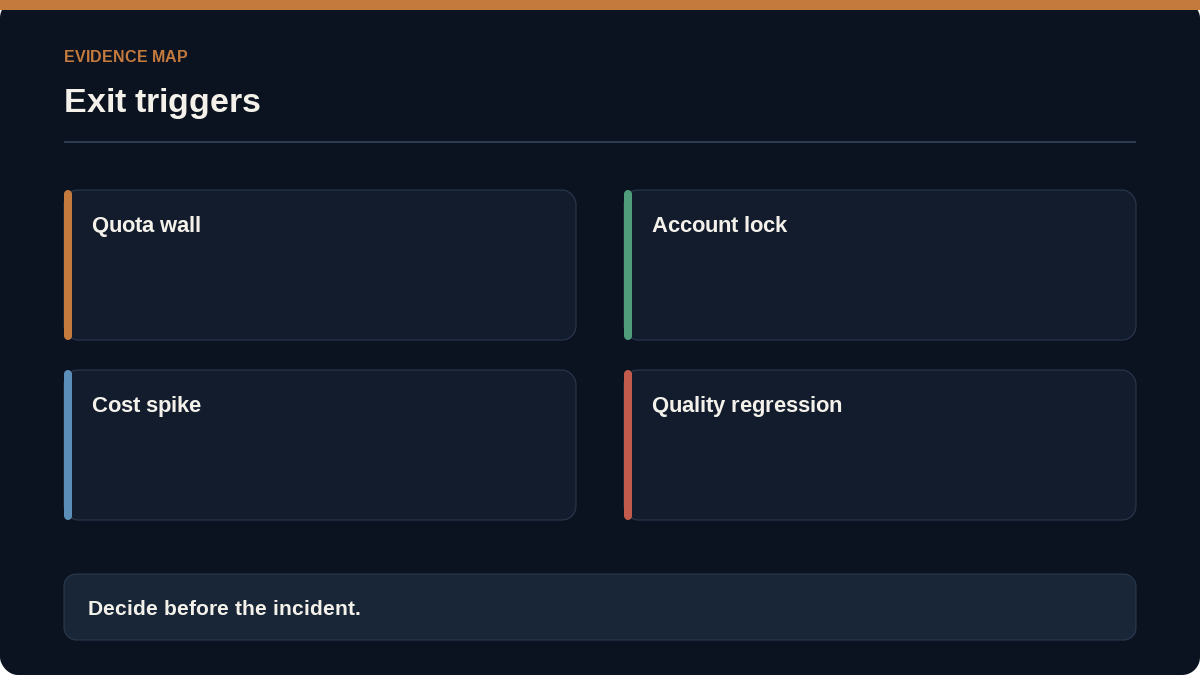
Build the exit plan before you need it. A quota wall, account lock, cost spike or model regression is a bad time to discover that your project rules live in one private session or that your backup agent has never completed a real task. A usable plan has four parts: trigger conditions, backup models, prepared credentials and portable configuration. It also has a fallback agent and a quarterly drill.
The active backup route is an OpenAI-format agent using https://api.oneaiapikey.com/v1, one gateway key and the 46 live free model IDs. The free IDs do not work inside Claude Code. Claude Code’s Anthropic-format gateway route is documented, but all four Claude IDs were unavailable on 2026-11-27. Plan around the route that works, not around a future promise that those IDs will return.
Exit triggers: decide before the incident
An exit trigger is an observable condition that starts a predefined action. It should not be a feeling that the tool has become annoying. The trigger can be mild, such as a cost threshold, or severe, such as an account restriction. What matters is that the team agrees on the condition and the response before pressure rises.
| Trigger | Observable signal | Immediate action | Longer-term response |
|---|---|---|---|
| Quota wall | Documented window or weekly allowance exhausted | Move bounded work to the backup | Adjust plan, schedule or capacity mix |
| Account lock | Restricted-account page or login denial | Submit official appeal, protect billing | Restore from portable configuration |
| Cost spike | Usage or credit crosses the agreed threshold | Pause non-essential requests | Tighten key caps and task budgets |
| Quality regression | Known task set fails after a change | Pin or revert where possible | Compare another model and open a reproducible issue |
| Regional restriction | Travel or entity review shows an eligibility problem | Pause use where required | Move work to a compliant provider |
| Upstream outage | Official status or repeated verified failures | Stop retry storms | Use the tested second route |
Quota triggers should use the documented mechanics. Official: the standard five-hour window starts with the first message and resets five hours later. Weekly limits reset at a fixed account time, and usage across claude.ai, Claude Code and Claude Desktop shares the same limit. Verified Ultra accounts do not have the standard five-hour cap, but a weekly limit remains. The usage documentation is the source for those rules.
Account triggers should use the official route. Official: termination grounds include repeated Usage Policy violations, account creation from an unsupported location and Terms of Service violations. Users can appeal through the form linked from the restricted-account page, and Anthropic says responses are slower than normal. The appeals documentation does not promise reinstatement.
Cost triggers need a defined budget. Claude offers usage credits, monthly spending caps, alerts and auto-reload, so an exit plan should not claim that spending controls do not exist. The usage-credit controls documentation is the source for those controls. The problem is unmanaged thresholds, not the total absence of controls. Decide who can approve a reload and what happens when the threshold is crossed.
Backup models: choose live routes, not names from memory
A backup model should be available through a route your fallback agent can actually use. The active free lane provides 46 live IDs across 22 families on 2026-11-27. Choose an ID from the live page, verify it with a minimal request and run it through the same task set you use for the primary model. Do not assume that a listed model is callable or that a model from one family will behave like another.
The four Claude IDs on the gateway were claude-sonnet-5-5, claude-sonnet-5, claude-opus-5-5 and claude-haiku-4-5. All four were marked unavailable with no working upstream on 2026-11-27. They are not a backup inventory. The free IDs are OpenAI-format only and do not work in Claude Code. A plan that lists either set as a live Claude Code fallback is wrong.
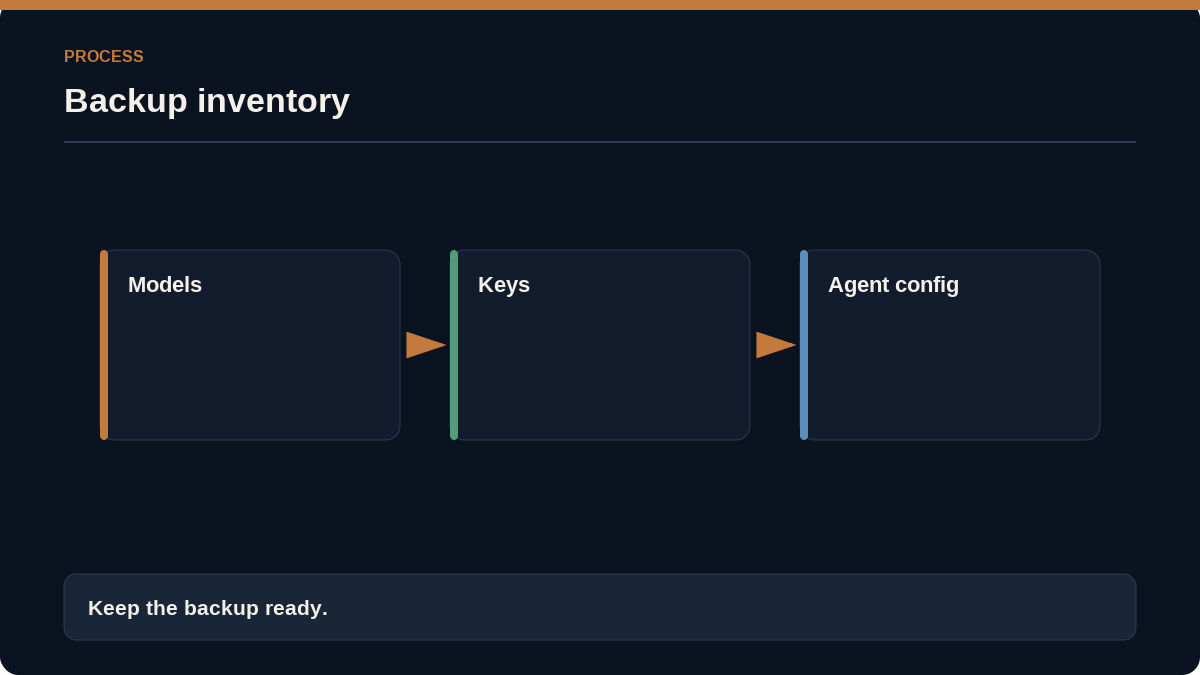
Limit the backup set. One primary alternative and one secondary option are easier to test than a long list of untried IDs. Record the exact ID, format, date checked and tasks it passed. When the catalogue changes, update the record. A stale inventory creates false confidence because it looks complete.
The model selection guide for coding agents can help choose a task fit, but the final test is your repository. A model that explains code well may still produce weak diffs. A model that handles short edits may lose constraints in a longer task. Score accepted work and review effort, not just response fluency.
Credential preparation: make the backup usable without scrambling
Credentials are part of the exit plan, not an afterthought. Create the backup key before an incident, give it a clear project name and apply the controls you will need. Official: accounts can have up to three keys, and per-key controls include a spending cap, expiry date and allowed-model list. The console shows per-request model, token and cost logs.
The free lane allows 100 requests and 5,000,000 tokens per day per account, shared across the 46 free IDs. The reset is 05:30 IST, which is 00:00 UTC. One request can be in flight per key on free models. These limits should be written into the runbook so a developer does not mistake three keys for three daily allowances.
| Backup item | What to prepare | Verification | Security boundary |
|---|---|---|---|
| Primary backup key | Project name, cap, expiry and allowed models | One minimal request | Store outside the repository |
| Secondary key | Separate project or recovery scope | One bounded task | Do not share across unrelated projects |
| Credential location | Documented secret store or environment variable | Restore test on a disposable machine | Never put the value in the runbook |
| Billing owner | Named person who can approve top-ups | Contact path confirmed | Separate from daily development access |
| Usage record | Request, token and cost logs | Review after each drill | Redact secrets and sensitive prompts |
The per-project key and spend-limit guide explains the separation pattern. The console keys and usage guide covers where to inspect activity. Keep the secret values in a secret store, not in the exit-plan document. The runbook should say where the credential lives and who can retrieve it.
Test recovery from a fresh shell or disposable machine. A key that works only because an old environment variable is already set is not a complete recovery path. Confirm that the fallback agent can read the credential, reach the endpoint and select an allowed model without exposing the value in logs or screenshots.
Configuration portability: move the knowledge, not only the key
The most valuable configuration is often the knowledge around the tool: project rules, accepted patterns, known failures, test commands and decisions that should survive a session. If that knowledge exists only in Claude Code’s private state, an account lock can take it out of reach. Export what you are allowed to export and keep a portable copy in the repository or a secure team location.
Start with a migration inventory. List prompts, context files, hooks, tool permissions, test commands and reviewer expectations. Mark each item as portable, replaceable or provider-specific. Do not promise that every hook will transfer. The goal is to preserve the knowledge and the verification workflow, even if the implementation changes.
The context-portable migration guide provides a fuller inventory and cutover plan. The lock-in and exit-cost analysis explains why configuration and habits matter as much as API code. Use both before the incident, when there is time to test a restore.
A portable project brief should state the goal, constraints, architecture notes, test command and known traps. Keep it short enough to read and specific enough to catch a bad diff. Avoid copying secrets, customer data or entire private conversations into a file that may be committed. Portability is not permission to broaden data exposure.
Runbook template: one page, named owners
The runbook should be short enough to use under pressure and specific enough to remove guesswork. Start with the scope: which projects and task classes the backup covers. A backup for small fixes is different from a backup for long architectural work. State the limit so a developer does not discover it during an outage.
Next, list the trigger and the first action. For a quota wall, the action may be to move bounded tasks to the fallback agent. For an account lock, the action is to submit the official appeal and restore portable configuration. For a quality regression, the action is to run the known task set and compare the result. Each action should name an owner and a place to record evidence.
Add the connection details without secrets: agent name, base URL, credential location, model inventory link and status page. Include the verification command and the definition of done. Finish with rollback conditions and the date of the last drill. If any field is stale, the drill should update it.
A useful runbook also records what the backup cannot do. It may not support a particular hook, a long task or a sensitive data class. Writing that limitation down is not a failure. It prevents a developer from overestimating the backup at the worst possible moment.
Fallback agent: choose an OpenAI-format client
The fallback agent should be a client that speaks the format of the backup route. For the active free lane, that means an OpenAI-format agent such as OpenCode or Cline. Set the base URL to https://api.oneaiapikey.com/v1, use the prepared project key and select a live free ID. Do not point the free IDs at Claude Code.
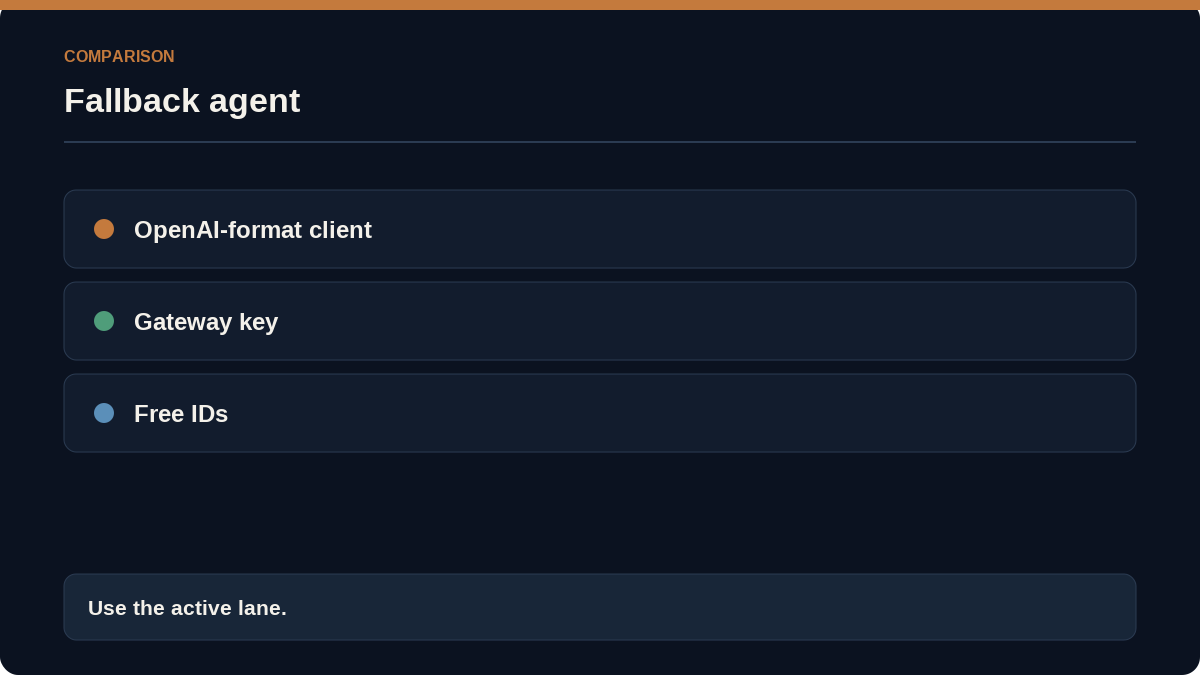
Choose the client for reviewability. You need to see proposed commands, inspect diffs, reject unsafe actions and recover state after an error. A client that hides tool output makes verification harder even if the model is capable. Start with read-only access, then add a disposable directory, then add the specific command needed for a test.
The multi-model OpenAI-agent setup gives the full configuration sequence. The 46 free model IDs guide documents the lane’s limits. Keep those references in the runbook, but recheck the live pages before a drill because model availability can change.
The honest loss is parity. The fallback agent will not reproduce every Claude Code feature, hook or habit. It may need different project files or permission prompts. That is acceptable if the fallback can complete the defined task set and produce evidence you can review. A backup that only opens a chat window is not a workflow backup.
Quarterly drill: prove the plan works
A quarterly drill is a recommendation, not a provider requirement. Its purpose is to keep the backup from becoming stale. Use a disposable project or a branch with no production side effects. Run the same small task set through the fallback agent, record the results and fix the gaps before a real incident.
| Drill stage | Action | Evidence | Pass condition |
|---|---|---|---|
| Prepare | Retrieve the runbook and credential location | Named owner and current inventory | No secret appears in the runbook |
| Connect | Send a minimal request | Status, model and request log | Correct route and live ID |
| Execute | Complete one bounded coding task | Diff and targeted test output | Accepted, verified change |
| Recover | Simulate a controlled failure | Error and restoration steps | Task restored without hidden state |
| Review | Compare with the primary baseline | Review time and failure notes | Gaps have owners and dates |
| Close | Update inventory and expire temporary access | Updated runbook | Next drill starts from current facts |
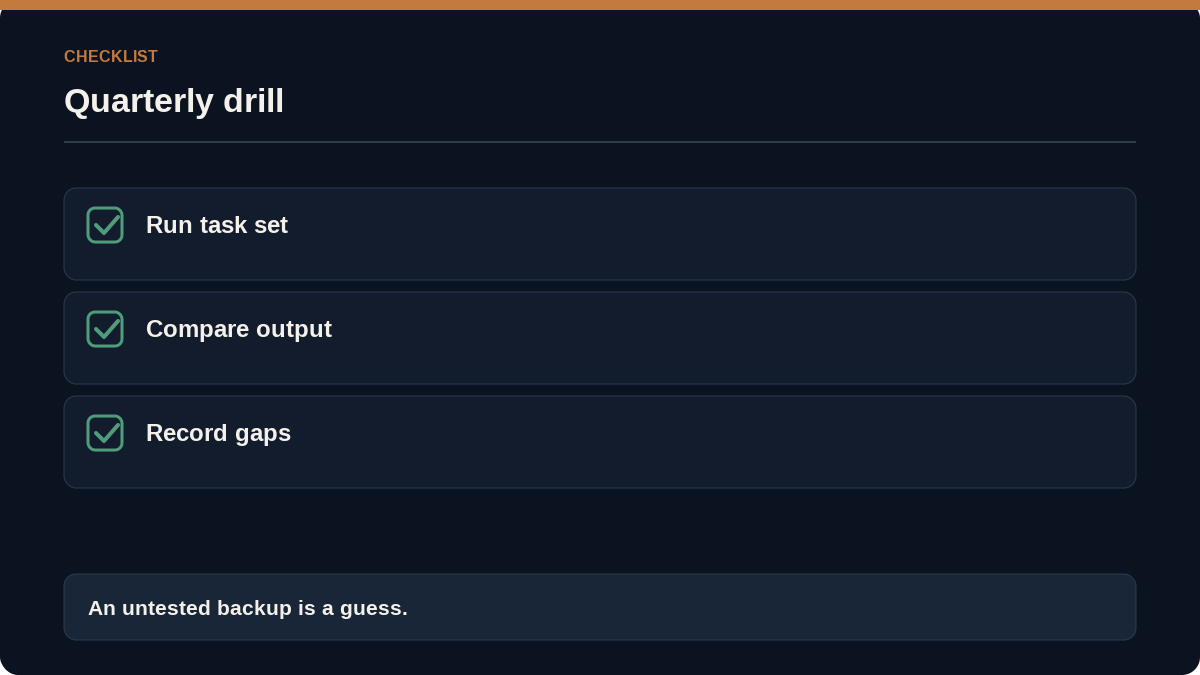
Score the drill on accepted work, not on how quickly the agent produces text. Record the changed files, test command, actual output and one independent check. The proof-of-work packet provides a reusable format. The false-success verification guide explains why a passing demo can still miss the real path.
A drill can fail usefully. A format error reveals a configuration gap. A weak diff reveals a model or prompt mismatch. A missing test command reveals that the runbook is incomplete. The purpose is not to preserve a perfect score; it is to find the break while the cost of breaking is low.
Worked example: a 30-minute recovery target
Suppose the team sets a 30-minute target for restoring a bounded task after the primary route becomes unavailable. This is an illustrative operating target, not a benchmark. Derived: if credential retrieval takes 5 minutes, the minimal request takes 2 minutes, the task takes 15 minutes and verification takes 8 minutes, the total is 5 + 2 + 15 + 8 = 30 minutes.
Now add a failure. If the selected model ID is stale and the first request fails, the team may spend 6 minutes finding a live replacement. Derived: the revised total is 30 + 6 = 36 minutes, assuming no other delay. The point is not the exact number. The point is that model freshness and credential access belong in the recovery budget.
Keep the target realistic. A fallback that restores a small bug fix may not restore a long architectural task in the same time. Define the task class the backup is meant to cover. A narrow, tested recovery path is more valuable than a broad promise that any task can move instantly.
After the drill, compare the measured time with the target and record the largest delay. Fix one bottleneck at a time. If credential retrieval dominates, improve the secret-store path. Where model selection dominates, keep a verified live ID in the inventory and recheck it before each drill.
What to do during the first hour
The first hour after a trigger should follow the runbook, not a debate. Confirm the signal, protect active work and move only the task classes the backup is designed to handle. Save the current diff, branch and test state before changing tools. A recovery attempt that overwrites uncommitted work can turn an availability problem into a data-loss problem.
Send one minimal request through the fallback route. If it fails, classify the error before running the full task set. Check the key, endpoint, selected model and daily limit in that order. If the route works, run one bounded task and verify it independently. Do not hand the fallback agent a large, undefined project and hope the context survives.
Record the timeline as you go. Note when the trigger was confirmed, when the backup request succeeded, when the first verified change landed and what remained blocked. That timeline is useful for the appeal, the incident review and the next drill. It also prevents the team from reconstructing events from memory.
At the end of the hour, decide whether to continue on the backup, pause the affected work or escalate. The decision should be based on verified progress, not on how many messages the agent produced. A calm pause is better than an uncontrolled retry loop that consumes the remaining daily pool.
Honest loss: a backup can still fail
The concrete win is preparedness. The concrete loss is maintenance. Keys expire, models disappear, agents change and project rules drift. A backup that is not tested can be worse than no backup because it creates confidence without evidence. The quarterly drill exists to pay that maintenance cost deliberately.
A second route also does not remove every interruption. The gateway can be unavailable, an upstream can fail and a policy can change. The routing documentation and gateway overview conflict on automatic fallback, so the plan should not promise it. Test the behavior you depend on and keep a manual path.
Claude Code’s integrated workflow remains a real benefit. An exit plan should preserve what works rather than treating every dependency as a mistake. The goal is to make the dependency visible and survivable, not to generate work for its own sake.
Data gap and future update
The frozen evidence does not quantify how often quota, account or model failures interrupt Claude Code users. It also does not provide a controlled comparison of recovery time between agents. The 30-minute target in this article is an example, not a measured result. A future update should add actual drill data with date, agent version, model ID, task set and timings.
The Claude route status is also time-sensitive. All four Claude IDs were unavailable on 2026-11-27. Update the inventory only after the live catalogue or a verified endpoint shows a working route. Until then, the free IDs remain an OpenAI-format backup and must not be described as usable inside Claude Code.
Cluster guide
These posts provide the evidence and checklists behind each part of the exit plan.
- Cost: Claude Code free-tier entry price establishes the primary subscription floor.
- Quota: Claude Code five-hour and weekly limits documents quota triggers.
- API math: Fable 5.2 agent-loop pricing math explains cost spikes from repeated context.
- Billing: Ultra API credits versus Claude Code usage separates billing routes.
- Value: Claude Code cost per verified change adds review to the cost model.
- Account: Claude Code suspension notice gaps covers account triggers.
- Travel: Claude Code travel and regional ban risk explains location eligibility.
- Teams: Claude Code regional restrictions for teams extends the review to teams.
- Exception: Claude Ultra five-hour exception keeps the exception precise.
- Appeal: Claude Code appeal evidence packet prepares the official appeal route.
- Privacy: Claude Code privacy and retention rules compares data defaults.
- Retention: Claude Code zero-data-retention limits explains qualified Enterprise coverage.
- Legal: AI government-request policies keeps legal claims evidence-based.
- Secrets: Claude Code settings-file secret exposure shows why saved approvals need scanning.
- Security: Claude Code harness security boundaries maps tool authority.
- Incident: Anthropic April 2026 Claude Code postmortem documents a dated regression.
- Context: Claude Code context versus memory separates capacity from retained state.
- Compaction: Claude Code compaction retention test scores what survives a summary.
- Verification: Claude Code false-success verification tests the oracle behind a demo.
- Receipts: Claude Code proof-of-work packet defines receipts for completed work.
- Token use: Claude Code agent-team token overhead keeps the plan-mode condition attached to the estimate.
- Lock-in: Claude Code lock-in and exit costs inventories migration work.
- Credentials: Claude Code third-party harness rules explains credential restrictions.
- Migration: Claude Code context-portable migration preserves prompts, hooks and context.
- Failure domains: Claude Code single points of failure maps quota, region, account and model risk.
- Setup: Multi-model OpenAI-agent setup shows the active architecture.
- Free lane: 46 free AI model IDs for OpenAI agents documents the free lane and its limits.
- Trial: $10 no-card gateway trial turns signup credit into a measured test.
- Architecture: Claude Code alternatives and model-layer ownership synthesizes the two-layer design.
Practical response: prepare the backup this week
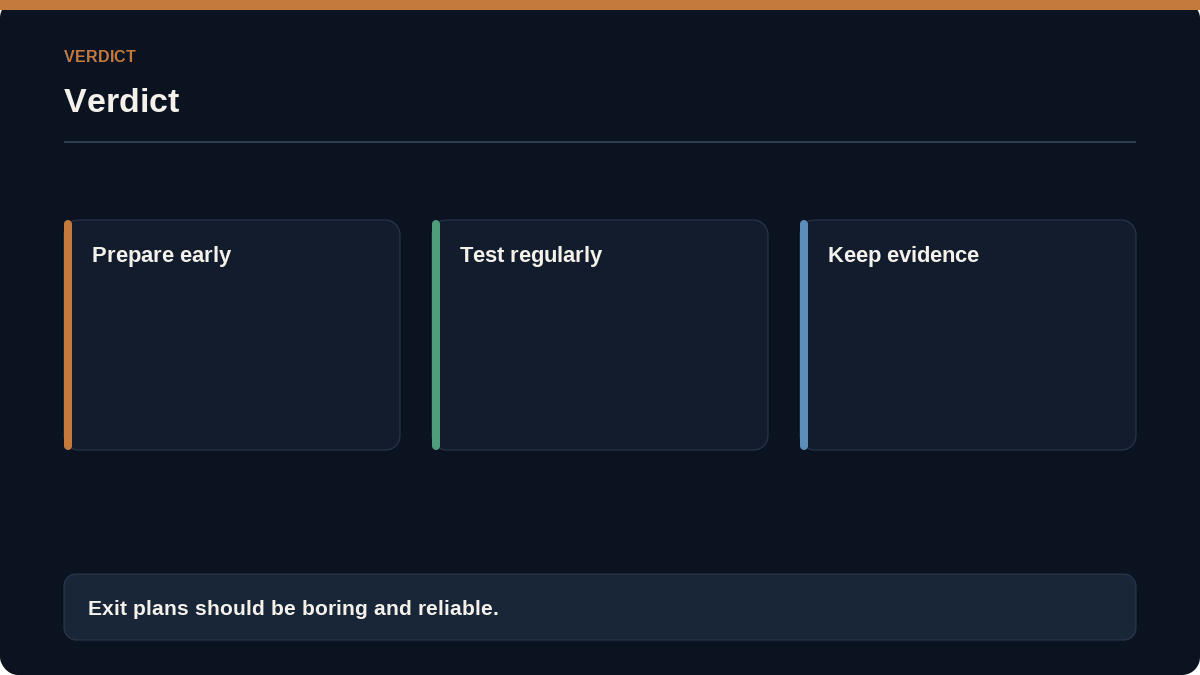
Write the trigger table, create the backup key, export the portable project brief and configure one OpenAI-format fallback agent. Run one bounded task and save the evidence. Put the next drill on the calendar and name the owner.
One AI API Key’s active route is an OpenAI-format agent using https://api.oneaiapikey.com/v1, one key and the 46 live free model IDs. Use the 46 live free model IDs, the quickstart and the per-key controls to prepare the backup. Claude Code’s Anthropic-format route is documented, but all four Claude IDs were unavailable on 2026-11-27. Never list those IDs as a working backup, and never claim the free IDs work in Claude Code.
The win is a recovery path you have used. The loss is the ongoing work to keep it current. The practical implication is to make the drill boring: same task set, same evidence, same owner, every quarter.
FAQ
When should I build an exit plan?
Before an incident. A quota boundary or account lock is a poor time to export configuration, create credentials and learn a new agent. A short plan prepared in advance is easier to test and maintain.
Can the 46 free IDs be my Claude Code backup?
Not inside Claude Code. They use the OpenAI format and work through OpenAI-format agents. The four Claude IDs on the Anthropic route were unavailable on 2026-11-27.
How often should I run a drill?
Quarterly is a reasonable recommendation, plus a drill after a major agent, model or configuration change. The cadence is an operating choice, not a provider requirement. Record results so each drill has a baseline.
What should the drill prove?
It should prove credential retrieval, endpoint connectivity, one bounded coding task, independent verification and recovery from a controlled failure. A chat response alone is not enough.
Does a backup guarantee zero downtime?
No. The gateway and upstreams can fail, policies can change and the backup agent can have gaps. A tested backup reduces concentration risk; it does not eliminate it.
Sources
- Claude usage and length limits
- Claude usage credits and spending controls
- Claude supported regions policy
- Claude safeguards, warnings and appeals
- Anthropic April 2026 Claude Code postmortem
- Gateway free model lane
- Gateway API reference and format matrix
- Coding-agent API key compatibility and Claude status