Direct answer
Claude Code regional restrictions are a team logistics problem because the policy covers more than a user’s IP address. Physical location, an entity’s headquarters and certain ownership or control situations all matter. A contractor in another country does not automatically ban an entire team, and the public policy does not disclose every verification method or review timeline. Teams should maintain an access inventory, review travel and contractor changes before they happen, and keep a tested alternative route. A VPN is not a compliance fix.
Why this belongs in team operations
Most teams treat software access as a procurement task: buy the plan, assign the seat and move on. Regional policy makes that model too simple. A developer can be employed by a supported entity, hold a valid subscription and still create a new access question by working from an unsupported location. A contractor can add an ownership or headquarters question that never appears in the seat list.
The operational cost shows up later. A sprint stalls because one reviewer cannot access the agent. A contractor receives a restriction notice and the team has no receipt, timeline or policy record. A finance owner discovers that a backup route was purchased without a data-handling review. None of those problems is solved by telling everyone to use a VPN.
A team-level approach separates four records: who uses the service, where they physically work, which entity contracts for the service and who owns or controls that entity. Keep those records current and a restriction becomes easier to assess. The Claude Code travel and regional ban risk article covers the individual traveler case; this one covers the roster behind it.
The policy criteria that affect a team
Official: The supported-regions policy took effect on 2026-11-12. It covers physical location, entities headquartered in unsupported regions and certain ownership or control situations. Mainland China, Hong Kong, Macau, Russia, Belarus and Iran do not appear on the supported list. The list should not be described as identical to a sanctions list.
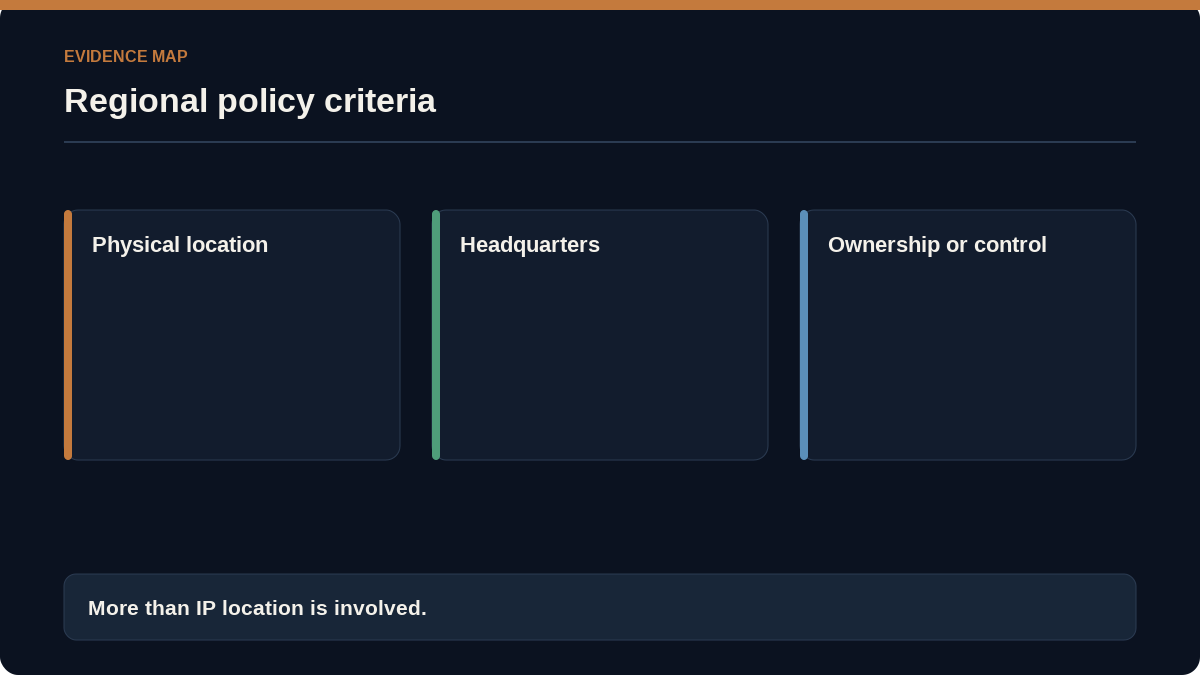
| Criterion | Team record to maintain | Common mistake |
|---|---|---|
| Physical location | Country or region where each person works, including temporary locations | Recording only home-office country |
| Headquarters | Contracting entity and its headquarters | Assuming a supported customer location settles an entity question |
| Ownership or control | Known parent companies, controlling parties and relevant corporate changes | Treating a contractor as separate from all ownership questions |
| Account identity | Named user, account email and plan owner | Sharing one login across a team |
| Policy review date | Date the roster was checked against the current policy | Treating an old review as permanent |
The policy creates a reason to ask better questions, not a license to invent answers. If ownership is complex, record the structure and seek a qualified review. Do not let a project manager guess whether a parent company controls a vendor.
Distributed-team scenarios
Distributed teams need scenario planning because the same roster can produce different access questions as people move. The important distinction is between a permanent staffing fact and a temporary location change. Both can matter, but they require different records.
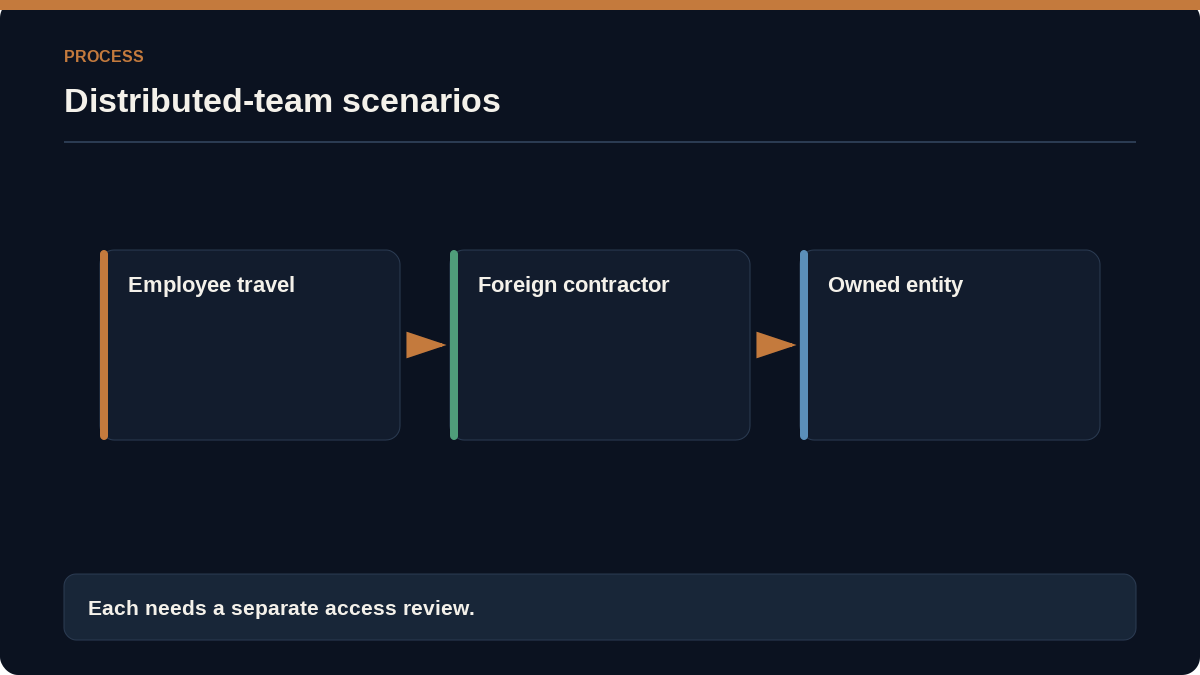
| Scenario | What to review | Safe operational response |
|---|---|---|
| Employee travels to an excluded region | Physical work location during the trip | Pause use before arrival and activate a tested backup |
| Foreign contractor joins a supported team | Contractor location, contracting entity and client policy | Complete access review before issuing work |
| Team member works from a second home | Physical location of the second home | Add the location to the roster and review it |
| Company opens an office in another region | Headquarters, entity structure and ownership | Recheck policy and procurement before rollout |
| Parent company or control changes | Ownership or control facts | Update the access inventory and seek review |
| Client requires a specific tool region | Client contract and data-handling rules | Use an approved environment or decline the mismatch |
A supported-to-unsupported trip is not the same question as an unsupported-to-supported move. The first can require a pause before travel. The second may still involve an existing restriction or account review. Do not treat arrival in a supported country as an automatic restoration event.
Contractor and ownership questions
Contractors deserve a clear process. They should know which account they may use, where they may work, what data they may send and who handles an access problem. Ambiguity pushes the contractor toward workarounds, and workarounds create more risk than the original access question.
Start with the engagement record. Identify the contracting entity, the contractor’s physical work location and the client’s rules for cross-border work. Then identify the account owner. If the contractor uses a client-provided seat, confirm that the arrangement is permitted. If the contractor uses a personal account, confirm that the client accepts the data route.
| Question | Why it belongs in onboarding |
|---|---|
| Where will the contractor physically work? | Location is a published policy criterion |
| Which entity signs the agreement? | Headquarters can be relevant |
| Is there a parent company or controlling party? | Ownership or control can be relevant |
| Who owns the account and payment method? | Shared credentials obscure responsibility |
| What project data may enter the agent? | Client and privacy obligations still apply |
| Who receives a restriction notice? | The team needs a named escalation owner |
Do not claim that one contractor automatically bans a whole team. The fact pack does not support that statement. It also does not support the opposite claim that contractors are always harmless to entity-level review. Record the facts and ask for review when the structure is unclear.
The Claude Code third-party harness rules are relevant to onboarding too. Official login guidance restricts tools that misrepresent identity or route traffic against subscription limits. A contractor should not be told to disguise location or identity to keep a seat active.
What the policy does not disclose
The public policy is clear about broad criteria, but it does not disclose every enforcement detail. The fact pack contains no verified enforcement rate, no standard review timeline for regional cases and no complete description of the evidence used in every account decision.
That gap matters because teams often want a yes-or-no answer before hiring or travel. A roster can identify risk, but it cannot guarantee an outcome. A clean inventory does not prove that an account will never be restricted. A restriction does not prove that the team misunderstood the policy.
Community: A GitHub report involving an organization suspension describes an account-access problem, and a Reddit travel thread collects travel complaints. These sources show that users have reported disruptions. They do not establish why a particular organization was restricted or how often regional enforcement occurs.
The honest team position is to document what is known, label what is unknown and prepare for both. The Claude Code suspension notice gaps article explains why a short notice should not be treated as a complete root-cause report.
Build a team access inventory
An access inventory is a living operations record, not a one-time legal questionnaire. It should be easy to update when someone joins, moves, travels or changes employers. It should also be readable by the people who handle procurement, security and support.
Use one row per person and one linked record per contracting entity. Record the account email, plan owner, normal work region, expected travel, contractor status and last policy review. Add a field for the approved backup route. Do not store passwords or API credentials in the inventory.
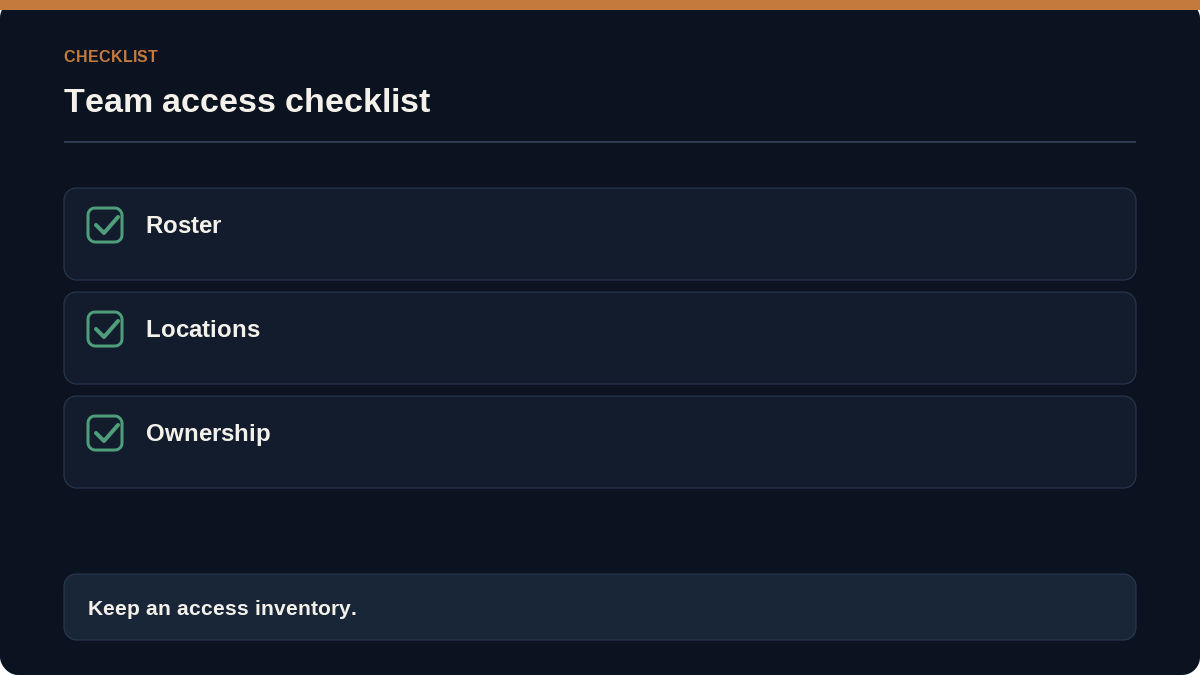
| Inventory field | Owner | Update trigger |
|---|---|---|
| Named user and account email | Team operations | Joiner, mover or leaver |
| Normal physical work region | People operations | Relocation or remote-work change |
| Expected travel regions | The traveler | Itinerary change |
| Contracting entity and headquarters | Procurement or legal | New contract or entity change |
| Ownership or control notes | Legal or finance | Corporate restructuring |
| Approved backup route | Engineering or security | Tool or provider change |
| Last policy review date | Access owner | Scheduled review or policy update |
| Escalation contact | Team operations | Ownership change |
Review the inventory before international offsites, contractor starts and acquisitions. Those events change the facts faster than an annual procurement cycle. A lightweight review at the moment of change is more useful than a polished document that is already out of date.
Keep credentials out of the roster
The inventory should point to the approved credential system, not duplicate secrets. The per-project API key guide explains why separate keys and spend limits help operations. That guidance becomes more important when a team needs to revoke one route without stopping everyone else.
If a restriction occurs, the account owner should preserve the exact notice and timeline. The Claude Code appeal evidence packet provides the individual checklist. At team level, add the affected project, the backup owner and the next delivery deadline.
Separate access eligibility from work allocation
A provider restriction is not the same thing as a performance problem. Keep the access question separate from the person’s assignment. If one developer cannot use the primary route, the team can often move review, local development or client communication to another approved path while the account question is resolved.
Do not solve the problem by sharing another person’s login. That hides the affected account and makes the timeline harder to reconstruct. Assign work explicitly instead. The project lead should know which tasks require the restricted route and which can continue without it.
Quota is a separate failure domain. A developer who hits the five-hour and weekly limits has a usage problem, not necessarily a regional restriction. A verified Ultra account has a specific five-hour exception, but it is not unlimited; the Ultra five-hour exception explains the remaining weekly boundary. Mixing these issues leads to the wrong support request.
A worked handoff for a contractor restriction
Consider a contractor who reports a restricted-account page during a client engagement. The team already has a problem, but it does not yet have a story about cause. The first job is to preserve the record. Save the notice, account email, receipt and timeline. Do not ask the contractor to recreate the event through repeated login attempts.
Next, stop any shared workaround. If the client provided the account, the account owner should control the response. If the contractor used a personal account, the contractor should submit the official appeal and share only the status information the client needs. Keep credentials and unrelated personal details out of the handoff.
Then protect delivery. Move the active task to the approved backup route or assign it to another developer. Tell the client what changed, what work continues and when the next update will arrive. Avoid naming a cause until the evidence supports it. A precise status update is more useful than a confident theory.
| Handoff step | Owner | Record |
|---|---|---|
| Preserve the notice | Account owner | Exact text, timestamp and page |
| Confirm account identity | Account owner | Account email and plan receipt |
| Protect active work | Project lead | Task, deadline and backup assignment |
| Submit the appeal | Account owner | Form receipt and requested review |
| Update the client | Engagement lead | Factual status and next update |
| Review the outcome | Access owner | Decision, gap and process change |
The Claude Code appeal evidence packet supplies the individual document list. The team handoff adds delivery ownership. Both are needed because a successful appeal does not finish the project, and a finished project does not resolve the account.
Review the inventory when facts change
A roster becomes unreliable when it is updated only after a problem. Build the review into the events that change access: hiring, relocation, travel, corporate restructuring and a new client contract. Each event should have a named owner and a small set of fields to update.
The review does not need to block ordinary work. It needs to identify when a policy question exists and who will answer it. If the answer is unclear, use the approved backup or pause the affected route. Do not let uncertainty quietly become a shared credential or an unrecorded exception.
| Trigger | Review action |
|---|---|
| New contractor | Confirm location, entity, account owner and client rules |
| International offsite | Check destinations and pause points before booking |
| Relocation | Update physical work region and recheck policy |
| Acquisition or ownership change | Review headquarters and control records |
| New client data | Confirm approved tools and data-handling terms |
| Provider policy update | Recheck the roster against the current page |
This event-driven approach fits the Claude Code exit-plan checklist. The exit plan defines what happens when access fails; the inventory defines whose access changed and who owns the response.
Escalate the right question
Different questions belong with different owners. Legal or procurement should review entity structure, contract terms and cross-border work. Security should review data routes, credentials and client obligations. Engineering should test the backup and verify output. Team operations should maintain the roster and preserve notices.
A useful escalation includes the facts and the decision needed. “We have a contractor in region X, the contracting entity is Y and the client requires Z; which route is approved?” is actionable. “Are we banned?” is not. The first question can be reviewed against documents. The second invites speculation.
If the public policy does not answer the issue, mark it Unknown and seek qualified advice. The goal is not to produce a legal conclusion from a blog post. The goal is to prevent an operational decision from outrunning the evidence.
Alternative routing considerations
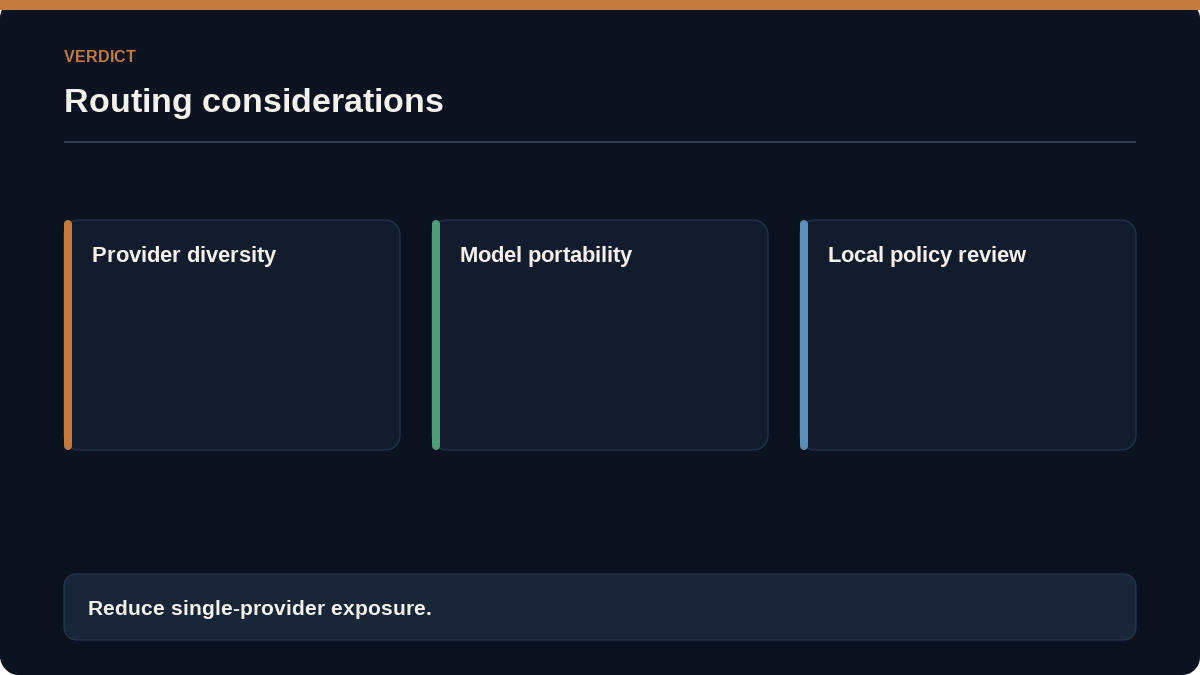
A backup route should reduce concentration without creating a second unmanaged dependency. Start by separating the agent interface from the model access layer. An OpenAI-format agent can use a different endpoint while the team keeps familiar editing and review workflows. That separation makes a provider change less disruptive than replacing every habit at once.
The multi-model OpenAI-agent setup describes the active architecture. The 46 free AI model IDs for OpenAI agents are suitable for small tests, subject to the published daily limits. Neither route should be described as a way to make unavailable Claude IDs work.
| Routing question | Team check |
|---|---|
| Does the agent use the expected API format? | Confirm OpenAI-format compatibility before assigning work |
| Is the chosen model currently available? | Check the live catalogue rather than an old note |
| What data leaves the developer’s machine? | Review the provider and upstream terms |
| Who can create or revoke keys? | Assign ownership and least privilege |
| What happens when the free allowance is exhausted? | Define a pause or paid top-up path |
| How is output verified? | Keep tests and human review independent of the route |
Provider diversity is not the same as duplicating the same upstream behind two names. Ask what actually serves the request. The single-points-of-failure analysis explains why quota, region, account and model behavior should be tracked separately.
The win, the loss and the practical implication
The win is that the policy gives teams a usable set of questions. Physical location, headquarters and ownership or control can be recorded and reviewed. A team that keeps those records can respond to a restriction with facts instead of rumour.
The loss is that the public policy does not provide a complete enforcement forecast. A perfect roster cannot promise access, and a restriction notice may not explain the decisive fact. The Claude Code lock-in and exit costs become more visible when one provider controls both the workflow and the access decision.
The practical implication is to make provider access an operations responsibility. Assign an owner, review changes early and test a backup on real but non-sensitive work. The context-portable migration guide helps preserve prompts and project rules. The Claude Code exit-plan checklist turns that preparation into a repeatable drill.
Client confidentiality during an access change
A backup route can solve an access problem and create a data problem at the same time. Before moving a client repository to another agent, confirm that the client permits the route and the data involved. A free model is not automatically an approved data processor. A paid route is not automatically approved either.
Use a sanitized task for the first test. Remove credentials, customer records and unrelated source files. If the real task requires sensitive context, ask the client’s security owner for approval and record the answer. Keep the approval with the engagement record, not in a chat thread that disappears.
Notices need similar care. An appeal packet may contain account and payment evidence, but it rarely needs the client’s source code. Share status with the client without forwarding unrelated personal information. The provider’s privacy and retention policy is one input to the review, not a substitute for the client’s contract.
A note for open-source maintainers
Open-source work can blur the line between a personal account and an organization. A maintainer may review public code from a personal subscription while also making decisions that affect a project’s direction. The public regional policy does not resolve every governance question, so the project should state which accounts and routes are acceptable.
Contributors should not borrow a maintainer’s login to work around access. Use named accounts and keep credentials separate. If a contributor travels to an excluded region, pause the affected route and continue through an approved alternative.
Project owners should also avoid publishing private support details in a public issue. Account emails, receipts and restriction notices belong in a private channel. A public issue can document a reproducible technical problem without exposing the account evidence needed for an appeal.
Record the access decision
When a regional question is resolved, write down the answer and its basis. Include the account, entity, location, policy date and approver. If the answer is conditional, record the condition and the event that would trigger another review.
A short decision record prevents the same question from being reopened without new facts. It also helps a new operations owner understand why a route was approved. Store the record with the access inventory, not in a private message that disappears when someone changes roles. Date the decision and name the person who can reopen it. Review the record whenever the itinerary or entity changes.
Data gaps and future updates
The team guidance needs revision when the official regional policy changes or when Anthropic publishes clearer enforcement or review details. Until then, avoid publishing a risk score that looks measured but is not. The available evidence supports an inventory and a backup plan, not a numerical ban probability.
A future update should also distinguish provider policy from client policy and local law. Those are separate layers. A route that is technically available may still be unsuitable for a client’s data, and a client-approved route may still require a provider eligibility review.
Practical response: test the live OpenAI-agent lane
One AI API Key is not a Claude Code replacement interface. Its active route is an OpenAI-format agent such as OpenCode, Cline or Cursor using https://api.oneaiapikey.com/v1, one gateway key and the 46 live free model IDs. Verify the current free model list before assigning a model to a contractor or traveler.
The documented Claude Code route uses https://api.oneaiapikey.com without a trailing /v1 and the Anthropic Messages format. All four Claude IDs were unavailable on 2026-11-27: claude-sonnet-5-5, claude-sonnet-5, claude-opus-5-5 and claude-haiku-4-5. Free IDs are OpenAI-format only and do not work in Claude Code. The coding-agent compatibility guide and OpenAI versus Anthropic format guide make that boundary explicit.
For a team pilot, use the endpoint quickstart, check the current model catalogue, review prepaid pricing and create accounts through the sign-up page. Assign separate keys where practical, record usage and use the LLM cost calculator for paid work. Check gateway status before a drill. The custom base URL guide does not make the unavailable Claude route live.
FAQ
Does one foreign contractor automatically ban the whole team?
No such rule is established in the fact pack. Review the contractor’s location, the contracting entity and any ownership or control questions. Do not turn an individual access issue into an unsupported claim about the entire organization.
Is checking the supported-regions list enough?
It is a necessary start, not a complete team process. Teams also need current locations, entity records, contractor terms, client requirements and a tested backup route.
Can a team solve regional restrictions with a VPN?
No. The official policy says VPN use does not create eligibility. Location masking is not a compliance strategy and can create additional identity or terms problems.
What should a team do when a restriction notice arrives?
Preserve the notice, account email, receipt and timeline. Use the official appeal route, activate the approved backup and record the project impact. Do not promise reinstatement or invent a cause.