A working Claude Code alternative is an OpenAI-format agent such as OpenCode or Cline pointed at https://api.oneaiapikey.com/v1, using one gateway key and one of the 46 live free model IDs. That is the active route. Claude Code’s own gateway route is documented, but all four Claude IDs were unavailable on 2026-11-27, and the free IDs do not work inside Claude Code’s Anthropic-format client. The useful alternative is therefore a different agent architecture, not a free-model swap inside Claude Code.
This boundary is the first thing to get right. An OpenAI-format agent sends chat-completion requests to /v1. Claude Code sends Anthropic Messages requests to a base URL without /v1, because it appends the path itself. Mixing those conventions produces configuration errors before model quality enters the picture. Once the format matches, the setup is straightforward: create a key, set the base URL, select a live free ID and verify a minimal request before giving the agent repository access.
Compatibility boundary: match the client to the route
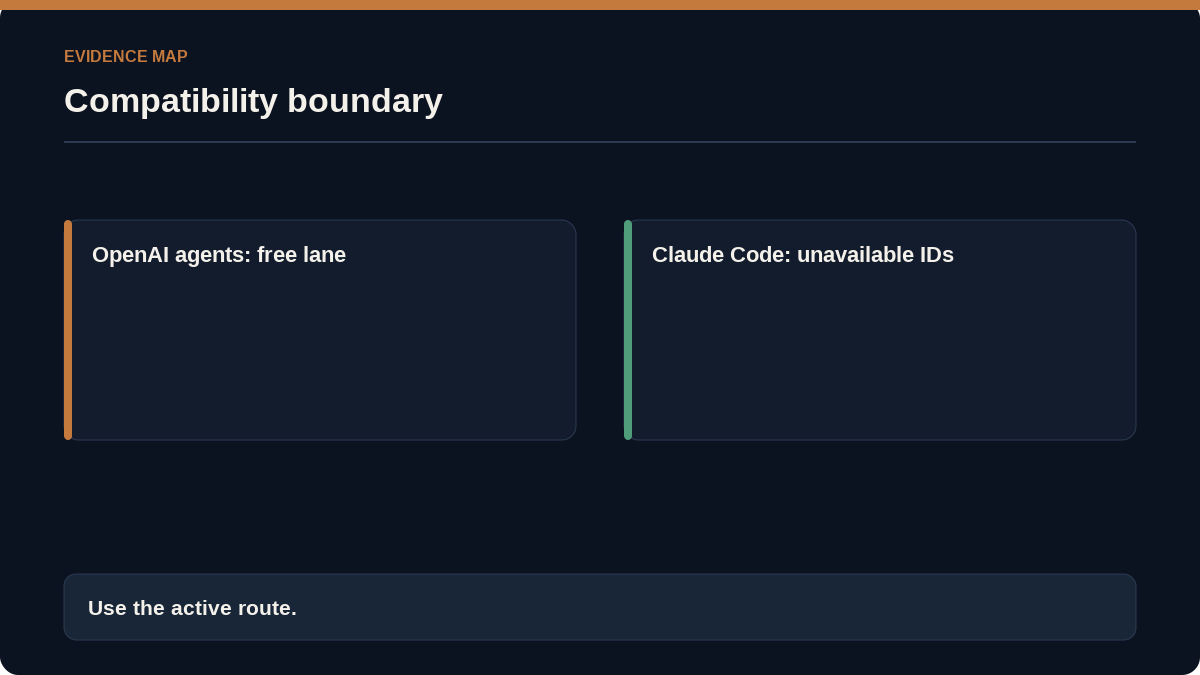
The gateway lists 76 models, with 46 available-now free IDs across 22 families on 2026-11-27. Official: all listed models use the OpenAI format, and four also accept the Anthropic Messages format. The free IDs are OpenAI-format only. The four Claude IDs that accept the Anthropic format were all marked unavailable with no working upstream on the audit date.
That creates a clean compatibility matrix. OpenAI-format agents can use the free lane. Claude Code cannot. A custom script can use the OpenAI route if it implements the chat-completions shape. An Anthropic-format script may use one of the four compatible models only when that model is available, which was not the case for the four Claude IDs in the frozen audit.
| Client or script | Required format | Endpoint shape | Free IDs | Claude IDs on 2026-11-27 |
|---|---|---|---|---|
| OpenCode, Cline, Cursor or another OpenAI-format agent | OpenAI chat completions | https://api.oneaiapikey.com/v1 |
Yes, 46 live IDs | Not the active route |
| Claude Code | Anthropic Messages | https://api.oneaiapikey.com with no trailing /v1 |
No | Four IDs documented, all unavailable |
| Custom OpenAI-format script | OpenAI chat completions | https://api.oneaiapikey.com/v1 |
Yes | Use only if listed and available |
| Custom Anthropic-format script | Anthropic Messages | Base origin, client appends /v1/messages |
No | Check live status before use |
The OpenAI versus Anthropic API format guide explains the request shapes in more detail. The coding-agent compatibility guide covers the Claude Code route and its unavailable status. Read those before changing an existing integration, because a base URL that works for one client can be wrong for another.
Architecture: separate the agent from the model layer
The architecture has three layers. The agent owns the workflow: reading files, proposing edits, running commands and presenting a diff. The gateway owns authentication, model selection and metering. The upstream model owns inference. Keeping those layers separate is what makes a multi-model setup possible without rewriting every project rule each time the backend changes.
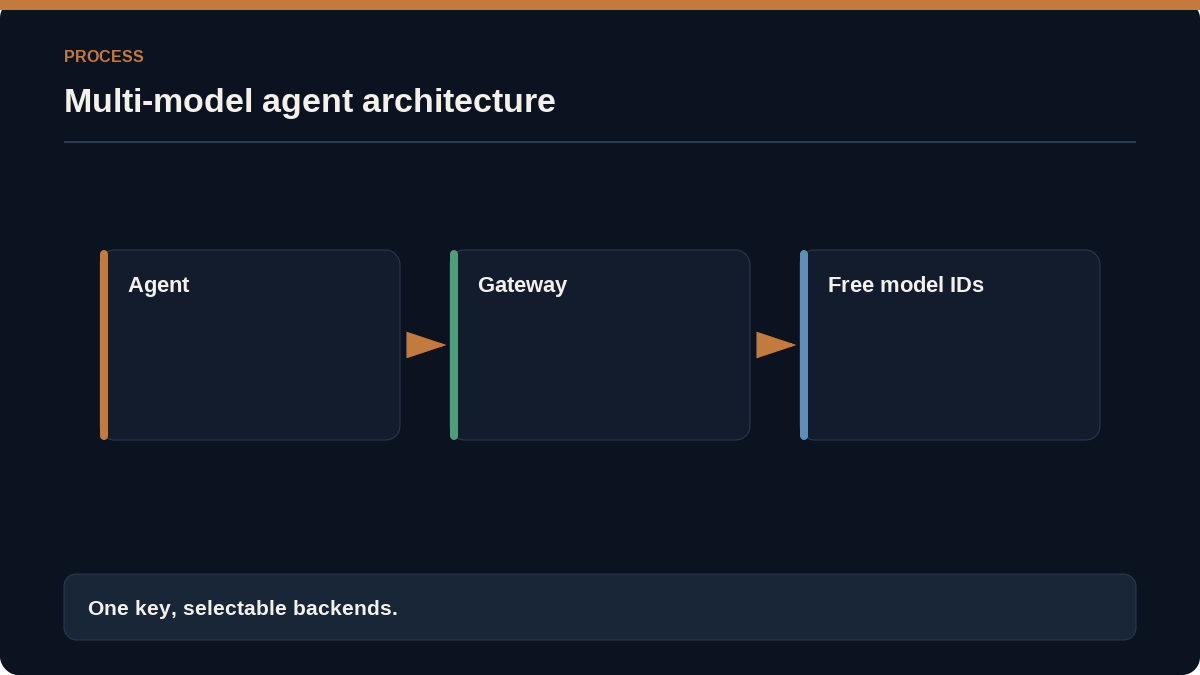
The agent should remain replaceable. Store project instructions in a portable file, keep tests in the repository and avoid hiding required context in a provider-specific session. The gateway key should be scoped to the project where possible. Official: per-key controls include a spending cap, expiry date and allowed-model list, and the console shows per-request model, token and cost logs. Those controls are documented in the API reference.
The honest loss is that separation adds a dependency. You now have an agent, a gateway and an upstream provider in the path. If the gateway is unavailable, the agent cannot reach the model through it. Should the agent change its tool format, the workflow may need adjustment. The benefit is choice; the cost is one more layer to monitor and test.
Base URL and key: use the OpenAI route exactly
For an OpenAI-format agent, set the base URL to https://api.oneaiapikey.com/v1. Use the gateway key as the API key or bearer token, following the agent’s configuration screen. Do not add /v1 twice. If the agent appends /chat/completions, the final path should be /v1/chat/completions, not /v1/v1/chat/completions.
The Claude Code convention is different. Its documented base URL is https://api.oneaiapikey.com with no trailing /v1, because Claude Code appends /v1/messages. That route is not an active conversion option today. The four Claude IDs were unavailable on 2026-11-27. A reader should not copy the Claude Code base URL into an OpenAI-format agent or expect the free IDs to work in Claude Code.
Create the key in the console and give it a clear project name. Official: accounts can have up to three keys, with one request in flight per key on free models. The free lane allows 100 requests and 5,000,000 tokens per day per account, shared across the 46 free IDs. The daily reset is 05:30 IST, which is 00:00 UTC. Multiple keys do not create multiple daily allowances.
The free model lane is the authoritative place to choose a current ID. The model catalogue shows listed models and availability. Do not copy an ID from an old article without checking the live page. A model can be listed without being available, and availability can change after the frozen audit.
Permissions and secret handling
A working endpoint does not make an agent safe to run on a repository. Start with read-only access, then add the ability to edit a disposable directory, then add command execution for the specific test or build step you need. The Claude Code harness security boundary explains why tool authority matters as much as model behavior. The same reasoning applies to an OpenAI-format agent: the model proposes actions, but the harness decides which actions can run.
Keep the gateway key out of project files, committed settings and pasted support tickets. Store it in the agent’s secret field or an environment variable that the process can read. Official: per-key controls include a spending cap, expiry date and allowed-model list. Use those controls to limit the damage from a leaked key. A project key with a short expiry and a narrow model list is easier to rotate than one personal key used everywhere.
The settings-file secret exposure research shows how literal credentials can enter saved approval text and public repositories. That research is about Claude Code settings files, not a claim that every agent has the same bug. The general lesson still applies: approval dialogs and saved commands are part of your secret-handling surface. Scan them before committing, and use fake credentials in demonstrations.
Review data handling before sending private code. The gateway’s privacy and retention policy says prompt and response bodies are not written to usage logs by default, while troubleshooting captures and opt-in logs have separate retention periods. That is a first-party policy statement, not an independent audit. If your project requires a specific retention or subprocessor arrangement, verify the written terms rather than relying on a general privacy page.
Model selection: choose for the task, then verify
A multi-model setup is only useful if selection is deliberate. Start with one live free ID and a small task. Confirm that the agent can complete a tool call, read a file and return a diff. Then add a second ID for comparison. Keep the same prompt, repository state and test command so the comparison measures the model route rather than a changing environment.
| Selection need | What to look for | Safe test | What not to assume |
|---|---|---|---|
| First working request | A currently available free ID | Ask for a one-line response and inspect the returned model | That every listed ID is callable |
| Focused code edit | Clear diff and passing targeted test | Fix a small bug with a known expected result | That a fluent explanation proves correctness |
| Tool use | Correct command proposal and readable output | Read one file, then run a harmless test | That tool support is identical across agents |
| Longer task | Stable context handling and recoverable state | Summarize decisions, then ask for the next step | That a large context window guarantees recall |
| Cost control | Visible token and request usage | Run a bounded task and inspect the request log | That free means unlimited |
The model selection guide for coding agents provides a broader decision framework. The important point here is narrower: choose from the live free catalogue, keep the first test small and record what the model actually did. The fact pack does not provide a benchmark ranking for the 46 free IDs, so this article does not invent one.
Streaming and tool calls
An agent does more than exchange one prompt for one answer. It may stream a response, pause to run a command, send the command output back to the model and continue. Each of those steps is a compatibility point. A minimal non-streaming request can succeed while a streaming client fails, and a chat response can look correct while a tool call is malformed.
Test the mode your agent actually uses. If it streams, watch for a complete response rather than a connection that opens and closes without content. When it uses tools, run one harmless command and inspect the proposed arguments before approving execution. Confirm that the agent displays the command clearly and that you can reject it. These are workflow checks, not model benchmarks.
Keep tool output bounded. A command that prints thousands of lines can flood the context and make the next decision worse. Prefer a targeted test, a focused search or a truncated log. When a task needs a large artifact, save it to a file and ask the agent to read the relevant section. The habit improves reviewability regardless of which model is behind the agent.
A second model may require a different prompting style or may propose a different command for the same goal. Do not treat that difference as a failure automatically. Compare the result against the requirement, then record whether the variation helped or created extra review work. The purpose of a multi-model setup is controlled choice, not identical prose from every backend.
Setup steps: from account to first successful response
The setup is short, but the order matters. Verify the route before giving an agent broad permissions. A minimal request separates credential, format and network problems from repository or tool problems. Once that request works, add project context and increase authority gradually.
| Step | Action | Evidence of success | Common mistake |
|---|---|---|---|
| 1 | Create an account and a project key | Key exists with a name and expiry or cap | Reusing a personal key everywhere |
| 2 | Open the live free model page | A current available-now ID is selected | Choosing a listed but unavailable model |
| 3 | Set the agent base URL | Agent shows https://api.oneaiapikey.com/v1 |
Using the Claude Code origin without /v1 |
| 4 | Send a minimal request | HTTP success with a readable response | Starting with a full repository task |
| 5 | Inspect the request log | Model, tokens and cost are visible | Assuming the selected ID was used |
| 6 | Add project rules and tools | A bounded edit passes the targeted test | Granting broad access before verification |
| 7 | Record the working configuration | A portable note exists outside the agent | Leaving the only copy in a private session |
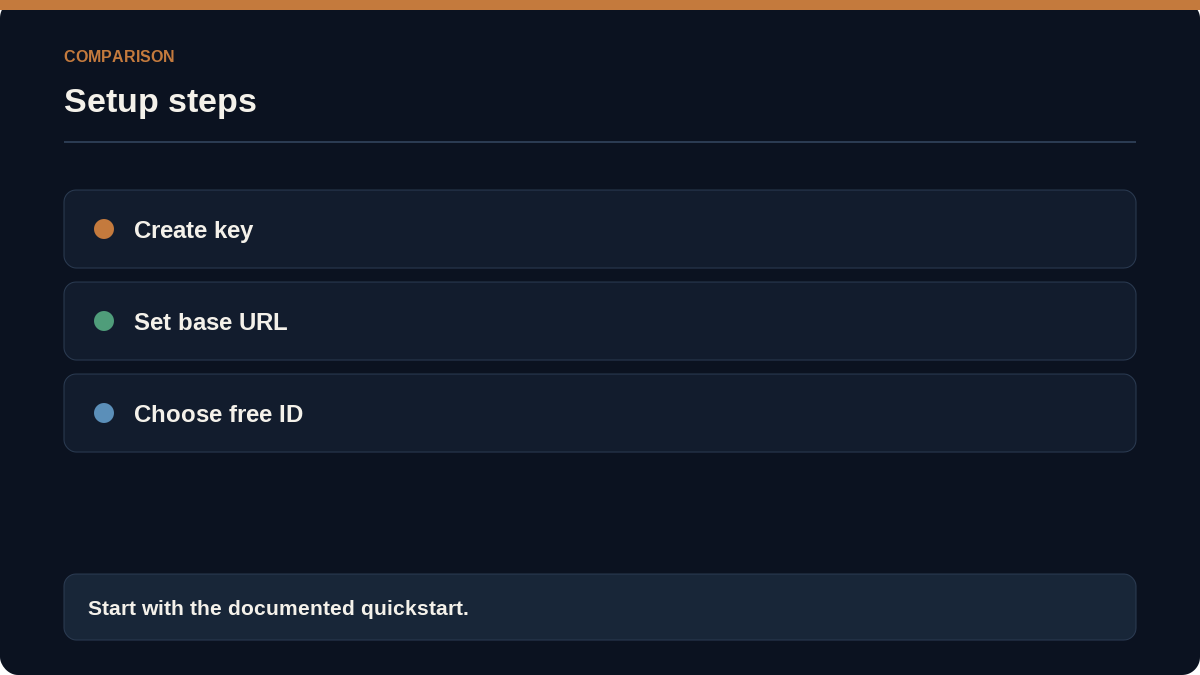
Use the quickstart for the current first-request details. If the agent has its own gateway integration, prefer the documented fields over a custom proxy. A custom proxy adds another place for headers, streaming and error handling to diverge. The simplest working path is the one with the fewest moving parts.
First request: prove the endpoint before the agent
Run a minimal chat-completion request with a placeholder for the live model ID. Replace <LIVE_FREE_MODEL_ID> with an available ID from the free lane. Keep the key in an environment variable rather than pasting it into a file or shell history.
curl https://api.oneaiapikey.com/v1/chat/completions -H "Authorization: Bearer $GATEWAY_KEY" -H "Content-Type: application/json" -d '{"model":"<LIVE_FREE_MODEL_ID>","messages":[{"role":"user","content":"Reply with OK"}]}'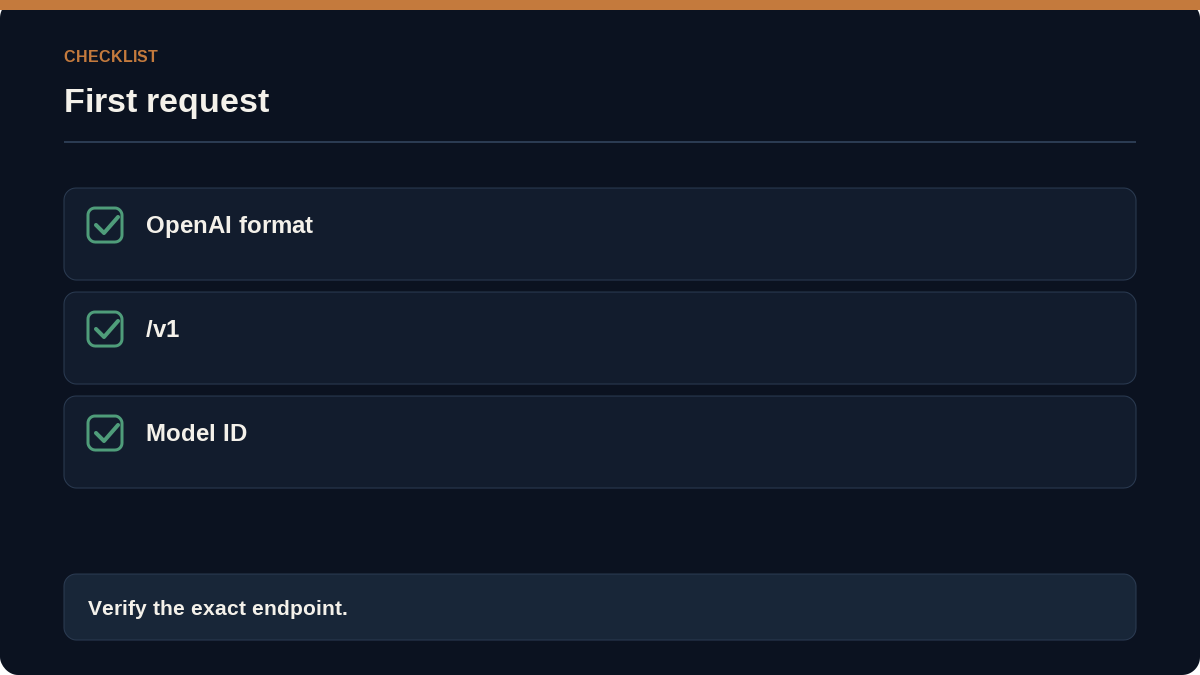
A successful response should include a readable assistant message. Then inspect the console log to confirm the model, token counts and cost. If the response is an error, classify it before retrying. A 401 points to the key. A 403 can point to the allowed-model list, cap or balance. A 404 can point to the endpoint shape. A format error can point to a client sending Anthropic fields to the OpenAI route.
Do not turn a failed request into a retry storm. The free lane has explicit limits, and repeated attempts consume the same shared daily pool. Save the error, the endpoint and the selected ID. The record is more useful than a vague report that the gateway does not work.
Verification: test the workflow, not only the connection
The first request proves connectivity. It does not prove that the agent can do useful work. A verification pass should include one read-only task, one bounded edit and one external-state check. Read a file and ask for a summary. Make a small change with a known test. Confirm that the change appears in the working tree and that the test result matches the claim.
Ask for a proof-of-work packet: changed files, the command run, the actual output and one independently verified result. The Claude Code proof-of-work packet describes a reusable format. The same discipline applies to any agent. A confident summary is not evidence that a tool ran or that a side effect occurred.
For automation, use a non-zero exit code as a failure signal and keep structured output separate from prose. Do not let an agent mark a task complete because a demo looked convincing. The false-success verification post explains how mocks and weak test oracles can hide a broken integration. The failure mode does not disappear when the model changes.
When the setup fails
Classify the failure before changing several variables at once. If the minimal request fails, stay at the endpoint layer. Once the minimal request succeeds but the agent fails, move to the client configuration. When the client connects but cannot use a tool, inspect the tool permission and output format. This order prevents a model-quality problem from hiding a simple base URL mistake.
A 401 usually sends you back to the key. Check for whitespace, a revoked value or a header the client did not send. A 403 sends you to the key’s allowed-model list, cap or balance. A 404 sends you to the endpoint shape, especially a duplicated /v1. A format error sends you to the client: it may be sending Anthropic fields to an OpenAI endpoint or using a response parser that does not match the returned data.
Use the live gateway status and the quickstart as external checks. If the status page shows an incident, record it instead of retrying repeatedly. Where the quickstart works but the agent does not, compare the agent’s effective configuration with the working request. Some clients store settings in more than one place, so the visible field may not be the value in use.
Keep a small failure log with the date, agent version, endpoint, selected model, error and resolution. Do not include the key. The log turns the next incident into a lookup rather than a fresh investigation. It also gives a future migration a record of which compatibility issues were real.
Honest loss: this is not Claude Code with free models
The concrete win is a working multi-model route with explicit limits and per-key controls. The concrete loss is parity. An OpenAI-format agent is a different client. It may use different project files, permission prompts, hooks and tool conventions. Claude Code’s tight Anthropic workflow can be harder to leave than a base URL change suggests.
The free lane is also bounded. It allows 100 requests and 5,000,000 tokens per day per account, shared across the free IDs, with one request in flight per key. It is not unlimited, and multiple keys do not multiply the daily allowance. Model quality varies by task, and the frozen fact pack contains no benchmark comparison that would justify ranking the 46 IDs.
Privacy needs the same care. The gateway’s privacy policy says it does not train on prompts, files or outputs and does not sell them. This is a first-party policy claim, not an independent audit. Upstream providers receive requests under their own terms. Review the policy before sending sensitive code or customer data.
Data gap and future update
The fact pack verifies the route, the free-lane count and the audit-date availability. It does not provide a controlled comparison of OpenCode, Cline and Cursor, or a quality ranking for the 46 free IDs. Those gaps matter because the best agent depends on your repository, permissions and review process. A future update should add a reproducible task set and measured results rather than a generic “best alternative” claim.
The Claude route may change. This article freezes its status on 2026-11-27: four documented Claude IDs, all unavailable. Update that status only from the live catalogue or a verified endpoint. Until then, the free IDs remain an OpenAI-format lane and must not be presented as a Claude Code conversion path.
Cluster guide
These posts cover the evidence behind the architecture, the limits of the free lane and the migration work that surrounds a model change.
- Cost: Claude Code free-tier entry price establishes the paid floor for the primary route.
- Quota: Claude Code five-hour and weekly limits explains the quota behavior a backup may need to absorb.
- API math: Fable 5.2 agent-loop pricing math shows why repeated context belongs in a cost model.
- Billing: Ultra API credits versus Claude Code usage separates API credit from interactive overage.
- Value: Claude Code cost per verified change adds human review to the comparison.
- Account: Claude Code suspension notice gaps covers account-standing risk.
- Travel: Claude Code travel and regional ban risk explains location eligibility.
- Teams: Claude Code regional restrictions for teams extends that review to contractors and ownership.
- Exception: Claude Ultra five-hour exception keeps the exception precise.
- Appeal: Claude Code appeal evidence packet prepares the official appeal route.
- Privacy: Claude Code privacy and retention rules compares consumer and commercial defaults.
- Retention: Claude Code zero-data-retention limits explains qualified Enterprise coverage.
- Legal: AI government-request policies keeps legal claims evidence-based.
- Secrets: Claude Code settings-file secret exposure shows why approval text can leak secrets.
- Security: Claude Code harness security boundaries maps authority across model, tools and host.
- Incident: Anthropic April 2026 Claude Code postmortem documents a dated model regression.
- Context: Claude Code context versus memory separates capacity from task state.
- Compaction: Claude Code compaction retention test scores what survives a summary.
- Verification: Claude Code false-success verification tests the oracle behind a passing demo.
- Receipts: Claude Code proof-of-work packet defines receipts for completed work.
- Token use: Claude Code agent-team token overhead keeps the plan-mode condition attached to the estimate.
- Lock-in: Claude Code lock-in and exit costs inventories what a migration must move.
- Credentials: Claude Code third-party harness rules explains credential restrictions without a blanket-ban claim.
- Migration: Claude Code context-portable migration preserves prompts, hooks and context files.
- Failure domains: Claude Code single points of failure maps quota, region, account and model risk.
- Free lane: 46 free AI model IDs for OpenAI agents documents the lane used here.
- Trial: $10 no-card gateway trial provides a measured evaluation plan.
- Exit: Claude Code exit-plan checklist prepares a fallback before an incident.
- Architecture: Claude Code alternatives and model-layer ownership synthesizes the two-layer design.
Practical response: run the smallest working setup
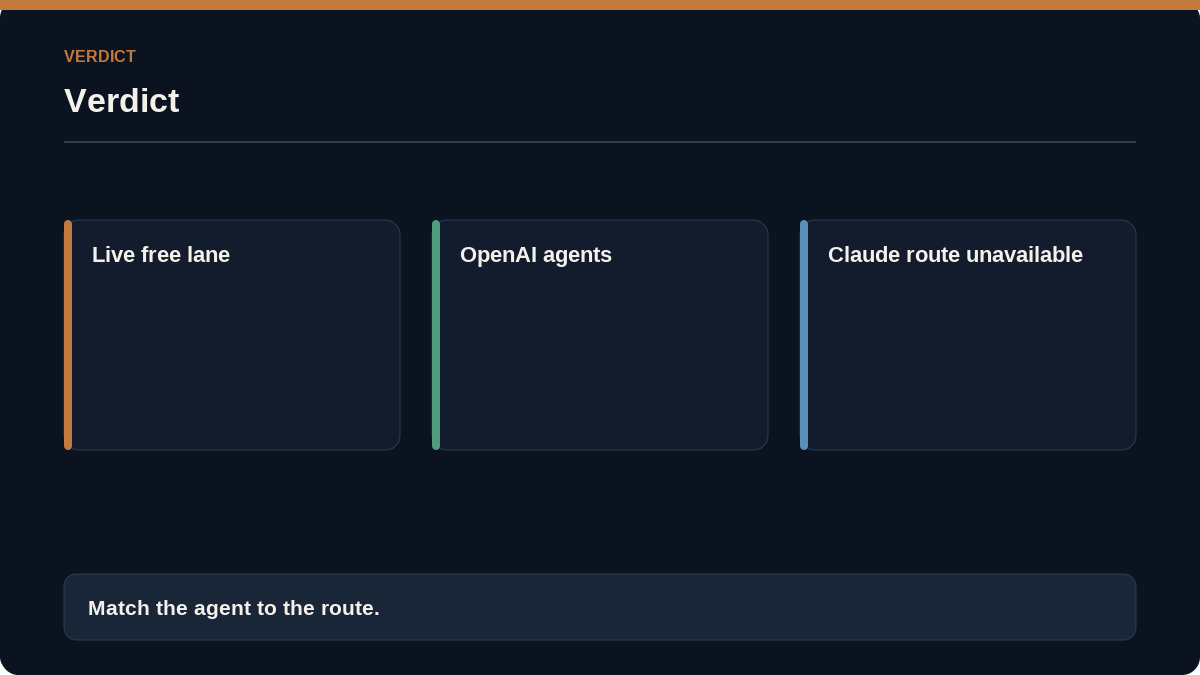
Choose one OpenAI-format agent, create one project key, select one live free ID and send one minimal request. When that works, run one bounded repository task and keep the diff, test output and request log. Do not start by migrating every hook or promising feature parity.
One AI API Key’s active route is the OpenAI-format path: https://api.oneaiapikey.com/v1, one key and the 46 live free model IDs. Use the 46 live free model IDs, the quickstart and the per-key controls reference to keep the test bounded. Claude Code’s Anthropic-format route is documented, but all four Claude IDs were unavailable on 2026-11-27. The free IDs do not work inside Claude Code.
The win is a working second architecture. The loss is the migration and review work required to make it useful. The practical implication is to prove the route with a small task before you depend on it for real delivery.
FAQ
Can I put the 46 free model IDs into Claude Code?
No. The free IDs use the OpenAI format. Claude Code uses the Anthropic Messages format, and the four Claude IDs on that route were all unavailable on 2026-11-27.
Which OpenAI-format agent should I use?
The fact pack does not rank OpenCode, Cline and Cursor. Choose one that supports a custom OpenAI base URL, exposes the settings you need and produces a reviewable diff. Verify it with the same small task set before committing.
Why does the OpenAI base URL include /v1?
The OpenAI route is https://api.oneaiapikey.com/v1. Claude Code’s Anthropic route uses the origin without /v1 because that client appends /v1/messages. The two conventions are not interchangeable.
Do three keys give three free daily allowances?
No. Accounts can have up to three keys, with one request in flight per key on free models, but the 100 requests and 5,000,000 tokens per day are shared per account across the free IDs.
Does the gateway automatically fall back to another model?
Do not assume so. The routing guide documents configurable fallback behavior, while the gateway overview says the service does not answer with a different model. The conflict is unresolved in the frozen evidence, so test and document the behavior you rely on.