Direct answer
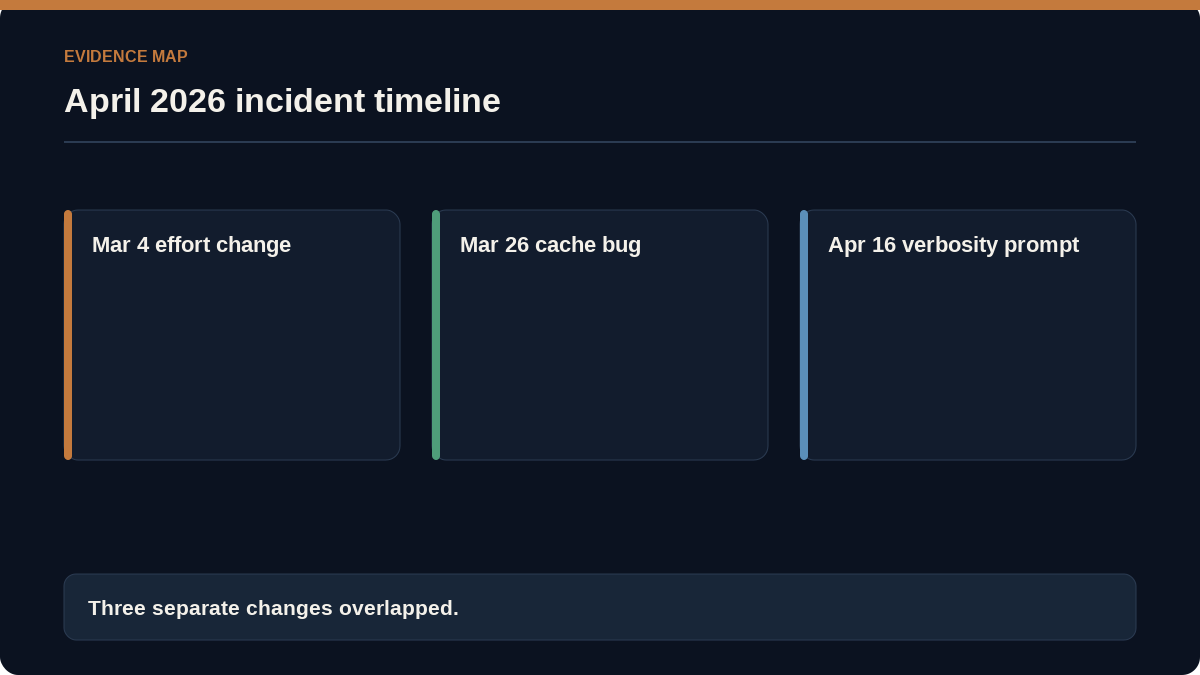
Anthropic’s April 2026 postmortem attributes a Claude Code quality regression to three separate changes that overlapped: a reasoning-effort default moved from high to medium, a caching bug repeatedly cleared older reasoning after an idle condition, and a prompt change limited verbosity in a way that hurt coding quality.
The dates matter. The reasoning default changed on 2026-03-04 and was reverted on 2026-04-07. The caching bug appeared on 2026-03-26 and was fixed on 2026-04-10. The verbosity prompt changed on 2026-04-16 and was reverted on 2026-04-20. Anthropic says the fixes landed in v2.1.116 and usage limits were reset for all subscribers on 2026-04-23.
This is evidence of a real, dated regression. It is not evidence that the bugs still exist, that every quality complaint has the same cause or that a later model change produced a measured failure rate.
Why a dated postmortem is more useful than a vague complaint
“Claude Code got worse” is hard to investigate. The statement does not identify a version, a date, a task or a failure. A postmortem gives developers something better: a timeline, named mechanisms and fixes they can compare with their own experience.
That matters because a coding agent has several layers that can change independently. The default reasoning effort affects how much work the model does before answering. The cache affects what earlier reasoning remains available. The prompt affects how the answer is framed. A user can experience all three as “the agent feels different,” even though the causes are distinct.
The Claude Code context versus memory discussion explains why retained reasoning and task state are separate concerns. The compaction retention test covers another lossy event. Neither should be conflated with the historical caching bug, but all three benefit from the same discipline: define what should survive and test it.
A dated incident also helps with cost. The caching bug contributed to cache misses and faster usage consumption. That connects quality and billing without turning the incident into a claim that every session became a fixed multiple more expensive. The Fable 5.2 agent-loop pricing math shows how repeated context affects cost in general.
The incident timeline
Official. The Anthropic postmortem is the primary source for the sequence below. The table keeps the changes separate so a reader can see how they overlapped.
| Date | Event | Effect described by Anthropic | Resolution |
|---|---|---|---|
| 2026-03-04 | Default reasoning effort changed from high to medium | Behavior changed; latency complaints followed | Reverted on 2026-04-07 |
| 2026-03-26 | Caching bug began clearing older reasoning after an idle condition | Cache misses and faster usage consumption | Fixed on 2026-04-10 |
| 2026-04-16 | Prompt change limited verbosity | Coding quality was hurt | Reverted on 2026-04-20 |
| 2026-04-23 | Fixes released in v2.1.116 | Usage limits reset for all subscribers | Incident remediation announced |
The timeline shows why a single-cause explanation is inadequate. The reasoning default and caching bug overlapped for part of March and early April. The verbosity prompt arrived after the cache fix and created another quality problem. A user who reported a broad decline could have been describing more than one mechanism.
The reasoning default changed from high to medium
Reasoning effort is the amount of work a model applies before producing an answer. A higher setting can spend more effort on difficult steps. A lower setting can reduce latency, but it can also change the quality of a result. The tradeoff depends on the task.
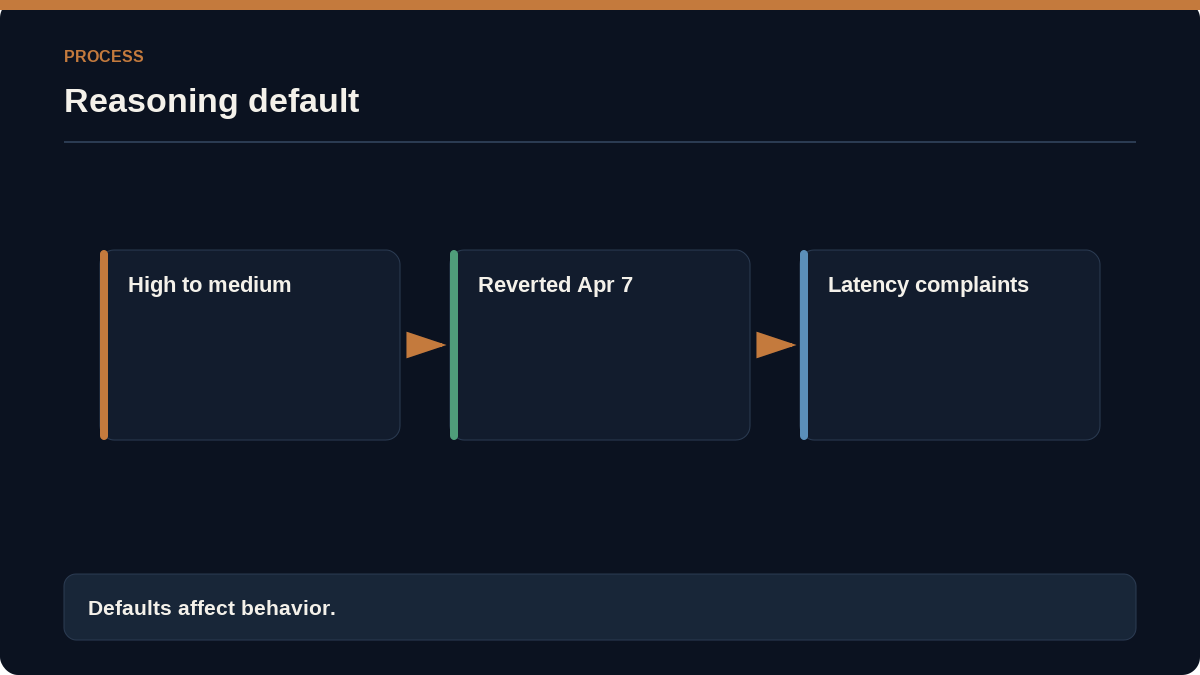
On 2026-03-04, Claude Code’s default reasoning effort changed from high to medium. Anthropic says it reverted the change on 2026-04-07 after latency complaints. The postmortem does not say that medium is always worse or that high is always better. It says the default change was part of the regression story.
For a developer, the practical lesson is to record the active setting when comparing runs. If one session uses high effort and another uses medium, a quality difference may come from configuration rather than model capability. The model selection guide for coding agents is useful for matching a model to a task, but the reasoning setting belongs in the same test record.
A fair test holds the model, prompt, repository and tools constant while changing only the effort setting. Run the same task more than once if the result varies. Record latency and accepted output, not just the first answer. This is slower than switching a setting and declaring a winner, but it produces evidence that can survive a subjective impression.
The honest loss is that defaults are part of the product. A user who never opens the settings still experiences the vendor’s choice. Pinning a version or setting can improve reproducibility, but it also means the team owns updates and compatibility. That is a real maintenance cost.
The caching bug cleared older reasoning
Caching reuses earlier work so a system does not have to rebuild it on every request. In an agent session, retained reasoning can matter because the model may refer to earlier analysis while solving a later step. A cache bug can therefore affect both behavior and usage.
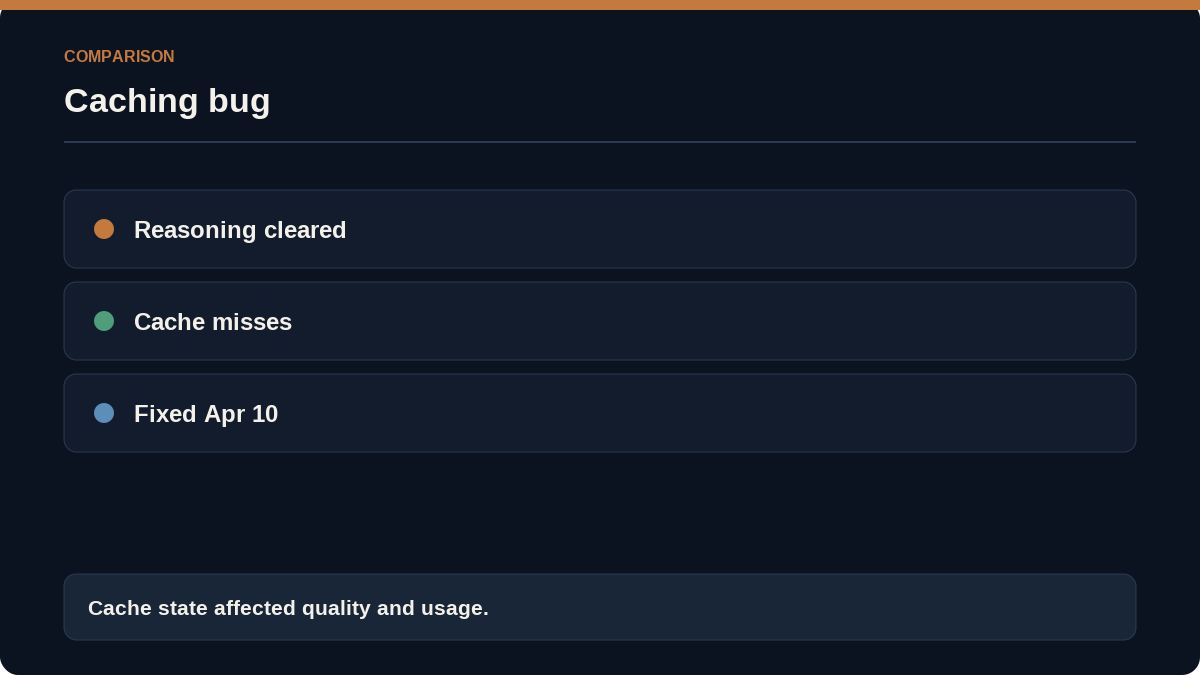
Official. On 2026-03-26, a caching bug repeatedly cleared older reasoning after an idle condition. Anthropic says it was fixed on 2026-04-10 and contributed to cache misses and faster usage consumption. The scope is specific: older reasoning was cleared under that condition. The postmortem does not say that every conversation memory was erased.
That distinction matters. The context window versus memory analysis separates capacity, retained reasoning and task state. A cache problem can make the agent lose useful earlier reasoning even when the conversation text remains available. It can also make a session cost more because the cache is missed.
| Issue | What changed | Why it mattered | Fix date |
|---|---|---|---|
| Reasoning default | High changed to medium | Default behavior and latency changed | 2026-04-07 |
| Caching bug | Older reasoning cleared after idle | Cache misses and faster usage consumption | 2026-04-10 |
| Verbosity prompt | Output was limited | Coding quality suffered | 2026-04-20 |
The Claude Code cost documentation explains why agent context and token use deserve attention. It does not turn this incident into a universal cost multiplier. A team that wants to measure the effect should record cache behavior, token use and accepted work on its own tasks.
A useful regression test places a known fact or decision early in a session, waits through the relevant idle condition and then asks the agent to use it. The test should record whether the fact is recalled, whether the answer is correct and whether the cache behaves as expected. Use synthetic facts so a failure does not expose real project data.
The verbosity prompt hurt coding quality
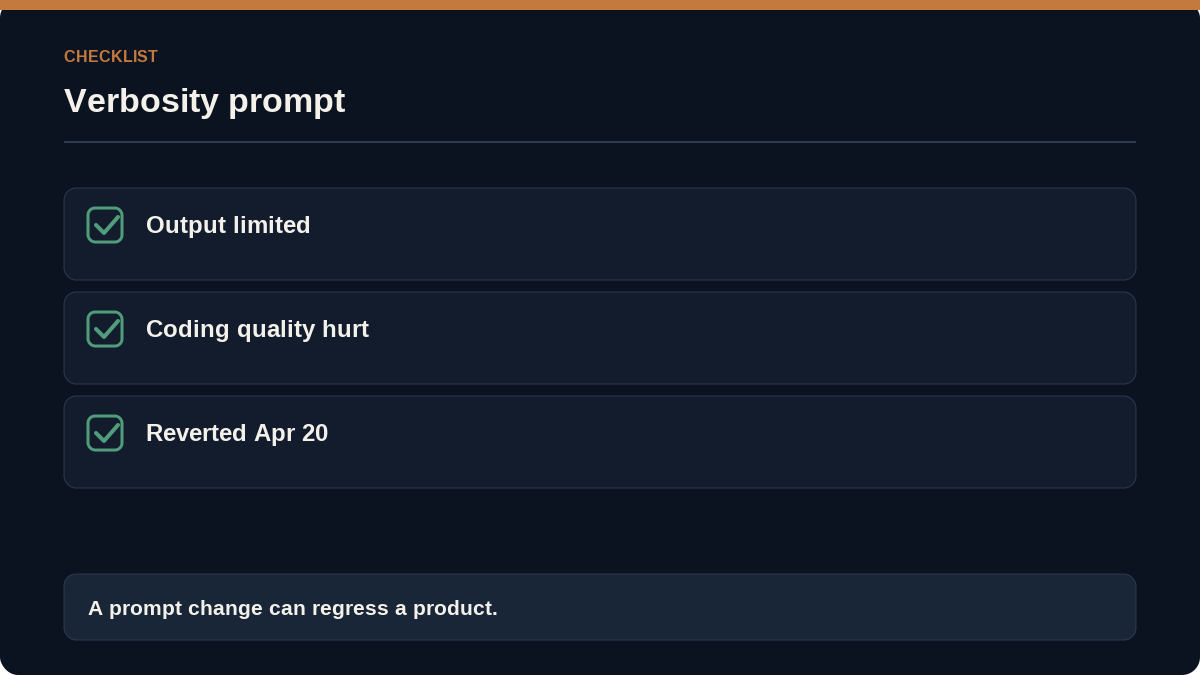
The third change was a prompt adjustment. On 2026-04-16, a prompt change limited verbosity. Anthropic says it hurt coding quality and was reverted on 2026-04-20. This is a useful reminder that a small-sounding instruction can have a large effect on an agent’s output.
A coding task often needs detail: a constraint, an error message, a reason for a design choice or a precise test result. A prompt that pushes the model toward shorter answers can remove information the next step needs. The result may look concise while being less useful.
The false-success verification pattern is relevant here. A shorter answer can sound confident while omitting the evidence that a change is complete. The proof-of-work packet asks for changed files, test output and external-state checks, which helps separate brevity from completeness.
For a team, the practical response is to test output against requirements rather than style preferences. A concise answer passes only if it preserves the constraints, the changed files and the verification evidence. If the task needs a longer explanation, ask for it explicitly and check that the extra detail is accurate.
The fixes and usage reset
Anthropic says the fixes landed in v2.1.116 and usage limits were reset for all subscribers on 2026-04-23. That reset is a concrete remediation step. It also gives teams a date to compare with their own usage records.
The five-hour and weekly limits explain the normal reset mechanics. The incident reset is a separate event. A team reviewing an old bill or quota complaint should not assume that a normal reset and the April remediation mean the same thing.
The Ultra API credits versus Claude Code usage distinction is also relevant. Interactive Claude Code usage and monthly API credits follow different billing paths. The postmortem’s usage reset should be read in the context of the affected product, not as a general statement about every API balance.
The cost per verified change framework offers a better way to evaluate the remediation. Record the subscription or API spend, the review time and the number of accepted changes before and after the fix. Do not infer productivity from token count alone.
What the incident proves
The postmortem proves that a coding agent can regress through several ordinary product changes. A default setting, a cache implementation and a prompt can each alter behavior. It also proves that a vendor can publish a dated account, identify mechanisms and ship fixes.
For a buyer, the useful conclusion is not that Claude Code is uniquely broken. It is that reproducibility matters. Record versions, settings and task fixtures. Compare accepted output and usage across a controlled change. Keep enough evidence to distinguish a model issue from a harness or configuration issue.
The incident also shows why a single complaint should not be generalized. A latency problem, a cache problem and a verbosity problem can feel similar to a user while requiring different investigations. A good issue report names the task, the version, the active settings and the observed failure.
The single points of failure analysis treats model regression as one failure domain. The framing is more useful than treating every bad session as the same event. A team needs a fallback for regression, but the fallback should be tested with the same task set.
What the incident does not prove
The postmortem does not prove that the bugs still exist after the fixes. It does not provide a population-wide failure rate, a measured productivity loss or a universal cost increase. It also does not establish that every later complaint has one of the three named causes.
The Claude Code data usage documentation and security documentation cover separate policy and control questions. They should not be used to fill gaps in the incident record. A postmortem is evidence about a dated event, not a complete audit of the product.
The evidence is also incomplete for individual impact. The public account does not say how many sessions encountered the idle-condition bug or how much usage each affected session consumed. A team can measure its own experience, but it should label that measurement as local evidence rather than a vendor-wide statistic.
Build a regression baseline
A baseline is a small set of tasks with known expected results. It should cover a straightforward edit, a multi-file change, a test run and a task that requires remembering an early constraint. Use synthetic data and keep the fixtures stable.
| Baseline element | What to record | Why |
|---|---|---|
| Client version | Exact release or build | Makes the run reproducible |
| Model and effort | Model ID and reasoning setting | Separates model changes from defaults |
| Task fixture | Repository state and prompt | Holds the task constant |
| Expected result | Files, tests and constraints | Defines success before the run |
| Actual result | Diff, output and side effects | Captures evidence |
| Usage | Tokens, cache behavior and cost | Connects quality to spend |
Run the baseline after a client upgrade, a model change or a prompt change. If the result differs, investigate before accepting the new configuration. The monthly LLM API cost worksheet can help track spend, while the cost calculator can compare scenarios.
The agent-team token overhead is another reason to keep baselines small and controlled. A team of agents can multiply context and review work. Measure accepted output, not just the number of generated changes.
Write a regression report someone can reproduce
A useful regression report starts with the task, not the verdict. State what the agent was asked to do, what repository state it started from and what result was expected. “It wrote worse code” gives the next person almost nothing to test. “It changed the wrong handler and the existing test still passed” gives them a failure they can investigate.
Record the client version, model, reasoning effort, permission mode and enabled tools. Include the prompt and any relevant context files. If the session was compacted or resumed, say so. Those details separate a model regression from a configuration or context problem.
Then describe the observed result precisely. Include the changed files, the test output and the point where the behavior diverged from the expectation. If the agent produced a confident summary, quote only the part needed to show the mismatch. Do not turn a single run into a claim about every session.
Add the usage evidence. Record token use, cache behavior and cost if they are available. A quality regression and a cost regression can share a cause, but they are not the same measurement. The cost per verified change framework keeps both in view without treating tokens as productivity.
Finally, state what would change your mind. For example, the issue may disappear on a pinned version, reproduce only after an idle period or depend on a specific reasoning setting. A report with a falsifiable condition is more useful than one that simply asks the vendor to make the product better.
Compare versions without fooling yourself
A before-and-after comparison is easy to contaminate. The repository may have changed, the prompt may be different or the model may be using a new default. A careful comparison holds those variables steady or records them explicitly.
Start with a clean checkout of the same fixture. Use the same task prompt and the same synthetic data. Run the task with the old client, record the evidence, then run it with the new client. If the task is nondeterministic, repeat it and report the range rather than selecting the best run.
Keep the tool configuration identical where possible. A new permission mode can change what the agent attempts, which makes a model comparison misleading. If the new client requires different tools, document the difference and treat the result as a system comparison rather than a pure model comparison.
Score the output against the requirement. Did the change compile? Did the tests pass? Did the agent preserve the constraint? Did it touch only the intended files? Did a human need to repair the result? These questions measure accepted work. A longer answer or a higher token count is not automatically an improvement.
The verification proof packet is a good place to store the evidence. Keep the expected result, actual result, changed files and independent checks together. The packet lets a reviewer see whether a claimed improvement survived contact with the task.
A comparison should end with a decision rule. Continue with the new version if it preserves accepted quality and cost. Adjust the configuration if one setting explains the difference. Roll back if the regression is material and the old path remains supported. Decide the rule before looking at the result so the conclusion does not move to fit the data.
What to do during the next suspected regression
When a workflow suddenly feels worse, resist the urge to rebuild the whole setup. First, preserve the current state. Log the client version, model, settings and the task that failed. Save the diff and test output before changing anything.
Next, reproduce the failure on a clean fixture. If it does not reproduce, add the missing context in small steps. The cause may be a stale session, a changed file or a different permission mode. If it does reproduce, compare the same task on the previous client version.
Check the boring causes early. A wrong model, a changed default or a stale cache can look like a model regression. The April postmortem is a reminder that several ordinary changes can overlap. A short checklist prevents the team from blaming the most visible component before checking the rest.
Then decide whether to continue, adjust or roll back. Keep the old path available until the new one passes the baseline. Log the decision and the evidence so the next person does not have to repeat the investigation.
Share the report with the team in a form they can scan: the failing task, the affected version, the observed difference and the current workaround. A long transcript is useful evidence, but it is a poor summary. Keep both, with the summary pointing to the raw record. Include the date and the owner so the report does not become an orphaned note.
Measure latency and quality together
The reasoning-default change shows why speed and quality cannot be reviewed in isolation. A lower effort setting may reduce latency, but the postmortem does not say that medium is always wrong. The problem was the default change and its place in a broader regression.
A useful comparison records both time to first useful result and time to an accepted change. A fast answer that needs extensive repair may cost more overall. A slower answer that satisfies the constraints may be worth the wait. The right balance depends on the task and the reviewer’s capacity.
Do not compare runs with different models, prompts and effort settings and call the result a latency improvement. Hold the variables steady or report them explicitly. The cost per verified change framework helps connect speed, review time and spend without pretending they are the same metric.
Log the reviewer’s experience as well. A fast result that requires several corrections may take longer to accept than a slower result that is correct on the first pass. Preserve those observations with the test evidence, but label them as local workflow data rather than a universal benchmark.
Honest loss and data gap
The win is a documented remediation path. Anthropic named the changes, gave dates and released fixes. The loss is that users experienced a period of degraded behavior and faster usage consumption before the record was complete.
The public postmortem does not quantify every user’s impact or establish a general regression rate. Future updates should compare later versions against a stable baseline rather than assuming the April causes continue. Recheck the official postmortem and the cost documentation before drawing conclusions about a new incident.
Practical response: test a portable route
If you want a fallback for model regressions, test it before you need it. One AI API Key lists 46 live free model IDs for OpenAI-format agents. The quickstart shows the /v1 endpoint, and the prepaid pricing page explains billing.
Those free IDs do not work inside Claude Code. Claude Code’s Anthropic-format route is documented, but all four Claude IDs were unavailable on 2026-11-27, so it is not an active fallback. Use an OpenAI-format agent for the free lane and compare the same baseline tasks across clients.
The current model catalogue shows availability, and the live status page provides operational context. Store the coding-agent API key compatibility guide and the API format comparison beside the test record so a route change is explicit.
Build the fallback test around the same baseline tasks. Use a disposable key with a spending cap and expiry from the API reference, and create the evaluation account through the sign-up route. Run the tasks with synthetic data, capture the diff and test output, and score accepted work rather than answer length.
Log any difference in tool behavior, permission prompts or context handling. Those differences may come from the client rather than the model. Leave the old path available until the fallback passes the same acceptance checks, then store the evidence with the regression report.
FAQ
What caused the April 2026 Claude Code regression?
Anthropic’s postmortem names three overlapping changes: a reasoning default moved from high to medium, a caching bug cleared older reasoning after an idle condition, and a verbosity prompt hurt coding quality.
Are those bugs still present?
The postmortem says the issues were fixed, with fixes in v2.1.116 and a usage-limit reset on 2026-04-23. It does not support a claim that the same bugs remain in later versions.
Did the caching bug erase all conversation memory?
No. The documented scope was older reasoning being repeatedly cleared after an idle condition. This is not the same as wiping every conversation message or all task state.
How should a team respond to a suspected regression?
Pin the client version, record the model and effort setting, run a stable baseline and capture the diff, test output and usage. Compare accepted work rather than relying on a general impression.