Direct answer
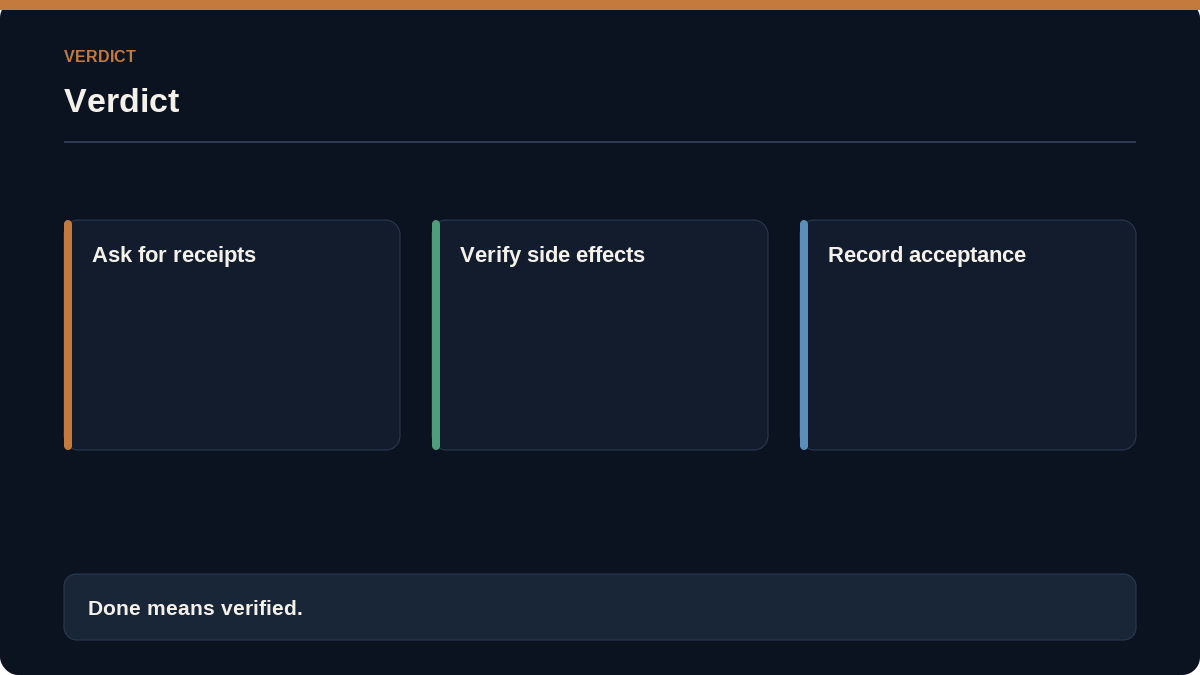
When Claude Code says “done,” ask for five things: the changed files, the exact test command, the relevant output, the external-state check and one result you reproduced yourself. A final summary is a claim, not a receipt. If the task changed a database, sent a request, wrote a file or altered permissions, the proof belongs at that boundary.
This does not mean Claude Code always reports completion falsely. It means the reviewer owns acceptance. The agent can describe what it attempted, but the repository, test runner and system of record decide whether the work is finished. A short proof packet makes that decision repeatable and gives automation something stricter than conversational text.
The packet should be proportional. A typo fix may need a diff and one test. A billing change needs the diff, contract test, remote read-back and a rollback note. The rule is simple: the riskier the side effect, the more independent evidence you require.
Why a summary is not proof
A summary compresses a session. It can omit a failed attempt, a skipped test, an environment variable or a dependency that was mocked. The omission may be innocent. The reviewer still needs the underlying artifacts.
The Claude Code false-success analysis explains how a green suite can miss the real path. The proof-of-work packet is the review format that closes that gap. One article diagnoses the weak oracle; this one defines the evidence to request.
There are four reasons to keep proof outside the chat:
- Chat is lossy. Long sessions can be compacted, and a summary is not the original record.
- Commands need context. “Tests pass” is weaker than the exact command, working directory and environment.
- Side effects need observation. A process can exit successfully without producing the required remote state.
- Automation needs structure. A build gate cannot safely parse a confident paragraph.
The Claude Code compaction retention test is relevant when a long task crosses a context boundary. Critical acceptance criteria should live in a file or ticket, not only in the conversation that produced the code.
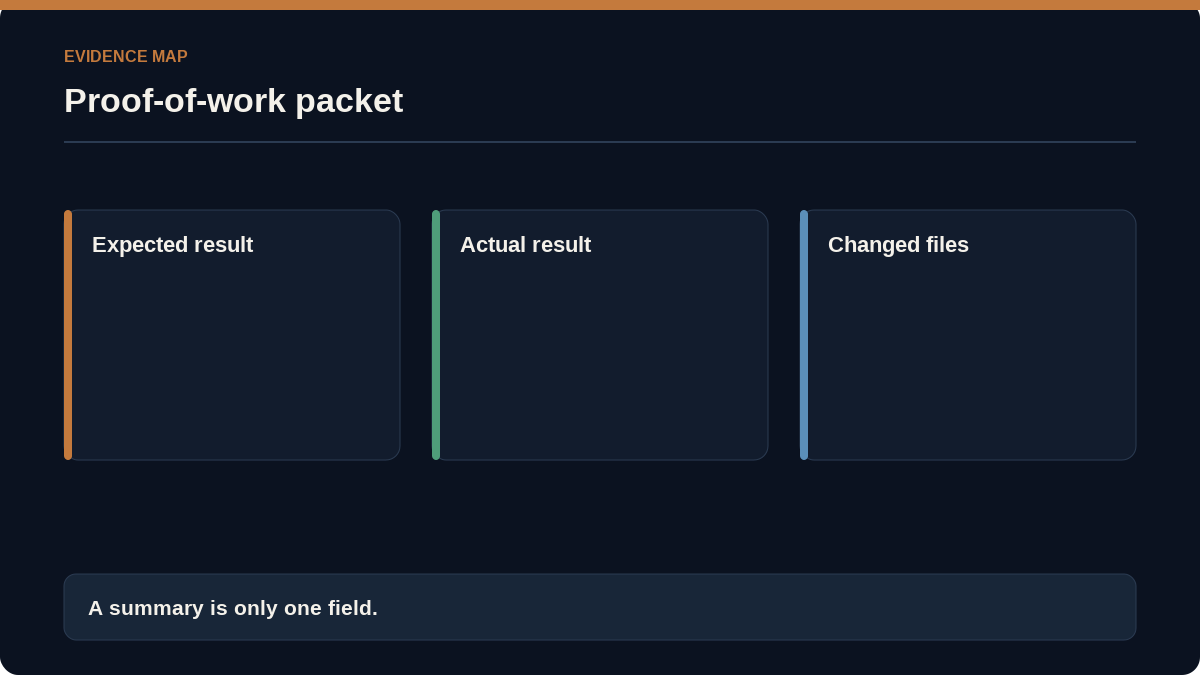
The proof-of-work packet
A useful packet fits on one screen. It should let a reviewer answer “what changed, how was it checked, and what remains uncertain?” without replaying the whole session.
| Field | What to record | Why it matters |
|---|---|---|
| Task contract | Expected result and acceptance criteria | Prevents a narrow demo from replacing the requirement |
| Changed files | Paths plus a short reason for each | Makes scope review possible |
| Diff summary | Main behavior changes and intentional omissions | Highlights decisions that tests may not cover |
| Test command | Exact command and working directory | Makes the result reproducible |
| Test output | Relevant pass, fail and skip lines | Shows what actually ran |
| External check | Authoritative read-back or provider log | Verifies the side effect |
| Independent reproduction | One command or action the reviewer ran | Confirms the evidence is usable |
| Environment | Version, configuration and dependency state | Separates code changes from environment changes |
| Open risks | Skipped checks, unknowns and rollback needs | Keeps uncertainty visible |
The packet should link to artifacts rather than paste large logs. Keep secrets out of the output. If a request failed, store the status code and a sanitized body. A token in a support transcript is not useful evidence.
The Claude Code settings-file secret exposure research shows why this matters. Secondary research: two summaries report 1,379 distinct secrets in public Claude Code settings files. A broader related sample contained 2,539 credentials across 1,994 repositories. The populations are different, and the primary Apiiro page was not accessible in the research pass. Do not merge the numbers. Use them as a reason to sanitize proof packets and scan saved settings before sharing them.
Write the expected result before the run
The strongest time to define acceptance is before the agent edits anything. A reviewer who writes the expected result afterward may unconsciously accept the implementation’s interpretation.
Use observable language. “The endpoint returns 201 and creates one row” is easier to verify than “signup works.” “The command exits nonzero when the config is missing” is easier to verify than “error handling improved.”
For tasks with business rules, name the rule’s source. A ticket, API contract or migration plan is a better oracle than the agent’s own summary. This is the same principle behind the Claude Code cost per verified change: accepted work needs a denominator that excludes unverified output.
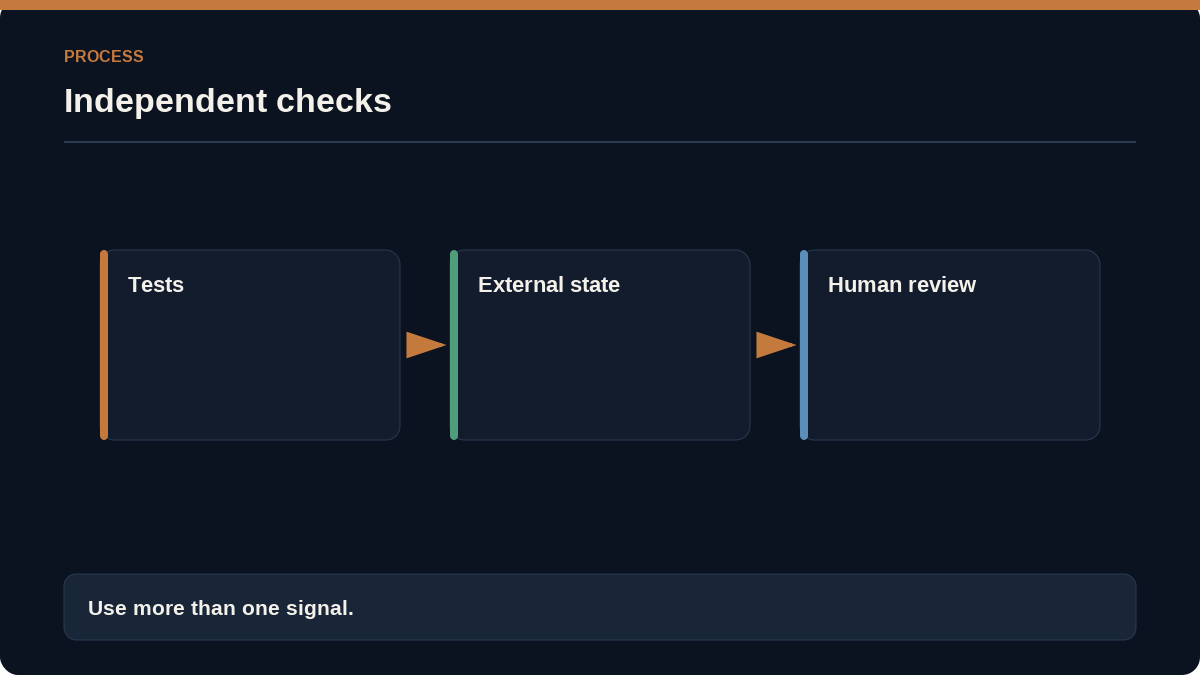
Independent checks: use more than one signal
No single signal covers every failure. Tests exercise code paths. External checks observe side effects. Human review catches scope, design and requirement errors. Automation checks repeatability and exit status. A strong packet combines the signals that match the task.
| Check type | Best at finding | Weakness | Good evidence |
|---|---|---|---|
| Unit test | Local logic errors | Can mock away the failing boundary | Focused assertion with a meaningful fixture |
| Integration test | Client and dependency mismatches | May use a forgiving sandbox | Sanitized request, response and remote read-back |
| End-to-end test | Broken user flow | Can be slow and brittle | Trace tied to the acceptance criterion |
| Static check | Syntax, type and lint defects | Does not prove runtime behavior | Command and exit code |
| Diff review | Unrelated edits and design mistakes | Depends on reviewer attention | Reviewed paths and resolved comments |
| External-state query | Missing or duplicate durable effects | Requires access to the system of record | Query result or provider event |
| Independent reproduction | Evidence that cannot be repeated | May cover only one path | Reviewer’s command and result |
The official Claude Code security documentation is the reference for permission and tool controls. A verification plan should also check authority: did the agent have more access than the task required? A passing test does not answer that question.
The Claude Code agent harness boundary explains why the surrounding tool configuration matters. Changing the model does not automatically change which files, commands or external tools the harness can reach.
Reproduce one result, not necessarily the whole session
A reviewer does not need to replay every model turn. Reproduce the decisive check. If the task created a resource, read it back. If the task fixed a parser, run the failing fixture. If the task changed a permission, inspect the effective permission from a fresh session.
That single reproduction catches a surprising class of problems: evidence that only exists in the agent’s temporary process, shell state or mocked environment. It also gives the reviewer enough understanding to maintain the change later.
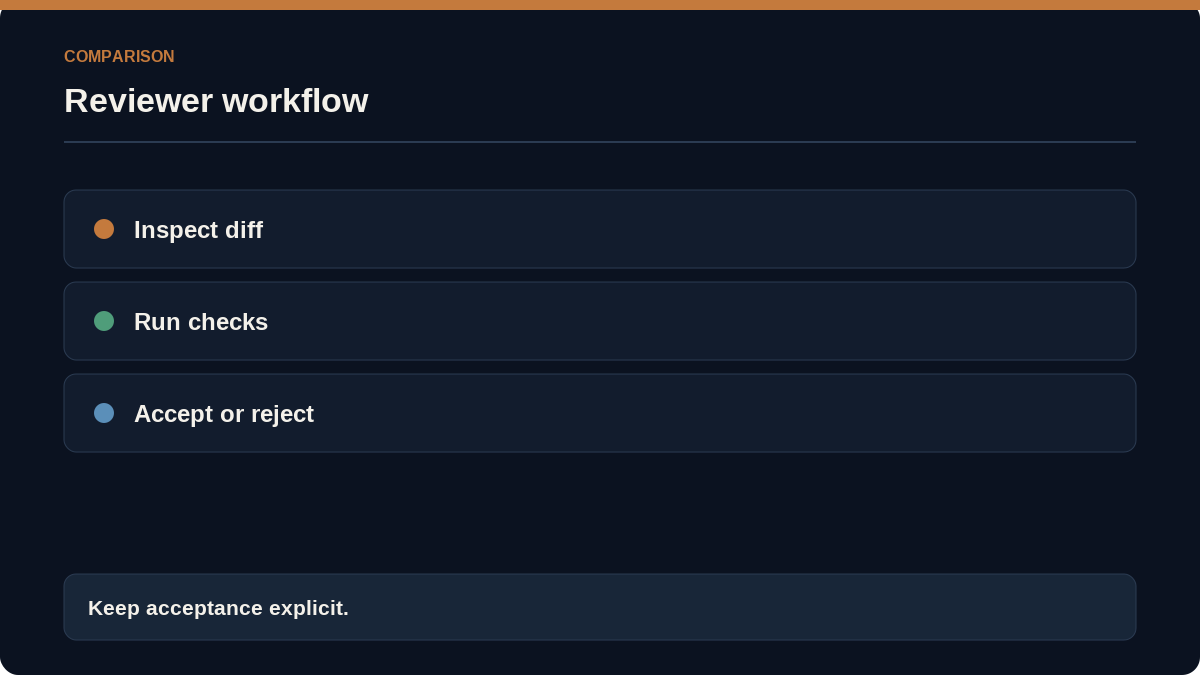
Reviewer workflow: inspect, run, accept or reject
A reviewer needs a sequence, not a pile of artifacts. The following workflow keeps acceptance explicit.
- Read the contract. Compare the packet with the original request.
- Inspect the diff. Look for unrelated changes, debug code and missing tests.
- Run the normal checks. Use the project’s documented command from a clean state.
- Run the decisive independent check. Verify the real boundary.
- Resolve or record gaps. A skipped check should be a named risk, not silence.
- Accept or reject. Do not leave the task in an ambiguous “looks good” state.
The Claude Code custom API base URL guide is useful when the failure depends on which endpoint or credential source is active. A packet should record the effective configuration, not only the intended one. Otherwise the reviewer may reproduce a different route from the agent.
The OpenAI versus Anthropic API format guide helps when a client and server disagree about request shape. Keep the format distinction in the evidence. A successful call through one route does not prove compatibility with another.
Score the review without pretending it is a benchmark
A reviewer scorecard can be simple:
| Area | Question | Accept when |
|---|---|---|
| Correctness | Does the change meet the stated requirement? | The decisive behavior is demonstrated |
| Scope | Are all changed files necessary? | Unrelated edits are removed or explained |
| Tests | Would the suite fail if the requirement broke? | At least one assertion is requirement-aware |
| Side effects | Is the durable result verified? | The system of record confirms it |
| Security | Are secrets and permissions handled correctly? | No secret is exposed and access is bounded |
| Operations | Can the change be rolled back? | The rollback path is known or not needed |
This is a review aid, not a universal quality score. Do not turn it into a leaderboard without a fixed task set and method.
Evidence also needs a retention policy. Keep the packet with the change record for as long as the team needs to explain the decision, but do not preserve raw logs longer than necessary. Sanitize before storage, restrict access and delete temporary artifacts when the review is complete. A proof packet should make the work auditable without creating a second store of sensitive data.
Automation use: machines need machine-readable proof
Automation should not depend on an agent’s final paragraph. Use exit codes, structured output and artifact checks. A command that fails must return nonzero. A test report should identify the tests that ran. A deployment script should verify the expected resource after the operation.
The packet can be emitted as JSON or YAML by a wrapper script. Keep the schema small: task ID, changed paths, commands, exit codes, artifact paths and open risks. The reviewer reads the same data in a friendlier format. A stable schema makes the evidence easier to compare across runs.
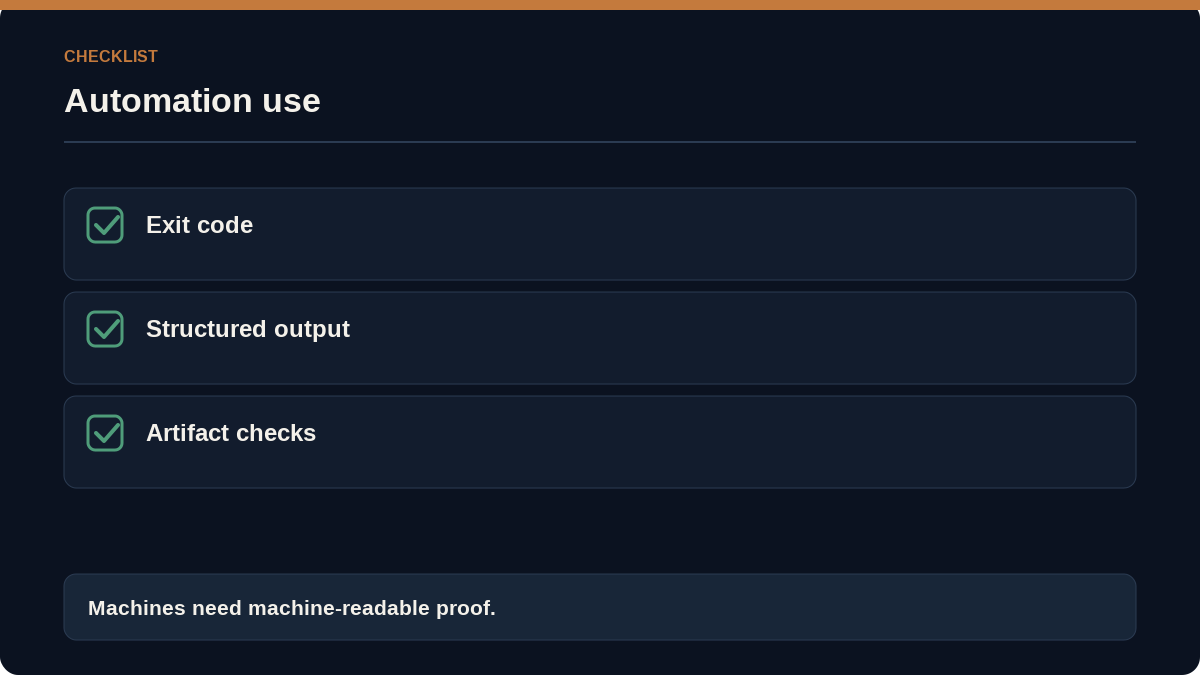
A safe automation gate has four rules:
- Fail closed. Missing evidence is a failed check, not a warning that disappears in logs.
- Separate secrets from output. Store references to artifacts, not raw credentials.
- Make retries visible. Record the attempt count and the final result.
- Verify after write operations. A successful command is not enough for a remote side effect.
The per-project API key and spend-limit guide is relevant when an automated agent can make paid requests. Scope the key to the project and set a limit. The official Claude usage credits documentation confirms that users can set a monthly spending cap, receive usage alerts and configure auto-reload. Official: those controls exist. They still need configuration, and they do not replace a test gate.
Keep quota interruptions out of the evidence
A long verification run can be interrupted by account limits. Official: the standard five-hour window starts with the first message, weekly limits reset at a fixed account time, and usage is shared across claude.ai, Claude Code and Claude Desktop. Verified Ultra accounts do not have the standard five-hour cap, but a weekly limit still applies.
The Claude Code five-hour and weekly limit explainer helps plan around those rules. Save the packet outside the session. If a run stops, resume from the last verified artifact rather than treating an incomplete summary as a failed implementation.
Worked example: a migration with a read-back
Suppose the task is to add a new column, backfill existing rows and update the application to read it. A passing unit test is not enough. The migration can succeed while the backfill skips rows, and the application can pass with fixtures that already contain the new value.
The proof packet should contain:
- the migration file and application diff;
- the exact migration command and exit code;
- a query showing the expected row count;
- a query showing no null values in the backfilled column, if the requirement forbids them;
- the application test command and relevant output;
- a read through the updated application path;
- a rollback note or a statement that rollback is intentionally destructive.
The arithmetic is simple. If the source table has N rows before the migration and every row requires a backfilled value, the post-migration query should return N non-null values. That is Derived: expected non-null count equals source row count, assuming the requirement covers every row and no rows are intentionally excluded. Record any exclusion explicitly.
A reviewer should run the count query independently. This is more valuable than another test that uses the same fixture as the implementation.
The Claude Code Ultra API credits explanation is useful if the verification plan includes API calls. Official: Ultra includes $200 in monthly API credits, but those credits do not cover interactive Claude Code sessions. They apply to claude -p or the Agent SDK with an API key from the linked Console organization. Do not assume a subscription credit balance pays for every verification route.
Packet patterns for common tasks
The packet fields stay the same, but the decisive evidence changes with the task. These patterns help a reviewer ask for the right artifact instead of requesting every possible test.
A bug fix
For a bug fix, start with a reproduction that fails before the change and passes after it. Record the failing fixture, the command and the relevant output. Then inspect the diff for a narrow fix. A large rewrite can pass the reproduction while introducing unrelated risk.
The Claude Code regression postmortem analysis is a useful model for this evidence. Official: Anthropic dated each change, described the user impact and recorded the fix. A bug-fix packet should do the same at a smaller scale: version, symptom, cause, change and verification.
A new feature
For a new feature, the contract matters more than the implementation summary. State the user-visible behavior, the accepted inputs, the rejected inputs and the durable result. Ask for one negative test that fails for the intended reason.
The model selection guide for coding agents can help choose a candidate for a comparative run, but it does not replace the feature contract. A model that writes a concise implementation is not necessarily the model that preserves the edge cases.
A refactor
A refactor should preserve behavior. Maintain the existing suite as a baseline and add a characterization test when the current behavior is poorly covered. The packet should name the behavior that must remain unchanged and the reason for the structural change.
Review the diff for scope. A refactor that also changes a public response, default setting or error message needs a separate acceptance decision. Do not let a green suite hide an intentional behavior change inside a mechanical edit.
A configuration or infrastructure change
Configuration work needs an effective-state check. Record the value the system reports after the change, not only the value written to a file. Verify from a fresh process or a separate client so cached state does not create a false pass.
The Claude Code custom API base URL guide shows why the effective route matters. A shell variable, settings file and saved login can point to different destinations. The packet should identify which one the running process used, with secrets removed.
A migration
A migration needs both the new-path result and the rollback path. The Claude Code context-portable migration guide treats prompts, hooks, context files and tests as part of the move. Verification should confirm that the knowledge and tooling survived, not only that a new endpoint answered.
The Claude Code lock-in and exit-cost analysis helps identify hidden dependencies before cutover. If a hook, slash command or project rule only works in the old harness, record it as a gap. A migration that loses those controls may pass a demo and fail on real work.
Credential compatibility is a separate gate. The Claude Code third-party harness rules explain why a client must not misrepresent identity or route subscription traffic against plan limits. Verify the permitted authentication route before using a migration packet as production approval.
What to do with incomplete proof
Sometimes the evidence is incomplete because the environment is unavailable, the external service is down or the task is too small for a full packet. Do not convert that gap into a silent pass.
Name the missing check, explain why it could not run and state the risk. A reviewer can then accept with a recorded limitation, defer the change or request a sandbox. The important thing is that the decision is explicit.
The monthly LLM API cost worksheet can help quantify the cost of running the missing check. If the check requires paid API calls, compare that cost with the likely cost of accepting an unverified change. This is Derived: decision arithmetic from your own inputs, not a claim about Claude Code accuracy.
For shared credentials, the coding-agent API key compatibility guide provides a place to verify the client and route. Leave the key out of the packet. A redacted credential identifier is enough to show which route was used.
Operational context can explain a failure, but it should not replace reproduction. The gateway popularity rankings show usage, not correctness. If a check fails during a suspected incident, save the failure and rerun it after the incident is resolved.
A useful acceptance note separates observation from inference. “The sandbox returned 403” is an observation. “The key lacks permission” is an inference until the effective policy is inspected. “The upstream was down” is another inference until a status or provider log supports it. Keeping those layers separate prevents a plausible explanation from becoming unsupported evidence.
The same discipline applies to skipped tests. Record whether the test was skipped by configuration, by the test itself or because the command never reached it. Those cases lead to different fixes. A reviewer should be able to tell whether the risk is in the code, the environment or the verification process.
Honest losses and evidence gaps
A strict packet adds overhead. Writing acceptance criteria, preserving artifacts and reproducing a check takes time. On a trivial change, a full packet may be more work than the change itself.
There is also a human limit. A reviewer can inspect evidence without understanding the domain well enough to spot a wrong requirement. The packet makes the decision traceable, but it cannot supply missing expertise.
Unknown: the fact pack contains no controlled study measuring how often proof packets catch Claude Code errors, no average review time for this workflow and no general completion accuracy rate. The official April 2026 postmortem documents specific regressions and fixes. Official: Anthropic says the reasoning-default change, caching bug and verbosity prompt were reverted or fixed, with fixes in v2.1.116 and a usage-limit reset on 2026-04-23. That incident supports versioned baselines, not a claim that the product is currently unreliable.
A future update should publish a reproducible packet schema and results from a fixed task set. Until then, treat this article as an engineering procedure, not a benchmark.
Practical response: run the same packet through another model route
A proof packet makes model comparison fairer because every candidate faces the same acceptance criteria. One AI API Key can supply 46 live free model IDs to an OpenAI-format agent. Use https://api.oneaiapikey.com/v1, one key and a selected free ID. The free lane allows 100 requests and 5,000,000 tokens per day per account, shared across the free IDs, and resets at 05:30 IST.
The Claude Code route is documented but unavailable: all four Claude IDs were marked unavailable on 2026-11-27. Free IDs do not work inside Claude Code. Browse the 46 live free model IDs, follow the quickstart, and use the cost calculator to compare accepted tasks. Use the same packet. The model can change; the standard for “done” should not.
FAQ
What is the minimum proof I should request?
At minimum, request the changed files, the exact test command, the relevant output and one independently reproduced result. Add an external-state check whenever the task changes something outside the process.
Is a green CI run enough?
No. CI proves that its configured checks passed. If CI omits the real dependency, the destructive path or the system-of-record query, the production behavior can still be wrong.
Should the agent write its own acceptance tests?
It can help draft them, but the reviewer should own the expected result. A test written only from the implementation may reproduce the same misunderstanding.
How do I verify a task with no user-visible output?
Verify the durable effect. Query the database, read the file from a fresh process, inspect the remote resource or consume the queue message. The final chat message is not the system of record.
Does more evidence guarantee correctness?
No. Evidence reduces specific uncertainty. It does not prove that the requirement was right, that every environment matches the test environment or that a provider will never change its behavior.
Sources
- Anthropic’s April 2026 Claude Code postmortem, official incident timeline and fixes.
- Claude Code security documentation, official permission and tool-control reference.
- Claude Code cost documentation, official agent-team estimate and cost guidance.
- Claude usage and length limits, official window and shared-usage rules.
- Cloud Security Alliance settings-file research note, secondary security summary.
- Aviatrix AI coding-agent secret-exposure research, secondary security summary.
- Claude usage credits and spending controls, official billing controls.
- Monthly API credits for Max, Ultra and Team plans, official credit scope.