Direct answer
Faster generation helps only when review capacity and acceptance checks keep up. If generated changes arrive faster than the team can inspect them, the queue moves from writing code to reviewing it. Count accepted changes, review time, defect escape and rework, not pull-request volume alone.
Official: Claude Code best practices recommend independent subagent review because a fresh reviewer has not seen the reasoning behind the code. The Code Review feature uses a read-only Find, Verify, Rank and Post pipeline. It requires Team or Enterprise, excludes ZDR and HIPAA organizations, and does not push commits. Use those controls as review inputs, not as proof that a change is safe to merge.
The bottleneck can move without getting worse
A team does not need to become slower for review to become the constraint. Suppose implementation gets faster while the number of reviewers stays fixed. More changes reach the review queue, waiting time rises and reviewers begin to skim. The generation stage improved, but the delivery stage did not.
Treat it as a capacity question before a model-quality question. A large queue can reflect more work entering the system, larger diffs, unclear acceptance rules or too few available reviewers. Each cause needs a different response. Buying more generation capacity will not fix a missing reviewer.
Unknown: the frozen evidence contains no universal review-time penalty caused by Claude Code. It also contains no measured defect-escape rate for AI-assisted changes. Treat the bottleneck as a local measurement problem, not a confirmed universal defect.
The Claude Code overengineering and diff scope guide is relevant because diff size affects the work a reviewer must do. A narrow change with a clear acceptance rule is easier to inspect than a broad rewrite that includes unrelated cleanup. Size is not the only quality signal, but it changes review cost.
The Claude Code proof-of-work packet guide helps define what “done” means before review starts. If the author and reviewer disagree about acceptance, the reviewer becomes a specification writer. That work belongs in the queue even when nobody names it.
Independent review has a concrete benefit. Official: a subagent that did not see the original reasoning can challenge assumptions rather than repeat them. When reviewing against a specification, Claude Code best practices advise telling the reviewer to skip style to avoid unnecessary abstraction.
The loss is equally concrete. A fresh reviewer can miss context that made a strange-looking choice necessary. Independent review should test the specification and evidence, not erase repository history or invent a cleaner design. Keep the author available to explain constraints without dictating the verdict.
Separate the delivery stages
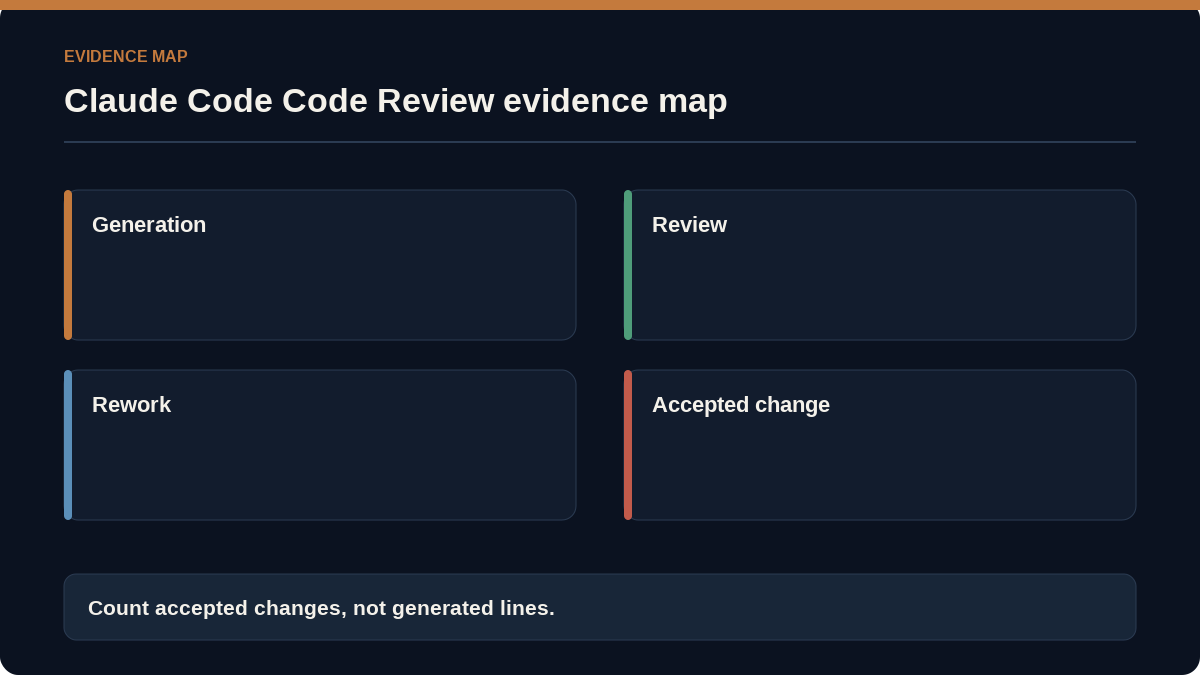
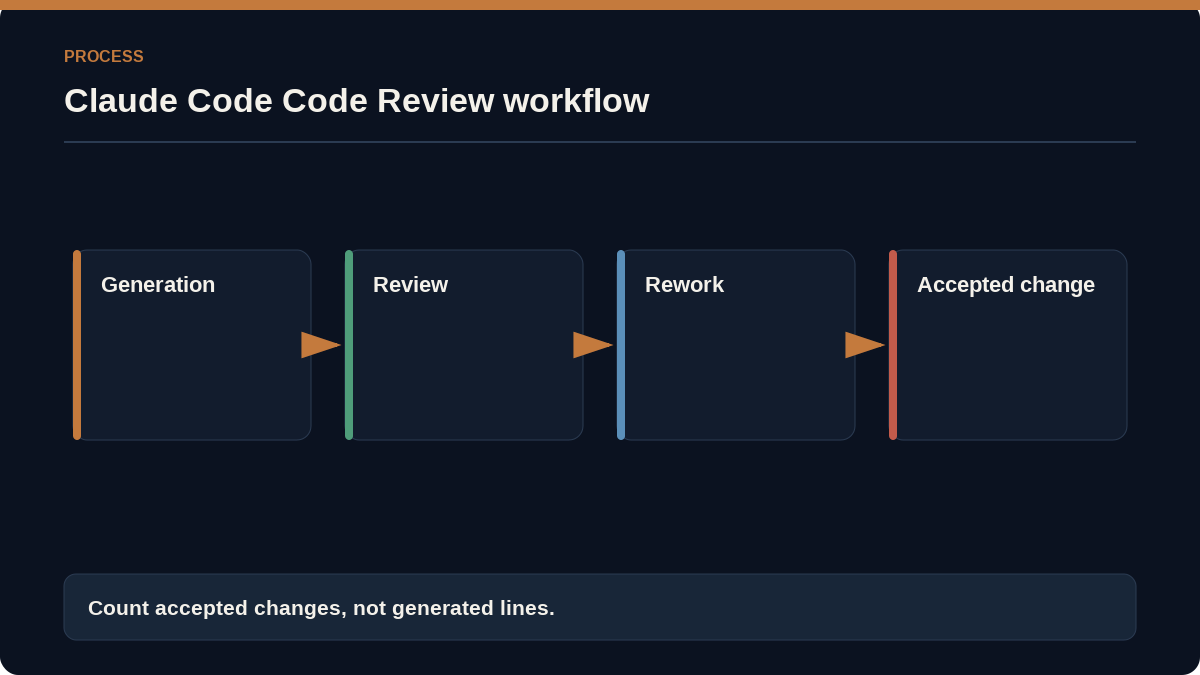
A single “cycle time” number hides where work waits. Break the path into generation, review, rework and acceptance. Then record the handoffs between them. A change that generates quickly but waits three days for a reviewer has a different problem from one that cycles through repeated corrections.
| Delivery stage | Work performed | Useful measure | Common distortion |
|---|---|---|---|
| Generation | Prompt, exploration, edits and local checks | Time to first reviewable diff | Counting partial output as finished |
| Review | Specification check, diff inspection and verification | Active review minutes and queue wait | Using wall-clock wait as reviewer effort |
| Rework | Corrections after review or failed checks | Rework cycles and minutes | Hiding discarded attempts |
| Acceptance | Merge decision and confirmed behavior | Accepted changes and defect escape | Counting merged PRs as correct outcomes |
Queue wait and active review time answer different questions. A reviewer may spend 20 focused minutes on a change that waits two days because they were unavailable. Both numbers matter for delivery, but only one measures inspection effort.
Defect escape means a defect that passes the team’s checks and is found after acceptance. Define the observation window before comparing periods. A bug found minutes after merge and a bug found a month later should not be silently treated as identical signals.
Rework includes changes requested during review, corrections after failed verification and discarded approaches. If the team records only the final clean diff, the cost of reaching it disappears. The Claude Code cost per verified change method keeps that hidden work in the calculation.
A useful scorecard therefore has both throughput and quality. Accepted changes show useful output. Review time shows inspection cost. Defect escape shows what verification missed. Rework shows how much correction the workflow required.
What independent review can and cannot do
Independent review is most useful when the reviewer receives a specification, a bounded diff and evidence. “Look at this code” invites personal preference. “Check whether the retry path preserves idempotency and whether the regression test fails before the patch” gives the reviewer a testable target.
Official: Claude Code best practices recommend subagents for independent review because they have not seen the reasoning behind the code. That freshness can expose assumptions the author stopped questioning. It does not make the subagent infallible or authorized to change production systems.
The Claude Code verification-done proof guide is a practical input to review. Include the failing reproduction, the changed files, the checks run and any known gap. A reviewer should not have to reconstruct the task from a long transcript.
Scope the review. The Claude Code overengineering and diff scope guide recommends rejecting unrelated cleanup. Apply the same rule to reviewer comments. A suggestion that improves abstract design but violates the task contract should not become mandatory rework.
Security review needs its own boundary. The Claude Code security-research refusal workflow article explains authorization and lab scope. Anthropic’s security review feature re-examines findings and filters false positives, but it does not authorize every test, exploit or target.
The Code Review feature is read-only. Official: its pipeline is Find, Verify, Rank and Post, it requires Team or Enterprise, and ZDR and HIPAA organizations are excluded. It does not push commits. A team should still decide who accepts a finding and what evidence closes it.
| Review input | What the reviewer checks | What it cannot prove alone |
|---|---|---|
| Written specification | Required behavior and exclusions | That the specification was correct |
| Bounded diff | Changed files and unrelated edits | Runtime behavior outside the tests |
| Reproduction | Failure before the change | That the fix addresses every cause |
| Test evidence | Expected checks and results | That the tests are strong oracles |
| Independent findings | Fresh assumptions and risks | Legal, security or production authorization |
| Human decision | Context, ownership and merge readiness | That no future defect will appear |
A reviewer should record unresolved uncertainty. “No issue found” is different from “the risky path was exercised and passed.” The difference matters when the team later measures defect escape.
Measure review time without blaming the reviewer
Review time begins with a reviewable change. If the author submits a partial diff with no acceptance rule, the reviewer performs planning work that should have happened earlier. Record that separately so the metric does not misattribute the delay.
Use active time where possible: focused inspection, running checks and writing findings. Queue time measures waiting. Split rework cycles by cause: missing requirement, incorrect implementation, weak test, unrelated change or unclear specification.
| Review metric | Definition | Why it helps |
|---|---|---|
| Time to first review | Diff ready to first substantive inspection | Shows queue delay before feedback |
| Active review time | Focused inspection and verification minutes | Estimates reviewer capacity used |
| Review rounds | Distinct feedback and correction cycles | Shows rework churn |
| Finding acceptance | Findings confirmed and resolved | Tests whether review produces useful signal |
| Defect escape | Defects found after acceptance within a defined window | Measures verification gaps |
| Rework time | Correction effort after feedback or failed checks | Captures hidden delivery cost |
Do not rank individual reviewers with these numbers. Task difficulty, repository familiarity and access to the author all change review time. The scorecard is a workflow diagnostic, not a performance league table.
A team can reduce review load by narrowing the change contract. The Claude Code overengineering and diff scope guide recommends allowed files and explicit stop conditions. A reviewer should be able to see why every changed file belongs.
Task handoffs also matter. The Claude Code session handoff and team context guide explains how to preserve decisions without sharing a raw transcript. A concise handoff can reduce the time a reviewer spends reconstructing intent.
When a session grows long, context quality can affect both generation and review. The Claude Code compaction context-retention test article provides a way to examine what a summary retains. A lost constraint can create a review finding that looks like a code defect but began as a context failure.
Worked example: find the constrained stage
The following example is Derived from stated assumptions. It is not a measured team benchmark.
Assume a team accepts 10 changes in a week. Generation takes 40 hours in total. Active review takes 30 hours. Rework takes 20 hours. The team has 15 reviewer hours available that week, so review demand exceeds capacity by 30 - 15 = 15 hours.
| Example line | Calculation | Result |
|---|---|---|
| Accepted changes | Stated count | 10 |
| Generation effort | Stated hours | 40 hours |
| Review demand | Stated hours | 30 hours |
| Rework effort | Stated hours | 20 hours |
| Reviewer capacity | Stated hours | 15 hours |
| Review shortfall | 30 - 15 |
15 hours |
| Review share of effort | 30 / (40 + 30 + 20) |
33.3% |
| Rework share of effort | 20 / (40 + 30 + 20) |
22.2% |
Review is not the largest effort category in this example, but it is the constrained one because capacity is fixed at 15 hours. The distinction matters. A stage can dominate total effort without being the immediate queue bottleneck.
Now assume generation improves and 15 changes reach review the next week, while review demand rises to 40 hours and capacity stays at 15. Derived: the shortfall becomes 40 - 15 = 25 hours. More generation did not create the capacity limit, but it made the limit more visible.
Possible responses include narrowing diffs, adding reviewer capacity, improving acceptance evidence or reducing reework. The arithmetic alone does not choose among them. Inspect the findings and queue before changing the workflow.
Do not attach a dollar value without a stated internal rate and verified costs. The frozen evidence does not provide a universal review-time cost or an AI productivity multiplier. Use the LLM cost calculator for verified API rate arithmetic and keep human assumptions explicit.
Reduce defect escape with stronger evidence
Defect escape is easier to discuss when the team defines what counts as a defect and when it counts. A typo caught by a linter before review is not the same as a production behavior error found after merge. Keep severity and discovery point beside the count.
A passing test is useful only when it tests the required behavior. The Claude Code verification-done proof guide explains why weak oracles can make incomplete work look finished. Review the test’s assertion, not just its green status.
A bug fix needs a reproduction that fails before the patch. Refactors need existing behavior to remain covered. Features need a user-visible acceptance check. The exact evidence depends on the task, but it should be written before review.
Independent findings should be verified. Official: Anthropic’s security review feature re-examines findings and filters false positives. That principle applies more broadly: a review comment is a claim to check, not an automatic instruction to change code.
Not every finding is a defect. Some are preferences, speculative risks or suggestions outside the task scope. Record the disposition so the team can distinguish useful review from noise. The Claude Code overengineering and diff scope guide is useful when reviewers propose unrelated abstraction.
Checkpointing does not replace verification. Official: Claude Code tracks file edits with retention of 30 days or 100 snapshots, but Bash-only changes, subagent edits, external modifications, symlinks and mid-turn messages are not fully tracked. The Claude Code rewind and checkpoint limits guide explains the recovery boundary.
A restored file can help diagnose a bad patch. It cannot prove that a remote service, database row or queue message returned to its earlier state. Reviewers should ask for external-state evidence when a change crosses those boundaries.
A team scorecard that stays small
A scorecard should fit on one page and use definitions the team can repeat. Start with accepted changes, review demand, reviewer capacity, rework and defect escape. Add context only when it explains a change.
| Scorecard field | Weekly entry | Decision it supports |
|---|---|---|
| Accepted changes | Count meeting the written rule | Useful throughput |
| Review demand | Active review hours | Capacity required |
| Reviewer capacity | Available focused hours | Queue pressure |
| Time to first review | Median or representative range | Handoff delay |
| Review rounds | Distribution by change | Rework churn |
| Defect escape | Count and severity in a defined window | Verification quality |
| Rework hours | Correction and discarded work | Hidden delivery cost |
| Top finding cause | Missing spec, weak test, scope or implementation | Next workflow experiment |
Keep raw evidence linked to each accepted change. The Claude Code AI attribution and provenance guide explains how to record what changed, who reviewed it and which model helped without inventing a universal watermark.
Licensing belongs in the review boundary too. Independent: research on license compliance in LLM-generated code finds room for improvement, but it does not establish a Claude Code-specific violation rate. The Claude Code generated-code license compliance guide covers dependency and copied-code review.
Do not turn the scorecard into a contest for the most PRs. A week with fewer accepted changes and lower defect escape may be healthier than a week with a large queue of shallow merges. The denominator should be accepted, verified work.
Compare the trend beside the task mix. A week dominated by migrations should not be compared directly with a week of small fixes. Split the scorecard by task class when the mix changes materially. Otherwise, a rise in review time may reflect harder work rather than a weaker tool or reviewer.
Keep the definition of acceptance stable, too. If one week counts a generated branch and the next counts only merged, verified behavior, throughput will appear to change for administrative reasons. The Claude Code verification-done proof guide provides a consistent basis for that decision.
A monthly review should end with one experiment. Narrow the next diff, improve a weak test, add reviewer capacity for a defined period or change the review packet. Record the expected effect before running it. That turns the scorecard into an operating tool instead of a retrospective decoration.
When review capacity is not the real problem
A long queue can come from unreviewable work. Missing specifications make reviewers discover intent. Weak tests make them repeat manual verification. Unrelated files make them inspect cleanup that the task never needed. Each cause needs a different response before adding more reviewer capacity.
Start with the review packet. It should name the goal, affected files, acceptance rule, checks run and known gaps. The Claude Code session handoff and team context guide provides a useful structure for preserving decisions across sessions and people.
Next inspect scope. The Claude Code overengineering and diff scope guide recommends a diff plan and allowed-file contract. A broad rewrite may be correct, but it needs stronger evidence than a focused patch.
Then inspect tooling. Official: the Code Review feature is read-only and has plan and organization restrictions. If your organization cannot use it, independent subagent review remains an official best practice, but you need your own process for verifying findings and recording dispositions.
Permissions should stay visible during review. Authenticated tools can still return untrusted content, as the Claude Code MCP trust boundaries guide explains. Executable configuration belongs to the Claude Code plugin security audit guide. Neither a high review score nor an accepted PR grants extra tool authority.
Sensitive evidence needs careful handling. The Claude Code secrets in logs and transcripts article explains why prompts and tool output can persist. Share redacted findings and evidence links, not raw logs containing credentials.
Honest loss and data gaps
The concrete win is a visible delivery constraint. A team can see whether review demand exceeds reviewer capacity, whether rework is rising and whether defects are escaping after acceptance. That makes the next experiment specific.
The concrete loss is that measurement can create overhead and false precision. Review time is often estimated, defect severity is judgmental and task mix changes week to week. A simple scorecard with stated definitions is more useful than an elaborate dashboard nobody maintains.
Unknown: the frozen evidence does not provide a universal review-time penalty, a Claude Code defect-escape rate or a guaranteed productivity gain from automated review. It also does not establish that the Code Review feature is available to every organization. Those gaps require local data and current eligibility checks.
Update the scorecard definitions when the workflow changes. If the team starts counting smaller changes, accepted-change volume can rise without a real delivery improvement. Keep task categories beside the headline number so the comparison stays fair.
The practical implication is to manage review as part of delivery. Give reviewers a bounded change, a specification and evidence. Measure the queue and the outcome. Faster generation is valuable when accepted work rises without a matching increase in defect escape or rework.
Practical alternative: compare review outcomes on another route
One AI API Key can support a controlled comparison in an OpenAI-format agent. On 2026-11-27, the 46 live free model IDs covered 22 families. They shared 100 requests and 5,000,000 tokens per day per account, resetting at 05:30 IST or 00:00 UTC. Accounts could have up to three keys, with one request in flight per key on free models.
Use an OpenAI-format agent such as OpenCode, Cline or Cursor with https://api.oneaiapikey.com/v1, one key and a selected free ID. The endpoint quickstart shows the base URL and first request. Review the prepaid pricing before paid evaluation; new accounts received $10 credit without a card under the frozen evidence.
Do not use these free IDs in Claude Code. They are OpenAI-format only. Claude Code’s documented route uses the Anthropic Messages format, but all four Claude IDs were unavailable on 2026-11-27. The coding-agent API key compatibility guide explains the boundary.
Run the same scoped task set with the same acceptance rules. Compare accepted changes, active review time, defect escape and rework using the cost per verified change method. Do not assume another agent’s review feature has the same eligibility or read-only behavior.
Limit the test with per-key caps, expiry and model allowlists, and read the gateway privacy and retention policy before sending code. The honest loss is workflow difference. Another agent may produce a different diff, expose different evidence or require a different review process. A lower token bill cannot prove a healthier delivery queue.
Choose the next diagnosis by failure mode
Scope problems start with the Claude Code overengineering and diff scope guide. Reasoning depth belongs to the Claude Code reasoning effort defaults article. Truncation belongs to the Claude Code thinking tokens and output caps guide, while input eligibility belongs to the Claude Code prompt-cache minimums article.
Destructive changes need separate controls. Read the Claude Code database migration safety, Claude Code dependency-install side effects, Claude Code gitignored-file deletion risks and Claude Code rewind and checkpoint limits guides before merge.
Trust and privacy failures are not review-throughput problems. Untrusted content and retained data appear in the Claude Code repository prompt injection, Claude Code MCP trust boundaries, Claude Code plugin security audit and Claude Code secrets in logs and transcripts articles. Authorization appears in the Claude Code security-research refusal workflow and Claude Code game-development IP restrictions guides.
Platform and network failures can delay review without changing code quality. Use the Claude Code Linux ARM and headless login, Claude Code macOS Keychain permissions and Claude Code PowerShell path quoting guides for setup. The Claude Code network storm and NAT retry diagnosis, Claude Code corporate proxy TLS and mTLS and Claude Code outage status and failover articles cover connectivity.
Access and plan choices remain separate. Remote-work limits appear in the Claude Code offline-mode boundaries and Claude Code mobile Remote Control limits guides. Economics are separated in the Claude Code annual plan lock-in analysis, Claude Code Max and Ultra tier value, Claude Code fast-mode speed and cost and Claude Code Batch API versus subscription guides.
For records and obligations, read the Claude Code AI attribution and provenance and Claude Code generated-code license compliance guides. The Claude Code session handoff and team context article helps carry review decisions into the next session.
FAQ
Does Claude Code always create a code-review bottleneck?
No. The frozen evidence contains no universal review-time penalty. Faster generation can move the constraint to review, but the effect depends on diff scope, reviewer capacity, tests and acceptance rules.
What does the Claude Code Code Review feature do?
Official documentation describes a read-only Find, Verify, Rank and Post pipeline. It requires Team or Enterprise, excludes ZDR and HIPAA organizations and does not push commits.
Why use a subagent for review?
Official best practices recommend independent review because the subagent has not seen the reasoning behind the code. Give it a specification and evidence, and tell it to skip style when style is outside the task.
What is defect escape?
It is a defect that passes the team’s checks and is discovered after acceptance. Define the discovery window and severity before comparing periods.
Can the 46 free gateway IDs be used in Claude Code?
No. They are OpenAI-format only and require an OpenAI-format agent. The documented Claude Code route uses the Anthropic format, and all four Claude IDs were unavailable on 2026-11-27.
Sources
- Claude Code best practices for independent review
- Claude Code read-only code review pipeline
- Anthropic Claude Code security review feature
- Claude Code checkpoint coverage and limits
- Claude Code session management and handoff guidance
- Independent research on license compliance in generated code
- Gateway endpoint quickstart