Direct answer
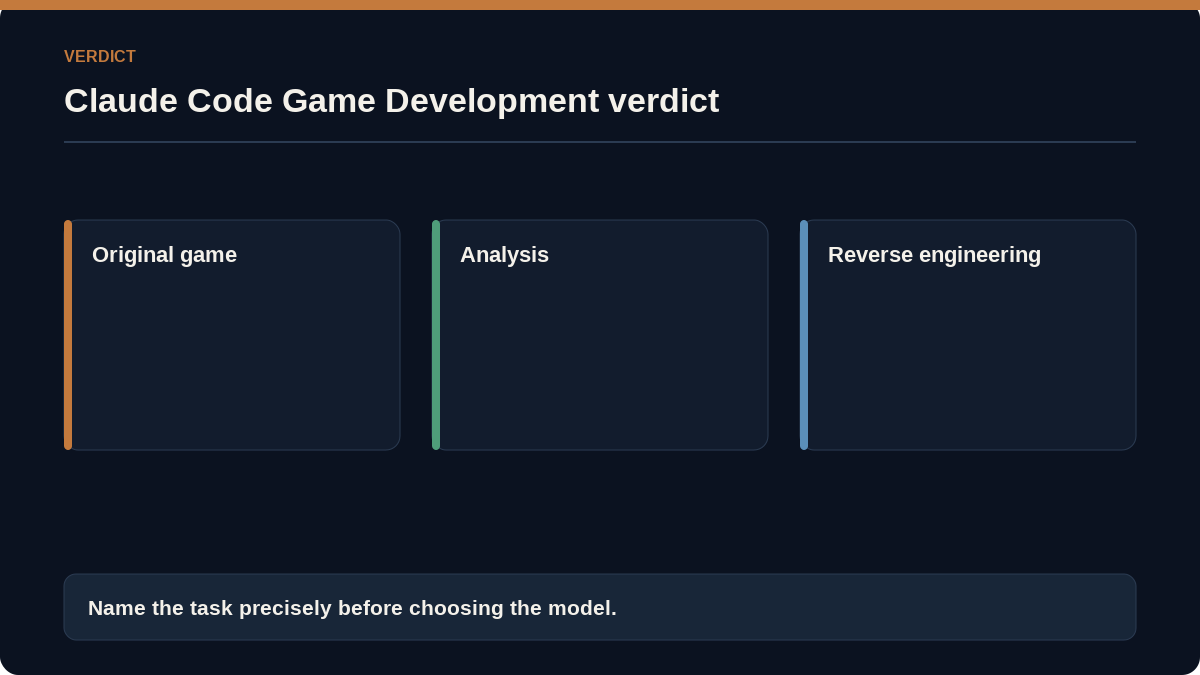
Treat original game development, technical analysis, interoperability work and recreation of a protected game as different tasks. Tech press (F022): reporting describes limits intended to prevent recreation of existing games, alongside developer reports of broader reverse-engineering refusals. The supplied sources do not contain a complete official policy or a universal refusal rate. For legitimate work, name the exact file, interface or behavior you own or are authorized to study, define a safe output and keep protected assets out of the prompt. If a model declines, do not disguise the request. Check the task classification, narrow the experiment, review the provider’s terms and choose a model that permits the work. The win is a cleaner development and review trail. The loss is that no prompt format can guarantee approval or settle an intellectual-property question.
The reported restriction
Two reports matter here, and they do different jobs. Tom’s Hardware describes added game-cloning limits and reports that developers also encountered reverse-engineering refusals. The New Stack covers developer complaints about refusals more broadly. Tech press (F022): these are reports about product behavior and user experience, not a complete policy document from Anthropic.
That distinction changes how you should troubleshoot. A refusal in a game project can come from the requested outcome, the named franchise, copied assets, a security-looking action, a permission block or an ambiguous instruction. “The model will not help with games” is too broad to be useful. Record the actual request and the actual stop. Then classify the task before changing models.
The same caution applies to claims that a new limit blocks all reverse engineering. The fact pack does not establish that. It also does not establish that every reported refusal was correct or that every one was a false positive. A team needs a task policy of its own: what the project is building, which references are allowed, who reviews generated code and when legal advice is required.
Scope wording helps on ordinary development work. Official (F008): best practices recommend naming files, describing symptoms and defining success. A request to implement an inventory screen for an original game is different from a request to reproduce a protected game’s distinctive presentation. One has a concrete code objective. The other asks for protected expression, even if the prompt never uses the word “clone.”
Task types
| Task type | Appropriate input | Safe output | Boundary to check |
|---|---|---|---|
| Original development | Your design document, owned code and generic mechanics | New implementation, tests and editor tools | Do not import protected art, audio, names or code |
| Technical analysis | A system or format you own, or public documentation | Behavior notes, diagrams and test cases | Confirm authority to inspect the target |
| Reverse engineering | Authorized binary, protocol or save fixture | Compatibility findings and a scoped report | Do not bypass access controls or copy protected expression |
| Interoperability | Documented public interfaces and synthetic messages | Adapter, parser or import/export tool | Confirm rights, contracts and security scope |
| Recreation | Requests for a protected game’s distinctive assets or expression | Stop and redesign the task | Do not provide instructions to clone the protected game |
Original development
Original work should stay anchored to your own design. Put the mechanic, player outcome and acceptance test in the task brief. For example, an inventory system can be specified through capacity rules, item categories, save behavior and a local test fixture. Those requirements guide implementation without asking the model to imitate a protected interface or presentation.
Separate reference material from implementation input. A folder of purchased assets may be licensed for use in your game but not for extraction, imitation or redistribution. A screenshot may help a human discuss layout while being a poor prompt for generating similar protected art. Independent (F043): research on license compliance in generated code finds room for improvement, but it does not establish a Claude Code-specific violation rate. Treat licenses and organizational policy as review inputs, not as problems the model can clear by itself.
The practical workflow is to generate against owned source, review the diff and record provenance. Official (F009): an independent reviewer is useful because it has not seen the reasoning behind the code. For game projects, ask that reviewer to check behavior, asset origin and copied patterns, not to relitigate style. The Claude Code code-review bottleneck explains how to measure whether review capacity keeps up with generated changes.
Asset provenance deserves its own record. Official (F040, F041): supported Claude outputs can carry a text watermark and files can carry C2PA Content Credentials, but detection has limits. A missing mark does not prove human authorship, and editing can weaken the signal. The AI attribution and provenance guide shows how to keep a project-level record instead of relying on a watermark as proof.
Dependencies need review too. Official (F011): package installs can run lifecycle scripts and reach the network. A game toolchain can add native build steps, asset processors and platform SDKs. The dependency-install side-effects guide gives a pre-install review sequence. Treat a new engine package or plugin as executable code, not as a harmless suggestion from the agent.
Maintain a small source inventory beside the feature brief. List each art, audio, code and data input with its origin and permitted use. When the agent proposes a new dependency or copied helper, add it to that inventory before merge. This turns provenance into a routine development check rather than a cleanup exercise after release. It also gives a reviewer a concrete list to compare with the final diff.
The inventory does not need private license text in the model prompt. A reference to the approved asset manifest is enough for most coding tasks. If the agent needs a detail that is missing from the repository, add the non-sensitive rule to the project brief rather than uploading the full contract. That follows Official (F008) guidance to keep project instructions short and limited to information the repository does not already contain.
Reverse engineering
Reverse engineering becomes easier to discuss when you name the authorized object and the permitted result. “Understand how this owned save file stores a player position” is bounded. “Extract everything from this commercial game” is not. The first task can use a synthetic fixture and a local parser. The second raises rights, security and scope questions that a coding agent cannot decide.
Write the authorization into the project brief. Include the owner of the binary or service, the environment, the allowed observations and the forbidden actions. If the work is for interoperability, record the public interface you need to support and why existing documentation is insufficient. If the work is for security, use the authorized security-research workflow rather than treating a game target as a special exception.
Make the experiment reversible. Use a copy of an owned fixture, not the only original. Record hashes when integrity matters, and keep generated files outside the source tree until review. Official (F014, F015): checkpoints cover file edits, not every shell command, subagent change or external side effect. The rewind and checkpoint limits explain why a disposable workspace is still required.
Untrusted input remains untrusted even when the target is a game. A malformed save file, crash dump or community mod can carry instructions into tool output. Official and independent (F016, F017): repository content and MCP results can become paths for indirect prompt injection. The repository prompt-injection guide covers project files, while the MCP trust-boundary guide covers connected tools. Do not give an analysis session broad production access just because the input is a local file.
A useful report separates observation from inference. “The parser accepted this synthetic record” is an observation. “The original format always behaves this way” is a broader claim that needs more evidence. Save the sample set, command and result beside each conclusion. That habit makes a refusal easier to handle too, because you can show that the task is a narrow compatibility study rather than a request for protected content.
Interoperability
Interoperability work connects systems through an agreed interface. It might mean reading a documented save format, exchanging messages with a public service or building an adapter for hardware you own. The coding task should be described in terms of the interface contract, not in terms of copying another product’s implementation.
Start with public documentation and synthetic messages. If documentation is incomplete, record the gap and the authorization for further observation. Do not turn “the documentation is missing” into permission to defeat access controls. Official (F021): a security feature does not authorize testing, and a compatibility goal does not create rights to a target.
Use a clean boundary around the adapter. Input parsing should produce validated data, output generation should follow your contract, and errors should be explicit. That design helps a reviewer see whether the change implements interoperability or merely reproduces protected code. It also gives the agent a specific success criterion, which follows Official (F008) scope guidance.
The generated-code license compliance guide is the right next stop when an adapter depends on copied patterns, permissive dependencies or code with unclear origin. Independent (F043): the supplied research is not legal advice and does not prove a violation in your project. It does support a review process that checks dependencies, copied code, licenses and organizational policy before merge.
Model choice should follow documented permission for the task. Use the same fixture and expected result when comparing providers, and record the model actually used. The model selection guide for coding agents helps structure that comparison. The OpenAI versus Anthropic API format guide explains why an agent’s format requirements may limit which hosted routes you can test.
Policy boundary
| Signal in the request | Why it matters | Practical response |
|---|---|---|
| A protected title, character or asset is named as the output | The requested result may reproduce protected expression | Stop and redesign around original mechanics and owned assets |
| A file or interface belongs to your team | Ownership supports a bounded technical task | Record authority, fixture and expected result |
| A public interface is documented | Interoperability can be specified without copying implementation | Build against the contract and synthetic messages |
| The task requires bypassing access controls | Authorization and security scope become central | Stop until the engagement owner approves a separate protocol |
| The only evidence is a developer complaint about a refusal | Anecdote does not establish a universal rule | Capture the exact request and classify the stop |
A worked classification example
Consider a team building an original space-trading game. Its designers want a save system, a market simulator and an import tool for a documented third-party data format. Those goals should not be bundled into one prompt.
The save system uses the team’s own schema and a synthetic player record. The market simulator uses generic supply and demand rules written in the design document. The import tool uses a public format specification and sample messages created for testing. Each task has a different input, a different acceptance test and a different review owner.
Now compare that with a request to reproduce a protected game’s distinctive ship designs, soundtrack and campaign map. That request crosses from original implementation into recreation. The safe response is to stop that part of the work and return to the design brief. Do not split the request into smaller prompts to make the same prohibited outcome harder to recognize.
This classification gives the agent a better task and gives the reviewer a better record. It also exposes dependencies early. Official (F010): community reports of scope drift do not provide a measured rate, but diff planning and allowed-file contracts are useful controls. The overengineering and diff scope guide explains how to keep a feature request from becoming a broad rewrite.
If the import tool changes a live database, separate generation from production apply. The database migration safety workflow provides the phase split. A compatibility feature is not a reason to let an agent own a destructive production command.
Model selection after classification
Once the task is legitimate, model selection becomes a documented comparison rather than an attempt to evade a refusal. Check the provider’s terms, confirm the agent supports the required format and run the same harmless fixture through each candidate. Record acceptance, scope compliance, output quality and review time separately.
A model that completes the task but introduces unlicensed code has not produced a good result. A model that refuses an ambiguous recreation request may have prevented a bad merge. A model that accepts a scoped parser task still needs permission controls around its tools. Official (F016, F017): approval systems and sandboxing remain necessary because model output and tool results can carry untrusted instructions.
Third-party plugins deserve the same scrutiny. Official partner guidance (F018, F019): Red Hat recommends review discipline for plugin code, and plugins can load commands, hooks, MCP servers and skills. The Claude Code plugin security audit covers the exact version and permission review. A game-development extension is not automatically safer than any other executable configuration.
Keep the handoff small. Official (F001, F002): session tools can continue, rewind, compact or clear context, but a bad summary can drop important details. For a multi-person game project, the session handoff and team context guide helps preserve decisions about assets, interfaces and allowed references without sharing an entire private transcript.
A short review record should travel with the change. Include the task classification, authorization reference, input manifest, model route and the tests that support the result. Add the reviewer’s decision about asset origin and copied code. This record is useful when a later contributor asks why an import tool exists or why a reference was rejected. It also prevents a new session from treating an old creative constraint as an accidental omission.
Do not turn that record into a claim of legal clearance. Its purpose is to show what the team checked and what remains unresolved. Independent (F043): generated-code license research supports review discipline, not automatic approval. When a dependency or asset has unclear terms, mark the issue and route it to the responsible owner before release.
Checklist
| Check | Original development | Analysis or interoperability |
|---|---|---|
| Input ownership | Design docs, owned code and licensed assets | Authorized fixture or public interface documentation |
| Output definition | New behavior with acceptance tests | Scoped findings, parser or adapter |
| Protected expression | No request to reproduce protected assets or presentation | No copying of protected implementation or content |
| Tool access | Only build and test permissions needed for the task | Disposable environment with narrow network and file access |
| Dependency review | Manifest, lockfile and lifecycle scripts | Same review, including native tools and SDKs |
| Human review | Behavior, provenance and license checks | Evidence, scope and compatibility checks |
| Stop condition | The task shifts into recreation or unrelated cleanup | The target, rights or authority become unclear |
Practical response: a game task checklist
Use this sequence before a model writes code, analyzes a binary or proposes an import path.
- Name the deliverable. Choose original implementation, analysis, interoperability or recreation. If the answer is recreation of protected expression, stop that task.
- Record authority. Identify the owner of the code, asset, binary or interface. Do not infer rights from possession or public availability.
- Choose safe inputs. Prefer your design documents, owned fixtures and public interface contracts over protected source material.
- Define success. Write an observable result, such as a parser accepting a synthetic record or a test proving a save round trip.
- Set forbidden actions. Name destructive commands, production access, credential enumeration and network targets that are outside the task.
- Inspect dependencies and plugins. Review manifests, lockfiles, lifecycle scripts, hooks and connected MCP servers before execution.
- Capture a refusal precisely. Save the redacted request, model, tool decision and message. Do not translate a single event into a claim about all game development.
- Re-scope or change provider. Keep the same safe fixture and choose a model whose documented terms permit the task. Do not disguise the objective.
- Review provenance and behavior. Check asset origin, copied patterns, dependencies and tests before merge. Escalate legal questions to qualified counsel.
- Preserve the decision. Keep the classification and approval with the change record so the next session does not reopen a settled boundary.
Official (F020): transcript and telemetry controls exist, but they do not establish zero logging or a universal retention default. Game projects often include unreleased designs and licensed assets. Review the secrets in logs and transcripts guide before sharing a session, and use the context-portable migration guide when moving work between agents without exporting everything.
Measure success as accepted, reviewed work rather than generated volume. The cost per verified change guide provides a better frame than lines of code. The single-model lock-in analysis is useful when a provider boundary forces a workflow change, but it does not remove the need to follow each provider’s terms.
Honest loss and data gaps
The public record is incomplete in three important ways. First, the supplied reports do not provide a complete official policy text. Second, they do not measure how often legitimate game-development or interoperability tasks are refused. Third, they do not prove that a particular wording change will produce approval.
There is also no verified rate of license violations in Claude Code output. Independent (F043): the research evaluates generated-code license compliance and finds room for improvement. It cannot tell you whether your project is compliant, and it is not legal advice. Keep dependency licenses, asset licenses, copied patterns and organizational policy in the review record.
Model behavior can change. Keep the date, provider, model identifier, agent version and task classification with each result. When a provider updates its terms or a model changes, re-evaluate the harmless fixture rather than assuming an old success still applies. The custom API base URL guide is relevant when an agent’s route changes, but a working endpoint does not imply that a model is available or permitted for every task.
Finally, human review remains a real cost. Official (F038, F039): the Code Review feature is read-only and restricted by plan and organization configuration, while the fact pack contains no universal review-time penalty. The harness security boundary guide and the proof-of-work packet help keep tool access and evidence separate from model confidence.
Practical alternative for OpenAI-format agents
One AI API Key can be used to compare permitted models on the same original-game fixture without changing the task’s rights or safety boundary. On 2026-11-27, the 46 live free model IDs were available in OpenAI format. The active pattern is an OpenAI-format agent such as OpenCode, Cline or Cursor using the documented base URL and one selected free ID. The quickstart covers endpoint setup.
Do not use those free IDs inside Claude Code. First-party (F047, F048): free IDs are OpenAI-format only, Claude Code uses the Anthropic-format endpoint, and all four Claude IDs were marked unavailable on 2026-11-27. The coding-agent compatibility notes explain the distinction. A different model does not make protected recreation acceptable.
The free lane shares 100 requests and 5,000,000 tokens per day per account, resetting at 05:30 IST or 00:00 UTC. Up to three keys are allowed per account, with one request in flight per key on free models. New accounts receive $10 credit without a card, and billing is prepaid with no subscription or seat fee. Check pricing, per-key controls and the privacy policy before sending unreleased game material. Create an account only after reviewing those terms.
FAQ
Does Claude Code refuse all reverse engineering?
The supplied evidence does not support that claim. Tech press (F022): developers reported refusals, while the sources do not provide a complete policy or a universal rate. Capture the exact request and determine whether it involved protected recreation, unclear authority, a security action or another boundary.
Can I ask for the same protected game in smaller pieces?
No. Splitting a prohibited recreation task does not change the requested outcome. Return to original mechanics, owned assets and your design document. If the work is legitimate analysis or interoperability, document authority and use a narrow fixture.
Can a model decide whether generated code is license-compliant?
No. Independent (F043): research shows room for improvement in generated-code license compliance, not a reliable clearance method. Review dependencies, copied code, licenses and organizational policy. Seek legal advice for unresolved questions.
What should I save after a game-development refusal?
Save the redacted request, task classification, model, tool decision, response and authorization reference. Keep protected assets and private design material out of the shared record. A single refusal is evidence about that run, not a product-wide rule.
Is a watermark enough to prove a game asset was AI-generated?
No. Official (F040, F041): marking has coverage limits, and heavy editing or stripped metadata can weaken it. A detected mark suggests Claude processing; no detected mark does not prove human authorship. Keep a provenance record instead.
Sources
- Tom’s Hardware reporting on game-cloning limits and developer reports
- CellCog analysis of the game-recreation rule
- Anthropic’s Claude Code best practices
- Independent research on license compliance in LLM-generated code
- Anthropic’s Claude Code security model
- Red Hat’s guidance on securing Claude Code plugins