Direct answer
Price Claude Code by accepted, verified changes, not by the subscription fee alone. A useful formula is:
Cost per verified change = (allocated subscription cost + API or usage-credit spend + review cost + rework cost) / accepted verified changes
The denominator matters. Generated diffs, passing demos and confident summaries are not accepted changes. A change belongs in the denominator only after it meets your acceptance criteria and the relevant checks pass.
Pro costs $20 per month or $200 annually. Max costs $100 per month and Ultra costs $200 per month. Those are real costs, but they do not measure the human work required to review, correct or discard the output. The Claude Code free-tier entry price covers the plan floor. This article covers the fuller bill.
Why subscription price is incomplete
A subscription is easy to count. It appears once on a receipt. The harder costs arrive as time: reading a diff, reproducing a failure, rewriting a patch, waiting through a quota reset or rebuilding context after an interruption.
Those costs do not appear in the plan price. They still belong in the buying decision. A $20 plan can be economical when it produces small, correct changes with light review. The same plan can be expensive when most output needs rework.
The Claude Code proof-of-work packet gives you a way to define acceptance before counting a change. Without that definition, the metric can drift. A team might count every generated file as progress, then wonder why delivery slowed.
Usage limits add another incomplete line. Official: the standard five-hour window starts with the first message, and a separate weekly limit resets at a fixed account time. Usage across claude.ai, Claude Code and Claude Desktop is shared. An interruption can create context-rebuilding work that never appears as an API charge. The Claude Code rate limits explain the clocks.
Billing routes also differ. Interactive Claude Code usage credits are billed at standard API rates, while monthly API credits have a narrower eligible route. The Ultra API credits versus Claude Code usage guide separates those balances. A cost model that merges them will misattribute spend.
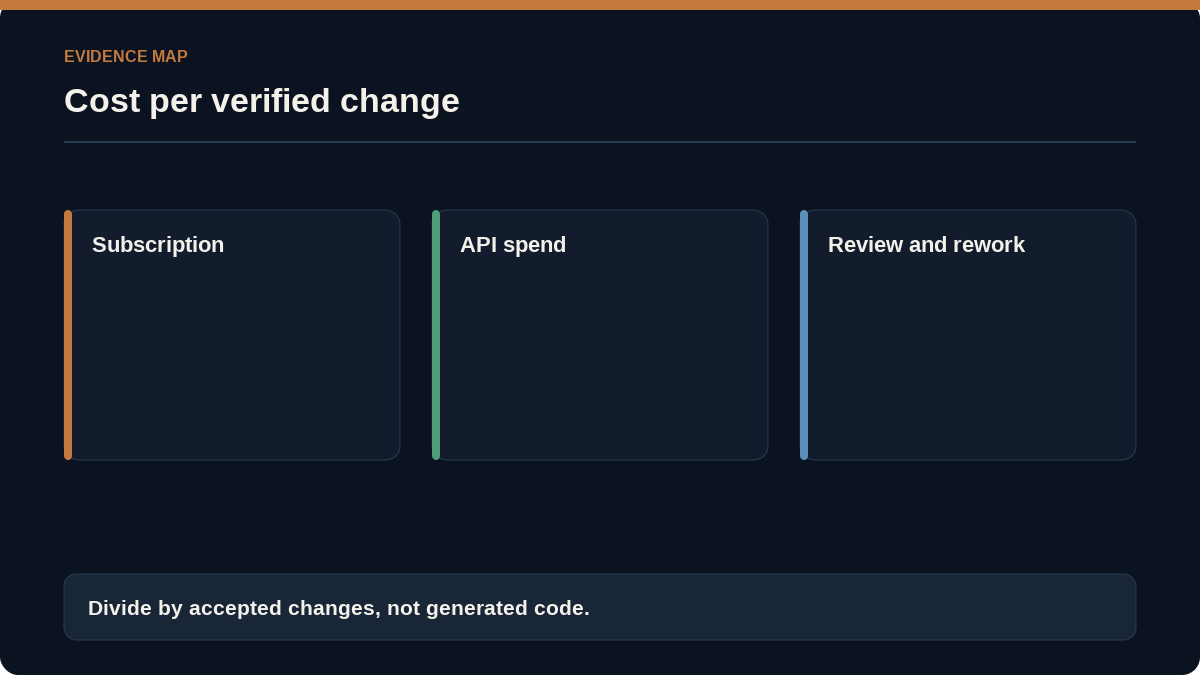
Cost per verified change formula
The formula has two sides: total cost and accepted output. Keep both visible.
Total cost
Total cost includes the subscription allocated to the measurement period, API or usage-credit spend, tool costs, human review and rework. Use the same period for every line. A monthly subscription should not be compared with a yearly review total.
For annual Pro, the cash cost is $200 up front. Derived: the monthly equivalent is $200 / 12 = $16.67, rounded. That equivalent is useful for comparison, but it does not change the cash-flow requirement.
Review cost is human time multiplied by a loaded hourly rate. The rate is an internal assumption, not a fact from Anthropic. Rework cost includes time spent correcting output that failed acceptance. Failed loops belong here even when they produced no usable change.
Accepted verified changes
An accepted change meets a written acceptance rule. The rule might require a passing regression test, a reviewed diff, a manual check of the affected path and confirmation of an external side effect. The exact rule depends on the task.
Do not count a change twice because it took several agent turns. Do not count a generated test that only repeats the implementation’s assumption. The Claude Code false-success verification guide explains why weak oracles can make incomplete work look finished.
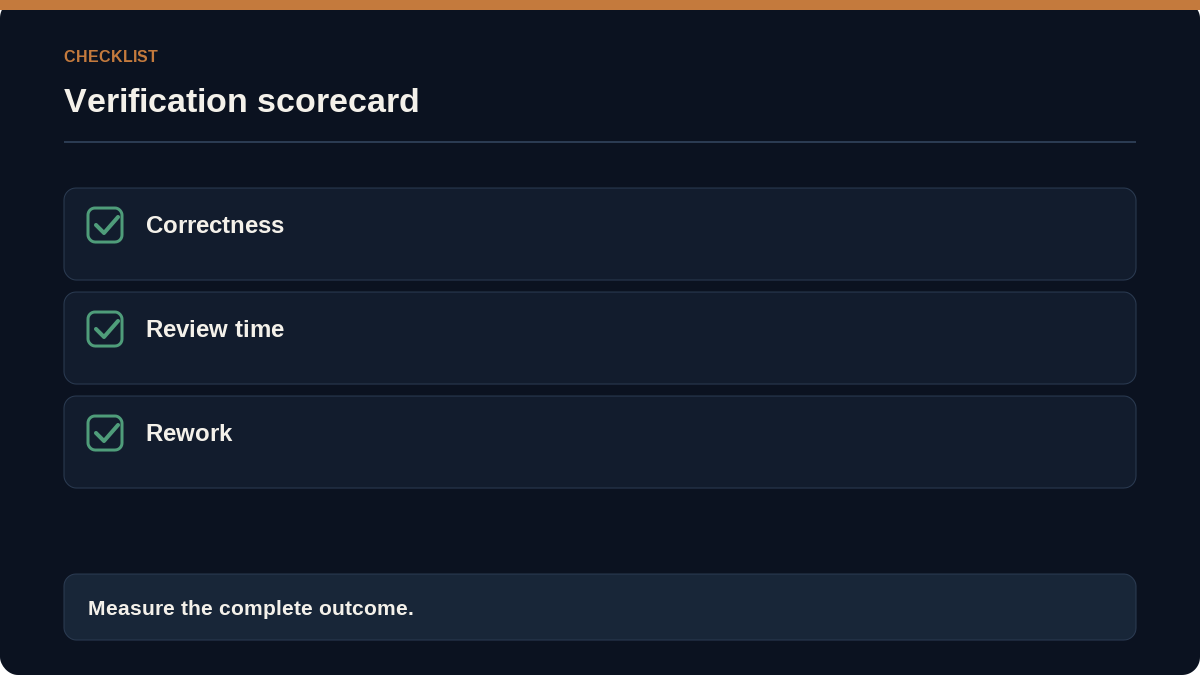
A practical scorecard records both cost and evidence. That keeps the denominator honest.
Cost components
| Component | Include | Common omission |
|---|---|---|
| Subscription | Allocated plan cost for the period | Treating annual Pro as $17 cash per month |
| API or usage credits | Actual spend on the relevant route | Mixing monthly API credits with interactive usage |
| Tools | Required services or infrastructure | Assuming every tool is free |
| Review | Human inspection and verification time | Counting only generation time |
| Rework | Corrections, retries and discarded output | Ignoring failed loops |
| Interruption recovery | Context rebuilding after quota or account stops | Treating delays as zero cost |
The monthly LLM API cost worksheet helps with the API lines. The cost-per-change framework adds the human lines. Both are needed for a whole-workflow number.
Vendor enterprise estimates
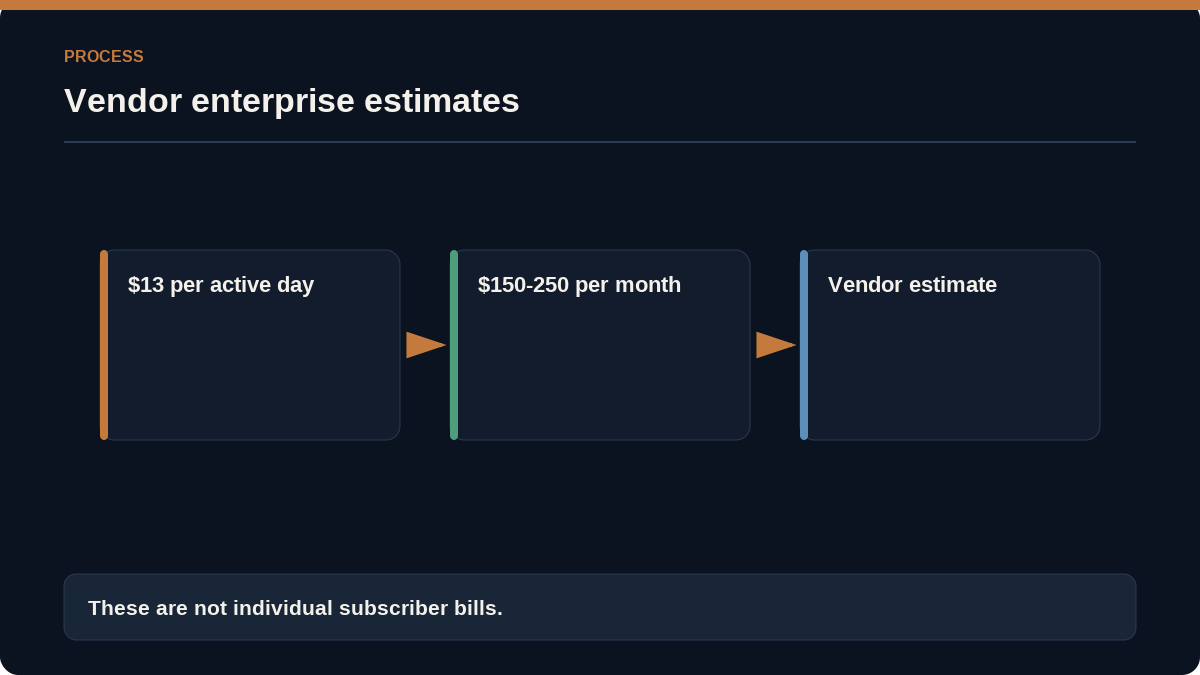
Anthropic reports enterprise averages of about $13 per developer per active day and $150 to $250 per developer per month in its Claude Code costs documentation. These are vendor estimates, not an individual Pro subscriber’s bill.
The distinction matters. An enterprise average can include different workloads, team structures, model choices and usage patterns. It does not establish what one developer will spend on Pro, Max or Ultra.
Anthropic also says agent teams can use approximately seven times more tokens than standard sessions when teammates run in plan mode. The condition is part of the claim. It is not a universal multiplier for every session. The Claude Code agent-team token overhead guide keeps that condition attached to the number.
Use the vendor estimates as context, not as a substitute for your own ledger. A team with heavy review needs may have a high cost per accepted change even when token spend looks ordinary. A team with light, well-scoped tasks may see a different result.
Worked example
The following example is Derived from the official Pro price and explicitly stated assumptions. It is not a measured productivity result.
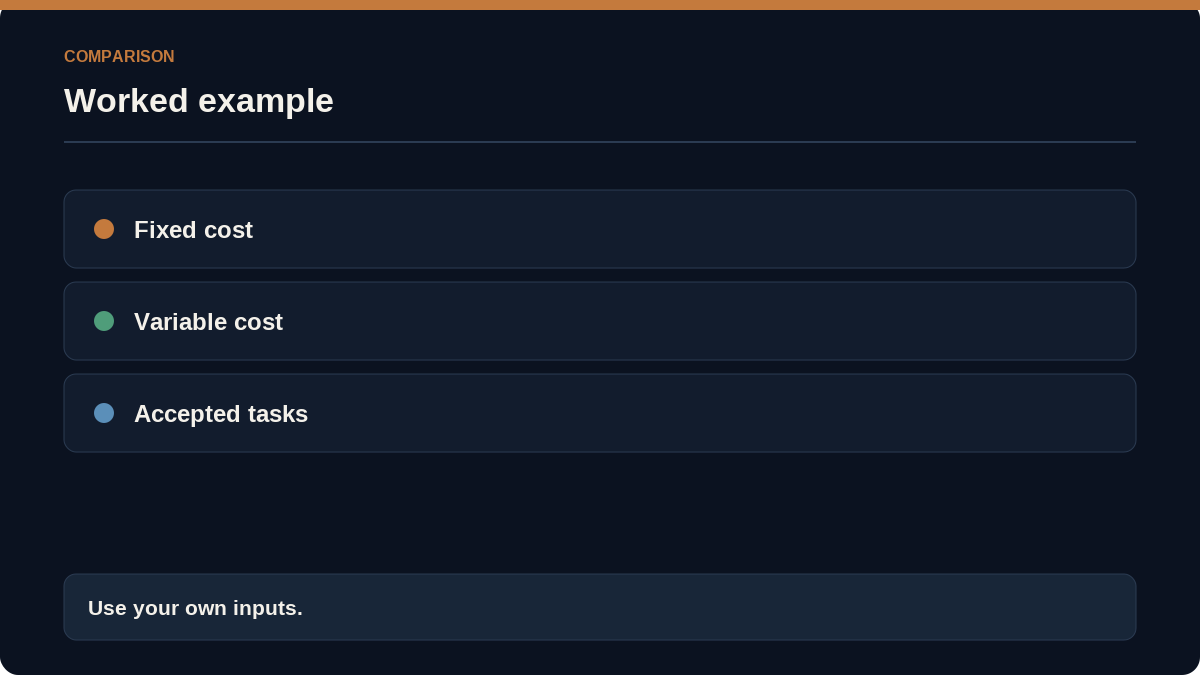
Assume one developer pays $20 for a month of Pro. During that month, the developer accepts 10 verified changes. Review takes 3 hours, rework takes 1 hour, and the internal loaded rate is assumed to be $50 per hour. Assume no additional API or tool spend in this simplified example.
Worked example
| Line | Calculation | Cost |
|---|---|---|
| Pro subscription | Official monthly price | $20.00 |
| Review | 3 hours × assumed $50/hour | $150.00 |
| Rework | 1 hour × assumed $50/hour | $50.00 |
| API or tool spend | Assumed $0 for this example | $0.00 |
| Total cost | $20 + $150 + $50 | $220.00 |
| Accepted verified changes | Assumed count | 10 |
| Cost per verified change | $220 / 10 | $22.00 |
The result is $22 per accepted, verified change under those assumptions. It is not a claim that Claude Code always costs $22 per change. Change the review time, accepted count or loaded rate and the answer changes.
A second Derived view uses annual Pro. The monthly equivalent is $200 / 12 = $16.67. With the same 4 hours of review and rework at the assumed $50 rate, total monthly-equivalent cost is $16.67 + $200 = $216.67. Divided by 10 accepted changes, that is about $21.67 per change.
The annual plan lowers the equivalent cost in this example, but it requires $200 up front. The Claude Code free-tier entry price covers that cash-flow trade-off.
What the example excludes
The example excludes quota interruptions, account problems, privacy review, tool fees and taxes. It also excludes the value of the work itself. A $22 cost per change can be excellent for a revenue-critical fix and poor for a cosmetic edit.
The point is not to produce one universal number. The point is to make the assumptions visible. Once they are visible, you can test them against real tasks.
Measurement template
A useful template fits on one page per developer per month. It should be easy enough to maintain during ordinary work.
Start with the billing period and plan. Record the subscription cost, API or usage-credit spend and tool costs. Then record the human side: review hours, rework hours and interruption-recovery time. Finish with accepted verified changes and links to the evidence.
Measurement scorecard
| Field | What to record | Why it matters |
|---|---|---|
| Period and plan | Month, plan, billing route | Keeps costs comparable |
| Subscription | Cash paid and monthly equivalent | Separates cash flow from allocation |
| API or usage credits | Actual spend by route | Prevents balance confusion |
| Review hours | Time spent inspecting output | Captures the main human cost |
| Rework hours | Corrections and discarded work | Keeps failed loops visible |
| Interruptions | Quota, account or service stops | Explains recovered time |
| Accepted changes | Count meeting the written rule | Defines the denominator |
| Evidence | Tests, diff review, external checks | Makes acceptance auditable |
| Cost per change | Total cost / accepted changes | Supports the buying decision |
The Claude Code verification checklist helps fill the evidence column. The Claude Code privacy and retention rules matter when the task involves sensitive data, because compliance review can add real cost.
Do not turn the scorecard into a ranking of developers. It is a workflow diagnostic. A high review total may indicate vague prompts, weak tests, a difficult repository or a model mismatch. The number should start an investigation, not a performance argument.
Start with a small baseline
A baseline is a short set of representative tasks with known acceptance criteria. Run it before changing the model, prompt or plan. Save the prompts, repository state and verification output so the same test can be repeated later.
Keep the baseline small enough to finish. Three to five tasks are enough to reveal obvious mismatches in context handling, tool use or review burden. The goal is not a benchmark score. The goal is a repeatable comparison.
Record the boring details: agent version, model ID, plan, date, task branch and test command. Without them, a later difference is hard to explain. The April 2026 Claude Code postmortem is a useful reminder that defaults, caching and prompt changes can affect behavior. A baseline gives you a way to notice a regression without relying on memory.
When the baseline is repeated, compare accepted changes first. Then compare review and rework time. A model that produces fewer lines but more accepted tasks may be the better buy. A model that looks faster in a demo may still lose on the complete workflow.
When the math favors switching
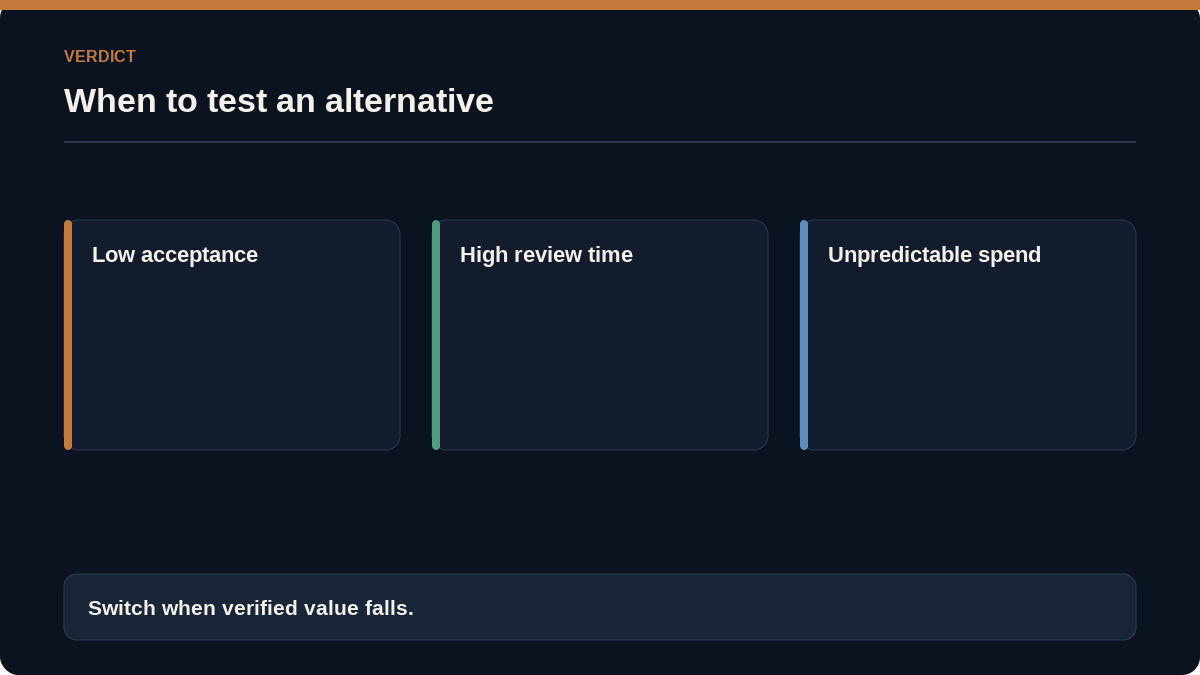
Switching becomes reasonable when the current route produces low acceptance, high review time, unpredictable spend or repeated interruptions that destroy value. The trigger should be written before a frustrating week forces an emergency migration.
Low acceptance means many generated changes fail the written rule. High review time means the human savings are smaller than the activity suggests. Unpredictable spend means the billing route is hard to attribute. Repeated interruptions mean the workflow depends on a single quota or account boundary.
The Claude Code single points of failure guide separates quota, region, account and model failures. Each needs a different response. A second model may help with a quality problem, but it will not fix an account restriction.
Switching also has costs. Prompts, hooks, context files and team habits may need work before another agent can reproduce the workflow. The Claude Code lock-in and exit costs guide turns those costs into a worksheet. A cheaper route that requires a long migration may not be cheaper in the period you are measuring.
A fair switch test uses the same task set and acceptance checks. Record the new agent, model ID, review time and accepted changes. The Claude Code context-portable migration guide helps preserve the knowledge that should survive the move.
Keep the denominator stable
A cost-per-change number is only comparable when the definition of a change stays stable. If one month counts a one-line fix and the next month counts a multi-file migration, the ratio can move without any real change in tool value.
Write the acceptance rule before the measurement period. For a bug fix, the rule might require a failing test before the change and a passing test afterward. For a refactor, it might require the existing suite to pass and the public behavior to remain unchanged. For a feature, it might require a manual check of the user-visible path.
The rule should also say what does not count. A generated sketch, an unmerged branch or a change that fails review is not accepted output. The Claude Code proof-of-work packet helps separate those states.
When the task mix changes, report the mix. A month dominated by small fixes will naturally produce more accepted changes than a month dominated by one difficult migration. Rather than hiding that difference in an average, split the scorecard into task categories.
The same caution applies to review time. A senior developer may verify a change quickly because they know the codebase. A new contributor may need longer. Both times are real costs, but they measure different amounts of inherited context and risk.
A stable denominator does not mean a rigid one. It means the team can explain why the definition changed and can restate earlier results if needed. That is what makes the number useful at renewal time.
Account for quota interruptions
A quota stop can consume time without producing a billable API request. The developer may need to save partial work, rebuild context or wait for a reset. Those minutes belong in the workflow record even when the subscription price stays fixed.
Official: the standard five-hour window starts with the first message, and the weekly limit resets at a fixed account time. Usage across claude.ai, Claude Code and Claude Desktop is shared. Verified Ultra accounts do not have the standard five-hour cap, but a weekly limit still applies. The Claude Ultra five-hour exception explains the boundary.
Record the interruption separately from review and rework. That keeps the cause visible. If interruptions are rare, the recovered time may be minor. If they repeatedly hit long tasks, the workflow may need smaller checkpoints or a second route.
The Claude Code rate limits guide provides the reset mechanics. Use the account’s displayed reset information rather than a generic schedule. A personal observation can explain one incident, but it cannot establish a population-wide failure rate.
An interruption can also change the accepted-change count. A task that stops halfway may produce useful notes but no accepted change. Count the notes as research output if they have value, but do not silently move them into the verified-change denominator.
Review the metric once a month
A monthly review should answer three questions: what did we spend, what did we accept, and what caused the gap? Keep the meeting short and tied to records.
Start with the billing lines. Confirm the plan, any API or usage-credit spend and the tool costs. Then review the accepted changes and their evidence. Finish with the human time: review, rework and interruption recovery.
Look for a pattern before changing the tool. High output with low acceptance points toward task definition or verification. High acceptance with high review time points toward context or model fit. High spend with ordinary output points toward loop length, retries or billing-route confusion.
The April 2026 Claude Code postmortem is a useful example of why a dated baseline matters. Defaults, caching and prompt changes can alter behavior. A monthly scorecard helps a team notice a change without relying on a general impression that the tool has become worse.
Use the cost calculator when a forecast needs official rate arithmetic. Use the scorecard when the question is whether the workflow earns its cost. The two views complement each other, but they answer different questions.
A good review ends with one action. Keep the plan, change the prompt pattern, tighten acceptance, adjust a cap or run an alternative test. A long list of possible improvements usually means the team has not identified the main cost yet.
Avoid false precision
A cost-per-change figure can look more exact than the underlying inputs. Review time is often estimated. Accepted changes may be counted differently by different people. A loaded hourly rate may be a rough internal assumption.
Report the assumptions beside the number. Instead of presenting $22 as a universal fact, say that the example used a $20 Pro plan, 10 accepted changes, four hours of review and rework, and an assumed $50 hourly rate. The reader can then judge whether the shape matches their work.
Avoid averages that hide task categories. A small fix and a security-sensitive migration should not carry the same implied weight. If the team needs one headline number, keep the category breakdown behind it.
The same rule applies to vendor estimates. Anthropic’s enterprise averages are useful context, but they are not a substitute for local measurements. The Claude Code costs documentation should be labeled as a vendor source whenever those figures appear.
False precision can lead to a bad switch. A team might abandon a workflow because a rough ratio rose for one month, or adopt a new agent because a demo looked cheaper. Repeat the measurement before making a large change.
The goal is a decision aid, not a universal price. A range with clear assumptions is often more honest than a single number with hidden guesses. Store the raw inputs with the result so another developer can reproduce the calculation.
Use the result to choose a test
A cost-per-change score becomes useful when it points to a specific experiment. If review time is high, test a narrower task scope or a stronger acceptance checklist. If rework is high, inspect the failed changes for a missing constraint. If interruption recovery is high, test smaller checkpoints or a backup route.
Avoid changing the plan, model, prompt and agent at the same time. That may produce a better week, but it will not tell you which change helped. Pick one variable and repeat the baseline.
The Claude Code verification checklist is a good first variable when acceptance is unstable. The Claude Code context versus memory guide is a better starting point when the agent loses constraints in long sessions.
Write the expected effect before the test. For example: “A narrower task scope should reduce review time without lowering acceptance.” Then record the result. If the effect does not appear, keep the evidence and try a different hypothesis.
This turns the metric into a learning loop. The goal is not to defend a previous purchase. It is to find the workflow that produces accepted work at a cost the team can explain. Save the baseline with the result, because the same task set is what makes the next comparison meaningful.
A practical comparison with an OpenAI-agent gateway
If the scorecard points to a switch, One AI API Key offers an active OpenAI-format lane for a measured comparison. The 46 live free model IDs run through https://api.oneaiapikey.com/v1 with one key. Use an OpenAI-format agent such as OpenCode or Cline, then follow the quickstart.
The free lane allows 100 requests and 5,000,000 tokens per day per account, shared across the 46 free IDs. It resets at 05:30 IST, which is 00:00 UTC. Accounts can have up to three API keys, with one request in flight per key on free models. For paid evaluation, review the prepaid pricing and use the per-key controls to cap and expire test keys.
Do not use the free IDs in Claude Code. They are OpenAI-format only. The documented Claude Code route uses the Anthropic Messages format at https://api.oneaiapikey.com, but all four Claude IDs were unavailable on 2026-11-27: claude-sonnet-5-5, claude-sonnet-5, claude-opus-5-5 and claude-haiku-4-5.
Run the same tasks, keep the acceptance rules fixed and record review time, rework and accepted changes. The multi-model OpenAI-agent setup provides the architecture. The 46 free AI model IDs guide explains the compatibility boundary.
The honest loss is that an OpenAI-format agent is a different workflow. A lower token bill does not prove a lower cost per verified change if review rises. The Claude Code alternatives and model-layer ownership guide explains why separating the agent from the model layer can make the comparison clearer.
Data gaps and future updates
The frozen fact pack does not provide an individual developer’s acceptance rate, review time or monthly task volume. It also does not provide a universal cost per verified change. Those values depend on the repository, task mix, acceptance rule and team.
The vendor enterprise estimates remain vendor estimates. They should not be presented as an individual Pro bill or as a guaranteed result. The agent-team token estimate should remain attached to its plan-mode condition.
This article should be updated when official pricing, credit rules or limit mechanics change. The measurement template can stay stable while the inputs change. This is the main advantage of pricing by verified change: the model can change without discarding the evidence you collected.
FAQ
What is cost per verified change?
It is total workflow cost divided by changes that met your acceptance criteria. Total cost includes subscription, API or usage-credit spend, review and rework.
Why not use the subscription price alone?
The subscription is only one line. Review, rework, failed loops and interruption recovery can cost more than the plan fee.
Are Anthropic’s $13 daily and $150 to $250 monthly figures my bill?
No. They are vendor enterprise estimates, not an individual subscriber’s bill or a guaranteed cost.
What counts as a verified change?
A change that meets a written acceptance rule and has supporting evidence, such as tests, diff review and checks of external side effects.
Can the 46 free gateway IDs be used in Claude Code?
No. They use the OpenAI format and require an OpenAI-format agent. The documented Claude Code route uses the Anthropic format, and all four Claude IDs were unavailable on 2026-11-27.