Direct answer
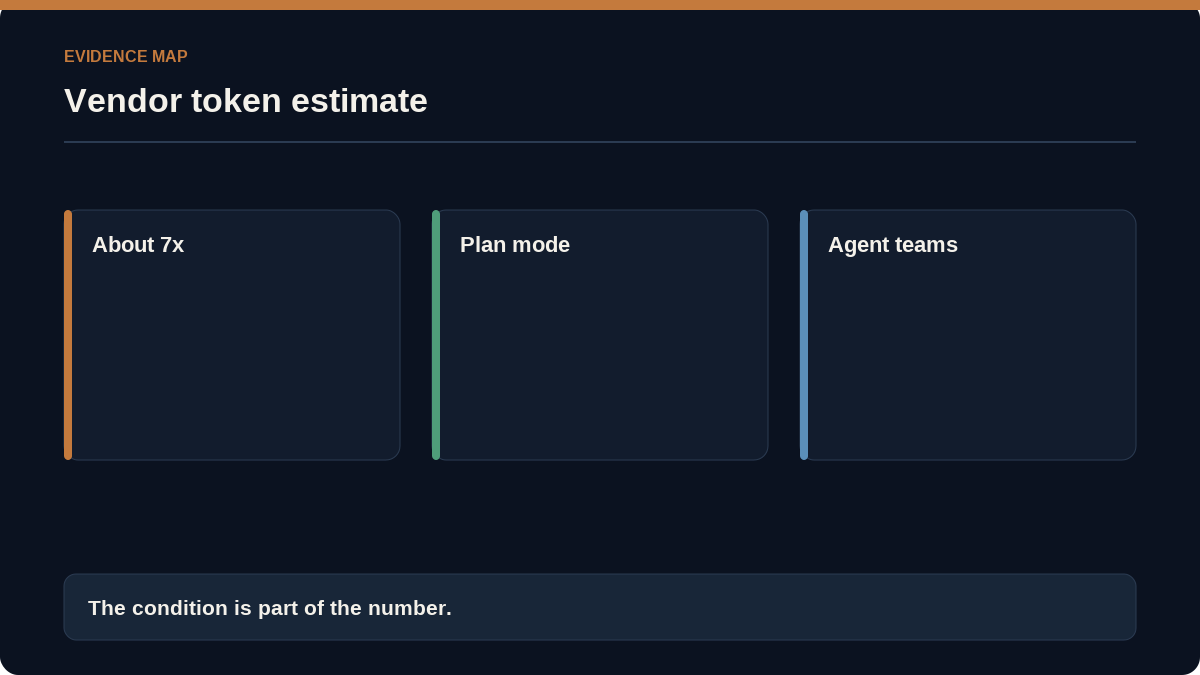
Claude Code agent teams can use about seven times more tokens than standard sessions when teammates run in plan mode. That is Anthropic’s vendor estimate, and the plan-mode condition is part of the claim. It is not a rule that every team costs exactly 7×, and it is not a measured result for your repository.
Use the estimate as a budgeting warning, not a verdict. Teams can parallelize independent work, but each teammate can carry its own context, instructions and tool results. The extra tokens may buy useful exploration. They can also buy duplicated reading, broad plans and integration work that one agent would have avoided. Measure accepted output and human review time before deciding that the multiplier is justified.
The practical rule is to give a team a bounded task, a clear division of labor and a reviewer who can integrate the result. If those conditions are missing, the token increase can arrive without a matching increase in finished work.
Why the vendor estimate matters
An agent team is a group of agents working on related tasks. The appeal is obvious: one can investigate the frontend, another the backend, and another the tests. The cost is less obvious because the work is not one request multiplied by the number of teammates. Context, instructions and tool output can accumulate in more than one place.
Vendor estimate: in the official Claude Code cost documentation, Anthropic says agent teams can use approximately seven times more tokens than standard sessions when teammates run in plan mode. The words “can,” “approximately” and “when teammates run in plan mode” all matter.
The estimate does not say:
- every agent-team session uses exactly 7× the tokens;
- every plan-mode teammate spends the same amount;
- the extra tokens guarantee better code;
- a subscription quota can be converted into a token price;
- the same multiplier applies to every model, task or repository.
Treat the number as a prompt to instrument the run. Record the standard-session baseline, the team run, the accepted changes and the review time. Without those inputs, the multiplier is context, not a forecast.
The Claude Code cost per verified change provides the right denominator. Count a change only after it meets the acceptance criteria. A team that produces more diffs but requires more rework may not lower cost per accepted result.
Why teams consume more tokens
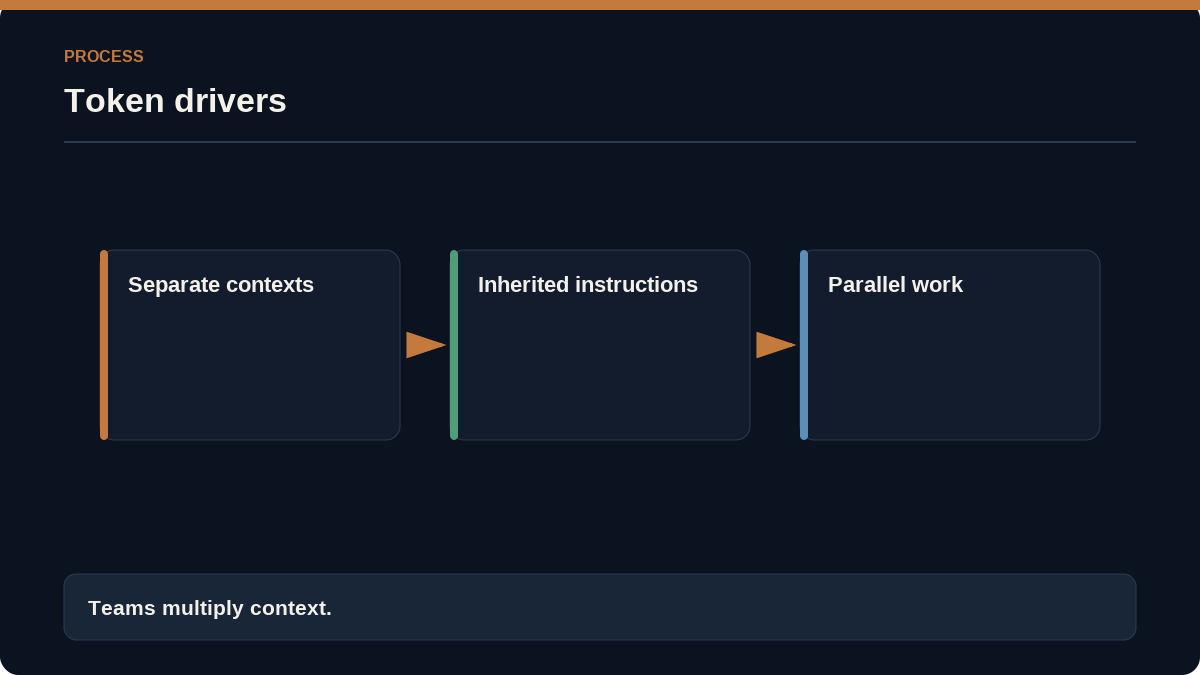
A standard session already loops. The agent reads files, proposes changes, runs commands and sends the results back as context. A team adds more participants to that loop. The increase can come from several places at once.
| Token driver | What happens | Why it can grow |
|---|---|---|
| Separate contexts | Each teammate receives task-relevant instructions and files | The same repository material may be read more than once |
| Inherited instructions | Project rules and task constraints travel with each agent | Longer context is resent as the session continues |
| Parallel exploration | Several agents investigate different paths | More branches produce more tool output |
| Plan mode | Teammates reason about approach before execution | Planning can add turns without changing files |
| Coordination | Results must be combined into one implementation | Summaries and integration steps add context |
| Rework | Conflicting or incomplete plans need correction | Repeated reasoning consumes tokens without accepted output |
The Claude Code context versus memory guide explains why more context is not automatically better. Capacity, retained reasoning and task state are different layers. A teammate can have room for more text and still lose the constraint that determines whether the plan is valid.
The Claude Code compaction retention test is useful when a long plan crosses a context boundary. Write the decision, constraint and acceptance criteria outside the session. Otherwise a summary can preserve the topic while dropping the detail that prevents rework.
Plan mode is the condition, not a footnote
Plan mode is useful when the team needs to investigate before changing files. It can expose trade-offs, map dependencies and produce a implementation plan. It can also become an expensive way to restate the same repository facts in several contexts.
Before starting, ask each teammate to own a distinct question. “Investigate the authentication flow and identify the smallest safe change” is easier to bound than “help with auth.” The second prompt invites overlapping reads and vague coordination.
The Claude Code false-success analysis adds another risk. A team can agree on a plan that passes visible tests while missing the real integration. Require the plan to name the acceptance test and the external-state check before execution begins.
Worked comparison: token math with explicit assumptions
The following example uses official Fable 5.2 list rates to make the arithmetic visible. It is Derived: a planning example, not a Claude Code subscription price and not a measurement of agent-team behavior.
Official: Fable 5.2 standard API pricing is $8 per million input tokens and $40 per million output tokens. Cache reads cost $0.20 per million tokens. Fast mode costs $16 per million input tokens and $80 per million output tokens. These rates come from the Fable 5.2 pricing page.
Assume one standard session uses 100,000 input tokens and 10,000 output tokens. Ignore caching, retries, tool-specific charges and taxes. The cost is:
(100,000 × $8 / 1,000,000) + (10,000 × $40 / 1,000,000) = $0.80 + $0.40 = $1.20
Now apply the vendor’s approximate 7× token estimate as a scenario, not a prediction. If the team session uses 700,000 input tokens and 70,000 output tokens, the same formula gives:
(700,000 × $8 / 1,000,000) + (70,000 × $40 / 1,000,000) = $5.60 + $2.80 = $8.40
The difference is $7.20 for this hypothetical shape. The ratio is exactly 7× because both input and output were multiplied by 7. Real sessions may not scale that way.
| Scenario | Input tokens | Output tokens | Standard cost | Fast cost |
|---|---|---|---|---|
| One standard session | 100,000 | 10,000 | $1.20 | $2.40 |
| Team scenario at 7× tokens | 700,000 | 70,000 | $8.40 | $16.80 |
| Difference | 600,000 | 60,000 | $7.20 | $14.40 |
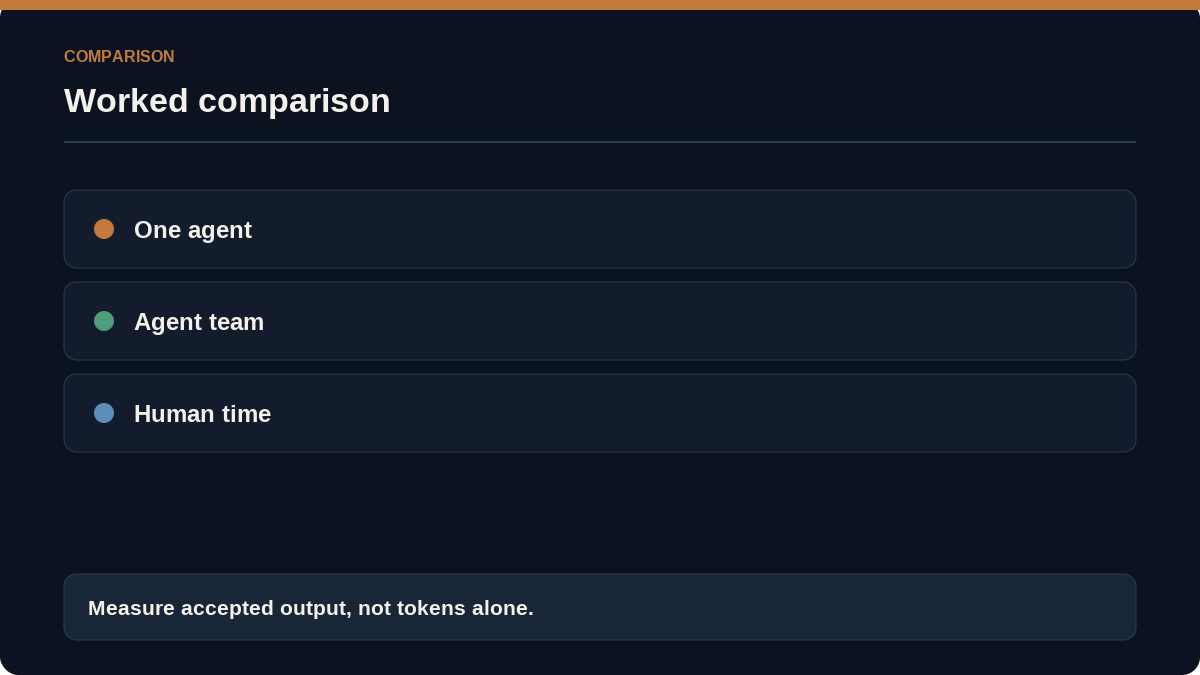
The example leaves out important variables. A cache hit can lower input cost. A team can produce fewer output tokens by dividing work. A failed plan can consume tokens without producing an accepted change. That is why the usage log and the review outcome matter more than the headline multiplier.
What the math excludes
The official Claude Code cost documentation also reports enterprise averages of about $13 per developer per active day and $150–$250 per developer per month. Vendor estimate: those are Anthropic’s enterprise figures, not an individual Pro subscriber’s bill and not a price for agent-team tokens.
The example also excludes human time. A team that saves an hour of implementation but adds an hour of integration has not reduced total effort. Use the monthly LLM API cost worksheet to keep token spend and human rework in separate columns until you can combine them honestly.
Human review is the counterweight
More agents can produce more surface area to review. A plan may be internally consistent and still conflict with the existing architecture. Two teammates can solve the same problem differently. Tests can pass in isolation while the integrated change fails.
The Claude Code proof-of-work packet is the control. Require each teammate to report changed files, commands, results and open risks. The integrator should reproduce the decisive check rather than trust the combined summary.
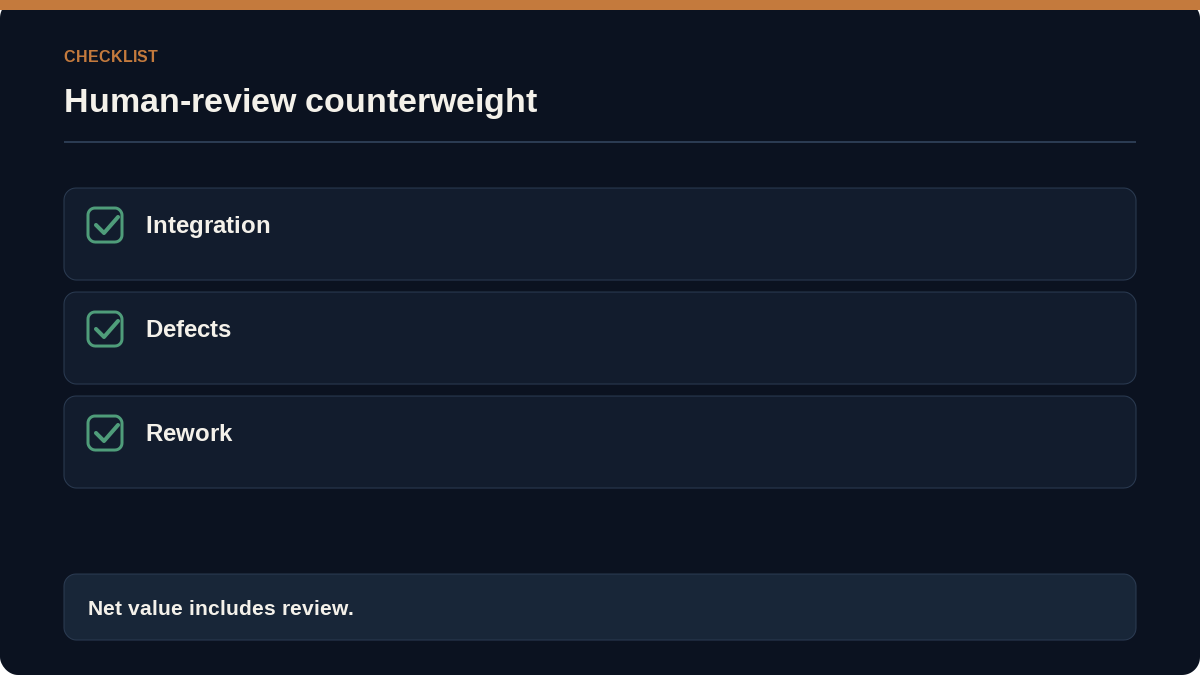
A simple review scorecard can use four questions:
- Did the team answer distinct questions? Overlap is a sign of poor task division.
- Did the plan name the acceptance test? A plan without an oracle is difficult to verify.
- Did integration require substantial rewriting? If yes, the apparent parallelism may be false.
- Was the accepted result better than a bounded single-agent run? Compare against a real baseline, not an imaginary one.
The Claude Code harness security boundaries matter here. More teammates can mean more tool authority. Keep permissions narrow and verify that one agent’s output does not gain trust merely because another agent produced it.
When teams help
Teams are most defensible when the work splits cleanly, the interfaces are known and the review capacity exists. They are least defensible when the task is a single tangled change that requires constant shared context.
| Situation | Team fit | Reason | Control |
|---|---|---|---|
| Independent research questions | Good | Parallel reads can reduce wall-clock time | Give each teammate a distinct question |
| Separate modules with stable interfaces | Good | Integration points are easier to define | Require contract tests at the boundary |
| One small bug | Poor | Coordination can exceed the work | Use a single bounded session |
| Large refactor with shared decisions | Mixed | Parallel edits can conflict | Plan first, then assign non-overlapping files |
| Unfamiliar codebase | Mixed | Exploration helps, but overlap is likely | Start with a map, then divide work |
| High-risk production change | Poor by default | Review burden rises with blast radius | Prefer a small diff and independent verification |
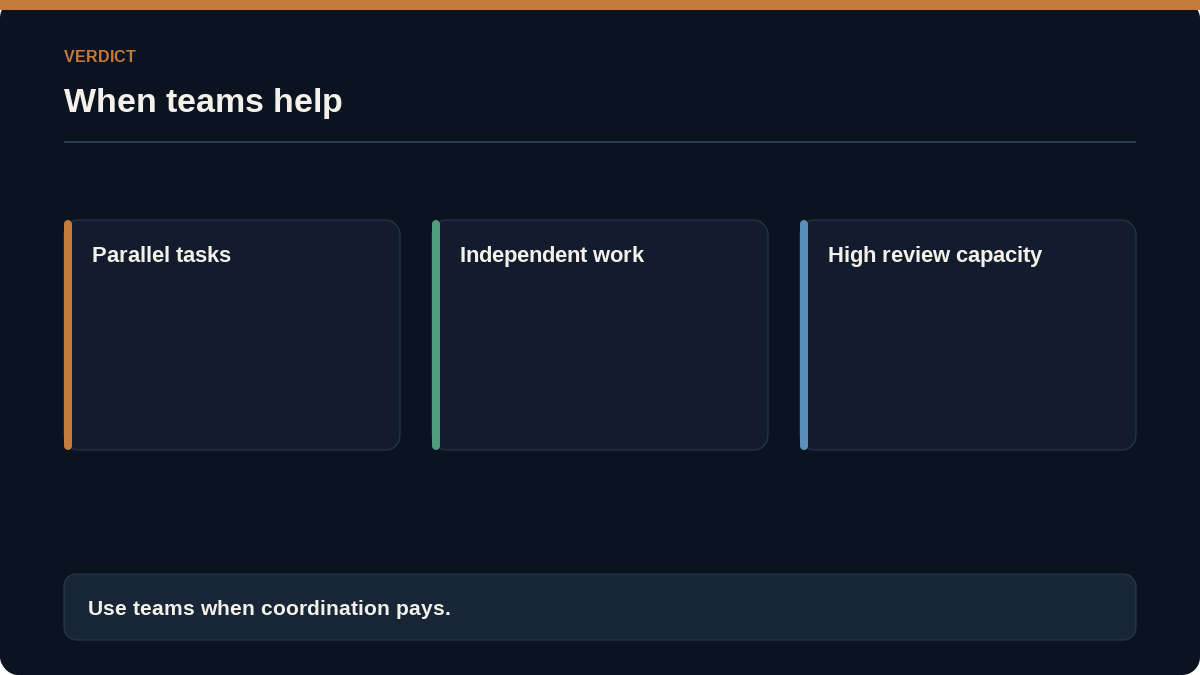
A concrete win looks like this: three teammates investigate separate subsystems, return evidence, and one integrator implements a small change against a known interface. A concrete loss looks like this: three teammates read the same files, produce overlapping plans, and a reviewer spends the saved time reconciling them.
The practical implication is to budget review before launching the team. If nobody owns integration, the token multiplier is likely to buy ambiguity.
A team experiment should also have a stop condition. Decide in advance what result would make you end the run: repeated overlap, an unresolved interface conflict or a token total that exceeds the agreed budget. Stopping a bad run early is a valid outcome. The purpose of the experiment is to learn whether the team model fits the work, not to prove that the initial configuration was correct.
Quota and billing boundaries
Official: the standard five-hour window starts when the user sends the first message and resets five hours later. Weekly limits reset at a fixed time assigned to the account. Usage across claude.ai, Claude Code and Claude Desktop counts toward the same limit. Verified Ultra accounts do not have the standard five-hour cap, but a weekly limit still applies.
The Claude Code five-hour and weekly limit guide explains how to plan around those rules. A team run can reach a limit while several tasks are still in flight. Save the plan and acceptance criteria outside the session so the work can resume without reconstructing the team’s reasoning.
Billing controls exist. Official: users can set a monthly spending cap, receive usage alerts and configure auto-reload. Usage credits are billed at standard API rates. Those controls are documented in the Claude usage credits guidance.
Monthly API credits are a separate benefit. Official: Ultra includes $200 in monthly API credits, Max includes $100, and Team includes $20 per seat for Standard or $100 per seat for Premium, pooled up to $500. Those credits do not cover interactive Claude Code sessions. They apply to claude -p or the Agent SDK with an API key from the linked Console organization. The Ultra API credits explainer keeps the two balances separate.
The Claude Code third-party harness rules also matter if a team wants to move a subscription workflow into another client. Do not assume a credential that works in one harness is permitted in another.
A practical runbook for a bounded team
The difference between a useful team and an expensive one is often the runbook. A short operating agreement keeps the teammates from solving the same problem and gives the reviewer a clear handoff.
Define one outcome and separate questions
Start with a single outcome that can be verified. “Make the sync job safe to retry” is a better team objective than “improve sync.” Then assign distinct questions: where duplicates enter, which idempotency key exists, how the retry is scheduled, and what the current tests miss.
Each teammate should return evidence, not a competing implementation. Ask for file paths, relevant code, a proposed constraint and the remaining unknown. This makes the planning phase useful even if the team does not write code immediately.
The Claude Code false-success analysis explains why evidence matters. A confident plan can omit the external state that determines whether the fix works. Require the plan to name the authoritative read-back.
Set a context budget for each teammate
Give each teammate the smallest context that can answer its question. A frontend investigator does not need the full backend migration history. A test author needs the acceptance criteria and the relevant interfaces, not every abandoned branch.
The Claude Code context versus memory guide is a useful reminder that capacity is not recall. More files can make the important constraint harder to find. Put the constraint at the start of the task and repeat it in the acceptance checklist.
When a teammate returns, ask whether it changed its recommendation after reading new evidence. If not, verify that it actually used the evidence. A summary that merely repeats the initial prompt is not a useful result.
Keep execution ownership clear
Parallel planning does not require parallel edits to the same files. After the plan is accepted, assign non-overlapping implementation areas or let one integrator make the changes. The team’s value may be the research, not the number of simultaneous writers.
The Claude Code harness security boundary helps define tool authority. A teammate that only investigates should not receive broad write access. If a task needs a destructive command, require an explicit approval at the point of use.
Record the effective configuration for the run. The Claude Code custom API base URL guide shows why the intended endpoint and the active endpoint can differ. A team cost comparison is not valid if one run used a different route, model or cache state without saying so.
Use a single integration checkpoint
Before merging teammate output, run the acceptance suite from a clean state. Inspect the combined diff for conflicts and unrelated edits. Then run the decisive external-state check. This is the moment to reject a plan that looked coherent in separate summaries but fails when the pieces meet.
The Claude Code proof-of-work packet gives each teammate a consistent handoff. Require changed files, commands, results and open risks. The integrator should reproduce at least one result rather than accepting the combined narrative.
Bound the spend before the run
Set a spending cap, usage alerts and a clear stop condition. Official: Claude supports a monthly spending cap, usage alerts and auto-reload configuration. Those controls are documented in the usage credits guidance. They reduce billing surprises, but they do not decide whether the team is producing value.
For automated or multi-project work, the per-project API key and spend-limit guide describes a useful separation pattern. Scope credentials to the project, record which key produced the run and revoke the key when the experiment ends.
The coding-agent API key compatibility guide helps verify the client and route. Do not infer permission from a successful request alone. The Claude Code third-party harness rules explain why identity and subscription routing matter.
Record the result where the next person can find it
A team run should leave a small record: objective, teammates, model and route, token count, accepted changes, review time and unresolved risks. The console keys, usage and billing guide can help locate usage records, but the acceptance decision belongs with the code review.
If a run fails, preserve the failure. The live status page can help investigate an external incident. The gateway popularity rankings cannot tell you whether the task was correct. Usage is context, not proof.
The next team experiment should start from that record. Otherwise the same coordination mistakes repeat with a different prompt. Keep the record brief enough that the next reviewer will actually read it, and specific enough to reproduce the run.
Read the token log by phase
A total token count hides where the team spent its context. Break the run into planning, execution, testing and integration. Record the input and output tokens for each phase where the tooling allows it. If the client does not expose a clean phase breakdown, mark that as a gap rather than guessing.
A large planning total with a small accepted diff suggests overlapping investigation or an unclear objective. A large integration total suggests that the teammates produced incompatible assumptions. A large testing total may be healthy if the tests caught a real defect, but it still needs a reviewer to explain the value.
Compare phases across runs, not just totals. The same task can require more exploration on one day because a dependency changed. The Claude Code April 2026 postmortem is a reminder that defaults and caching can change consumption without a change in the user’s request. Official: the caching bug repeatedly cleared older reasoning after an idle condition, contributed to cache misses and faster usage consumption, and was fixed on 2026-04-10. That historical incident does not describe the current product, but it shows why configuration belongs beside the token log.
Honest losses and evidence gaps
The honest loss is coordination. A team can be slower than one focused agent even when it uses more tokens. Plans can overlap, integrations can conflict, and the reviewer can become the bottleneck.
The evidence also has limits. Unknown: the fact pack provides no independent benchmark comparing agent teams with single-agent sessions on the same task set. It provides no measured review-time penalty and no distribution around the 7× estimate. The official enterprise averages are vendor figures, not a controlled team evaluation.
A future update should include a fixed repository, a standard-session baseline, the same acceptance tests, token logs and human review time. Until then, the 7× figure is a useful warning with a clear scope, not a universal cost model. Use it to decide what to measure, not to skip measuring.
The Claude Code lock-in and exit-cost analysis adds a strategic question. If a workflow depends on team behavior that is hard to reproduce elsewhere, the token cost is only one part of the exit cost.
Practical response: test the multiplier on your own task set
Keep the team experiment small. Run one bounded task as a standard session, then run a comparable task with a team. Use the same acceptance tests and record tokens, accepted changes and review time. Compare cost per accepted result, not cost per run.
If you want to compare another model route, One AI API Key lists 46 live free model IDs for OpenAI-format agents. The active setup uses https://api.oneaiapikey.com/v1, one key and a selected free ID. The free lane allows 100 requests and 5,000,000 tokens per day per account, shared across the free IDs, with a reset at 05:30 IST.
The Claude Code route is documented but unavailable: all four Claude IDs were marked unavailable on 2026-11-27. Free IDs do not work in Claude Code’s Anthropic-format route. Start with the 46 live free model IDs, follow the OpenAI-format quickstart, and compare results with the cost calculator. Use the per-key controls to bound the experiment. The goal is to measure whether the extra context produces accepted value.
FAQ
Does every Claude Code agent team use 7× the tokens?
No. Anthropic says teams can use approximately seven times more tokens than standard sessions when teammates run in plan mode. It is a conditional vendor estimate, not a fixed multiplier.
Why does plan mode matter?
Plan mode adds investigation and reasoning before execution. Teammates can carry separate contexts and produce overlapping analysis. The condition is part of the published estimate and should stay attached to it.
Are agent teams worth the extra cost?
They can be when the work splits into independent questions, interfaces are clear and someone owns integration. Agent teams are a poor fit for small or tightly coupled tasks where coordination exceeds the useful parallelism.
Can I use monthly API credits for interactive team sessions?
No. The official monthly API credits do not cover interactive Claude Code sessions. The credits apply to claude -p or the Agent SDK with an API key from the linked Console organization.
What should I measure besides tokens?
Measure accepted changes, review time, integration rework and whether the result met the original acceptance criteria. Cost per verified change is more useful than tokens alone.
Sources
- Claude Code cost and agent-team documentation, official vendor estimate and enterprise averages.
- Claude Fable 5.2 pricing, official standard, cache-read and Fast rates.
- Claude usage and length limits, official window, weekly and shared-usage rules.
- Claude usage credits and spending controls, official cap, alert and auto-reload controls.
- Monthly API credits for Max, Ultra and Team plans, official credit amounts and exclusions.
- Claude plan pricing and Claude Code inclusion, official plan access and prices.