Direct answer
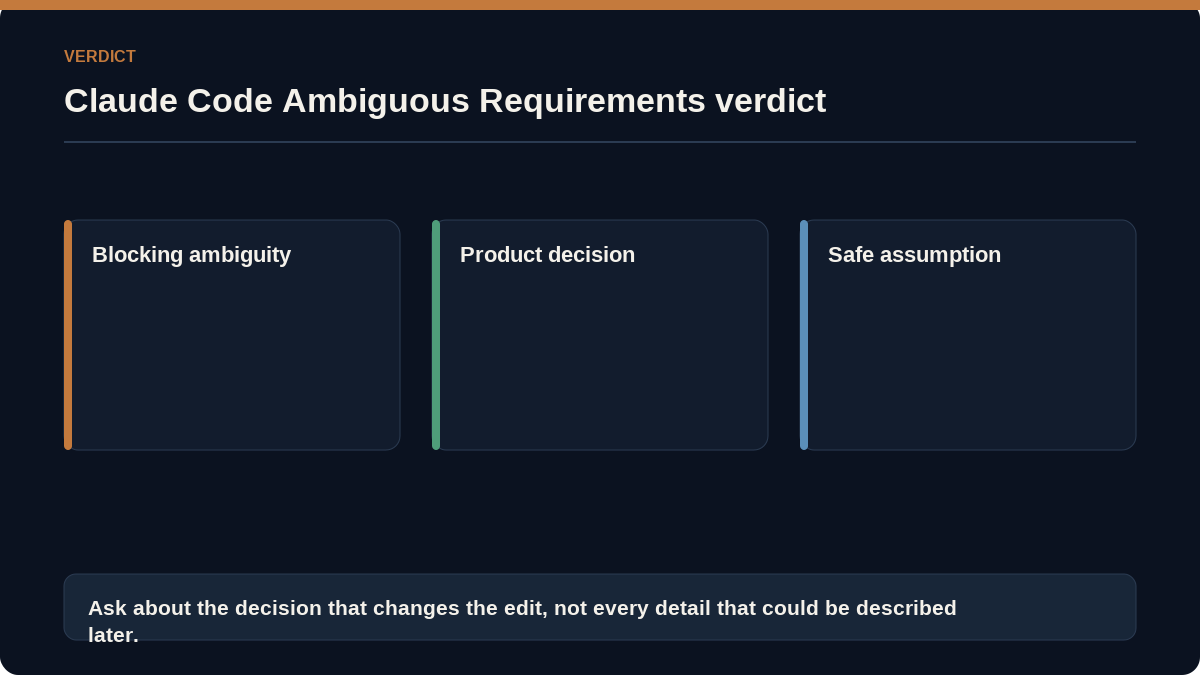
Clarify the smallest decision that would change the edit before asking Claude Code to implement an ambiguous requirement. Separate facts that can be discovered in the repository from product choices that need a human owner. Investigate the former, ask about the latter, and keep safe assumptions explicit.
For example, “add bulk project archive” leaves eligibility unclear. Code can reveal the current single-project archive path and permission checks. It cannot decide whether projects with active tasks should be archived, skipped, or rejected as a batch. That choice changes both behavior and interface.
Use plan mode to restate the interpretation before files change. Official documentation says it researches and proposes a plan without editing until approval (F014). Approval is a checkpoint, not proof that every ambiguity is gone. The practical verdict: resolve blocking policy first, investigate discoverable unknowns, and avoid asking about details that do not change the next decision.
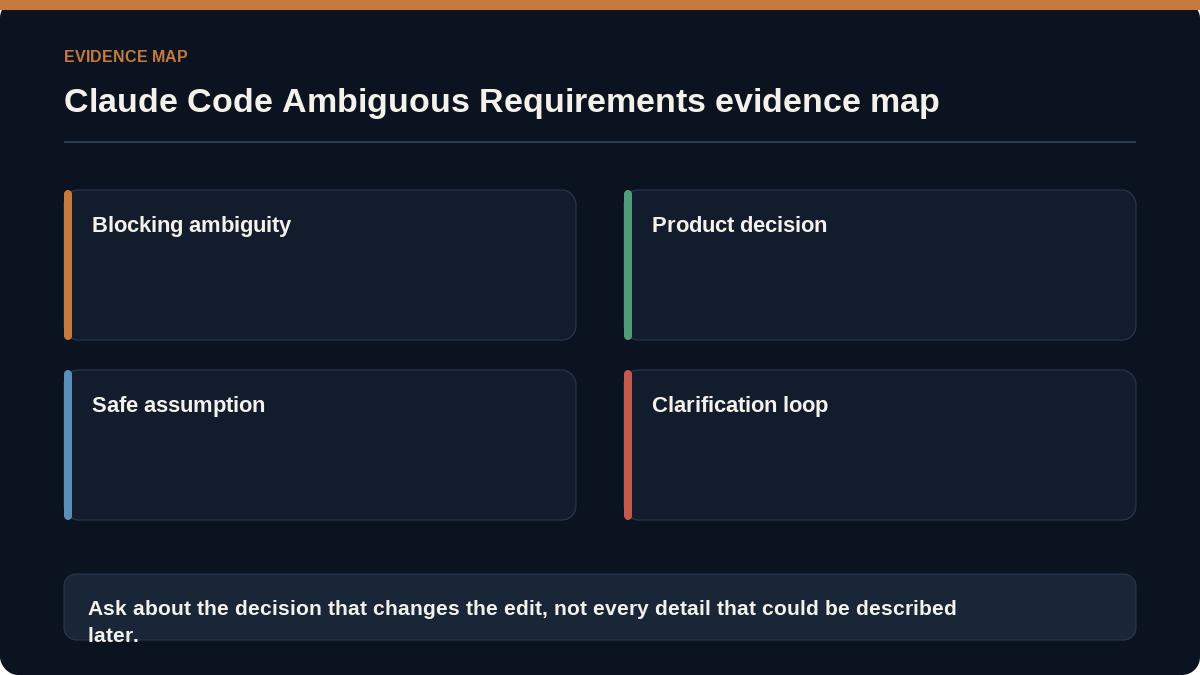
Spot wording that hides a decision
Words such as “smart,” “appropriate,” and “as needed” sound flexible while hiding ownership. They leave Claude Code to choose policy that may belong to a product manager, designer, or security owner.
A requirement can also hide a decision inside a technical noun. “Bulk archive” sounds like one feature, but it includes eligibility, partial success, confirmation, permission, and failure behavior. Each unanswered choice can produce a different implementation.
Listen for absolute terms as well. “Always,” “never,” and “all” may encode an unverified policy. “Archive all selected projects” raises the active-task question immediately. “Admins can archive projects” raises the definition of admin and the scope of permission.
The clarification target is not every vague word. It is the unresolved choice that would alter the code, data, interface, or risk of the task. A precise question about that choice is more useful than a request to “make the requirement clearer.”
Official, F013: The prompt engineering overview identifies a clear definition of success criteria as a prerequisite. A missing success criterion may require a product decision rather than better wording.
That caveat matters. Claude Code can help rewrite a sentence, but it should not invent the policy that makes the sentence complete. The Claude Code requirements guide supplies the observable-outcome frame; this article handles the decisions that frame cannot settle alone.
Evidence and its limits
Official, F013: Official prompting guidance treats clear success criteria as a starting point. It does not say that every missing criterion can be solved by prompting. Some gaps require an authorized human choice.
Official, F014: Claude Code common workflows says plan mode reads files and proposes a plan but makes no edits until the user approves. Research can still occur. The approval boundary concerns edits, not a guarantee that the plan is complete.
Independent, F015: A software requirements specification guide recommends documenting constraints and assumptions. This is search-index evidence only and vendor guidance, not a universal standard.
Official, F025: The same common-workflows guidance recommends starting exploration broadly and then narrowing with specific domain language. That supports a bounded investigation of code facts. It does not promise that the first narrow path is correct.
No verified community report is used. The research register contains no measured clarification-loop benchmark for Claude Code. The workflow below is an editorial method with explicit limits.
Separate code facts from product choices
A code fact can be answered by inspecting the repository. Which function performs the current archive action? Where is permission checked? Does the data model already include an archived state? Those questions belong to exploration.
A product choice determines what should happen. Should active projects be eligible? Should a mixed batch archive the eligible subset or fail as a whole? Should the interface warn before a destructive action? Code may reveal current patterns, but it cannot authorize a new policy.
The distinction prevents two failure modes. The first is interrupting the user for facts Claude Code can discover. The second is allowing Claude Code to make a product decision because the wording is vague.
| Question | Type | How to resolve | Why it matters |
|---|---|---|---|
| Where is single-project archive implemented? | Code fact | Inspect the current path | Identifies existing behavior |
| Which role may use bulk archive? | Product choice | Requirement owner confirms | Changes authorization scope |
| Does the schema have an archived state? | Code fact | Inspect model and migrations | Constrains implementation options |
| Are active projects eligible? | Product choice | Product owner decides | Changes batch result |
| What audit event already exists? | Code fact | Inspect current archive path | Preserves existing evidence |
| Is partial success acceptable? | Product choice | Product and engineering decide | Changes UI and data effects |
A useful investigation prompt says what to find and what not to decide. “Inspect the current archive path, permission check, and schema, then report the existing behavior. Do not choose eligibility policy.” That keeps discovery ahead of invention.
The Claude Code exploration plan guide goes deeper on bounded discovery. Here, exploration serves clarification by replacing guesses with repository evidence.
Ask the smallest blocking question
A blocking question changes the next edit. If two answers produce materially different files, data effects, or user-visible behavior, the requirement is not ready for implementation.
For bulk project archive, the smallest useful question may be: “Should projects with active tasks be eligible for bulk archive?” That one answer determines whether the batch needs filtering, rejection, or additional confirmation.
Avoid bundling several decisions into one question. “How should bulk archive handle permissions, active tasks, failures, and confirmation?” is really a requirements workshop. Ask the question that unblocks the plan, then record the remaining decisions with owners.
Offer concrete options when they are genuinely available. “Skip ineligible projects and archive the rest, or reject the entire batch?” is easier to answer than “What should happen?” The options should not hide a third reasonable answer, so leave room for the owner to reject the framing.
A good blocking question names the consequence. “This choice changes whether one request can produce partial data effects” explains why the answer matters without exaggerating the risk.
Official, F013: Clear success criteria are a prerequisite, but the missing criterion may be a policy decision. Better phrasing cannot substitute for an authorized answer.
The Claude Code ambiguity-free acceptance guide shows how a concrete example can expose this kind of choice before implementation.
Record assumptions that are safe to test
Not every unknown should block work. A safe assumption is narrow, reversible, and supported by existing evidence. It should be recorded so the reviewer can see where judgment entered the plan.
For bulk archive, reusing the current single-project permission check may be a safe starting assumption if the requirement owner confirms that bulk access should match single access. Preserving the existing audit event may be safe if the code shows that the event already records archive actions.
An assumption is not safe merely because it is easy to implement. Choosing to archive active projects would be a product decision, not a harmless default. Adding a new permission role would be a policy change, not a technical detail.
Record the owner and consequence of each assumption. If the assumption is wrong, the plan should change in a visible way rather than through an invisible implementation shortcut.
| Assumption | Evidence | Owner | Consequence if wrong |
|---|---|---|---|
| Bulk access matches current single-archive access | Existing permission path | Requirement owner | Revise role checks |
| Existing archived state is reused | Current schema | Engineering owner | Plan a data change |
| Current audit event remains | Existing archive path | Engineering owner | Add or revise event handling |
| Mixed batches use partial success | Product decision still open | Product owner | Change batch semantics |
F015 supports documenting assumptions and constraints, with the caveat that its evidence is search-index only. The table is an editorial format, not a standard imposed by the source.
The Claude Code plan revision guide explains what to do when evidence invalidates an assumption. Do not bury that revision inside execution.
Use exploration to narrow the unknown
Start with the domain language in the requirement. “Project archive” is more useful than a broad tour of the entire repository. Find the current action, its callers, its permission boundary, and its data effect, then stop when the blocking question can be stated precisely.
F025 recommends starting broad and narrowing with specific domain language. Apply that as a search strategy, not as permission to read everything. The output should be a small evidence set that changes the decision.
A useful exploration result names facts and uncertainties separately. “The current action sets archived_at and writes an audit event” is a code fact if verified in the repository. “The requirement does not say whether active tasks block archival” is a product gap.
Do not convert an observed pattern into policy automatically. If single-project archive currently permits active tasks, that may be a bug, a legacy choice, or the intended rule. The requirement owner must decide whether bulk archive should inherit it.
| Exploration step | Evidence sought | Stop condition |
|---|---|---|
| Locate current archive action | Function and caller | Current path identified |
| Inspect permission check | Role and guard | Existing access rule understood |
| Inspect data effect | State and related records | Consequences are visible |
| Compare single and bulk behavior | Reusable contract | Blocking policy question is precise |
The Claude Code context relevance guide explains why evidence should be selected by decision value rather than volume. Clarification improves when the investigation produces only facts that change the answer.
Worked example: bulk project archive
Suppose the request says, “Let admins archive projects in bulk.” The sentence names an actor and an action but leaves eligibility and batch semantics open.
A clarification pass could produce this record:
Discoverable facts: The repository has a single-project archive action, an existing permission check, and an archived state. Investigation must confirm the exact callers and side effects before planning. Blocking product decision: If a selection contains projects with active tasks, should the system skip those projects or reject the whole batch? Safe assumption: Reuse the current permission rule unless the requirement owner says bulk access differs. Deferred detail: Confirmation copy can follow the existing design pattern if no new policy is required. Evidence: The plan must show the selected projects, resulting archived projects, and unchanged projects for a mixed batch.
This record does not ask Claude Code to invent the answer. It identifies what code can establish and what the product owner must choose.
Derived arithmetic for the illustrative mixed batch: The user selects four projects. Two contain active tasks. Eligible projects = 4 - 2 = 2. Under partial-success policy, archived projects = 2 and unchanged projects = 2. Under all-or-none policy, archived projects = 0 and unchanged projects = 4. The policy choice changes the result even though the input is identical.
That contrast is the reason the question blocks implementation. A prompt that says only “handle active tasks” does not tell Claude Code which arithmetic outcome is acceptable.
The concrete win is a visible decision with a visible consequence. The concrete loss is that the example still depends on verified repository facts; if the current archive action has additional side effects, the assumption record must expand.
Approve the interpretation before editing
Once the blocking choice is answered, ask for a plan that restates the decision and its evidence. Official documentation says plan mode keeps edits closed until approval (F014).
Review the interpretation before the file list. A plan that confidently skips active projects has chosen partial success. A plan that rejects the whole batch has chosen all-or-none behavior. Either may be correct, but only one matches the approved requirement.
Ask the plan to list remaining assumptions. If an assumption would change the data effect or permission model, resolve it before approval. A lower-impact wording choice can remain open without turning the review into an endless requirements loop.
Approval does not remove all ambiguity. It establishes that a human accepted the current interpretation at a defined boundary. New evidence can still invalidate the plan, and execution can still drift.
The Claude Code plan mode guide provides the broader approval questions. For ambiguous requirements, the decisive question is: “Which product choice did this plan make, and who approved it?”
Update the brief when an answer changes scope
An answer can widen or narrow the task. If the owner chooses all-or-none behavior, the interface may need a batch validation step. If the owner chooses partial success, the result must identify skipped projects.
Update the requirement visibly. Replace the ambiguous sentence with the chosen outcome, record the owner, and note any new boundary. A silent update makes later review harder because the original uncertainty disappears from the record.
Do not treat every answer as a new project. Some answers simply clarify existing behavior. Others introduce a new role, data migration, or user-facing policy that deserves separate approval.
| Answer | Scope effect | Required update |
|---|---|---|
| Skip ineligible projects | Adds partial-result reporting | State skipped-project visibility |
| Reject the whole batch | Adds preflight validation | State no data effects on rejection |
| Reuse current permission | Narrows implementation | Name the existing rule |
| Add a new role | Widens policy and access | Seek separate authorization |
F015 supports recording constraints and assumptions, but the source is vendor guidance available only through search. The practical benefit comes from making the decision traceable, not from following a universal documentation standard.
Avoid open-ended clarification loops
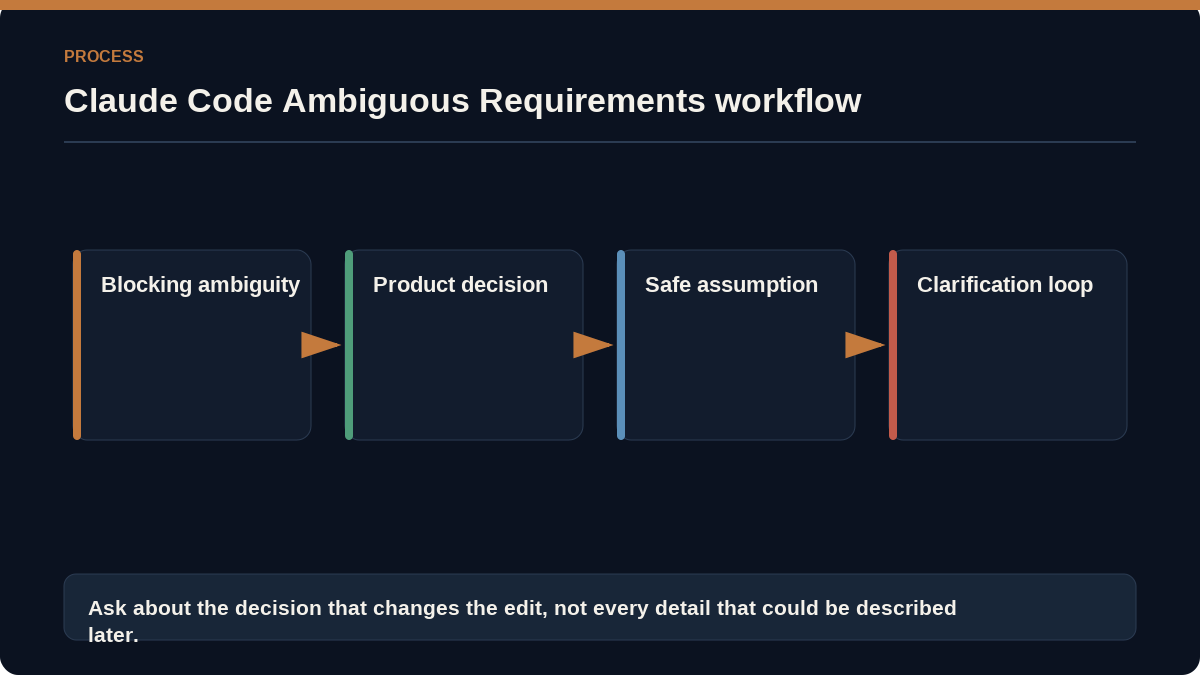
A clarification loop begins when each answer creates another question without moving the edit closer to a decision. Bound the pass by naming the blocking unknown, the owner, and the next action.
Ask whether the answer changes the current plan. If not, record it as a later detail or an explicit non-goal. If it does, update the brief and replan. The loop should end with a decision, an owner, or a documented stop.
Do not ask the user to confirm facts that Claude Code can inspect. Do not ask Claude Code to approve product policy. Do not reopen settled choices unless new evidence contradicts them.
| Question timing | Ask now? | Reason |
|---|---|---|
| Which archive function is used? | No, inspect first | Discoverable code fact |
| Are active projects eligible? | Yes | Blocking product choice |
| What button radius matches the design system? | Usually later | Does not change data behavior |
| Does a new role require separate approval? | Yes if the role is new | Authorization and scope change |
| Which internal helper name is clearest? | Usually no | Implementation detail unless constrained |
The Claude Code task checkpoint guide helps record state, blocker, and next action without repeating the whole conversation. A checkpoint is progress evidence, not completion proof.
Practical runbook
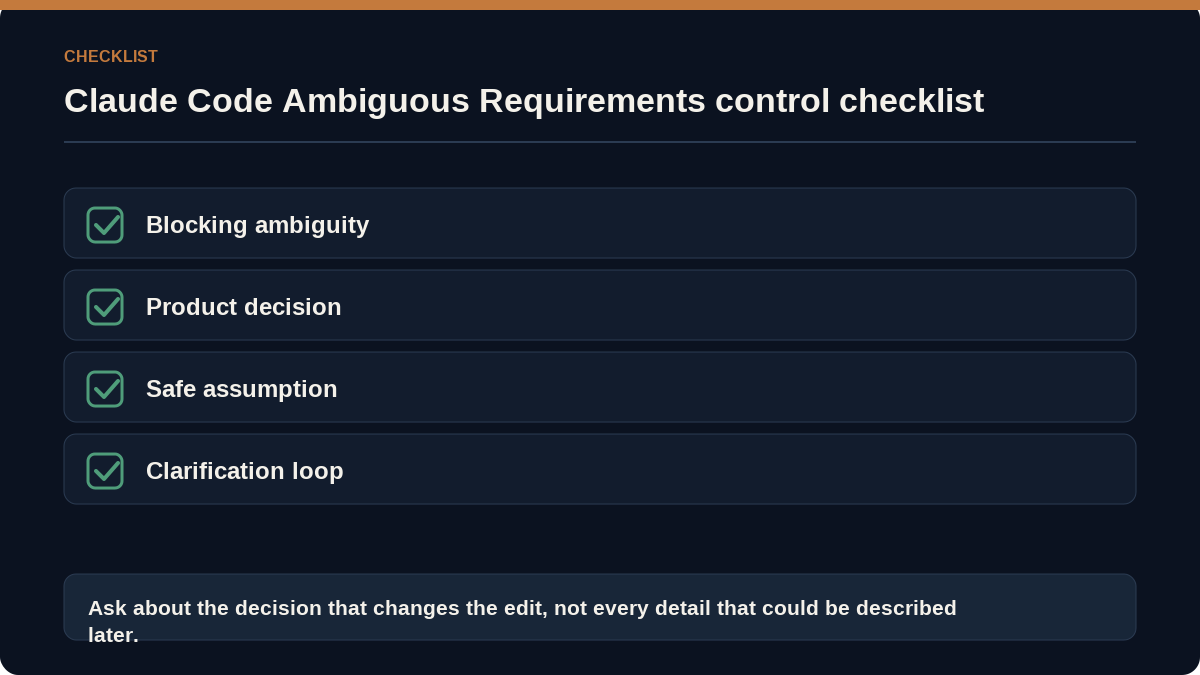
Use this sequence when a requirement contains unresolved policy.
- Underline decision words. Mark terms such as all, appropriate, and as needed.
- Classify each unknown. Separate repository facts from product choices.
- Investigate code facts. Use bounded domain language and stop when the decision is clear.
- Choose the blocking question. Ask only what changes the next edit.
- Offer honest options. Include consequences and room to reject the framing.
- Record safe assumptions. Name evidence, owner, and consequence.
- Restate the interpretation in plan mode. Review choices before files change.
- Approve, revise, or stop. Do not convert an unanswered policy into an implementation default.
- Update the brief. Keep the answer and its scope effect visible.
- Close the loop. Move nonblocking details to later work instead of asking endlessly.
| Gate | Pass condition | Failure response |
|---|---|---|
| Fact versus choice | Each unknown has a type | Split mixed questions |
| Blocking question | Answer changes the edit | Defer nonblocking detail |
| Assumption | Narrow and reversible | Resolve or narrow it |
| Plan | Product choices are explicit | Revise before approval |
| Loop | Next action is named | Stop or assign an owner |
The practical implication for a developer is to protect decision authority. Claude Code can speed up investigation and proposal, but a vague requirement should not silently transfer product policy to the implementation.
Concrete win, honest loss, and implication
Win: In the bulk-archive example, one question distinguishes two outcomes for the same four-project selection. The product owner can choose partial success or all-or-none behavior before either is coded.
Loss: Clarification can become overhead when every unknown is treated as blocking. F014 provides an edit approval boundary, not a complete requirements analysis, and F025 provides a search strategy rather than a guarantee that exploration found every relevant fact.
Implication: Use a clarification pass when different reasonable answers change data, permissions, interfaces, or durable side effects. Keep discovery bounded and ask the smallest question that unblocks the plan.
The Claude Code negative requirements guide helps preserve decisions once they are made. The Claude Code stop conditions guide helps end clarification when the agreed boundary is reached.
Connect clarification to the batch
A clear target comes from observable requirement outcomes. Separate blocks in goal, rule, and example prompt structure keep decisions visible.
Protected behavior belongs in negative requirements and scope boundaries. Concrete situations belong in acceptance examples with observable results.
Pointers become useful through prompt specificity for files, symbols, and exceptions. Approval belongs in plan mode before editing.
Discovery itself should follow exploration plans that resolve unknowns. Execution steps need checkable exit conditions.
Ordering constraints belong in read-before-edit dependencies. Invalidated assumptions require plan revision for new evidence.
Early work can use reversible planning with small steps. Persistent project guidance should stay essential in CLAUDE.md.
Narrow instructions benefit from progressive disclosure by path. Evidence selection should follow context relevance principles.
Contradictory instructions need clear precedence rules. Screenshots require written constraints alongside image evidence.
Add evidence through file references that reduce context noise. Existing inputs deserve a loaded-context audit.
When the answer depends on investigation, request evidence gathering before an answer. Independent reads may use parallel calls without conflicting state.
Supported integrations can use structured briefs. Tool results should satisfy evidence contracts rather than opaque status.
Deferred loading and schemas remain API-specific in deferred tool discovery and unambiguous tool schemas.
Long tasks need inspectable checkpoints. Edits should use exact target blocks and local style patterns.
Structural work should preserve refactoring behavior contracts. Finish at explicit stop conditions, then carry decisions through the session handoff guide.
Data gap and future update
The research register contains no verified benchmark for clarification passes, interruption frequency, or plan completeness. No time saving or defect reduction is claimed.
The requirements guide is search-index evidence only. Independent evidence is thinner than official product evidence, so a future editorial pass can replace it with an accessible primary requirements source if verified.
Official documentation is live. Recheck the cited pages before publication and keep plan approval separate from any claim that ambiguity has been eliminated.
One AI API Key option for OpenAI-format agents
One AI free IDs do not work as a Claude Code model source. Claude Code uses an Anthropic-format route, and the packet records Claude IDs as unavailable on 2026-11-27.
For a separate OpenAI-format agent, One AI API Key offers https://api.oneaiapikey.com/v1, one key, and 46 live free IDs. That option is a different integration path, not a Claude Code workaround. Review the free model list before choosing an agent route.
FAQ
Should every unknown become a user question?
No. Investigate discoverable code facts first. Ask the user only when a product choice changes the edit and cannot be resolved from approved requirements or existing policy.
Can plan mode resolve ambiguity by itself?
No. F014 says it researches and proposes a plan without editing until approval. The plan can expose assumptions, but a human still owns unresolved product decisions.
What makes an assumption safe?
It is narrow, reversible, supported by evidence, and recorded with an owner and consequence. Easy implementation alone does not make a policy assumption safe.
How do I stop a clarification loop?
Name the blocking decision, resolve it or assign an owner, update the brief, and defer details that do not change the next edit. End with a decision or an explicit stop, not another vague request for clarity.
Sources
- Official: Claude Code best practices, supporting precise investigation and evidence-oriented prompts.
- Official: Claude Code common workflows, supporting plan approval and bounded exploration (F014, F025).
- Official: Prompt engineering overview, supporting clear success criteria and the product-decision caveat (F013).
- Official: Claude prompting best practices, supporting explicit instructions and context structure.
- Independent: Software requirements specification guide, search-index evidence only for constraints and assumptions (F015).