Direct answer: put evidence-producing changes before durable commitments
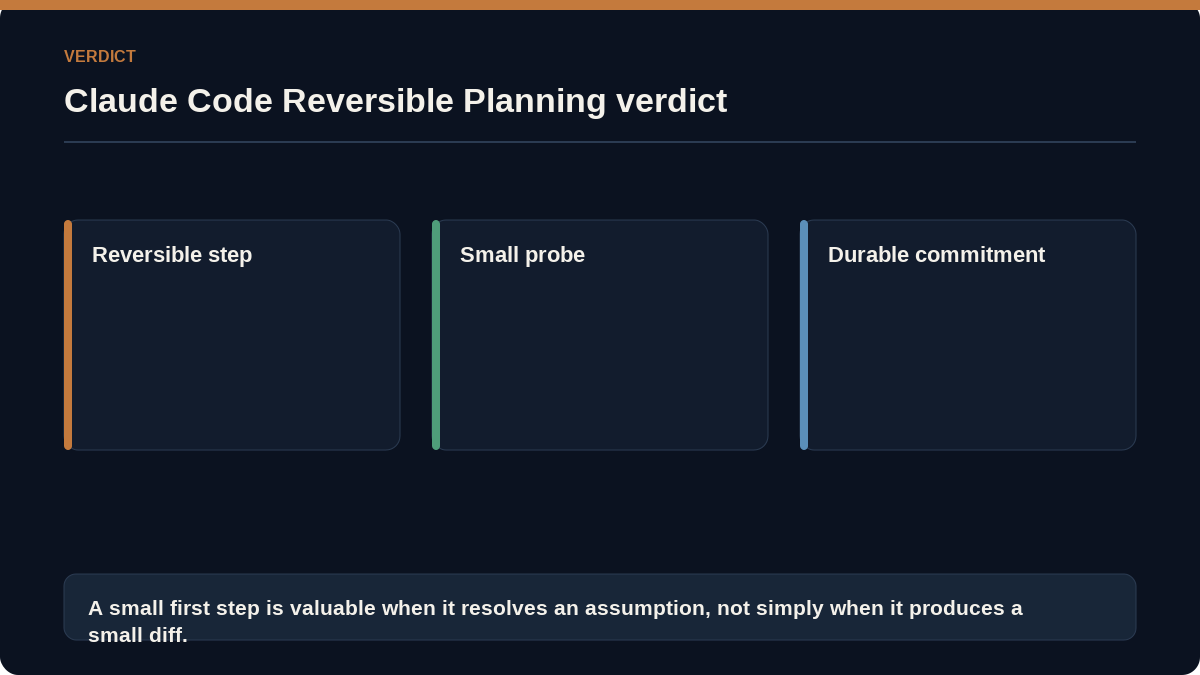
Sequence a Claude Code plan around reversibility by first resolving the assumption that could invalidate the most later work. Choose a small, observable step with a known way to undo it, inspect what that step reveals, and only then authorize broader changes. A small diff is not automatically safe, and an approval is not a rollback mechanism. The useful order is: identify the least understood behavior, run a bounded probe, assess the result, revise the plan, and expand scope only if the assumption still holds.
The approach has a direct engineering payoff. A wrong assumption costs an inspection and a reversal rather than a migration once an early step can be removed without changing a public contract. The loss is real too: extra inspection breaks add work, and some apparently local changes still touch shared state. Reversibility must be assessed for each proposed step, not inferred from its size.
Why the first step determines the cost of being wrong
A broad first edit can turn one unresolved question into several coupled corrections. Suppose the team has not decided which component owns a validation rule. If the first change spreads that rule through a form, a request handler, and a shared type, discovering a different owner later makes the correction touch all three locations. The problem is not simply the amount of generated code. It is the number of durable decisions hidden inside the first edit.
Small steps help by exposing a decision while the surrounding commitment is still limited. The refactoring chapter recommends small steps to reduce the chance of introducing bugs, which is independent process guidance rather than a Claude Code benchmark (F037, independent). Its caveat matters: a small transformation can still break behavior, and it can still modify state that is difficult to restore.
Official Claude Code guidance supports preparing a specification before implementation (F038, official). Plan mode separates proposing edits from making them until the user approves (F039, official). Together, those facts support a review boundary before execution. They do not establish a universal reversible-planning method, and approval does not make a change reversible.
Define reversibility as a property of the proposed step
Use three questions for every step:
- Restore path: What exact action would return the system to its previous state, and what evidence confirms that restoration?
- Blast radius: Which files, interfaces, stored records, or team decisions can this step change?
- Evidence yield: Which unresolved assumption will the result confirm, reject, or narrow?
The restore path should name a real boundary. Replacing a local helper may be reversible when the old behavior can be restored in the same file and no consumer depends on the new shape. Sending a notification may be hard to reverse because an external recipient has already observed it. Writing a durable record can also require compensation rather than deletion. These are planning judgments about the proposed system, not claims about Claude Code internals.
Evidence yield prevents a common mistake. A tiny formatting edit may be easy to reverse but tells the team nothing about the uncertain behavior. A slightly larger probe that reproduces the disputed input may be more valuable because it changes the next decision. The goal is not the smallest possible change. It is the earliest cheap disproof of the riskiest assumption.
Identify the least understood part
Start with the decision that has the most downstream dependents. Ask which unknown, if answered differently, would cause the largest rewrite. That is not always the least familiar file or the most complicated function. It is the assumption that currently holds the plan together.
For a proposed settings change, useful unknowns might include:
- Which existing type owns the value?
- Does the current form treat an empty value as absence or as an explicit choice?
- Is normalization performed before storage, after storage, or only during display?
- Which consumers rely on the current response shape?
These questions are discoverable through code for some projects. A policy choice, such as whether an empty value should clear a saved preference, may require a human decision. Do not disguise a product question as a technical probe. Record the unknown, name who can answer it, and distinguish code inspection from approval.
A practical prompt for the discovery pass is: “Read the files that own this behavior. Identify the current data path, the unresolved assumption, and the smallest inspection that would distinguish the plausible interpretations. Do not edit yet.” This is a suggested brief, not a guarantee that Claude Code will choose a particular tool sequence. The plan-mode workflow supplies the documented approval boundary (F039, official).
Choose a small observable change
An effective probe produces an inspectable result. The result might be a displayed value, a changed function signature in a local diff, or a short comparison of two code paths. “Explore the area” is not an exit condition because it does not say what observation ends the step.
Use this sentence shape: “Change only the local behavior needed to observe X, leave the public contract unchanged, and show the evidence that distinguishes A from B.” If the requested change cannot satisfy the scope sentence, split it again or return to discovery.
The plan should also name what the probe must not alter. Protected behavior might include an existing response shape, an unrelated screen, or a stored value. Reversible planning connects to negative requirements that protect scope without treating exclusions as automatic enforcement.
Step, reversibility, and evidence table
| Proposed step | Reversibility assessment | Evidence produced | Decision it can change |
|---|---|---|---|
| Read the owning form and its value type | No repository edit; inspection can be repeated | Current data path and named symbols | Whether the planned edit targets the right owner |
| Add a local display binding | Narrow file change if consumers and public shape stay unchanged | Observed empty-value and populated-value behavior | Whether display normalization belongs in the form |
| Change the shared value type | Potentially broad; every consumer must be inspected | Compile or inspection evidence about affected callers | Whether a shared contract change is necessary |
| Write to persistent storage | Requires a defined compensation or restore procedure | Stored-state evidence | Whether the proposed data model is acceptable |
| Publish a durable integration contract | Hard to reverse after consumers rely on it | Consumer compatibility evidence | Whether broader rollout can begin |
The table is an editorial decision aid, not a universal ranking. A local binding becomes less reversible if another system already imports it. A persistent write can be straightforward to reverse in a controlled test environment and costly in production. State the environment and the restore path rather than assigning a permanent label to a kind of edit.
Assess how each change can be reversed
Write the reverse action before requesting the forward action. For a file edit, the reverse action might be restoring the reviewed prior version and checking the affected behavior again. For a schema or interface change, the reverse action may require compatibility work rather than a simple file restoration. If no credible reverse action exists, mark the step as durable.
Do not rely on a tool name as proof of recoverability. The subject here is planning, not the limits of checkpoint or rewind features. Readers who need that separate comparison can use the guide to rewind limits and checkpoint boundaries, while keeping this plan focused on the system state each change can affect.
A reverse action also needs an inspection condition. “Undo the edit” is incomplete. A better statement is: “Restore the previous value path, then confirm that the existing form behavior and public response shape are unchanged.” The condition makes the reversal reviewable, although it still does not guarantee that the inspection will detect every regression.
Separate reversible exploration from durable change
Durable commitments include decisions that other work will depend on: a public response shape, a stored-data convention, a cross-team naming rule, or an external side effect. These can be valid and necessary. The planning error is placing them before the evidence that would justify them.
| Reversible exploration | Durable commitment | Why the order matters |
|---|---|---|
| Inspect a symbol and its callers | Rename an exported interface | Caller evidence should precede a contract change |
| Add a local adapter behind an existing boundary | Replace the boundary everywhere | The adapter can reveal missing cases before broad replacement |
| Demonstrate an interpretation with a bounded input | Store data in the new interpretation | Storage creates a restore and migration question |
| Compare two behaviors against the specification | Publish the selected behavior to consumers | Consumers make reversal more expensive |
Use the specification as the boundary between learning and committing. A specification can still contain assumptions, which is why a probe may send the work back for clarification. Ambiguous requirements deserve a clarification pass when the unknown is a product choice rather than a code fact.
Worked example: a settings form with an unresolved empty-value rule
The following is an illustrative repository scenario, not a reported result or benchmark. A team wants a display-name field to reflect a saved profile value. The unresolved question is whether clearing the field means “save an empty display name” or “keep the previous value.” That answer affects the form, the save path, and any consumer that reads the value.
A reversible plan starts with inspection:
- Read the current form, the profile value type, and the save path.
- Record how the existing form distinguishes an untouched field from a cleared field.
- Add only a local display binding that makes the distinction observable without changing stored data or the public response.
- Compare the populated and cleared cases against the proposed product rule.
- Stop if the code cannot represent the distinction without a broader contract change.
The local binding is the first edit because it tests the assumption without committing storage behavior. Its reverse action is to restore the previous form binding and inspect the same cases. If the product owner chooses the other interpretation, the team has learned that before changing the save path.
Here is a derived planning illustration. Assume the candidate plan has six steps: four bounded probes and two durable commitments. The share of steps placed before durable work is 4 / 6 = 0.667, or about 66.7%. The arithmetic is not a quality score and does not prove the sequence is safe. It simply makes the proposed order visible. A different plan could rationally place a durable preparatory step first if that step creates no external dependency and is easy to restore.
Use the result to refine the plan
After each probe, update the plan with three lines:
- Observed: What did the inspected state or behavior show?
- Changed: Which assumption was confirmed, rejected, or narrowed?
- Next: Which later step is now authorized, revised, or removed?
Marking a todo complete is less useful than that. Completion text records activity; the observation records evidence. Claude Code best practices supports asking for evidence rather than trusting a summary, and the separate guide on verification evidence when work is called done explains that boundary in more detail.
If the probe reveals another owner for the behavior, revise the target rather than forcing the original route. If it reveals that two product interpretations remain plausible, escalate the decision. The existence of new evidence does not mean every new file requires a new plan. The trigger is an assumption that changes the approved direction. The guide to replanning when evidence changes assumptions provides a companion decision process.
Assumption, probe, and next decision table
| Assumption | Small probe | Evidence to inspect | Next decision |
|---|---|---|---|
| The form owns the display rule | Read the form and its helper | Location of validation and normalization | Keep the edit local or include the helper |
| Empty and untouched values are distinguishable | Add a local observable binding | Behavior for populated, untouched, and cleared inputs | Request a product ruling or proceed with a stated rule |
| The save path preserves the distinction | Inspect the current save payload construction | Value sent by each input case | Keep storage unchanged or revise the contract |
| Consumers tolerate the proposed value shape | Read representative consumers | Assumptions about missing and empty values | Approve or reject the durable contract change |
Each probe has a stopping condition. Stop when the row’s question has an answer or when answering it requires a product decision. Do not keep reading merely because more related files exist. That is an evidence-selection problem, covered further in the guide to choosing the smallest useful evidence set.
Expand scope only after the assumption holds
Expansion should be an explicit approval point. Restate the evidence, the remaining durable changes, and the reverse path for those changes. If the evidence supports the original direction, request the broader edit with the same protected boundaries. If it does not, revise the specification before implementation.
A practical implication for a developer is to make the first implementation request narrower than the final feature. The first request should buy information. The second request should spend that information on a durable change. Turning every feature into a permanent sequence of tiny edits is what that avoids; the probe phase ends once the important assumption is resolved.
The loss is additional coordination. A team may spend time reviewing a probe whose answer seems obvious to an experienced maintainer. Use judgment: if the code directly answers the question and the product rule is settled, inspection may be enough. Small-step sequencing is most valuable when the cost of a wrong durable decision is materially larger than the cost of the probe.
Record what cannot be easily reversed
Keep a short durable-change record near the plan:
- The public or stored contract being changed.
- The consumers that will depend on it.
- The reason the evidence justifies committing now.
- The restore or compensation path, if one exists.
- The person who approves an irreversible or externally visible action.
Do not recommend an irreversible action without approval. If a step sends data, changes a shared interface, or removes a supported path, make that consequence explicit in the request. This is a scope and review practice, not a claim that Claude Code enforces the record.
Stop if the small step changes the product decision
A probe can expose a conflict that wording alone did not resolve. For example, the code may reveal that empty display names are meaningful elsewhere, while the requested feature assumes they are invalid. At that point, continuing the implementation would select a product policy by accident.
Stop the edit sequence and write the conflict plainly: “The existing path accepts X; the proposed requirement forbids X; the probe cannot choose between them.” Ask the owner to choose or narrow the requirement. This preserves the value of the probe. Turning it into an implementation guess wastes the evidence.
Practical reversible-planning checklist
Before approving the first edit:
- Name the least understood assumption and its downstream dependents.
- State an observable result for the probe.
- Name protected behavior and interfaces.
- Write the reverse action and its inspection condition.
- Mark external side effects and persistent writes as durable unless a credible compensation exists.
- Keep product decisions separate from code-discovery questions.
- Request approval for durable expansion after the evidence is recorded.
After the probe:
- Record what was observed, not only what was done.
- Revise or remove later steps that depended on a rejected assumption.
- Escalate unresolved policy conflicts.
- Expand only to the scope justified by the result.
- Keep the final review focused on the durable change and its remaining limits.
Concrete win, concrete loss, and implication
Win: In the illustrative settings case, a local display binding can reveal whether empty and untouched values are distinguishable before storage behavior changes. The team gains decision evidence while the public response remains outside the edit boundary.
Loss: Even a narrow binding can be coupled to a shared component, and inspecting or reversing it still takes work. Small-step guidance reduces exposure rather than eliminating bugs (F037, independent). If the real risk is an external side effect, a small local probe may not address it.
Implication: Put the highest-value disproof before the most dependent commitment. Treat the first edit as an experiment with an exit condition, not as the first installment of the whole feature.
Data gaps and future updates
No verified benchmark in this packet measures defect reduction, time saved, or token cost for reversible Claude Code plans. The 66.7% figure above is an explicitly illustrative ratio, not a measured outcome. No verified community issue is used, because the research register contains no issue with confirmed scope and outcome.
Official documentation supports specification-first work and the plan-mode approval boundary, but it does not define an automatic reversibility score or a universal probe size. A future update should revisit the live documentation and add measured examples only if their inputs, environment, and comparison method are available.
One AI API Key for a separate OpenAI-format agent
If your evaluation uses an OpenAI-format agent rather than Claude Code, One AI API Key offers a separate route at https://api.oneaiapikey.com/v1 with one key and 46 live free IDs as checked in this batch. Review the free model options and the OpenAI-format quickstart. This is not a model source for Claude Code, and the packet records Claude IDs as unavailable on 2026-11-27.
FAQ
Does a small Claude Code edit count as reversible?
No. Assess the restore path, affected consumers, stored state, and external effects. A small file change can still alter a shared contract. The independent small-step principle supports limited exposure, not guaranteed safety (F037).
Should every task begin with a reversible edit?
No. Start with inspection when the code answers the question. Add a reversible probe when an observable result would change a meaningful decision. Avoid ritual probes that do not reduce uncertainty.
Does plan mode make the first step reversible?
No. Plan mode keeps edits behind an approval boundary (F039, official). Approval authorizes direction; it does not supply a restore procedure or remove side effects.
When should the plan stop for a human decision?
Stop when the next step would choose between conflicting product policies. Code evidence can expose the conflict, but it cannot decide which policy the owner intends.
Batch reading path
For planning boundaries, read plan mode as an approval checkpoint, exploration plans that resolve unknowns, and plan dependencies that preserve read-before-edit order.
For stronger briefs, use observable requirement outcomes, goals, rules, and examples in prompt structure, prompt specificity through files and exceptions, and acceptance examples with observable results.
For execution quality, compare task steps with exit conditions, inspectable task checkpoints, and exact edit targets.
For context discipline, read essential CLAUDE.md instructions, path-scoped progressive disclosure, context relevance and evidence selection, and instruction precedence without guesswork.
For tool and scope decisions, see structured agent briefs, investigation before answers, independent parallel reads, evidence-shaped tool results, deferred API tool discovery, and unambiguous tool schema inputs.
For visual and final-boundary work, read image prompts with written constraints, file references without repository noise, loaded-context audits, style-preserving local edits, behavior-preserving refactor scope, and stop conditions at the agreed boundary.
Sources
- Refactoring chapter, independent source for small-step and behavior-preservation guidance.
- Claude Code best practices, official source for specification-first planning.
- Claude Code common workflows, official source for the plan-mode approval boundary.
- Software requirements specification guide, independent vendor guidance available through search-index evidence in this packet.
- Claude Code tools reference, official canonical reference; no detailed mechanics beyond the fact pack are asserted here.