Make a long Claude Code task inspectable by recording four things together: the current state, the evidence already inspected, the active blocker, and the next smallest action. Update task status from observation rather than optimism. A useful checkpoint helps someone decide what to do next in the same run. Completion, verification, and checkpoint frequency remain separate questions. Use checkpoints at changes in direction, dependency boundaries, and meaningful state changes.
Why long work becomes opaque
A long task can produce activity without a readable state. Files get inspected, a plan shifts, a partial edit appears, and the next action changes. A final summary may compress that history into a confident sentence. When the work is still active, the missing information is often not what happened in general. It is which evidence has already been inspected and what decision should happen next.
That opacity creates avoidable review work. A teammate may repeat a search because the checkpoint says only that research is underway. A reviewer may approve a task item because its label changed to complete, without checking the state the item was supposed to produce. An operator may continue after a failed assumption because no record names the assumption.
Checkpoints solve a narrower problem than session handoff. They keep the current run legible. Transferring context to another person and enforcing a hard task budget are outside this article. For those separate concerns, use the existing guides on sharing session context and advisory limits versus hard stops.
The practical unit is a state change. Reading another similar file may not deserve a new checkpoint. Discovering that the planned target does not exist does. Replacing one local value may be routine. Changing the implementation route after that edit fails is a decision boundary.
What the evidence supports
Official, F076: The Agent SDK todo-tracking page says item status is updated as Claude works. That makes status text a useful progress signal. The caveat is decisive: status is not independent proof that the work is correct. The source is Agent SDK documentation, so interactive UI behavior may differ.
Official, F077: The official prompting best practices describe chained prompts as a way to inspect intermediate outputs. That source describes API calls. The checkpoint format in this article is an editorial adaptation of the inspection principle, not a claim that Claude Code automatically creates these records.
Official, F078: Claude Code best practices recommends asking for evidence of completion rather than trusting a summary. Applied here, that principle supports recording the evidence behind a status change. Correctness still requires evidence beyond the record.
The supplied source register records Interactive mode as search-index-only official documentation and common workflows as fetched. No automatic checkpoint command is inferred from either page. The method below uses explicit progress records that a developer can request and inspect.
No verified benchmark in the packet measures checkpoint frequency, interruption recovery, or time saved. There is also no verified community issue used as evidence. The claims are limited to documented status updates, the value of intermediate inspection, and the evidence principle.
The four-field checkpoint
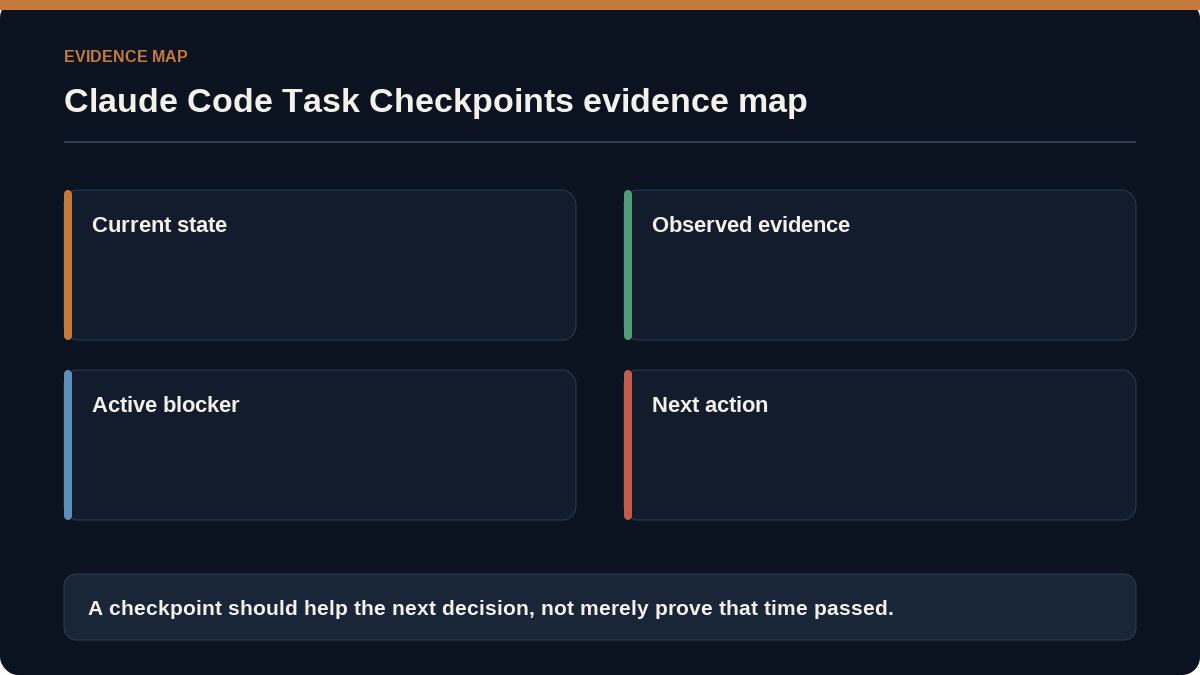
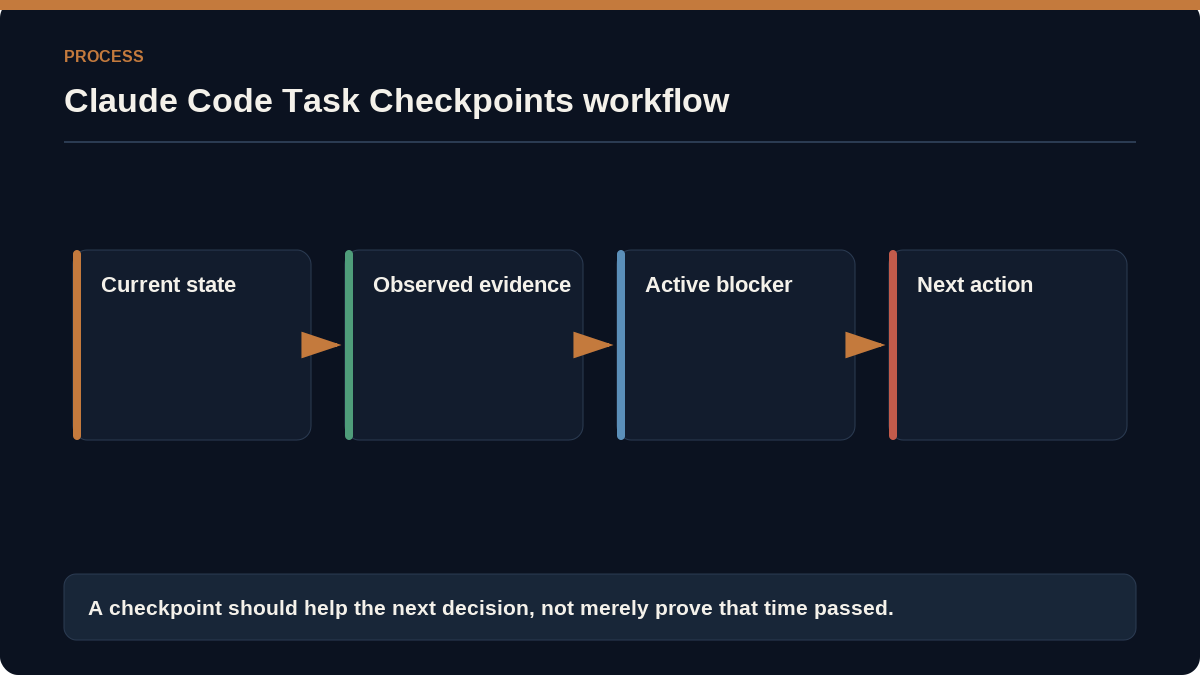
A checkpoint should be short enough to scan and specific enough to act on. Four fields carry most of the useful state:
- Current state: what has changed in the task or working tree.
- Observed evidence: what was actually read, run, or inspected.
- Active blocker: what prevents the next meaningful change, or none.
- Next action: the smallest step that advances or resolves the current decision.
The current objective sits above these fields. Without it, a detailed record can still describe the wrong task. The objective should name the requested outcome and its boundary, not merely the tool being used.
| Checkpoint field | Purpose | Weak entry | Useful entry |
|---|---|---|---|
| Current objective | Keep the requested outcome visible | Work on validation | Replace the duplicate validator in the named module |
| Current state | Record meaningful changes | In progress | Shared validator added; call sites not yet inspected |
| Observed evidence | Ground the next decision | Looked at files | Read both call sites and confirmed different accepted inputs |
| Active blocker | Expose the unresolved decision | Stuck | Unclear whether the legacy empty-string behavior is protected |
| Next action | Make progress inspectable | Continue | Ask whether empty strings must remain accepted before editing |
The example is illustrative. It shows the difference between activity labels and decision-ready state. Automatic production of this exact format by Claude Code is not established.
The task-breakdown guide supplies a useful companion idea: each step should produce an inspectable state change. A checkpoint records such a change. A todo label describes intent or progress. Neither alone establishes that the overall requirement has been met.
Define the current objective
Begin the checkpoint with a stable objective sentence. Naming the target, the intended change, and the most important exclusion comes first. That framing prevents later details from quietly redefining the task.
For example: “Consolidate duplicate validators in the named module without changing accepted input behavior.” That sentence gives the checkpoint a reference point. A newly discovered feature does not expand the objective automatically. The discovery becomes a deferred item or a decision request.
The requirements guide on observable outcomes helps make the objective reviewable. The negative-requirements guide helps protect behavior that the structural change must not alter. Use both when a long task could drift into cleanup or feature work.
Keep the objective stable across routine checkpoints. Change it only when the requested outcome itself changes. Should the route change while the outcome stays the same, update the plan or next action instead of rewriting the objective to match whatever happened.
Record completed state changes
Record changes that another person could inspect. A file created, a function replaced, a call site updated, or a definition narrowed are state changes when they correspond to the task. “Read more code” is usually an activity, not a completed state.
A strong entry names the target and the result. “Added the shared validator in validators.ts” is more useful than “made progress on refactoring.” “Updated the checkout call site to pass the normalized value” tells a reviewer where to look.
Do not equate a written item with a verified result. Uninspected edits should be labeled as such. A completed edit can coexist with an open review question. Keeping those facts separate makes the checkpoint honest without stopping all progress.
For structural work, reversible planning in small steps provides context for sequencing changes. The checkpoint records which step is complete. Safety and reversibility remain unproven by size alone.
State records should also mention adjacent work that was deliberately left alone. A short phrase such as “legacy export untouched” can protect a boundary during review. Especially useful when the requested change sits beside tempting cleanup, a short phrase like that holds the line.
Record evidence already inspected
The evidence field should identify what was inspected and what it established. A path alone is weak if several files share a name. A symbol or block name adds precision. A command result should be summarized by the relevant observation, not copied wholesale.
For example: “Read normalizeCode and both callers; both currently trim input before validation.” That entry supports a decision about preserving trimming order. “Investigated validation” does not.
Use the smallest evidence set that can change the next decision. The context-relevance guide explains why more files do not automatically mean better grounding. A checkpoint should point to evidence, not become a second repository index.
Evidence conflicts should stay visible rather than being smoothed over. One caller may treat an empty string as valid while another rejects it. Recording only the first inspected file would hide the precondition problem. The conflicting-instructions guide concerns instructions rather than code behavior, but its general lesson applies: do not settle a conflict by ignoring one side.
If evidence is missing, write “not yet inspected” or name the missing source. Unknown is a valid checkpoint state. Filling the gap with an assumption makes the next action harder to choose.
Record the active blocker
A blocker is not a feeling that the task is difficult. It is a specific condition that prevents the next meaningful change. Common forms include a missing file, an unresolved product decision, contradictory call-site behavior, or a failed precondition.
Write the blocker so the next person can test it. “Unclear whether empty strings are protected” can be resolved by inspecting existing behavior or asking the owner. “Refactoring is complicated” cannot.
Not every checkpoint needs a blocker. Write “none” when the next action is clear. This avoids inventing obstacles just to fill the field. It also distinguishes ordinary progress from a genuine decision boundary.
| Blocker | Evidence already inspected | Next smallest action |
|---|---|---|
| The planned target block is absent | Searched the named module and its exports | Reopen the plan and name the actual owning block |
| Callers disagree on accepted input | Read two callers with different guards | Ask which behavior is the protected contract |
| The next edit depends on a generated file | Found the generated header and source template | Ask whether generated output is in scope before editing it |
| No active blocker | Target and replacement contract are clear | Apply the single-block edit, then inspect its surroundings |
The table uses illustrative scenarios, not reported defects. Its purpose is to connect each blocker with evidence and an action rather than leaving a vague warning.
A blocker may also mark a scope decision. Useful cleanup outside the objective becomes deferred work. Do not perform it merely because it is adjacent. The stop-condition guide explains how to separate the desired end state from follow-up work.
Write the next smallest action
The next action should be executable without reopening the entire task. “Inspect the second caller’s empty-string guard” is better than “continue refactoring.” “Ask whether the generated file is protected” is better than “resolve issues.”
A small action has a visible finish. After it completes, the checkpoint can record new state or a new blocker. A chain of inspectable decisions results, without requiring a checkpoint after every read or edit.
Avoid prescribing a complex implementation in the next-action field. Its job is to identify the next move, not to hide a new design inside a progress note. When the route is uncertain, make exploration the action. The exploration-plan guide offers a bounded way to reduce that uncertainty.
Dependencies matter here. When the next edit consumes the result of a read, keep that order visible. The plan-dependencies guide explains producer-consumer relationships without claiming that API parallel-call formatting defines Claude Code scheduling.
Update task status from observation
A task item should change status when its exit condition has been observed. For an item that says “inspect both callers,” completion means both callers were read and their relevant behavior recorded. Correctness of the refactor remains a separate question.
This distinction prevents a common review error: treating a long list of completed items as a proof chain. Each item closes a defined step. The overall requirement remains the source of truth.
| Reported status | Observed state | Appropriate checkpoint wording |
|---|---|---|
| In progress | Search has started but no owning block is confirmed | Target search active; next evidence is the module export list |
| Completed | Both callers were inspected and their guards recorded | Caller inspection complete; behavior conflict remains open |
| Blocked | Product owner must choose the protected empty-string behavior | Decision requested; no edit applied to that branch |
| Completed | Shared validator edit applied and surrounding region read | Edit and local inspection complete; broader acceptance still outside this item |
The wording is illustrative. Built-in status labels and identical interactive controls are not established by it. F076 supports the general fact that Agent SDK item status is updated as work proceeds.
Ask for the evidence behind a status change when the summary is vague. F078 supports that evidence-first review habit. Keep the request focused: “Which observed state closes this item?” is more useful than demanding a longer narrative.
A worked checkpoint sequence
Suppose the task is to consolidate duplicate validation in one module while preserving accepted inputs. The following sequence is illustrative. No live run or verified issue outcome is described here.
Objective: Consolidate duplicate validators without changing accepted inputs.
State: Exploration complete; no edit applied.
Evidence: Read the shared validator and two callers. Both callers trim first.
Blocker: One caller permits an empty string; the other rejects it.
Next action: Ask which empty-string behavior belongs to the protected contract.
That checkpoint makes the decision visible. A less useful version would say “refactor in progress.” The reader would have to repeat the inspection to discover the conflict.
After the owner answers, the next checkpoint can record the decision and the planned structural change:
Objective: Consolidate duplicate validators without changing accepted inputs.
State: Contract clarified; ready for the first edit.
Evidence: Owner confirmed that the rejecting caller defines current protected behavior.
Blocker: None.
Next action: Replace only the named validator block, then inspect its callers.
The record does not claim the edit succeeded. It identifies the next observable state. After the edit, the checkpoint should name the edited block and any remaining call-site work.
This sequence reflects the inspection principle in F077 without claiming that chained API prompts and interactive checkpoints are the same mechanism. It also keeps completion evidence separate from status text, as required by the F076 and F078 caveats.
Avoid checkpoint busywork
A checkpoint after every trivial action creates noise. The record becomes longer than the work, and meaningful changes get buried among repeated statements. Use event boundaries instead.
Good checkpoint moments include:
- A blocking unknown is resolved.
- The planned route changes because evidence invalidated an assumption.
- A meaningful edit is applied and inspected.
- A new dependency or scope decision appears.
- Work pauses and the next action must remain clear.
A routine read inside the same investigation usually does not need its own checkpoint. Neither does a formatting-only adjustment that does not change the task state. The test is whether the record helps the next decision.
Keep each checkpoint short. If a field needs several paragraphs, the underlying plan or evidence reference probably needs restructuring. Link to the relevant block or record rather than copying large output.
Checkpoint writing should not become an alternate task. Should the record start adding new cleanup, new abstractions, or unrelated analysis, return to the objective. The style-preserving edit guide is useful when the progress record itself begins copying inconsistent local formats.
Resume from the recorded state
To resume, read the objective first, then the observed evidence, then the blocker and next action. Recheck evidence that may have changed outside the session. A checkpoint is a map to state, not a guarantee that the state is still current.
Do not restart the whole investigation merely because the work paused. Start from the named next action and expand only if it fails. This keeps the resume focused while leaving room for new evidence.
When recorded state conflicts with current files, update the checkpoint with the discrepancy. Do not silently rewrite history. The plan-revision guide explains when new evidence should change an approved direction rather than merely alter execution details.
A resume review should ask:
- Does the objective still match the requested outcome?
- Are the recorded state changes present?
- Does the cited evidence still support the next decision?
- Is the blocker still active?
- Is the next action still the smallest useful move?
These questions are a review aid, not a promise that resuming will reproduce a prior result.
Keep evidence references stable
A checkpoint should point to evidence that another reader can find again. Prefer a path plus symbol, a named block, or a specific observed result over a vague phrase such as the validator. Stable references reduce the work needed to resume.
Avoid copying large command output into the checkpoint. Summarize the observation that matters and keep the source available through the session or project record. The file-reference guide explains the difference between a useful pointer and bulk context.
When an evidence reference changes, update the checkpoint instead of leaving two competing locations. A stale pointer can send the next action to the wrong block even when the objective is correct.
Concrete win, loss, and implication
Win: During a validation refactor, a checkpoint records that two callers disagree about empty strings. The next action becomes a product decision instead of another speculative edit. The win is avoided rework and a visible decision, not a measured speed increase.
Loss: A checkpoint can be perfectly formatted and still be stale or wrong. A todo item marked complete can describe an edit that was never inspected. The loss is false confidence in the record itself. Evidence must be rechecked when it matters.
Implication: Use checkpoints as decision aids inside a run. Objective, state, evidence, blocker, and next action belong together. Mark status from observed exit conditions, and keep deferred work out of the active path. A short truthful record is more useful than a detailed narrative that hides uncertainty.
Data gap and future update
The supplied research contains no verified benchmark for checkpoint formats, update frequency, or recovery time. Universal interactive UI behavior remains unestablished by Agent SDK documentation. No community report is presented as evidence.
A future update should compare explicit checkpoint practices on named integration surfaces, with reproducible task examples and observed outcomes. It should separate Agent SDK behavior from interactive Claude Code behavior and avoid treating status labels as completion proof. Documentation should be rechecked before publication because the sources are live.
Until such evidence exists, the four-field format remains an editorial workflow. Its value can be judged by whether it makes the next decision clearer, not by an invented success rate.
One AI option for OpenAI-format agents
For a separate OpenAI-format agent project, One AI offers one key and 46 live free IDs through https://api.oneaiapikey.com/v1. Use the free model list to inspect that OpenAI-format option, or follow the OpenAI-format quickstart. This is not a Claude Code model route. The packet records the Claude IDs as unavailable on 2026-11-27, and the free IDs must not be described as working inside Claude Code.
FAQ
When should I write a checkpoint?
Write one when a meaningful state change, resolved blocker, plan change, or pause affects the next decision. Routine reads and edits inside the same step usually do not need separate records.
Is a completed todo item proof that the task is done?
No. F076 describes status updates as progress signals. An item closes its defined step, while the overall requirement still needs evidence tied to its own exit condition.
Does Claude Code automatically create this four-field checkpoint?
Not according to the supplied evidence. The format is an editorial adaptation. F077 supports inspecting intermediate outputs through chained API prompts, not an automatic interactive checkpoint feature.
What makes a blocker useful?
A useful blocker names a condition that can be tested or resolved. Pair it with inspected evidence and the next smallest action instead of writing a general statement that work is difficult.
Connect checkpoint practice to the batch
Start with observable requirements, goals, rules, and examples, and negative requirements. Use acceptance examples, clarification before choosing, and prompt specificity to make the objective and evidence concrete.
For planning, read structured agent briefs, plan-mode approval, bounded exploration plans, and task exit conditions. Keep dependencies explicit through reads before dependent edits, and revise direction through new-evidence replanning.
For tool work, compare investigation before answering, independent parallel reads, evidence-bearing tool results, and on-demand tool definitions. The unambiguous schema guide helps make the next tool call meaningful.
For edit quality, continue with exact block targets, local style patterns, behavior-preserving refactor scope, and agreed stopping boundaries. These determine which state changes belong in the checkpoint and which work should remain deferred.
More Claude Code troubleshooting
- Claude Code CLAUDE.md: Keep Only Instructions Every Task Needs
- Claude Code Progressive Disclosure: Scope Rules to Relevant Files
- Claude Code Image Prompts: Pair Visual Evidence With Written Constraints
- Claude Code Context Audit: Inspect Loaded Files Before Adding More
Sources
- Track todos, official. Supports F076; search-index-only in the supplied register and scoped to Agent SDK evidence.
- Claude Code best practices, official. Supports F078 and the request for completion evidence.
- Claude prompting best practices, official. Supports F077 with an API-chain caveat.
- Interactive mode, official. Search-index-only in the supplied register; no automatic checkpoint mechanic inferred.
- Claude Code common workflows, official. Fetched source; no automatic checkpoint mechanic inferred.