Direct answer
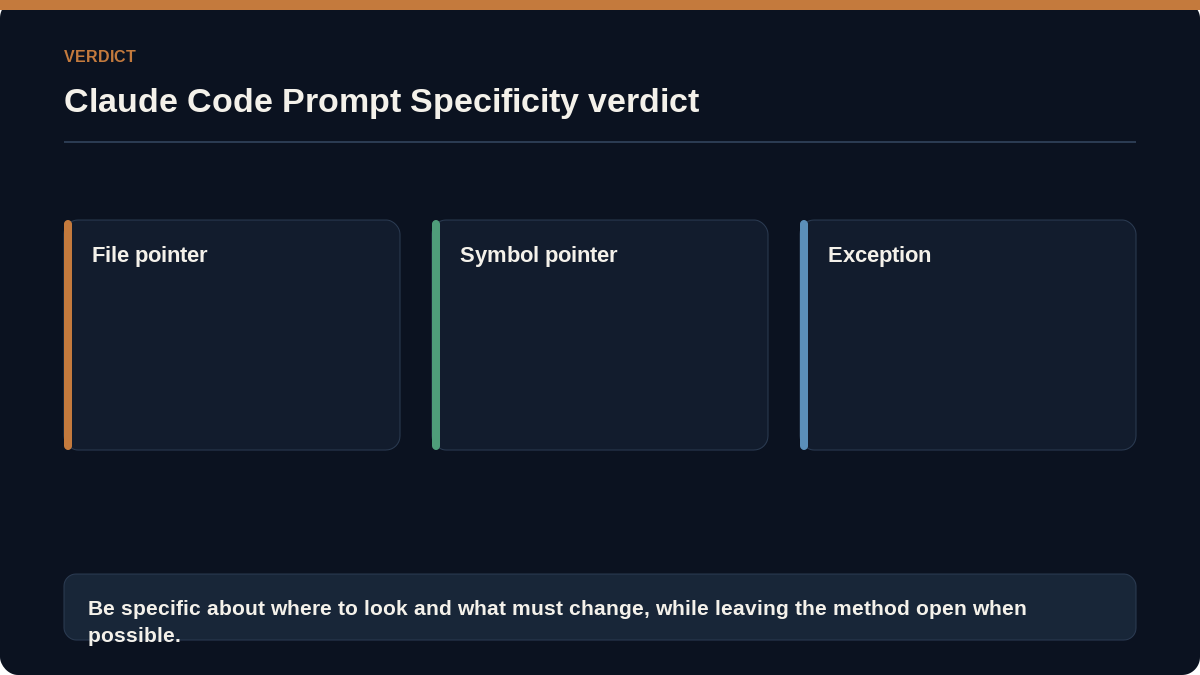
Make a Claude Code prompt specific about evidence, not every implementation step. Name the likely file or entry point, the relevant symbol, the observable symptom, and the exception that matters. Then state the required outcome while leaving the method open where the codebase can decide it.
For example: “Start from the illustrative invoice-export.ts path and serializeInvoiceRow symbol. The exported due date uses the wrong timezone for accounts outside the default. Credit rows have no due date and must keep the existing blank representation. Preserve stored values and unrelated date fields. Investigate related callers before choosing the fix.”
This is more actionable than “fix the export,” but it is not a guarantee. A named file can be wrong, a symbol can have several callers, and an exception can expose a missing product rule. Specificity should focus investigation and review, not micromanage the edit.
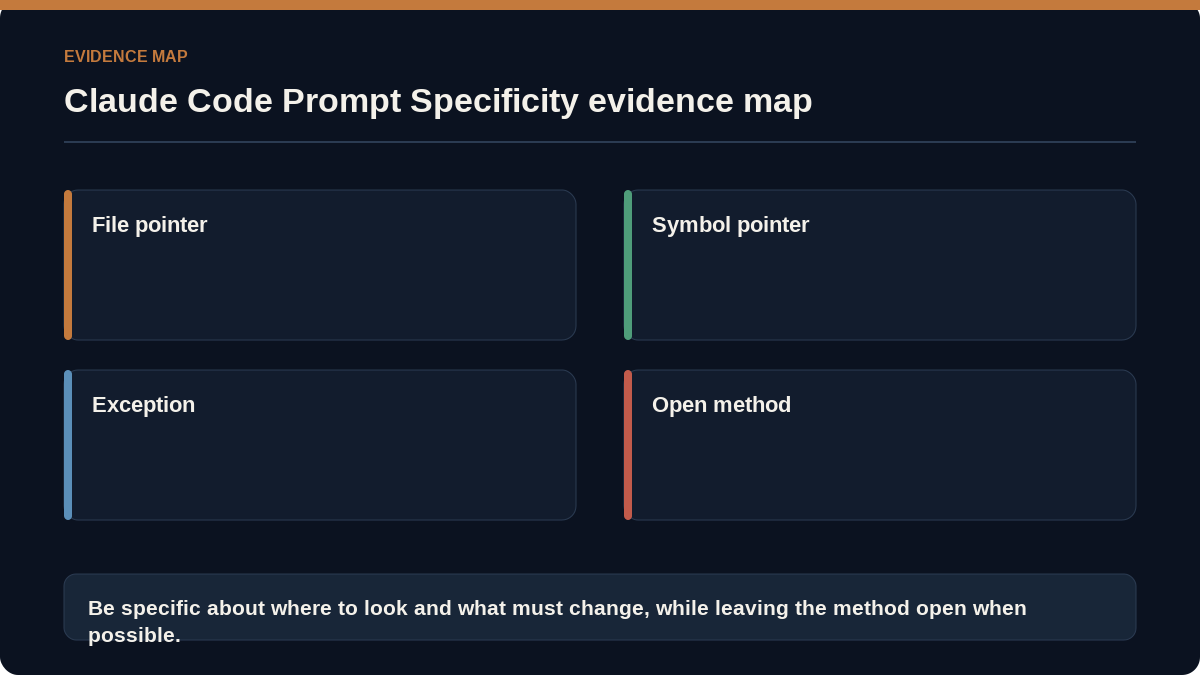
Recognize broad location language
Broad wording forces Claude Code to begin with location discovery. “Fix the export,” “update the handler,” and “clean up dates” can each refer to several files, symbols, or behaviors.
Broad language also hides the symptom. A date problem might be storage, parsing, formatting, or display. Naming the observed output helps distinguish those possibilities without prescribing the cause.
The goal is not to perform the search mentally before every task. It is to give the investigation a useful starting point and a clear stopping question. If the named location is only a guess, label it as a starting point.
A specific prompt can still be wrong. Official best practices recommends precise prompts with file names and symptoms, while the fact pack cautions that a prompt can point at the wrong location (F016). Treat specificity as a hypothesis supported by evidence.
The Claude Code monorepo search guide covers broader search mechanics. This article stays with the wording that makes a task easier to investigate, not with repository-wide search strategy.
Evidence and its limits
Official, F016: Claude Code best practices recommends precise prompts that include file names and symptoms. The guidance supports concrete starting evidence. It does not prove that the named file contains the only relevant logic.
Official, F017: The memory documentation favors instructions concrete enough to verify over vague wording. Here, verifiability concerns the instruction: a reviewer can tell what it asks for. It is not proof that the task succeeded.
Official, F018: Claude prompting best practices suggests showing the prompt to a colleague with minimal task context as a clarity check. That is a heuristic, not a validation benchmark.
Official, F055: Claude Code best practices recommends including relevant files through @ mentions or piped output. The source does not say that larger inclusions are always better, so relevance still has to be judged against the task.
No verified community report is used. The research register contains no measured comparison of broad and specific prompts for edit accuracy or investigation time. The examples below are editorial applications of the cited guidance.
Name the file or entry point
A file pointer reduces the initial search space. Use a path you have verified, or label an uncertain path as the place where the symptom was observed rather than the guaranteed cause.
An entry point can be more useful than a guessed implementation file. A route, command, screen, or job may identify where the behavior begins even when several modules contribute to it.
Pair the location with its role. “Start from the invoice export handler that builds the downloaded file” tells Claude Code why the path matters. A bare list of files leaves the relationship unclear.
Do not assume the named file is the only relevant file. Shared formatters, call sites, types, and tests may change the interpretation. Ask the investigation to follow evidence beyond the starting point when the symptom requires it.
| Broad pointer | Concrete starting pointer | Remaining investigation |
|---|---|---|
| Fix the export | Start from the invoice export entry point | Follow the formatter and response path |
| Update the handler | Start from the request handler that emits the error | Inspect shared validation and callers |
| Change the date display | Start from the component that renders the due date | Check the source value and timezone helper |
| Fix the command | Start from the command entry point and observed failure | Follow configuration and dependent modules |
The Claude Code edit target guide goes deeper on unique replacement anchors. A file pointer identifies an area; an edit target identifies a precise block within it.
Name the symbol or observable symptom
A symbol pointer is useful when it is stable and meaningful. A function, class, type, or constant can narrow the investigation more than a file alone. Verify the symbol before relying on it.
A symptom pointer is useful when the internal cause is unknown. “The exported due date shifts for accounts outside the default timezone” describes observable behavior without claiming which function is wrong.
Symbols and symptoms serve different situations. Use a symbol when the code vocabulary is known. Use a symptom when the report comes from a user, log, or interface and the implementation path is uncertain.
Avoid inventing a symbol to make the prompt sound precise. If the function name is a guess, say “the function that serializes each exported invoice row” and let investigation identify it.
Official, F016: File names and symptoms are both supported forms of precision. A symptom can be accurate while the assumed cause is wrong, so keep the required outcome separate from the diagnosis.
A strong prompt lets both facts coexist: “The observed symptom is a shifted due date, and serializeInvoiceRow is the current serialization point to inspect.” That wording does not claim the symbol must contain the bug.
The Claude Code tool choice guide explains how to ask for evidence gathering before an answer. Specificity gives that investigation a clearer target.
State the exception that matters
An exception names the case that should not follow the normal rule. It is often where vague prompts fail because the implementation applies the main behavior everywhere.
For invoice dates, credit rows may have no due date. A prompt that says only “use the account timezone” leaves the blank representation undecided. Adding “credit rows keep the existing blank representation” prevents an invented date or a changed schema.
An exception should be concrete and justified. “Handle edge cases” is not an exception. “Keep the current blank value when the source has no due date” is reviewable.
Do not add exceptions that do not affect the requirement. A long catalogue of hypothetical cases can obscure the important one and create work that was never requested.
| Normal rule | Exception | Observable boundary |
|---|---|---|
| Due dates use the account timezone | Credit rows have no due date | Existing blank representation remains |
| Selected rows are exported | Ineligible rows are excluded | Excluded rows do not appear |
| Validation errors appear inline | Permission refusal follows existing policy | No new permission behavior is invented |
| Updated labels use the new term | Legal field names stay fixed | Interface contract remains stable |
The Claude Code negative requirements guide helps turn exceptions into protected behavior. The acceptance examples guide shows how to make them concrete.
Separate required outcome from suggested method
Specificity becomes micromanagement when every sentence dictates an implementation choice. The prompt should say what evidence matters and what result is required, then leave room for investigation to select the method.
A useful method note can be labeled as a suggestion. “Consider the existing timezone helper, but follow the actual call path before deciding” gives Claude Code a lead without making the helper mandatory.
A real technical constraint is different. If a public function signature cannot change, state that as a rule. If a dependency cannot be added, state the boundary. The distinction is whether the method is required by the system or merely preferred by the author.
Review the prompt for hidden implementation demands. Words such as “by,” “using,” and “inside” often introduce a method. Keep them only when the method is part of the requirement.
| Detail | Helps investigation | Overconstrains when |
|---|---|---|
| File path | Points at observed evidence | Treated as the only possible location |
| Symbol name | Identifies current code vocabulary | Assumed to be the cause without inspection |
| Symptom | Defines observable failure | Rewritten as an unverified diagnosis |
| Exception | Protects a meaningful case | Added without product relevance |
| Suggested helper | Offers a lead | Treated as mandatory without a constraint |
| Exact step list | Rarely needed in the requirement | Replaces the outcome with a prescribed edit |
F017 favors concrete, verifiable instructions, but verifiability is not the same as prescribing every step. A reviewer can verify an outcome and a boundary without knowing the final helper structure in advance.
Use file references when they help
F055 supports relevant file inclusion through @ mentions or piped output. Use that capability when the file’s contents are necessary to understand the task and the amount of material is proportionate.
A reference is a pointer to evidence, not a reason to attach the whole module. If a short excerpt contains the relevant symbol and symptom, prefer it to a large unrelated file dump.
Keep secrets and sensitive output out of the prompt. If piped output contains credentials or private data, sanitize it before inclusion. Specificity should reduce ambiguity, not expand exposure.
The Claude Code file reference guide covers evidence selection in more depth. Its central distinction applies here: mention what can change the answer, not everything that might be related.
A practical format is:
Starting evidence:
src/exports/invoice-export.tsand the current output fixture. Observed symptom: due dates shift for non-default account timezones. Open question: which shared formatter owns the conversion?
That format distinguishes evidence, observation, and uncertainty. It gives Claude Code permission to investigate without treating the initial file guess as a final answer.
Check whether the prompt still leaves room to investigate
Read the prompt once as an implementer. If every decision has already been made, the prompt may be an implementation plan rather than a requirement. If no decision has been made, it may still be too vague.
Look for three things: a starting location, an observable problem, and a required result. Exceptions and boundaries should be present where they matter. The method should remain open unless a real constraint closes it.
F018 recommends a fresh-reader check with minimal task context. Ask the reader to identify the symptom, the likely starting point, and the exception. If the reader cannot tell whether the named file is a guess or a verified cause, revise the wording.
The check is not a benchmark. It is a way to expose language that only makes sense to someone already familiar with the task.
The Claude Code prompt structure guide helps separate evidence from rules and examples. Specific pointers belong in context; required behavior belongs in the goal and rules.
Worked example: a precise export-date brief
Suppose the original request says, “Dates are wrong in the invoice export.” The sentence identifies an area and a symptom but gives no location, exception, or protected behavior.
A more specific brief could read:
Starting evidence: In this illustrative repository, begin with
src/exports/invoice-export.tsand the symbolserializeInvoiceRow. Treat both as current pointers to verify, not proof of the cause. Observed symptom: Exported due dates use the wrong timezone for accounts outside the default timezone. Exception: Credit rows have no due date and keep the existing blank representation. Required outcome: Exported due dates reflect the account timezone while stored values and unrelated date fields remain unchanged. Method boundary: Investigate the existing conversion path and related callers before choosing the fix. Do not redesign the export schema. Evidence: Inspect a dated invoice row and a credit row in the resulting export.
The paths and symbol are illustrative, not claims about the reader’s repository. Their purpose is to show how a pointer can be precise without pretending to know the implementation.
Derived arithmetic for the fixture: The export contains three rows. One is a credit row with no due date, so dated rows = 3 - 1 = 2. Both dated rows should reflect their account timezone, while blank due-date rows = 1. This arithmetic checks the example’s exception handling; it is not a measured bug rate.
A reviewer can now inspect the relevant outcomes without requiring a particular helper. If investigation shows that conversion happens before serialization, the plan should say so and update the context rather than forcing an edit into the guessed symbol.
The concrete win is a smaller, better-framed investigation. The concrete loss is that a verified-looking path and symbol can still create anchoring, especially if the prompt does not label them as starting evidence.
Revise the prompt after new evidence appears
New evidence should change the brief when it changes the location, symptom, exception, or method boundary. Keep the required outcome stable unless the requirement owner changes it.
A useful revision names the old assumption and the new evidence. “The export delegates formatting to the shared date formatter, so the context now includes that call site” is clearer than silently replacing the file pointer.
Do not widen the task just because a related file was discovered. Add the file when it changes the answer, and explain why. The Claude Code plan revision guide covers when a changed assumption requires fresh approval.
Official plan-mode documentation says Claude Code can research and propose changes without editing until approval (F014). Use that checkpoint to review the revised evidence before implementation.
| New evidence | Prompt update | Scope decision |
|---|---|---|
| Named symbol delegates formatting | Add the formatter as related context | Keep the same outcome |
| Credit rows use a separate type | Refine the exception | Preserve blank representation |
| Stored value is already correct | Narrow symptom to export formatting | Avoid data migration |
| Shared formatter affects other exports | Surface caller impact | Approve or narrow the method |
The Claude Code ambiguity clarification guide helps when new evidence exposes a product choice rather than a code fact. Do not resolve policy by adding more technical detail to the prompt.
Practical specificity checklist
Use this checklist before sending a prompt that needs investigation.
| Check | Pass condition | Failure response |
|---|---|---|
| Starting location | Verified path or labeled guess | Replace broad area language |
| Symbol | Current name or functional description | Avoid invented identifiers |
| Symptom | Observable behavior is stated | Separate diagnosis from outcome |
| Exception | Consequential special case is named | Remove generic edge-case wording |
| Outcome | Required result is explicit | Replace adjectives with state changes |
| Method | Open unless constrained | Remove unnecessary step lists |
| Evidence | Relevant files or output only | Reduce unrelated inclusion |
| Fresh reader | Roles are understood | Clarify guess versus fact |
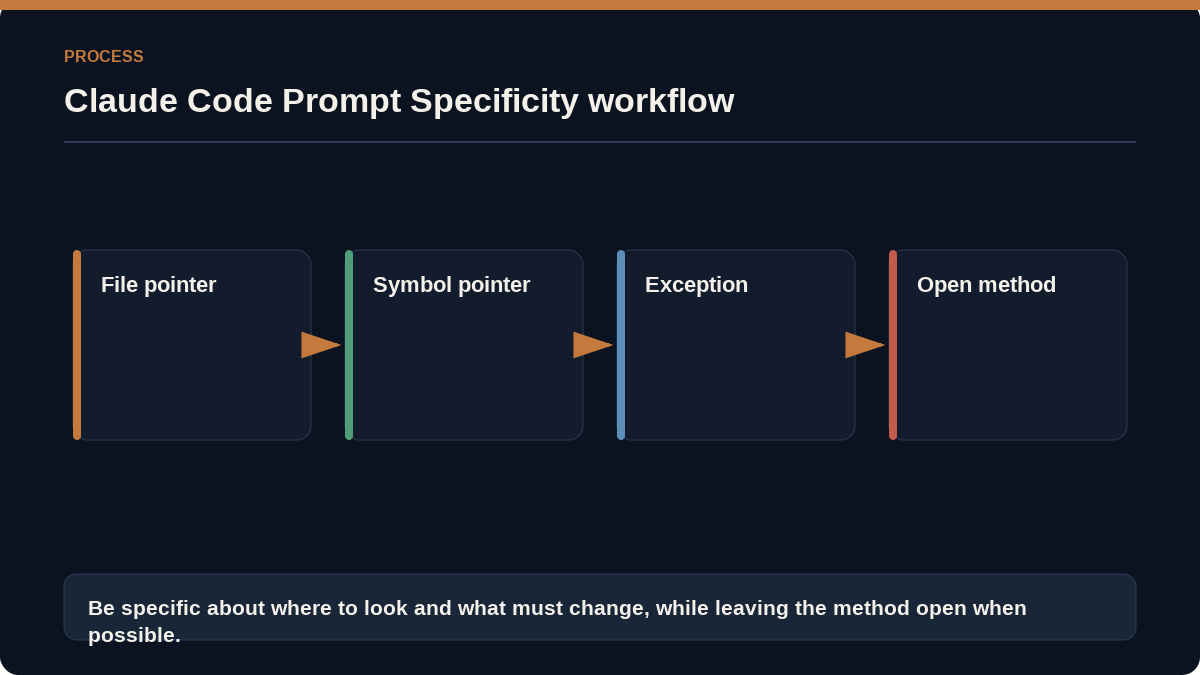
A practical runbook is to write the symptom first, add the strongest verified pointer second, name the exception third, and state the outcome fourth. Then remove any implementation detail that is not a real constraint.
The Claude Code verification guide supplies the final review principle: inspect the changed files and observable result rather than trusting a confident summary.
Concrete win, honest loss, and implication
Win: In the export example, Claude Code receives a starting file, a symbol, an observable timezone symptom, and a credit-row exception. The investigation can begin with evidence instead of a broad search for anything date-related.
Loss: Precision can anchor the investigation on the wrong cause. F016 explicitly cautions that a prompt can be specific and still point at the wrong location. F018’s fresh-reader check can reveal unclear wording, but it cannot validate the diagnosis.
Implication: Use file, symbol, symptom, and exception details when they reduce genuine ambiguity. Leave the method open unless a real interface, dependency, or behavior constraint requires otherwise.
The Claude Code context relevance guide explains why more evidence is not automatically better. Specificity works best when each added detail changes the investigation or the review.
Connect specificity to the batch
Begin with observable outcomes for requirements, then separate content through goal, rule, and example prompt blocks.
Protected behavior belongs in negative requirements and scope boundaries. Representative behavior belongs in acceptance examples with observable results.
Missing policy belongs in clarification before choosing. Direction should pass plan mode approval before editing.
Unknown paths benefit from exploration plans that resolve unknowns. Execution steps need checkable exit conditions.
Dependencies require read-before-edit ordering. Changed assumptions may require plan revision for new evidence.
Low-impact work can follow reversible planning with small steps. Persistent guidance should stay essential in CLAUDE.md.
Narrow rules benefit from progressive disclosure by path. Evidence should follow context relevance principles.
Contradictions need clear instruction precedence. Visual references need written image-prompt constraints.
Targeted evidence belongs in file references that reduce context noise. Existing inputs deserve a loaded-context audit.
Request investigation before an answer when the symptom does not identify a cause. Batch only independent parallel reads.
Supported integrations can use structured briefs. Tool results should satisfy evidence contracts rather than opaque status.
Deferred loading and schemas remain API-specific in deferred tool discovery and unambiguous tool schemas.
Long tasks benefit from inspectable checkpoints. Edits should target exact replacement blocks and follow local style patterns.
Structural work needs behavior-preserving refactoring scope. Finish at explicit stop conditions, then carry context through the session handoff guide.
Data gap and future update
The research register contains no verified benchmark for prompt specificity, file references, or fresh-reader checks. No accuracy gain, token saving, or investigation-time reduction is claimed.
The memory documentation is used only for its preference for concrete, verifiable instructions. This article makes no claim about memory capacity, loading behavior, or task success.
Official documentation is live. Recheck the cited pages before publication and preserve the caveat that a specific prompt can still point at the wrong location.
One AI API Key option for OpenAI-format agents
One AI free IDs are not a Claude Code model source. Claude Code uses an Anthropic-format route, and the packet records Claude IDs as unavailable on 2026-11-27.
A separate OpenAI-format agent can use One AI API Key at https://api.oneaiapikey.com/v1 with one key and 46 live free IDs. That route does not make those IDs compatible with Claude Code. Review the free model list before selecting an agent integration.
FAQ
Does naming a file make the prompt specific enough?
Not by itself. Add the observable symptom, relevant exception, and required outcome. F016 supports file names and symptoms, but warns that a precise pointer can still be wrong.
Should every prompt name a function?
No. Use a symbol when it is verified and useful. When the cause is unknown, a functional description and an observable symptom are more honest than an invented identifier.
Can a specific prompt prescribe the whole implementation?
It can, but that usually removes useful investigation. State real constraints as rules and leave method choices open unless the interface or behavior requires them.
What if investigation finds a better starting file?
Update the context and explain the new evidence. Keep the required outcome stable, and seek fresh approval if the change alters the plan’s direction rather than merely its route.
Sources
- Official: Claude Code best practices, supporting precise file and symptom pointers plus relevant file inclusion (F016, F055).
- Official: Claude Code common workflows, supporting the research-and-proposal boundary before edits (F014).
- Official: How Claude remembers your project, supporting concrete, verifiable instruction wording without proving task success (F017).
- Official: Claude prompting best practices, supporting the minimal-context fresh-reader check (F018).
- Official: Claude Code tools reference, included as further reading; no unseen tool mechanics are asserted here.