Direct answer
Replan when new evidence invalidates an assumption that controls direction, scope, a protected behavior, or a dependency. Do not replan merely because discovery found another file. Pause the affected work, name what changed, revise the smallest necessary part of the plan, and request approval again when the direction changes.
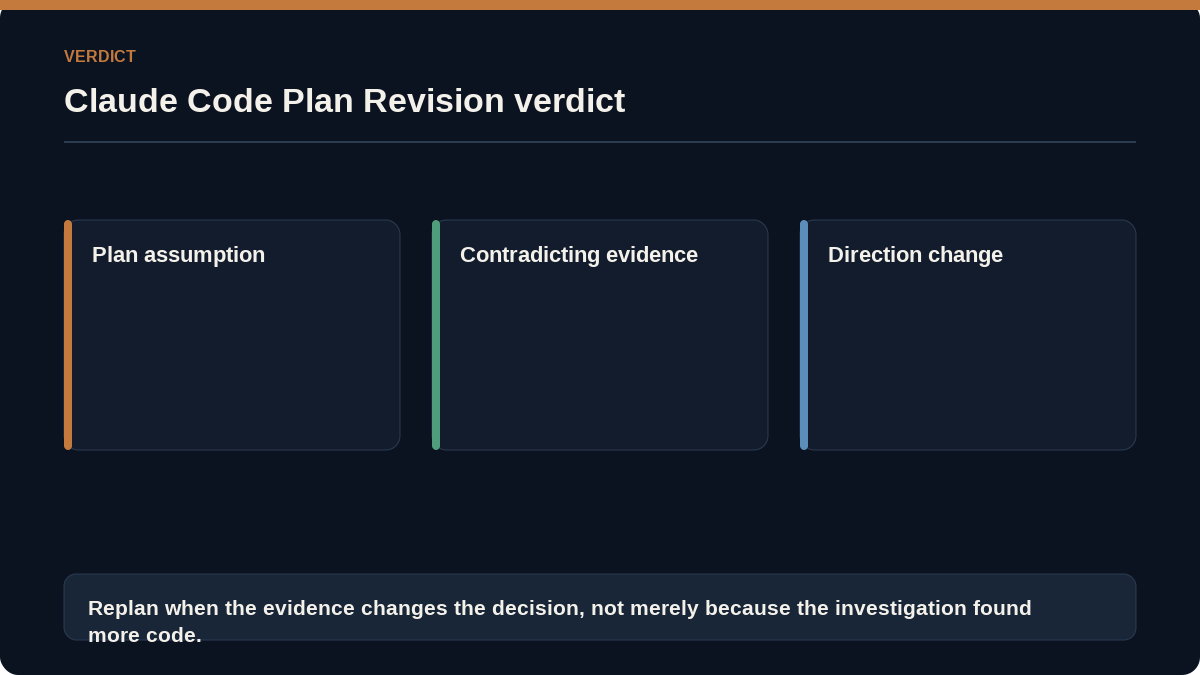
Preserve decisions that remain valid. A revised plan should show the old assumption, the contradicting evidence, the affected steps, and the new route. Replanning supports better decisions; it does not guarantee a better result.
Why continuing can be more expensive than revising
An approved plan carries authority. Once work begins, each completed step can make the next one feel inevitable. That momentum is dangerous when a newly read file contradicts the assumption that justified the route.
The cost is not only rework. A hidden direction change can alter scope, violate a protected interface, or make a dependency invalid. The final summary may still sound coherent because the change was absorbed into execution instead of reviewed as a new decision.
Official (F034): the common-workflows documentation says plan mode keeps the edit boundary closed until the user approves the proposed direction. The documentation does not define an automatic replanning threshold.
Official (F035): the prompt engineering overview frames success criteria as controllable through prompt engineering while noting that not every failure is best solved by prompting. That framing supports revisiting the brief when evidence changes, not a claim that replanning fixes every failure.
Independent (F036): the OpenStax software engineering process chapter describes inception as including refinement and management of requirements. The source is foundational process guidance, not a Claude Code-specific replanning rule, and the source was available through search evidence.
The session handoff guide for team context covers continuity across sessions. The focus here is the narrower decision of when a current plan has lost its basis.
Record the assumptions behind the plan
A plan cannot be revised against an assumption that was never written down. Record the beliefs that make the route valid, especially those that determine targets, scope, and order.
An assumption is not a finding. “The helper is local to this view” is a belief until the relevant callers are inspected. “The requester wants the default order preserved” may be a stated requirement rather than an assumption. Keep the categories distinct.
A useful assumption record includes the belief, why it matters, the evidence that would confirm it, and the steps that depend on it. That makes later contradictions easier to classify.
| Assumption | Why it matters | Evidence to check | Dependent steps |
|---|---|---|---|
| The named component owns the behavior | Controls the edit target | Definition and consumers | Target selection and edit |
| The existing interface can stay stable | Controls scope | Caller expectations | Implementation and inspection |
| The new behavior is local | Controls dependency order | Data flow and state ownership | Sequence and verification |
| The requester approves an exception | Controls acceptance | Human decision | Scope and final report |
The exploration plan guide for unknowns helps identify assumptions before implementation. The task breakdown guide for exit conditions helps attach each assumption to the step it controls.
Do not record every implementation detail as a plan-level assumption. The record should focus on beliefs that would invalidate the route if false. Smaller choices can remain inside their steps.
Watch for evidence that contradicts them
Contradictions often appear during ordinary work: a caller with an unexpected expectation, a shared helper with another owner, a requirement that conflicts with the proposed target, or a producer that fails before its consumer runs.
Treat the evidence as a signal to compare, not as an automatic command to rewrite everything. Read enough to understand the contradiction and its scope. Ambiguous evidence calls for a recorded uncertainty and a pause limited to the affected decisions.
The context relevance guide for evidence selection helps identify the smallest useful evidence set. The file reference guide for reducing context noise helps keep that set focused.
| Signal | Question to ask | Immediate action |
|---|---|---|
| An unexpected caller appears | Does it change the protected contract? | Inspect the relevant expectation |
| A shared symbol has another owner | Is the proposed edit still local? | Recheck target and scope |
| A requirement conflicts with current behavior | Is the requested outcome still valid? | Ask the requester if policy is involved |
| A producer cannot supply its output | Which consumers are now unsupported? | Block dependent steps |
| A proposed step adds unrelated work | Did scope change? | Remove or request separate approval |
Official (F035): not every failure is best solved by prompting. If the problem is a contradicted architectural assumption, adding more emphatic instructions does not restore the plan’s basis. Change the plan or the requirement.
The conflicting instructions and precedence guide is relevant when project guidance conflicts with observed code. Keep the conflict visible rather than resolving it by reading order alone.
Classify the impact of the contradiction
A contradiction can be local, directional, or blocking. A local adjustment changes how a valid step is performed. A directional change alters the approved route or scope. A blocking contradiction means the task cannot continue until a decision is made.
Classification prevents both overreaction and underreaction. Replanning for every new file creates noise. Ignoring a changed interface because the goal sounds similar hides a direction change.
| Old assumption | New evidence | Plan impact |
|---|---|---|
| The helper belongs to one view | Another view consumes it | Target and scope may change |
| The default order is unchanged | The current sort is applied elsewhere | Protected behavior needs review |
| The producer can run before the edit | The required source is unavailable | Edit is blocked |
| The copy change is isolated | The same string appears in another flow | Target list may expand |
| The request excludes dependency changes | The route requires one | Scope exception needs approval |
The plan dependency guide for reads before edits helps trace which consumers are affected. If one producer is invalidated, every dependent step needs review even when the final goal remains unchanged.
A direction change should be visible in the revised plan. Do not bury it in an execution note that says only “adjusted implementation.” The plan mode approval guide explains why the edit boundary matters at this point.
Pause the affected work
Pause the steps that consume the invalidated assumption. Independent work may continue only when it remains valid and does not depend on the unresolved decision. Avoid turning a local contradiction into a full-session stop by default.
State the blocker precisely. “The helper is shared” is incomplete. “The proposed helper edit would change the export view as well as the settings view, so the target and protected behavior need review” identifies the actual problem.
A pause should preserve state. Record what has changed, which decisions remain valid, and what evidence is needed next. The task checkpoint guide for inspectable progress provides a format for state, evidence, blocker, and next action.
| Work state | Continue? | Condition |
|---|---|---|
| Independent read unrelated to the contradiction | Usually | It does not consume the invalidated assumption |
| Decision that depends on shared ownership | No | Wait for target and scope review |
| Edit based on the old target | No | Wait for revised approval if direction changes |
| Inspection of already valid work | Yes | It does not imply acceptance of the invalidated step |
| Unrelated cleanup | No | It is outside the agreed outcome |
The stop conditions guide for the agreed boundary helps prevent a pause from becoming unrelated expansion. The task should wait for the missing decision, not accumulate extra work.
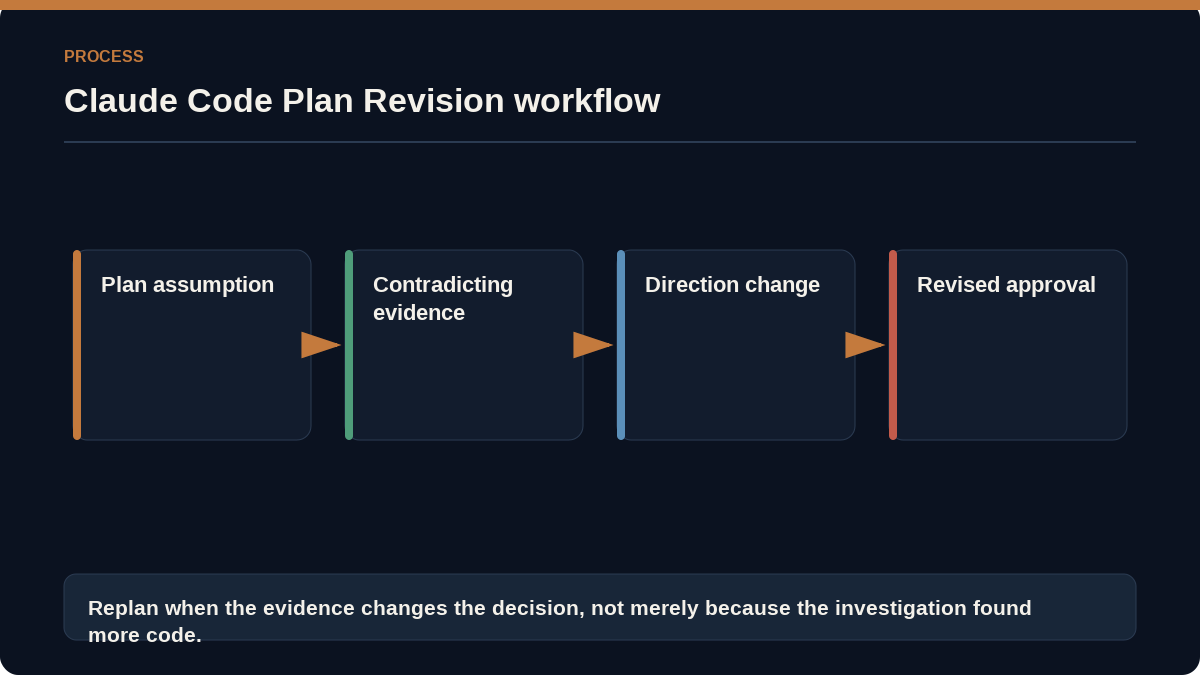
Revise the smallest necessary part of the plan
Start with the invalidated assumption and its direct consumers. Rewrite those steps, then check adjacent dependencies. Preserve the rest unless the new route changes their inputs.
A revised plan should answer four questions: what changed, why the old route is no longer valid, which steps are affected, and what direction is proposed now. Those answers make the new approval meaningful.
Avoid rewriting the entire specification when only the target changed. A focused revision is easier to review and less likely to discard valid decisions. A changed outcome needs a broader brief update.
| Revision part | Required content |
|---|---|
| Old assumption | The belief that controlled the previous route |
| New evidence | The source or observation that contradicts it |
| Impact | Direction, scope, behavior, or dependency affected |
| Revised route | The smallest coherent replacement |
| Preserved decisions | What remains valid and why |
| Approval need | Whether the change crosses the approved direction |
Official (F034): plan mode keeps edits behind approval, but the documentation supplies no automatic threshold. The classification and revision format here are editorial practices, not a documented Claude Code feature.
The negative requirements guide helps recheck protected behavior after a target change. A new route can satisfy the same outcome while violating an exclusion unless that exclusion is carried forward.
Distinguish a minor adjustment from a direction change
A minor adjustment stays inside the approved outcome, scope, and dependency structure. Choosing a more precise anchor for the same edit may qualify. Adding a new subsystem or changing a protected interface does not.
The distinction is not about diff size alone. A small edit can change direction when it alters a public contract. A larger mechanical change can remain within direction when the approved requirement explicitly calls for it.
| Change | Minor adjustment | Direction change |
|---|---|---|
| Target precision | Same owner, clearer block | Different owner or behavior |
| Scope | Same required files and outcome | New subsystem or unrelated cleanup |
| Protected behavior | Implementation detail changes, contract stays | Contract or exclusion changes |
| Dependencies | Same inputs, clearer order | New producer or reversed prerequisite |
| Acceptance | Same condition, better evidence | Different product outcome |
The reversible planning guide for small steps helps assess exposure, but small size does not decide whether approval is needed. The decision depends on what the change means for the approved direction.
The exact edit target guide is useful for minor precision changes that do not alter the target’s ownership or contract. If the evidence points to another owner, return to the plan.
Recheck scope and dependencies
A revised target can introduce new consumers, exclusions, and producers. Recheck the scope boundary before approval. Then recheck the dependency chain so no consumer relies on an output the new route no longer supplies.
A local revision can become a direction change at that point. A narrower target may avoid a shared interface but require a different data source. That new source is a dependency and may alter the implementation route.
The plan dependency guide for reads before dependent edits provides the producer-consumer review. The task breakdown guide for exit conditions helps update the states that changed.
| Recheck | Question |
|---|---|
| Outcome | Does the revised route still satisfy the original observable behavior? |
| Scope | Are all changed files and behaviors necessary? |
| Exclusions | Does protected behavior remain intact? |
| Producers | Does every consumer have the evidence it needs? |
| Decisions | Are human-owned choices still explicit? |
| Acceptance | Does the final condition match the revised route? |
A revised plan should not keep obsolete dependencies merely because they were already approved. Remove them with a reason, or retain them if they still serve the outcome.
Worked example: a shared helper invalidates the target
Consider an editorial plan to change a local formatting helper in one view. The recorded assumptions say the helper belongs to that view, the existing format elsewhere must remain stable, and the change can be completed through a local edit.
During execution, a caller read shows that the export flow uses the same helper. That contradicts the ownership assumption and puts the protected behavior at risk. The local edit is paused.
The reviewer classifies the impact as directional because the target and scope would change. A local wrapper may preserve the export behavior, but that route needs its own evidence and approval. The original outcome remains valid.
Derived editorial example: the plan recorded four controlling decisions: target selection, protected behavior, edit scope, and inspection condition. The new evidence invalidates target selection and edit scope while preserving protected behavior and the inspection goal. Formula: 4 recorded decisions - 2 invalidated decisions = 2 decisions preserved. Only the hypothetical example feeds that arithmetic. It is not a threshold or measured improvement.
The revised plan names the shared caller, proposes a local wrapper as the route to evaluate, and keeps the export format protected. It also adds a dependency: read the export caller’s expectations before choosing the wrapper’s interface.
A wrapper that introduces an unnecessary abstraction can be rejected in favor of another route. The style-preserving edit guide supports following local patterns when they still serve the requirement.
Request approval again when direction changes
A revised direction needs a new decision. Present the old assumption, the contradicting evidence, the affected steps, and the proposed route. Ask for approval of the change rather than assuming the earlier approval still covers it.
The approval request should be narrow. It does not need to reopen decisions that remain valid. Naming those preserved decisions helps the reviewer focus on the actual change.
| Approval request | Include |
|---|---|
| What changed | The assumption and evidence |
| Why it matters | The direction, scope, behavior, or dependency affected |
| What is proposed | The smallest coherent revised route |
| What stays valid | Preserved outcome and exclusions |
| What remains unknown | Blocking questions and owners |
Official (F034): the edit boundary remains closed until the user approves the proposed direction. The source does not say that every adjustment requires a new approval, so use the classification above to avoid unnecessary interruptions.
The plan mode approval guide provides the approve, revise, or stop decision. A revised plan can still be rejected when the new route exceeds the request.
Preserve decisions that remain valid
Revision is not a reset. Keep the outcome, exclusions, and evidence that still apply. Discarding valid work makes the plan harder to review and can introduce new mistakes.
A preserved decision should have a reason. If the original acceptance condition remains valid, say so. If an exclusion still protects the same interface, carry it into the revised plan. Do not preserve a decision merely because it was already approved.
| Valid decision | Invalidated decision |
|---|---|
| The user needs the clarified message | The named component is the only edit target |
| The redirect must remain unchanged | The helper is local to one view |
| The active filters must apply | The current data source is sufficient |
| The result needs inspectable evidence | The original dependency order is still valid |
| Unrelated cleanup is excluded | The revised route can include cleanup |
The acceptance examples guide for observable results helps preserve the intended behavior while the implementation route changes. Examples can keep the outcome stable when the target moves.
The behavior-preserving refactoring guide is relevant when the revised plan changes structure. It supports keeping the observable contract visible, not assuming preservation from structure alone.
Concrete win, loss, and practical implication
Win: a shared-helper contradiction can trigger a focused revision before the edit changes an unintended export flow. Valid acceptance conditions and exclusions remain in place.
Loss: another review adds time, and a revised plan can still be wrong. Frequent replanning can also create noise if every discovery is treated as a direction change.
Implication: classify contradictions by impact, pause only affected consumers, and request approval when the route changes. Use the plan dependency guide to find every step affected by the invalidated assumption.
A compact revision record
A short revision record is enough when it preserves the reasoning. Use the old assumption, new evidence, impact, revised route, preserved decisions, and approval status. Avoid a long narrative that hides the actual change.
The record should let a reviewer answer whether the old approval still applies. If the answer is no, the direction change belongs in the approval request. If the answer is yes, document why the adjustment remains inside the boundary.
The structured brief guide for supported outputs can help when the revision record is consumed by a program. A structured record still needs semantic review; valid fields do not prove a valid new route.
The evidence-bearing tool results guide helps when a tool supplies the contradicting evidence. Return enough detail to support the classification instead of an opaque failure label.
The verdict: revise when the decision changes
New evidence matters when it changes what the team should decide. More files, more calls, and more progress do not automatically invalidate a plan. A contradicted assumption that controls direction, scope, behavior, or dependencies does.
Pause the affected work, preserve valid decisions, and make the new route explicit. Approval should attach to the revised direction rather than to the memory of the old one.
Data gaps and future updates
Unknown: the supplied research defines no automatic replanning threshold, frequency benchmark, or quality improvement from revising a plan. The impact categories and revision record are editorial practices.
The OpenStax source was available through search evidence. It supports foundational requirements refinement, not a specific Claude Code behavior. Official documentation is live and should be rechecked before publication or future updates.
Community evidence: no verified issue or reproducible run appears in the packet. No community anecdote gets used and no issue outcome is claimed here.
A future update should add a threshold only if a primary source defines one. Any quantitative comparison of replanning strategies would need a named method, comparator, and source.
One AI API Key option for OpenAI-format agents
If the revised plan belongs to an OpenAI-format agent, One AI API Key provides https://api.oneaiapikey.com/v1, one key, and the packet’s 46 live free IDs for that path. Review the free model list and quickstart. Those IDs are not Claude Code model sources; Claude Code uses an Anthropic-format route, and its Claude IDs were unavailable on 2026-11-27.
FAQ
Does every new file require replanning?
No. Replan when evidence invalidates a controlling assumption. A new file that confirms the route may require no change beyond recording the evidence.
What makes a change directional?
A change to the approved outcome, scope, protected behavior, or dependency structure is directional. A clearer implementation detail inside the same boundary may be a minor adjustment.
Should valid decisions be rewritten too?
No. Preserve them and state why they remain valid. A focused revision is easier to review and avoids discarding useful requirements or exclusions.
Does replanning guarantee a better result?
No. F035 supports revisiting the brief when appropriate, but it does not claim that replanning fixes every failure. The new route still needs evidence and review.
Sources
- Official, fetched: Claude Code common workflows, F034. Plan mode keeps the edit boundary closed until approval; no automatic replanning threshold is defined.
- Official, fetched: Prompt engineering overview, F035. Success criteria can be revisited, and not every failure is best solved by prompting.
- Independent, search-index only: Software engineering process, F036. Requirements refinement and management, not Claude Code-specific behavior.
- Official, fetched: Claude Code best practices, F024. Brainstorm and create a specification before implementation.
- Official, fetched: Claude prompting best practices, F007 and F020. Clear instructions and exact formats do not guarantee a revised result.