Direct answer
A useful Claude Code session handoff is a small, portable packet containing the goal, current state, decisions, approvals, constraints and next action. Send that packet with links to the relevant files and verification evidence, not a raw transcript by default. Official: Anthropic documents continue, rewind, /compact and /clear, and it describes creating a handoff message with “summarize from here” or /rewind (F001, F002). Those controls help a session continue. They do not replace a team agreement about which decisions must survive. The concrete win is that a teammate can resume without replaying every failed attempt. The honest loss is that a short packet can hide an assumption, so the receiving engineer still needs a short confirmation step before changing code.
Why raw transcripts fail
A transcript records an interaction. A handoff has to support a decision. Those are different jobs. Raw sessions often include search results, abandoned approaches, corrected commands and model explanations that mattered at the time but no longer change the next action. Copying the whole conversation transfers volume without transferring priority.
Official: The session-management guidance warns that performance can degrade as context grows and that a bad autocompact can drop important details (F002). A transcript can therefore become both expensive to review and unreliable as a memory aid. The failure is not that every long session goes wrong. The failure is that nobody marked the few lines the next person must trust.
Raw transcripts also create a privacy problem. Tool output can contain paths, identifiers, internal URLs or secrets. A packet should link to controlled evidence instead of copying sensitive text into a chat channel. The privacy and retention guide for Claude Code explains why a session boundary and a data-retention boundary are separate questions.
Finally, a transcript rarely shows authority. Seeing a proposed production command in the history does not tell the next person whether it was approved, rejected or merely discussed. That distinction belongs in an approvals section with an owner and a scope.
What the evidence supports
Official: Anthropic describes four session controls (F001). continue keeps relevant context in a working session. rewind returns to a previous message. /compact replaces history with a summary. /clear starts a new session with a distilled brief. The same source describes handoff creation and warns about context loss during compaction (F002). Use those controls to prepare a handoff, then inspect the result before sharing it.
Community: Issue #40981 asks for conversation sharing through links, exports or a shared workspace (F003). That report establishes demand for a sharing workflow. It does not prove that every product surface lacks sharing, and it does not define a supported export format. A team handoff process should not depend on an unconfirmed feature.
Official: The engineering best practices recommend independent review through subagents because a fresh reviewer has not seen the reasoning behind the code (F009). A human teammate needs the same separation. Give them the requirements and evidence, then ask them to reconstruct the plan. If the packet already contains the reviewer’s conclusion, the test is weaker.
Official: Checkpointing has its own boundary. Claude Code tracks its file edits, while Bash-only changes, subagent edits and some external changes are not fully tracked (F014). Do not describe a handoff packet as a restore point. It explains state. A checkpoint or a version-control commit may recover files under different rules.
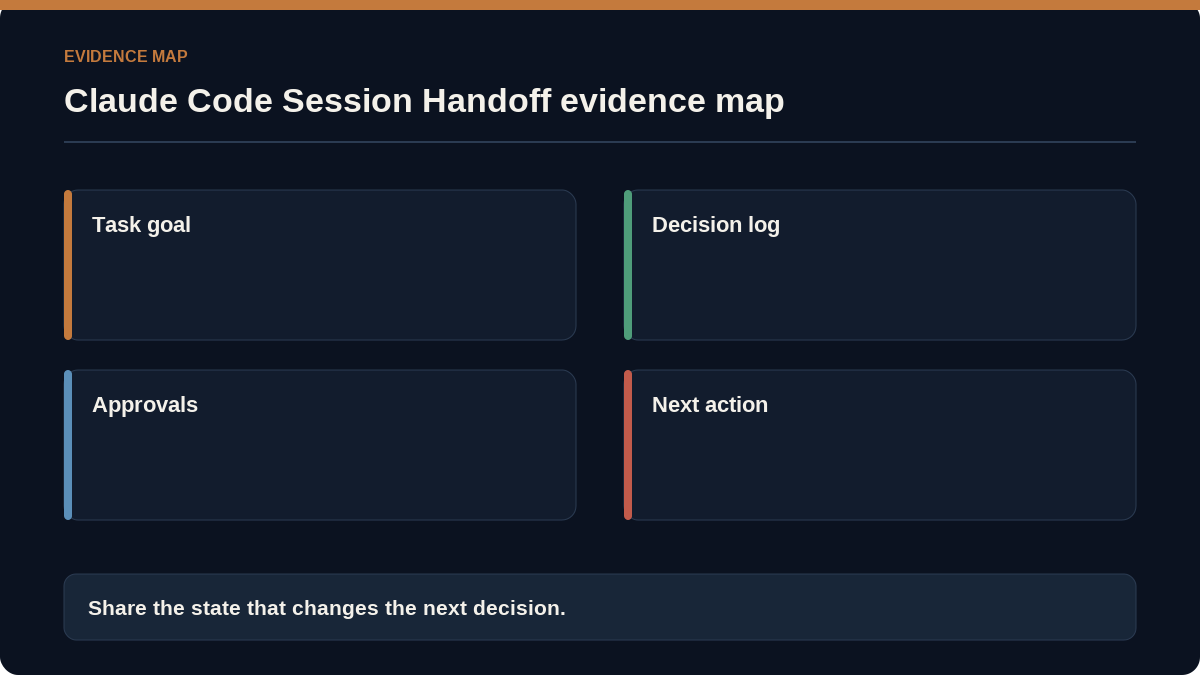
The handoff packet
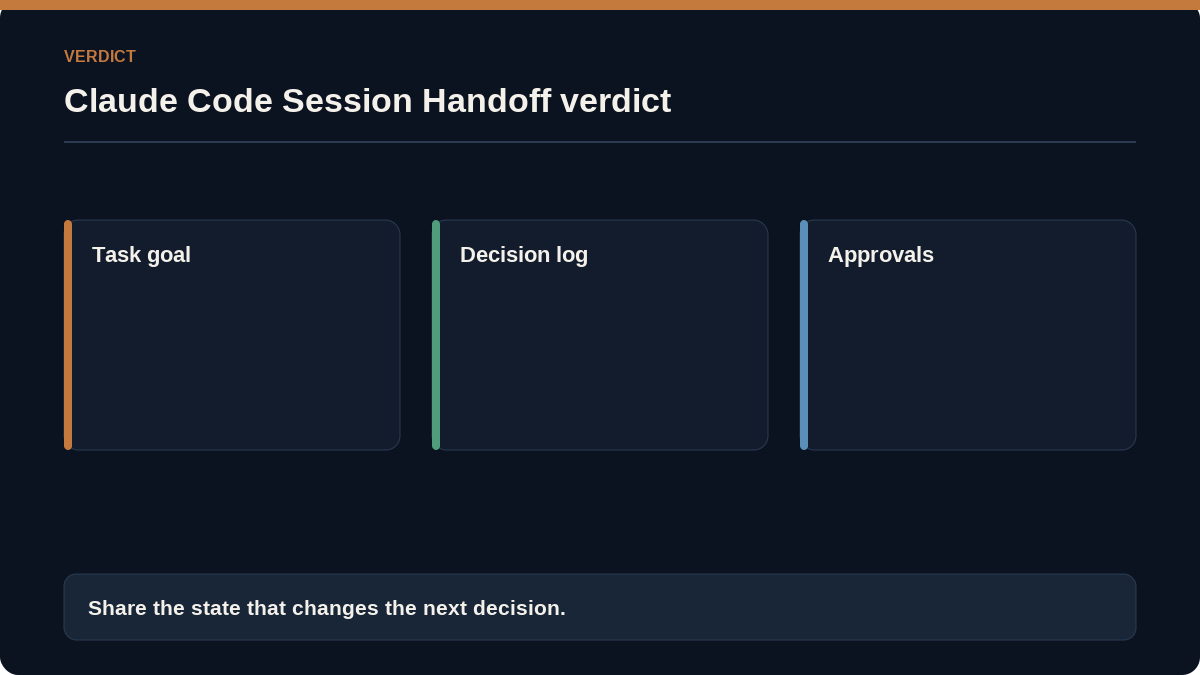
The packet should answer six questions: Which outcome is wanted? What is already true? Which approach was decided? What is allowed? What evidence exists? What happens next? Keep the main packet brief enough to read before opening a repository. Put detail behind links.
Handoff fields
| Field | What to write | Why the next person needs it |
|---|---|---|
| Task goal | One observable outcome and the affected workflow | Prevents a polished but irrelevant solution |
| Current state | Branch or workspace location, completed work and known failures | Separates progress from speculation |
| Decision log | Chosen approach, rejected options and reason | Stops a teammate from reopening settled questions |
| Approvals | Named approver, allowed action and expiry or review point | Keeps discussion distinct from authorization |
| Constraints | Allowed files, forbidden actions, compatibility and security limits | Defines the boundary of the next change |
| Evidence | Test commands, results, diffs and issue links | Makes claims inspectable |
| Open questions | Unknowns that could change the plan | Prevents guesses from becoming facts |
| Next action | One action, one owner and a clear stop condition | Turns the packet into a usable start |
| Sensitive references | Links to controlled records, not copied secrets | Reduces accidental redistribution |
| Updated at | Date and author of the latest packet edit | Shows whether the state is stale |
Write the goal as an outcome, not a task list. “Make checkout reject expired cards without changing settlement” gives a reviewer a boundary. “Improve checkout” does not. The context-portable migration guide is useful when the work also crosses repositories or tool boundaries.
Keep the current state factual. “Validation passes on the local fixture” is evidence. “Everything looks good” is an opinion without a test. If a command failed, record the command class and the failure category without pasting sensitive output. Link the controlled log when the receiving engineer has access.
A packet should also name its source of truth. The issue can hold acceptance criteria, the repository can hold code and the decision log can hold rationale. Do not create three competing descriptions and hope the newest one wins.
A compact packet layout
Use short labels so a receiver can scan the packet before opening any links. A practical layout is goal, state, decisions, approval, evidence, unknowns and next action. The labels matter less than the separation. Do not bury an approval inside a paragraph about implementation progress.
Goal: Name the user-visible result and the boundary. For a validation-message task, the goal could be to show the approved message when a field fails validation while leaving successful submission unchanged. That sentence gives the receiver something to test. It also tells a reviewer which nearby behavior is out of scope.
State: Identify the workspace, the branch and the last verified condition. If the baseline suite failed before the edit, say so. A receiver who assumes a clean baseline may blame the handoff for an existing problem. If work happened in more than one workspace, name the workspace that holds the current diff and link the others only when they contain relevant evidence.
Decisions: List choices that should survive the session. Include the reason and a revisit condition. A choice to preserve an existing public interface may matter more than the exact helper used internally. Recording both is acceptable, but mark the interface choice as the one that requires approval to reverse.
Approval: State what the next person may do now and what remains blocked. Editing a handler can be approved while production deployment stays outside the agent workflow. Do not convert “the owner saw the plan” into permission for a destructive command. The scope should be explicit enough that a careful receiver can tell when the plan has changed.
Evidence: Link the diff, the test result and the relevant issue. Describe what each item proves. A passing unit test supports the behavior it exercises. It does not prove migration safety, production readiness or the absence of unrelated changes. This is where the proof-of-work approach keeps a handoff honest.
Unknowns: Put unresolved questions in their own field. A question about an inaccessible fixture should not disappear into the decision log. Mark whether the unknown blocks implementation, blocks review or can become follow-up work. That classification tells the receiver when to stop.
Next action: Use an imperative sentence with an owner. “Review the parser diff, run the stated fixture and stop if the accepted output changes” is actionable. “Continue the work” transfers ambiguity. The action should be small enough to complete or reject without another long planning session.
Keep the packet current when the plan changes. Append a short update rather than rewriting the history so thoroughly that the original rationale vanishes. If an approval expires or the allowed files change, update that field before the next person acts. A stale packet can be worse than no packet because it looks authoritative.
Decision logs
A decision log is not a changelog. It records why one path beat another. Each entry should be short enough to scan but specific enough to challenge.
Decision log
| Decision | Alternatives considered | Reason | Revisit when | Owner |
|---|---|---|---|---|
| Use a summary plus file links for handoff | Raw transcript, summary only | Preserves evidence without copying the whole session | Sharing requirements change | Task owner |
| Keep production apply outside the agent workflow | Let the agent apply after approval | Preserves a human-controlled boundary | Apply process is redesigned | Service owner |
| Limit the next change to named files | Open-ended cleanup | Keeps the review aligned with the request | A dependency requires broader edits | Implementer |
| Reject an unsupported sharing claim | Assume issue #40981 describes current behavior | The issue is a request, not a product contract | Official sharing documentation appears | Reviewer |
Several habits make this table useful. First, distinguish a decision from a preference. A preference can change during implementation. A decision needs an explicit revisit condition. Second, record rejected options only when they affect future work. Third, keep the owner visible. “The team decided” is hard to audit when the plan fails.
Do not use the decision log to rewrite history. If new evidence reverses a choice, append a new entry that references the old one. The next engineer can then see that the change was deliberate. This is especially important when a small request expands into a large diff.
Unknown: The supplied evidence contains no measured rate of lost decisions during Claude Code handoffs. The format here is a proposed control. It should be evaluated by whether a receiver can make the next safe decision, not by an invented productivity percentage.
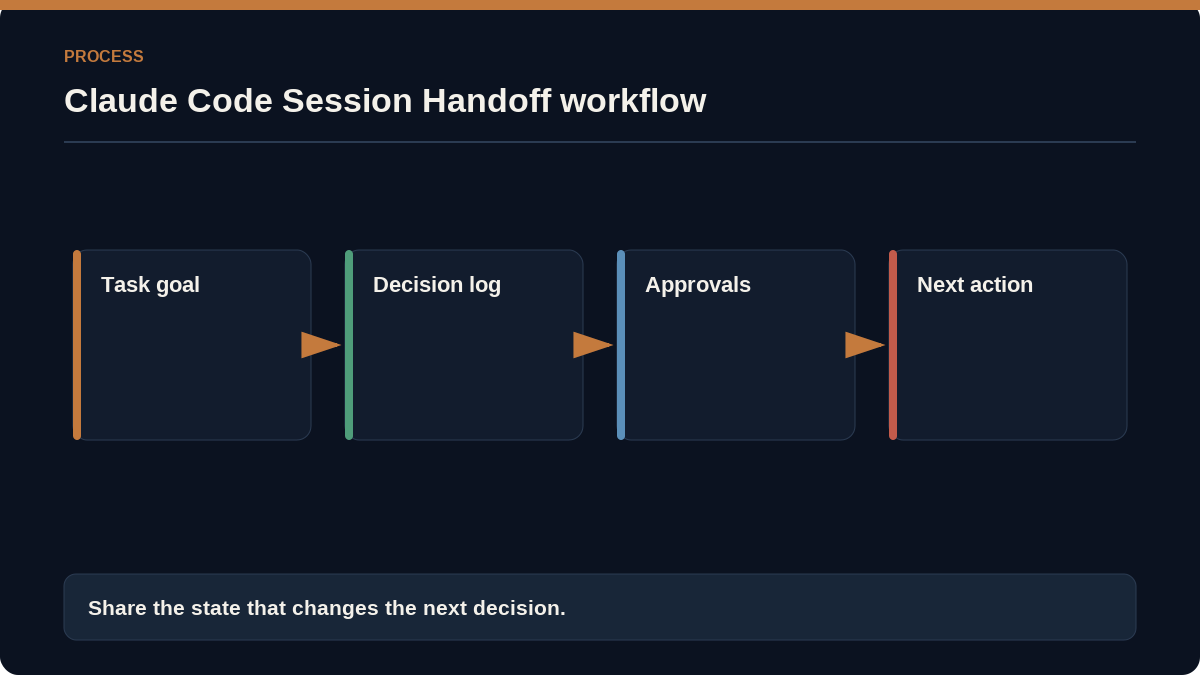
Approvals and constraints
An approval must name the action. “Approved” is too vague when the next step includes edits, package installation, a network request and a production command. Separate those actions even if one person owns the task.
Use scoped language. “May edit the listed handler and its test file” is narrower than “may fix the bug.” “May run the staging migration rehearsal” does not authorize a production apply. If the plan changes, the old approval may no longer cover it.
Constraints should include both positive and negative boundaries. Name the files that may change, the behavior that must remain stable and the commands that need separate review. The dependency-install side-effects checklist shows why an apparently ordinary setup command deserves its own decision. The database migration safety runbook applies the same separation to schema work.
Official: Settings, permissions and hooks provide controls around tool actions (F011). A written handoff does not enforce those controls. Put durable restrictions in the appropriate configuration, then reference that configuration from the packet. Do not paste credentials into the packet to prove that access exists.
Transcript retention also belongs in the sharing decision. Official: The settings reference exposes cleanupPeriodDays, desktopSessionCleanupPeriodDays, telemetry settings and feedback settings (F020). Those controls do not justify a claim of zero logging. They are reasons to decide what should be copied, who should receive it and where the controlled copy lives.
The Claude Code harness security boundary provides useful context when repository instructions and tool permissions meet. A handoff that says “follow the project instructions” should name which instructions were reviewed and which trust boundary applies.
A worked example: the safe receiver test
Use a disposable task with a clear boundary. A small validation-message change is enough. The task owner works in a scratch branch, makes one proposed edit and leaves one unresolved question about behavior. No production access is needed.
The owner then writes the packet without attaching the raw session. It contains the expected message, the file boundary, the chosen approach, the rejected alternative, the test result and the next action. The question is whether the unresolved behavior should block the change or become a follow-up issue.
Hand the packet to a teammate who has not seen the session. Ask that person to answer four prompts before opening the repository:
- State the intended outcome and the behavior that must not change.
- Name the decision that is already settled and the reason behind it.
- Identify the allowed action and the action that still needs approval.
- Choose the next step and state when to stop.
This is a safe test of information quality, not a benchmark. If the teammate invents a production apply, the constraints were unclear. If the teammate reopens the rejected alternative, the decision log was weak. If the teammate asks for the raw transcript, inspect whether the packet omitted evidence or merely made the evidence hard to find.
The concrete win is a receiver who can act without replaying the session. The concrete loss is that the test uses one simple task, so it says little about a complicated migration or a security investigation. The practical implication is to scale packet detail with consequence. A typo correction needs a few lines. A schema change needs linked migration evidence and a separate apply approval.
A teammate checklist
The receiving engineer should not accept a packet just because it looks complete. Check whether each claim has a source and each action has a boundary.
Checklist
| Check | Pass condition | If it fails |
|---|---|---|
| Goal is observable | A test or reviewer can decide whether it is met | Rewrite the goal before editing |
| State is current | Branch, workspace and recent result are identified | Ask the owner to refresh the packet |
| Decisions have reasons | Rejected paths will not be repeated by accident | Add rationale and revisit conditions |
| Approvals are scoped | Allowed and forbidden actions are explicit | Pause at the permission boundary |
| Evidence is accessible | Tests, diffs and issues open for the receiver | Move evidence to an approved location |
| Sensitive data is minimized | Secrets and unnecessary private output are absent | Redact and replace copies |
| Next action has an owner | One person knows what to do first | Assign ownership |
| Stop condition is clear | The receiver knows when to ask for review | Add a concrete stop rule |
| Checkpoints are not overstated | File recovery claims match checkpoint coverage | Link the actual recovery plan |
| Open questions are visible | Unknowns are not presented as decisions | Mark them unknown |
Before resuming, read the packet once, inspect the diff and run the stated verification. The proof-of-work packet guide helps distinguish “the agent finished” from “the change passed a check.” That distinction matters during handoff because the next person inherits both the code and the confidence attached to it.
Do not silently repair the packet while implementing. If a decision is wrong, update the log and tell the owner. If evidence is missing, obtain it. Quiet edits make the next handoff harder because the rationale no longer matches the repository.
Honest loss and data gaps
A handoff packet compresses information. Compression is useful only when the discarded detail does not change the next decision. A receiver may still need the original issue, a relevant test fixture or a controlled transcript excerpt. Keep links to those sources and state why they matter.
Unknown: The supplied sources do not define a standard Claude Code handoff schema, a universal session-sharing mechanism or a measured handoff success rate. Issue #40981 is evidence of demand, not a release commitment (F003). If Anthropic later publishes a supported sharing workflow, compare its access controls and export scope with this packet rather than assuming it removes the need for decisions and approvals.
Official: rewind and checkpointing are not interchangeable with a handoff. Rewind changes session position. Checkpointing tracks certain file edits with documented exclusions (F001, F014). Neither proves that external state, a database or a teammate’s mental model has been restored.
The rewind and checkpoint limits deserve a place in any recovery discussion. So does the gitignored-file deletion risk. Both are reminders that “we can go back” needs a defined mechanism and a tested scope.
Adjacent checks worth keeping separate
Session handoff crosses several failure boundaries, but each needs its own control. The offline-mode boundaries determine whether a receiver can continue at all, while mobile Remote Control limits determine whether phone review is appropriate. Network and platform faults belong with connection storms and NAT retries, Linux ARM and headless login, macOS Keychain permissions, PowerShell path quoting, corporate proxy TLS and mTLS and outage status and failover.
The change itself may need a tighter boundary. Use the large-diff scope guide, the dependency-install review and the migration safety workflow. Recovery claims should be checked against gitignored-file deletion and rewind checkpoint coverage, not assumed from the existence of a session history.
Security context needs separate treatment from ordinary task notes. Review repository prompt injection, MCP trust boundaries, plugin security audits, secrets in logs and transcripts, security-research refusal workflows and game-development IP restrictions. A handoff can carry a decision from one of these areas, but it should not blur their authorization rules.
Buying and delivery decisions use different evidence. Compare annual plan lock-in, Max and Ultra value, fast-mode cost and Batch API versus subscription pricing. For model behavior, consult prompt-cache minimums, thinking-token caps and reasoning effort defaults. Judge delivery through the code-review bottleneck, and preserve AI attribution and provenance alongside generated-code license compliance.
A practical OpenAI-format alternative
If you want to rehearse a handoff with a second agent without adding another subscription, the 46 live free model IDs are available through OpenAI-format agents. First-party, checked 2026-11-27: the catalogue showed 76 listed models and 46 available-now free IDs across 22 families (F044). Those free IDs share 100 requests and 5,000,000 tokens per day per account, reset at 05:30 IST or 00:00 UTC, with one request in flight per key (F045).
One AI API Key is the working route for an OpenAI-format agent such as OpenCode, Cline or Cursor. Use the endpoint quickstart, choose one free ID and send requests to https://api.oneaiapikey.com/v1 (F047, F048). The prepaid pricing page documents $10 signup credit with no card and no subscription or seat fee (F046). The per-key controls cover caps, expiry and model allowlists, while the cost calculator can help compare a controlled trial.
Do not put those free IDs into Claude Code. Free IDs are OpenAI-format only. The documented Claude Code route is currently unavailable because all four Claude IDs were marked unavailable on 2026-11-27 (F047). Treat a second-agent handoff test as a comparison of packet quality, not proof that one model will accept another model’s private session.
FAQ
What is the minimum useful Claude Code handoff?
Include the goal, current state, decisions, approvals, constraints, evidence, open questions and next action. A branch name alone is not enough. The receiver should know what may change, what must remain stable and when to stop.
Can I share a Claude Code transcript with a teammate?
The supplied official sources do not establish one sharing mechanism for every surface. Community issue #40981 requests sharing options (F003). Prefer a reviewed packet and controlled evidence links unless you have confirmed a supported sharing path for your product surface.
Is /compact enough for a team handoff?
No. /compact replaces history with a summary, and the official guidance warns that a bad autocompact can drop details (F001, F002). Inspect the summary, then add decisions, approvals and a next action that the team explicitly agrees to preserve.
Does a handoff replace checkpoints or commits?
No. A handoff explains state and intent. Checkpointing tracks certain file edits with exclusions, while commits follow version-control rules (F014). Use the recovery mechanism that matches the changed surface, and do not imply that a packet restores databases or external systems.
Should the handoff include every failed command?
Only failed commands that change the next decision belong in the main packet. Link controlled logs when detail is necessary. Remove secrets and unnecessary private output before sharing.