Direct answer
Generated code is not automatically license-safe. Review the dependencies, copied patterns, notices and organizational policy before merging, just as you would for a human-written change. A model cannot clear those obligations for you.
Independent: research on license compliance in LLM-generated code finds room for improvement, but it does not establish a Claude Code-specific violation rate. Treat copyleft and intellectual-property questions as review triggers. Read the exact license, document how the code is used and involve qualified counsel when the answer affects distribution or commercial rights. This article is an engineering workflow, not legal advice.
Why generated code is not exempt
A coding agent can produce a patch quickly, but speed does not change the permissions attached to source code. Dependencies can carry conditions. Copied snippets can retain their original notice requirements. Generated implementations can resemble existing code without anyone intending to copy them.
The practical risk is not that every AI-generated change is unlawful. Teams skip the same review they would perform for a manually written patch, and that is where avoidable exposure begins.
Independent: the supplied research evaluates license compliance in LLM-generated code and finds room for improvement. It is not legal advice, not a Claude Code audit and not evidence of a universal violation rate. Use it to justify a review process, not to accuse a model or predict a lawsuit.
License compliance belongs beside correctness, security and provenance. The Claude Code proof-of-work packet guide helps define acceptance. Add license and notice checks to that packet when the change touches third-party material.
Scope discipline reduces avoidable exposure. The Claude Code overengineering and diff scope guide recommends naming files, symptoms and success conditions. A broad rewrite makes it harder to see which dependency, copied pattern or notice changed.
Independent review can catch assumptions the author missed. Official: Claude Code best practices recommend subagents for independent review because they have not seen the reasoning behind the code. Give the reviewer the license questions and the actual diff, not a request to provide legal clearance.
The honest limit is simple. A reviewer or model can identify a risk, locate a license file and compare a diff. It cannot guarantee that a use is permitted in every jurisdiction or contract. Escalate uncertain cases instead of turning confidence into policy.
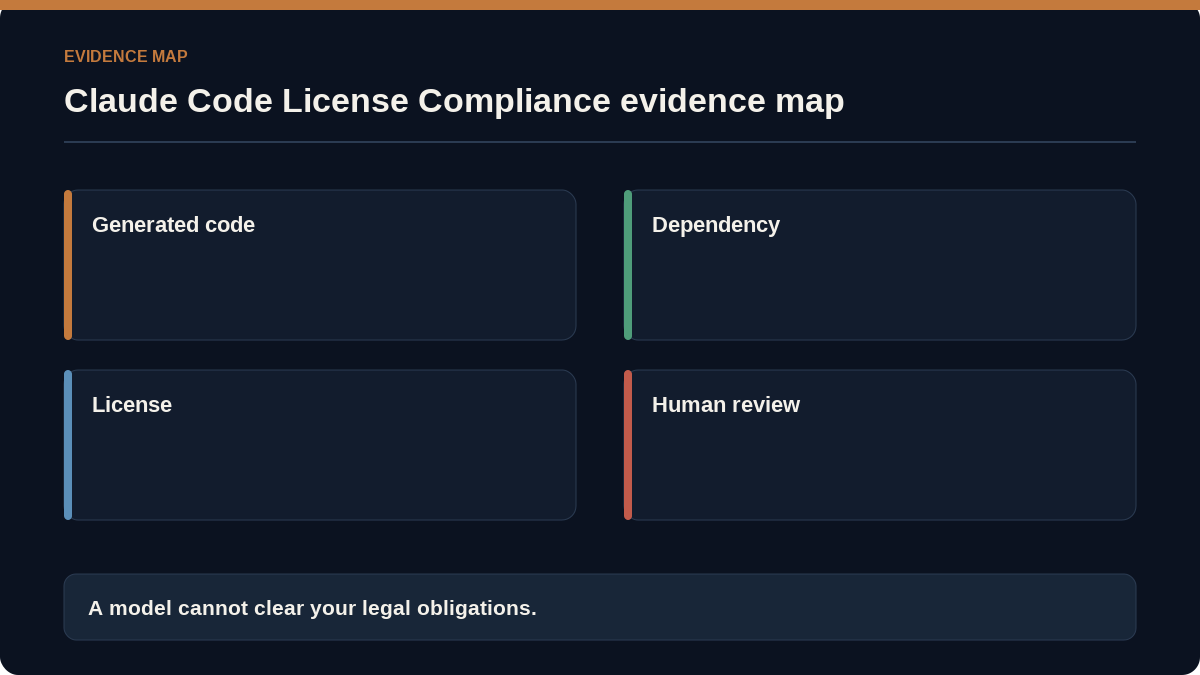
Map the license risks in the change
Start with the material the change introduces or modifies. A direct dependency is only part of the inventory. Transitive dependencies, vendored files, copied snippets, generated fixtures and plugin code can all matter.
| Risk surface | What to inspect | Why it matters |
|---|---|---|
| Direct dependency | Manifest entry, exact version and license | The team deliberately added the package |
| Transitive dependency | Lockfile and dependency inventory | It arrives through another package |
| Vendored code | Source files, headers and notices | The code ships inside the project |
| Copied pattern | Diff against known source material | Similarity may require review or attribution |
| Generated fixture | Origin of sample data or code | Generated does not mean unrestricted |
| Plugin or tooling | Exact version and executable components | Third-party code can enter the workflow |
| Distributed artifact | What ships to users or clients | Conditions can depend on distribution |
| Internal-only use | Access and deployment boundary | The analysis may differ from external distribution |
A software bill of materials is an inventory of components and dependencies. It can support review, but it does not decide whether a use is permitted. Treat the inventory as evidence for a human or legal decision.
The Claude Code dependency-install side effects guide notes that package managers can run lifecycle scripts and reach the network. Inspect the manifest, lockfile and install command before allowing the agent to proceed. That safety review and the license review should happen together because both concern third-party code entering the project.
Do not assume a package is safe because it is popular or already present. Popularity is not a license, and an existing dependency can still have conditions that matter for a new distribution model. Note the exact version and the license text used for the decision.
The Claude Code plugin security audit guide covers hooks, commands, MCP servers, skills and updates. Official partner guidance: Red Hat recommends review discipline for third-party plugin code. A plugin can add executable components and source material, so include its exact version in the inventory when it affects the change.
A plugin is not automatically malicious. The review question is narrower: what did this version introduce, what can it execute and what license or notice obligations travel with it? Separate those questions from a general judgment about the author.
Read the license before naming the risk
A package name is not a license analysis. Locate the license text, notice files and any additional terms that apply to the component. Save the exact version and the date of the review so another person can reproduce the decision.
The workflow should answer four questions. What material is present? How is it used? What ships or becomes available to others? Which conditions does the exact text attach to that use? If any answer is unclear, mark the item unresolved.
| Review question | Engineering evidence | When to escalate |
|---|---|---|
| What is the component? | Name, version, source and lockfile entry | Origin or version cannot be established |
| How is it used? | Imported, modified, vendored or served | The boundary between components is unclear |
| What is distributed? | Binary, source, container, client artifact or internal service | Distribution changes the applicable conditions |
| What notices are required? | License and notice files | Requirements are missing or ambiguous |
| Who owns the decision? | Named reviewer and policy reference | Commercial or legal rights are uncertain |
Copyleft is a review trigger, not a one-word verdict. Whether a condition is triggered can depend on the exact license text, modification, combination with other code and distribution. Do not let an agent reduce that analysis to “copyleft good” or “copyleft bad.”
Some teams use internal policies that are stricter than the license text. Others rely on counsel-approved component lists. Both can be valid operating choices. State which policy applies so the reviewer does not invent a rule during a deadline.
The Claude Code security-research refusal workflow article demonstrates a useful habit: authorization and scope belong in the record. Apply the same discipline to legal review. Identify the decision owner, the systems in scope and the question that needs an answer.
Do not treat a refusal or an uncertain answer as proof of a violation. It may mean the task lacks context, the component is unfamiliar or the model cannot give legal advice. Preserve the uncertainty and route it to the right person.
Copyleft needs a decision record
A copyleft discussion often becomes vague because people argue from labels instead of facts. Replace the label with a short decision record. Name the component, quote or link the relevant condition, describe the intended use and state what remains unknown.
That record does not need to be a legal memorandum. It needs enough detail for a qualified reviewer to understand the engineering facts. A sentence such as “the package is copyleft” is not enough to decide whether a particular artifact can ship.
| Decision-record field | Example of useful content |
|---|---|
| Component and version | Exact package or vendored source |
| License reference | Link or path to the reviewed text |
| Intended use | Internal tool, modified library or distributed artifact |
| Distribution boundary | What leaves the controlled environment |
| Notices | Files or attribution that must travel with the artifact |
| Open question | The specific condition that needs interpretation |
| Decision owner | Named reviewer or counsel |
| Outcome and date | Approved, rejected, replaced or pending |
Keep the record beside the change. The Claude Code AI attribution and provenance guide explains how to link evidence from a commit without copying sensitive material into public history. A license decision can use the same pattern: concise status in the change record, detailed evidence in a protected location.
Checkpointing is not a license audit. Official: Claude Code tracks file edits with retention of 30 days or 100 snapshots, but Bash-only changes, subagent edits and external modifications are not fully tracked. The Claude Code rewind and checkpoint limits guide explains why a restored diff cannot prove that a dependency’s conditions were satisfied.
A dependency change may also arrive through a shell command rather than a tracked file edit. Check the lockfile and installation output as separate evidence. Do not rely on a rewind snapshot to tell you what a package manager executed.
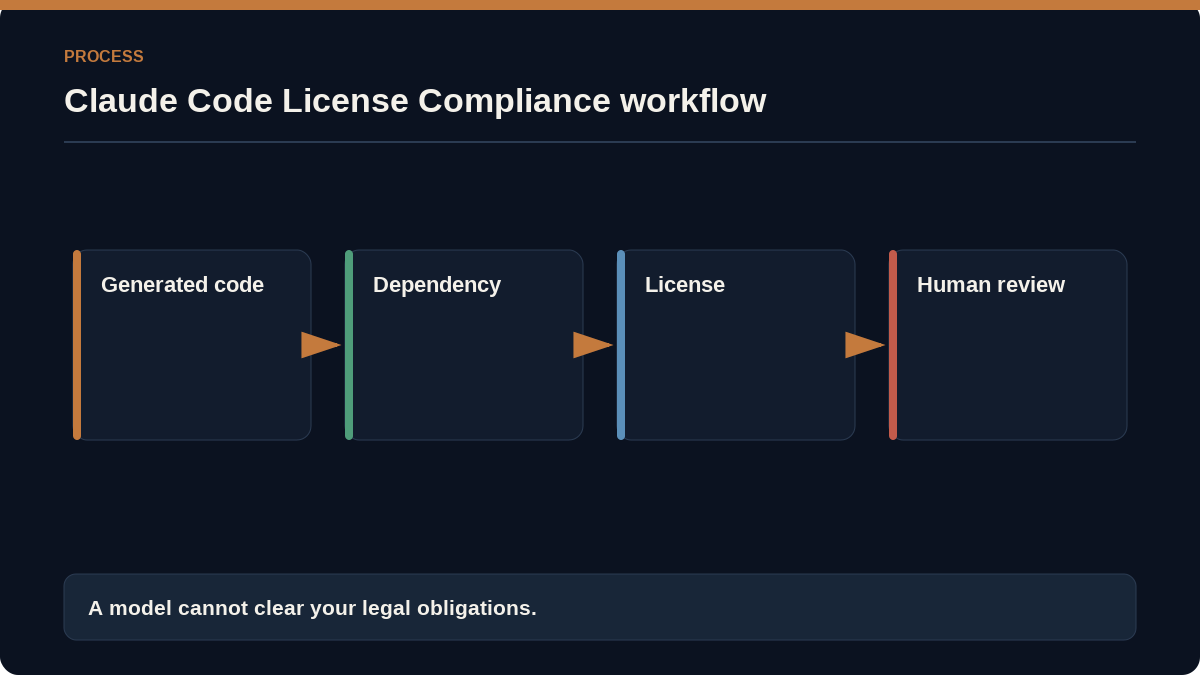
Copied patterns need provenance, not accusation
A generated implementation can resemble code the model saw during training or code present in the repository. Similarity alone does not establish intentional copying, and a clean-looking diff does not prove independence. Treat the question as a provenance review.
Start with the task and the source material the team deliberately supplied. Supplied snippets bring their own license status into the review. Repository searches need a record of the files used as reference. The Claude Code repository prompt injection guide explains why repository content is untrusted input; licensing is another reason to inspect it deliberately.
Compare the generated change with known source material when there is a concrete concern. Log what was compared and why. Do not run a broad accusation based on a vague resemblance or a detector score without understanding the detector’s limits.
Official: supported Claude outputs can carry watermarking, and files can carry C2PA Content Credentials. A detected mark indicates content may have been processed by Claude, not conclusive origin. Code has minimal watermarking because exact outputs constrain arbitrary word choices. A watermark therefore cannot replace a source or license review.
The Claude Code AI attribution and provenance guide provides a record for the generated diff, human edits and reviewer. Use that record to distinguish supplied code from newly written code. It still does not grant permission to use the supplied material.
| Provenance question | Evidence to collect | Limit |
|---|---|---|
| Was source code supplied? | Prompt or task reference | The prompt may be private |
| Was repository code referenced? | Files and search context | Reference does not grant new rights |
| What did the agent generate? | Proposed diff | Similarity needs context |
| What did a human change? | Later edits and review notes | Human edits do not erase earlier issues |
| What ships? | Final artifact and notices | Distribution can change obligations |
| What remains unknown? | Open provenance or license question | Unknown is not approval |
Keep prompts and source excerpts out of public records when they contain confidential material. The Claude Code secrets in logs and transcripts guide explains retention surfaces. A protected evidence link is safer than pasting raw repository content into a commit or issue.
Worked example: inventory first, decide second
The following example is Derived from stated assumptions. It is not a measured audit result or a claim about a real repository.
Assume a proposed change adds 12 direct dependencies. The lockfile shows 30 transitive packages, and the team confirms there is no overlap between the two groups. Derived: the initial inventory contains 12 + 30 = 42 packages to review.
Assume four files contain snippets copied from external sources, and two dependency entries have missing or unclear license files. Derived: six items need explicit resolution before the change can be called license-reviewed: four copied-source items plus two unclear dependency items.
| Example inventory | Count | Required next step |
|---|---|---|
| Direct dependencies | 12 | Review exact versions and license text |
| Transitive dependencies | 30 | Inspect lockfile and notices |
| Total unique packages | 12 + 30 = 42 |
Record inventory evidence |
| Copied-source items | 4 | Establish origin and permission |
| Unclear license items | 2 | Resolve or replace before merge |
| Open review items | 4 + 2 = 6 |
Assign a decision owner |
The arithmetic does not say that 42 packages are risky or that six items are violations. It says the review has a defined workload. Without the inventory, the team cannot tell whether a reviewer checked every component or only the obvious direct dependency.
Now assume the distribution plan changes from an internal tool to a client artifact. The package count stays the same, but the legal question may change because the artifact leaves the controlled environment. Reopen the decision record rather than copying the earlier approval.
Do not convert the inventory into a risk score without a stated method. A package count is not a probability of infringement, and a scanner result is not a legal opinion. Use the count to make sure the review is complete.
The Claude Code cost per verified change method can include license-review time as part of acceptance cost. A cheap dependency that creates days of legal review may be a poor operating choice. Record the tradeoff rather than hiding it in the merge deadline.
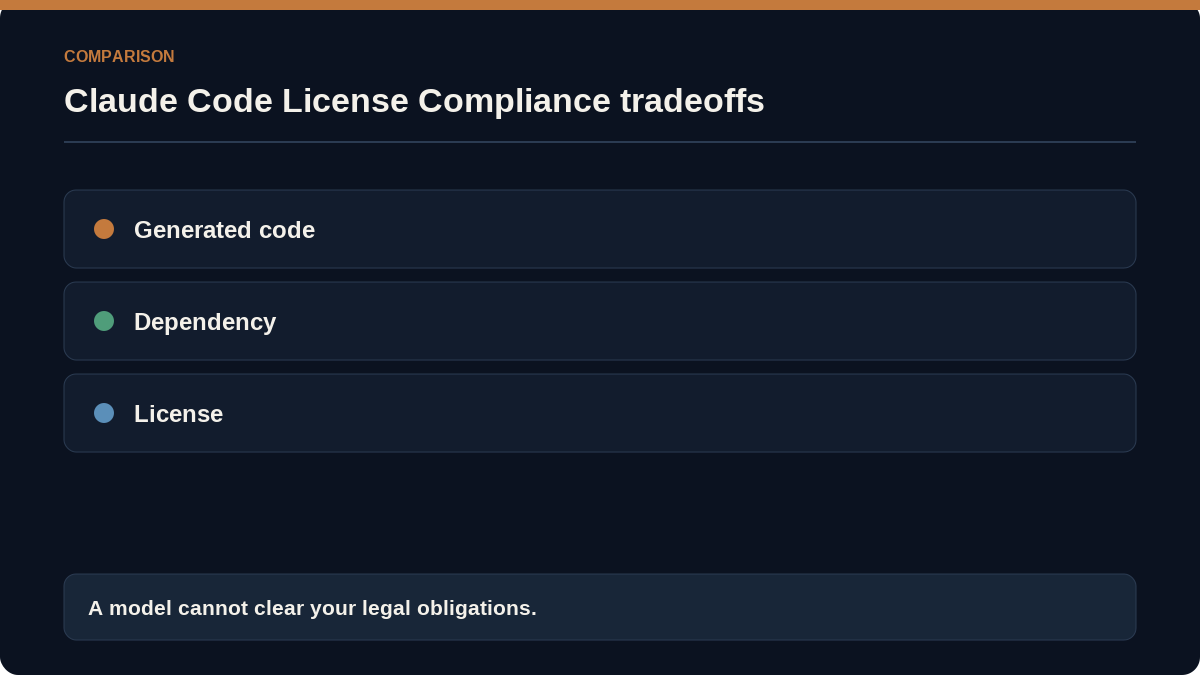
A review workflow for AI-assisted changes
License review works best as a stage in the normal change process. Do not leave it until after the code is merged or the artifact is distributed. Add a clear gate before acceptance.
Plan the change
Name the dependencies, copied material and distribution boundary in the task brief. If the agent may add packages, require it to show the manifest and lockfile changes before installation. The Claude Code dependency-install side effects guide explains why an install is executable work, not a harmless metadata edit.
Generate and inspect
Keep the diff bounded. The Claude Code overengineering and diff scope guide recommends allowed files and stop conditions. A reviewer should be able to separate generated code from unrelated cleanup and identify every new third-party component.
Build the inventory
Record direct and transitive dependencies, vendored files, copied snippets and plugin versions. Use the lockfile and exact source references. If the agent cannot establish an origin, mark it unknown rather than filling the gap with a guess.
Review conditions
Read the exact license and notice files. Describe the intended use and distribution. Escalate copyleft, unclear ownership or commercial-rights questions to the designated decision owner. The model can help organize evidence, but the team owns the decision.
Verify and merge
Attach the inventory, notices and decision status to the acceptance packet. The Claude Code verification-done proof guide helps keep tests and review evidence together. A change with unresolved license questions should not be labeled fully verified under a policy that requires them.
| Workflow stage | Required artifact | Stop condition |
|---|---|---|
| Plan | Dependency and distribution brief | Scope or distribution is unknown |
| Generate | Bounded diff and manifest changes | Unrelated files or unexplained packages |
| Inventory | Component and copied-source list | Origin or version is missing |
| Review | Exact license text and decision record | A material condition is unresolved |
| Merge | Acceptance packet and notices | Required review is incomplete |
| Release | Final artifact check | Notices or conditions changed |
Security and license controls can share infrastructure without sharing conclusions. Plugin review examines executable behavior. License review asks what permissions and obligations apply. A plugin can pass one review and remain pending in the other.
A checklist reviewers can actually use
Keep the checklist short enough to run on ordinary changes. Scale the depth to the material and distribution risk, but do not skip the gate because the diff was generated quickly.
- Identify every new direct and transitive dependency.
- Record the exact version, source and license text.
- Check vendored files, copied snippets and generated fixtures.
- Describe what ships or becomes available outside the team.
- Preserve required notices and attribution with the artifact.
- Review material copyleft questions with the designated owner.
- Record unknown origin or unclear terms as unresolved.
- Link the decision record from the change evidence.
- Recheck if the distribution plan changes after approval.
| Checklist item | Evidence of completion | Common failure |
|---|---|---|
| Dependency inventory | Lockfile and component list | Reviewing only direct packages |
| License text | Exact version-specific reference | Relying on a package label |
| Copied material | Source comparison and permission | Assuming short snippets are exempt |
| Notices | Files included with the artifact | Omitting them during packaging |
| Copyleft decision | Named owner and written outcome | Treating the label as the answer |
| Provenance | Generated diff and human edits | Losing the origin during rework |
| Release boundary | Final distribution description | Reusing approval for a new artifact |
Independent review can help locate missing evidence. Official: Claude Code best practices recommend subagents for review against a specification, with style skipped when it is outside scope. Ask the reviewer to find missing license files, unexplained dependencies and unsupported attribution claims. Do not ask it to certify legal compliance.
The Claude Code code-review bottleneck guide explains why review capacity and rework belong in the delivery scorecard. License work is part of that capacity. If every change waits for the same legal reviewer, plan smaller dependency changes or establish an approved component policy.
A policy can reduce repetitive review without eliminating judgment. Maintain a reviewed component list with exact versions, permitted uses and notice requirements. Recheck it when a version or distribution model changes. The list is an internal control, not a universal guarantee.
Test the process with a safe fixture
A license-review drill does not need production dependencies. Build a small fixture repository with a manifest, lockfile, one vendored file, one notice file and a proposed generated diff. Use synthetic names and text that the team owns.
Ask the agent to produce the inventory and flag missing evidence. The expected result is not a legal verdict. It is a list of components, exact versions, source references, open questions and the intended distribution boundary.
Then remove a notice file or make a version unclear. Confirm that the review stops instead of inventing an answer. The Claude Code verification-done proof guide provides a useful standard: a complete-looking checklist is not evidence if the underlying facts are missing.
Test the install boundary separately. The Claude Code dependency-install side effects guide notes that package managers can execute lifecycle scripts and reach the network. Use a controlled fixture and permissions that prevent real production access.
Record what the agent can and cannot see. The Claude Code secrets in logs and transcripts article explains why tool output and local transcripts can retain sensitive material. Keep the drill free of credentials and private source code.
A safe drill should end with a human decision. The reviewer confirms the inventory, resolves the synthetic open items and links the evidence. That tests the workflow without pretending that a model can practice law on the team’s behalf.
Honest loss and data gaps
The concrete win is a repeatable gate. Teams can identify third-party material, preserve notices, document copyleft questions and stop a merge when required evidence is missing. That is more reliable than asking whether generated code is “safe” in the abstract.
The concrete loss is that license review remains uncertain and sometimes expensive. Scanners miss context, licenses can be ambiguous and distribution changes the analysis. A model can help organize the record, but it cannot eliminate the need for qualified judgment.
Unknown: the frozen evidence does not provide a Claude Code-specific violation rate, a detector accuracy rate for copied code or a universal rule for copyleft compliance. It also does not establish that every dependency or generated snippet has been reviewed by the model provider. Those gaps should remain visible.
Update the workflow when official review features, license texts or organizational policies change. Keep the inventory and decision records tied to exact versions. A later dependency update can reopen a question that was resolved for an earlier release.
The practical implication is to treat licensing as part of acceptance, not as a disclaimer after merge. Give the agent a bounded task, inspect the diff and dependencies, preserve provenance and route uncertain conditions to a human owner. Generated code can move quickly through that process without skipping it.
Practical alternative: compare routes without skipping review
One AI API Key can support a controlled comparison in an OpenAI-format agent. On 2026-11-27, the 46 live free model IDs covered 22 families. They shared 100 requests and 5,000,000 tokens per day per account, resetting at 05:30 IST or 00:00 UTC. Accounts could have up to three keys, with one request in flight per key on free models.
Use an OpenAI-format agent such as OpenCode, Cline or Cursor with https://api.oneaiapikey.com/v1, one key and a selected free ID. The endpoint quickstart shows the base URL and first request. Review the prepaid pricing before paid evaluation; new accounts received $10 credit without a card under the frozen evidence.
Do not use these free IDs in Claude Code. They are OpenAI-format only. Claude Code’s documented route uses the Anthropic Messages format, but all four Claude IDs were unavailable on 2026-11-27. The coding-agent API key compatibility guide explains the boundary.
Run the same synthetic fixture and acceptance checks on each route. Compare the inventory quality, unresolved questions, review time and rework with the cost per verified change method. Do not transfer a legal conclusion or provenance claim from one provider to another.
Use per-key caps, expiry and model allowlists to limit the test, and read the gateway privacy and retention policy before sending code. The honest loss is workflow difference. Another agent may produce different dependencies, expose different evidence or require a different review process. A lower token bill cannot prove license compliance.
Start with the failure that actually blocks the change
Context and scope problems can hide license-relevant material. Continuity appears in the Claude Code session handoff and team context and Claude Code compaction context-retention test guides. Reviewable change scope appears in the Claude Code overengineering and diff scope article.
Destructive commands need separate controls. Read the Claude Code dependency-install side effects, Claude Code database migration safety, Claude Code gitignored-file deletion risks and Claude Code rewind and checkpoint limits guides before granting broad execution.
Trust and privacy are not license clearance. Untrusted content and retained data appear in the Claude Code repository prompt injection, Claude Code MCP trust boundaries, Claude Code plugin security audit and Claude Code secrets in logs and transcripts articles. Authorization appears in the Claude Code security-research refusal workflow and Claude Code game-development IP restrictions guides.
Platform and service failures can interrupt the evidence trail. Use the Claude Code Linux ARM and headless login, Claude Code macOS Keychain permissions and Claude Code PowerShell path quoting guides for setup. The Claude Code network storm and NAT retry diagnosis, Claude Code corporate proxy TLS and mTLS and Claude Code outage status and failover articles cover connectivity.
Access and performance do not settle licensing. Remote-work limits appear in the Claude Code mobile Remote Control limits and Claude Code offline-mode boundaries guides. Request behavior appears in the Claude Code prompt-cache minimums, Claude Code thinking tokens and output caps and Claude Code reasoning effort defaults guides.
Billing choices also remain separate. The Claude Code annual plan lock-in analysis, Claude Code Max and Ultra tier value, Claude Code fast-mode speed and cost and Claude Code Batch API versus subscription guides cover plan economics.
For delivery evidence, read the Claude Code code-review bottleneck and Claude Code AI attribution and provenance guides. A license decision, a review record and a watermark answer different questions. Keep all three visible without treating any one as a universal clearance.
FAQ
Is AI-generated code automatically safe to use?
No. Generated code can introduce dependencies, copied patterns and notice obligations. Review the actual change, exact licenses, distribution boundary and organizational policy before merging.
Does the research prove Claude Code violates licenses?
No. The supplied independent research finds room for improvement in LLM-generated code compliance. It does not establish a Claude Code-specific violation rate or provide legal advice.
How should a team handle copyleft?
Record the exact component, license text, intended use, distribution boundary and open question. Route uncertain conditions to the designated legal or policy owner instead of relying on a label.
Can a watermark prove that code is original?
No. Official documentation says code has minimal watermarking. A detected mark indicates content may have been processed by Claude, and no mark does not prove human authorship or independent creation.
Can the 46 free gateway IDs be used in Claude Code?
No. They are OpenAI-format only and require an OpenAI-format agent. The documented Claude Code route uses the Anthropic format, and all four Claude IDs were unavailable on 2026-11-27.
Sources
- Independent research on license compliance in LLM-generated code
- Claude Code best practices for scoped work and review
- Red Hat guidance on securing Claude Code plugins
- Claude Code settings, sandbox and permission controls
- How Claude marks AI-generated content
- Anthropic technical explanation of code watermarking limits
- Gateway endpoint quickstart