Direct answer
Treat a healthy-looking Claude Code CLI as one signal, not proof that the service is healthy. Official: the Claude status page covers claude.ai, Claude API and Claude Code, shows a 90-day uptime graph, and publishes incident impact levels and update stages. The supplied page states no contractual SLA or guaranteed uptime percentage.
During a failure, compare the status page with a narrow synthetic check and local network evidence. Record the incident window, preserve the task state and switch to approved manual or pre-arranged work. Do not promise zero downtime or assume an automatic model fallback. A failover plan is only real when the alternate route, credentials, data rules and return path have been tested.
Why the green terminal can be misleading
A local process can start, display a prompt and accept keystrokes while the remote path is broken. The failure may occur at DNS, the corporate proxy, a certificate check, the service edge or the account boundary. Each produces a user-visible stop, but the correct owner differs.
The distinction matters because the wrong response adds load. A developer who treats a proxy fault as a provider outage may retry aggressively. An operator who treats a provider incident as a laptop problem may rebuild a workstation that was already configured correctly. Both waste the incident window.
Community: issue #19006 reports hundreds of simultaneous reconnection attempts during a network fault. That report is evidence that one user observed a connection storm. It does not prove a universal NAT exhaustion defect or establish that every retry comes from Claude Code. Measure socket state and retry behavior before changing router or firewall capacity.
The Claude Code network storm and NAT retry diagnosis guide provides the local diagnostic path. This article starts one layer higher: how to decide whether work should pause, continue manually or move to a tested alternate route.
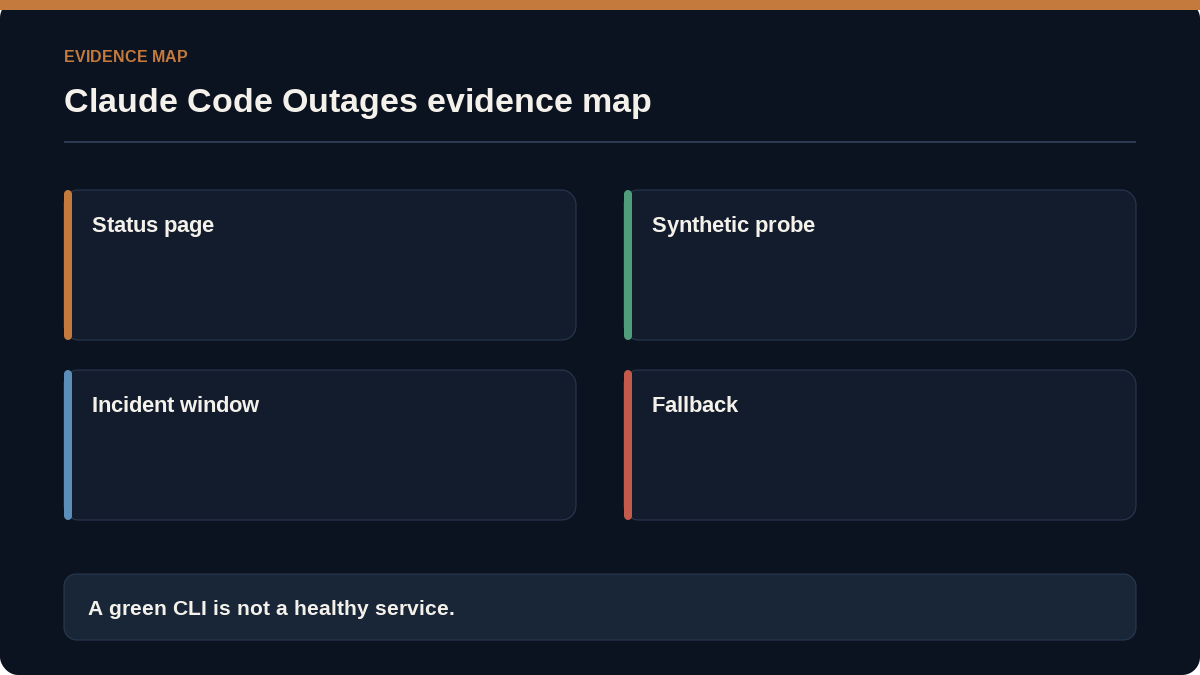
Status versus symptoms: read both without forcing agreement
The Claude status page is the official incident surface. It lists product areas, a 90-day uptime graph, impact levels and update stages. Use it to identify a published incident and follow its progress.
A synthetic check is a small, controlled request that tests a defined path. It can reveal a failure before a developer hits it, or confirm that one workstation cannot reach a service that appears healthy elsewhere. The check should use test data, an approved account and a strict request budget. Do not replay a production prompt merely to see whether the endpoint answers.
A local symptom record captures what the developer actually saw: timestamp, surface, error class, task scope and whether other users on the same network are affected. It should not contain secrets or a full transcript. Redact authorization headers, proxy credentials and private project text before attaching it to an incident.
| Signal source | What it supports | What it cannot prove |
|---|---|---|
| Official status page | Published incident state and product scope | Every user’s local experience |
| Synthetic probe | Health of one defined request path | Every feature, model or account |
| Local CLI result | Behavior of one process and environment | Provider-wide availability |
| Network telemetry | Route, socket and proxy behavior | Model correctness or account entitlement |
| Teammate report | A second observation with its own context | A universal defect without reproduction |
The status page’s uptime graph is historical context, not a promise. Unknown: the fact pack supplies no contractual uptime percentage, no incident-frequency baseline and no method for converting the graph into an SLA. Do not turn a visual trend into a made-up availability number.
The live gateway status page is a separate service surface. It can be relevant to a gateway route, but it does not describe Anthropic’s Claude Code service. Keep the two records separate when diagnosing a chain that contains more than one provider.
Define an incident window before counting impact
An incident window is the interval your team uses to group failures and recovery evidence. A practical local window starts at the first failed check that meets your alert rule. It ends after the service and the affected workflow both pass the recovery checks you chose.
That definition is an operational recommendation, not an official Anthropic incident stage. The status page may publish an incident with different boundaries or update stages. Record both timelines instead of rewriting one to match the other.
| Window event | Evidence to save | Why it matters |
|---|---|---|
| First failed probe | Timestamp, route and error class | Establishes the local start |
| First user report | Affected surface and task | Connects service evidence to work impact |
| Published incident | Official update and product scope | Adds provider context |
| Fallback decision | Alternate route and approver | Prevents silent data or credential changes |
| First healthy probe | Timestamp and probe definition | Shows one successful path |
| Workflow recovery | Accepted task and normal checks | Avoids declaring recovery from one response |
Derived: suppose a team runs six scheduled probes during a suspected interruption and two pass after the service update. The observed probe pass share is 2 / 6 = 33.3% for that chosen window. That number does not estimate monthly uptime. It describes six observations with a specific schedule and route.
A sparse schedule can miss a short failure. A dense schedule can add traffic and cost. Choose the interval from the workflow’s tolerance and the account’s approved budget. Document skipped probes as missing data, not as successes.
The Claude Code five-hour and weekly limit guide covers a different boundary. An account usage limit can interrupt work without a service outage. Classify the error before opening a provider incident or waiting for a status update.
Synthetic checks need a narrow contract
A useful probe answers one question. For example: can this managed workstation complete an approved minimal request through the expected proxy and account route? It should not test code generation quality, reproduce a large repository task or depend on a production secret.
Start with a test identity or account scope approved for monitoring. Use non-sensitive content. Cap retries so a failed probe cannot become the connection storm you are trying to diagnose. Store the result as a small record: timestamp, route, status class, latency if measured, and a correlation identifier when available.
| Probe element | Safe default | Avoid |
|---|---|---|
| Payload | Minimal synthetic text | Production code or customer data |
| Account | Approved monitoring scope | Owner’s paid account without permission |
| Retry policy | Bounded attempts with backoff | Infinite reconnect loop |
| Frequency | Matched to incident tolerance | Assuming more probes always means more truth |
| Storage | Redacted result and route label | Raw authorization headers |
| Success rule | Expected response and workflow check | Treating any HTTP response as healthy |
Official: the network documentation lists HTTPS_PROXY, HTTP_PROXY, NO_PROXY, NODE_EXTRA_CA_CERTS, CLAUDE_CODE_CLIENT_CERT and CLAUDE_CODE_CLIENT_KEY, with values loaded once at startup. A probe running under a different environment can miss the exact failure affecting a developer session.
Run at least one check from the same launcher and network zone as the affected workflow. A probe from a cloud host may succeed while the managed workstation fails at the proxy. A probe from the workstation may fail while a browser-based surface works because the routes differ.
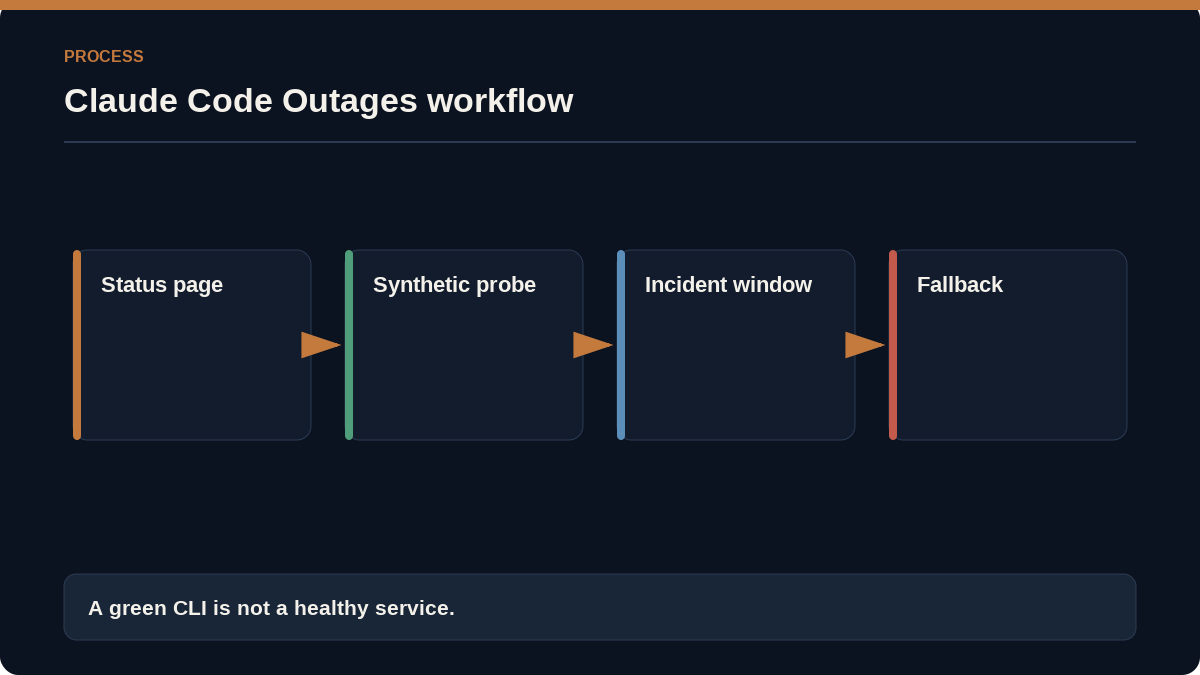
Classify the interruption before choosing failover
Use local categories that describe the evidence. These are not official status-page impact labels.
| Local class | Typical evidence | First response |
|---|---|---|
| Local route | One network or device affected; approved route fails | Check proxy, CA, mTLS and startup environment |
| Account boundary | Explicit entitlement or usage-limit response | Review account state and documented limit mechanics |
| Service interruption | Official incident or failures across independent routes | Pause remote work and follow the incident |
| Feature-specific failure | One tool or surface fails while a narrow request works | Bound the feature and use manual review |
| Unknown | Signals disagree or evidence is incomplete | Preserve state, reduce probes and escalate |
The Claude Code corporate proxy, TLS and mTLS guide handles the local route branch. The Claude Code usage limit mechanics guide handles account windows. Neither branch should be relabeled as a provider outage without evidence.
Official: Remote Control can continue a local session from a phone, tablet or browser, but the local process must stay running. It requires a paid plan and claude.ai authentication, and API keys are unsupported. That makes Remote Control a possible approval surface during a commute, not an independent failover host. If the workstation or its network path fails, the phone does not replace the runtime.
The Claude Code mobile Remote Control limits guide explains the security and review boundary. A phone approval should not become a substitute for inspecting a large diff on a workstation.
Fallback routes: decide before the incident
A fallback route is an approved way to keep useful work moving when the primary route is unavailable. It can be manual editing, a pre-arranged alternate agent, a different provider under the same data policy, or queued work that does not need a model.
Do not assume a gateway will silently substitute another model. One AI’s routing documentation and overview contain a conflict about whether a different model can be returned automatically. The final practical section explains that boundary. For the main Claude Code plan, record failover as an explicit, tested decision.
| Fallback option | Precondition | Main loss |
|---|---|---|
| Manual local editing | Developer has context and test access | Slower generation and more context switching |
| Alternate approved agent | Compatible workflow, credentials and data approval | Different tool behavior and output format |
| Alternate provider | Contract, privacy and network route approved | Model behavior and evaluation may differ |
| Queued non-model work | Written task list and local tools | Delayed model-dependent steps |
| Pause and preserve state | Handoff packet and clean stop point | Work waits for recovery |
The Claude Code context-portable migration guide helps preserve decisions when changing tools. Raw transcript transfer is not enough. Carry the goal, constraints, approved files, verification commands and unresolved questions.
The Claude Code offline-mode boundary guide prevents another false fallback. Local files and cached transcripts remain available without a network, but the supplied sources do not document frontier Claude inference without a connection. A cached session is useful evidence, not a replacement model.
The Claude Code session handoff and team context guide gives the packet structure. A good handoff shortens recovery, but it still requires a human to confirm that the alternate route understood the task.
A runbook for the first failed request
- Stop the retry loop. Preserve the error class, timestamp, route and task scope. Do not paste secrets into the incident channel.
- Check the official status page. Record any matching incident, product scope and update stage. Absence of an incident does not prove the local route is healthy.
- Run one approved synthetic check. Use the same network zone and launcher where possible. Keep the payload minimal and the retries bounded.
- Classify the boundary. Separate local network, account limit, service interruption, feature failure and unknown.
- Protect the work. Save the diff state, decision log and next verification step. Avoid a destructive cleanup command during uncertainty.
- Choose an approved fallback. Use manual work, an already tested alternate route, queued tasks or a pause. Record the choice.
- Verify recovery. Require both a healthy probe and a narrow workflow check before resuming normal operation.
- Close the window. Record the local start and end, the official incident timeline if any, affected tasks and remaining gaps.
| Runbook decision | Evidence threshold | Action |
|---|---|---|
| Retry once within policy | Explicit temporary response and bounded route | Follow the documented wait or retry signal |
| Pause automated work | Repeated failures or unclear boundary | Stop load and preserve state |
| Escalate locally | Proxy, CA or mTLS evidence | Send a redacted network packet |
| Escalate to provider | Matching official incident or independent failures | Attach timestamps and route evidence |
| Switch route | Alternate path already approved and tested | Record credential and data boundary |
| Resume | Probe and narrow workflow both pass | Watch for recurrence before full load |
The Claude Code rewind and checkpoint limits guide matters during recovery. Checkpoints track file edits, not every Bash side effect, subagent change or external state. A service interruption does not make those untracked effects reversible.
The Claude Code proof-of-work packet provides the recovery check. A response that says the task is done is not enough. Confirm the accepted files, tests and relevant external effect before closing the incident.
Test the fallback before the incident
A fallback that exists only in a document is a hypothesis. Schedule a controlled exercise with a non-production task and an approved alternate route. The goal is not to prove uninterrupted service. The goal is to expose missing credentials, incompatible instructions and unclear ownership while failure is still simulated.
Start by writing the handoff packet before disabling the primary route. Include the task goal, allowed files, current diff state, decisions already made, verification commands and the next safe action. Remove secrets and customer data. Then ask a teammate to continue from that packet without reading the original chat. Any question they cannot answer identifies a missing handoff field.
| Exercise step | Pass evidence | Failure to record |
|---|---|---|
| Prepare alternate route | Approved account, endpoint and data scope | Missing approval or credential ownership |
| Write handoff | Teammate can state the next action | Reliance on unstated context |
| Disable primary access | Exercise starts from a clean stop point | Destructive cleanup or hidden retry loop |
| Complete narrow task | Alternate route produces a reviewable diff | Format, tool or permission mismatch |
| Verify result | Independent checks meet the written acceptance rule | Confident summary without proof |
| Return to primary | Normal route and workflow both pass | Partial recovery or stale environment |
Use the Claude Code overengineering and diff scope guide to keep the exercise small. Use the Claude Code independent review guidance context to assign verification to someone who did not watch the model reason. A switch that produces more work than it saves is still a useful finding, provided the team records it honestly.
The exercise also reveals data-handling differences. An alternate provider may have different retention terms, logging defaults and regional behavior. Review those terms before sending real project material. The Claude Code privacy and retention guide explains why deleting a local session does not settle every remote copy.
Unknown: the fact pack contains no measured failover success rate and no universal recovery-time target. Set a local objective from the team’s delivery needs, then report actual exercise results without presenting them as vendor performance. Repeat the exercise when the account route, proxy, launcher or data policy changes.
Worked example: bounded recovery without invented uptime
Assume an approved probe runs every 10 minutes during a suspected incident. That schedule is a team choice, not an Anthropic recommendation. Over one hour it produces six scheduled observations. If one probe is skipped, the record contains five results, not six.
Derived: if four of those five recorded probes fail, the observed failure share is 4 / 5 = 80% for that sample. It would be wrong to publish that as an uptime figure. The sample covers one route, one account scope and one hour. It does not include other regions, features or users.
Now assume the official incident is resolved after the fourth failed probe. The next probe passes, but the narrow workflow check still fails because the managed proxy has a stale process environment. The incident window should not close yet. Restart the approved launcher, repeat the workflow check and record the separate local recovery time.
| Observation | Result | Interpretation |
|---|---|---|
| Probe 1 | Fail | Start local evidence collection |
| Probe 2 | Fail | Check status and route class |
| Probe 3 | Skipped | Missing data, not success |
| Probe 4 | Fail | Preserve state and choose fallback |
| Probe 5 | Pass | One remote path has recovered |
| Workflow check | Fail | Local or feature boundary remains |
| Restarted workflow check | Pass | Candidate local recovery point |
This example produces a concrete win: the team avoids confusing one healthy response with restored delivery. The loss is time spent on a second boundary after the provider recovers. The practical implication is to measure recovery at the workflow layer, not only at the endpoint.
Keep continuity and safety controls beside the runbook
Outage planning works better when the rest of the operating system is explicit.
- Continuity: the Claude Code offline-mode boundaries, mobile Remote Control limits and session handoff format define what can continue when the primary session stops.
- Scope and destructive work: the diff-scope controls, dependency-install review, database migration safety, gitignored-file protection and checkpoint coverage keep an interruption from triggering unsafe cleanup.
- Untrusted content: the repository prompt injection guide, MCP trust boundary guide, plugin security audit, secrets and transcript controls, authorized security research workflow and game IP task boundaries still apply during degraded operation.
- Platform evidence: the network storm diagnosis, Linux ARM setup, macOS Keychain permissions and PowerShell quoting checks help separate workstation faults from service faults.
- Economics: compare annual commitment, Max and Ultra capacity, fast-mode premiums and Batch API workload fit before paying for a second route.
- Quality: review cache minimums, thinking-token caps, effort defaults, review capacity, provenance records and license compliance when an alternate model handles recovered work.
An alternate route can change output style, tool support and verification needs. Do not treat a successful connection as proof that the recovered task meets the same acceptance bar. The Claude Code cost per verified change guide keeps review and rework in the incident cost.
Honest loss and data gaps
The win is a bounded response. The team can pause safely, keep useful manual work moving and return with evidence. The loss is that failover rarely preserves every convenience. Context transfer, model behavior, credentials and review capacity can all change.
Unknown: the public record does not provide a universal Claude Code outage rate, a guaranteed failover mechanism, or one incident threshold that fits every team. The 90-day status graph is useful context but does not establish future availability. Remote Control’s local runtime requirement also prevents it from serving as an independent backup host.
Update the runbook after each real incident and whenever the official status, network or Remote Control documentation changes. Keep failed probes and skipped observations. Removing inconvenient data makes the recovery story cleaner and less useful.
A practical OpenAI-format alternate with One AI API Key
For a separately approved test, the 46 live free model IDs work through OpenAI-format agents. The quickstart provides the base URL and request shape. Choose an agent that supports that format and keep this route outside Claude Code.
The documented Claude Code route is currently unavailable. First-party, checked 2026-11-27: all four Claude IDs were unavailable, and free IDs are OpenAI-format only. Never present those free IDs as a Claude Code failover. The shared free allowance is 100 requests and 5,000,000 tokens per day per account, resetting at 05:30 IST / 00:00 UTC, with one request in flight per key and up to three keys per account.
The prepaid pricing page lists $10 signup credit with no card and no subscription or seat fee. The published privacy and retention policy describes prompt logging off by default, a no-training policy and per-key controls. Upstream providers receive requests under their own terms, so an alternate route still needs data approval.
Do not assume automatic cross-model failover. The routing guide documents same-model retries and configurable fallback headers, while the gateway overview says the service does not answer with a different model. Treat that contradiction as unresolved. The key control reference covers caps, expiry and allowed-model lists. Create an account only for the approved OpenAI-format test, not as a promised fix for a Claude Code outage.
FAQ
Does a green status page mean Claude Code is working?
No. It means the official surface has not published a matching incident at that moment. Local proxy, certificate, account and feature failures can still block a request. Compare status with a narrow probe from the affected route.
Is the 90-day uptime graph an SLA?
No. Official: the supplied status page presents a 90-day graph and incident information, but it states no contractual SLA or guaranteed uptime percentage.
Can Remote Control keep work running if the desktop goes offline?
No. Official: the local process must stay running. Remote Control continues that local session from another device; it does not move execution to the phone or browser.
Should I retry continuously during an outage?
No. Use a bounded retry policy and preserve evidence. Community issue #19006 reports a reconnection storm, but it does not establish a universal bug. Reducing retry load is a safe diagnostic step.
Is automatic fallback guaranteed?
No. For the separate gateway route, the supplied documentation conflicts on cross-model fallback. Treat failover as an explicit tested choice. For Claude Code, use only an alternate route you have independently approved and verified.