Direct answer
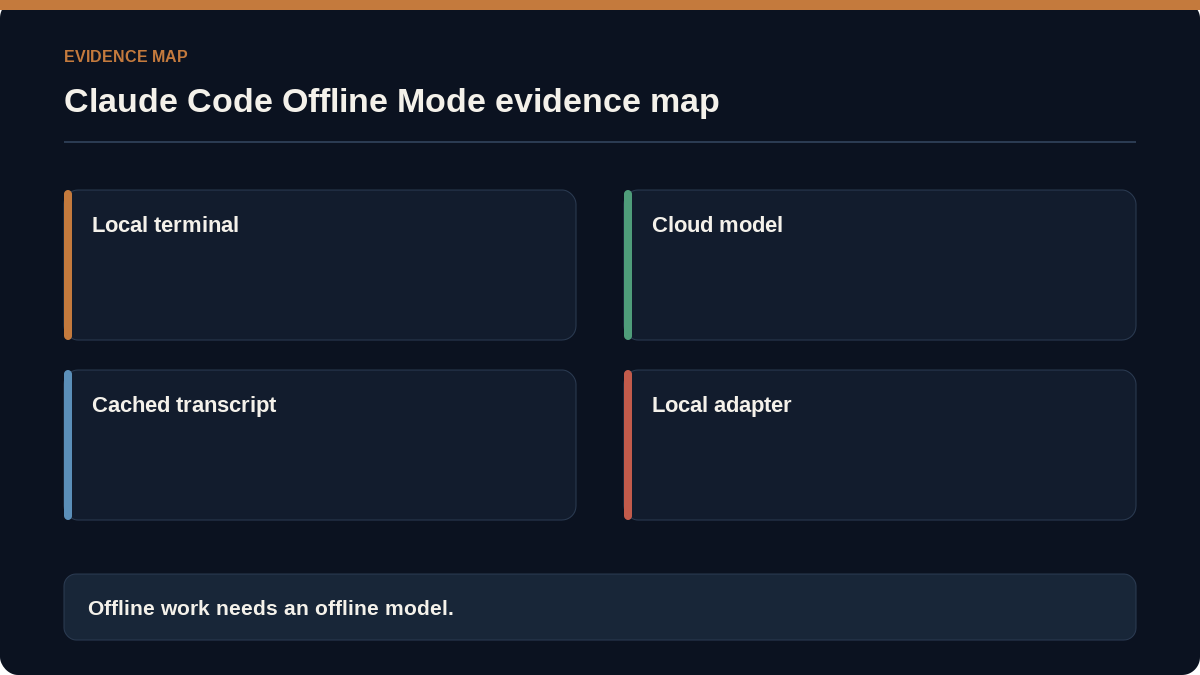
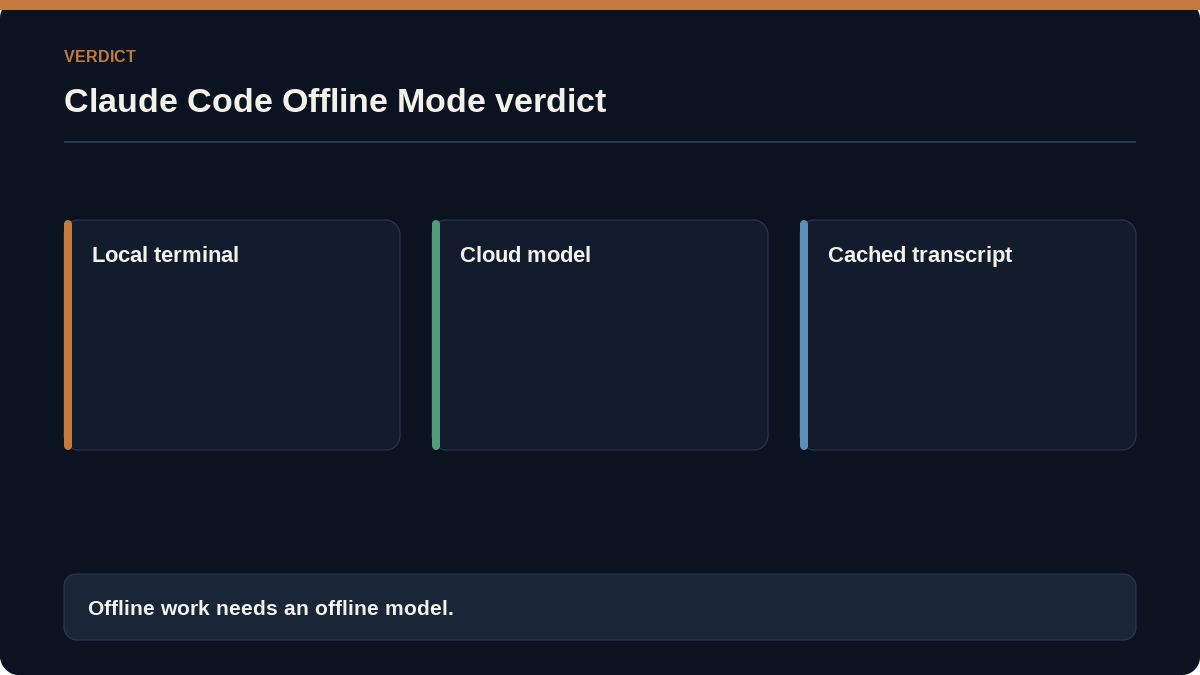
Claude Code does not have a documented offline mode that runs frontier Claude models without a network. You can still use local files, local tools and saved transcripts while disconnected. A local-model adapter can also support a separate offline model workflow, but that is not the same as running Claude offline. Official: the supplied product and Remote Control sources do not document network-free frontier inference (F006). Remote Control is not an exception. It continues a local session from another device while the local process stays running and connected (F004, F005). The practical answer is to plan disconnected work around review, notes and local verification, then reserve model calls for a connected period. The win is useful offline progress. The loss is that a disconnected agent cannot provide the cloud-dependent reasoning the connected workflow relies on.
Why the boundary matters
“Offline” gets used for several different capabilities. A repository can be on disk. A terminal can open. A transcript can remain in a local cache. None of those facts proves that a model can generate a new response. Once the distinction blurs, a travel plan or incident procedure depends on a capability that was never available.
This matters operationally. A developer who expects model access during a flight may leave without the notes, fixtures or review evidence needed to work. A team that calls a local adapter “Claude offline” may also miss differences in tool support, model quality and data handling. Name the component that is local before deciding what the workflow can do.
Official: the network documentation lists the hosts and configuration used by Claude Code, including proxy variables and certificate settings (F028). That is evidence of a networked client, not evidence of a complete list of offline features. The safe conclusion is narrow: the supplied sources do not document a network-free frontier mode (F006).
The offline boundary also affects handoff design. A teammate who is disconnected needs a packet they can read and verify locally. Sending a live session link is not enough if the local process or service is unavailable.
What is local
Local means the work happens on the machine in front of you. It does not automatically mean private, durable or independent of a license. Check each layer.
Local versus cloud
| Capability | Where it happens | Works without network? | Boundary to remember |
|---|---|---|---|
| Repository files | Local workspace | Yes, if already present | A local checkout is not a model |
| Local terminal and editor | Local machine | Usually, for installed tools | Installed software may still phone home |
| Git operations on local history | Local repository | Yes, for local inspection and commits | Remote fetch and push need connectivity |
| Local tests and static checks | Local machine | Yes, if dependencies and inputs are present | Passing local tests is limited evidence |
| Saved transcript | Local storage or a product surface | Can be read as a record when available | A record is not a new model response |
| Claude model request | Remote model service | No documented offline frontier mode | Do not promise cloud inference while disconnected |
| Remote Control | Local runtime plus remote interaction | No | The local process must remain online |
| Local-model adapter | Separate local inference stack | Potentially, after separate setup | It is not frontier Claude inference |
Official: setup documentation lists supported operating systems and minimum platform requirements, including x64 or ARM64 processors and at least 4 GB RAM (F024). Those requirements describe running the client. They do not provide hardware guidance for hosting a frontier model offline. Windows native also lacks sandboxing according to the supplied setup facts (F024), which is a separate security consideration when planning local work.
Local tests are often the most valuable disconnected capability. They can check deterministic behavior, parse a fixture and confirm that a build still works. They cannot replace a model when the next step is “decide how to redesign this interface.” Treat local verification as evidence about code, not evidence about a future model response.
What needs the cloud
A new frontier Claude response needs the model service. So do Remote Control interactions that depend on the service. Cached files do not change that dependency.
Official: Remote Control can continue a local session from a phone, tablet or browser. It requires a paid plan and claude.ai authentication, does not support API keys and requires the local process to stay running (F004). The feature synchronizes transcripts to Anthropic servers and keeps full access to the local environment (F005). In practice, that means remote access to a connected runtime, not a mobile or offline copy of the model.
Some limitations are easy to miss. Remote Control supports one remote session per interactive process outside server mode. Some commands remain terminal-only. Zero Data Retention and HIPAA configurations cannot enable it. Bedrock, Google Cloud Agent Platform and Microsoft Foundry endpoints are unsupported (F005). Do not build a disconnected procedure around a feature with those boundaries.
The mobile Remote Control guide separates phone approval from workstation review. The same distinction applies offline. A phone can be an interaction surface only when the connected local runtime and service are available.
Network failures need their own diagnosis. The enterprise network configuration guide covers proxy and certificate behavior, while the connection storm runbook covers retry-related symptoms. Neither should be mistaken for an offline feature. When the service is reachable again, outage status and failover planning can help decide whether to resume or switch work.
Cached sessions
A cached transcript is a historical record. It can preserve useful notes, a decision trail or a command that still needs review. It cannot answer a new question by itself.
Official: session management includes continue, rewind, /compact and /clear, with warnings that context growth and bad autocompaction can lose important details (F001, F002). A saved or summarized session should therefore be treated as evidence to inspect, not a perfect memory. The compaction context-retention guide goes deeper on that limitation.
Official: the settings reference exposes cleanupPeriodDays for transcript retention and desktopSessionCleanupPeriodDays for Desktop and Cowork transcripts (F020). The fact pack does not establish a universal default retention period. Do not tell a traveler that a transcript will remain available for a specific number of days unless the configured environment confirms it.
Prepare for disconnected work by extracting what matters. Write a short task note with the current branch, accepted decisions, open questions and the next verification step. Link the transcript if access is appropriate. Avoid copying secrets or private tool output into the note. The secrets-in-logs checklist explains the storage surfaces that deserve review.
A cached session also does not restore external state. Official: checkpointing covers Claude Code file edits but not every Bash, subagent or external modification (F014). If the disconnected task depends on a database, remote service or generated artifact, prepare that dependency explicitly rather than assuming session history will supply it.
Local model adapters
A local-model adapter is a translation layer between an agent interface and a model running on local hardware. It can let a compatible agent send prompts and receive responses without a cloud model request. That is a different architecture from Claude Code calling frontier Claude.
The supplied sources do not document a supported Claude Code configuration that turns an arbitrary local model into offline frontier Claude. Treat adapter claims as Unknown until a specific harness, model and integration have verified documentation. Do not infer support from the existence of model weights or a local server.
If you evaluate a local adapter, separate three questions:
- Can the agent complete the required tool calls with that model?
- Can the model handle the repository context within the available hardware?
- Does the workflow meet your privacy, security and quality requirements?
Those are evaluation questions, not product guarantees. Run the adapter against a disposable fixture first. Compare accepted changes and verification results rather than assuming that a familiar chat interface means equivalent coding behavior. The model selection guide for coding agents provides a useful decision framework.
A local model can still have network-enabled features, depending on the stack. Likewise, local files can contain sensitive data. “Offline” describes connectivity, not a complete security posture. Review the adapter’s update path, telemetry, tool permissions and model data handling before treating it as an air-gapped component.
The honest loss is practical. A local setup requires hardware, model files, compatible software and evaluation time. The supplied fact pack contains no local-model benchmark for this workflow. It also contains no evidence that a local adapter matches frontier Claude on agentic coding. Present it as an alternative to test, not a drop-in replacement with proven parity.
Choosing an offline option
Choose the option by the job, not by the word “offline.” A developer reviewing an existing diff has different needs from one designing a new subsystem. The first job may need only local files and tests. The second may need to wait for a connected model session.
Offline options
| Option | Suitable work | Capability it does not provide | Required preparation |
|---|---|---|---|
| Local repository and tools | Inspection, bounded edits, deterministic checks | New frontier Claude responses | Current checkout and installed dependencies |
| Reviewed task note | Following settled decisions without a live model | Fresh reasoning about an unresolved design | Goal, boundaries, evidence and open questions |
| Saved transcript | Reference to prior context when locally available | A new model turn | Controlled copy and confirmed local access |
| Separate local-model adapter | Offline inference with a separately evaluated model | Proven frontier Claude parity | Compatible harness, model files, hardware and tests |
| Connected Remote Control | Remote interaction with a running local session | Offline execution or a phone-based runtime | Paid plan, authentication and online local process |
| Reconnect queue | Recording work that must wait | Immediate completion | Clear blocker, owner and next connected action |
The table is a planning aid, not a compatibility certification. Unknown: the supplied sources do not verify a specific local adapter or establish that cached transcripts are readable in every surface. Confirm the exact environment before assigning either option to a task.
For inspection and documentation, use the local repository and a written task note. This option has the smallest technical dependency because the required files are already present. Its loss is equally clear: it cannot generate a fresh design or explain unfamiliar code through a model. If the task crosses into interpretation, record the question and move it to the reconnect queue instead of improvising.
For deterministic implementation, use a bounded local edit with installed dependencies. This can cover a fixture update, a small refactor with known behavior or a test correction. The control is a written change contract that names the allowed files and the check that must pass. The scope-drift review helps prevent a disconnected cleanup from spreading into unrelated code.
For reference, carry a reviewed handoff and controlled evidence links. This is not inference, but it can preserve the decisions made while connected. The team handoff packet should state which questions are settled and which still require a model. A receiver can then work on the settled portion without treating an old summary as a live answer.
For separate local inference, evaluate a local-model adapter only when the task justifies the setup. Ask whether the model and harness can complete the required tool sequence, whether the hardware can hold the needed context and whether the output passes the same repository checks. Do not call the result “Claude” unless the actual model and integration support that description. The supplied sources do not establish such parity.
For remote interaction, Remote Control remains a connected option. It may help someone approve work away from the desk, but it does not remove the local runtime or network requirement (F004, F005). If the laptop cannot stay online, choose a different device plan. The mobile approval checklist explains which reviews belong on a phone and which need the workstation.
A useful decision rule is to stop at the first unmet dependency. If the task needs a new model decision, a missing package or a remote service, stop the offline attempt and write down the blocker. That rule sounds restrictive, but it protects the limited disconnected period. The alternative is to spend the window troubleshooting a dependency that was predictable before departure.
The concrete win is a smaller, more honest offline queue. The concrete loss is that some attractive tasks must wait. The practical implication is to prioritize work by local verifiability rather than by how important it feels. Importance does not make a cloud-dependent task executable without the cloud.
A disconnected workflow
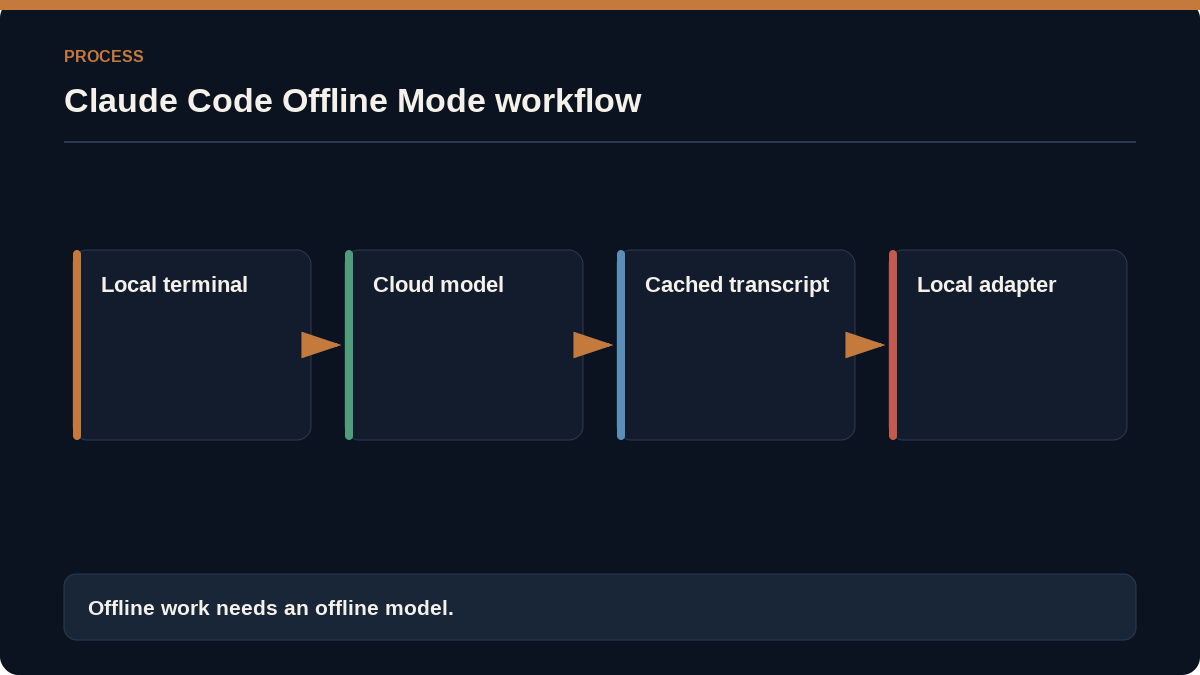
Plan the connected and disconnected phases separately. The connected phase gathers context and makes decisions. The disconnected phase executes bounded work that does not need a new model response.
Workflow checklist
| Phase | Action | Output to carry offline | Stop condition |
|---|---|---|---|
| Before disconnect | Confirm the goal and allowed files | Short task packet | Goal remains ambiguous |
| Before disconnect | Resolve design choices that affect implementation | Decision log | A major option is still open |
| Before disconnect | Install and verify required local dependencies | Locked dependency state | Setup needs registry access |
| Before disconnect | Run the baseline checks | Test and build notes | Baseline failure is unexplained |
| Before disconnect | Save controlled evidence links | Issue, diff and fixture references | Receiver lacks access |
| Offline | Edit only the bounded files | Local diff | A new dependency or design choice appears |
| Offline | Run deterministic local checks | Results with command names | Check needs a remote service |
| Offline | Record unresolved questions | Reconnect queue | An action needs production access |
| After reconnect | Compare the diff with the packet | Reviewed change set | Scope or assumptions changed |
| After reconnect | Resume model work with a distilled brief | Updated handoff | Evidence contradicts the plan |
This workflow borrows the handoff packet format but does not depend on a live model during the offline phase. The large-diff scope contract helps keep local edits within the decisions made before disconnect.
Prepare for the likely interruption, not the ideal one. If a local test needs a package that was not installed, record the gap and move to a task that can finish. Do not improvise a dependency install from memory. Package managers can run lifecycle scripts and reach the network (F011), which is exactly the kind of action that should wait for a reviewed connected phase.
A safe offline test
Use a scratch repository with a tiny deterministic task. A parser fixture or a validation function works well. The task should have one expected result and no remote services.
First, complete the connected preparation. Write the allowed files, record the intended behavior and run the baseline check. Then disconnect the test machine from the network. Open the repository, inspect the saved notes and make the bounded edit. Run only local checks whose dependencies are already present.
Next, try to distinguish three things in practice. Can you read the local task note? Can you inspect the saved transcript if the environment exposes it? Can you get a new model response? The supplied evidence supports treating the first two as separate local capabilities and does not support expecting the third (F006). Record the actual behavior without turning one machine’s result into a universal claim.
The safe test passes when you can state exactly what progressed offline and what waited. A useful outcome might be a completed local edit with one question queued for reconnect. A failed outcome is discovering halfway through that the task needed a model decision, a registry download or a remote database.
Derived: For planning, use offline capacity = available local tasks with installed dependencies and deterministic checks. This is a task-counting rule, not a token estimate. A task that fails any term stays in the reconnect queue. No benchmark data is needed for the formula.
The concrete win is a dependable offline queue. The concrete loss is that preparing that queue takes connected time. The practical implication is to spend a few minutes before travel or a maintenance window deciding which tasks can finish without a model call.
Honest loss and data gaps
The supplied official sources do not document an offline frontier mode (F006). That is an evidence boundary, not proof that no future product will add one. It also does not prove that every local tool fails offline. The correct claim is that local files, cached records and separate local inference must not be presented as the same capability.
Unknown: The fact pack contains no verified list of offline-compatible adapters, no local-model coding benchmark and no measured offline productivity result. It also does not establish how every product surface stores or exposes cached transcripts. Check the specific client and configuration before relying on a cache.
Official: Remote Control synchronizes transcripts and keeps full local-environment access (F005). That makes it a poor candidate for an “offline by another device” story. The local runtime remains part of the system, and some commands stay terminal-only. Use the mobile capability matrix before assuming a phone can cover a disconnected workstation.
When connectivity returns, resume with a distilled brief rather than replaying the entire cached session. Official: continue, rewind, /compact and /clear support different continuation choices, and compaction can lose details (F001, F002). The receiver test in the session handoff guide helps catch omissions.
Adjacent checks worth keeping separate
Offline planning touches handoff, device and platform behavior without making them interchangeable. Start with team context and session handoff and mobile Remote Control limits. Then check connection storms and NAT retries, Linux ARM and headless login, macOS Keychain permissions, PowerShell path quoting, corporate proxy TLS and mTLS and outage status and failover.
A local edit can still create a broad or unsafe change. Keep large-diff scope control, dependency-install side effects and database migration safety in the offline queue. Recovery should follow gitignored-file deletion risks and rewind checkpoint limits, not assumptions about local session history.
Untrusted material remains untrusted while disconnected. Use the repository prompt-injection review, MCP trust-boundary checklist, plugin security audit, secrets and transcript cleanup, security-research authorization workflow and game-development IP boundaries. An air gap does not convert repository instructions into trusted commands.
Cost and model decisions resume after reconnect. Review annual plan commitment, Max and Ultra usage value, fast-mode pricing and Batch API versus subscription. For request design, consult prompt-cache minimums, thinking-token output caps and reasoning effort defaults. Keep review capacity, AI provenance and license compliance attached to the work that returns from the offline queue.
A practical OpenAI-format alternative
A connected alternative does not solve offline inference, but it can provide a second place to resume prepared work when you have network access. The 46 live free model IDs run through OpenAI-format agents. First-party, checked 2026-11-27: the catalogue showed 76 listed models and 46 available-now free IDs across 22 families (F044). The free lane shares 100 requests and 5,000,000 tokens per day per account, resetting at 05:30 IST or 00:00 UTC, with one request in flight per key (F045).
One AI API Key supports that OpenAI-format route through agents such as OpenCode, Cline or Cursor. Follow the endpoint quickstart, select one free ID and use https://api.oneaiapikey.com/v1 (F047, F048). The prepaid pricing page documents $10 signup credit with no card and no subscription or seat fee (F046). Use the per-key controls for caps, expiry and model allowlists, and the cost calculator when comparing a small reconnect trial.
Do not place these free IDs in Claude Code. They are OpenAI-format only. The documented Claude Code route is unavailable because all four Claude IDs were marked unavailable on 2026-11-27 (F047). A local adapter and this hosted lane are separate options. Neither should be described as offline frontier Claude.
FAQ
Does Claude Code work without internet?
Local files and installed tools can work without internet, but the supplied official sources do not document network-free frontier Claude inference (F006). Prepare bounded local work and reconnect for model decisions.
Can Remote Control keep a session alive while my laptop is offline?
No. Official: Remote Control requires the local process to stay running, and it is a connected remote-access feature (F004, F005). It does not move the runtime or frontier model onto the phone.
Are cached transcripts usable offline?
A saved transcript can be used as a record when the local client makes it available. It is not a new model response. Retention controls exist, but the supplied facts do not establish a universal retention default (F020).
Can a local-model adapter replace Claude offline?
It may provide separate local inference if the adapter, model and harness are compatible. The supplied sources do not establish frontier Claude parity or a supported offline Claude configuration. Evaluate the exact stack on a disposable fixture.
What should I prepare before a flight or maintenance window?
Write the goal, allowed files, decisions, local dependencies, baseline checks and reconnect questions. Keep tasks that need model calls, package downloads or production access in a separate queue.