Direct answer
A dependency belongs in the plan whenever one step consumes another step’s result. Read the defining contract before choosing an edit target. Make the decision before the implementation that relies on it. Inspect the changed state before reporting completion.
Independent reads may be grouped when neither needs the other’s output. Dependent calls must remain ordered, and a failed producer should block its consumers. The Messages API documentation explains ordering and result handling for that API flow; it does not specify a universal Claude Code scheduler.
Why a flat list can hide invalid order
A flat plan says what to do but not what each step assumes. An edit item may silently depend on a read that appears later. A decision may depend on evidence that was never requested. The list looks complete while the sequence is impossible to execute safely.
Dependencies also make partial progress easier to interpret. If a producer fails, the plan can identify exactly which later steps are blocked. Without that relationship, an agent may continue with a guess or mark dependent work complete by assumption.
Official (F031): the parallel tool-use documentation says execution order is user-defined and dependent calls can be skipped with an error result. This is Messages API behavior, not a Claude Code scheduler specification.
Official (F032): the tool-use overview describes a round trip in which Claude returns tool_use and the application returns tool_result. That API loop should not be presented as a description of interactive Claude Code internals.
Official (F033): the parallel-tool documentation requires all tool results together in a single user message without preceding text for that API flow. The message contract does not define a universal Claude Code dependency graph or scheduling rule.
The parallel agents and worktrees guide covers a different concurrency problem. This article stays with dependencies between planning steps and tool work.
Identify information-producing steps
An information-producing step returns evidence that another step needs. Reading a schema, tracing a caller, or inspecting current behavior can produce that evidence. The output does not have to be a file edit to be valuable.
Name the output precisely. “Read the handler” is an activity. “Confirm the accepted input fields and the current error branch” produces information. A consumer can then refer to that confirmed contract instead of relying on a filename.
A read should have an exit condition. When the source is missing or ambiguous, the producer is incomplete. Later steps that consume its result must remain blocked rather than filling the gap with an assumption.
| Producer | Output | Consumer |
|---|---|---|
| Read the input definition | Accepted fields and types | Mapping decision |
| Trace current callers | Expected inputs and outputs | Edit target choice |
| Inspect current behavior | Baseline visible state | Acceptance condition |
| Read project guidance | Relevant constraint | Scope decision |
| Check an external contract | Documented requirement | Implementation plan |
Official (F032): the API round trip separates a requested tool action from the returned result. The planning lesson is editorial: a consumer needs the producer’s output, not merely evidence that the producer was invoked.
The exploration plan guide for unknowns helps when the information source is not yet known. Once discovery identifies it, convert the result into a named dependency.
The file reference guide for reducing context noise helps keep the producer focused. A broad file dump is not a precise output contract.
Identify decision-producing steps
A decision-producing step chooses between routes that the evidence does not settle alone. It may select an edit target, approve a product behavior, or choose between two valid implementation patterns.
Do not hide a decision inside an implementation item. An edit step that says “use the appropriate pattern” conceals a choice that may change scope or behavior. A separate decision makes the owner and the required evidence visible.
Some decisions belong to Claude Code because code evidence resolves them. Others belong to a human because they express product policy or accept scope. The plan should name the owner rather than treating every choice as an agent action.
| Decision | Evidence needed | Owner | Blocks |
|---|---|---|---|
| Which component owns the behavior | Definition and consumers | Agent can propose, human can review | Target selection |
| Whether an empty state offers retry | Requirement or product answer | Product owner | Acceptance wording |
| Whether a dependency change is necessary | Current interfaces and alternatives | Reviewer | Scope approval |
| Which output column is excluded | Mapping policy | Product owner | Export implementation |
| Whether new evidence changes direction | Contradiction and impact analysis | Requester | Further edits |
The ambiguous requirements guide separates discoverable facts from human choices. Use it before assigning a decision to discovery work.
A decision is complete when its result is recorded and its dependencies are satisfied. A discussion without a recorded outcome leaves consumers unresolved.
Identify edit-producing steps
An edit-producing step changes files or external state. It should consume named evidence and a settled decision. If either input is missing, the edit is premature even when the intended destination is plausible.
Separate edits that touch dependent state. A later edit may rely on a symbol, interface, or block created by an earlier one. That relationship belongs in the plan. Independent edits may still share risks, but independence should be established rather than assumed.
The exact edit target guide helps make the consumer precise. A unique textual anchor and replacement contract reduce ambiguity about what the edit consumes.
| Edit step | Must consume | Produces |
|---|---|---|
| Change a message block | Current text and approved wording | Updated visible text |
| Adjust an interface | Caller evidence and compatibility decision | Changed contract |
| Add a local mapping | Confirmed data shape and column policy | New transformation |
| Remove obsolete scaffolding | Evidence that this task introduced it | Reduced local complexity |
Official (F031): dependent calls can be skipped with an error result in the documented API flow. The caveat prevents a direct leap to Claude Code behavior, but the planning principle remains useful: do not let a consumer proceed as if a failed producer succeeded.
The negative requirements guide helps state what an edit must not disturb. That protected behavior becomes another input to the edit decision.
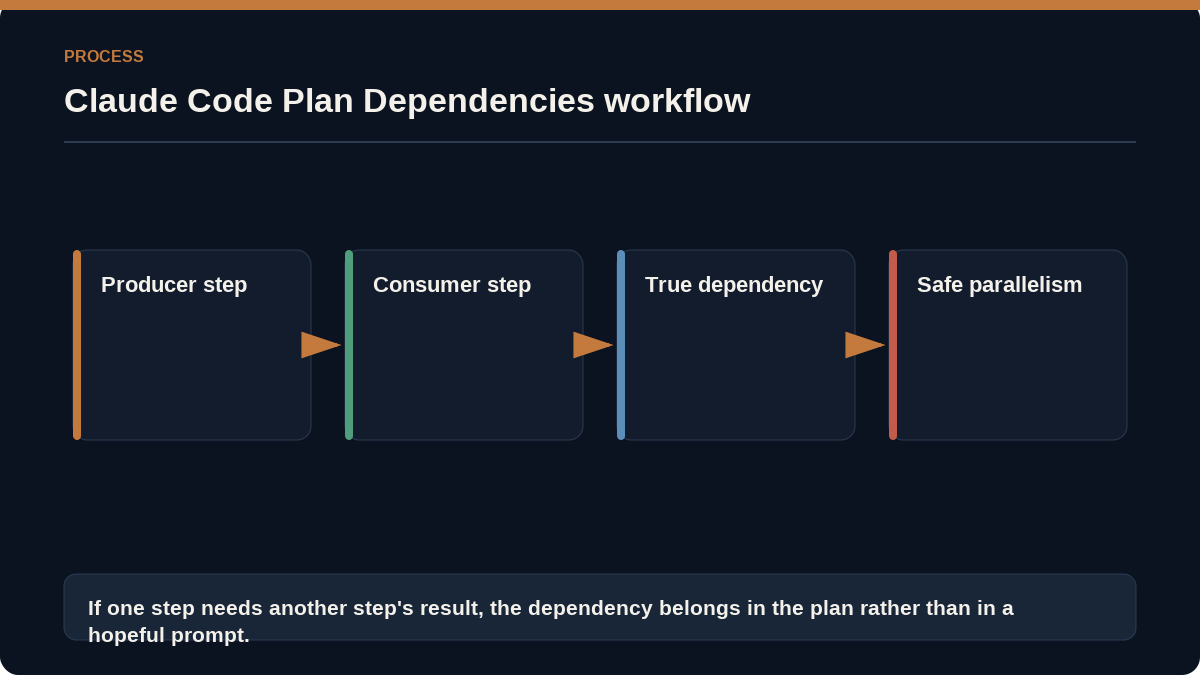
Mark true dependencies
A true dependency exists when removing the order would make a later step invalid. Ask what input the consumer needs and which producer supplies it. If no output is consumed, the steps may be independent.
Use a compact notation: producer -> consumer. Add the output beside the arrow when the relationship would otherwise be unclear. For example, read input definition -> choose column mapping states both the order and the reason.
Avoid turning every chronological preference into a dependency. Reading one file before another may be convenient without being required. Marking optional order as mandatory makes the plan rigid and obscures the relationships that matter.
| Step | Produces | Consumes | Must precede |
|---|---|---|---|
| Read input definition | Field evidence | Current source | Mapping decision |
| Approve mapping | Column policy | Field evidence and requirement | Edit |
| Apply mapping edit | Changed behavior | Approved mapping | Inspection |
| Inspect output | Acceptance evidence | Changed behavior | Completion report |
A dependency can also point to a human decision. product answer -> empty-state edit is as real as schema read -> target edit. The plan should not treat human-owned inputs as automatically available.
The task breakdown guide for exit conditions helps define when a producer is complete. A consumer should wait for the exit condition, not merely for an activity label.
Separate independent reads
Independent reads do not consume each other’s output. A schema read and a caller read may both inform a later decision without depending on one another. Grouping them can simplify the plan, but it does not prove how Claude Code will schedule the calls.
Official (F031): the API documentation describes user-defined execution order for parallel tool use. It is not a promise about interactive scheduling or latency. Use the documentation to understand the API contract, not to advertise a Claude Code performance result.
| Work | Relationship | Planning treatment |
|---|---|---|
| Read schema and read caller | Neither output is needed to perform the other read | May be grouped as independent evidence |
| Read schema and choose mapping | Mapping consumes schema evidence | Must remain ordered |
| Approve mapping and edit component | Edit consumes the approved mapping | Must remain ordered |
| Inspect output and write summary | Summary should consume inspection evidence | Must remain ordered |
| Edit two unrelated blocks | No shared output, but shared file state may still matter | Review conflicts before grouping |
The parallel tool-call guide for independent reads covers the API pattern in more detail. Keep its compatibility caveat attached whenever the mechanism is mentioned.
Independence is not only about data. Two reads may be logically independent while one changes session state or produces a large result that affects later work. The supplied facts do not define a universal safety test, so use a conservative review when the surface is unclear.
Handle a dependency that fails
A failed producer should produce a visible blocker, not a guessed consumer result. Record what failed, which output is missing, and which steps are now invalid. Then choose the smallest recovery action.
If the producer can be retried safely, retry it with a clearer target. If the evidence contradicts the plan, revise the route. If a human decision is missing, stop the dependent work and ask the owner rather than inventing policy.
Official (F033): the API flow requires tool results together in a single user message without preceding text. That requirement belongs to the documented API integration. Do not copy it into an interactive prompt as though it were a universal Claude Code rule.
| Failure | Immediate response | Plan response |
|---|---|---|
| Required source is missing | Record the missing evidence | Block target selection |
| Producer returns ambiguous fields | Request a focused clarification | Keep mapping decision open |
| Human decision is unanswered | Name the owner and question | Block dependent edit |
| Evidence contradicts the route | Preserve valid findings | Revise affected dependencies |
| Consumer already ran | Inspect partial state | Do not assume the result is valid |
The tool result evidence contracts guide helps make the failure informative. An opaque error status does not tell the planner which output is missing or whether retry is safe.
The MCP trust boundaries guide is relevant when external tool output informs a dependency. Treat the result as input to evaluate, not as proof that the requested fact is true.
Revise the sequence after new evidence
New evidence can add a producer, remove an obsolete step, or reverse a dependency. Revise the smallest affected part of the plan and then recheck every consumer.
A newly discovered caller may invalidate the assumption that a helper is local. A clarified requirement may remove a decision that previously blocked an edit. A failed read may show that the target belongs elsewhere. Each change should be tied to evidence.
Do not revise the sequence silently when the change alters approved direction. The plan revision guide for new evidence defines when another approval pass is appropriate. A new file alone is not enough; the evidence must change a decision, boundary, or dependency.
The plan mode approval guide provides a checkpoint before direction changes become edits. Carry the accepted dependency order into execution rather than relying on memory.
When a producer becomes unnecessary, check whether its output is still required elsewhere. Removing a read because it looks redundant can leave several consumers unsupported.
Worked example: order a small integration change
Consider an editorial task to change how a local adapter maps an incoming payload. The plan starts with two independent reads: the input definition and the current adapter caller. Neither read needs the other’s result.
The next step chooses the mapping. It consumes both reads plus the stated requirement. The following step edits the adapter. It consumes the approved mapping and the current adapter block. The final step inspects behavior against the original contract.
Derived editorial example: two independent reads form one evidence group. Formula: 2 reads × 1 group = 1 evidence batch. The ordered stages are then 1 evidence batch + 1 mapping decision + 1 adapter edit + 1 inspection = 4 stages. This arithmetic describes the hypothetical plan only. It is not a tool-call limit, scheduling guarantee, or benchmark.
Without the input definition, the evidence batch is incomplete. The mapping decision and adapter edit remain blocked. The inspection cannot prove a mapping that was never approved.
If the caller read reveals an additional protected behavior, the mapping decision changes. The edit remains downstream, but its acceptance condition must be updated before work proceeds.
The reversible planning guide supports placing the evidence and decision stages before broader changes. The stop conditions guide helps keep the task from expanding when discovery finds adjacent work.
Keep the dependency graph small
A dependency graph is useful only while it clarifies the plan. A small task rarely needs a node for every file or action. Use enough detail to show producers, consumers, and failure boundaries.
Start with the blocking chain. Add independent groups only when their relationship matters. If the graph cannot be explained in a short review, it may be modeling implementation detail rather than planning decisions.
| Graph size signal | Interpretation | Action |
|---|---|---|
| One producer feeds several consumers | Shared evidence controls multiple steps | Keep the producer and its exit condition explicit |
| Several producers feed one decision | The choice needs combined evidence | Group only independent reads |
| A cycle appears | The plan contains contradictory prerequisites | Stop and rewrite the sequence |
| Every tool call is a node | The graph has become an execution log | Collapse activity into meaningful states |
| No edges appear | Dependencies may be hidden or the task is truly flat | Review inputs before accepting independence |
The task checkpoint guide for long work can record which producer completed and which consumer is next. A checkpoint should preserve the dependency state rather than replace it with a generic progress sentence.
Concrete win, loss, and practical implication
Win: a missing input definition blocks mapping and editing before an invalid change can be justified. Independent reads remain grouped without pretending that their results are interchangeable.
Loss: explicit dependencies add planning and maintenance work. An oversized graph can be harder to review than a short ordered list, and API documentation still does not prove interactive Claude Code scheduling.
Implication: mark only dependencies that consume real outputs, name the evidence at each edge, and block consumers when producers fail. Use the task breakdown guide for exit conditions to define producer completion.
A compact dependency review
Before approval, read each arrow aloud as a sentence: “This step needs that result.” If the sentence is vague, the edge is not defined. If the result already exists, record where it came from rather than adding an unnecessary producer.
Check that every decision has its evidence and every edit has its decision. Check that independent reads truly avoid consuming each other’s output. Finally, check that failure handling names the blocked consumers.
The structured brief guide for supported outputs helps when the plan is exchanged with a program. Keep dependency fields machine-readable where supported, but do not confuse their validity with correct ordering.
The evidence-bearing tool results guide helps a producer return the output its consumers need. A success label without the required evidence leaves the dependency unresolved.
The verdict: order by consumed results
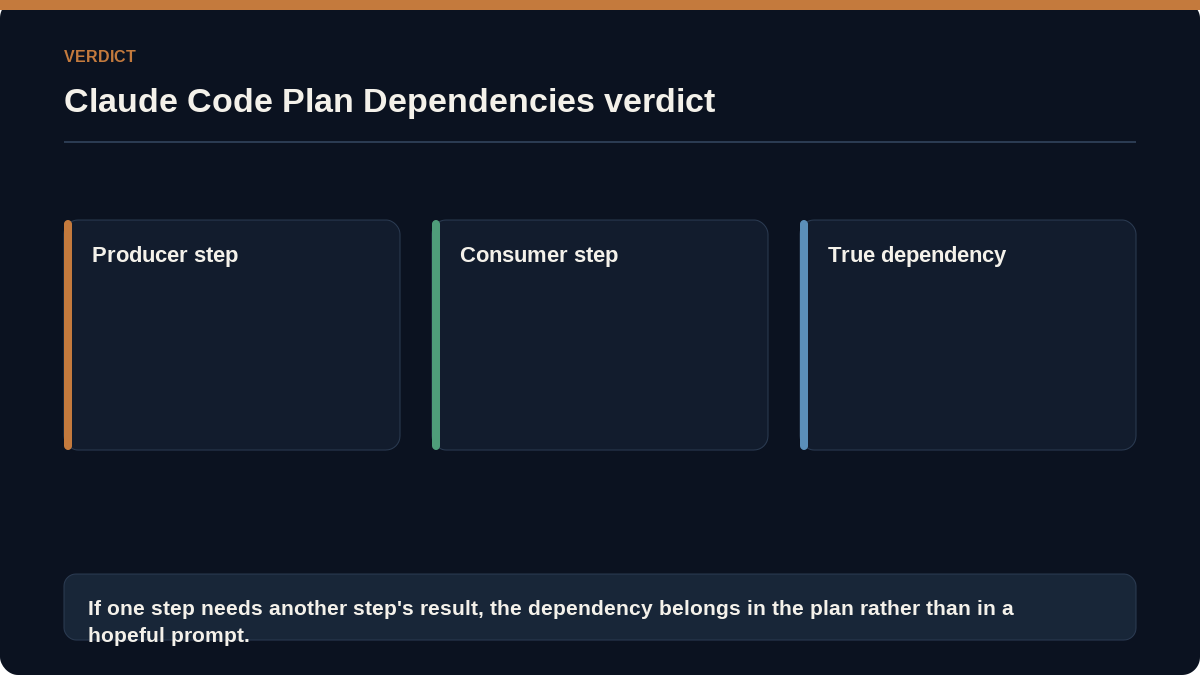
A valid plan is not merely a list of plausible actions. It is a set of producers and consumers whose outputs line up. Reads supply evidence, decisions settle choices, edits change state, and inspection closes the outcome.
Keep the graph small and the boundaries explicit. Use API documentation for the API contract it actually describes, and keep interactive Claude Code assumptions separate.
Data gaps and future updates
Unknown: the supplied research does not define a universal Claude Code dependency graph, scheduler, safe-parallelism test, or latency benefit. The planning notation in this article is editorial.
The handle-tool-calls page was a canonical link only, so no detailed mechanics are drawn from it. The OpenStax software engineering process chapter was available through search evidence and provides foundational process context, not Claude Code-specific scheduling.
Community evidence: no verified issue or reproducible run appears in the packet. No community scheduling anecdote or issue outcome is presented as fact.
A future update should recheck the official API pages and any Claude Code-specific source before adding behavior claims. A performance comparison would need a named method, comparator, and source.
One AI API Key option for OpenAI-format agents
If these dependencies belong to an OpenAI-format agent, One AI API Key provides https://api.oneaiapikey.com/v1, one key, and the packet’s 46 live free IDs for that format. Review the free model list and quickstart. Those IDs are not Claude Code model sources; Claude Code uses an Anthropic-format route, and its Claude IDs were unavailable on 2026-11-27.
FAQ
What makes a dependency real?
A consumer needs an output that another step produces. If removing the order would make the later step invalid, the dependency belongs in the plan.
Can independent reads be parallelized?
They can be grouped as independent planning work. F031 describes Messages API parallel tool behavior, not a Claude Code scheduling or latency guarantee.
What happens when a producer fails?
Record the missing output and block every consumer that depends on it. Retry, clarify, or revise the route instead of letting dependent work proceed on a guess.
Should every action be a node in the graph?
No. Use nodes for meaningful information, decisions, and state changes. Collapse routine tool activity into those states so the graph remains reviewable.
Sources
- Official, fetched: Parallel tool use, F031 and F033. User-defined API order, skipped dependent calls with errors, and the documented result-message contract; not a Claude Code scheduler specification.
- Official, fetched: Tool use with Claude, F032.
tool_useandtool_resultround trip for the Messages API. - Official, canonical link only: Handle tool calls. Further reading only; no unseen mechanics asserted.
- Official, fetched: Claude Code best practices, F024. Create a specification before implementation; assumptions may remain.
- Independent, search-index only: Software engineering process, F027. Foundational process guidance, not tool scheduling behavior.