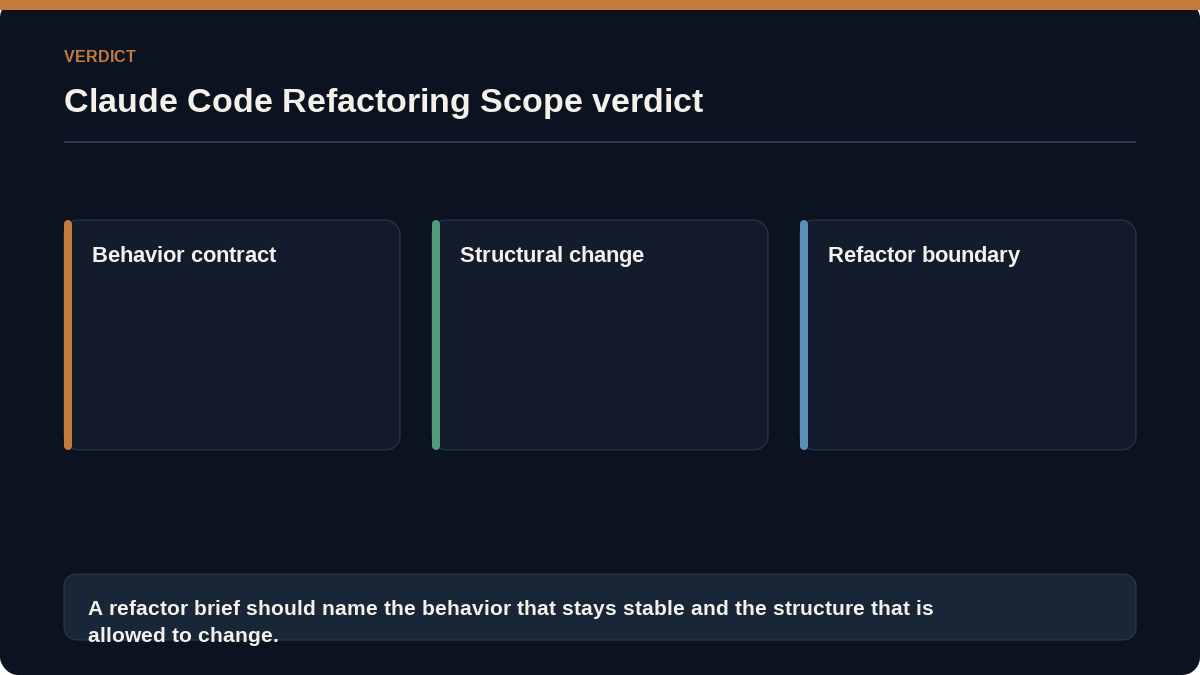
A behavior-preserving refactor needs a written contract before it needs an implementation plan. Name the observable behavior and interfaces that must remain stable, then state the structural change that is allowed. Separate feature requests from the refactor, use small transformations, and check preconditions before each dependent edit. Stop when the structural goal is met. Structure alone cannot prove behavior preservation, so inspect behavior-relevant edits and existing evidence without turning the brief into a testing campaign.
Why refactors expand into feature work
Refactoring changes structure. Feature work changes what a system does. Mixing them makes both harder to review because the final diff no longer has one purpose.
Expansion often begins with a plausible improvement. While moving a function, the editor notices an unclear parameter and renames it. A caller then needs adaptation. A missing validation branch appears nearby, so the change adds behavior. Each step can look useful, yet together they cross the agreed boundary.
A written behavior contract prevents that drift. It names what callers observe and what interfaces must survive. Structural freedom stays inside those limits. This follows the independent definition in F085: refactoring aims to improve maintainability without affecting behavior. The definition states a goal, not proof that a generated edit achieved it.
Use observable requirements to describe behavior. Use negative requirements to protect interfaces and excluded changes. The exact-target guide then helps place each structural transformation in the intended block.
Edit quality and scope are the limits here; the article does not prescribe a test campaign, cover legacy-code characterization, or retread generated-test coverage. Existing project evidence can inform the contract, but the brief should not silently become a request to build a new verification system.
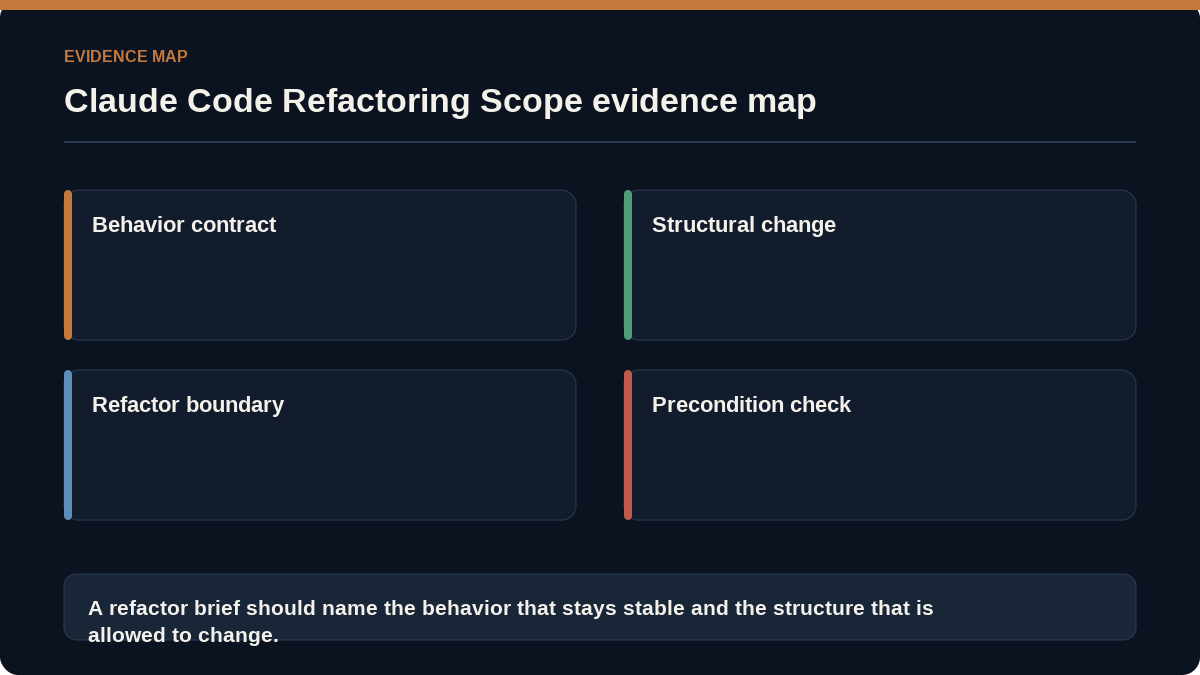
What the evidence supports
Independent, F085: The refactoring chapter defines refactoring as a transformation that improves maintainability without affecting behavior. The caveat is essential: the definition states an objective. It does not prove that any particular generated edit preserved behavior.
Independent, F086: The textbook recommends small steps and checking transformation preconditions to avoid unintended behavioral changes. Its broader discussion emphasizes tests. This article uses the small-step and precondition lessons without prescribing a testing campaign.
Independent, F087: Parallel’s acceptance-criteria overview describes acceptance criteria as predefined conditions that determine whether a deliverable is acceptable. The supplied register records this source as search-index-only. Criteria still require project-specific judgment, and they do not enforce an agent’s behavior automatically.
Claude Code best practices is an official companion source in the plan. The tools reference is canonical-link-only in the supplied register, so no unseen tool mechanics are inferred. The independent software engineering process chapter is search-index-only and provides process context rather than Claude Code-specific behavior.
No verified benchmark in the packet measures refactor quality or behavior preservation. No community report is used as evidence. The guidance below is an editorial method grounded in the independent refactoring and acceptance-criteria facts.
Define the behavior contract
A behavior contract names what an observer can check. For a function, that can mean accepted inputs, returned shape, error behavior, ordering, and side effects that callers rely on. For a module, it can include exports and interactions with neighboring components.
Start with the current behavior, not an idealized version. If existing behavior is undesirable, record the defect separately. A refactor should not quietly correct it.
| Observable contract | Owner or evidence | Allowed structural change |
|---|---|---|
| Function accepts the same input domain | Callers and current implementation | Move validation behind a private helper |
| Return shape and error signal stay stable | Direct consumers | Replace branching with a clearer local structure |
| Calculation order remains unchanged | Current implementation and relevant examples | Extract named operations without reordering them |
| Public exports remain stable | Module boundary and importers | Reorganize private functions |
| Persistence calls occur in the same sequence | Owning workflow | Rename or relocate internal steps without adding calls |
The table is illustrative. Each row needs project-specific evidence. A contract should be narrow enough to inspect and broad enough to cover the behavior the transformation could affect.
The acceptance-examples guide helps choose examples that expose interpretation errors. Examples can clarify a contract, but a few examples do not establish complete behavior coverage. Record that limit when evidence is incomplete.
Write the contract in plain language before choosing the new structure. Otherwise, the desired design can quietly redefine acceptable behavior.
Identify interfaces that must remain stable
An interface includes more than a function signature. Callers may depend on field names, error categories, timing relationships, or the order of operations. Identify the relationships that the refactor could disturb.
Separate public and private boundaries. Moving a private helper usually leaves callers untouched. Renaming an exported function or changing a returned object can affect consumers outside the edited file. Those changes need an explicit decision, even if the internal structure becomes cleaner.
A useful interface inventory names:
- Exported symbols consumed outside the module.
- Parameters and return shapes used by callers.
- Error values or exceptions that callers branch on.
- Side effects and their observable order.
- Serialized or persisted shapes, where relevant.
Do not assume a named file is the only relevant location. The prompt-specificity guide supports concrete pointers while warning that a named file may not contain every dependency. Inspect consumers when the contract crosses a boundary.
When an interface must change, the work is no longer only an internal refactor. Split the interface change into a separate decision or task. F087 supports predefined conditions for acceptance, but it does not authorize an unagreed contract change.
Check the interface from the caller side
Read at least one direct consumer when the transformation touches a shared boundary. The implementation may look equivalent while the caller depends on a detail that moved. A returned field, exception category, or callback order can carry meaning that is not obvious inside the refactored block.
Record the caller relationship in the contract. “Caller reads error.code” is stronger evidence than “return shape stays the same.” It tells the editor which part of the shape matters and tells the reviewer where to inspect.
If no caller can be identified, mark the boundary unknown rather than assuming the interface is private. Search for imports or references within the agreed scope. The file-reference guide supports targeted evidence without turning exploration into an unlimited repository tour.
A caller-side check does not guarantee complete coverage. It does make the protected relationship explicit before structure changes.
Choose the structural change
Name the maintainability goal in concrete terms. “Extract duplicated calculation into a private helper” is a structural goal. “Improve the module” is too broad to review.
A good structural statement identifies the current problem, the allowed transformation, and the boundary. For example: “Replace repeated total calculations inside the invoice module with a private helper while preserving calculation order, inputs, outputs, and exports.”
| Structural goal | Why it may help | Boundary to state |
|---|---|---|
| Extract duplicated calculation | One place defines the operation | No public export or result-shape change |
| Replace nested branches with guards | Control flow becomes easier to scan | Preserve branch outcomes and side effects |
| Rename private functions | Names match current responsibilities | Keep public names and caller contracts stable |
| Move a private helper | Related logic sits together | Do not change dependency direction without approval |
These are illustrative options, not claims that one structure is always more maintainable. F085 defines maintainability improvement as a goal. The actual benefit still depends on the code and its consumers.
Avoid choosing a new abstraction merely because it appears modern. The local-pattern guide helps compare the proposal with existing conventions. Official best practices also advises against unnecessary abstraction layers under F084, although that fact belongs to the neighboring style article rather than this post’s primary ledger.
Separate refactoring from feature work
Create an explicit exclusion list. Name behavior that looks adjacent but must not change during this refactor. Examples include new validation rules, new fields, new endpoints, changed defaults, and broader cleanup.
When a feature request appears during exploration, record it without implementing it. A short deferred item can name the request, why it is outside scope, and who should decide its future. The stop-condition guide explains how to keep deferred work out of the active path.
| Refactoring step | Feature request | Decision |
|---|---|---|
| Extract total calculation | Add a discount tier | Defer the new behavior |
| Reorder private setup for clarity | Change which default is applied | Treat as a behavior change, not cleanup |
| Rename a private helper | Expose a new public option | Separate interface decision |
| Remove duplicated mapping | Accept a new input field | Separate feature task |
| Move validation into a private function | Reject a previously accepted value | Stop and clarify the contract |
The distinction is observable. If a caller can see a new result, input, error, or side effect, the change does more than restructure the implementation.
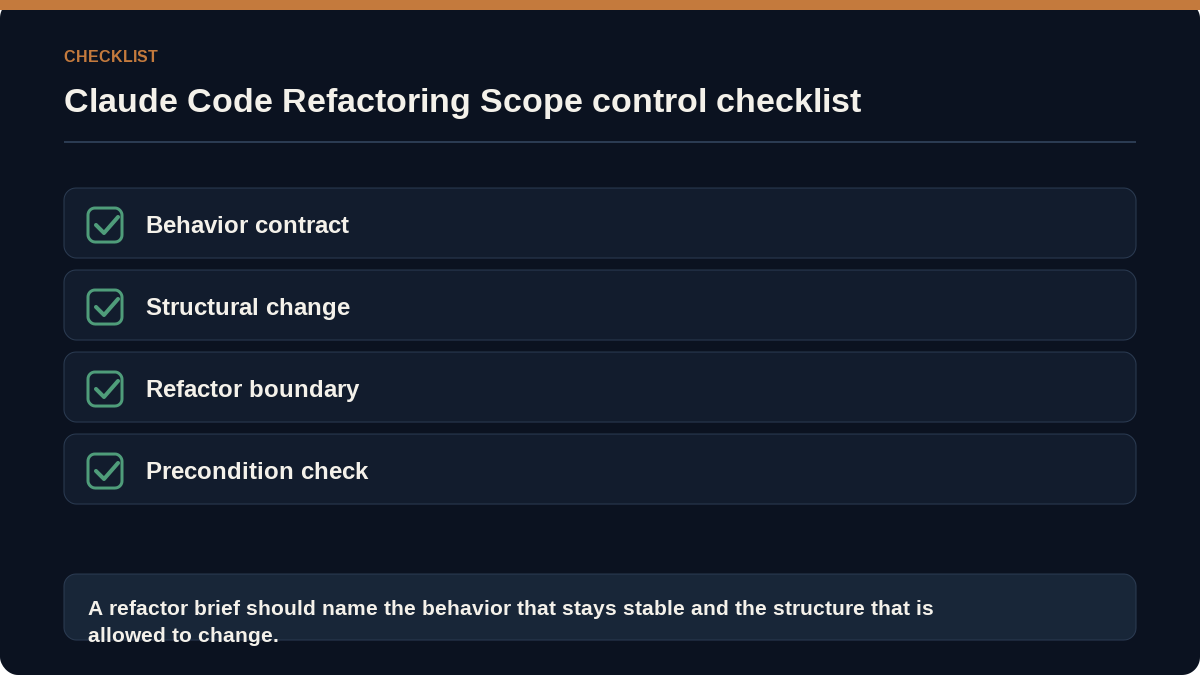
Review also gains protection from that boundary. A reviewer can evaluate the structural goal without debating product behavior that was never part of the request.
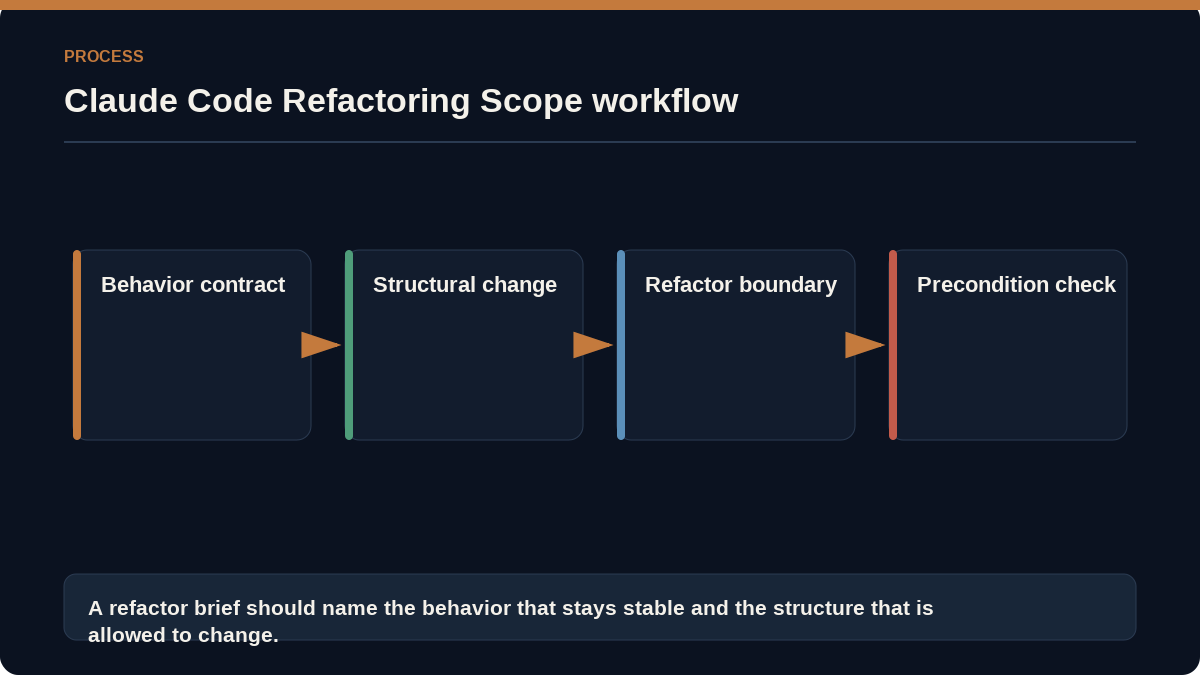
Use small transformations
F086 recommends small steps and checking transformation preconditions. Apply that lesson by sequencing changes that each have a clear structural purpose and a visible finish.
A small transformation might extract one calculation, rename one private helper, or replace one branch structure. After each step, inspect the affected region and its immediate relationships before proceeding.
Small steps do not guarantee safety. They make the change easier to interpret and give preconditions a clearer place to apply. The reversible-planning guide likewise treats reversibility as a property to assess rather than a synonym for size.
A useful sequence is:
- Confirm the current behavior contract.
- Inspect the target and its direct consumers.
- Apply one structural transformation.
- Inspect the edited region and relevant interface relationships.
- Record the state or blocker before the next dependent change.
The sequence is an editorial adaptation. It does not claim that Claude Code automatically enforces step boundaries. Use an inspectable checkpoint when the next action depends on evidence from the previous step.
Avoid bundling several transformations merely because they share a file. Separate purposes make it easier to identify which change affected a contract.
Surface preconditions that do not hold
A precondition is a condition required for the transformation to make sense. Examples include a helper having no hidden side effects, callers sharing the same input domain, or a branch ordering not carrying meaning.
Check preconditions against current code. Do not infer them from a function name or a previous summary. When a precondition fails, stop that transformation and record the evidence.
| Precondition | Evidence to inspect | Decision when it fails |
|---|---|---|
| Callers share the accepted input domain | Direct callers and guards | Keep separate paths or clarify the contract |
| Extracted logic has no hidden side effect | Current body and dependencies | Redesign the extraction boundary |
| Branch order does not affect behavior | Conditions and side effects | Preserve order or seek a decision |
| Return shape is stable | Consumers and serialization points | Keep the shape or separate the interface change |
| Private helper is not imported elsewhere | Module exports and importers | Expand scope only with approval |
The table is illustrative. It applies F086’s precondition lesson to edit planning rather than describing a specific automated transformation.
A failed precondition is not a reason to improvise a broader refactor. Name what failed and why the planned step no longer fits. The plan-revision guide explains how new evidence can change the approved direction.
If the evidence is unknown, say so. Unknown preconditions belong in the checkpoint as open questions, not as assumptions embedded in the edit.
A worked behavior-preserving refactor
Consider this illustrative calculation. Two line items have quantities of two and one, with unit values of ten and five. The arithmetic is derived only from these example inputs:
total = (2 × 10) + (1 × 5) = 25
The current implementation also records the line values in input order. Suppose the structural goal is to extract the repeated line-value expression into a private helper while preserving the total, the returned order, and the public function signature.
A scoped brief could read:
Refactor only the private calculation inside calculateInvoiceTotal.
Preserve the public signature, accepted input shape, returned total, returned
line-value order, and existing error result. Extract the repeated line-value
expression into a private helper if inspection confirms both paths use the
same arithmetic. Do not add discounts, validation rules, fields, or exports.
Use separate small edits for the two paths. Stop if their preconditions differ.
The brief separates structure from behavior. It also makes a precondition visible: the two paths must use the same arithmetic before extraction can proceed.
If inspection shows that one path rounds differently, the shared-helper precondition fails. The next action is to record the difference and choose a narrower transformation. Copying one path’s behavior into the other would introduce a feature-like change under the guise of refactoring.
After an edit, inspect the helper, both call paths, the return statement, and the exported signature. That review checks behavior-relevant structure. It does not replace the project’s existing verification practices.
Inspect behavior-relevant edits
Focus review on places where structure can alter behavior. Look for changed condition order, moved side effects, adjusted return paths, altered input normalization, and modified interface shapes.
A useful inspection reads the edited block beside its caller or dependency. The exact-target guide explains why surrounding context matters. For refactoring, the key question is whether the new structure still expresses the same contract.
Ask:
- Did any input become accepted, rejected, or transformed differently?
- Did a return value or error signal change?
- Did a side effect move relative to another operation?
- Did an export or caller dependency change?
- Did the edit add behavior that belongs to a separate feature request?
These questions keep review tied to the contract. They do not establish complete correctness, and this article does not prescribe a testing campaign. Use existing project evidence where appropriate, and state what remains unverified.
When the evidence conflicts with the structural goal, revise the plan. Do not redefine the contract merely to make the current diff look acceptable. The contract came from the agreed requirement, not from the implementation that happened to be produced.
Stop when the structural goal is met
A refactor needs an end state just as a feature does. Name the structural condition that is enough. For example: “Both line-value paths use the private helper, and the protected contract remains unchanged.”
Once that condition is met, stop. Do not continue into naming cleanup, broader module reorganization, or new abstractions. Deferred observations can be recorded without being implemented.
The agreed-boundary guide provides a companion method for desired state, required evidence, and excluded follow-up. F087’s acceptance-criteria definition supports naming conditions for acceptability, but those conditions do not automatically enforce a stop.
A final checkpoint can record the structural goal, the transformations applied, the contract evidence inspected, and any deferred item. That record makes the scope reviewable. It is not a proof that no behavioral difference exists.
A practical refactor-scope runbook
Use this checklist before and during structural work.
| Stage | Contract question | Scope action |
|---|---|---|
| Observe | What behavior do callers rely on now? | Read target, consumers, and relevant interfaces |
| Define | Which inputs, outputs, errors, and effects stay stable? | Write the protected contract |
| Structure | What specific maintainability change is allowed? | Name one structural goal |
| Separate | Which adjacent requests change behavior? | Defer feature work explicitly |
| Sequence | Can the work be divided into small transformations? | Order dependent edits and inspections |
| Preconditions | Does current evidence support each transformation? | Stop and revise when a precondition fails |
| Inspect | Which edited relationships could affect behavior? | Read the region beside its dependencies |
| Stop | Has the structural goal been met? | End work and record deferred observations |
This runbook is an editorial control grounded in F085 to F087. It does not guarantee behavior preservation or replace project-specific review.
Keep the contract visible throughout execution. A long refactor can gradually normalize new assumptions. Re-reading the original contract at each meaningful checkpoint helps reveal that drift before it spreads.
Write a contract that can be reviewed
A reviewable contract avoids abstract promises. “No behavior changes” is a useful intention, but it does not tell a reviewer what to inspect. Name the relationships that the planned structure could affect.
For each protected item, identify its current evidence and the inspection that would reveal a change. A signature can be compared directly. Calculation order needs the relevant operations read together. A side-effect sequence needs the owning workflow inspected.
This preparation keeps the refactor brief within edit quality. It does not require inventing a new verification system. It asks the author to make existing assumptions visible so the editor and reviewer can challenge them before the diff grows.
When a contract item cannot be stated precisely, record the uncertainty. A narrower structural step may still be possible, but the unknown should remain attached to the work rather than disappearing into a general assurance.
Concrete win, loss, and implication
Win: A planned shared helper is paused when inspection shows different rounding in two paths. The team keeps the paths separate and preserves the current contract. The win is avoided behavioral drift, not a measured refactor speedup.
Loss: A refactor can satisfy its structural goal while still changing an overlooked side effect or interface relationship. The loss is the gap between a clean-looking structure and observed behavior. F085 defines the goal but does not prove it was achieved.
Implication: Write the protected behavior first, allow only named structural change, separate features, and check preconditions before small dependent edits. Inspect behavior-relevant relationships and stop at the structural end state. Record uncertainty instead of treating structure as proof.
Data gap and future update
The packet contains no verified benchmark for behavior-preserving refactors performed by Claude Code. It contains no universal proof that small generated transformations preserve behavior. The acceptance-criteria source is search-index-only, and no community issue is used as evidence.
A future update should add reproducible before-and-after examples, named contracts, observed interface relationships, and review outcomes on a specific integration surface. Measured claims would require defined comparators and evidence beyond structural inspection.
Documentation is live and should be rechecked before publication. The refactoring textbook supplies independent principles, not Claude Code-specific guarantees. Until stronger evidence exists, the brief remains a scope-control method.
One AI option for OpenAI-format agents
For separate OpenAI-format agents, One AI offers one key and 46 live free IDs through https://api.oneaiapikey.com/v1. Review the free model list or follow the OpenAI-format quickstart. This option is not a Claude Code model source. The packet records the Claude IDs as unavailable on 2026-11-27, and the free IDs must not be presented as working inside Claude Code.
FAQ
What makes a refactor behavior-preserving?
Its observable behavior and protected interfaces remain stable while structure changes. F085 states that goal, but a specific edit still needs inspection and relevant evidence.
Can I include a small feature while refactoring?
Keep it separate. A new input, output, error, default, or side effect changes behavior and needs its own decision. Record it as deferred work instead of hiding it in the structural diff.
What if a transformation precondition fails?
Stop that transformation, record the evidence, and revise the plan. Do not broaden the edit merely to make the original route work.
Does this article require a new test suite?
No. It stays within edit quality and scope. Use existing project evidence where appropriate without turning the refactor brief into a testing campaign.
Connect refactor scope to the batch
Define behavior through observable requirements, goals, rules, and examples, and negative requirements. Clarify it with acceptance examples, clarification before choosing, and prompt specificity.
Plan through structured agent briefs, plan-mode approval, bounded exploration plans, and task exit conditions. Keep read-before-edit dependencies explicit and use new-evidence replanning when a precondition fails.
For tool evidence, compare unambiguous schemas, investigation before answering, independent parallel reads, and evidence-bearing results. Keep deferred tool definitions within the documented API boundary.
For execution quality, read inspectable checkpoints, exact block targets, local style patterns, and agreed stopping boundaries.
More Claude Code troubleshooting
- Claude Code CLAUDE.md: Keep Only Instructions Every Task Needs
- Claude Code Progressive Disclosure: Scope Rules to Relevant Files
- Claude Code Context Relevance: Read the Smallest Useful Evidence Set
- Claude Code Conflicting Instructions: Write a Clear Precedence Rule
- Claude Code Image Prompts: Pair Visual Evidence With Written Constraints
- Claude Code Context Audit: Inspect Loaded Files Before Adding More
Sources
- Refactoring chapter, independent. Supports F085 and F086 with goal and precondition caveats.
- Claude Code best practices, official. Fetched companion source; no refactor guarantee inferred.
- Software engineering process, independent. Search-index-only process context.
- Claude Code tools reference, official. Canonical link only in the supplied register; no unseen mechanics inferred.
- Acceptance criteria overview, independent. Supports F087; search-index-only and not automatic enforcement.