Direct answer
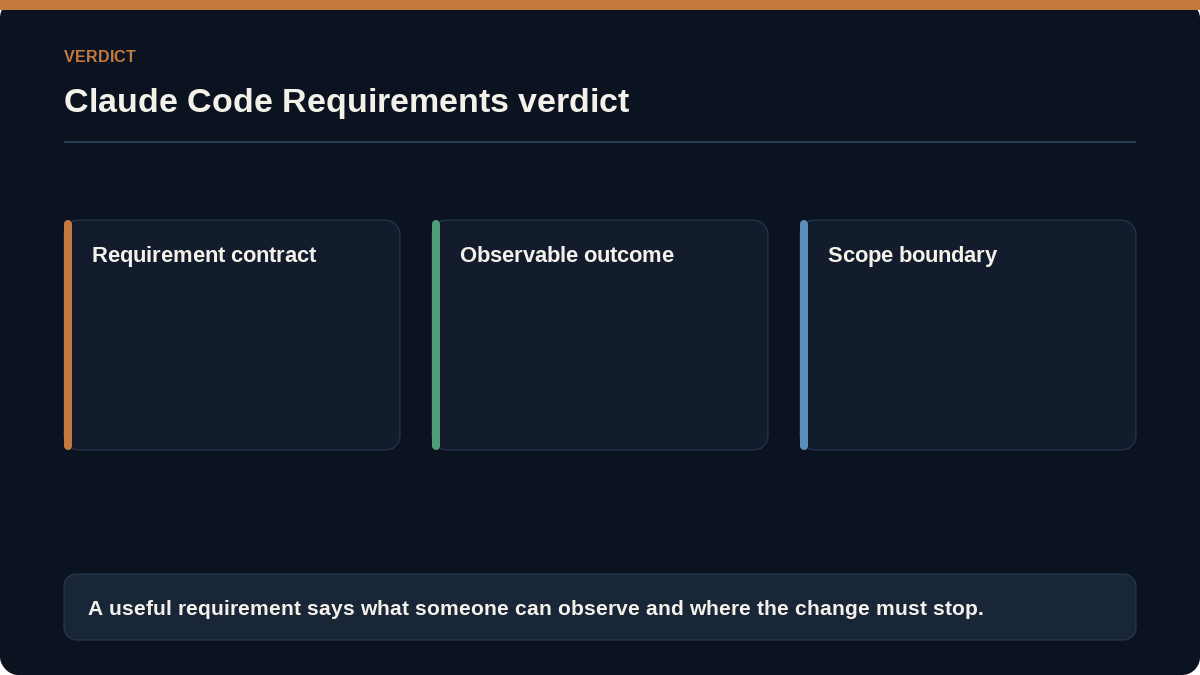
Turn a vague request into a small contract before Claude Code edits anything. Name the actor, the triggering situation, the visible result, the boundary, and the evidence a reviewer can inspect. A stakeholder request such as “improve search” becomes actionable only after those choices are explicit.
For example: “When a signed-in customer searches a catalog with no matches, show an empty-state message and a link back to all products. Keep filtering, ranking, and API response fields unchanged. Inspect the rendered state and the existing request shape.” That wording describes behavior rather than decorating a feature slogan.
The contract does not guarantee a correct edit. It gives the engineer and Claude Code the same target, exposes missing product decisions, and creates a basis for review. Treat acceptance language as a requirement to check, not as proof that completion already happened.
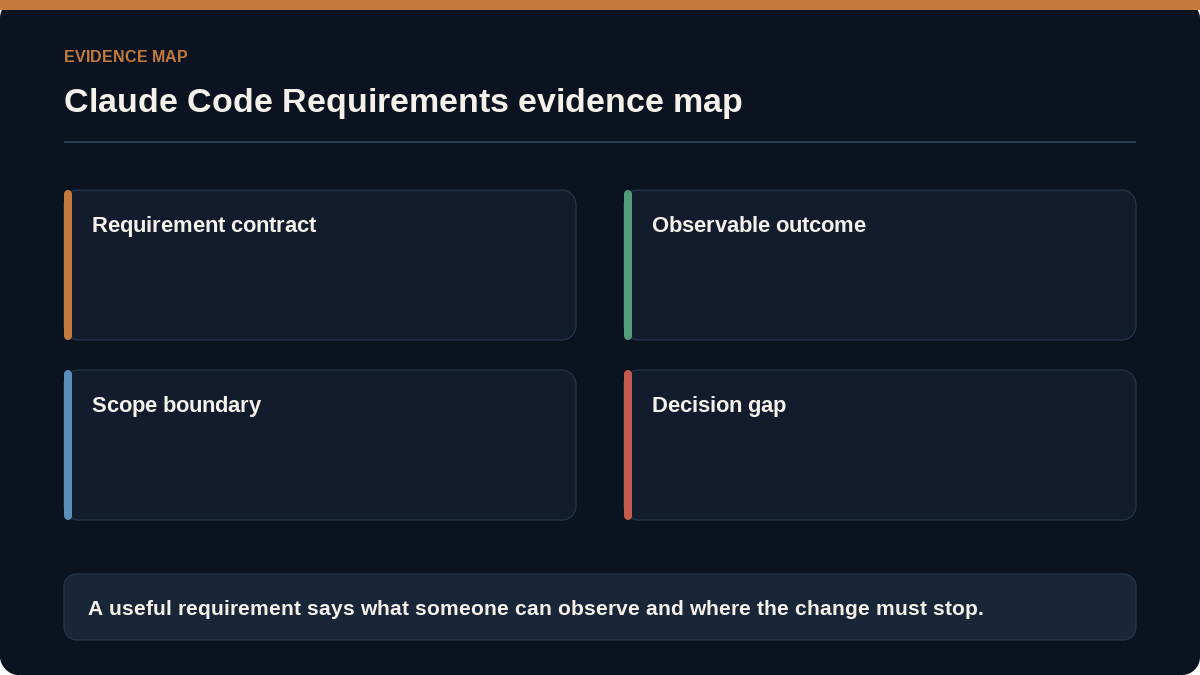
Why vague goals produce broad edits
A broad goal leaves several reasonable interpretations open. “Improve search” might mean changing copy, adding a filter, altering ranking, redesigning the page, or rewriting the request handler. Each interpretation can produce code that looks responsive to the sentence while missing the stakeholder’s actual concern.
That ambiguity creates three costs. First, the edit may touch unrelated behavior because the boundary was never named. Second, review becomes a debate about intent after the code already exists. Third, a polished summary can hide the fact that nobody agreed on what visible result would count.
Specificity helps, but it cannot invent product policy. Official Claude Code best practices recommends precise prompts with file names and symptoms, while warning implicitly that location detail does not replace a decision about desired behavior (F002). If the stakeholder cannot say who should see the change or what should happen, a longer prompt only preserves the uncertainty.
A requirement should therefore answer different questions from an implementation plan. The requirement says what someone can observe and what must remain stable. A plan proposes files, symbols, and steps. Keeping those layers separate lets Claude Code investigate the method without quietly choosing the product outcome.
The Claude Code cost per verified change guide supplies the related economic frame: generated output is not the same unit as accepted work. Here, the narrower lesson is that a vague request makes acceptance harder before any generation begins.
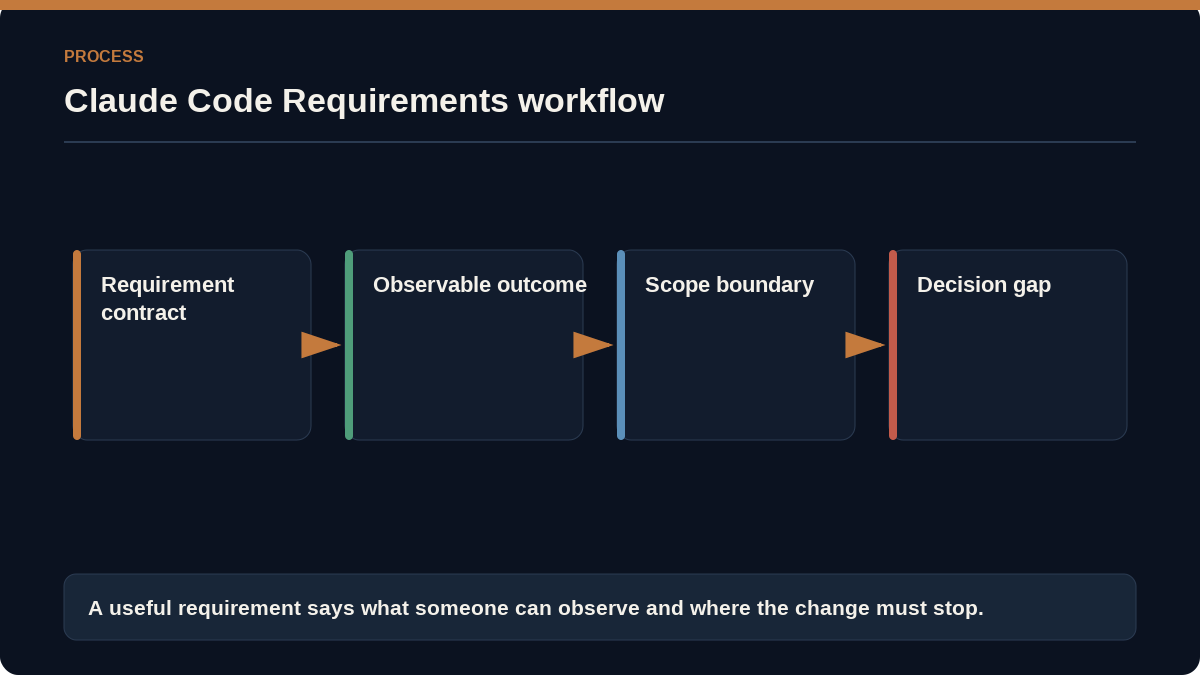
Evidence and its limits
Official, F001: The prompt engineering overview begins with the need for a clear definition of success criteria. That supports writing the visible outcome before execution. It does not establish that a well-written prompt will always produce the intended change.
Official, F002: Claude Code best practices recommends precise prompts that include file names and symptoms. Use that advice to anchor the investigation. A named file can still be the wrong starting point, and a symptom can have more than one cause.
Independent, F003: Atlassian describes acceptance criteria as predefined conditions a deliverable must satisfy to be acceptable. This is vendor guidance, not a universal standard. The research pass could retrieve only a search excerpt because the full page returned an access error, so the article uses no detailed wording or numerical claims from it.
Official, F014: In plan mode, Claude Code reads files and proposes a plan but makes no edits until the user approves. This creates a useful approval boundary. It does not prove that the proposed interpretation is complete or correct.
No verified community report is used. The fact pack contains no reproducible issue run showing that this method changes completion rates. The workflow below is an editorial adaptation of the cited guidance, not a benchmarked intervention.
Define the actor and triggering situation
Start with the person or system whose behavior matters. “User” is often too broad. A signed-in customer, an administrator, a batch worker, and an anonymous visitor may need different outcomes from the same feature area.
Next, state the trigger without prescribing machinery. “When a customer submits the search form with a term that has no matches” identifies a situation. “Call the new search service and render the component” starts choosing an implementation before the behavior is agreed.
A precise trigger also exposes missing policy. Does an empty search term count as a search? Does a network failure enter the same state? Should a customer who lost access see the normal empty state or a permission message? Those questions belong in the requirement conversation because different answers change the visible result.
| Actor | Trigger | Decision hidden in vague wording | Requirement move |
|---|---|---|---|
| Signed-in customer | Submits a valid search term | What counts as no matches? | Name the state and the visible response |
| Anonymous visitor | Opens a restricted result | Should the product reveal that a result exists? | State the visibility policy or flag it as unresolved |
| Administrator | Changes a catalog setting | Does the change affect active searches? | Name the timing and affected audience |
| Batch worker | Processes an empty input set | Is success, refusal, or a retry expected? | Define the recorded result and side effects |
The actor does not need a job title if a role is enough. The useful distinction is behavioral: who initiates the action, who receives the result, and who has authority to make the decision.
Write the observable outcome
An observable outcome can be seen, heard, read, or queried at a defined boundary. “Fast search” is not observable without a measurement rule. “Show an empty-state message after the response contains no matching products” gives a reviewer something specific to inspect.
Use a verb that names the state change. Show, reject, preserve, return, record, and remove are usually clearer than improve, optimize, support, or handle. The verb should point at an artifact rather than an intention.
Consider this pair:
- Vague: “Make failed saves user-friendly.”
- Bounded: “When the save request is rejected, keep the entered values visible, show an error next to the form, and do not display a success confirmation.”
The bounded version still leaves implementation choices open. It does not dictate a component library, state-management pattern, or error taxonomy. Those choices can follow from the codebase and the plan.
Outcome wording should also preserve the distinction between an empty state and an error. A response with no matches may be a normal result. A failed request may be an operational error. Combining them under “no data” can produce a change that satisfies the sentence while confusing the person using the product.
For machine-visible behavior, name the response or record that carries the evidence. For human-visible behavior, name the screen, message, or notification. Avoid requiring both unless both are part of the requirement; unnecessary evidence requests can turn a small change into a broad verification exercise.
Name the boundary and exclusions
A boundary says where the change stops. It protects existing behavior that the request did not intend to alter. This is where a requirement becomes more than a longer feature description.
Useful boundaries cover behavior, interfaces, files, and product choices. Examples include preserving the current request fields, leaving ranking unchanged, excluding unrelated visual cleanup, and keeping the existing permission policy. Each exclusion should be concrete enough to review.
“Keep it simple” fails that test. It does not say whether a dependency change is allowed, whether a shared component may move, or which current behaviors are protected. A negative requirement becomes useful when both the implementer and reviewer can tell whether an edit crossed it.
Here, a requirement becomes more than a longer feature description.
The Claude Code negative requirements guide develops this boundary method. Its central caution applies here: exclusions are instructions to inspect, not automatic enforcement. If a necessary change conflicts with a boundary, surface the conflict rather than silently violating either statement.
| Vague request | Observable outcome | Scope boundary | Evidence to inspect |
|---|---|---|---|
| Improve search | No-match searches show a clear empty state and a return link | Ranking, filters, and response fields stay unchanged | Rendered state plus current request shape |
| Make saves friendlier | Rejected saves retain input and show an inline error | No success message appears for a rejected save | Form state and error presentation |
| Add account controls | An administrator can disable a selected account | Existing sign-in and permission rules stay unchanged | Authorized action and protected behavior |
| Reduce notification noise | Duplicate alerts for one event are not sent | Delivery timing and recipient policy stay unchanged | Event record and resulting notifications |
Identify the evidence to inspect
Evidence closes the gap between a requirement and a claim of completion. Choose evidence before the edit so the result is not judged only by the implementation’s own explanation.
For a visible change, inspect the relevant state with a representative input. For a data change, inspect the record or response that carries the result. For a protected behavior, inspect evidence that would reveal an accidental alteration. The evidence should match the actual boundary of the requirement.
Avoid asking for “proof it works” without naming the artifact. A screenshot may show layout while missing a rejected request. A response body may show data while missing the user-facing message. A summary may describe both while proving neither.
A compact evidence statement can sit beside the outcome:
Given the no-match state, inspect the rendered empty-state message, the return link, and the unchanged search request fields.
That sentence is not a testing methodology. It tells Claude Code what must remain observable and tells the reviewer where to look. The project’s existing checks and review practices still determine how the inspection runs.
The Claude Code verification guide explains why a final summary is weaker than changed files and reproducible evidence. The requirement should name that evidence, not rely on a later prompt to reconstruct it.
Compare vague and bounded requests
The difference is not length alone. A long paragraph can still hide every important choice, while a short structured brief can expose them.
| Request element | Weak version | Stronger version | Why the stronger version helps |
|---|---|---|---|
| Actor | Users | Signed-in customers | Removes audience ambiguity |
| Trigger | Search is bad | A valid search returns no matches | Identifies the situation |
| Outcome | Better experience | Empty state and return link are visible | Gives a reviewable result |
| Boundary | Do not break anything | Ranking and request fields stay unchanged | Names protected behavior |
| Evidence | Make sure it works | Inspect state, link, and request shape | Points at observable artifacts |
| Gap | Use best judgment | Product owner must choose anonymous visibility | Prevents invented policy |
A bounded request can still be wrong. The actor may be misidentified, the boundary may protect a bug, or the evidence may miss an important side effect. Specific wording makes those errors easier to challenge because the assumptions are visible.
Contract language has practical value because it makes judgment visible. A contract does not eliminate judgment. It makes the agreed obligations inspectable and gives each participant a clearer basis for saying that an interpretation is wrong.
Worked example: an empty search state
Suppose the original ticket says, “Search feels dead when nothing is found. Please improve it.” The phrase names a concern but leaves the desired behavior and the protected surface unresolved.
A bounded rewrite might read:
Actor and trigger: A signed-in customer submits a valid catalog search and the current response contains no matching products. Outcome: Show a no-matches message and a link back to the full catalog. Keep the customer’s entered term visible. Boundary: Do not change ranking, filters, pagination, or the search response fields. Do not redesign unrelated catalog screens. Evidence: Inspect the no-match state, the return link, and the current request shape. Open decision: Anonymous visibility is outside this ticket until the product owner answers it.
Because the target is explicit, Claude Code has a place to investigate without dictating the component structure. A reviewer can make a direct comparison: does the state appear, is the term retained, and did protected behavior remain stable?
Derived arithmetic for a small review fixture: The scenario defines three returned products before filtering and one product excluded by the active filter. Visible products = 3 - 1 = 2. The empty state should not appear for this fixture because 2 is not zero. This arithmetic checks the chosen interpretation; it is not a performance measurement.
A second fixture can return zero matching products. That fixture should expose the new message and return link. Keeping both fixtures in view prevents a solution that treats any filtered list as empty.
The concrete win is interpretive: two readers can compare the brief with the same visible target. The concrete loss is that the example still depends on the existing meaning of “valid search” and the current response contract. If those definitions are wrong, precise wording can still direct the edit to the wrong behavior.
Use plan mode to confirm interpretation
Before implementation, ask for a plan that restates the actor, outcome, boundary, evidence, and open decisions. In plan mode, official documentation says Claude Code reads files and proposes a plan without making edits until approval (F014).
Review the plan for interpretation, not just file names. A plan that immediately proposes a new service may have skipped the product decision. A plan that touches ranking may have ignored the boundary. A plan that lists only a component change may have missed the response contract.
A useful approval question is: “What observable result will exist after this plan, and which current behaviors will remain unchanged?” If the answer cannot be tied to the brief, revise the plan or return to the stakeholder.
Plan approval is not completion evidence. It confirms that the proposed direction crossed a human checkpoint. The resulting files and behavior still need inspection against the original requirement.
The Claude Code plan mode approval guide provides the broader review method. For requirements work, the critical addition is to review assumptions as carefully as file targets.
Record unresolved product decisions
Some gaps should stop the edit; others can remain outside the approved scope. A product decision is blocking when different answers would produce materially different behavior and no reversible default exists.
Record each gap with an owner and a consequence. “Anonymous visibility unresolved” is weaker than “Product owner must choose whether anonymous visitors see restricted-result messaging before that behavior is added.” The second statement explains why the gap matters.
Do not ask Claude Code to invent the answer. Official guidance on success criteria supports making the target clear, but a missing target may require a human decision rather than better wording (F001). Asking for a recommendation can be useful, provided the recommendation is labeled as a proposal and does not silently become policy.
The Claude Code ambiguity clarification guide separates discoverable code facts from choices that require product authority. Use that distinction to keep the decision log short and relevant.
| Question | Why it matters before editing | Owner | If unresolved |
|---|---|---|---|
| Who sees the new state? | Different actors may need different outcomes | Product owner | Exclude the unresolved audience |
| What counts as no matches? | An empty response and a failed request differ | Product plus engineering | Keep the current definition |
| Which fields are protected? | Shared interfaces can widen the change | Engineering owner | Narrow the edit |
| What evidence is authoritative? | A screenshot may miss data behavior | Requirement owner | Name a later review gate |
Practical checklist and runbook
Use this sequence when a stakeholder request arrives. It keeps requirement work ahead of implementation without demanding a large document for a small task.
- Capture the original wording. Preserve the request so later rewrites do not erase intent.
- Identify the actor. Name the role that initiates or receives the behavior.
- State the trigger. Describe the situation without choosing an implementation.
- Write the visible result. Use a state-changing verb and a named artifact.
- Name the boundary. List protected behavior, interfaces, and excluded cleanup.
- Select evidence. Point at the screen, response, record, or side effect a reviewer can inspect.
- Separate decisions from facts. Let code investigation answer code questions; route policy questions to an owner.
- Restate the brief in the plan. Check that the proposed direction preserves the requirement.
- Approve, revise, or stop. Do not treat an unresolved blocking choice as permission to guess.
- Compare the result with the contract. Acceptance language remains a target to check, not a completion badge.
| Review gate | Pass condition | Failure response |
|---|---|---|
| Actor and trigger | One clear situation is named | Rewrite the opening sentence |
| Outcome | A reviewer can observe the result | Replace adjectives with state changes |
| Boundary | Protected behavior is specific | Remove vague exclusions |
| Evidence | Artifacts match the requirement | Add the missing inspection point |
| Product gap | Blocking choices have owners | Pause the affected scope |
| Plan | Direction matches the contract | Reject or revise the plan |
The practical implication for a developer is simple: spend a small amount of effort making the target inspectable before asking for an edit. The person reviewing the result should not have to reconstruct the stakeholder’s intent from the generated diff.
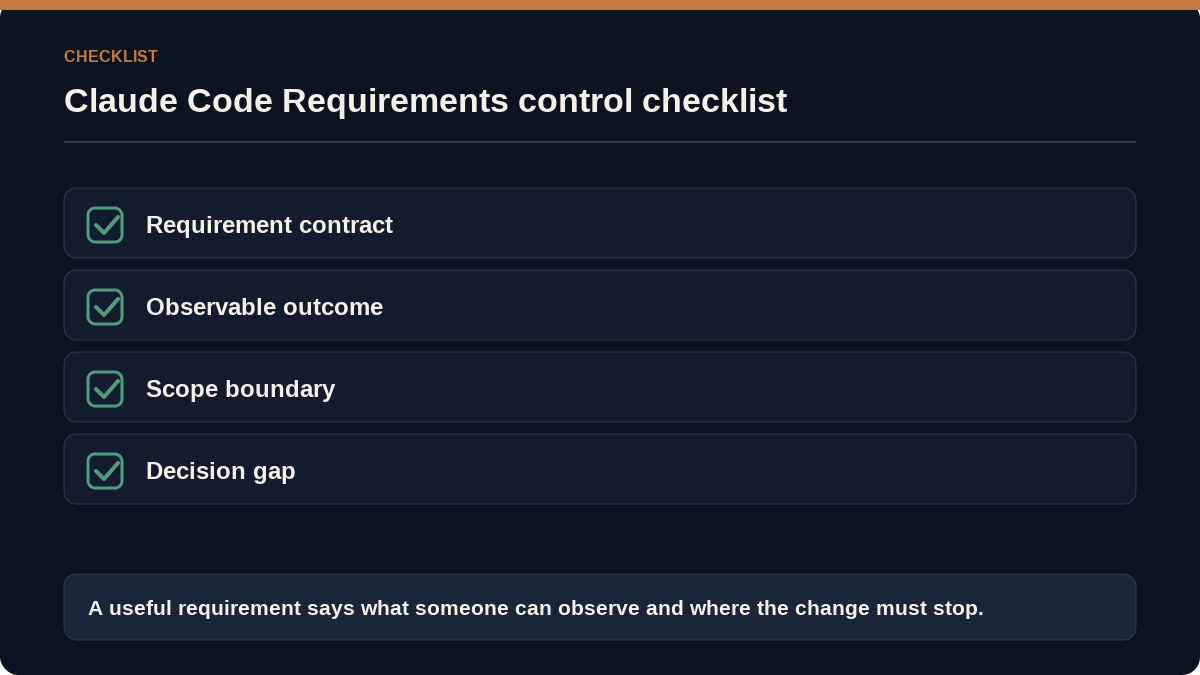
Concrete win, honest loss, and next decision
Win: In the illustrative search brief, the target changes from an opinion about the experience to a visible empty state, a retained search term, a return link, and named protections. Claude Code can investigate how to implement that behavior while the reviewer keeps the original outcome in view.
Loss: Precision can magnify a mistaken assumption. If the current response uses a different no-match representation, a carefully written brief may still point at the wrong contract. The method does not validate the stakeholder’s premise or guarantee that the selected evidence is sufficient.
Implication: Use observable requirements when a change must survive handoff, review, or later revision. For a trivial correction with an obvious target, keep the contract lightweight. When behavior, policy, or shared interfaces are involved, the extra structure earns its place.
The Claude Code false-success discussion is the relevant warning: satisfying a narrow acceptance statement does not prove the wider product works. Keep the requirement narrow enough to review and honest enough to acknowledge what it does not cover.
Connect the requirement to the rest of the batch
A requirement becomes easier to maintain when adjacent decisions remain distinct. Separating goals, rules, and examples keeps the contract readable without treating labels as enforcement.
For protected behavior, use the method in negative requirements and scope boundaries. For representative inputs, consult acceptance examples with observable results.
When a gap blocks the target, follow clarification before choosing an implementation. When the brief needs concrete pointers, add files, symbols, symptoms, and exceptions.
Planning decisions have their own guides: approve direction in plan mode, resolve unknowns with exploration plans, and give each task step an exit condition.
Sequence matters when one result feeds another. Read-before-edit dependencies prevents a plan from hiding a producer-consumer relationship.
If evidence invalidates the brief, replan when assumptions change rather than burying the change in execution. Reversible planning with small steps reduces exposure without promising safety.
Project context should stay proportional: keep CLAUDE.md essential, scope rules through progressive disclosure, and select relevant evidence.
Contradictory instructions deserve repair, not louder wording. Write a clear precedence rule, pair image evidence with written constraints, and use file references without repository noise.
Before adding more context, audit the files already loaded. Tool-related boundaries are covered in investigation before answering and parallel independent reads.
For integrations, distinguish structured briefs on supported surfaces, evidence-rich tool results, deferred API tool discovery, and unambiguous tool schemas.
Long work benefits from inspectable task checkpoints. Edit quality depends on exact replacement blocks, local style patterns, and behavior-preserving refactoring scope.
Finish at the agreed edge with explicit stop conditions. The session handoff guide helps when the requirement must move to another engineer without losing its decisions.
Data gap and future update
The research register contains no verified benchmark for observable-requirement briefs, plan approval, or exact edit targets. No measured reduction in edits, tokens, defects, or review time is claimed here.
The independent acceptance-criteria evidence is thinner than the official product evidence, and the Atlassian page was not fully retrieved. A future update should replace snippet-only support with an accessible primary requirements source if one becomes available.
Rolling documentation can change. Recheck the cited official pages before publication and preserve the caveats if the wording shifts. Until stronger evidence exists, treat this method as a reviewable workflow rather than a proven performance intervention.
One AI API Key option for OpenAI-format agents
Claude Code uses an Anthropic-format route, so the One AI free model IDs are not a Claude Code model source. The packet records Claude IDs as unavailable on 2026-11-27.
For a separate OpenAI-format agent, One AI API Key offers https://api.oneaiapikey.com/v1, one key, and 46 live free IDs. That option is about a different client and request format, not a workaround for Claude Code authentication. Review the free model list and eligibility details before choosing an agent route.
FAQ
Does an observable requirement guarantee that Claude Code will implement it correctly?
No. F001 and F002 describe prompting guidance, not a correctness guarantee. The requirement makes the target reviewable, while the resulting files and behavior still need inspection.
How much detail belongs in a small change?
Enough to identify the actor, trigger, result, boundary, and decisive evidence. A typo correction may need only a file and exact text. A behavior change usually needs more because interpretation affects the edit.
Can Claude Code decide missing product policy?
It can propose options, but the requirement owner must choose policy when different answers change behavior. Treat a proposal as analysis, not approval. F014 keeps edits behind a plan boundary but does not make the plan complete.
Should acceptance criteria become a test plan?
Not automatically. Criteria state what must be acceptable. A test plan describes how to check it and may include implementation-specific setup. This article stays with observable requirements and leaves the project’s verification method intact.
Sources
- Official: Claude Code best practices, supporting precise prompts with file names and symptoms (F002).
- Official: Claude Code common workflows, supporting the no-edit-before-approval plan boundary (F014).
- Official: Prompt engineering overview, supporting clear success criteria (F001).
- Official: Claude prompting best practices, supporting clear structure and context.
- Independent: Atlassian acceptance criteria guide, available only through a search excerpt in the research pass (F003).