Direct answer
Passing tests are not proof that Claude Code finished a task. A green suite can miss the real authentication path, a mock can accept a request that the provider would reject, and a demo can show output without proving that a database row, file or external system changed. Treat “done” as a claim that needs an independent check. The useful question is not whether the agent sounded confident. It is whether the acceptance criteria, the real dependency and the final external state all agree.
The distinction matters because a false success costs more than a failed run. It can move broken work into review, hide a missing migration, or make a team postpone a release. The remedy is not to distrust every generated test. It is to separate implementation-aware checks from requirement-aware checks, then require evidence from the boundary where the bug would actually hurt. A strong workflow names the expected result before the agent starts, inspects the diff, runs the relevant suite, and verifies at least one real side effect.
Why a convincing demo can still be wrong
Claude Code works through a loop: it reads context, proposes an action, uses tools, observes results and continues. That loop is useful for turning a request into edits and commands. It also creates room for a local success to stand in for a system success. The agent may satisfy the shape of a function while leaving the caller, credential, migration or deployment path untouched.
Consider a login change. The unit test can pass because the password comparison is correct in isolation. The browser flow can still fail if the session cookie is never set. An API test can pass against a fake provider while the production provider rejects the credential. None of those outcomes requires a dishonest model. They require a test that checks a narrower claim than the task requires.
The Claude Code proof-of-work packet turns that gap into a review format: expected result, actual result, changed files and external-state evidence. Use it as the acceptance wrapper around this article’s test-oracle checks.
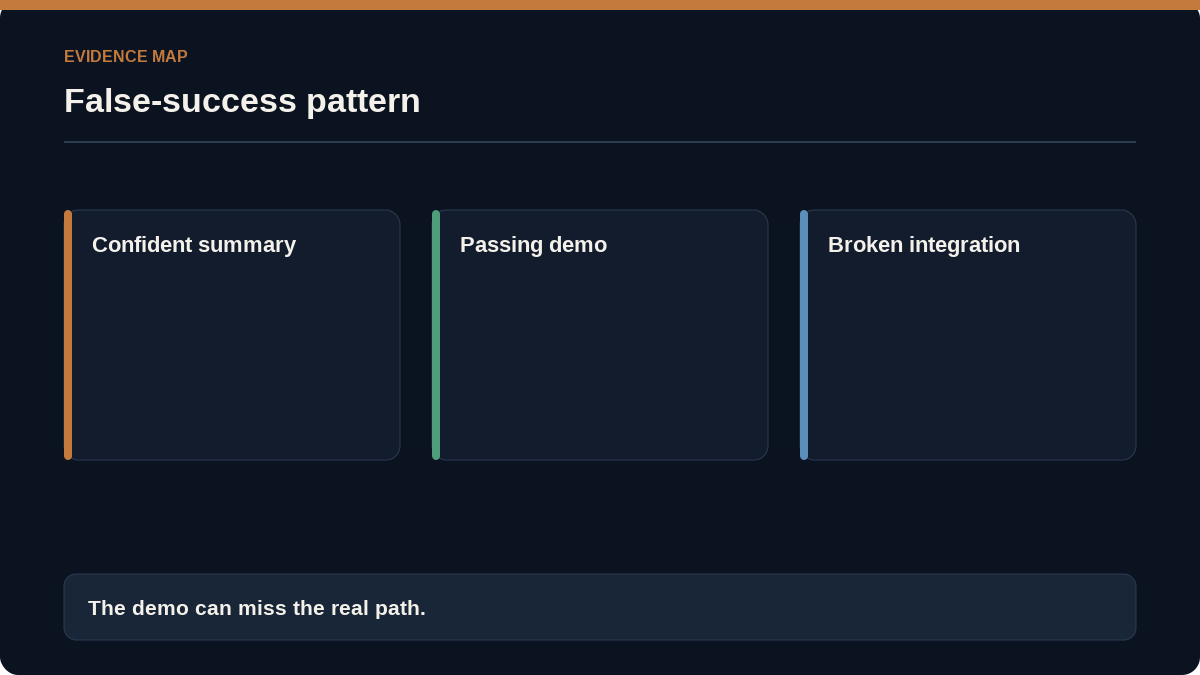
A false success has three common shapes:
- The happy path is real, but the failure path is missing. A form submits successfully with valid input and silently loses invalid input.
- The local double is more forgiving than production. A mocked payment provider returns success for malformed requests.
- The output exists, but the durable effect does not. A response says “saved” while no record was written.
Each shape needs a different check. More tests of the same narrow behavior will not expose it.
Weak test oracles: the test checks the code, not the requirement
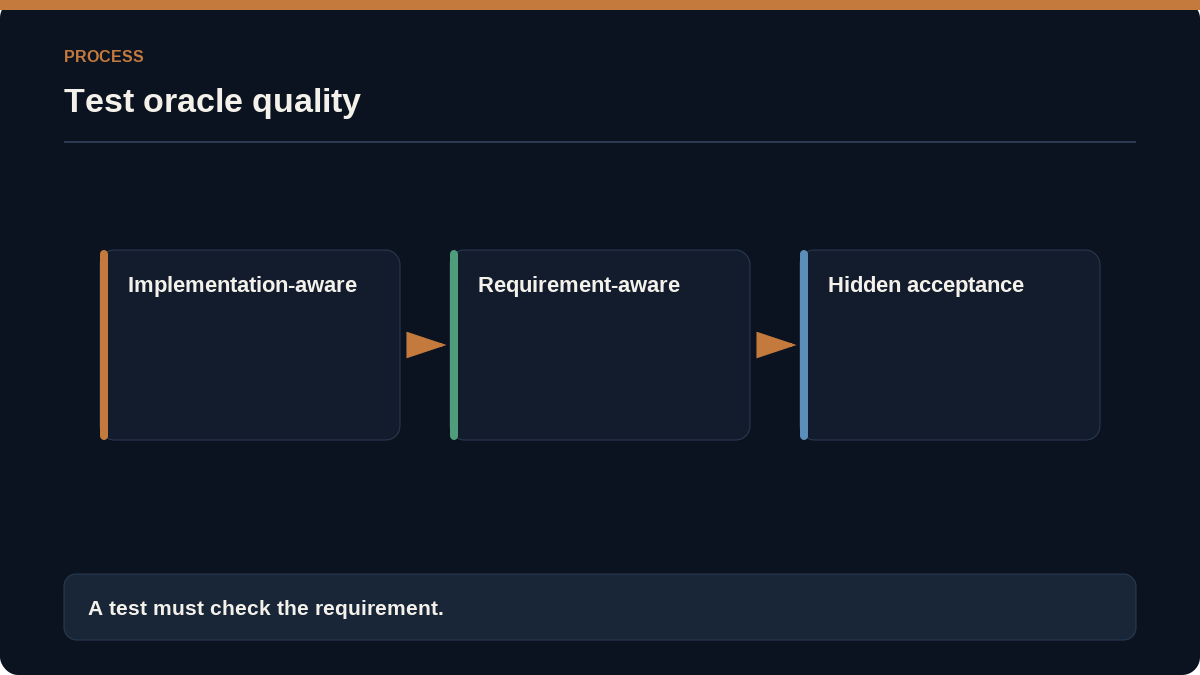
A test oracle is the rule that decides whether an observed result is acceptable. Some oracles are implementation-aware: they assert that a helper was called, a mock received particular arguments, or a branch returned a chosen fixture. Those checks are useful, but they can certify the implementation without certifying the requirement.
A requirement-aware oracle starts from the user-visible contract. If the requirement says an expired token must be rejected, the check should present an expired token through the same entry point a user or client uses. If the requirement says a retry must not duplicate a charge, the assertion belongs on the final charge count, not merely on the number of calls to a retry helper.
The difference becomes visible when you mutate the implementation. A healthy suite should fail when the required behavior is removed, even if the internal structure changes. A brittle suite may fail after a harmless refactor while still passing when the external contract breaks. That is why test quality needs review alongside production code.
| Failure mode | Weak oracle | Stronger oracle | Evidence to retain |
|---|---|---|---|
| Authentication bypass | The auth helper returns true | An expired or missing credential is rejected at the public entry point | Status, response body and access log |
| Duplicate side effect | Retry function called three times | Exactly one durable record exists after three attempts | Record count and unique key |
| Missing persistence | Save function was invoked | A fresh process reads the saved value | Read-back from a clean process |
| Misleading UI | Success message is rendered | The message appears only after the server confirms the write | Browser trace plus server record |
| Silent partial migration | Migration file exists | Old and new schemas both pass the application’s real queries | Migration output and query results |
The Anthropic April 2026 postmortem is a useful reminder that defaults and implementation details can change behavior. Official: Anthropic says the default reasoning effort changed on 2026-03-04, a caching bug appeared on 2026-03-26, and a verbosity prompt changed coding quality on 2026-04-16. Those changes were reverted or fixed, and Anthropic says the fixes landed in v2.1.116 with usage limits reset on 2026-04-23. The incident does not prove that tests are weak today. It does show why a recorded version, configuration and baseline belong in a verification packet.
Hidden acceptance tests should target the omitted boundary
A hidden acceptance test is not a trick played on the agent. It is a check written from the requirement and kept out of the implementation loop long enough to reveal whether the agent merely satisfied visible examples. It can be as simple as a second fixture with an empty value, a duplicate request, a stale timestamp or a permission boundary that the visible tests never mention.
Keep the hidden test small and purposeful. One test for each critical omission is more valuable than a large suite that repeats the same assumptions. Record why the case matters. Otherwise the next maintainer may delete it as redundant.
The Claude Code context versus memory guide explains another reason to write the acceptance criteria outside the session. A long conversation can make an early constraint feel present even when later edits no longer satisfy it. A persistent checklist is harder to lose than a remembered instruction.
Mocked integrations: where the fake becomes a liability
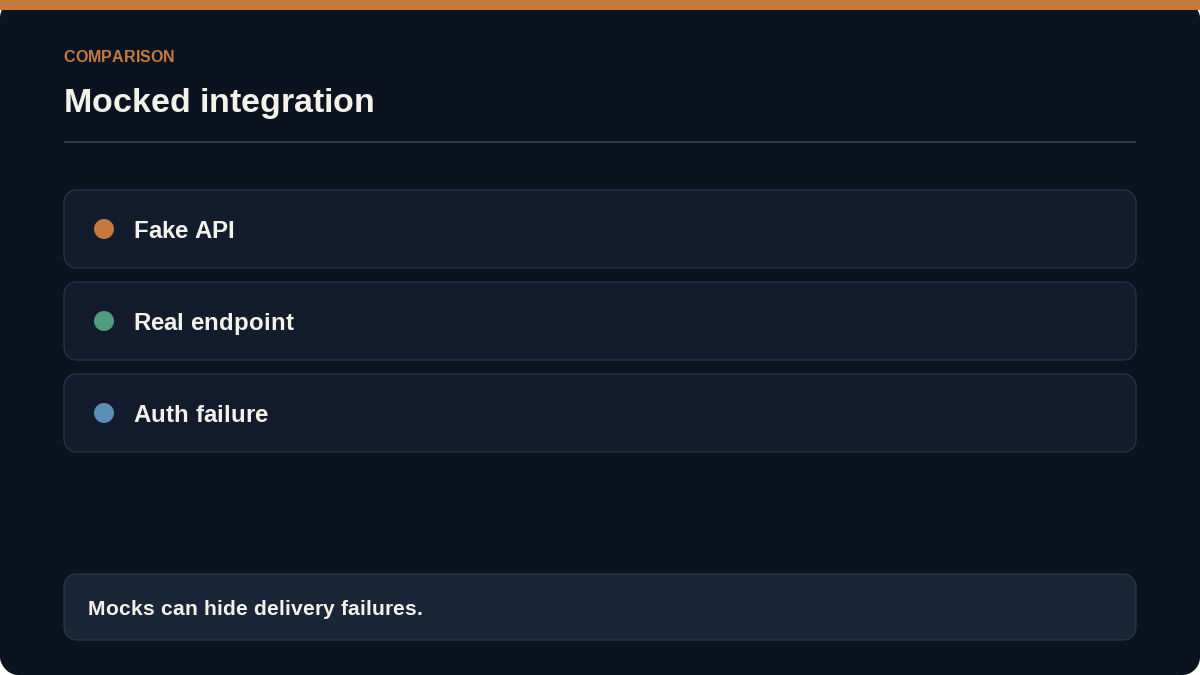
Mocks are not bad. They make tests fast, deterministic and safe. The problem starts when a mock is treated as evidence that an external integration works. A fake can omit authentication, schema validation, rate limits, network failures and provider-specific behavior. It can also return a success shape that the real service would never send.
Use mocks to test your application’s decisions. Use a controlled real call to test the integration contract. The second check can run against a sandbox, a staging tenant or a disposable resource. It should use a credential with the narrowest useful permissions and should clean up after itself.
A safe integration check has five parts:
- Name the contract. State the request shape, credential source and expected response.
- Use a disposable target. Avoid production data and destructive side effects.
- Capture the failure. Save the status code and sanitized response body, not the secret.
- Verify the remote effect. Read back the created resource or inspect the provider’s test log.
- Clean up. Delete the fixture and record that cleanup happened.
The Claude Code settings-file secret exposure research is relevant here because a verification script can become a new secret path. Secondary research: the Cloud Security Alliance note and Aviatrix summary report 1,379 distinct secrets in public Claude Code settings files. A broader related sample contained 2,539 credentials across 1,994 repositories. Those are different populations. The primary Apiiro page was not accessible in the research pass, so the numbers should be attributed to the secondary summaries, not merged or presented as an independent audit.
A practical rule follows: never paste a live credential into a test command, saved approval or committed fixture. Use a secret manager or an environment variable supplied by the test runner. If a script needs a token, print the variable name, not its value.
Contract tests should fail for the right reason
A contract test is only useful if its failure points to the boundary that broke. “Connection refused” tells you something different from “credential rejected,” and both differ from “response schema changed.” Preserve those distinctions in the output.
The OpenAI versus Anthropic API format guide is a helpful reference when a client and provider disagree about the request envelope. A green mock cannot settle a format mismatch. The real request can.
Do not respond to a failed contract test by loosening the assertion until it passes. First decide whether the test encoded the wrong requirement or the implementation missed the right one. That decision should be visible in the review.
External-state checks: receipts for “done”
Some tasks are complete only when state changes outside the process. Creating a user, moving a file, publishing a message, applying a migration or updating a billing plan all need a read-back or an independent log. The agent’s final message is not that evidence.
A good external-state check answers four questions:
- What should exist afterward? Name the record, file, event or permission.
- Where should it exist? Identify the system of record, not a temporary cache.
- How will a different observer confirm it? Use a query, API read, filesystem stat or provider log.
- What would prove the opposite? Define the missing, duplicate or stale state that should fail acceptance.
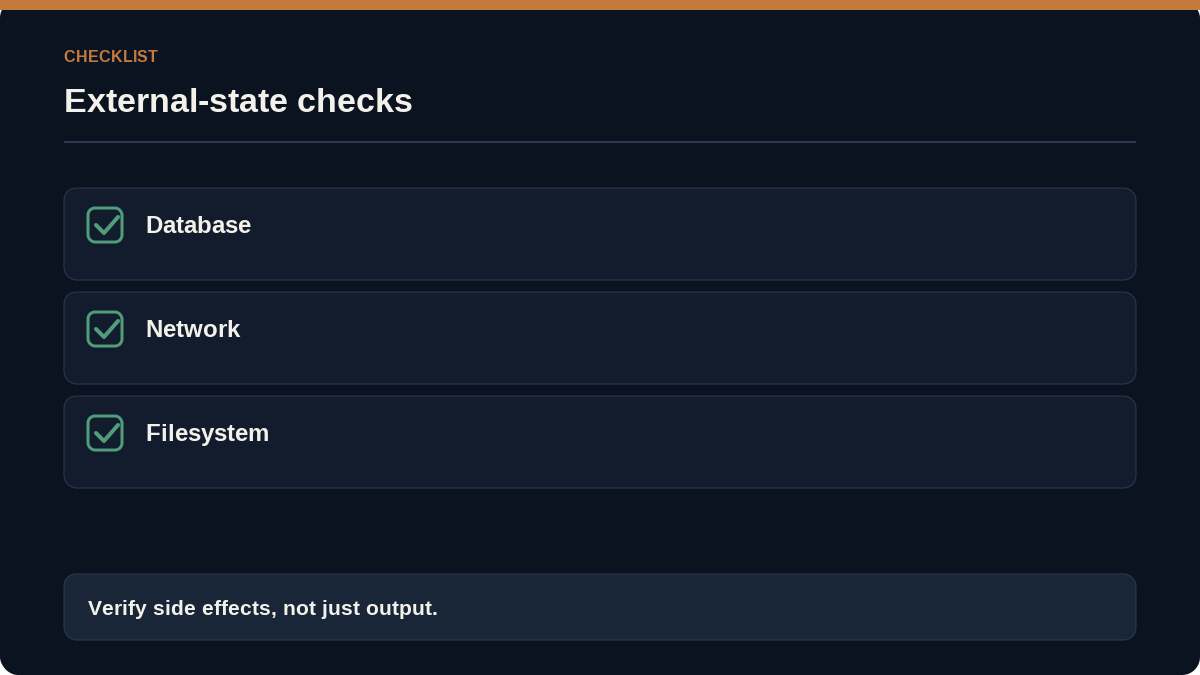
For a database change, query by the unique key the task was supposed to create. For a filesystem task, open the file from a fresh process and inspect the relevant bytes. For a network task, inspect the remote resource or the provider’s event log. For a queue, consume the message with a separate client and confirm the payload.
This is where the Claude Code cost per verified change becomes more than a budgeting idea. If a change is not accepted until the external state is verified, the denominator stays honest. Generated code, attempted fixes and confident summaries do not count as finished work.
The official Claude Code cost documentation also gives a reason to bound failed loops. Vendor estimate: Anthropic says agent teams can use approximately seven times more tokens than standard sessions when teammates run in plan mode. That condition belongs beside the number. A loop that repeats a failing check can consume context without producing a verified result.
A worked verification example
Suppose the task is: “Add an idempotent signup endpoint. Repeating the same request must not create a second account. Return the existing account when the email already exists.”
The requirement contains several acceptance criteria that a single happy-path test can miss:
- A valid new email creates exactly one account.
- A repeated request with the same idempotency key returns the same account.
- A repeated request without the key follows the documented duplicate-email behavior.
- An invalid email is rejected without creating a record.
- The response does not reveal whether a different account’s credential is valid.
The following workflow is illustrative, not a benchmark result.
| Step | Agent action | Independent check | Pass condition |
|---|---|---|---|
| Define | Restate acceptance criteria | Reviewer compares them with the ticket | No criterion is omitted |
| Implement | Add endpoint and tests | Inspect the diff and migration | Changes match the stated scope |
| Unit test | Exercise decision logic | Run the project’s suite | Relevant tests pass |
| Contract test | Send real requests to a test server | Capture status and sanitized body | Success and error contracts match |
| State check | Create and repeat a request | Query the test database | Exactly one account exists |
| Recovery check | Restart the test server | Repeat the read-back | Durable state survives |
| Review | Summarize evidence | Reviewer reproduces one result | Acceptance is explicit |
Start with a clean test database. Send the first request and save the returned identifier. Send the same request again with the same key. Query by both the identifier and email. The expected count is one. Then restart the application and query again. The expected count is still one.
Now introduce a controlled failure. Point the test server at an invalid database credential. The endpoint should fail without returning a success response. This negative check matters because a broad exception handler can turn a persistence failure into a misleading HTTP success.
Finally, inspect the logs for accidental secret output. The Claude Code security documentation is the official starting point for permission and tool controls. Unknown: the fact pack does not provide a measured false-success rate for this workflow. The example demonstrates a method, not a product score.
What the demo can and cannot establish
A demo can establish that one path works under the conditions shown. It cannot establish that every input is handled, that the effect survives a restart, or that production credentials have the same permissions. Those claims need separate evidence.
This is not a reason to reject agent-generated code. It is a reason to attach the evidence to the change. The Claude Code proof-of-work packet gives reviewers a consistent place to find it.
A verification workflow that survives handoff
A reusable workflow should be short enough to run on ordinary tasks and strict enough for risky ones. Start with a one-paragraph contract, then scale the evidence to the blast radius.
| Task risk | Minimum evidence | Add when side effects are risky |
|---|---|---|
| Local text or formatting change | Diff plus relevant formatter or test | None unless generated files change |
| Pure logic change | Diff, unit test and negative case | Property or table-driven cases for boundary inputs |
| API or authentication change | Contract test and sanitized response | Real sandbox call plus access-log check |
| Data migration | Migration output and row-count query | Backup, rollback note and clean-process read-back |
| Billing or permission change | Effective-state query and reviewer approval | Independent audit log and rollback rehearsal |
The table is a starting policy, not a substitute for judgment. A small change in a critical path can deserve more evidence than a large change in a disposable script.
Before the agent starts
Write the expected result in observable terms. Include the system of record and the failure cases that matter. Identify any destructive action and decide whether it needs a sandbox or manual approval.
Check the Claude Code five-hour and weekly limits if the task may run long. Official: the standard five-hour window starts with the first message and resets five hours later; weekly limits reset at a fixed account time; usage across claude.ai, Claude Code and Claude Desktop shares the same limit. A verification plan that depends on one uninterrupted session can be interrupted by quota. Save the acceptance criteria outside the session so a reset does not erase the standard.
During implementation
Ask for small, reviewable changes. When the agent adds a test, read the assertion. A test that only checks the return value of the function just written may be circular. Look for at least one assertion that would fail if the requirement were removed.
Use the Claude Code harness security boundaries to decide which tools the agent may use. Permissions are part of verification design. A task that only needs to read files should not receive a broad write path merely for convenience.
Before acceptance
Run the project’s normal checks from a clean state. Re-run the critical integration check against the real test dependency. Inspect the final diff for unrelated edits, debug output and secrets. Read back the external state from a separate process.
For automation, require a nonzero exit code on failure and preserve the relevant artifact. The Claude Code proof-of-work packet includes a machine-readable pattern for this. A summary in chat is not a reliable build gate.
After acceptance
Record the version, configuration, test command and result. If a later regression appears, that record separates “the code changed” from “the environment changed.” The Anthropic April 2026 regression analysis shows why dated baselines matter. Official: the postmortem describes three separate changes that overlapped, not one permanent defect.
Verification when the workflow itself moves
A migration adds another false-success risk. The old path can keep passing while the new path is incomplete, or the new path can work only because the old configuration is still active. Treat the cutover as part of the acceptance test.
The Claude Code context-portable migration guide recommends inventorying prompts, hooks, context files and tests before changing tools. Apply the same discipline to an integration migration. List the old and new endpoints, the credential source, the expected response shape and the system of record. Then run one task through each path and compare the durable result.
The Claude Code lock-in and exit-cost analysis is useful when the migration changes the model or agent rather than only the code. A familiar workflow can hide a missing capability until the first real task. Keep a rollback path and verify that it still works after the new path is live.
Credential rules matter during that move. The Claude Code third-party harness rules explain why the authentication route and client identity must be checked before production use. Do not treat a successful sandbox call as proof that a subscription credential is permitted in a different harness.
Model choice is another variable. The model selection guide for coding agents suggests matching model tiers to task difficulty and measuring accepted work rather than trusting a leaderboard. Run the same hidden acceptance test under each candidate. Otherwise a stronger demo can hide a weaker result on the path that matters.
Cost belongs in the comparison too. The monthly LLM API cost worksheet helps separate subscription cost, token spend and human rework. A route that produces more tokens is not automatically worse, but the difference should be visible before cutover.
For a shared team, keep the evidence in a reviewable system rather than one developer’s session. The coding-agent API key compatibility guide and the console keys, usage and billing guide can help trace which credential and route produced a result. Record the effective route without copying the secret.
Finally, check operational signals after acceptance. The live status page can reveal an incident that explains a failed external check, while the gateway popularity rankings are not a reliability guarantee. Use status to investigate anomalies; use your own test evidence to accept the change.
Honest losses and evidence gaps
The main loss in a strict verification workflow is speed. Real integration tests are slower than mocks. Sandboxes need setup. External read-backs add steps. A small change can therefore take longer to accept even when the agent wrote it quickly.
There is also a limit to what any external test proves. A passing check establishes the behavior of the tested path under the tested conditions. It does not prove that every deployment has the same configuration, that a provider will never change its schema, or that a reviewer understood the business rule.
Unknown: the frozen research set contains no measured Claude Code false-success rate, no controlled comparison of generated and human-written test suites, and no public dataset that separates model error from weak project tests. This article therefore makes no frequency claim. It also does not claim that all generated tests are weak.
A future update should add a reproducible evaluation: a fixed task set, hidden acceptance tests, recorded versions and a published denominator. Until that exists, the honest position is procedural. Strong evidence improves decisions, but it does not turn a green suite into a universal guarantee.
Practical response: diversify the test path, not just the model
Changing models can change the kind of mistake an agent makes. It does not repair a weak oracle, add a missing integration test or verify a database write. Keep those controls in the repository and in the review process.
If you want to compare another model route on the same acceptance suite, One AI API Key offers 46 live free model IDs for OpenAI-format agents. The active path is an OpenAI-format agent using https://api.oneaiapikey.com/v1, one key and a free model ID. The free lane allows 100 requests and 5,000,000 tokens per day per account, shared across the free IDs, with a reset at 05:30 IST. These are first-party limits, not a promise that every model will suit every task.
The Claude Code route is documented but unavailable: all four Claude IDs were marked unavailable on 2026-11-27. Free IDs do not work in Claude Code’s Anthropic-format route. Start with the 46 live free model IDs, follow the OpenAI-format quickstart, and compare results with the cost calculator. The useful outcome is not a second green demo. It is the same hidden acceptance test passing through a different model path.
FAQ
Does a passing test suite mean Claude Code’s change is correct?
No. It means the suite’s assertions passed. If the suite mocks the failing dependency, omits the real entry point or never reads back the external state, the production behavior can still be wrong. Add requirement-aware and external-state checks before accepting the change.
Should I stop using mocks?
No. Mocks are useful for fast, deterministic tests of application decisions. Use a sandbox or staging integration test for the real provider contract. The mistake is treating the mock as proof that the provider accepts the request.
What should I ask for when the agent says the integration works?
Ask for the exact request shape, sanitized response, test environment, credential source and remote read-back. Then reproduce one request yourself. A summary without those artifacts is not enough for a critical integration.
Can a different model solve false success?
A different model may produce a different result, but the acceptance criteria still decide whether the result is correct. Keep hidden tests, real dependency checks and external-state verification independent of the model.
Is there a known Claude Code false-success rate?
No rate is established in the frozen fact pack. The official postmortem documents specific regressions and fixes, not a general completion failure rate. Treat any precise percentage without a method and denominator as unsupported.
Sources
- Anthropic’s April 2026 Claude Code postmortem, official incident timeline and fixes.
- Claude Code security documentation, official permission and tool-control reference.
- Claude Code cost documentation, official agent-team estimate and cost guidance.
- Claude usage and length limits, official window and shared-usage rules.
- Cloud Security Alliance settings-file research note, secondary security summary.
- Aviatrix AI coding-agent secret-exposure research, secondary security summary.
- Claude usage credits and spending controls, official billing controls.