Direct answer
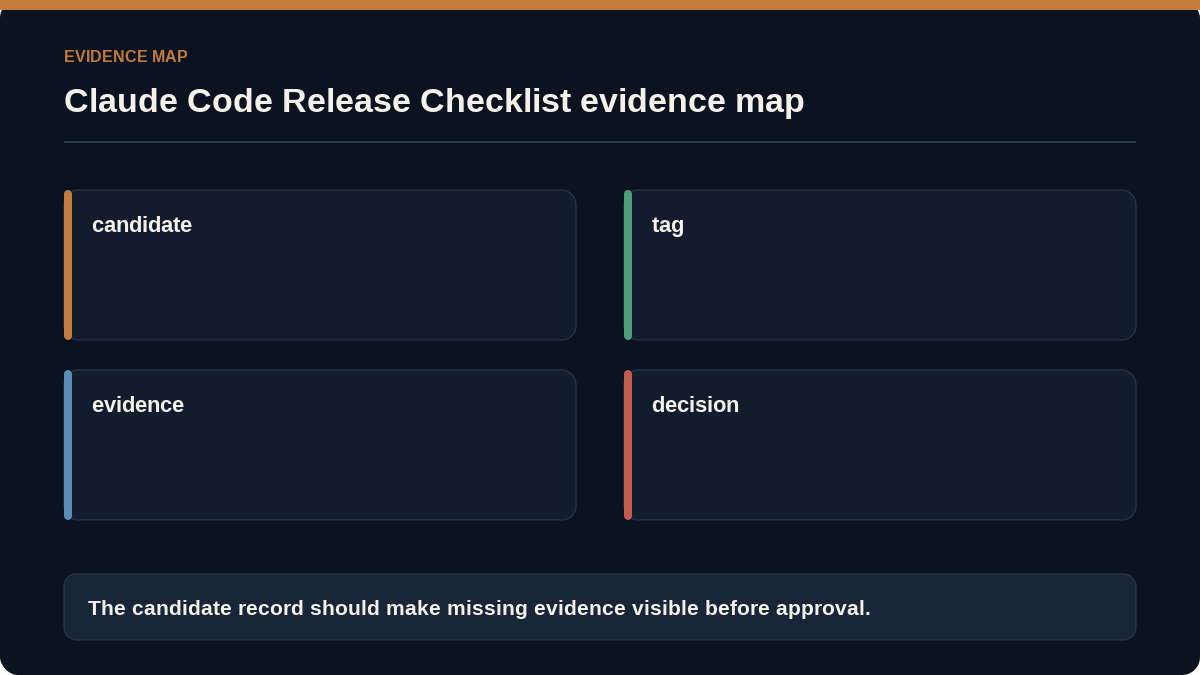
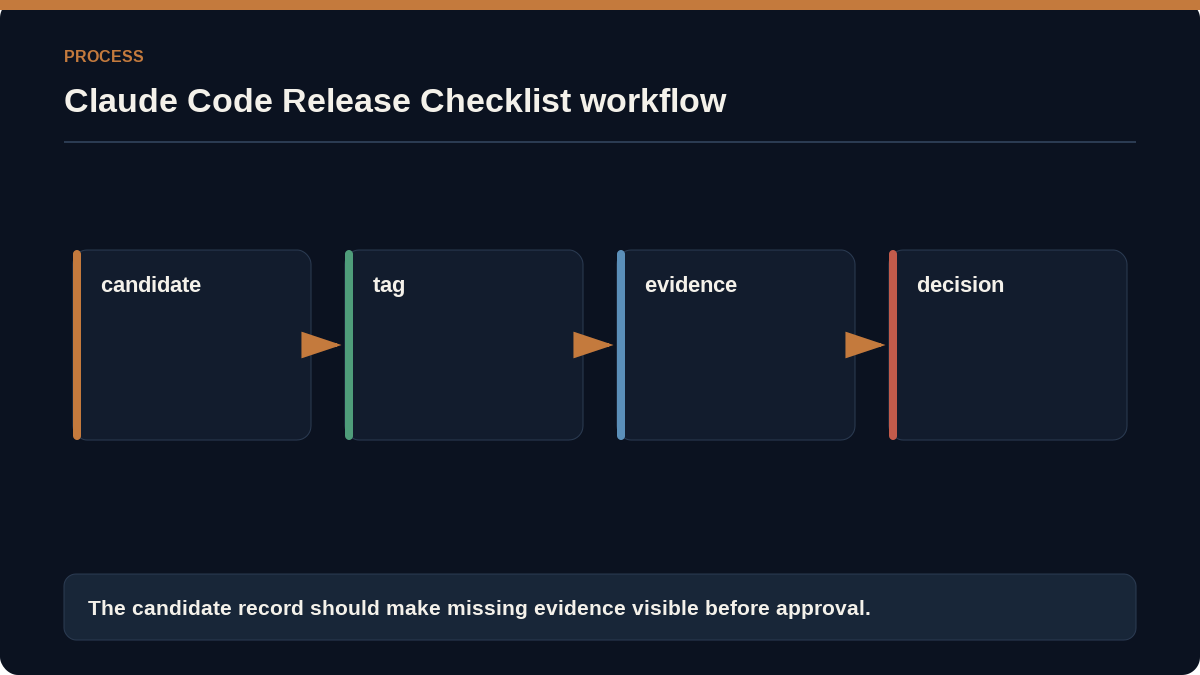
Assemble one candidate record before you approve a release, and make every decision read from that record instead of from someone’s memory. The record holds the candidate identity, the tagged commit, the verification scope, the changelog and migration notes, the rollback unit, and any accepted exceptions. Approval is then a review of evidence rather than a feeling that the release is done. The official Claude Code best practices describe a sample release skill that checks branch and tree state, runs versioning, updates changelogs, and tags commits for continuous integration publishing, and presents it as an example to adapt to your own release system (F088).
A tag identifies a revision; it does not prove which checks were run (F089). That gap is exactly what the candidate record closes. Keep tag identity, verification scope, changelog, exceptions, and rollback unit in one place, because separate records drift apart (F090).
Why a single record prevents drift
Release decisions are made by different people at different times. An engineer picks the version increment on Monday. Another engineer tags the commit on Tuesday. A third writes the changelog on Wednesday. A release manager approves on Thursday. Each of them holds part of the picture, and none of them holds all of it.
Without a shared record, the parts drift. The tag points at a commit that is not the one that was tested. The changelog describes a version number that was changed after the notes were written. The rollback plan names a unit that no longer matches what shipped. Each drift is small and each is defensible on its own, and together they produce a release nobody can fully explain.
The candidate record is the fix, and its value is not the fields. The value is that every decision has to be written next to the others, which makes a contradiction visible. A minor version bump next to a breaking changelog entry is obvious on one page and invisible across four conversations.
Freeze the candidate identity
Start by fixing what is being released. The candidate identity is the version number, the tag name, and the commit the tag will point at, decided together before any other step.
Freezing early prevents the most common drift. If the version and tag are decided before the changelog is written, the changelog cannot disagree with them. If the target commit is named before artifacts are built, nothing builds from the wrong code.
| Candidate field | Value | Evidence source | Status |
|---|---|---|---|
| Version | 3.0.0 | Compatibility classification from the change list | Decided |
| Tag name | v3.0.0 |
Repository tag convention | Decided |
| Target commit | a1b2c3d |
Candidate record from the test run | Confirmed |
| Branch | main |
Release branch policy | Confirmed |
The version is a compatibility decision, not a preference. Deciding a major, minor, or patch increment covers how to classify it from observed consumer impact, and annotated release tags covers how to confirm the tag points at the reviewed commit rather than at a branch tip that has since moved (F077 context).
Confirm the tagged commit
The tag is the release identity, so the checklist confirms it against the tested commit before anything else reads from it. Git tags the current HEAD unless a specific commit is supplied, so a branch that moved after testing will produce a tag naming the wrong code unless the target is explicit (F077).
Three things need confirming, and all three should be written down. The commit the tag points at. The commit that was tested. Whether they are the same. Git tags can target a specific commit, which lets the candidate identity be checked independently of the current HEAD (F089).
| Tag target | Reviewed commit | Test scope | Match result |
|---|---|---|---|
a1b2c3d |
a1b2c3d |
Full suite, lint, contract tests | Match |
d0e1f2a |
a1b2c3d |
Full suite, lint | Mismatch, docs commit landed after testing |
e4f5a6b |
e4f5a6b |
Backport scoped tests | Match |
The mismatch row is the case the checklist exists to catch. A documentation commit is usually harmless, but the checklist does not assume that. The reviewer decides whether to retag the tested commit or to re-test including the newer commits. Either answer is acceptable. Silently shipping a tag nobody compared is not.
Inspecting the tag object is the mechanical step. Showing the tag reveals its target, and reviewing the commit range it encloses confirms the notes will describe the right changes (Git show, official; Git log, official).
Record the verification scope
The verification scope is what green meant for this candidate. It is the most often omitted field and the one that decides what the release can be trusted for.
Write down the checks that ran, the scope each covered, and any check that was skipped with a reason. A release that ran the full suite supports a stronger claim than one that ran a targeted subset, and a release that skipped a known-flaky area should say so rather than imply a clean run.
| Check | Executed scope | Result | Skipped scope | Exception |
|---|---|---|---|---|
| Unit tests | All packages | Pass | None | None |
| Integration tests | Core flows | Pass | Legacy billing flow | Known gap, tracked as #512 |
| Contract tests | Public API surface | Pass | None | None |
| Lint and build | Whole tree | Pass | None | None |
| Performance smoke | Read path | Pass | Write path under load | Deferred to next release |
A tag identifies a revision and does not prove which checks were run (F089), which is why this field has to be recorded separately. Without it, every reader of the release has to guess what the tag’s green means.
The tests behind the scope come from the methods in this batch. Mapping changed code to checks chooses the relevant checks, triaging flaky tests before rerunning keeps a rerun from standing in for a pass, and contract tests for API expectations backs the compatibility claim the version number makes. The broader warning is false success from passing tests: a green pipeline is not proof of correctness.
Review the changelog and migration notes
Read the notes against the tagged diff, not against a summary. Every consumer-visible change in the range should have an entry, every entry should match a change, and every breaking entry should carry a migration step.
The version number has to agree with the entries. A set of notes with a Removed entry and a minor version is a contradiction that should stop the approval until it is resolved. This cross-check is the reason the changelog lives in the candidate record rather than in a separate file nobody compares.
| Check | Pass condition | Failure response |
|---|---|---|
| Coverage | Every consumer-visible change has an entry | Add the missing entry |
| Support | Every entry matches the tagged diff | Remove or rewrite the entry |
| Migration | Breaking entries name consumer steps | Write the missing migration step |
| Version agreement | Entries match the frozen increment | Resolve before approving |
Writing consumer-facing notes is covered in consumer-facing changelog entries, which starts from behavior and compatibility rather than commit volume. The versioning specification ties the increment to compatibility impact, which is what the notes and the version both have to reflect (F086).
Confirm the rollback unit
Every release needs a named inverse, and the candidate record is where it lives. The rollback unit, the inverse action, and the effects Git cannot undo all need confirming before approval.
A rollback unit that was rehearsed is worth more than one that was written down and never tried. The rehearsal and the list of external effects are the parts that decide whether a rollback works under pressure, and the Git documentation warns that reverting a merge commit has consequences for later merges that must be analyzed for the repository’s own history (F082).
| Rollback unit | Inverse action | External effects Git cannot restore | Owner |
|---|---|---|---|
| Validation commit in 3.0.0 | Revert commit, release as 3.0.1 | Analytics rows written under the new outcome value | Service owner plus data owner |
| Feature flag default change | Flip flag off | No code change required | Feature owner |
| Merge of the search rewrite | Revert of the merge commit | Search index entries built by the new code | Integration owner |
Planning the inverse is covered in planning a revert before release, including the external effects that a revert leaves in place. Confirming the unit at approval time closes the loop: the plan that was written before the release is the plan the approver reads.
Check outstanding exceptions
An exception is a check that did not pass cleanly and that the team is accepting anyway. Exceptions are normal. Undocumented exceptions are the problem.
Each exception should name what was skipped, why, who accepted it, and what the follow-up is. An exception with an owner and a tracking item is a decision. An exception with no record is a defect waiting to be discovered in production.
| Exception | Reason | Accepted by | Follow-up |
|---|---|---|---|
| Legacy billing integration tests skipped | Flow deprecated, being removed | Service owner | Removal tracked as #512 |
| Write-path performance not measured | Requires load environment | Performance owner | Measure in next release cycle |
| One flaky test quarantined | Reproduced flake, fix in progress | Test owner | Fix tracked as #498 |
The quarantined flake deserves a note in the record even when the fix is routine, because a future reader comparing a green run against a quarantined test will otherwise assume the area was verified. Triage before you rerun covers the distinction between a reproduced flake and a real failure.
Ask Claude Code to find missing evidence
Before approving, ask Claude Code to audit the record for gaps. A useful prompt names the fields and asks for contradictions:
Here is the release candidate record for
v3.0.0: tag, target commit, verification scope, changelog entries, rollback unit, and exceptions. List any field that is missing, any contradiction between fields, and any consumer-visible change in the tagged range that no changelog entry covers.
Review the response for the failure modes this check catches. A missing verification scope is the most common gap. A contradiction between the changelog and the version is the most consequential. A consumer-visible change with no entry is the one that reaches an integrator.
Claude Code can also confirm the tag target by inspecting the tag object and the range it encloses, which is the same inspection used in annotated release tags. The tool sees the repository state. It does not know whether an exception was actually accepted by a person with authority, so a human still owns that judgment.
The sample release procedure in the official documentation is an example to adapt (F088), not a required workflow and not a guarantee of readiness. Treat the generated audit as a list of objections to resolve, in the same way as the review steps in planning a revert before release and deciding a major, minor, or patch increment.
Approve, hold, or rework the candidate
The record produces one of three outcomes, and the checklist should say which conditions map to which outcome before the decision is made.
Approve. Every field is filled, the tag matches the tested commit, the verification scope is recorded, the changelog agrees with the version, and each exception has an owner. Approval means the release proceeds.
Hold. A field is missing or a contradiction exists that a reviewer cannot resolve from the record. The release waits until the gap is filled. A hold is not a failure; it is the checklist working.
Rework. The tag points at the wrong commit, the changelog contradicts the version in a way that changes the increment, or the rollback unit was never rehearsed. The candidate goes back, and a new candidate record is assembled after the fix.
| Decision criterion | Observed evidence | Outcome | Owner |
|---|---|---|---|
| All fields complete and consistent | Record reads clean end to end | Approve | Release manager |
| Verification scope has an unowned gap | Integration coverage missing with no owner | Hold | Release manager |
| Tag target differs from tested commit | Commit comparison shows a mismatch | Rework | Release engineer |
| Changelog contradicts frozen version | Breaking entry with a minor bump | Rework | Library owner |
The decision criteria are recorded before the evidence is gathered, so the outcome is a lookup rather than a negotiation. Treat a missing evidence field as a failing check rather than as a pass with an asterisk (guardrail).
Worked example: approving a major release candidate
Suppose the candidate is v3.0.0, a major release prompted by a breaking validation change and a removed export. The test run covered the full suite, lint, and contract tests at commit a1b2c3d.
Identity: version 3.0.0 from the compatibility classification, tag v3.0.0, target commit a1b2c3d.
Tag check: the tag object points at a1b2c3d, which matches the tested commit. The range from v2.9.4 to v3.0.0 encloses 41 commits.
Verification scope: unit, integration, contract, lint, and build all ran and passed. Legacy billing integration tests were skipped because that flow is deprecated, accepted by the service owner with removal tracked as #512.
Changelog: five consumer-visible entries, with the Removed export leading and a migration note naming the replacement. No breaking entry contradicts the major increment.
Rollback: the unit is the validation commit plus the removed export, inverse is a revert released as 3.0.1, and the analytics rows written under the new outcome value are the external effect Git cannot restore. The inverse was rehearsed on a branch.
Audit: Claude Code flags that the range contains a reworded error string with no changelog entry. Review confirms integrations parse that text, so the entry is added under Changed as breaking, which is consistent with the already-major increment.
Derived arithmetic for the record: the range has 41 commits. Consumer-visible entries after the audit = 6. Excluded internal commits = 41 - 6 = 35. Fields required in the record = 5 (identity, tag, scope, notes, rollback) plus exceptions = 6. Fields complete at approval = 6 of 6. This arithmetic checks record completeness; it is not a release quality score.
Outcome: approve, because every field is filled, the tag matches, and each exception has an owner and a follow-up.
The concrete win is that the approval decision is traceable to a record that another engineer can audit later without asking anyone what happened. The concrete loss is that the checklist found the missing error-string entry, but it could not find a consumer dependency nobody on the team knew about, so approval is bounded by the team’s knowledge of its consumers.
Practical checklist and runbook
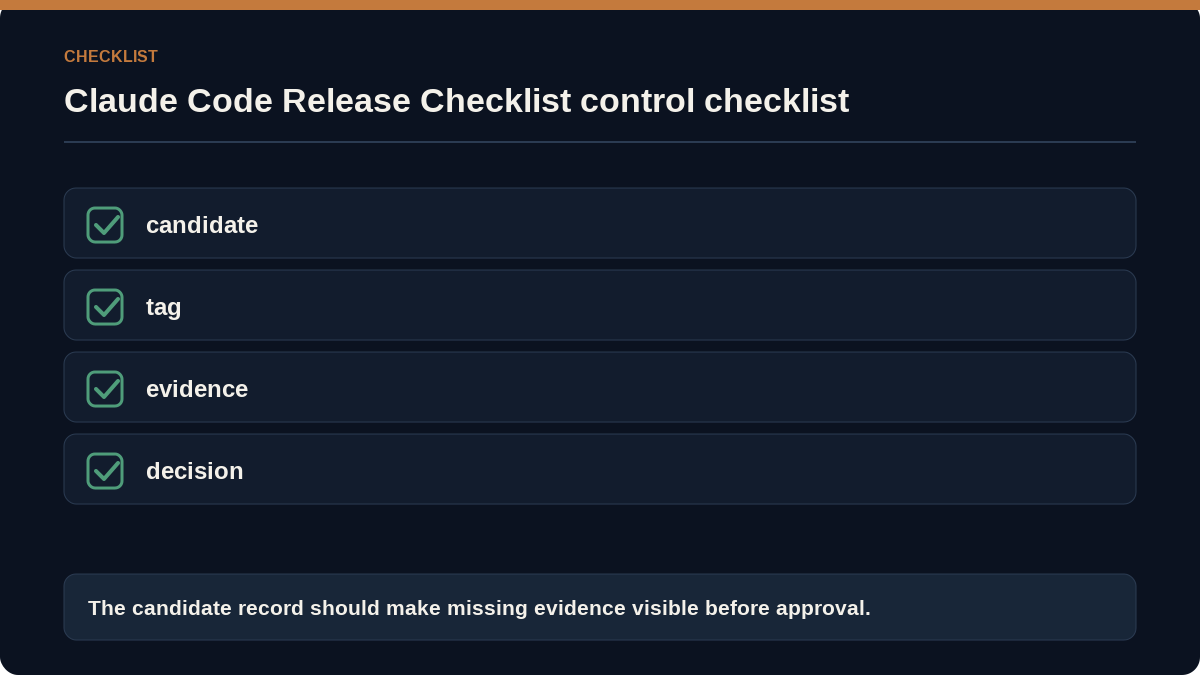
Use this sequence for every release candidate. On a small patch it takes minutes. On a major it is the most valuable review in the cycle.
- Freeze the identity. Version, tag name, target commit, branch.
- Confirm the tag. Tag target equals the tested commit, compared explicitly (F089).
- Record the scope. Checks that ran, coverage, results, skips with reasons.
- Review the notes. Coverage of the diff, support for each entry, migration steps.
- Confirm the version agreement. Entries match the frozen increment.
- Confirm the rollback unit. Inverse action, external effects, owner, rehearsal status.
- List exceptions. Skipped checks with reason, accepter, and follow-up.
- Audit the record. Ask Claude Code to find missing fields and contradictions.
- Decide. Approve, hold, or rework against pre-recorded criteria.
| Gate | Pass condition | Failure response |
|---|---|---|
| Identity frozen | Version, tag, and commit are decided together | Freeze before any other step |
| Tag confirmed | Tag target equals tested commit | Retag or re-test |
| Scope recorded | Every check has a result or a recorded skip | Add the missing scope |
| Notes reviewed | Coverage and support both hold | Fix the notes |
| Rollback confirmed | Inverse action and owner are named | Complete the rollback plan |
| Exceptions owned | Each exception has an accepter and follow-up | Assign ownership |
| Decision criteria pre-set | Approve, hold, and rework conditions are written | Write the criteria before deciding |
The practical implication is that approval is only as good as the record it reads from. A record that makes missing evidence visible turns a release review into a checklist, and a release that cannot be explained from its record should not be approved.
Concrete win, honest loss, and next decision
Win: In the major-release example, the candidate record caught a tag that could have drifted, a missing changelog entry for a parsed error string, and an unowned integration-coverage gap. Approval reads from evidence, and a later engineer can audit the decision without a conversation.
Loss: The record proves only what was written into it. A check nobody ran, a consumer nobody identified, and an exception accepted without authority all look the same as a clean record if the omission is invisible. The official sample procedure is explicitly an example to adapt (F088), and a checklist does not prove the release is correct (guardrail).
Implication: Use a candidate record for any release with outside consumers, a rollback that touches shared state, or an approval that has to survive an audit. For a single-artifact internal deploy with one owner, a lightweight record with identity, scope, and rollback is enough. The structure should scale with the blast radius, not with ceremony.
Connect the record to the rest of the batch
The candidate record is the summary of the batch. Deciding a major, minor, or patch increment fills the version field, and annotated release tags fills the tag and commit fields with an inspected target.
Consumer-facing changelog entries fill the notes field, backporting a hotfix with cherry-pick covers the supported-line case that produces a second candidate, and planning a revert before release fills the rollback field with a rehearsed inverse.
Verification evidence comes from mapping changed code to checks, triaging flaky tests before rerunning, and contract tests for API expectations. The limits of a green run are in false success from passing tests and inspecting the snapshot diff rather than trusting green.
For the commits the candidate contains, atomic commits that stay revertible and commit messages that encode change intent make the range reviewable. Resolving merge conflicts by behavior matters when the candidate includes a merge, and hunting a regression with git bisect locates a change when the candidate misbehaves.
Release mechanics around the approval appear in defining branch protection merge checks and recovering failed merge-queue groups. Branch protection is the automated half of the same idea: rules that must pass before a merge, recorded separately from the manual record (GitHub branch protection rules, official).
Upstream quality gates are in static analysis baselined to reduce noise, proving usage before removing dead code, and mutation testing for weak assertions. For deterministic checks that the scope depends on, see controlling time and randomness in tests.
When the approval has to move to another maintainer, session handoff with team context carries the record, and verification as done proof frames what counts as release evidence.
Data gap and future update
The official Claude Code documentation describes a sample release skill that checks branch and tree state, runs versioning, updates changelogs, and tags commits for continuous integration publishing, and states that it is illustrative and must be adapted to the repository’s release system (F088). The Git documentation supports tags targeting specific commits and confirms that a tag identifies a revision without proving which checks ran (F089). The candidate-record practice itself is a derived recommendation rather than an official requirement (F090).
This article does not assume a specific continuous integration provider or release platform, and it does not run build, deploy, or publishing commands. Whether a particular platform’s checks satisfy a checklist field is a repository decision that the cited sources do not resolve.
No cited source provides a measured release-failure rate, a benchmark comparing checklist-driven and informal approvals, or data on how often a missing evidence field precedes an incident. No such figure is claimed. A future update could add measured data on checklist effectiveness if a team publishes it with method and environment. Rolling documentation can change, so recheck the cited pages before relying on specific wording and keep the caveats if the text shifts.
One AI API Key option for OpenAI-format agents
Claude Code uses an Anthropic-format route, so the One AI free model IDs are not a Claude Code model source. The packet records Claude IDs as unavailable on 2026-11-27.
For a separate OpenAI-format agent, One AI API Key provides https://api.oneaiapikey.com/v1, one key, and 46 live free IDs. That option concerns a different client and request format, not a workaround for Claude Code authentication. Check the free model list and eligibility details before choosing an agent route.
FAQ
Does completing a checklist prove the release is correct?
No. The checklist makes the evidence visible and the contradictions detectable. Correctness still depends on the checks that ran and the behavior those checks covered. Treat missing evidence as a failing check rather than as a pass (guardrail).
Why keep everything in one record instead of separate documents?
Because drift happens between documents, not within them. Version, tag, tests, notes, and rollback are decided by different people at different times, and a shared record is what makes a contradiction between them visible (F090).
Does the tag prove the release passed its checks?
No. A tag identifies a revision (F089). Which checks ran, and what green meant, must be recorded separately in the verification scope field.
Is this checklist tied to a specific CI provider?
No. The record describes what must be true about a candidate, and it works with any release system. The sample release procedure in the official documentation is an example to adapt rather than a required platform (F088).
What should block approval versus just be recorded?
A missing field, a tag that does not match the tested commit, or a contradiction between the changelog and the version should block approval until resolved. A documented exception with an owner and a follow-up can be recorded and accepted. The difference is whether a person with authority accepted the gap.
More Claude Code troubleshooting
- Claude Code Property Tests: Generate Edge Cases
- Claude Code Test Fixtures: Isolate Shared State
- Claude Code Minimal Repro: Shrink the Failure
- Claude Code Debug Log: Separate Facts from Hypotheses
- Claude Code Async Races: Make Scheduling Deterministic
- Claude Code Memory Leaks: Compare Allocation Snapshots
- Claude Code Complexity: Refactor Hotspots, Not Metrics
- Claude Code Duplication: Choose Reuse or Independence
- Claude Code Git Stash: Recover Work Without Dropping It
- Claude Code Git Rebase: Choose a Branch Policy
Sources
- Official: Claude Code best practices, supporting the sample release skill that checks state, versions, updates changelogs, and tags for CI (F088).
- Official: Git tag, supporting tags targeting specific commits and the default HEAD behavior (F089, F077 context).
- Official: Git show, supporting inspection of the tag target.
- Official: Git log, supporting review of the range the candidate tag encloses.
- Official: Semantic Versioning 2.0.0, supporting the compatibility classes the version and changelog must agree on (F086).
- Official: GitHub branch protection rules, supporting the automated checks that complement the manual record.