Direct answer
Use mutation testing to investigate whether your tests assert behavior, not to chase a universal mutation score. Stryker introduces small changes into source code and runs the test suite; a mutant is killed when the tests fail (F019). Surviving mutants are leads for human review, not automatic defects. Ask Claude Code to scope mutations to one high-risk behavior, run the suite against those mutants, and classify each survivor as either a real assertion gap or an equivalent mutant.
The payoff is a short list of focused tests that assert what the code must actually do. The cost is runtime and review noise, both of which stay visible in the run report. Code coverage does not guarantee assertion quality, according to Stryker documentation (F020), so a high coverage percentage can coexist with tests that execute a line and never check its result.
This article walks through the full sequence: choose a behavior whose failure has a cost, run the existing suite against mutants in that region, classify what survived, inspect the missing assertion in words before writing code, separate equivalent mutants from genuine gaps, add the smallest test that kills the mutant, and report findings without inventing a threshold. The workflow is derived from the cited documentation and from review practice, not from a benchmarked study of defect rates.
Why weak assertions cost more than missing tests
A test that executes code without checking the result passes for the wrong reason. It reports green during refactors, it survives a broken edge case, and it gives the team confidence the suite cannot support. The failure appears later, usually in production, where the assertion gap has already been paid for in incident time and on-call attention.
Mutation testing makes that gap visible in a way coverage cannot. When a mutant survives, the suite ran against changed behavior and still passed. Some observable result the code produces is not asserted anywhere. Covered code and asserted behavior are different properties, and only the second one protects a customer.
Two practical costs follow from a poorly run mutation pass. The first is investigation time. Each survivor needs a human decision about whether it matters, and a broad run can produce more survivors than a team can classify in a sprint. The second is false confidence in the opposite direction. A team that treats the raw survivor list as a defect backlog will either burn days on equivalent mutants or stop reading the report entirely, and both outcomes end the practice.
The method below limits both costs by narrowing the scope before running. You choose one behavior whose silent change would matter, mutate that region only, and review a small set of survivors with named owners and recorded labels. The run stays short enough to finish in a session and the report stays short enough to read.
Choose a high-risk behavior to mutate
Start from consequence, not from file size or line count. A high-risk behavior is one where a silent change produces a wrong result that reaches a customer, a payment, a permission check, an audit record, or a persisted data row. Those regions usually have tests already; the open question is whether the tests assert the outcome or merely execute the path.
Ask Claude Code to list candidate behaviors in a named directory along with the test files that currently exercise them. Review the list for consequence rather than complexity. A dense parser with no downstream effect can wait for a quieter week. A small discount function that feeds an invoice cannot.
| Candidate behavior | Failure consequence | Existing tests | Mutation priority |
|---|---|---|---|
| Discount calculation in billing | Wrong charge reaches a customer | Unit tests assert totals | High |
| Permission check in API middleware | Unauthorized access to a resource | Integration tests assert status codes | High |
| Date parsing in an importer | Silent corruption of stored records | No direct unit tests | Medium, needs a fixture first |
| Formatting helper for display text | Cosmetic only | Snapshot exists | Low |
| Retry policy in a background worker | Duplicate side effects | One test asserts retry count | Medium |
Scope the run to the files that implement the chosen behavior. A scoped run finishes fast enough to review in the same session, and the survivor list stays small enough that every entry gets a real decision. Broad runs across a whole services directory produce the opposite: a long report, a tired reviewer, and a habit of skimming.
Official Claude Code best practices recommends precise prompts that name files and symptoms when investigating a problem. Use that advice here. A prompt such as “find the test files that cover the discount calculation in billing/discount.ts and list the boundary values they assert” gives the agent a concrete target and gives you a reviewable answer.
Run the existing tests against mutants
Run the suite once before mutating anything. A suite that already fails, skips unpredictably, or depends on execution order will produce mutant results nobody can interpret. Fix or quarantine those cases first. The flaky test triage guide covers that cleanup in detail.
Then run the mutation tool against the scoped files. Stryker generates mutants per mutator and runs the test suite until the mutant is killed or all tests complete (F019). Results depend on the selected mutators, the test suite, and the configuration, so record which options the run used. An unreproducible survivor list is an opinion, not evidence.
| Run setting | What it changes | Practical effect on the report |
|---|---|---|
| File scope | Which mutants are generated | Smaller scope means faster runs and fewer survivors to classify |
| Mutator set | Which kinds of changes are introduced | Broader sets surface more gaps and considerably more noise |
| Test command | What counts as killing a mutant | A failing assertion kills; a skipped test does not |
| Timeout | When a hung run is treated as survived | Too short produces false survivors from slow tests |
| Concurrency | How many mutants run at once | Faster runs, but shared fixtures can produce false kills |
Claude Code can help in two concrete ways during this step. It can read the configuration and confirm the scope matches the behavior you chose, which catches the common mistake of mutating a whole directory when one module was meant. It can also run the tool and summarize the survivor list into a table you can review, without changing production code during the run.
Keep the exact command in the repository, either in a script or in the run report itself. The next engineer who inherits the code should be able to reproduce the same list of survivors with the same scope.
Classify killed and surviving mutants
A killed mutant is a change the suite caught. That is the healthy outcome and it needs no action. A surviving mutant is the interesting case: the suite ran against changed behavior and still passed, which means something observable went unasserted.
Sort every survivor into one of three groups before doing anything else. The first group is a real assertion gap: the changed behavior matters to the system and no test checks it. The second group is an equivalent mutant: the change is behaviorally indistinguishable from the original, so no test could kill it. The third group is out of scope: the change is real but sits in a region the team is choosing not to assert in this run.
| Source behavior | Mutation introduced | Test result | Investigation note |
|---|---|---|---|
| Total excludes an expired discount | Comparison operator flipped | Killed | Suite asserts the boundary directly |
| Refund rejects a negative amount | Guard condition removed | Survived | No test posts a negative refund |
| Cache key includes the tenant id | Key ignores tenant | Survived | Cross-tenant test missing entirely |
| Label trims trailing whitespace | Trim call deleted | Survived | Cosmetic; candidate for equivalent-or-low |
| Retry counter increments | Increment removed | Killed | Worker test asserts retry count |
Classification is a human step, and it is the step that determines whether the practice pays off. The tool reports what survived. It does not decide whether the change matters, and it cannot tell an equivalent mutant from a real gap without human judgment about intended behavior.
Inspect the missing behavioral assertion
For each real-gap survivor, name the assertion that would have killed it. Write the assertion as a sentence before writing any test code: “a refund with a negative amount is rejected with the current error code.” That sentence is the test target, and writing it first prevents the mutant from quietly narrowing the requirement.
Claude Code can propose the assertion from the survivor diff. Review the proposal against the behavior you actually want, not against the mutant. A mutant can suggest a test that is narrower than the real requirement, for example asserting only one boundary value when the requirement covers an entire range of invalid inputs.
| Surviving mutant | Missing assertion in words | Where it belongs |
|---|---|---|
| Negative refund guard removed | A refund below zero is rejected | Refund unit test |
| Tenant missing from cache key | Two tenants never share a cache entry | Cache integration test |
| Operator flip on expiry | An expired discount is never applied | Discount boundary test |
| Duplicate event suppressed silently | A repeated event id is rejected or deduplicated | Event handler test |
The deterministic tests guide matters at this point: the new assertion must pass reliably, or it becomes noise in the next mutation run and trains reviewers to distrust the report. If the assertion depends on randomness or timing, fix that first.
Separate equivalent behavior from test gaps
Some survivors cannot be killed by any test because the mutant is behaviorally identical to the original code. Chasing them wastes review time and teaches the team to ignore the report, which is a worse outcome than not running mutation testing at all.
Signs of an equivalent mutant include a change in an internal representation with no observable effect, a reorder of independent statements, and a removal of code that the asserted path never reaches. The confirming question is simple: what observable result differs? If the answer is nothing a customer or a downstream system could detect, record the survivor as equivalent and move on.
| Survivor type | Observable difference | Decision |
|---|---|---|
| Real gap | A customer-visible result changes | Add a focused assertion |
| Equivalent | No observable difference in any asserted path | Mark equivalent, no test |
| Out of scope | Difference exists outside the chosen boundary | Record for a later scoped run |
Labeling is part of the run report, not an optional extra. A survivor with no label forces the next reader to repeat the same investigation from scratch, which is how mutation testing acquires a reputation for producing noise.
Add a focused test or adjust the mutant scope
When the expected behavior is clear, add the smallest test that asserts it and rerun the mutant (F021). The test should fail against the mutant and pass against the original code. That pair of results is the proof the assertion is real and the classification was correct.
When the expected behavior is not clear, do not invent a test. Adjust the scope instead: exclude the region from this run and record why. A documented exclusion is honest about the limits of the report. An undocumented survivor is a debt with no owner and no context.
| Situation | Action | Recorded result |
|---|---|---|
| Expected behavior is documented | Add the focused test | Survivor becomes killed on rerun |
| Expected behavior is ambiguous | Exclude the region, name the decision owner | Documented exclusion with a reason |
| Behavior is intentionally unchecked | Record the intentional gap | Label as accepted, review annually |
Review the new test for two failure modes before merging. It should not assert implementation details that a legitimate refactor would break, because that converts the test into a brake on improvement. It should not assert so little that a different mutant in the same region would still survive, because that recreates the original problem one level down.
Keep runtime and noise visible
Mutation runs are not free. Record how long the scoped run took, how many mutants were generated, and how many survived. Those numbers let the next engineer decide whether to widen or narrow the scope, and they make the cost of the practice visible to the team that funds it.
| Run scope | Runtime on the project machine | Useful findings | Keep or narrow |
|---|---|---|---|
| One billing module | Measured per run, recorded in the report | Three real assertion gaps | Keep as a recurring scoped run |
| Whole services directory | Long enough that review lags behind | Mostly equivalent mutants | Narrow before the next run |
| Single permission file | Short | One cross-tenant gap | Keep and consider a scheduled weekly run |
Noise has a cost too. A report with dozens of equivalent mutants trains reviewers to skim, and a skimming reviewer misses the one real gap in the list. Labeling equivalents in the same run keeps the next report shorter and more readable, which is the difference between a practice that continues and one that quietly stops.
Report findings without a universal threshold
A mutation score is a description of one run under one configuration. It is not a release gate, and this article does not recommend a threshold. Two runs with different scopes, mutator sets, or test commands are not comparable, and a bare percentage hides whether the survivors were real gaps or equivalents.
Report three things instead. Name the behavior that was mutated so a reader knows the scope. List the real gaps found, each with the test that now asserts it. List the equivalents and exclusions with reasons. That report survives a configuration change; a single number does not.
| Report element | Why it survives review | What it avoids |
|---|---|---|
| Named behavior and scope | Reviewers know what was and was not mutated | Comparing runs with different scopes |
| Real gaps with new tests | Each gap has a fix in the suite | Treating survivors as defects |
| Equivalents and exclusions | Future readers do not re-investigate | Silent debt with no owner |
| Recorded runtime | The team sees what the practice costs | Quiet abandonment after one slow run |
Treating coverage as assertion quality is the specific failure this reporting style avoids. Stryker documentation states the limitation directly (F020), and the reporting format above keeps the distinction visible long after the run.
Worked example: a discount boundary
Suppose a billing module applies a percentage discount when a subscription is active and the discount has not expired. The suite covers the happy path and asserts the charged total for one active subscription that is far from expiry.
A scoped mutation run flips the expiry comparison. The mutant survives. The happy-path test still passes because its fixture uses a discount far from expiry, so the flipped comparison never changes the asserted result. The assertion gap is now specific and narrow: no test covers the expired side of the boundary.
Write the missing assertion as a sentence: “an expired discount is not applied and the total reflects the undiscounted price.” Add the smallest test that posts an expired discount and asserts that total. Rerun the same scoped mutant. The mutant is killed.
Record the run: one behavior, one survivor, one new assertion, no change to production code, and a runtime figure for the scoped run. Also record the two equivalent mutants found in the same module with a one-line reason each, so the next run starts from a labeled baseline rather than a fresh investigation.
The concrete win is a boundary test that would have caught the comparison flip before it reached a customer’s invoice. The concrete loss is that equivalent mutants in the same module produced review noise, and the run report needed labels before the team trusted it enough to act. The practical implication is to scope mutation runs to behavior whose silent failure has a real cost, and to review survivors as leads for a human decision rather than as a defect queue to burn down.
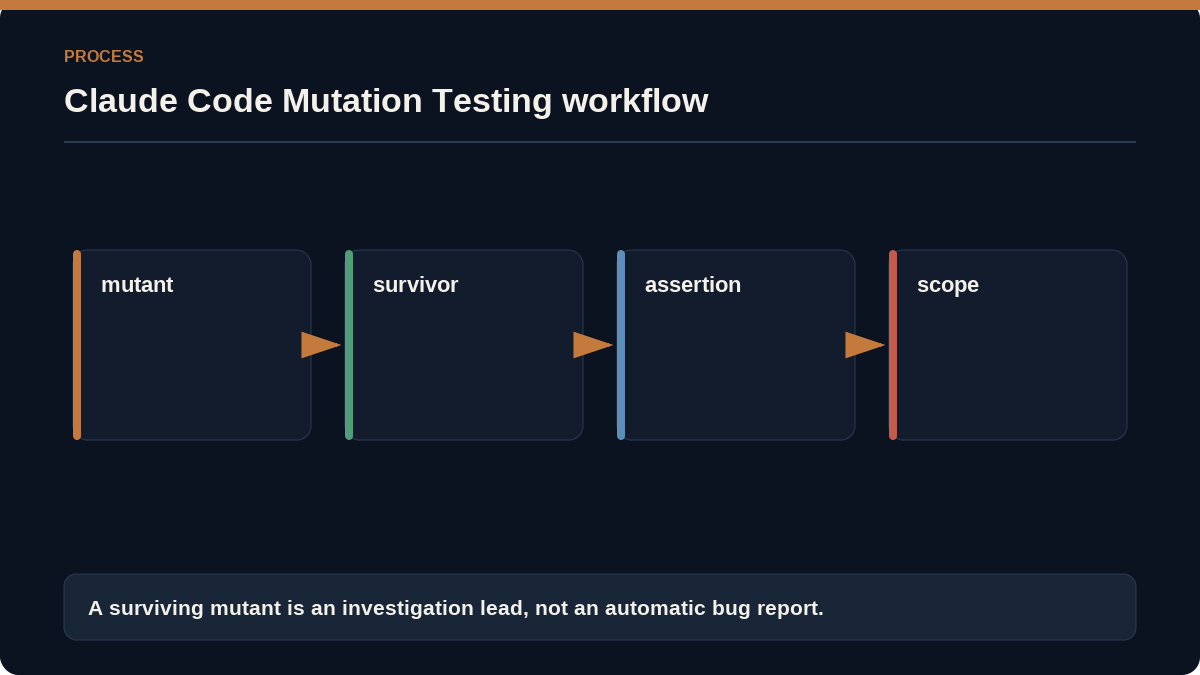
Connect the method to the rest of the batch
Mutation results are only as trustworthy as the suite behind them. Triaging flaky tests removes the intermittent failures that would otherwise kill mutants by accident and corrupt the report. Selecting tests for changed code keeps the mutation run’s test command fast enough to use regularly rather than once a quarter. Before adding assertions to a long-lived module, auditing the context already loaded keeps the investigation focused instead of pulling in unrelated code.
State isolation matters because a surviving mutant can reflect a test that never exercised the changed path at all. Test fixtures that isolate shared state covers that boundary, and contract tests for API expectations covers the interface assertions that mutation runs frequently expose.
When a survivor reveals a bug rather than a test gap, produce a minimal case with the minimal repro method. Record the investigation with the debug log that separates facts from hypotheses so the next reader can audit the reasoning. Concurrency gaps are a separate discipline covered by deterministic scheduling for async races, and resource growth is covered by comparing allocation snapshots.
For the broader test strategy, testing edge cases with property tests complements mutation testing by generating inputs rather than mutating code, and the two methods find different kinds of gaps. Reviewing snapshot diffs addresses the common case where a snapshot passes while asserting nothing specific about the changed region.
On the code-quality side, refactoring complexity hotspots and building a static analysis baseline cover the structural side of the same problem, and removing dead code with usage evidence handles regions where no test could ever kill a mutant because nothing calls the code. When a new assertion changes a public function’s contract, check it against semantic versioning decisions and branch protection and merge checks so the tightened test actually gates merges.
When a survivor points at a regression that already shipped, git bisect for regression hunts finds the commit that introduced the gap. For release decisions, the release checklist guide covers where a mutation report fits in a candidate review. If duplicated logic is what made the survivor hard to classify, duplication and reuse independence explains the structural cause, and atomic commits keep the new assertion in a reviewable change of its own.
Data gap and future update
The fact pack contains no measured defect-reduction rate for mutation testing, no benchmark comparing mutation scores across projects, and no evidence that Claude Code consistently improves test quality when asked to add assertions from a survivor diff. No such number is claimed in this article.
Stryker documentation describes the mechanism (F019) and the coverage limitation (F020). The workflow for reviewing survivors and adding focused tests only when expected behavior is clear is a derived practice (F021), not an official procedure with measured outcomes. A future update should add a reproducible case study with runtime figures, survivor classifications, and the resulting test additions from a real repository.
Tool configuration changes over time. Recheck the cited Stryker pages before publishing and preserve the caveats if mutator names, defaults, or reporting formats shift. Until stronger evidence exists, treat this method as a reviewable workflow rather than a proven performance intervention.
One AI API Key option for OpenAI-format agents
Claude Code uses an Anthropic-format route, so the One AI free model IDs are not a Claude Code model source. The packet records Claude IDs as unavailable on 2026-11-27.
For a separate OpenAI-format agent, One AI API Key provides https://api.oneaiapikey.com/v1, one key, and 46 live free IDs. That option concerns a different client and request format, not a workaround for Claude Code authentication or quota. Review the free model list and eligibility details before choosing an agent route.
FAQ
Does mutation testing replace code coverage?
No. Coverage reports which lines ran during the suite. Mutation testing reports whether the suite noticed a behavior change on those lines. Stryker documentation states that coverage does not guarantee assertion quality (F020), which is why the two are read together rather than treated as substitutes.
Should every surviving mutant become a ticket?
No. Each survivor needs a human classification into real gap, equivalent, or out of scope before it becomes work. Treating the raw list as a defect backlog produces wasted investigation on equivalent mutants and erodes trust in the entire report.
What mutation score should a team target?
This article recommends no threshold. Scores depend on scope, mutator set, test command, and configuration, so a universal target would be arbitrary and would invite gaming the metric. Report named behaviors and classified survivors instead of a single number.
Can Claude Code add the missing assertions automatically?
It can propose them from the survivor diff, and that proposal is often a useful starting point. The proposal still needs review against the intended behavior, because a mutant can suggest an assertion narrower than the real requirement. The evidence pack contains no measured quality gain for AI-written assertions, so no improvement is claimed here.
How often should a scoped mutation run happen?
Often enough that the report is still actionable and rarely enough that the runtime cost stays acceptable. A weekly run on one high-risk module is a common starting shape. The right cadence depends on how fast the region changes and how much review capacity the team has.
More Claude Code troubleshooting
- Claude Code Git Stash: Recover Work Without Dropping It
- Claude Code Git Rebase: Choose a Branch Policy
- Claude Code Merge Conflicts: Resolve Behavior, Not Lines
- Claude Code Commit Messages: Encode Change Intent
- Claude Code Merge Queue: Recover Failed Groups
- Claude Code Release Tags: Use Annotated Markers
- Claude Code Hotfix Backports: Cherry-Pick Carefully
- Claude Code Rollback: Plan a Revert Before Release
- Claude Code Changelog: Write Consumer-Facing Changes
Sources
- Official: Stryker mutation testing docs, supporting the kill condition and result dependencies (F019).
- Official: Stryker example, supporting how mutants are generated and reported in a real project.
- Official: Stryker FAQ, supporting the coverage limitation and survivor review guidance (F020, F021).
- Official: Vitest coverage guide, supporting what coverage measures and what it does not.
- Independent: SonarSource code quality guide, supporting the broader code-quality context.
- Official: Claude Code best practices, supporting precise investigation prompts with named files.