Direct answer
Define what correct behavior means before asking Claude Code to generate implementation-aware tests. A test oracle is the independent source of expected behavior: a requirement, a preserved legacy outcome, a protocol rule or a human-approved example. If the agent reads the new code first and writes assertions from it, the test can repeat the same mistake as the implementation.
Use a behavioral specification, hidden acceptance checks and small mutation tests to challenge the result. Do not treat coverage percentage as proof. Code-first oracle bias is a test-design problem, not evidence that every generated test is weak.
Why a passing test can still be wrong
A test executes code and compares an observation with an expectation. If the expectation comes from the implementation being tested, the comparison can become circular. The code returns a value, the test records that value, and the suite passes because the mistake was copied faithfully.
Generated tests can introduce this pattern easily. An agent can inspect a function, infer its current branches and produce assertions that describe those branches. The result may improve regression coverage without checking whether the branches match the product requirement. More tests can then create more confidence than the evidence supports.
Independent: The code-first test oracle bias research describes generated tests inheriting implementation faults. It cites a study where detection dropped from 25% to 14% when tests were generated from code. The study is not a Claude Code-specific failure rate and should not be presented as one.
The practical cost appears during review. A green suite can hide a wrong discount rule, an incorrect retry condition or a boundary that was never specified. The reviewer sees many assertions but little independent evidence about intended behavior. Independent evidence is why the oracle deserves its own artifact before implementation begins.
The oracle problem
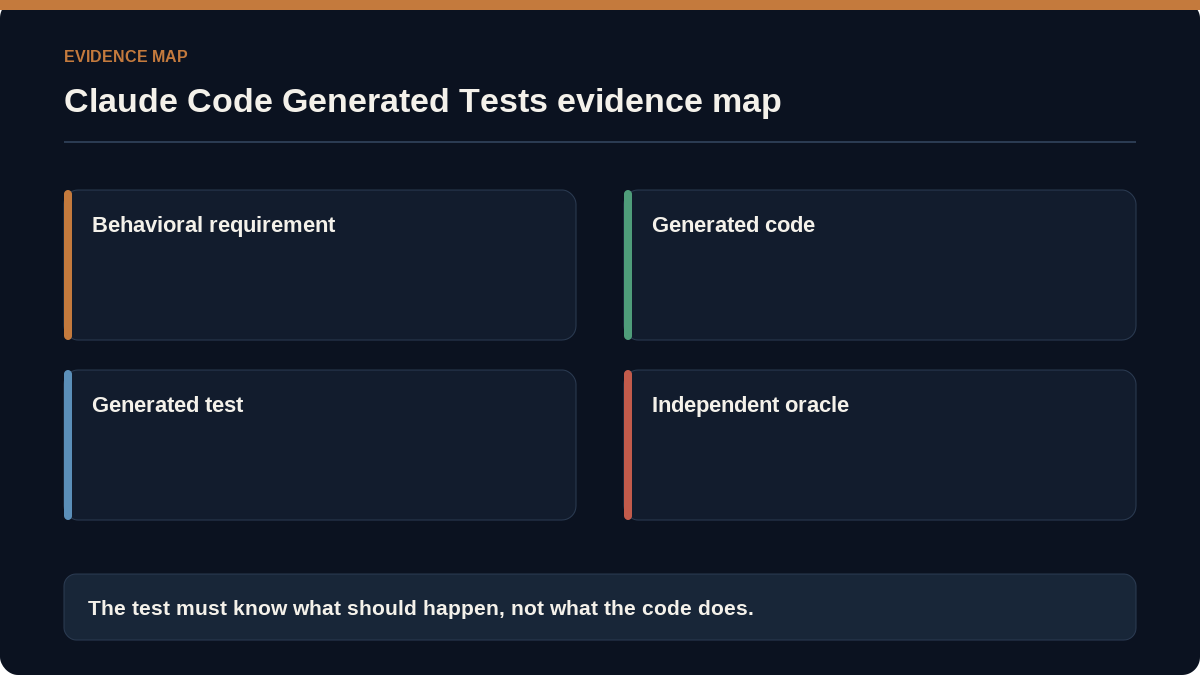
An oracle does not need to be a large document. It can be a precise sentence, a table of boundary cases, a protocol requirement or a preserved behavior extracted from a trusted legacy path. Its job is to say what should happen without consulting the new implementation.
For example, “eligible customers receive free shipping” is too vague to test alone. It leaves the threshold, currency, customer status, exclusions and rounding unresolved. A useful oracle names those decisions or marks them as open questions. The agent can then ask for clarification instead of inventing behavior and testing against it.
| Oracle type | Independent source | Good use | Main risk |
|---|---|---|---|
| Requirement | Approved product rule | New business behavior | Requirement is ambiguous |
| Protocol | Published interface contract | Request and response behavior | Contract has optional branches |
| Characterization | Trusted existing behavior | Legacy preservation | Existing behavior may be a bug |
| Example | Human-approved input and output | Boundary clarification | Example is not representative |
| Invariant | Property that must always hold | Broad safety checks | Property is too weak |
| Differential | Trusted reference implementation | Migration comparison | Reference is not truly trusted |
The structured behavioral oracle research describes encoding preserved or changed behaviors, setup constraints and control-flow hints to guide executable tests. Use that as a design concept, not a product guarantee. A structured oracle helps the test author, but a human still needs to approve the expected behavior.
The Claude Code proof-of-work packet is a natural place to keep the oracle. Link the requirement, test cases, implementation diff and observed results. A reviewer should be able to see which expectation came from outside the code.
Implementation-aware tests are still useful
The goal is not to ban code-aware tests. They are valuable for regression protection, branch coverage and refactoring. The problem appears when they are the only oracle. A suite can contain both implementation-derived assertions and independent acceptance checks.
Separate the two purposes in the test plan. Label tests that preserve current behavior, tests that enforce a new requirement and tests that probe a known boundary. The label tells the reviewer what kind of evidence each test provides. It also prevents a characterization test from silently becoming a product requirement.
For a legacy function, start with characterization. Capture the current outputs for selected inputs before changing structure. Then write a separate test for the intended corrected behavior. The old test preserves history; the new test states the desired change. Keeping both visible makes the behavior change explicit.
The legacy-code tribal knowledge guide explains why undocumented rules cannot be recovered automatically. If the original developer is unavailable, the team may only have current behavior and incomplete business notes. In that case, mark the oracle as provisional and require human review before treating it as correct.
Hidden acceptance tests
Hidden acceptance tests are checks the implementation agent does not use as the target while writing code. They can live in a separate test suite, a protected evaluation package or a reviewer-owned fixture. The point is independence, not secrecy for its own sake.
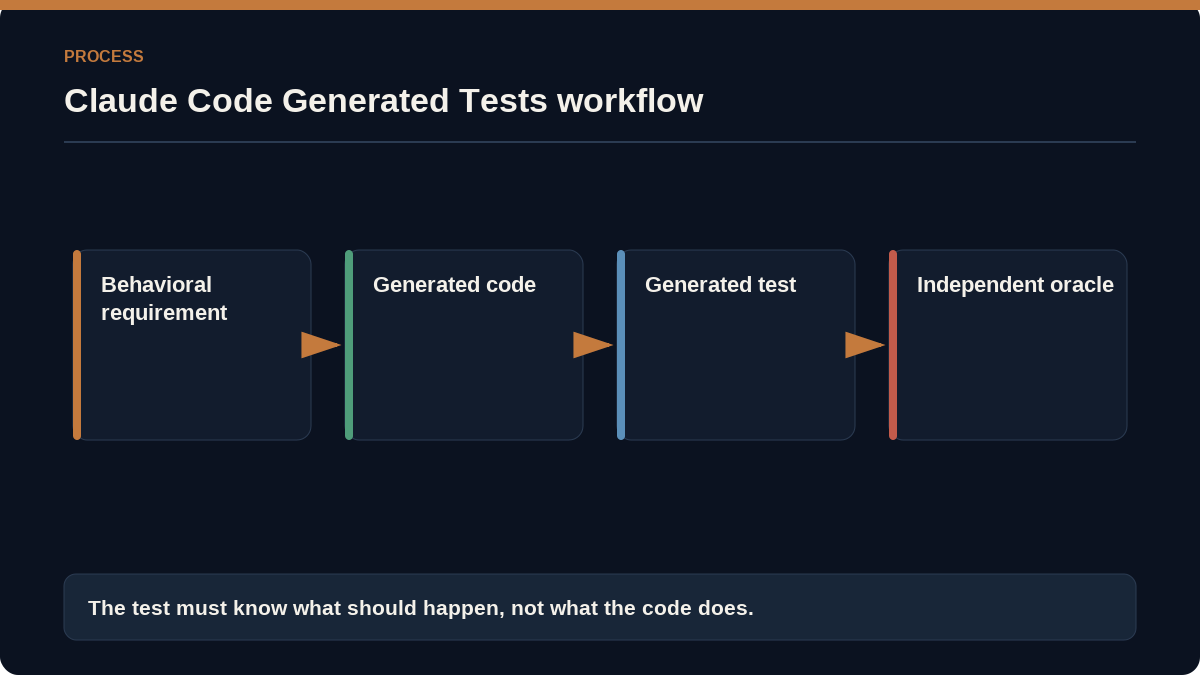
A simple workflow uses two artifacts. The implementation brief describes the task but withholds the final acceptance cases. The reviewer writes or approves those cases from the requirement. After implementation, the acceptance suite runs against the change. Any failure becomes a question about the code or the requirement, not a reason to rewrite the test until it passes.
Do not hide a requirement that the agent needs to implement correctly. Hide the final grading cases when the purpose is evaluation, but provide enough behavioral detail for the work itself. Otherwise the test measures guessing rather than software quality.
| Stage | Agent sees | Reviewer controls | Evidence produced |
|---|---|---|---|
| Specification | Approved behavior and open questions | Requirement wording | Versioned oracle |
| Implementation | Task, interfaces and constraints | Protected acceptance cases | Code diff and local tests |
| Evaluation | Acceptance suite result | Expected outputs and fixtures | Pass or failure record |
| Mutation challenge | Deliberate fault in disposable copy | Which faults should be caught | Detection and missed-fault list |
| Review | Full packet | Final behavior decision | Signed acceptance note |
The subagent context isolation guide explains that custom subagents start with fresh context rather than the parent’s full history. A separate test-design subagent needs the oracle in its task brief. Do not assume it can see acceptance cases that were only discussed in the parent session.
Parallel work also needs separate state. The parallel-agent worktree pattern can keep implementation and test experiments from editing the same files. A worktree does not make the oracle independent, but it reduces accidental sharing while the acceptance suite is being prepared.
Mutation checks: ask whether the test can fail
A passing test proves only that the checked inputs produced the expected outputs under the checked setup. A mutation check asks a stronger question: if the implementation contained a plausible fault, would the test notice?
Create a disposable copy of the code and introduce one small, deliberate fault. Change a boundary operator, invert a condition, remove a validation branch or alter a returned status. Run the relevant tests. A surviving fault is a signal that the suite may depend too closely on the current implementation or may not cover the intended behavior.
Do not mutate production code or leave deliberate faults in the main branch. The destructive git guardrails matter here because cleanup after a mutation experiment can itself destroy useful work. Use a disposable worktree and verify that the main checkout stays unchanged.
| Mutation | Behavior it challenges | Expected test response | If it survives |
|---|---|---|---|
Change < to <= |
Boundary inclusion | Boundary test fails | Add exact edge inputs |
| Invert a validation condition | Rejection path | Negative test fails | Add invalid-input cases |
| Remove a default branch | Fallback behavior | Fallback test fails | Specify default outcome |
| Alter an error status | Failure contract | Error assertion fails | Check status independently |
| Skip a retry condition | Retry policy | Retry test fails | Verify call count and timing |
| Change rounding order | Numeric invariant | Example or property fails | Clarify rounding requirement |
Mutation testing is not a scorecard by itself. A killed mutation shows that a test detected that specific fault under that setup. It does not prove the absence of other faults. A surviving mutation may also be an equivalent change that does not alter observable behavior. Assess each result instead of chasing a universal percentage.
The independent oracle should decide which mutations matter. If the requirement says a threshold is exclusive, changing < to <= is meaningful. If the requirement is silent, the mutation exposes a specification gap. That is useful evidence, but it should not be resolved by copying the implementation into the test.
A test design template
Start with one behavior and write it in plain language. Name the actor, trigger, expected result and constraints. Add boundary inputs, invalid inputs and observable side effects. Mark any expected value that came from current code as “characterized,” not “required.”
Then separate the cases into three groups. Acceptance cases encode approved behavior. Regression cases preserve existing behavior that must not change. Exploratory cases probe uncertainty and require review before becoming permanent expectations. This separation keeps a generated suite from blending facts with guesses.
| Field | What to record | Example shape |
|---|---|---|
| Behavior | One approved sentence | Reject expired credentials |
| Actor | Who or what triggers it | Authenticated request |
| Inputs | Boundary and invalid values | Expired, valid, missing |
| Expected output | Observable result | Specific status and no session |
| Side effects | What must not happen | No token issuance |
| Oracle source | Requirement or legacy record | Approved rule ID |
| Independence | Who approved the expectation | Reviewer name or role |
| Mutation | Plausible fault to challenge | Expiry check inverted |
A code block is not required for every case. A table can be the oracle when it is precise and versioned. The Anthropic large-codebase guidance recommends root and subdirectory context files, read-only exploration and scoped commands. Put the test contract near the package it governs so an agent can find it without scanning the entire repository.
Avoid vague instructions such as “add tests until coverage is high.” Coverage measures execution, not correctness. A test can execute a wrong branch and assert the wrong result. Ask for named behaviors, independent expected values and mutation cases instead.
Worked example: a discount boundary
Suppose the approved rule says a discount applies when the subtotal is greater than 100, not equal to 100. Currency is fixed to two decimal places, and the subtotal excludes shipping. These are illustrative requirements, not a benchmark or a claim about a real store.
The independent acceptance cases should include 99.99, 100.00 and 100.01. They should also include a case where shipping pushes the order total above 100 while the subtotal stays below it. The expected discount depends on the subtotal, so the shipping case challenges a common implementation mistake.
Derived: Three subtotal boundaries plus one shipping case produce four planned acceptance cases. If each case records input, expected discount and observed result, the worksheet contains twelve required values before optional timing or coverage data.
| Case | Subtotal | Shipping | Expected under the stated rule | Oracle source |
|---|---|---|---|---|
| Below threshold | 99.99 | 0.00 | No discount | Approved rule |
| Exact threshold | 100.00 | 0.00 | No discount | Approved rule |
| Above threshold | 100.01 | 0.00 | Discount applies | Approved rule |
| Shipping above threshold | 99.99 | 10.00 | No discount | Subtotal-only rule |
Now introduce a mutation in a disposable copy by changing the comparison from > to >=. The exact-threshold case should fail if the test uses the independent oracle. If it still passes, inspect whether the assertion was copied from the mutated implementation or whether the case never reached the relevant branch.
The win is a small suite with a clear reason for every assertion. The loss is that four cases do not cover tax, refunds, currency conversion or stacked discounts. Those behaviors need their own requirements. Do not inflate the example into a claim of complete correctness.
Acceptance workflow for Claude Code
Give the implementation agent the approved behavior, constraints and interfaces. Ask for local tests, but keep the final acceptance suite independent. Once the implementation returns, inspect the diff before running the acceptance checks. Look for branches that were invented because the requirement was silent.
Run the acceptance suite in a clean environment. Capture the command, version and result. A pass means the checked behaviors matched the checked oracle. It does not mean every possible input was tested or every hidden business rule was discovered.
Next, run a small mutation set in a disposable worktree. Note which faults were caught and which survived. Assess survivors with the requirement owner. A survivor can lead to a better test, a clarified requirement or a documented equivalence. It should not automatically lead to a weaker assertion.
| Review question | Evidence | Decision |
|---|---|---|
| Did the test use the approved oracle? | Oracle link and case table | Accept or revise |
| Did implementation and test share assumptions? | Diff and assertion review | Add independent case |
| Did boundary mutations fail? | Mutation results | Add or strengthen tests |
| Did side effects match the rule? | State assertions | Fix code or clarify rule |
| Are legacy behaviors intentionally preserved? | Characterization labels | Approve explicit behavior change |
| Is coverage being mistaken for correctness? | Review note | Require behavioral evidence |
The Claude Code permissions documentation can help keep mutation experiments bounded. Use a mode and rules appropriate to a disposable repository, but do not assume permissions prove test correctness. The test oracle and the execution boundary solve different problems.
A separate review agent can inspect the test plan without seeing the implementation first. The approach uses read-only subagent exploration without claiming that subagents have shared hidden memory. Give the reviewer the oracle and ask for missing cases, then compare those cases with the implementation.
Honest loss and data gap
Unknown: The frozen research does not provide a Claude Code-specific defect-detection rate, a guaranteed mutation-testing improvement or a universal coverage threshold. The cited 25% to 14% result belongs to a study discussed by independent research. It cannot be relabeled as a benchmark for this agent.
Hidden tests can also overfit. A reviewer-owned suite may miss the same ambiguity as the implementation brief. Mutation checks cover only the faults that were introduced. Characterization tests can preserve a bug if no one recognizes it. Those losses are why human review and a versioned requirement remain necessary.
The practical win is independence: at least some expectations come from outside the implementation. The honest loss is extra design work and a larger review packet. Revisit the oracle when the product rule changes, and keep old expectations labeled as legacy behavior rather than silently rewriting history.
Handle flaky tests without weakening the oracle
Legacy and generated suites can fail for reasons unrelated to the behavior under review. A clock, random value, locale, network call or shared fixture may change between runs. Treat instability as a harness problem until evidence shows a product defect. Replacing a precise assertion with a broad one only hides the uncertainty.
Make the failing case reproducible before editing the expectation. Capture the seed, fixed time, environment and fixture version when those inputs exist. Run the case in isolation, then in the suite. If it passes alone but fails in the suite, inspect shared state and ordering rather than immediately blaming the implementation.
A retry can be useful for a transient external dependency, but it should not conceal a deterministic mismatch. Separate infrastructure retries from behavioral assertions. The test report should say which layer retried and whether the final result matched the oracle. Otherwise a green rerun can erase the first meaningful failure.
If a test is quarantined, give it an owner and a reason. Do not let a generated suite accumulate disabled cases with no review path. The Claude Code proof-of-work packet can hold the failure evidence, the harness fix and the decision to restore the test.
Independent oracles also help with flaky legacy behavior. If the expected output depends on an external system, capture a reviewed fixture and state its limits. A fixture freezes one observed behavior; it does not prove the external contract will remain unchanged.
Triangulate uncertain expectations. Compare the written requirement, a trusted production example and the current implementation. If all three agree, confidence increases. If they disagree, capture the conflict and assign a decision owner. Do not let majority vote substitute for domain authority, and do not average conflicting outputs into a new expected value.
A test can also be independent in its input but circular in its assertion. Reviewing fixtures alone is therefore insufficient. Trace both sides of the comparison. The input should represent the approved case, and the expected output should come from the oracle rather than the implementation. This two-sided check catches a common generated-test pattern where realistic data accompanies a copied result.
Review the assertion, not just the test name
A generated test can have a precise name and a circular assertion. Read the expected value and trace its source. If the expected value was copied from a current response, ask whether an approved rule independently requires it. If no such rule exists, label the test as characterization or leave it provisional.
Naming helps but does not prove independence. “Rejects expired credentials” is a useful intention. The assertion still needs to check the observable rejection, the absence of a session and any relevant side effect. A test that only checks that an error message is nonempty may miss a system that issues a valid session before returning an error.
Separate fixtures from expectations. A fixture can provide realistic input without deciding the correct output. Store the expected output in the oracle table or acceptance suite. This reduces the chance that a generated fixture and generated assertion drift together because they were produced from the same implementation.
Use small tests for boundary logic and a few end-to-end checks for integration behavior. A unit test can isolate the threshold decision. An acceptance test can verify that the request path, authorization layer and response all agree. Neither layer replaces the other, and both need an independent expectation.
The Claude Code MCP output truncation guide explains why failure evidence can disappear inside large tool results. A test report should put the failing assertion, expected value and observed value in a compact summary. Preserve the full log separately instead of forcing the model to infer the failure from a truncated tail.
Long generated suites can also strain context. The long-context prefill latency test provides a measurement pattern for separating prompt processing, first token, decode and tool execution. Use the same discipline for test review: record which stage consumed time instead of calling the whole run “slow.”
Keep test generation bounded
A test task can expand indefinitely if the agent keeps adding cases without a stopping rule. Official: Task budgets count thinking, tool calls, tool results and output, but they are advisory rather than hard caps. The task budgets versus hard stops guide explains the distinction and the Agent SDK controls available for bounded loops.
For a writing task, a simpler boundary is a named case list. Ask for acceptance cases from the approved table, regression cases for touched branches and a fixed mutation set. If the agent discovers a missing requirement, it should record the gap and stop for review rather than invent another expected value.
A bounded task also makes review cheaper. The reviewer can compare the requested cases with the returned tests one by one. An open-ended request to “test everything” provides no clear completion condition and encourages generated volume without independent reasoning.
| Bound | Purpose | Stop condition |
|---|---|---|
| Named acceptance table | Cover approved behavior | Every row has a test or documented exclusion |
| Touched-branch review | Protect changed code | Each changed branch is explained |
| Fixed mutation set | Challenge test sensitivity | Each mutation is caught or reviewed |
| Fixture inventory | Control test data | Every fixture has an owner and purpose |
| Open-question log | Surface missing requirements | Unresolved question blocks final acceptance |
The Claude Code usage tracking and cost API guide explains the available session and historical usage surfaces. Use the appropriate surface for a local experiment, but do not turn a subscription display into an API token price. The purpose of the bound is controlled review, not a claimed universal saving.
Measure test quality without pretending to prove correctness
Track whether each approved behavior has an independent test, whether boundary mutations were detected, and how many assertions required clarification. These are review signals, not a complete quality score. A high detection count can still coexist with a missing requirement.
Show the denominator. If four mutations were introduced and three were caught, the observed result is three of four for that set. Do not generalize it to all possible faults. If ten acceptance cases were planned and eight have tests, the remaining two are open work, not evidence that the behavior is mostly correct.
| Measure | Numerator | Denominator | Interpretation |
|---|---|---|---|
| Acceptance mapping | Approved rows with tests | Approved rows | Requirement coverage, not code coverage |
| Mutation detection | Caught deliberate faults | Introduced faults | Sensitivity to the selected faults |
| Assertion provenance | Expectations linked to an oracle | Reviewed expectations | Independence of the checked cases |
| Open questions | Unresolved behavior questions | Questions found | Specification debt |
| Review outcome | Changes accepted after review | Changes submitted | Local delivery signal only |
The cost per verified change framework can combine test design, generation, execution and human review. Use the LLM cost calculator only with explicit inputs and the correct pricing source. Do not infer API cost from a coding-plan subscription or from wall-clock duration.
A useful experiment holds the oracle and repository constant, then compares two test-generation approaches. Capture model, version, prompt, fixture set and review time. The model-selection guide for coding agents can inform the comparison, but the independent acceptance result matters more than a vendor benchmark.
Do not paste production records into test fixtures merely to make them realistic. The Claude Code privacy and retention analysis frames provider-side data handling, while local fixture design still needs minimization. Synthetic data with the same boundary shape usually provides the test signal without copying customer information.
Practical checklist
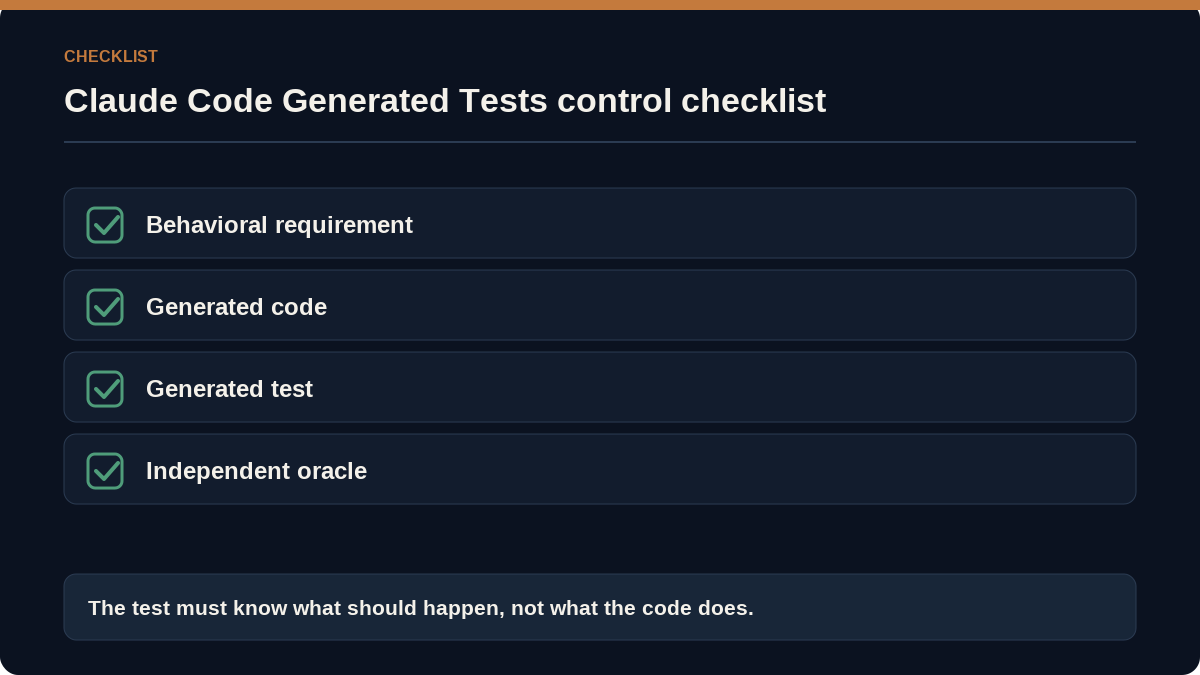
- Write the behavior before generating implementation-aware assertions.
- Mark each expected value as required, characterized or provisional.
- Include exact boundaries, invalid inputs and observable side effects.
- Preserve final acceptance cases independently from the implementation agent.
- Inspect the code diff before interpreting a green suite.
- Run a small mutation set in a disposable worktree.
- Investigate surviving mutations instead of weakening assertions.
- Treat coverage as execution evidence, not correctness proof.
- Preserve the oracle with the change record.
- Revisit tests when the requirement or trusted legacy behavior changes.
The Claude Code compaction context-retention test is relevant to long sessions. If the oracle lives only in early conversation turns, compaction can replace those turns with a summary. Store the test contract in a versioned file or ticket and link it from the task.
Large repositories need the same independence without excessive reading. The monorepo search and token budget guide can help a test agent locate the relevant package and fixtures. Scoped retrieval reduces noise, but it does not decide the expected behavior.
Practical OpenAI-format alternative with One AI API Key
If you want to compare test-generation behavior across models, the 46 live free model IDs are available through OpenAI-format agents. The free lane shares 100 requests and 5,000,000 tokens per day per account, resets at 05:30 IST or 00:00 UTC, and allows one request in flight per key. Accounts can have up to three keys.
Use the quickstart for the base URL and first request. The pricing page explains prepaid billing, the sign-up page starts an account, and the privacy policy covers logging defaults and upstream-provider terms.
The documented Claude Code route is unavailable because all four Claude IDs were marked unavailable on November 27, 2026. Free IDs are OpenAI-format only. Never claim they work inside Claude Code. A different model does not replace an independent oracle, hidden acceptance cases or mutation review.
New accounts receive $10 credit with no card, and billing is prepaid with no subscription or seat fee. The published controls include prompt logging off by default, per-key spend caps, expiry dates, allowed-model lists and request-level usage records. Upstream providers receive requests under their own terms. Use a synthetic test fixture and the per-key controls reference to limit the evaluation credential. Do not promise guaranteed automatic fallback across providers.
For a test-generation comparison, configure an OpenAI-format agent with https://api.oneaiapikey.com/v1, one key and a selected free ID. Give every run the same behavioral oracle and synthetic fixture, but withhold the final acceptance cases. Compare assertion provenance, caught mutations and reviewer findings rather than test count alone. Save the model ID and request total with the result. Hold the oracle version constant across runs so a fixture change cannot masquerade as a model difference. A model that writes more tests is not necessarily better, and the comparison does not establish a Claude Code-specific defect rate.
FAQ
Are all Claude Code generated tests weak?
No. Generated tests can provide useful regression coverage. The specific risk is using the implementation as the only source of expected behavior.
Does high coverage prove the behavior is correct?
No. Coverage shows which code executed. A test can execute a branch and assert the wrong result, so pair coverage with independent behavioral checks.
What is a test oracle?
It is the source of expected behavior, such as an approved requirement, protocol contract, preserved legacy outcome or human-approved example.
Should acceptance tests always be hidden?
No. Hide final grading cases when independence is the goal, but give the implementation agent enough behavioral detail to do the task. Do not make the work a guessing exercise.
What does a surviving mutation mean?
A surviving mutation means the deliberate fault was not detected by the selected tests. Assess whether the case is missing, the assertion is circular or the mutation is behaviorally equivalent.
More Claude Code troubleshooting
- Claude Code WSL IDE environment-variable diagnosis
- Claude Code WSL2 memory-warning breakdown
- Claude Code Windows subagent MCP memory leaks
- Claude Code VS Code WebSocket regression test
- Claude Code desktop browser-pane crash recovery
- Claude Code subagent hang and timeout controls
- Claude Code background subagent running-count diagnosis
- Claude Code subagent stop and resume semantics
- Claude Code compaction cost worksheet
- Claude Code prompt-caching break-even math
- Claude Code idle-session cache-miss analysis
- Claude Code 429 error decision tree
- Claude Code billing-dispute evidence packet
- Claude Code refund and support policy guide
- Claude Code hallucinated-package supply-chain controls
- Claude Code GitHub Actions secret boundaries
- Claude Code repository-hook security review
- Claude Code extension-trojan remediation steps
- Claude Code CVE-2026-55607 sandbox boundary
- Claude Code auto-mode classifier limitations
Sources
- Independent code-first test oracle bias research
- Independent structured behavioral oracle research
- Anthropic large-codebase guidance
- Claude Code worktree isolation
- Claude Code subagent context isolation
- Claude Code permissions documentation