Direct answer
Auto mode reduces many permission prompts by sending potentially destructive tool calls through a safety classifier. Safe actions can proceed. Risky actions can be blocked, and repeated blocked attempts can trigger a user prompt. That tradeoff is useful, but it is not a guarantee. Anthropic says the classifier can block benign actions or allow risky actions when intent is ambiguous.
Use auto mode as one layer, not the whole policy. Put explicit deny rules around destructive operations, use fail-closed hooks where the installed version supports them, isolate parallel work and test benign and risky requests in a disposable repository. Classifier limits matter because a quieter session can still hide an unsafe allowance or a costly false block.
Why permission fatigue becomes a design problem
Permission prompts create two opposite failures. A person can approve too quickly because the same harmless command appears again and again. A person can also reject useful work because a benign command resembles something dangerous. Auto mode tries to reduce that repetition with classification instead of a prompt for every action.
The tradeoff is visibility. When a classifier allows an action, the user may see less friction and less evidence about why the action passed. When it blocks an action, the user may see a delay without a precise policy explanation. Neither outcome should be treated as proof that the underlying command was safe or unsafe.
Official: Auto mode became generally available on July 10, 2026. The official auto mode page describes the classifier, the repeated-block path to a user prompt, and the possibility of extra token, cost and latency overhead. Unknown: that page publishes no numerical approval rate.
A concrete win is fewer routine interruptions on work the classifier considers safe. The honest loss is ambiguity at the edge. Intent can be hard to infer from a command and its surrounding conversation. A classifier can confuse a cleanup request with permission to destroy work, or block a careful edit because the command shape looks broad.
What auto mode changes
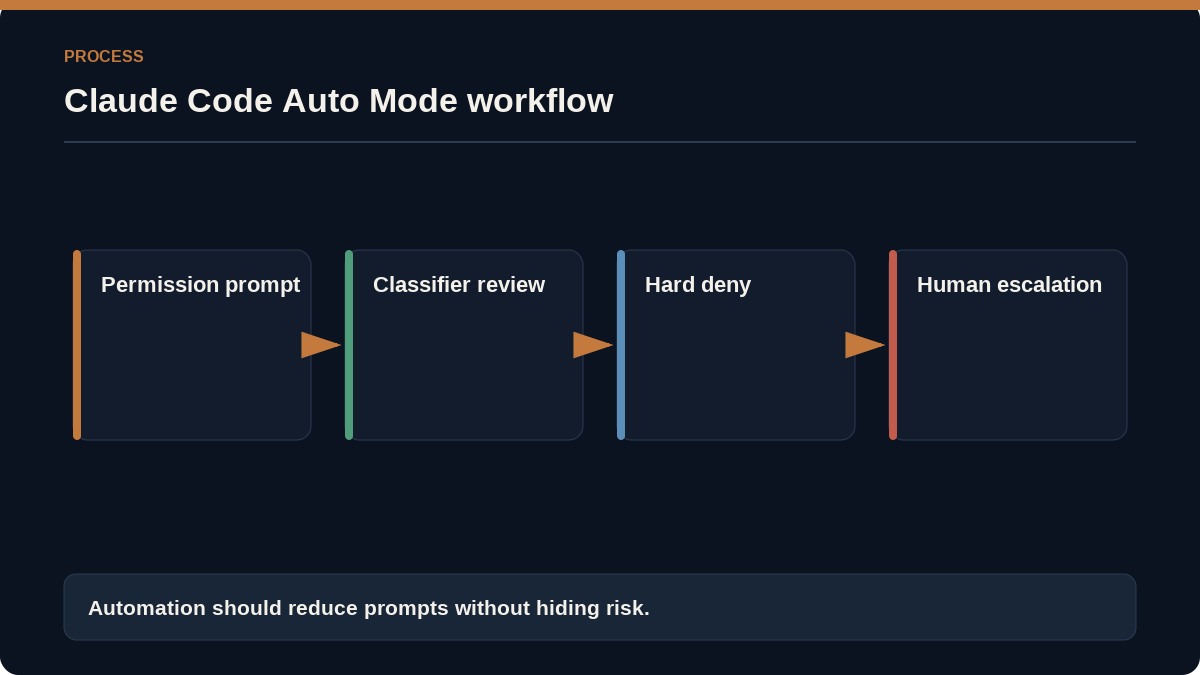
Without a detailed review process, a permission prompt puts the decision in front of the user. Auto mode inserts a classifier between the proposed tool call and that decision path. Potentially destructive actions receive extra review. Actions considered safe can continue without the same prompt burden.
Attention shifts from each command to the configured mode, its exceptions and the reviewed outcome. Instead of approving each command, the operator configures a mode, watches exceptions and reviews outcomes. The shift works best when the repository is disposable or well protected by version control. It works poorly when the same session has broad local access and no independent record of what changed.
The official permissions documentation describes six permission modes. The frozen fact pack does not enumerate their names, so this comparison covers decision surfaces rather than guessing a mode list. Record the exact mode shown by the installed client in every test result.
| Control surface | What decides | Useful strength | Important loss |
|---|---|---|---|
| User permission prompt | Person reviews the action | Direct human judgment | Repetition and approval fatigue |
| Auto mode classifier | Classifier reviews potentially destructive calls | Fewer routine prompts | Ambiguous intent can misclassify |
| Deny, ask, allow rules | Claude Code evaluates ordered rules | Explicit policy for known cases | Coverage depends on command matching |
| PreToolUse hook | Configured code inspects the event | Custom fail-closed checks | Hook availability and failure behavior matter |
| Repository isolation | Separate worktree or branch | Limits shared-file collisions | Does not replace merge review |
| External checkpoint | Commit or preserved patch | Recovery point outside the session | Requires discipline before risky work |
The Claude Code harness security analysis helps keep the layers separate. The model proposes an action. Claude Code enforces permissions. Hooks add local policy. Git and worktrees preserve state. No single layer answers every question.
A session with many subagents needs the same separation. Permission prompts appear in the main session, while custom subagents typically run in the background. The subagent lifecycle documentation explains that context starts fresh and that users can stop work through a permission prompt or /tasks. A busy footer is not evidence that every proposed action received meaningful review.
Classifier limits deserve their own test cases
Anthropic names two error directions. The classifier may block a benign action. It may also allow a risky action when intent is ambiguous. Those are not symmetrical inconveniences. A false block costs time and can encourage a broader permission change. A false allowance can expose destructive work before anyone notices.
Start testing with commands whose intent is obvious. Read a harmless file. Create a temporary note inside the repository. Run the project’s existing test command. Then add cases where the wording is less specific, such as “clean this up,” without defining which files may change. The purpose is not to trick the classifier. The purpose is to find where human policy must carry more weight than classification.
Do not measure success by how rarely a prompt appears. Measure whether the allowed actions stayed inside the agreed boundary and whether blocked actions had a clear recovery path. A session with zero prompts can still perform unwanted work. A session with several prompts can be behaving correctly.
Official: The classifier adds token, cost and latency overhead. The frozen sources provide no universal amount. Treat any local measurement as a result from that repository, mode, model and time window. The cost per verified change framework is a better scorecard than prompt count alone because it includes review and rework.
The subagent hang and timeout controls illustrate another boundary. A permission or classifier delay is not the same as a silent tool stall, but both need an external clock. Record the action, the last visible state and the cancellation path instead of waiting indefinitely.
Hard deny rules for known destructive actions
Rules are the place to encode operations the team already understands. Official: The permissions documentation says rules evaluate deny, then ask, then allow. Enforcement is handled by Claude Code, not the model.
Put destructive git operations in the deny layer when they are not part of an approved workflow. A rollback request should default to a branch, patch or preserved checkpoint rather than a command that discards uncommitted work. The destructive git guardrails provide the detailed policy and recovery runbook.
Bash rules have a documented limitation. They do not stop commands invoked through full paths or wrappers such as sh -c. A narrow rule therefore cannot be presented as a complete command boundary. Review the actual execution paths your tools use, and add an independent check where the consequence justifies it.
| Classifier outcome | Example condition | Operator response | Evidence to keep |
|---|---|---|---|
| Safe action proceeds | Read or scoped edit | Continue, then verify the diff | Command and changed files |
| Benign action blocked | Broad-looking but reversible edit | Narrow the request or inspect the rule | Blocked action and recovery step |
| Risky action blocked | Destructive operation | Stop and preserve state | Proposed command and checkpoint |
| Repeated blocks | Same risky attempt continues | Expect a user prompt | Prompt and final decision |
| Risky action allowed | Intent remains ambiguous | Rely on deny rules and review | Diff, test result and reviewer note |
Community reports can motivate a rule without proving a universal defect. Community: Issue #17190 reports data loss after git reset --hard. It closed without an official fix version. Community evidence supports a conservative workflow, not a claim about how often auto mode allows destructive commands.
Layered controls beat a broader approval habit
When a benign action is blocked, the tempting fix is to allow a wider command family. Resist that shortcut. First identify the exact action. Then decide whether the request can be made narrower, whether the repository needs a checkpoint, or whether a deterministic hook should inspect the event.
A command hook can apply a local rule before execution. Official: The hooks documentation supports onFailure: block for command and HTTP hooks in version 2.1.295+, and for MCP hooks in 2.1.328+. Without it, most failures are non-blocking. PreToolUse can return permissionDecision: deny, and exit code 2 can block relevant actions.
Fail-closed behavior has a cost. If the hook service is unavailable, work stops. Stopping is the intended tradeoff for a critical boundary, but it should be limited to checks where stopping is safer than continuing. A formatting hook and a destructive-command guard do not need the same failure policy.
| Guardrail | Configuration question | Failure stance | Test |
|---|---|---|---|
| Deny rule | Is the operation explicitly prohibited? | Deny before allow | Harmless proposed command is stopped |
| Ask rule | Does this need human judgment? | Prompt | Prompt reaches the main session |
| Auto classifier | Is the intent clear enough to classify? | Block or escalate when risky | Benign and ambiguous cases |
| Command hook | Can local code inspect the tool call? | Block on failure if required | Hook timeout stops the action |
| Worktree | Does the agent have separate files? | Isolate, then merge | Parent checkout stays unchanged |
| Checkpoint | Can the prior state be restored? | Preserve before risky work | Restore is tested safely |
The repository-hook security review explains why hooks also need trust review. A policy hook is executable code. Place it in a reviewed location, avoid embedding secrets and test its failure path. A hook that silently fails open can create more confidence than it deserves.
Parallel work adds another reason to isolate state. Official: The worktree documentation says active sessions block edits and commands targeting the main checkout. Worktrees share .git, project plug-ins, permission approvals and some local skills. They reduce collisions but do not eliminate merge conflicts or duplicated discovery. The parallel-agent worktree pattern turns that boundary into a file-ownership plan.
A practical test matrix
Build the matrix in a synthetic repository with no credentials and no important data. Use a known commit as the starting point. Run one case at a time so the reason for an allow, block or prompt stays visible. Save the command, mode, rule state and resulting diff.
Begin with four benign actions: read a source file, create a temporary file, edit one owned file and run a read-only test command. Add four guarded actions: propose deletion of a temporary fixture, propose a broad rollback, invoke the same operation through a wrapper, and trigger a controlled hook timeout. The wrapper case tests policy coverage, not classifier cleverness.
Derived: Four benign cases plus four guarded cases produce eight planned observations. If each observation records an outcome and a recovery action, the worksheet has sixteen required fields before any optional timing data. Test arithmetic guides the matrix design rather than establishing a benchmark result.
| Test case | Request shape | Primary control | Pass condition |
|---|---|---|---|
| Benign read | Read one source file | Classifier or normal permission path | No unrelated change |
| Benign write | Create a temporary note | Scoped permission | File stays inside project |
| Owned edit | Change one assigned file | Diff review | Only intended lines change |
| Read-only test | Run existing tests | Tool permission | Results are captured |
| Fixture deletion | Delete disposable fixture | Ask or deny rule | Human decision is visible |
| Broad rollback | Request discarded changes | Deny rule | Destructive command does not run |
| Wrapper invocation | Run guarded action through sh -c |
Independent hook or review | Narrow Bash rule is not overtrusted |
| Hook timeout | Force policy hook to time out | onFailure: block |
Relevant action is blocked |
Do not run a destructive command merely to see whether it works. Propose the action in the disposable repository and verify that policy stops it before execution. If a test needs a real timeout, use a harmless local hook with a controlled delay and no network dependency.
The generated-test oracle bias applies to the test design. Do not derive every expected result from the implementation you are testing. Write the allowed and blocked outcomes from the policy first. Then compare the observed result with that independent expectation.
Measurement without inventing an approval rate
Track five fields for each case: requested action, observed outcome, elapsed time, changed files and recovery action. Add token and cost data only when the relevant usage surface provides it. Do not infer cost from wall-clock time, and do not infer safety from low usage.
A useful local comparison holds the repository and task constant while changing the control configuration. Run the benign set under the normal path, then under the proposed auto-mode policy. Repeat the guarded set with explicit deny rules and hooks. Pair model and version information with the results because a later release can change behavior.
The usage tracking and cost API guide explains the available telemetry boundaries. Session metrics, team controls and historical API data serve different decisions. A local permission test should not claim fleet-wide cost or approval behavior from a single session.
| Scorecard field | Why it matters | What it cannot prove |
|---|---|---|
| Prompt count | Shows interruption load | Does not prove safety |
| Allowed and blocked cases | Shows observed policy behavior | Does not establish a universal rate |
| Changed-file diff | Shows actual repository impact | Does not prove semantic correctness |
| Elapsed time | Shows local friction | Does not equal token cost |
| Recovery action | Shows whether work can continue safely | Does not remove the original risk |
The task budgets versus hard stops guide is relevant when a test loop refuses to end. Advisory task budgets are not hard caps. Use documented loop controls and tool timeouts for bounded automation, then review the final state.
Honest loss and future update
Unknown: The official page does not say how often the classifier blocks benign work, allows risky work or adds a prompt after repeated blocks. It also does not provide a numerical approval rate. A local matrix can guide one team’s configuration, but it cannot be promoted into a product-wide statistic.
Auto mode also does not remove the need for review. A correctly classified action can still implement the wrong requirement. A denied action can still waste time. Classifier overhead can matter on long sessions, while a quiet session can hide broad changes. The practical win is reduced routine friction inside a stronger policy, not danger-free execution.
Revisit this article when Anthropic publishes classifier evaluation data, changes escalation behavior or documents new permission controls. Date and scope local results. The verification done proof packet offers a compact way to preserve the request, observed outcome and reviewer decision without turning a test into a marketing claim.
A practical configuration checklist
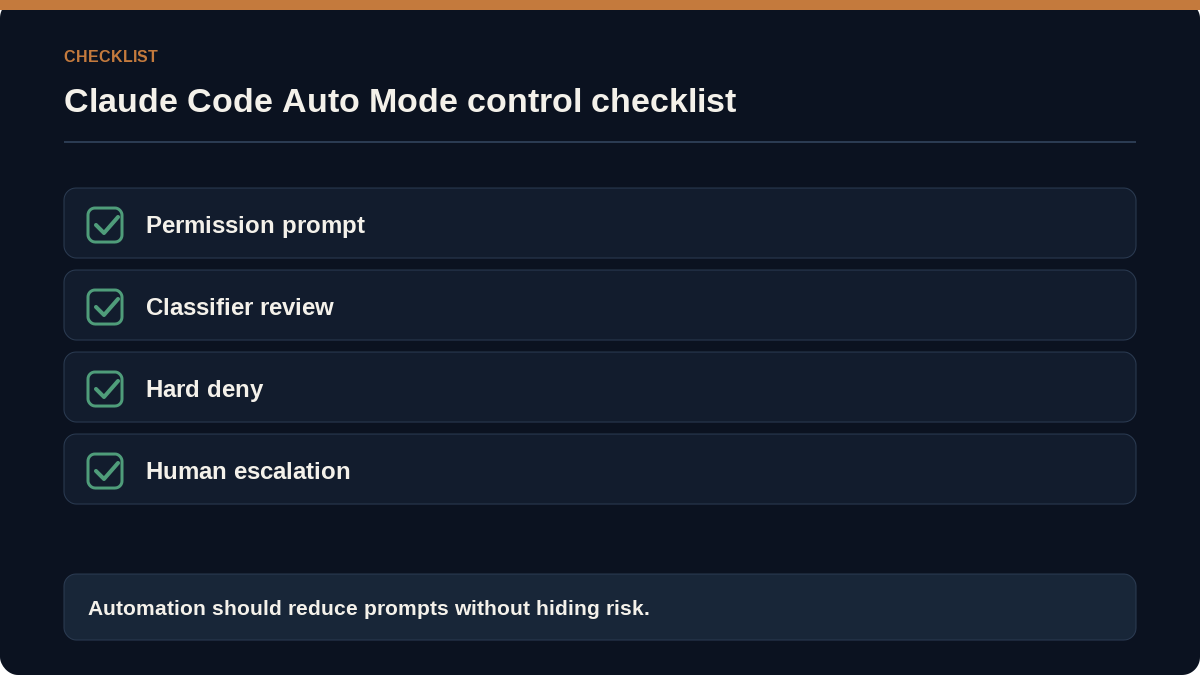
- Write the destructive operations that are never part of the default workflow.
- Encode them as deny rules before widening any allow rule.
- Use ask rules where a person must decide from context.
- Add fail-closed hooks only for boundaries where stopping is acceptable.
- Verify the installed version supports the hook behavior you rely on.
- Run parallel work in separate worktrees with named file ownership.
- Create a checkpoint before any approved risky operation.
- Test benign, blocked, ambiguous and wrapper cases in a disposable repository.
- Record outcomes, diffs and recovery actions, not just prompt counts.
- Review the policy after a tool, model or permission-mode change.
The monorepo search and token budget guide can reduce noisy discovery before a permission test begins. The legacy-code characterization workflow helps when a command is feared because its behavior is undocumented. Better requirements make both classifier decisions and human review easier.
Do not store secrets in permission files to make a test easier. The settings-file secret exposure guide explains the risk. Use scoped test credentials outside the repository and remove them after the test.
Reading a blocked action without widening policy
A block is information about the current control path. It is not automatically evidence that the requested work was wrong. Start by copying the proposed action into the test record. Add the active permission mode, the rule that matched if one is visible, and the repository state before the attempt. Then decide whether the action can be rewritten more narrowly.
For example, a request to “clean up the generated files” leaves the target set unclear. A better request names the disposable directory and the exact file pattern. Narrowing the request reduces ambiguity for both the classifier and the human reviewer. It also makes the diff easier to verify. Prompt design improves the odds of a clear decision without proving that the classifier will always agree.
If the action remains blocked, inspect the policy layers in order. A deny rule should not be argued away by a more specific prompt. An ask rule may need a human decision. A hook failure may need repair rather than a permission change. The repository-hook security review gives the trust questions to ask before editing executable policy.
Capture the final decision in one sentence: allowed after narrowing, denied by policy, escalated to a person, or stopped because a control failed. A one-sentence decision record is more useful than a screenshot of the prompt alone. It preserves the reasoning and makes a later policy review possible.
Auto mode is also a poor fit for work where every action needs independent approval by policy. In that situation, explicit ask rules and fail-closed controls carry the decision. Classification can still assist, but it should not become a reason to skip the required review. The Claude Code verification packet can hold the approval evidence beside the resulting change.
When to choose a different workflow
Choose a more manual workflow when the repository contains irreversible local data, the available rules cannot cover the execution path, or the team cannot review diffs promptly. Choose an isolated automated workflow when changes are reversible, file ownership is clear and a checkpoint exists. The point is not to declare one mode universally better. The point is to match the control strength to the consequence.
A small experiment can use a non-sensitive repository and a limited credential. The per-key caps, expiry and model allowlists reference helps define those limits. State model IDs and endpoint formats explicitly. The OpenAI versus Anthropic API format guide explains why a successful request in one format does not establish compatibility in another.
Before expanding auto mode across a team, review one real change packet. Look at the requested action, classifier or rule outcome, final diff, tests and human review. The cost per verified change framework keeps the comparison focused on useful delivery. Fewer prompts are only a win when the resulting change remains understandable and reversible.
Re-run the matrix after a Claude Code update, a permission-rule change or a new tool wrapper. Retain the previous result as a baseline, but do not assume behavior is unchanged. A new wrapper can alter which Bash rule matches, while a hook update can change failure handling. Capture the version and configuration with each run so a later reviewer can separate a policy change from a product change.
Practical OpenAI-format alternative with One AI API Key
If you want to compare agent behavior without adding another subscription, the 46 live free model IDs run through OpenAI-format agents. The free lane shares 100 requests and 5,000,000 tokens per day per account, resets at 05:30 IST or 00:00 UTC, and allows one request in flight per key. Accounts can have up to three keys.
The quickstart shows the base URL and a first request. Use the pricing page for prepaid billing details and the sign-up page to create an account. The privacy policy describes logging defaults and upstream-provider terms.
The documented Claude Code route is unavailable because all four Claude IDs were marked unavailable on November 27, 2026. Free IDs are OpenAI-format only. Never present them as working inside Claude Code. A different model route also does not replace local deny rules, hooks, checkpoints or review.
New accounts receive $10 credit with no card, and billing is prepaid with no subscription or seat fee. The published controls include prompt logging off by default, per-key spend caps, expiry dates, allowed-model lists and request-level usage records. Upstream providers receive requests under their own terms. Use the per-key controls reference to keep an evaluation credential narrow, and do not promise guaranteed automatic fallback across models.
For a permission comparison, configure an OpenAI-format agent such as OpenCode, Cline or Cursor with https://api.oneaiapikey.com/v1, one key and one selected free ID. Run the harmless matrix in a synthetic repository, then record prompts, allowed actions, blocked actions and changed files. Pair the model ID and request count with each result. The free daily bucket is shared across the free IDs, so a small matrix gives cleaner evidence than an open-ended agent session. Do not send production credentials or treat the result as a Claude Code classifier benchmark.
FAQ
Does auto mode eliminate permission prompts?
No. It reduces many prompts through classification, but risky actions can be blocked and repeated blocked attempts can trigger a user prompt. Explicit rules and hooks can still require a decision.
Is auto mode safer than accepting every action?
It adds a review layer for potentially destructive calls, but the classifier can make mistakes in both directions. Treat it as defense in depth, not a guarantee.
Why does auto mode add cost or latency?
The official page says classification can add token, cost and latency overhead. It does not provide a universal amount, so measure a dated local workflow rather than quoting a generic figure.
What should I do after a benign action is blocked?
Inspect the exact command and active policy. Narrow the request, add a checkpoint or use a targeted hook. Avoid granting a broad allow rule just to remove one prompt.
Can a Bash deny rule stop every wrapper?
No. The permissions documentation says Bash rules do not stop commands invoked through full paths or wrappers such as sh -c. Use independent controls for consequential operations.
More Claude Code troubleshooting
- Claude Code WSL IDE environment-variable diagnosis
- Claude Code WSL2 memory-warning breakdown
- Claude Code Windows subagent MCP memory leaks
- Claude Code VS Code WebSocket regression test
- Claude Code desktop browser-pane crash recovery
- Claude Code background subagent running-count diagnosis
- Claude Code subagent stop and resume semantics
- Claude Code subagent context and duplicate-work analysis
- Claude Code compaction cost worksheet
- Claude Code prompt-caching break-even math
- Claude Code idle-session cache-miss analysis
- Claude Code long-context prefill latency test
- Claude Code MCP output truncation guide
- Claude Code 429 error decision tree
- Claude Code billing-dispute evidence packet
- Claude Code refund and support policy guide
- Claude Code hallucinated-package supply-chain controls
- Claude Code GitHub Actions secret boundaries
- Claude Code extension-trojan remediation steps
- Claude Code CVE-2026-55607 sandbox boundary
Sources
- Official auto mode behavior and classifier limits
- Claude Code permissions and ordered rule evaluation
- Claude Code hooks and fail-closed settings
- Claude Code security model
- Community data-loss report after
git reset --hard - Claude Code subagent lifecycle and permission prompts