Direct answer
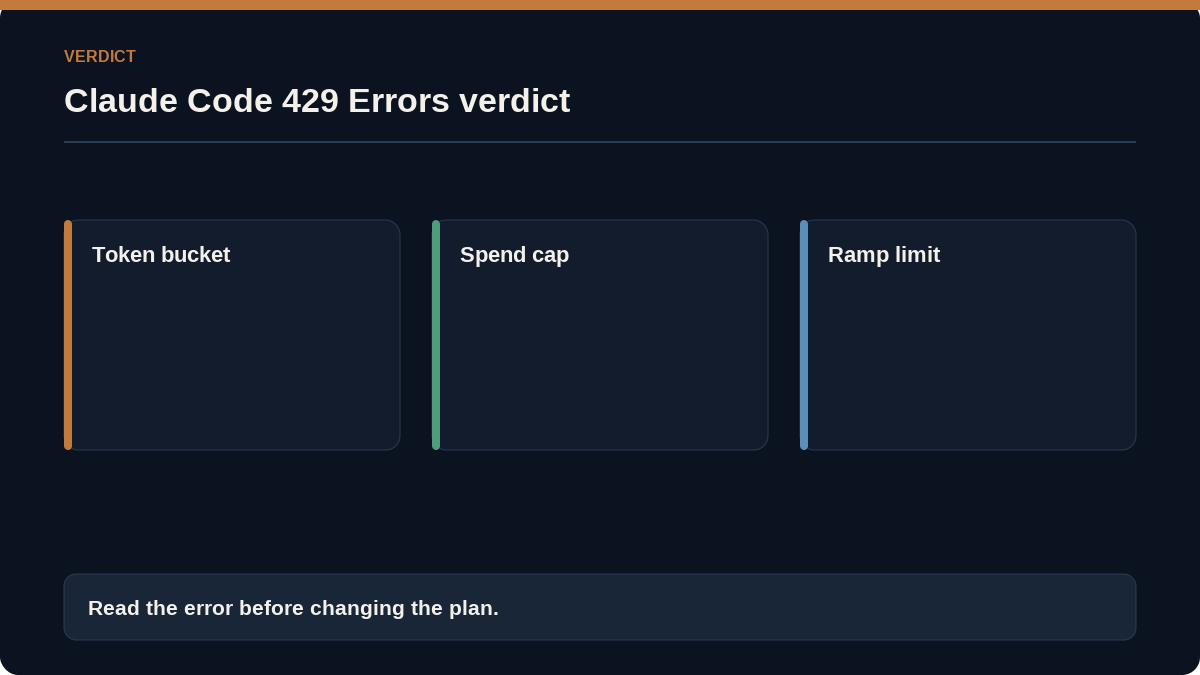
A 429 means a request was limited, but it does not identify one universal cause. Check the error type, retry-after header and account state before retrying. Standard limits use a token bucket that replenishes continuously; standard and ramp limits can return retry-after. A monthly spend-cap 429 has no retry-after and pauses usage until the next month at 00:00 UTC.
Do not assume every Claude Code 429 is a five-hour plan window. Avoid retrying a monthly spend cap blindly. Capture the surface, plan or API account, timestamp, request scope and exact error, then follow the branch that matches the evidence.
Official: the API mechanics come from Anthropic’s rate-limit documentation. Community: issue #29579 reports a Max account showing 16 percent usage while requests immediately returned a rate-limit error. This report does not prove a universal bug.
Why one status code needs a decision tree
HTTP 429 tells the caller that a request was limited. It does not say whether the boundary was a short burst allowance, a monthly spend cap, a ramp limit or something else. Retrying every case the same way can waste time or hammer a boundary that will not move soon.
The first useful question is where the request ran. Claude Code can appear as an interactive product surface or through an API-based setup. The supplied official API documentation explains API limit mechanics; it should not be silently treated as a complete description of every subscription interface.
Record the account and route before changing anything. A Max subscription report, an API workspace and a gateway key can show different usage views. The usage tracking and historical cost API guide explains why those telemetry surfaces have different latency and granularity.
A 429 also differs from a model stop reason. Official: max_tokens means the output limit was reached, while model_context_window_exceeded means context filled. end_turn means natural completion. An access limit is not the same event as generation stopping.
The task budgets versus hard stops guide helps with the surrounding workflow. A local turn or budget stop and an API rate limit need separate evidence and recovery.
Token-bucket limits can bind before a usage bar looks full
Official: standard limits use a token bucket that replenishes continuously. A token bucket is an allowance that refills over time. Bursts can consume available capacity faster than it returns, even when a longer-term usage display still shows room.
That mechanism explains why “usage looks low” and “request was limited” can coexist. The displayed percentage may describe a different window or aggregate than the bucket controlling the immediate request.
Do not infer the exact bucket size or refill rate from a screenshot. The supplied sources do not provide one universal value for every account and model. Capture the error and let the documented header or account state guide the retry.
Derived: in issue #29579, the reported display showed 16 percent usage. Subtracting that from 100 percent leaves 84 percentage points of displayed usage. That arithmetic does not prove 84 percent of immediate request capacity was available, because the display and the limiting bucket may measure different things.
| Signal | What it supports | What remains unknown |
|---|---|---|
| Low shown usage | Displayed allowance was not near its limit | Immediate bucket capacity |
| Immediate 429 | A limit blocked the request | Which limit without more evidence |
retry-after |
Documented retry timing for some limits | Exact future workload capacity |
| Continuous refill | Standard bucket replenishes over time | One universal refill rate |
The Claude Code five-hour and weekly limit guide covers subscription-window questions. Leave that subject separate from the API token-bucket mechanics documented here.
Monthly spend caps are a different branch
Official: a monthly spend-cap 429 has no retry-after header and pauses usage until the next month at 00:00 UTC. That is a calendar boundary, not a continuously refilling bucket.
The practical response is to stop repeated requests. A retry loop cannot make the month turn over, and each attempt adds noise to the incident record. Preserve the task state and choose work that does not depend on the paused route.
Check whether a spend limit was configured intentionally. Official: Anthropic documents spend limits as well as rate limits. Teams can set spend limits through admin settings or workspaces. The owner may need to review the account configuration rather than wait for a model response.
| Monthly cap evidence | Interpretation | Action |
|---|---|---|
| Explicit spend-cap error | Monthly boundary applies | Stop new requests and record state |
No retry-after |
Consistent with the documented cap case | Confirm error type before waiting |
| Next reset shown | Account-specific display may help | Verify against official 00:00 UTC rule |
| Configured spend limit | Administrative boundary exists | Review owner and intended scope |
Do not remove a spend cap just to finish a task without authorization. The billing-dispute evidence packet is useful if the charge or limit later needs review, but a 429 alone does not prove a billing error.
The refund and support policy guide explains why refunds depend on policy and evidence. An access interruption is not automatically a refundable charge.
Ramp limits need their own classification
Official: standard and ramp limits can return retry-after. The supplied fact pack names ramp limits as a distinct category but does not provide one universal ramp schedule, threshold or duration for every account.
A ramp limit should therefore be handled from the actual error and account state. Do not invent a fixed waiting period or claim that every new account follows the same ramp.
When the error identifies a ramp limit and supplies retry-after, preserve both. The header gives a documented retry signal for that case. It still does not guarantee that the next request will succeed if other conditions changed.
| Limit type | Documented timing signal | Safe default |
|---|---|---|
| Standard token bucket | Can return retry-after; refills continuously |
Honor the header and reduce burst |
| Ramp limit | Can return retry-after |
Confirm category and account state |
| Monthly spend cap | No retry-after; resets next month at 00:00 UTC |
Stop retries and checkpoint |
The distinction matters for automation. A worker that treats all 429 responses as temporary may retry a monthly cap indefinitely. A worker that treats all 429 responses as permanent may abandon a standard bucket that would refill shortly.
Classify first, then choose the retry policy. The Agent SDK loop controls can bound local execution, but they do not change the remote limit.
A decision tree for the next 429
Start with the exact error. Save the status, error type, message, request identifier if present, and response headers. Redact credentials before storing the record.
Next, check for retry-after. If the error identifies a standard or ramp limit and the header is present, honor it. If the error identifies a monthly spend cap, do not expect the header and do not retry until the documented reset.
Then inspect account state. Record the plan or API account, workspace, configured spend limit and usage display at the time of failure. A screenshot taken after the bucket refills can miss the condition that caused the error.
Finally, check the request shape. A burst of parallel requests can exhaust available capacity faster than sequential work. The long-context latency benchmark includes retries as a separate stage because they change both timing and usage.
| Decision | Yes branch | No branch |
|---|---|---|
| Error explicitly names a monthly spend cap? | Stop until next month at 00:00 UTC | Inspect other limit types |
retry-after is present? |
Honor it for the identified standard or ramp case | Capture account state and error text |
| Error names a standard token bucket? | Reduce burst and allow continuous refill | Check ramp or other account controls |
| Error names a ramp limit? | Follow its retry signal and account state | Escalate with the evidence packet |
| Cause remains unclear? | Pause automated retries and gather evidence | Continue only within known bounds |
The subagent hang and timeout controls provide a related discipline. A silent agent needs an external clock; a limited request needs an explicit classification instead of an endless wait.
Capture evidence before changing the plan
A useful incident record starts at the moment of failure. Save the timestamp, client version, model, route, account type and task scope. Then attach the exact error and headers with secrets removed.
Usage evidence needs its own timestamp. /usage can show session metrics and plan bars, while the historical Usage and Cost API typically has data within five minutes of request completion and provides daily cost buckets. Neither should be described as a live byte-level trace.
The usage tracking and cost API guide explains those boundaries. If the historical data has not arrived, mark the interval incomplete rather than assuming zero usage.
| Evidence field | Why it matters |
|---|---|
| Timestamp and time zone | Aligns error, usage and task events |
| Client and route | Separates interface from API behavior |
| Account and workspace | Identifies the relevant boundary |
| Model and request scope | Shows what the limited request attempted |
| Error type and message | Distinguishes cap, bucket and ramp cases |
| Response headers | Preserves retry-after when present |
| Usage display | Records the visible state at failure |
| Retry attempts | Prevents hidden retry storms |
Store the task checkpoint too. The context-portable migration guide explains how written state survives a client change. A 429 should interrupt access, not erase the work.
If the agent produced partial output, preserve it with the stop reason. The MCP output truncation guide helps keep the decisive error visible without dumping an entire log into the next prompt.
Retry with a policy, not a reflex
For a standard or ramp limit with retry-after, wait at least the indicated interval before retrying. Keep the request scope unchanged so the retry tests the limit rather than a different task.
For a monthly spend cap, stop. The documented reset is the next month at 00:00 UTC. Repeated retries before then do not restore access.
When the cause is unclear, pause automated retries and gather evidence. A single controlled retry after checking account state may be reasonable, but an unbounded loop is not a diagnostic method.
Backoff means increasing the wait between retries. Jitter adds variation so many clients do not retry at the same moment. Those are general engineering practices, not a universal Anthropic schedule in the supplied fact pack. Do not present invented intervals as official guidance.
| Retry case | Policy |
|---|---|
| Standard bucket with header | Honor retry-after, reduce burst |
| Ramp limit with header | Honor header, confirm account state |
| Monthly spend cap | No retry until next month at 00:00 UTC |
| Unknown 429 | Capture evidence, pause automation |
| Repeated 429 after valid wait | Escalate with request and account record |
The task budget and hard-stop guide adds a local bound. max_turns or a tool timeout can stop a workflow, but they do not replenish a remote bucket.
A retry can also consume additional input and output. The prompt-caching economics guide explains why repeated context may change cost. Count retries as separate requests in the incident record.
Reduce burst without weakening the task
Parallel requests can be useful, but a burst may hit available capacity before continuous refill catches up. Start with a narrower concurrency level and preserve independent work that can wait.
Read-only subagent exploration can run concurrently in the documented Agent SDK loop, while state-modifying tools execute sequentially. Official: that distinction concerns tool execution, not a guarantee that every parallel request avoids rate limits.
The parallel-agent worktree pattern reduces shared-file collisions. It does not create more account capacity. Treat isolation and quota as separate design problems.
A queue with a clear owner can serialize requests when a bucket is strained. The queue should expose which task is waiting, which request was limited and when the next attempt is allowed. Otherwise, the workflow merely hides the retry storm.
| Work shape | Better response to a 429 |
|---|---|
| Burst of independent reads | Reduce concurrency and queue remaining work |
| Long agent loop | Checkpoint and bound turns |
| Monthly cap reached | Stop and schedule after reset |
| Unclear account state | Pause and capture evidence |
| Repeated failure after valid wait | Escalate with a complete packet |
The background subagent running-count diagnosis warns that a UI count can lag completion. Do not launch duplicate agents because a counter still looks active after a limit event.
A worked diagnosis using the community report
Issue #29579 reports a Max account showing 16 percent usage while requests immediately returned a rate-limit error. Community: the issue remained open at the research cutoff with no maintainer confirmation or fix version.
The report supports a narrow conclusion: at least one user observed low shown usage alongside an immediate 429. It does not establish that the display was wrong, that every Max account behaves this way, or that a specific bug caused it.
Derived: the displayed unused portion was 100 - 16 = 84 percent. That number cannot be used as an immediate request allowance without knowing which limit controlled the request. The limiting bucket may operate on a shorter timescale or different unit.
A careful follow-up asks for the timestamp, exact error, headers, request shape, account state and usage window. Those facts can separate a burst limit from a spend control or a ramp case.
| Report element | What it establishes | What it does not establish |
|---|---|---|
| Max account | Subscription context was reported | API bucket configuration |
| 16 percent shown usage | A display value was reported | Immediate remaining capacity |
| Immediate 429 | Access was limited | Universal defect or fix version |
| Open issue | No confirmed resolution in the packet | That no user recovered |
The billing-dispute evidence packet uses the same standard. Reconstruct events before declaring a charge or account behavior erroneous.
Separate quota from latency and correctness
A 429 can add waiting, but it is not the only source of delay. Prompt processing, output decoding, tool execution and client overhead can all contribute. The long-context prefill test keeps those stages separate.
A retry after a limit also changes the experiment. If one request succeeds and another waits, the combined elapsed time is not a clean model-latency measurement. Record attempts separately.
Correctness needs its own check. Official: a final text-only response can end an Agent SDK run, but it does not prove acceptance. The proof-of-work packet keeps changed files, tests and external-state checks with the result.
The generated-test oracle bias guide adds a second warning. A passing test after recovery can still inherit an implementation mistake. Recovery restores access; verification establishes useful work.
| Question after recovery | Evidence |
|---|---|
| Did access return? | Successful request under known conditions |
| Did the task continue safely? | Checkpoint and current diff |
| Did retries add usage? | Separate attempt records |
| Did the result meet acceptance? | Tests and independent review |
| Is the limit likely to recur? | Request shape and account state |
The cost per verified change framework keeps the accepted result in the denominator. A recovered request with no accepted change is still operational cost.
Build a team runbook for repeated 429s
A runbook should make the first response predictable. Name the person who can inspect spend limits, the person who owns the affected workload and the place where evidence is stored.
First responders capture the error and stop unbounded retries. Workload owners checkpoint the task. Account owners review plan, workspace and spend-limit state. Only then should the team choose a retry or escalation path.
Keep subscription and API evidence separate. A plan usage bar, an API workspace report and a gateway key record may all be relevant, but they are not interchangeable.
| Role | Responsibility |
|---|---|
| First responder | Capture error, headers and timestamp |
| Workload owner | Checkpoint and classify request shape |
| Account owner | Inspect plan, workspace and spend limits |
| Reviewer | Verify recovered work independently |
| Incident owner | Decide retry, pause or escalation |
The team seat management policy matters when access is named-user based. Credentials cannot be shared and unused usage cannot be transferred. A workaround that shares a seat is not a valid quota strategy.
The Claude Code settings-file secret exposure guide is relevant to evidence handling. Redact keys and tokens from logs before sharing the packet.
Escalate with a packet that can be checked
If the error remains unclear or repeats after a valid wait, send a concise packet. Include the exact error, headers, account context, request scope, usage state and retry timeline. Remove secrets and unrelated personal data.
Avoid a message that only says “429 again.” It forces support to reconstruct the event. A precise packet lets the reviewer compare the claimed limit with the account state.
The billing-dispute evidence packet provides a transaction-level structure. A 429 is not itself a charge, but the surrounding usage may later need reconciliation.
The refund and support policy guide explains the separate question of eligibility. Keep access diagnosis and refund requests distinct.
| Packet item | Ready when |
|---|---|
| Error and headers | Exact text is saved with secrets removed |
| Account context | Plan or API account and workspace are named |
| Usage state | Timestamp and window are recorded |
| Request shape | Concurrency and task scope are described |
| Retry timeline | Each attempt and wait is listed |
| Task state | Checkpoint and partial output are attached |
The usage tracking and cost API guide explains why historical cost data may arrive later. Mark pending data instead of presenting an incomplete report as final.
Keep the retry timeline in chronological order. A later screenshot can make an earlier burst disappear from view, while a compressed summary can hide how many attempts happened. The timeline should show each request, the observed response and the wait before the next attempt.
That record also helps the workload owner. If a limit repeatedly interrupts the same parallel search pattern, the fix may be a queue or narrower batch rather than a plan change. Evidence turns a recurring interruption into a specific engineering decision.
The honest loss
Correct classification can prevent wasted retries and preserve useful work. Honoring retry-after for a standard or ramp limit can restore progress at the documented time. Stopping a monthly spend-cap retry loop avoids pointless traffic.
The loss is that a 429 can interrupt a task before a clean boundary, and the visible usage display may not explain the immediate limit. Retries add latency and can add usage. A recovered run may still need review or rework.
The supplied evidence does not provide one universal bucket size, ramp schedule or Claude Code subscription-limit mapping. Issue #29579 is an unresolved community report, not a confirmed defect rate. Future updates should revisit official rate-limit documentation and publish repeatable traces with account type, headers and request shape.
Do not replace one assumption with another. “Every 429 is the five-hour window” is unsupported, and so is “low displayed usage proves a bug.” The error, header and account state decide the branch.
Practical response: test an OpenAI-format fallback lane
If you want a separate route for synthetic evaluation, use the same task and record each provider’s limit behavior. One AI API Key lists 46 live free model IDs for OpenAI-format agents such as OpenCode, Cline or Cursor. The quickstart uses https://api.oneaiapikey.com/v1, and the pricing page explains prepaid billing.
Those free IDs do not work inside Claude Code. The documented Claude Code route uses the Anthropic Messages format, but all four Claude IDs were unavailable on 2026-11-27. Keep the active test on an OpenAI-format client. The OpenAI versus Anthropic format guide explains the compatibility boundary.
The free lane shares 100 requests and 5,000,000 tokens per day per account, resets at 05:30 IST or 00:00 UTC, and allows one request in flight per key. Check the model catalogue for availability. The cost calculator can estimate a separate budget, not predict an Anthropic 429.
Use a disposable key with expiry and a narrow allowlist from the API reference, review the privacy and retention policy, and create the account through sign-up. Send synthetic requests, capture errors without secrets and revoke the key afterward. Gateway limits are their own system, so compare observed behavior rather than promising identical quotas or fallback.
FAQ
Does every Claude Code 429 mean the five-hour window is exhausted?
No. The status code can represent different limits. Capture the exact error, headers and account state before assigning a cause.
What does retry-after mean?
For documented standard and ramp limits, it provides retry timing. A monthly spend-cap 429 has no retry-after and waits until the next month at 00:00 UTC.
Can a token bucket limit a request when usage looks low?
Yes. A continuously replenishing bucket can constrain a burst differently from a longer-term usage display. Low shown usage does not prove immediate capacity.
Should I retry a monthly spend-cap 429?
No. Stop automated retries and checkpoint the task. The documented pause lasts until the next month at 00:00 UTC.
Does issue #29579 prove a universal Claude Code bug?
No. It is an open community report without maintainer confirmation or a fix version in the supplied evidence.
More Claude Code troubleshooting
- Claude Code WSL IDE environment-variable diagnosis
- Claude Code WSL2 memory-warning breakdown
- Claude Code Windows subagent MCP memory leaks
- Claude Code VS Code WebSocket regression test
- Claude Code desktop browser-pane crash recovery
- Claude Code subagent stop and resume semantics
- Claude Code subagent context and duplicate-work analysis
- Claude Code compaction cost worksheet
- Claude Code idle-session cache-miss analysis
- Claude Code hallucinated-package supply-chain controls
- Claude Code GitHub Actions secret boundaries
- Claude Code repository-hook security review
- Claude Code extension-trojan remediation steps
- Claude Code CVE-2026-55607 sandbox boundary
- Claude Code auto-mode classifier limitations
- Claude Code destructive git guardrails
- Claude Code monorepo search and token budget
- Claude Code legacy-code characterization workflow