Direct answer
Verified Ultra accounts do not have the standard five-hour cap. A weekly limit still applies, and usage across claude.ai, Claude Code and Claude Desktop counts toward the same limit. Pro and Max use the standard five-hour window, which starts with the first message and resets five hours later. Ultra costs $200 per month, so the exception is valuable only when long sessions would otherwise interrupt work often enough to justify the plan. Ultra is not unlimited.
Why the exception matters
A five-hour cap is not a minor detail for a developer who uses an agent through long implementation sessions. The cap can arrive during a multi-file change, a difficult debugging run or a review that depends on repeated tool calls. When that happens, the next task is not always “wait five hours.” It may be “save state, switch work and return later.”
The exception changes that specific constraint for verified Ultra accounts. It does not remove every limit, and it does not make the weekly allowance infinite. The practical question is whether the five-hour boundary is the main problem in your workflow. If it is, Ultra may fit. If weekly exhaustion, cost or account access is the real issue, the five-hour exception may not solve it.
The Claude Code five-hour and weekly limits article explains the standard mechanics. This article focuses on the exception and the plan decision around it.
The standard five-hour window
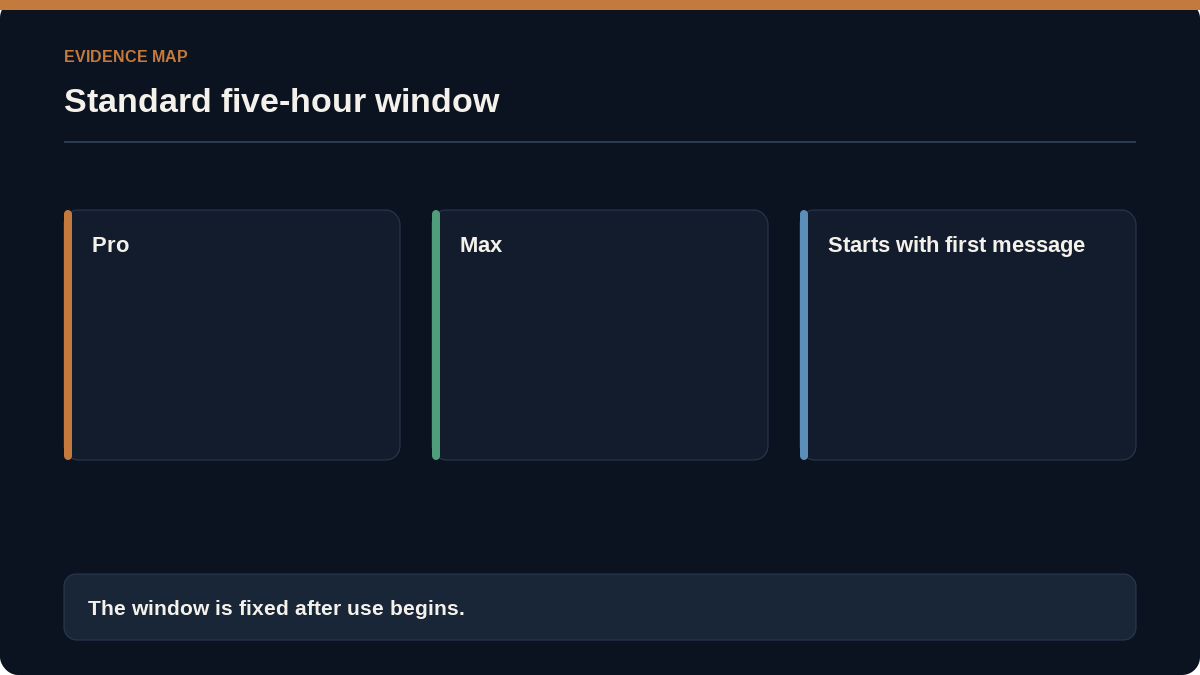
Official: The standard window starts when the user sends the first message. It resets five hours later. It is not a continuously rolling quota that moves forward with every request. That distinction matters when planning a session: the reset time is tied to the start of use, not to the last message.
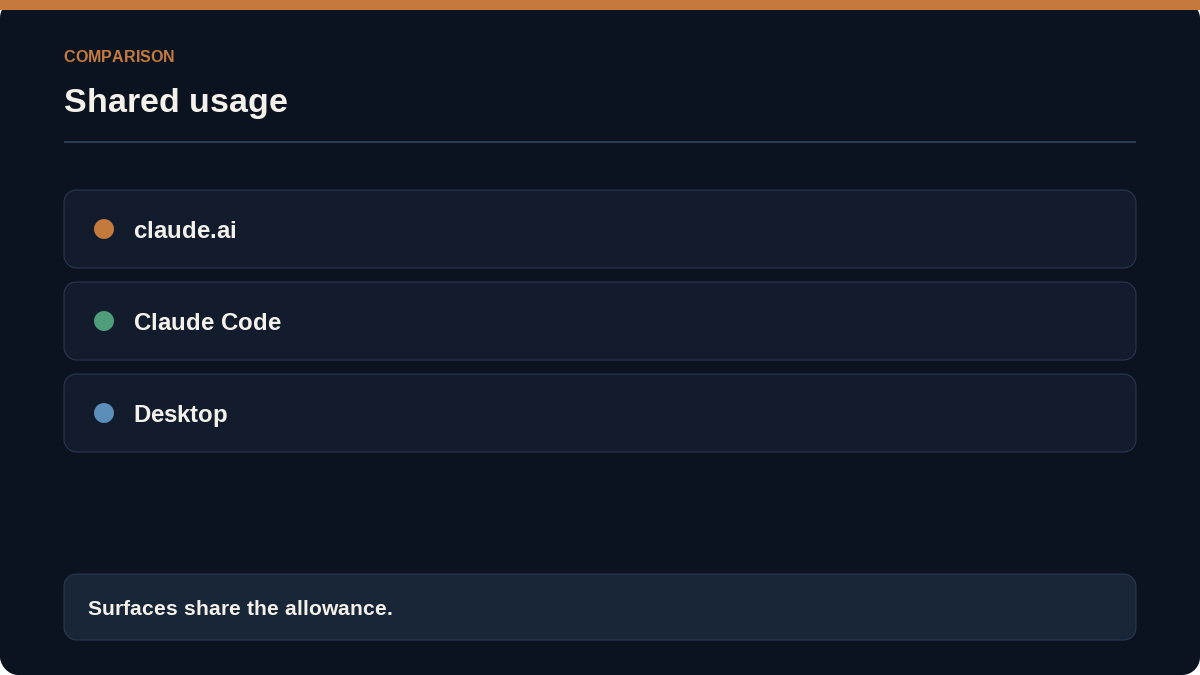
Usage across claude.ai, Claude Code and Claude Desktop counts toward the same limit. A developer who spends part of the allowance in the web chat has less available for the coding agent. The products are separate surfaces, but the usage pool is shared.
| Limit feature | Standard paid-plan behavior | Planning consequence |
|---|---|---|
| Window start | First message | The clock begins with use |
| Window length | Five hours | Plan long sessions around the boundary |
| Reset behavior | Resets five hours after the window starts | It is not a rolling five-hour balance |
| Shared usage | claude.ai, Claude Code and Desktop | Chat activity can reduce coding capacity |
| Weekly limit | Fixed reset assigned to the account | A session reset does not erase the weekly boundary |
The standard window is useful because it is predictable once it starts. The loss is that a fixed window can cut across a task that is not ready to stop. That is the specific problem the Ultra exception addresses.
The verified Ultra exception
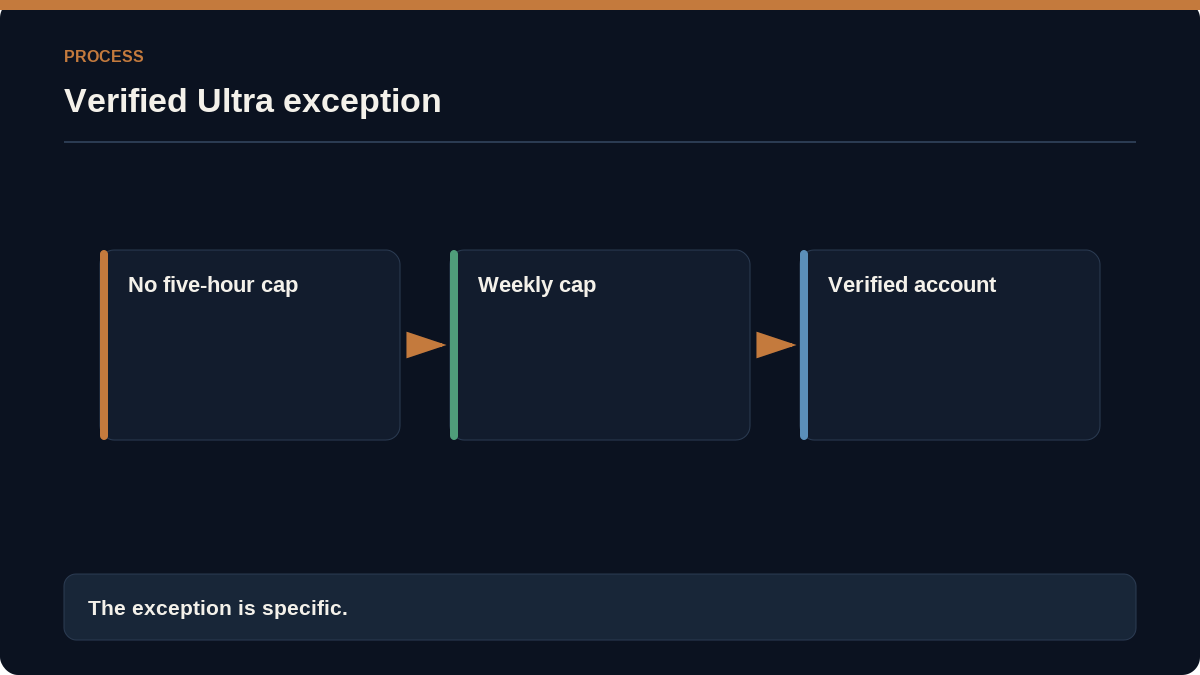
Official: Verified Ultra accounts do not have the standard five-hour cap. The word “verified” is part of the rule. The fact pack does not describe the verification process in detail, so this article does not invent one.
The exception is narrow. It removes the standard five-hour cap for the eligible account. It does not remove the weekly limit. It does not make usage unlimited. It does not change the fact that Claude products share usage.
| Ultra question | Answer supported by the fact pack |
|---|---|
| Does a verified Ultra account have the standard five-hour cap? | No |
| Does a weekly limit still apply? | Yes |
| Is Ultra unlimited? | No |
| Does usage remain shared across Claude products? | Yes |
| What is the Ultra monthly price? | $200 |
| Is the verification method detailed here? | Unknown |
That last row is important. A reader should not infer a verification checklist from the exception. If account status is unclear, use the official account guidance rather than a third-party workaround.
Weekly limits and shared usage remain
The weekly limit resets at a fixed time assigned to the account. The exact reset time and allowance are account-specific in this fact pack. A developer who plans around the five-hour exception still needs to know the weekly boundary.
Shared usage makes the weekly boundary easier to underestimate. A morning in claude.ai, an afternoon in Claude Code and a review in Claude Desktop all draw from the same allowance. The Ultra exception does not create three separate pools. It changes one limit while leaving the shared weekly structure in place.
A useful planning habit is to record which product consumed the allowance before blaming the coding agent. If the weekly limit arrived after heavy web usage, the five-hour exception was not the relevant failure. If the five-hour window interrupted a long coding session on a standard plan, the exception is directly relevant.
The Ultra API credits versus Claude Code usage article explains another common mix-up: monthly API credits are not the same thing as interactive Claude Code usage credits.
Who should choose Ultra
Ultra makes sense when the five-hour cap is a recurring operational constraint and the weekly allowance fits the workload. It makes less sense when the main problem is occasional use, unpredictable review quality or a need for many model families.
| Workload | Five-hour exception value | Weekly-limit exposure | Practical fit |
|---|---|---|---|
| Long daily coding sessions | High if sessions cross the standard window | Still present | Ultra may fit |
| Short, occasional coding tasks | Low | Usually not the main issue | A lower plan may fit |
| Heavy web chat plus coding | Helpful for long Code sessions, but shared usage remains | Higher because products share the pool | Measure total usage first |
| API-heavy automation | Does not change API billing mechanics | Separate billing route | Compare API costs directly |
| Multi-model experimentation | Does not add model-family portability | Provider quota still applies | Test a multi-model route |
Derived: Ultra costs $100 more per month than Max. The formula is $200 − $100 = $100, using the official plan prices. That difference is the price of the plan change, not a measured productivity return. Whether it pays back depends on the value of avoiding five-hour interruptions and on the weekly allowance remaining useful.
The Claude Code cost per verified change article provides a better value model than plan price alone. Count accepted changes, review time and rework. A plan that permits longer sessions can still produce poor value if the output needs heavy correction.

A worked planning example
Consider a developer whose coding session begins with a first message and continues beyond the standard five-hour boundary. On Pro or Max, the window resets five hours after that first message. The developer may need to save state and return later if the limit is reached.
On a verified Ultra account, that specific five-hour cap does not apply. The developer can continue subject to the weekly limit and other service conditions. The win is fewer interruptions caused by that window. The loss is that a long session can still consume a large share of the shared weekly allowance.
Now consider a different developer who hits the weekly limit after using claude.ai, Claude Code and Desktop. Ultra’s five-hour exception does not create more weekly capacity. Upgrading for the exception alone may miss the actual problem. The developer needs to measure shared usage and plan around the fixed weekly reset.
| Planning question | Standard plan reading | Verified Ultra reading |
|---|---|---|
| What starts the standard window? | First message | Not applicable to the standard five-hour cap |
| What happens five hours later? | Standard window resets | No standard five-hour cap |
| What remains? | Weekly limit and shared usage | Weekly limit and shared usage |
| What should be tracked? | Window start and weekly use | Weekly use across all products |
| What does the plan price prove? | Access to the included plan | Access plus the documented exception, not unlimited use |
This example uses the published mechanics, not an invented usage measurement. It shows why the exception should be matched to the interruption a developer actually experiences.
Credits, overage and spending controls
Ultra includes $200 in monthly API credits. Those credits apply when a user runs claude -p or the Agent SDK with an API key from the linked Console organization. They do not cover interactive Claude Code sessions. That distinction matters when a developer tries to treat the plan as one combined budget.
Official: Users can purchase usage credits or upgrade for more access. Paid-plan controls include a monthly spending cap, usage alerts and auto-reload. It is therefore wrong to say Claude Code has no spending controls. The controls exist, but they need to be configured and understood.
| Billing route | What pays for it | What not to assume |
|---|---|---|
| Ultra subscription | Plan access at $200 per month | It is not a token package |
| Monthly API credits | Eligible claude -p or Agent SDK usage with the linked API key |
They do not fund interactive Code sessions |
| Interactive usage credits | Purchased usage credits at standard API rates | They are separate from the monthly API credit benefit |
| Spending controls | Cap, alerts and auto-reload settings | A cap is not a forecast of normal usage |
The Ultra API credits versus Claude Code budget article works through the two balances. The practical rule is to track subscription, API credits and interactive usage separately.
Read account usage before changing plans
A plan upgrade is easier to justify when the interruption is visible. Record the start of the standard window, the fixed weekly reset, the products used and the tasks that stopped. Do not rely on a general feeling that the service has become slower or stricter. Usage limits and response quality are different problems.
For each interrupted session, write down what was happening and whether the five-hour boundary or the weekly limit stopped it. If the session ended because the model produced poor code, Ultra’s exception does not fix the output. If it ended because a long task crossed the standard window, the exception is directly relevant.
| Signal to record | What it helps distinguish |
|---|---|
| Standard window start and reset | Five-hour interruption versus weekly exhaustion |
| Weekly reset assigned to the account | Whether the task collided with the fixed weekly boundary |
| Usage in claude.ai, Code and Desktop | Whether shared product usage reduced coding capacity |
| Task state at interruption | How much context had to be rebuilt |
| Accepted changes from the session | Whether longer access produced verified value |
| Review and rework time | Whether the plan change improved the whole workflow |
The Claude Code cost per verified change article explains why accepted work matters more than session length. A longer session can still be expensive if it generates more review work. The agent-team token overhead article adds another caution: some workflows consume much more context than a standard session, so plan fit cannot be judged from elapsed time alone.
When Ultra does not solve the problem
The five-hour exception is specific. Several common complaints sit outside its scope.
If the weekly allowance is exhausted, Ultra still has a weekly limit. The answer may be workload planning, a different plan or a separate route, not the five-hour exception. If access is restricted because of regional policy or account standing, a higher plan does not resolve the underlying review. The regional restrictions for teams and Claude Code suspension notice gaps cover those separate failure domains.
If the main concern is dependence on one provider, Ultra increases commitment rather than reducing it. The Claude Code lock-in and exit costs article explains how configuration, habits and quota can make a later move harder. A team that needs model portability should test the multi-model OpenAI-agent setup instead of treating Ultra as a diversification strategy.
If the workload is API automation, compare the API billing route directly. Ultra’s monthly API credits have a defined scope and do not pay for interactive Claude Code sessions. If the workload is occasional, the Claude Code free-tier entry price article explains why the paid floor may matter more than the top plan.
None of this makes Ultra a bad choice. It makes the exception easier to use correctly. Pay for the constraint you need removed, not for a plan name that sounds more capable.
A plan-review worksheet
Use the worksheet during a normal work period, before a limit forces the decision. The goal is to connect plan features to observed work. It is not to manufacture a usage total or convert a subscription quota into a token price.
| Review question | Evidence to bring | Decision it supports |
|---|---|---|
| Do sessions cross the standard five-hour window? | Window start, interruption point and task state | Whether the Ultra exception matters |
| Does the weekly limit arrive first? | Fixed reset and product usage | Whether Ultra addresses the real constraint |
| How much work is accepted? | Verified changes and review notes | Whether longer access creates value |
| What does the plan cost? | Current subscription and any usage credits | Whether the upgrade fits the budget |
| Are API credits relevant? | claude -p or Agent SDK usage with a linked key |
Whether the credit benefit is usable |
| Is provider access the larger risk? | Region, account and quota history | Whether an exit plan is needed |
| Is model choice the larger need? | Tasks that require different model behavior | Whether a multi-model route deserves a test |
The Claude Code exit-plan checklist is useful even if you keep Ultra. It defines the backup route before a quota or account problem forces a rushed migration. The 46 free AI model IDs for OpenAI agents can support a small comparison, subject to their daily limits and format boundary.
Questions to ask before upgrading
Ask which limit actually interrupts the work. Ask whether the interruption happens often enough to justify the plan difference. Ask whether the weekly allowance remains adequate after shared use across Claude products. Ask whether the account is verified if the decision depends on the exception.
Then ask what the upgrade does not change. It does not remove the weekly cap. It does not separate usage across products. It does not turn API credits into interactive Code credits. It does not solve regional eligibility, account review or model lock-in.
A buyer who can answer those questions has a clearer decision than one who simply compares plan names. The answer may still be Ultra. The difference is that the reason will survive the first disappointing session.
The win, the loss and the practical implication
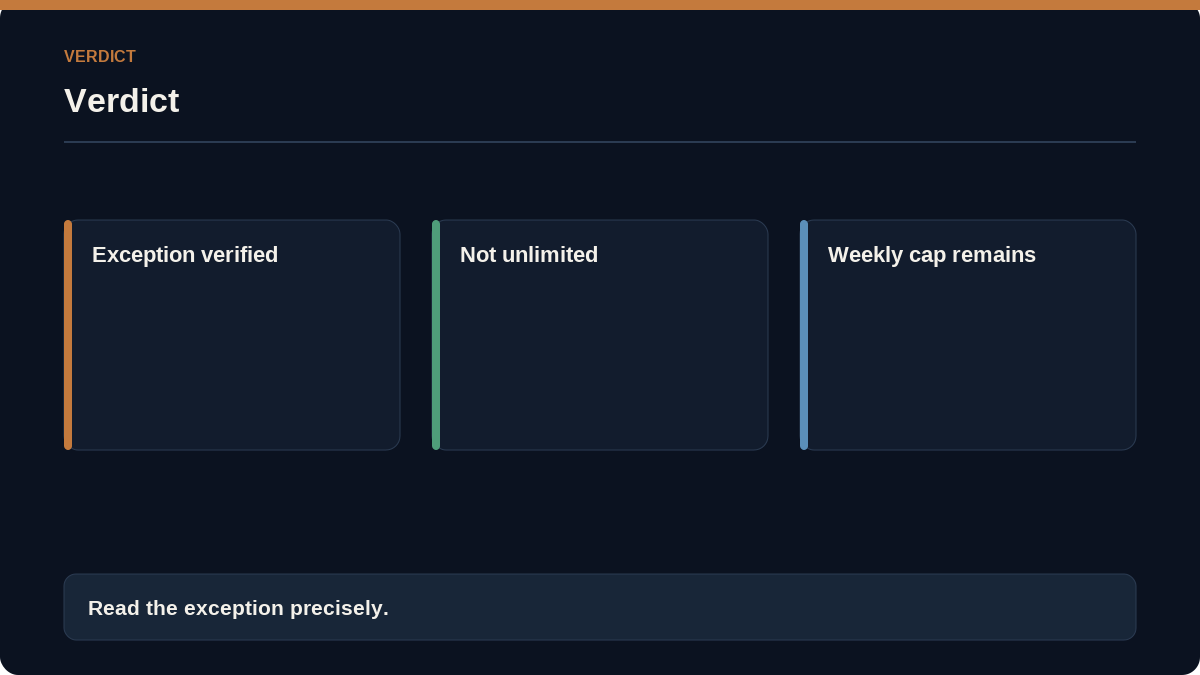
The win is precise. A verified Ultra account avoids the standard five-hour cap, which can matter for long coding sessions. The exception is documented, not a rumour from a forum.
The loss is equally precise. Ultra remains limited. The weekly cap still applies, usage is shared across products and the plan costs $200 per month. The fact pack does not provide the exact weekly allowance or a complete verification process, so a buyer should not treat the exception as a promise of unlimited work.
The practical implication is to choose the plan from the failure you feel. If five-hour interruptions dominate, test Ultra. If weekly exhaustion dominates, measure shared usage and consider workload changes or another route. If account access or regional eligibility dominates, the five-hour exception is irrelevant. The Claude Code single points of failure article separates those failure domains.
Explain the exception accurately to the team
A plan decision often involves more than the person using the agent. A budget owner needs to know what the extra spend buys. A project lead needs to know which interruptions remain. A support owner needs to know which limit to check when a session stops.
Use the same wording across those conversations. Verified Ultra removes the standard five-hour cap. The weekly limit remains. Usage remains shared across claude.ai, Claude Code and Desktop. The plan costs $200 per month. Monthly API credits have a separate scope and do not fund interactive Code sessions.
Avoid shorthand such as “Ultra is unlimited” or “Ultra has no limits.” Both phrases create false expectations and make later troubleshooting harder. Also avoid saying that every paid plan has the same five-hour cap. The verified Ultra exception is the specific correction to that claim.
| Audience | What to explain | What not to promise |
|---|---|---|
| Developer | Long sessions are not bound by the standard five-hour cap on a verified account | Unlimited weekly usage |
| Budget owner | The plan price and the specific exception | A measured productivity return |
| Project lead | Weekly and shared limits still affect delivery | That longer sessions remove every interruption |
| Support owner | Standard window, weekly reset and account status are separate checks | A reinstatement or access outcome |
| API developer | Monthly API credits apply to eligible non-interactive routes | That credits pay for interactive Code sessions |
A short written summary prevents the exception from becoming office folklore. Keep it with the plan review and update it if the official policy changes. The Ultra API credits versus Claude Code budget article can sit beside it when the team needs the billing detail.
Compare the exception with a different route
The Ultra exception solves one provider-specific constraint. A multi-model route solves a different problem: it reduces dependence on one model family and one quota pool. The two approaches can coexist, but they should not be compared as if they buy the same thing.
Use the same task set for both. Record accepted changes, review time, interruptions and cost. If the Ultra exception removes frequent five-hour stops, that is a real benefit. If the alternative route handles the work with acceptable quality and fewer access constraints, that is a different benefit. The decision should name the constraint each option addresses.
The Claude Code lock-in and exit costs article provides the comparison framework. Keep the old route available during a test, and define rollback before switching regular work.
Data gaps and future updates
The public fact pack does not state the exact weekly allowance for every account, the account-specific reset time or the full verification method for Ultra status. It also does not provide a measured comparison of completed work before and after the exception. Those gaps prevent a precise return-on-investment claim.
This article should be updated if Anthropic changes the exception, the weekly rules or the plan price. A future update should preserve the distinction between the standard five-hour window and the weekly limit. Collapsing them into one “rate limit” makes both plan advice and troubleshooting less accurate.
Keep the account’s fixed weekly reset visible in the same place as the standard window start. The two times answer different questions. A developer who can see both is less likely to plan a long task around the wrong boundary. Record the reset when it is assigned, and update the note if the account changes.
Practical response: test the live OpenAI-agent lane
One AI API Key is not a Claude Code replacement interface. Its active route is an OpenAI-format agent such as OpenCode, Cline or Cursor using https://api.oneaiapikey.com/v1, one gateway key and the 46 live free model IDs. The free model list shows current availability for small tests.
The documented Claude Code route uses https://api.oneaiapikey.com without a trailing /v1 and the Anthropic Messages format. All four Claude IDs were unavailable on 2026-11-27: claude-sonnet-5-5, claude-sonnet-5, claude-opus-5-5 and claude-haiku-4-5. Free IDs are OpenAI-format only and do not work in Claude Code. The coding-agent compatibility guide and OpenAI versus Anthropic format guide explain why.
If you are testing whether a different model route handles long sessions, start with the endpoint quickstart, check the current model catalogue, review prepaid pricing and use the sign-up page. Track accepted work with the LLM cost calculator, and check gateway status before a test. The custom base URL guide is not evidence that the unavailable Claude route works.
FAQ
Does Ultra have no rate limits?
No. Verified Ultra accounts do not have the standard five-hour cap, but a weekly limit still applies. The Ultra plan is not unlimited.
Is the five-hour window rolling?
No. The standard window starts with the first message and resets five hours later. It is not continuously rolling.
Does Claude Code usage stay separate from claude.ai on Ultra?
No. Usage across claude.ai, Claude Code and Claude Desktop counts toward the same limit. The Ultra exception does not create separate pools.
Do Ultra API credits pay for interactive Claude Code sessions?
No. Monthly API credits apply to eligible claude -p or Agent SDK usage with an API key from the linked Console organization, not interactive Claude Code sessions.
Who should not choose Ultra solely for the exception?
A developer whose main problem is weekly exhaustion, regional access, account standing or multi-model portability. The exception addresses the standard five-hour cap, not those other issues.