Direct answer
A Claude suspension notice does not necessarily explain the specific reason for the restriction. Official: Anthropic lists termination grounds that include repeated Usage Policy violations, account creation from an unsupported location and Terms of Service violations. The documented appeal route starts by signing in at claude.ai and using the form linked from the restricted-account page. Anthropic says appeal responses are slower than normal.
No public evidence in the frozen research set establishes a ban rate, a mass-ban campaign or an appeal success rate. Community reports show that some users received vague notices or slow responses. They do not prove that every suspension is wrong or that a particular cause applies to every account. Prepare a factual evidence packet, use the official appeal route and keep a backup workflow.
What a suspension notice does and does not tell you
A notice is a starting point, not a complete investigation. It may tell you that access is restricted and point you toward an appeal. It may not identify the exact event, policy clause or evidence behind the decision.
That gap is frustrating, but it is important to describe it accurately. The absence of detail does not prove a secret reason. It also does not prove that the restriction was correct. The public record supports a narrower statement: the notice can leave the user without enough information to reconstruct what happened.
The Claude Code appeal evidence packet guide turns that problem into a documentation checklist. A clear timeline, account email, plan receipt and exact notice text are more useful than an angry support thread.
A backup workflow matters for a different reason. An appeal can take time, and work may need to continue while it is reviewed. The Claude Code exit-plan checklist helps preserve prompts, configuration and tests before an account interruption forces an emergency move.
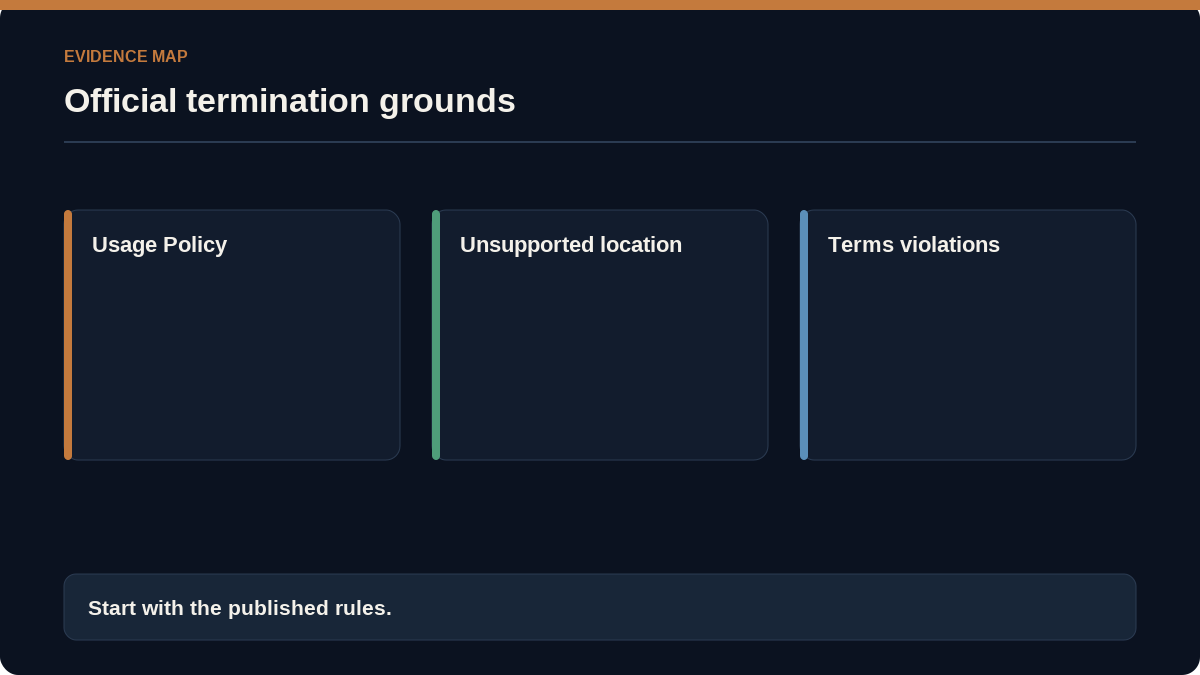
Official termination grounds
Official: Anthropic’s termination grounds include repeated Usage Policy violations, account creation from an unsupported location and Terms of Service violations. The safeguards, warnings and appeals article is the primary source.
Official grounds
| Published ground | What the source establishes | What it does not establish |
|---|---|---|
| Repeated Usage Policy violations | A documented termination ground | A public count of how often this ground is used |
| Account creation from an unsupported location | Location can affect account standing | That every traveler or VPN user is suspended |
| Terms of Service violations | A broad documented ground | The specific clause behind an individual notice |
The supported-regions policy adds detail to the location ground. Official: the policy is effective 2026-11-12 and covers physical location, entities headquartered in unsupported regions and certain ownership or control situations. Mainland China, Hong Kong, Macau, Russia, Belarus and Iran do not appear in the supported list. The list should not be described as identical to a sanctions list.
Official: VPN use does not create eligibility under the policy. The policy is based on location and control, not merely IP address. The Claude Code travel and regional ban risk guide explains the traveler scenario, and the Claude Code regional restrictions for teams guide covers headquarters, ownership and contractors.
Third-party login guidance adds another boundary. Official: it prohibits tools that misrepresent identity or route traffic against subscription limits. That is not a claim that every third-party tool is banned. The Claude Code third-party harness rules explains the exact restriction and its workflow impact.
The Claude consumer terms are also relevant, but a general terms page cannot explain an individual suspension by itself. Keep the published grounds separate from guesses about enforcement.
Warnings and appeals
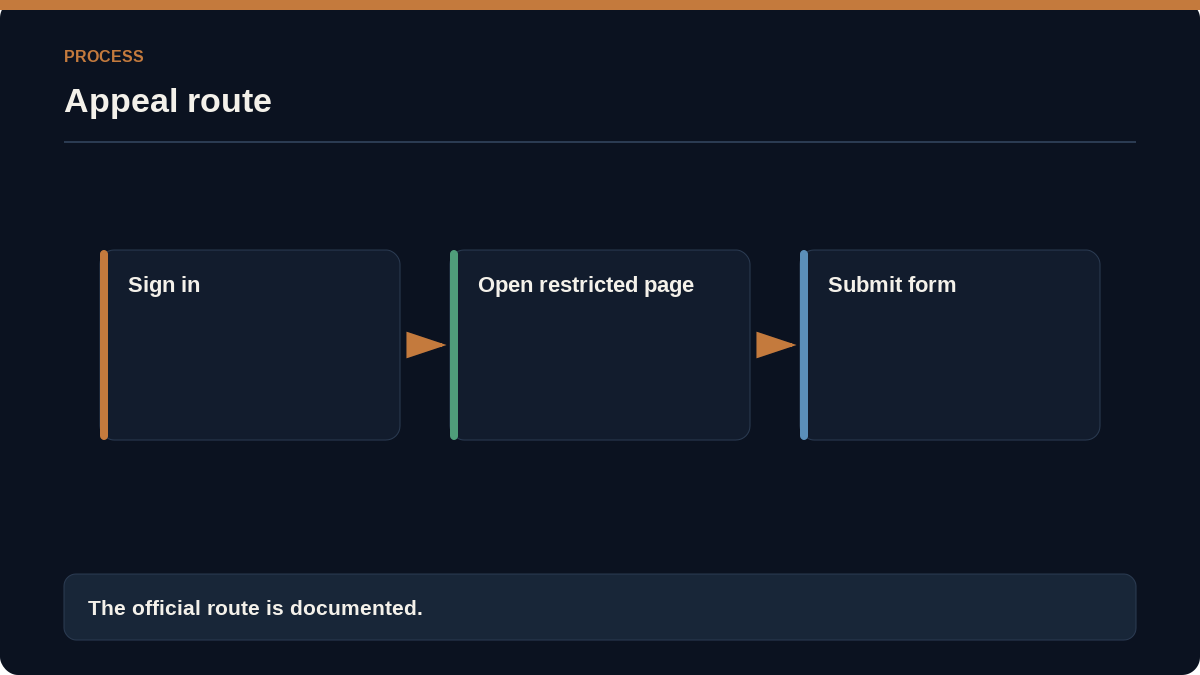
Official: users can appeal by signing in at claude.ai and using the form linked from the restricted-account page. Anthropic says appeal responses are slower than normal.
That is the documented route. It does not come with a promised response date, a guaranteed reinstatement or a published success rate. A user should not treat a community post about another account as a substitute for the official form.
The Claude Code appeal process guide provides a step-by-step packet. The most useful appeal is specific: what happened, when it happened, which account was affected, what changed and what review is requested.
Keep the appeal factual. Do not claim a cause that the notice does not establish. Do not threaten, spam duplicate tickets or include secrets. If the account involved travel, a VPN or a third-party tool, state the relevant facts plainly rather than hiding them.
What to expect while the appeal is pending
The frozen fact pack does not provide a typical response time beyond Anthropic’s statement that responses are slower than normal. Treat the wait as Unknown rather than filling it with a number from a forum.
Keep a copy of the submission and any response. If the account email is inaccessible, preserve whatever receipts and account identifiers are already available. Do not create a confusing web of duplicate accounts to work around the restriction.
Continue work through a separate, permitted route if possible. The Claude Code single points of failure guide explains why account standing should be treated as its own failure domain. A backup provider does not resolve the appeal, but it can reduce the cost of waiting.
What users report
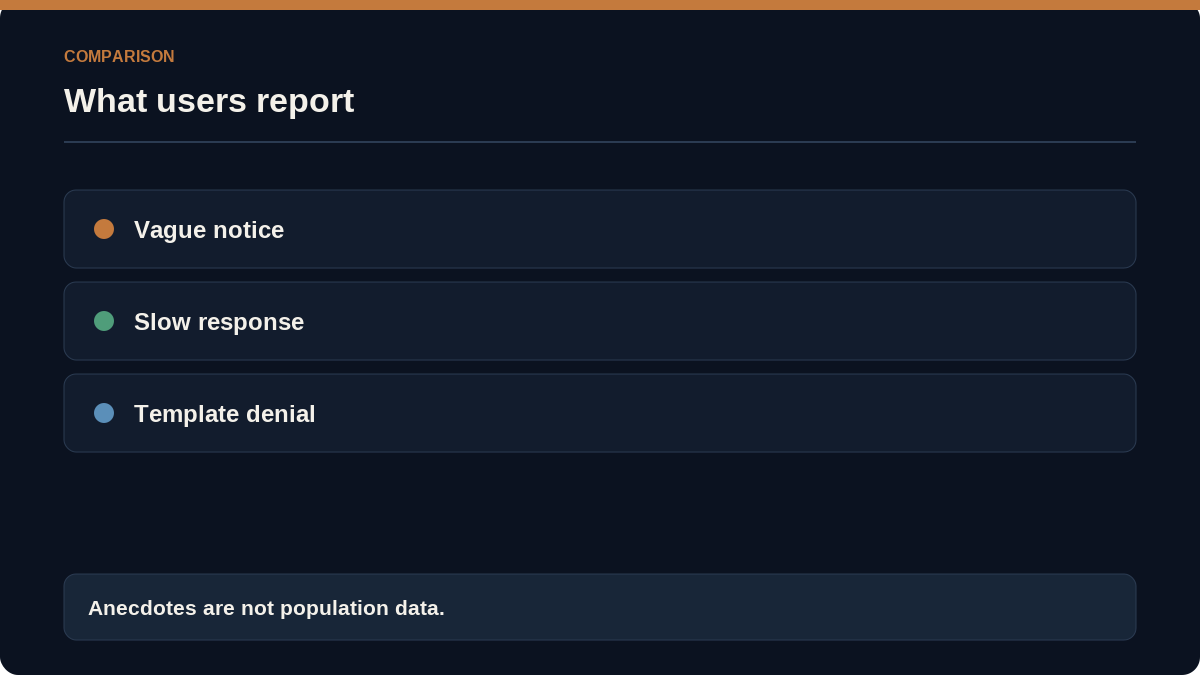
Community: the research set includes reports about signup restrictions, VPN-associated suspensions, KYC-related suspension and organization suspension. A GitHub issue describes a suspension after a corporate VPN; the root cause is not established. A Reddit thread collects travel-related access complaints; it does not establish how often enforcement happens.
Other community threads include a signup and ban report, a KYC and suspension report and an organization suspension report. These sources support the statement that users reported those experiences. They do not support a population-level conclusion.
A Hacker News discussion about bans can show concern and repeated themes. It cannot tell you what percentage of accounts were affected, whether a report was accurate, or why a particular decision was made.
How to read a community report
Start with the source type. A GitHub issue may contain useful timestamps and error text, but it is still a user report. A Reddit thread may collect many complaints, but the comments are not a representative sample. A press article may add reporting, yet it still may not have access to internal enforcement data.
Look for details that can be checked: account type, date, location, exact notice, appeal route and response. If those details are missing, keep the conclusion narrow.
Do not combine unrelated reports into a single story. A VPN report, a KYC report and an organization suspension may have different causes. Similar wording in a notice does not prove a shared root cause.
The honest use of community evidence is to identify questions for the official appeal and risks for your own workflow. It is not to invent a ban rate or declare that every restriction is arbitrary.
What the notice does not prove
A suspension notice does not prove a mass-ban campaign. It does not prove that every suspension is wrong. It does not provide an appeal success rate, a ban rate or a complete explanation of internal enforcement criteria.
The notice also does not prove that a VPN, a third-party tool or travel caused the restriction unless the notice or official response says so. Those factors may be relevant to the published policies, but relevance is not the same as causation.
The Claude Code privacy and retention rules are a separate issue. An account restriction should not be used to infer that all customer code is trained on by default. Official: commercial API, Team, Enterprise and Government data are not used for training by default, and qualified Enterprise zero-data-retention coverage exists with exceptions.
The Claude Code zero-data-retention limits guide explains that scope. Keep account access, data handling and model behavior as separate questions.
A notice also does not prove that a backup gateway will solve the problem. Another provider has its own terms, availability and account controls. The Claude Code lock-in and exit costs guide covers the work required to make a backup real.
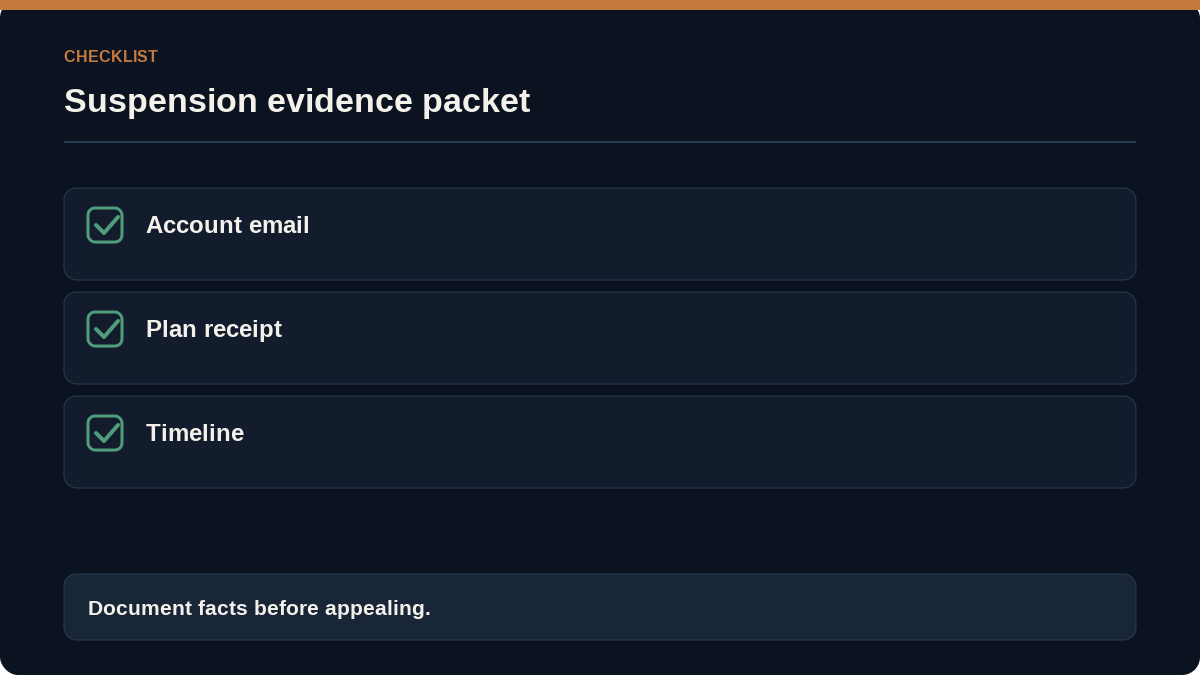
Evidence packet to prepare
A good evidence packet lets a reviewer reconstruct the account history without guessing. It should be factual, concise and free of secrets.
Evidence packet
| Item | What to preserve | Why it helps |
|---|---|---|
| Account email | The address used for sign-in and billing | Connects the appeal to the correct account |
| Plan receipt | Purchase date, plan and transaction reference | Establishes paid status without exposing full payment details |
| Exact notice | Text or screenshot with date and time | Preserves what Anthropic actually said |
| Timeline | Events in order with time zone | Separates account activity from the restriction |
| Recent tools | Agent, third-party harness and auth route | Clarifies how Claude was accessed |
| Location context | Travel or relocation facts when relevant | Addresses the supported-regions policy |
| Business impact | Work blocked and deadline affected | Explains urgency without inflating the claim |
| Requested review | The specific action requested | Gives the appeal a clear purpose |
The Claude Code appeal evidence packet guide expands each item. The Claude Code proof-of-work packet is useful for preserving work state, but it serves a different purpose from an account appeal.
Redact API keys, passwords, session tokens and full payment numbers. Do not paste private repository contents into an appeal unless they are necessary and you have permission to share them. The Claude Code settings-file secret exposure guide shows how easily credentials can end up in files that are later shared.
Risk controls
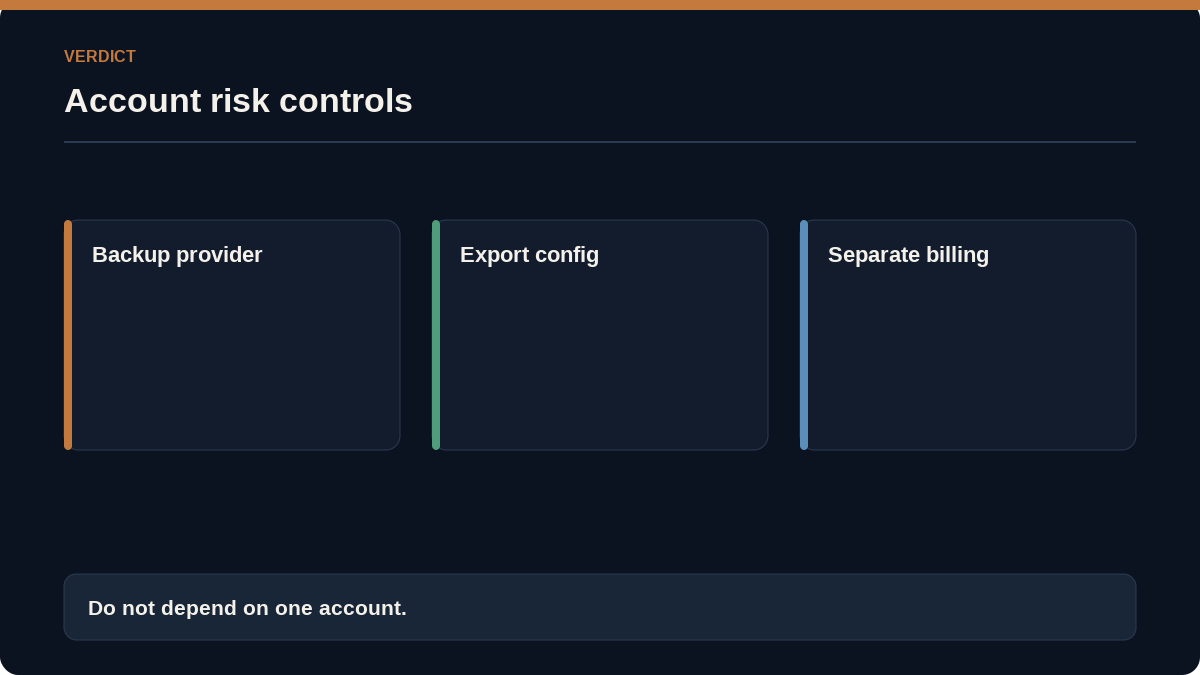
The best account-risk control is to avoid depending on one account for all work. That does not mean violating terms or misrepresenting identity. It means keeping a legitimate backup path and preserving the configuration needed to use it.
Risk-control matrix
| Risk | Control | Honest limit |
|---|---|---|
| Account restriction | Keep a separate permitted provider or agent route | A backup does not resolve the restricted account |
| Regional access change | Review the supported-regions policy before travel | A VPN does not create eligibility |
| Third-party tool ambiguity | Verify the client, identity and billing route | Not every third-party tool is banned |
| Configuration loss | Export prompts, hooks, context files and tests | Portability takes work |
| Billing disruption | Keep receipts and separate billing records | Receipts do not guarantee access |
| Secret exposure | Rotate exposed credentials and scan settings files | Deleting a file does not remove every copy |
The Claude Code travel and regional ban risk guide provides a pre-travel checklist. The Claude Code regional restrictions for teams guide adds ownership and contractor questions.
The Claude Code third-party harness rules are required reading before moving a subscription login into another client. Official: the guidance prohibits tools that misrepresent identity or route traffic against subscription limits. Do not turn a backup plan into a terms violation.
Configuration portability is another control. The Claude Code context-portable migration guide covers prompts, hooks, context files and test workflows. Export them before an incident, not during one.
Build a timeline that separates facts from inference
An appeal becomes weaker when it mixes what happened with what the user thinks happened. A timeline should keep those categories apart.
Start with the account creation date, plan purchase and last known successful session. Then add the restriction notice, any warning, the appeal submission and each response. Use a consistent time zone. If a timestamp is approximate, label it approximate.
Next, list the tools and access routes used before the restriction. Name the agent, the authentication method and any custom base URL. If a third-party client was involved, record its name and version when available. The Claude Code third-party harness rules explain why the identity and billing route matter.
Keep location facts separate from network observations. A VPN connection, a corporate network or a travel date may be relevant context, but none proves causation by itself. The supported-regions policy is based on physical location and control, not merely IP address.
Finally, write a short list of open questions. What exactly did the notice say? Was a warning shown? Did the restriction begin before or after a tool change? Which facts can be supported by a receipt, screenshot or log? This list helps the appeal ask for review without asserting an unproven cause.
A factual appeal structure
A clear appeal does not need to be long. It needs to be easy to review.
Begin with the account email and the date of the restriction. State the requested action in one sentence. Then give the timeline in chronological order. Attach the notice and receipt, and identify any relevant location or third-party tool context.
Close with the open questions. If the notice did not identify a specific ground, say that plainly and ask for the basis of the restriction or the information needed for review. Do not fill the gap with an accusation.
The Claude Code appeal evidence packet guide provides the fuller checklist. The goal is a record that another person can follow without access to your memory.
If the appeal is denied or unanswered
The frozen fact pack does not document a second-level appeal, a guaranteed escalation path or a response deadline. Those parts of the process are Unknown. Do not invent a formal route that the source does not describe.
Preserve the response and the original submission. If the response asks for more information, answer the specific request with documents rather than repeating the first appeal. If no response arrives, keep the record of the submission date and continue work through a permitted backup route.
A denial does not prove that the original decision was correct, and it does not prove a secret cause. It is the outcome communicated for that appeal. Without the underlying evidence, the public record cannot support a stronger conclusion.
The practical response is to reduce dependence while keeping the account record accurate. The Claude Code exit-plan checklist helps move work without destroying the history needed for the appeal.
Make account continuity a team practice
Account continuity is easier when it is designed before an incident. A team should know which accounts are critical, who owns the billing record and which work would stop if access disappeared.
Save receipts and plan details in a shared, access-controlled location. Do not store passwords or API keys in the same document. The Claude Code settings-file secret exposure guide explains why credential hygiene matters during an incident.
Separate billing records from usage records. The Ultra API credits versus Claude Code usage guide shows how easily two credit balances can be confused. A team that cannot explain a charge will struggle to produce a clean account history.
Measure the cost of an interruption with the Claude Code cost per verified change model. Context rebuilding, review delays and missed deadlines belong in the workflow cost even when no new invoice appears.
A team continuity plan should name a backup owner and a test date. The plan is not complete if only one person knows how to start the fallback agent or where the exported configuration lives.
Run a pre-incident drill
A backup that has never been tested is a hypothesis. A short drill can expose missing configuration, expired keys and assumptions about model compatibility.
Choose a small, non-critical task. Export the prompts, hooks, context files and test workflow. Start the backup agent, run the task and verify the result with the same acceptance rule used for the primary workflow.
Record how long the setup takes, which files were missing and whether the backup agent could use the required tools. The Claude Code context-portable migration guide provides the inventory. The Claude Code proof-of-work packet provides the evidence format.
Repeat the drill on a schedule that fits the team’s risk. A quarterly test is a practical choice for some teams, but the frozen evidence does not establish a universal cadence. The point is to keep the backup real.
The drill also tests the human side. Can a second developer follow the runbook? Can they find the account receipt without asking the primary user? Can they tell which model and agent produced the result? Those answers matter during an account restriction.
A drill can also reveal hidden policy assumptions. If the backup depends on a subscription login inside an unverified third-party client, stop and review the official guidance before using it. The Claude Code third-party harness rules prohibit misrepresented identity and routing against subscription limits. A resilience plan should use permitted routes, not workarounds that create a second account problem.
Store the drill report with the runbook. Record the date, task, agent, model, result and gaps. Update the backup when a provider changes availability or when the team’s task mix changes. The Claude Code single points of failure guide helps keep quota, region, account and model risks separate.
A practical backup route with an OpenAI-agent gateway
A backup workflow is useful only if it is configured and tested before an account interruption. One AI API Key has an active OpenAI-format lane that can serve as a separate route. The 46 live free model IDs run through https://api.oneaiapikey.com/v1 with one key. Use an OpenAI-format agent such as OpenCode or Cline, and follow the quickstart.
The free lane allows 100 requests and 5,000,000 tokens per day per account, shared across the 46 free IDs. It resets at 05:30 IST, which is 00:00 UTC. Accounts can have up to three API keys, with one request in flight per key on free models. For a backup that matters, test it with a small task set and record the agent, model ID and verification result.
Do not use the free IDs in Claude Code. They are OpenAI-format only. The documented Claude Code route uses the Anthropic Messages format at https://api.oneaiapikey.com, but all four Claude IDs were unavailable on 2026-11-27: claude-sonnet-5-5, claude-sonnet-5, claude-opus-5-5 and claude-haiku-4-5. The route is documented, not live.
The multi-model OpenAI-agent setup provides the architecture, and the 46 free AI model IDs guide explains the compatibility boundary. Use the per-key controls to cap, expire and restrict backup keys. Check the live gateway status before relying on the route for a deadline.
Do not assume guaranteed automatic fallback. The routing guide documents same-model retries and configurable fallback headers, while the gateway overview says the service does not answer with a different model. That contradiction remains unresolved in the frozen record. Test the behavior you need instead of promising it to your team.
The honest loss is that a backup agent is a different workflow. The Claude Code lock-in and exit costs and Claude Code migration context portability guides explain the work involved. A backup reduces concentration risk, but it does not make every provider interchangeable.
Content to avoid in an appeal
An appeal should not contain passwords, API keys, session cookies or full payment numbers. Redact those fields before attaching a screenshot or log. The Claude Code settings-file secret exposure guide shows how credentials can leak through ordinary project files, and an appeal is still a sharing channel.
Avoid unsupported accusations. A vague notice does not establish a secret motive, a mass-ban program or a specific enforcement algorithm. Tie the request to the account and the published grounds.
Do not attach unrelated customer data or private repository contents. Include only what is necessary to explain the account history, and remove material that belongs to other people. The Claude Code privacy and retention rules provide the policy context, but the appeal itself should practice data minimization.
Finally, avoid duplicate submissions through multiple channels unless the official response asks for them. Maintain one clear record of the appeal, the date and any response. The record is more useful than a scattered set of angry messages.
Data gaps and future updates
Several questions remain Unknown in the public record. The frozen research set does not provide a ban rate, an appeal success rate, a typical appeal duration or a complete account of internal enforcement criteria. It also does not establish that community reports are representative.
This article should be updated if Anthropic publishes new appeal terms, a transparency report with usable enforcement data or changes to the supported-regions policy. Until then, the accurate position is narrow: published grounds exist, an official appeal route exists, responses are slower than normal, and public population data is missing.
Community evidence should remain labeled as community evidence. A new thread can add a reported experience, but it cannot fill the statistical gap on its own.
FAQ
Does a Claude suspension notice explain the exact reason?
Not necessarily. The notice may confirm a restriction and point to an appeal without identifying the specific event or evidence behind it.
How do I appeal a Claude account restriction?
Sign in at claude.ai and use the form linked from the restricted-account page. Anthropic says appeal responses are slower than normal.
Are VPN users automatically banned?
The frozen evidence does not support that claim. The supported-regions policy says VPN use does not create eligibility, but it does not establish a universal suspension outcome for every VPN user.
Is there a known Claude ban rate or appeal success rate?
No public rate or success rate is established in the frozen research set. Community reports cannot supply population-level numbers.
Can the 46 free gateway IDs be used in Claude Code?
No. They use the OpenAI format and require an OpenAI-format agent. The documented Claude Code route uses the Anthropic format, and all four Claude IDs were unavailable on 2026-11-27.
Sources
- Claude safeguards, warnings and appeals
- Claude supported regions policy
- Claude consumer terms
- Log in to your Claude account and third-party login guidance
- GitHub community report on signup and ban concerns
- GitHub community report involving a VPN and suspension
- GitHub community report on KYC and suspension
- GitHub community report on organization suspension
- Hacker News discussion about bans
- Reddit community discussion of Claude Code travel problems