Direct answer
Traveling to an unsupported region does not mean every traveler is automatically banned. It means Claude’s official supported-regions policy applies to physical location, alongside headquarters and certain ownership or control tests. The policy took effect on 2026-11-12. Mainland China, Hong Kong, Macau, Russia, Belarus and Iran do not appear on the supported list. A VPN does not create eligibility. If your itinerary includes an excluded area, pause Claude Code before crossing the border and prepare a separate work route. The public record does not establish how often travelers are restricted or how any individual case will end.
Why travel is an access decision
A coding subscription can feel portable until a flight changes the legal and policy context around it. The developer who checks messages from a café, reviews a pull request from a hotel and runs an agent from a rented desk is still working from a physical location. That location now belongs in the access plan.
The cost is not only a missed afternoon. A restriction can interrupt an active task, remove access to project context and force a rushed search for another tool. It can also create uncertainty about account standing. That is why the Claude Code suspension notice gaps matter to travelers: the notice may identify a restriction without explaining the full evidence behind it.
There is a real advantage here. The regional rule is published, so a careful developer can check a destination before relying on the service. The loss is equally real: the policy does not provide a traveler-specific enforcement forecast. Treat the itinerary as a change in access conditions, not as a minor billing detail.
What the supported-regions policy covers
Official: Anthropic’s supported-regions policy is effective 2026-11-12. It covers physical location, entities headquartered in unsupported regions and certain ownership or control situations. The supported list excludes Mainland China, Hong Kong, Macau, Russia, Belarus and Iran. The fact pack also warns against treating that list as identical to a sanctions list.
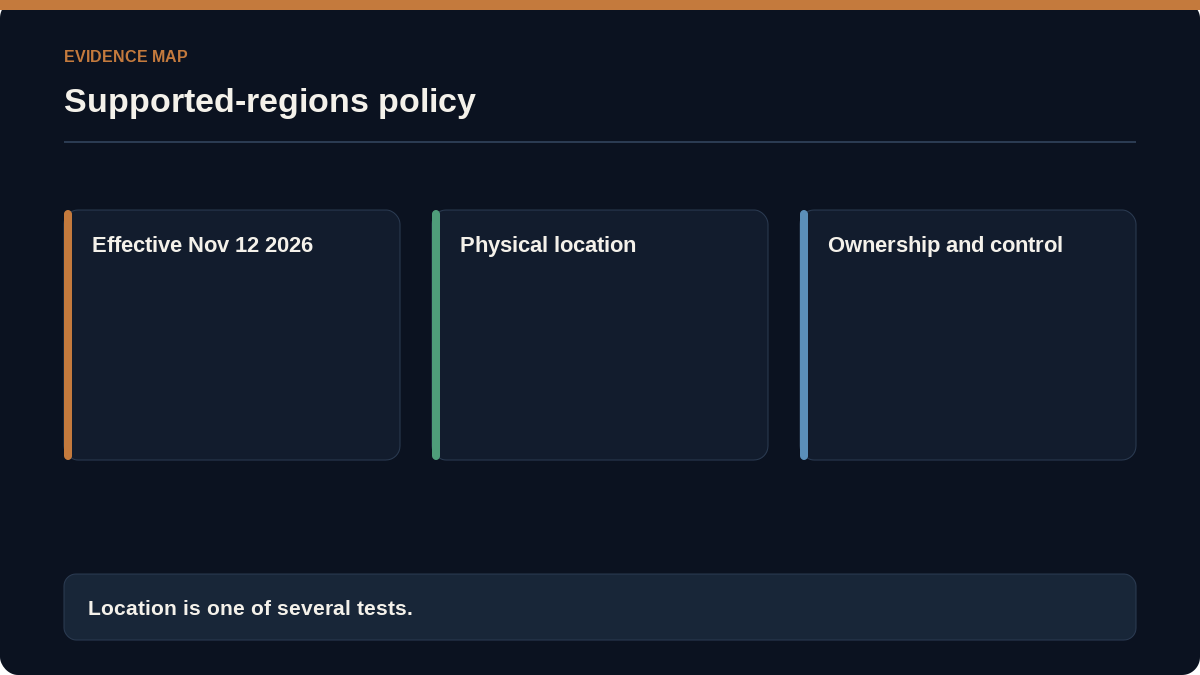
| Policy test | What the official policy says | Practical reading |
|---|---|---|
| Physical location | Location is one of the covered criteria | Check where you will physically work, not only where your employer is registered |
| Headquarters | Entities headquartered in unsupported regions are covered | A supported travel destination does not erase an entity-level question |
| Ownership or control | Certain ownership or control situations are covered | Ask for a review when corporate structure crosses regions |
| IP address or VPN | VPN use does not create eligibility | Do not use location masking as a compliance strategy |
| Regional list | Several named regions are absent from the supported list | Check the current official page before travel |
The table separates eligibility from convenience. A connection that works from a hotel network is not proof that the account is eligible. Likewise, a blocked sign-in does not by itself explain which policy test was applied.
The physical-location rule for travelers
The practical rule is simple: the policy follows physical location, not merely the IP address shown to a server. Anthropic states that VPN use does not create eligibility. That closes the tempting workaround of making a laptop appear to be in a supported country while the developer is somewhere else.
This does not mean every border crossing produces the same result. The public policy does not state a grace period for airport transit, a minimum trip length or a special hotel exception. Those are Unknown, not permission to assume the risk away. A short trip can still place the user in an unsupported location.
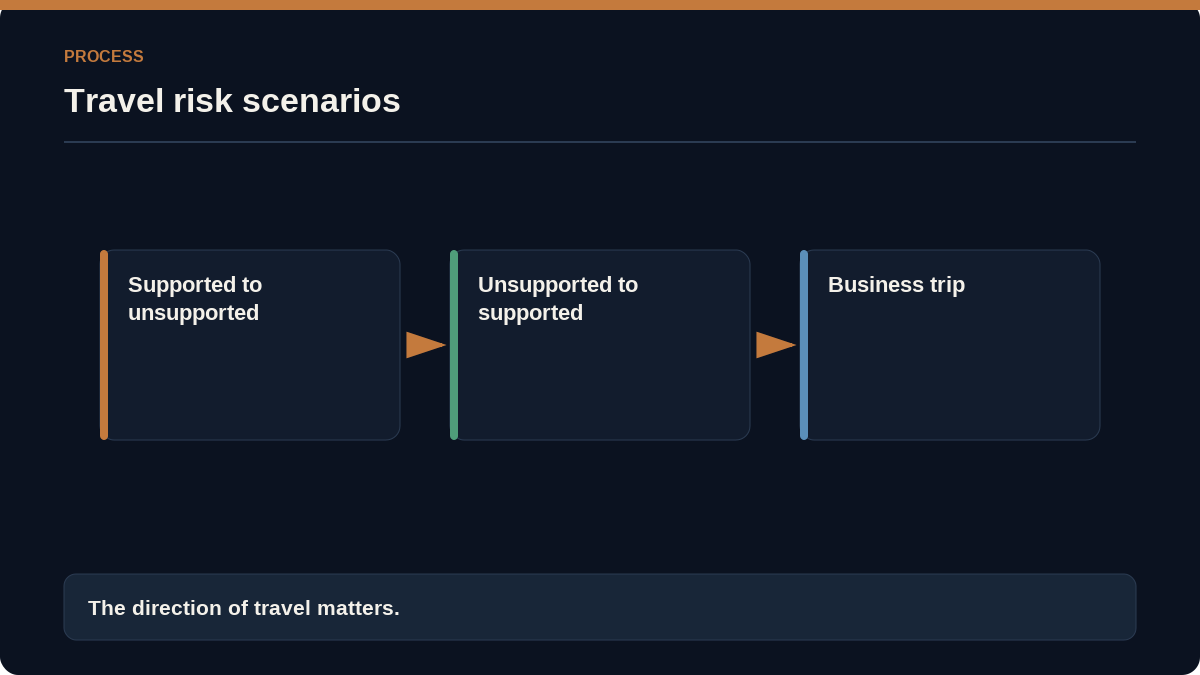
| Travel scenario | Sensible default | Reason |
|---|---|---|
| Supported region to unsupported region | Pause Claude Code before arrival | Physical location becomes a covered policy issue |
| Unsupported region to supported region | Check access after arrival, but do not assume an old restriction disappears | Eligibility and an existing account review are separate questions |
| Short transit through an excluded area | Avoid starting work there unless policy guidance confirms the position | No public transit exception appears in the fact pack |
| Remote employee working from a second home | Review the second home’s location before using the account | The workplace is where the developer is physically located |
| Business trip arranged by an employer | Ask the employer for an approved access plan | Company policy and provider policy both apply |
A developer who already has a restricted account should use the documented Claude Code appeal evidence packet rather than treating travel as a fix. Signing in from a supported country does not replace the official appeal route.
What users report
Community: A Reddit thread about Claude Code travel problems collects complaints from people using the service while traveling. A GitHub report involving a VPN and account restriction describes a suspension after corporate VPN use. Another GitHub report involving an organization suspension raises account-access concerns.
These reports support a narrow conclusion: some users have experienced access anxiety, restrictions or confusing account states around travel and network setup. They do not establish how often this happens. They do not prove that a VPN caused a particular suspension. They also do not show that every traveler is targeted.
The right response is neither panic nor dismissal. Keep the reports as prompts for preparation. If a problem occurs, preserve the account email, plan receipt, itinerary, dates, network setup and exact notice. Then follow the official process. The Claude Code account-ban overview explains why a vague notice should not be turned into a confident story about cause.
What is not proven
No public evidence in this research set establishes a travel-related ban rate. There is no verified percentage of travelers who lose access. There is no evidence that every person entering an excluded region is suspended, and no evidence that Anthropic deliberately targets legitimate developers.
There is also no public basis for claiming that a VPN makes travel compliant. The official policy says the opposite. A working connection can be a technical success and a policy failure at the same time.
Enforcement details remain Unknown. The public record does not disclose the verification method for every case, a standard review timeline or the evidence used in an individual restriction. Speculating about hidden criteria makes a difficult situation harder to manage. The regional restrictions for teams article applies the same evidence boundary to staffing and contractor decisions.
How policy, enforcement and account review fit together
Three layers are easy to confuse.
First, the written policy defines eligibility. Physical location, headquarters and ownership or control all matter. Second, enforcement determines how the provider applies that policy to activity and accounts. The public fact pack does not provide a complete enforcement manual. Third, an account review handles a specific restriction, warning or appeal.
Official: Anthropic lists account creation from an unsupported location among termination grounds. Users can appeal by signing in at claude.ai and using the form linked from the restricted-account page. Anthropic also says appeal responses are slower than normal. Those facts support preparation, not a promise of reinstatement.
The third-party harness rules add another boundary. Official login guidance prohibits tools that misrepresent identity or route traffic against subscription limits. That is not a claim that every third-party tool is banned. It is a reason to avoid workarounds that create a second problem during an already sensitive trip.
Pre-travel checklist
Build the checklist before departure, while there is still time to test a backup. Do not wait for a restriction notice to discover that your project context lives only inside one tool.
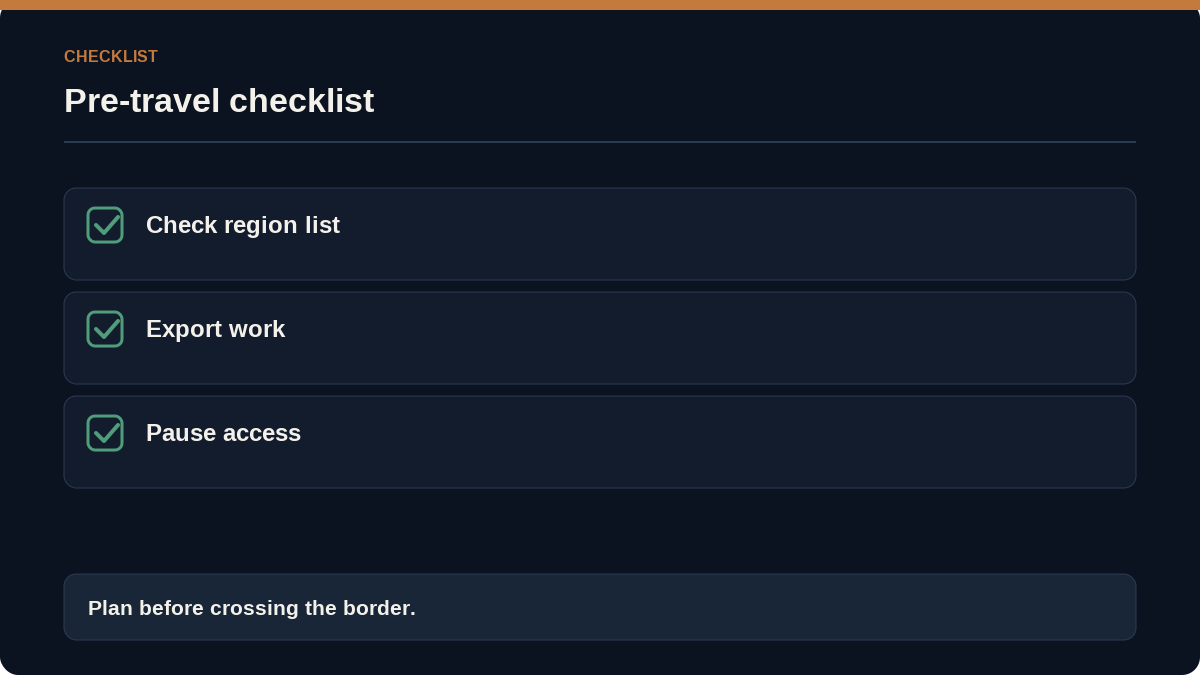
| When | Action | Evidence to keep |
|---|---|---|
| Before booking | Check every work destination against the current supported-regions page | Dated copy or link to the policy |
| Before booking | Review employer policy for international work | Written internal approval if required |
| Before departure | Export prompts, project rules and reusable configuration | Local export outside the account |
| Before departure | Test a separate coding-agent route on a small task | Request result and cost record |
| At the border | Pause Claude Code if entering an excluded area | Note the time and location |
| During the trip | Do not use a VPN as an eligibility workaround | Record any official guidance received |
| On return | Check account access and follow the appeal route if restricted | Exact notice and appeal receipt |
The context-portable migration guide is useful here because it treats prompts, hooks and project knowledge as assets that should survive a tool change. The Claude Code exit-plan checklist adds trigger points and a backup agent. Neither guide promises zero downtime. Both reduce the chance that one access change destroys a day’s work.
Run a small continuity drill
A backup that has never handled a real task is a hope, not a work route. Before travel, run a small drill with a disposable repository or a non-sensitive task. The goal is not to prove that two agents produce identical code. The goal is to confirm that you can move the minimum useful context, issue a request, inspect the result and keep working when the primary route is unavailable.
Start by writing down the task in plain language. Include the repository state, the expected change, the test command and the constraint that must not be broken. Then place that description outside the primary account. A local file is enough for the drill, but it should be somewhere you can reach without signing in to the service you are testing.
Next, choose an OpenAI-format agent and a currently available free model ID. Send the same small task through that route. Check the response against the written requirement, not against how confident the summary sounds. Run the test. Open the changed files. If the task needs an external service, verify the external state rather than accepting a mocked success.
| Drill step | Pass condition | Failure action |
|---|---|---|
| Export task context | The task description is readable without the primary account | Rewrite the context before departure |
| Configure the backup agent | The agent reaches the documented endpoint with the expected format | Fix the route before travel |
| Select a model | The chosen ID appears as available in the current catalogue | Choose another listed ID |
| Run a small task | The changed files match the written requirement | Record the gap and adjust the task set |
| Verify the result | Tests and a manual check agree | Keep the primary route available until the gap is resolved |
| Record cost and limits | Usage is visible against the free daily allowance | Reduce the test scope or plan paid usage |
The 46 free AI model IDs for OpenAI agents are useful for this drill because the free lane has explicit daily limits. They are not a reason to send sensitive production work through an untested setup. Use a disposable task first, then decide whether the route belongs in your travel plan.
Read the notice before writing the appeal
If a restriction appears, copy the exact notice before doing anything else. Save the timestamp, the account email, the plan receipt and the page address. A paraphrase written a day later can accidentally turn an uncertain cause into a confident memory.
Separate the notice from your interpretation. “Account restricted” is a status. It is not proof that travel, a VPN, a payment method or a particular request caused the decision. If the notice mentions usage limits rather than account standing, the five-hour and weekly limit explanation may be the relevant route instead. If it mentions a restricted account, use the official appeal process.
| Notice field | Why it matters |
|---|---|
| Exact wording | Preserves what the provider actually said |
| Date and time | Builds a usable timeline |
| Account email | Confirms which account is affected |
| Plan and receipt | Shows the paid relationship without exposing full payment details |
| Page or route | Helps distinguish login, quota and restriction problems |
| Requested action | Identifies whether the provider asks for a form, verification or another step |
Do not include secrets in an appeal packet. Redact full payment numbers, API credentials and unrelated customer data. The Claude Code appeal evidence packet gives a fuller checklist. Its central rule applies here: facts beat frustration.
Make the decision before the trip
A short decision record prevents rushed choices at an airport or hotel desk. Write the destination, the policy status you checked, the point at which you will pause Claude Code, the backup agent, the person who can approve a paid top-up and the owner of any appeal. If you are traveling with a team, name one person to collect notices so that five different stories do not circulate.
The record does not need to be elaborate. It needs to be findable. Store it with the exported project context, not inside the account that may become unavailable. Review it when the itinerary changes. A new country, a longer stop or a different workspace can change the access question.
For a team, the regional restrictions for teams article adds headquarters, ownership and contractor questions. A traveler’s physical location is only one field in that inventory. Keeping those fields separate makes it easier to ask a precise question instead of assuming that one contractor or one trip determines the whole company’s access.
Questions worth answering in advance
- Which destinations on this itinerary appear on the current supported list?
- Where will work physically happen, including hotels, homes and coworking spaces?
- What project context must be available without the primary account?
- Which backup agent has already completed a small verified task?
- Who owns the appeal if a restricted-account page appears?
- What spending approval exists if the free lane is insufficient?
These questions do not replace legal or policy advice. They make the operational decision visible. Those questions also give a reviewer something concrete to check before departure.
The win, the loss and the practical implication
The win is clarity. A published regional policy gives developers something concrete to check. The excluded regions are named, the effective date is known and the VPN position is explicit.
The loss is predictability. The same public record does not say how frequently restrictions occur, how long a review will take or what evidence will decide a particular appeal. A traveler can follow every preparation step and still face an account problem.
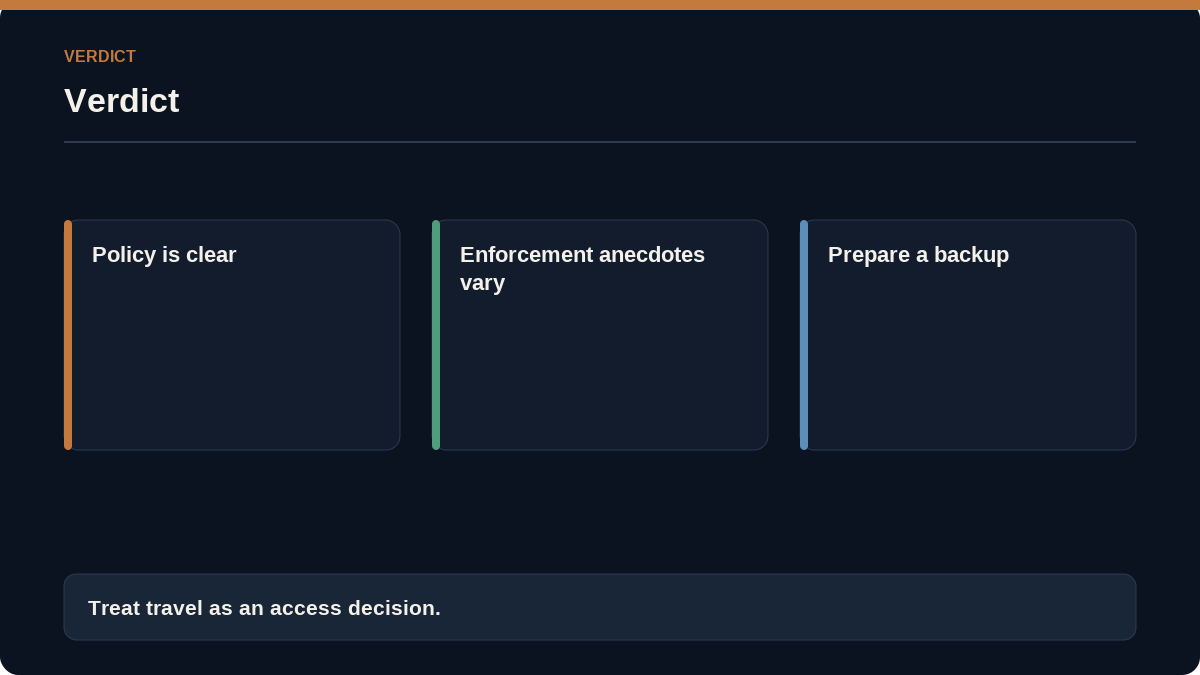
The practical implication is to separate eligibility from continuity. Confirm eligibility before travel, and maintain continuity through a tested alternative. The single-points-of-failure analysis explains why region, quota and account standing should be treated as distinct failure domains.
After the trip: close the loop
Returning to a supported region is a good moment to review the access plan while the details are fresh. Confirm whether the primary account works, whether any notice remains visible and whether the backup route completed the tasks you expected. Do not delete the itinerary, notice or appeal receipt just because service returns. Keep them until you have a clear record of what happened.
Review the drill as well. A backup that failed on a small task should not be promoted to a production dependency without another test. A backup that worked may still be too slow, too limited or too awkward for your normal workflow. Write down the difference between “it answered” and “it helped me finish verified work.” That distinction keeps the next travel decision grounded in evidence.
| Post-trip check | Question to answer | Follow-up |
|---|---|---|
| Primary access | Did normal sign-in and Claude Code access return? | Preserve any remaining restriction notice |
| Backup performance | Which tasks completed with acceptable review effort? | Keep, adjust or retire the backup route |
| Context export | Was the exported material sufficient? | Add missing prompts or project rules |
| Cost | Did the trip create paid usage or an unexpected top-up? | Reconcile receipts against usage logs |
| Privacy | Did any sensitive project material pass through the backup route? | Review the relevant retention and training terms |
| Team record | Did teammates need the same access change? | Update the shared access inventory |
The lock-in and exit-cost analysis explains why one account, one quota and one workflow can turn a travel problem into a larger dependency problem. The goal is not to abandon a tool that works. The goal is to know what it costs to lose access and to keep the most important project knowledge portable.
If the backup route handled project data, read the provider’s privacy and retention policy before repeating the drill with sensitive material. A successful request says nothing by itself about training defaults, retention periods or upstream providers. Those questions belong in the same review as speed and cost.
A note for independent contractors
Contractors often carry two sets of obligations: the provider’s terms and the client’s security or procurement rules. A destination that is acceptable to one may be unacceptable to the other. Before working from a client’s repository abroad, ask whether the contract limits where work can occur or which tools may handle project data.
Keep the answer in writing. If the client approves a backup agent, record the approved route and the data that may be sent to it. If the client does not approve the route, a technically working gateway does not solve the problem. The right fallback may be local development, a client-provided environment or a pause until the trip ends.
This is also a reason to avoid shared accounts. A contractor who borrows a client’s seat creates a second identity and access question that the public regional policy does not resolve. Use the account and credentials assigned to you, and escalate uncertainty before departure.
Keep the policy check dated
A supported-regions check is a snapshot. Save the date and the official page you used, then review it again before departure. A saved link is useful, but it does not show which version of the list applied when the team made its decision.
Keep the check with the travel record. If a restriction follows, the timeline can show that the team reviewed the policy and paused at the planned point. That does not guarantee an outcome, but it prevents the record from becoming a debate about what everyone remembered.
Data gaps and future updates
This article will need revision if Anthropic changes the supported-regions list, the effective policy or the appeal instructions. It also needs new evidence before making any claim about enforcement frequency. A future update should use a named dataset, a defined population and a date range, not a collection of dramatic threads.
Until then, keep three statements separate: the policy is documented, some users report access problems, and the outcome of an individual case is unknown. This is less satisfying than a simple ban-risk percentage, but it is the honest reading of the available record.
Practical response: test the live OpenAI-agent lane
One AI API Key is not a Claude Code replacement interface. Its active route is an OpenAI-format agent such as OpenCode, Cline or Cursor using https://api.oneaiapikey.com/v1, one gateway key and the 46 live free model IDs. The free model list is the place to verify current availability before choosing an ID.
The documented Claude Code route uses https://api.oneaiapikey.com without a trailing /v1 and the Anthropic Messages format. All four Claude IDs were unavailable on 2026-11-27: claude-sonnet-5-5, claude-sonnet-5, claude-opus-5-5 and claude-haiku-4-5. Free IDs are OpenAI-format only and do not work in Claude Code. The coding-agent compatibility guide and OpenAI versus Anthropic format guide explain the boundary.
For a travel backup, start with the endpoint quickstart, confirm the current model catalogue, check prepaid pricing and create an account through the sign-up page. Use the LLM cost calculator for paid work. The custom base URL guide is background, not evidence that the unavailable Claude route is live. Check gateway status before relying on any backup.
FAQ
Does Claude Code ban every traveler who enters an unsupported region?
No such claim is supported. The official policy applies to physical location, but the public record does not establish an automatic outcome for every traveler. Pause use in an excluded area and follow official guidance if a restriction appears.
Can I use a VPN to keep using Claude Code while traveling?
A VPN does not create eligibility under the supported-regions policy. The policy is based on location and control, not merely IP address. Do not treat a working connection as proof of compliance.
How should I prepare before a work trip?
Check every destination against the current policy, export reusable project context, test a separate agent route and pause Claude Code before entering an excluded area. Save receipts, notices and a timeline in case you need to appeal.
Does returning to a supported country automatically restore a restricted account?
Do not assume that. An existing restriction should be handled through the official restricted-account appeal route. A change of location is not a substitute for account review.