Direct answer
Claude’s third-party login guidance restricts subscription use in tools that misrepresent identity or route traffic against plan limits. It does not ban every third-party integration. The practical response is to verify the client’s identity, authentication route, billing path and terms before production use, then move to an API-key route or a compatible agent when the subscription route does not fit.
“What changed” needs a careful answer. The frozen record establishes the current guidance, but it does not provide a dated changelog or a complete history of every enforcement action. The workflow impact is clear: a team cannot assume that a credential accepted by one harness is permitted in another. Treat compatibility as a review item, not a discovery made during a failed release.
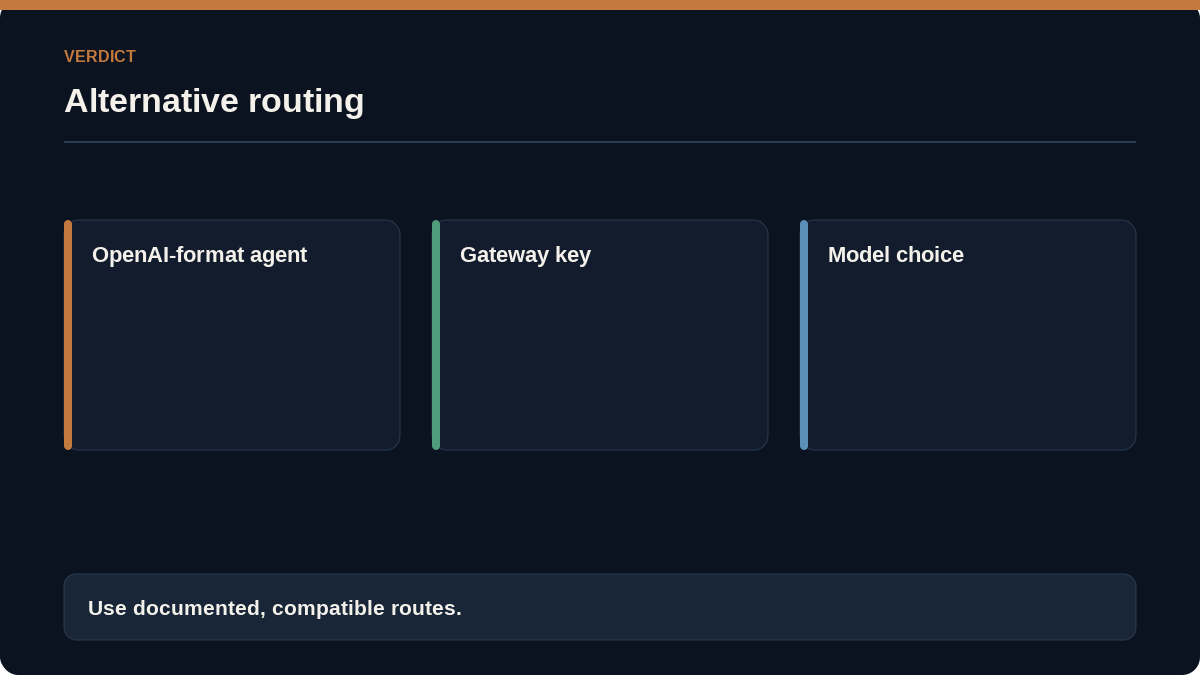
The active alternative is an OpenAI-format agent using one gateway key and 46 live free model IDs. The Claude Code route through the gateway is documented but unavailable: all four Claude IDs were marked unavailable on 2026-11-27. Free IDs do not work in Claude Code’s Anthropic-format route.
Official login guidance: the exact boundary
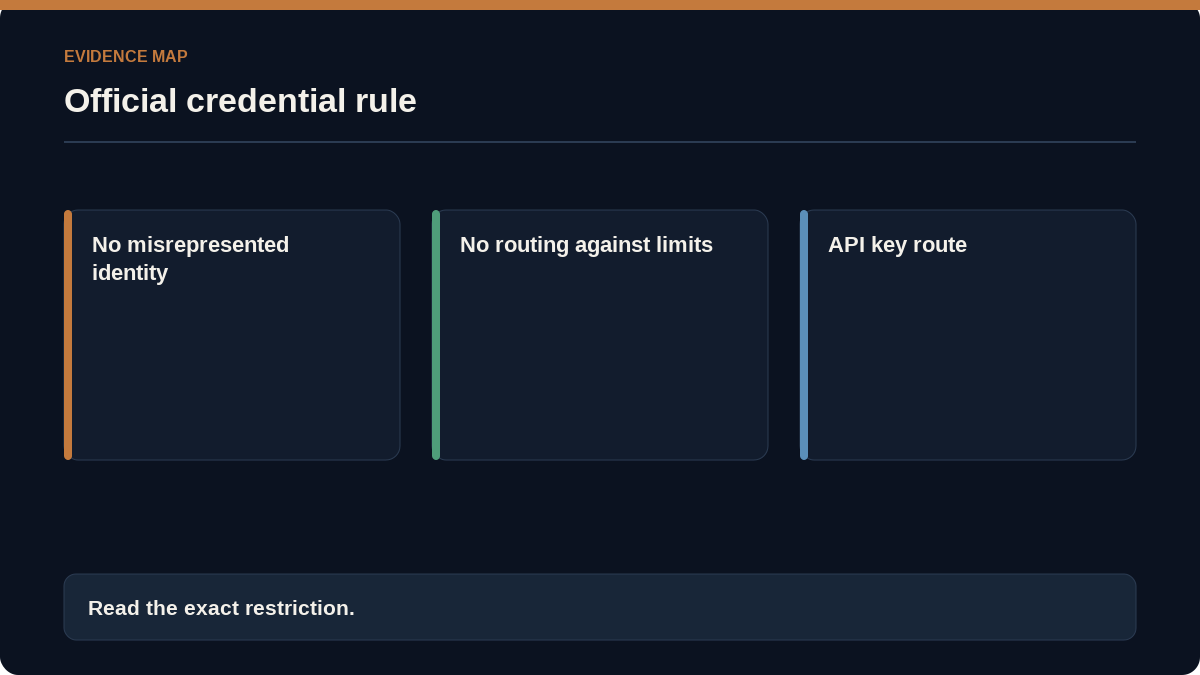
The official Claude account login guidance is the starting point. Official: it prohibits tools that misrepresent identity or route traffic against subscription limits. Those are the two restrictions in the frozen fact pack.
The first restriction concerns identity. A third-party tool should not present itself in a way that hides what it is or who is operating it. The second concerns routing. A tool should not use a subscription credential to send traffic in a way that circumvents the plan’s limits.
Neither sentence says that every third-party tool is prohibited. A compatible client can still have a legitimate integration if it follows the documented authentication and usage rules. The mistake is to turn a specific restriction into a general ban, or to ignore the restriction because a technical request happens to succeed.
A successful request is not proof of permission. It proves that a server accepted a request under the conditions of that moment. Terms, client identity and billing route are separate questions.
The Claude Code third-party harness compatibility checklist is useful when the client is part of a larger move. Do not let a migration plan treat authentication as a one-line configuration change.
Credential rules: separate identity, route and billing
A credential is not just a secret string. It carries an identity, a permitted client behavior and a billing path. Confusing those layers is how a team can build a workflow that works technically and fails policy review.
| Layer | Question | Evidence to record | Common mistake |
|---|---|---|---|
| Identity | What client is presenting the credential? | Client name, version and configuration | Assuming a generic user agent is enough |
| Authentication | Is this a subscription login or an API key? | Credential type, with the secret removed | Treating both as interchangeable |
| Route | Which endpoint and API format receive the request? | Base URL and format | Mixing OpenAI and Anthropic paths |
| Billing | Which balance or plan pays for usage? | Plan or key identifier | Assuming credits cover every route |
| Limits | What cap applies to this client? | Plan or key limit | Ignoring shared usage |
| Terms | Does the intended use fit the documented rules? | Policy link and review date | Relying only on a successful test call |
The Claude plan pricing page establishes that Claude Code is included in Pro, Max and Ultra, but not in the free Claude plan. Official: Pro costs $20 monthly or $17 per month with annual billing, Max costs $100 per month and Ultra costs $200 per month. Inclusion does not mean every plan has identical limits.
The Claude usage and length limits guidance adds the quota mechanics. Official: the standard five-hour window starts with the first message, weekly limits reset at a fixed account time, and usage across claude.ai, Claude Code and Claude Desktop shares the same limit. Verified Ultra accounts do not have the standard five-hour cap, but a weekly limit still applies.
Those facts matter because a third-party routing setup can change which usage is visible or which balance is charged. Do not infer the billing result from the client name alone.
API keys are a different route
An API key is not a subscription login. It authenticates a request against an API billing path. The monthly API credits explanation is a useful example of the distinction: monthly API credits do not cover interactive Claude Code sessions. They apply to claude -p or the Agent SDK with an API key from the linked Console organization.
The practical lesson is to name the route in the architecture diagram. “Claude Code with a key” is too vague if the key belongs to a gateway, a Console organization or a subscription-linked integration. Log the client, endpoint, format and billing owner separately.
Third-party tool scenarios
Not every third-party setup has the same risk. The useful distinction is whether the tool is a compatible client using a documented route, a wrapper that changes identity or routing behavior, or a workflow that needs a different API format altogether.
| Scenario | Likely route | What to verify | Safe response |
|---|---|---|---|
| Supported client with documented login | Subscription or approved integration | Client identity and current guidance | Use only within the documented behavior |
| Wrapper around a subscription credential | Subscription traffic through another process | Identity disclosure and routing limits | Stop and review before production |
| Automation using an API key | API billing route | Key scope, endpoint and format | Use a dedicated key with limits |
| OpenAI-format agent | OpenAI-compatible endpoint | Base URL and model format | Use the documented /v1 route |
| Claude Code client | Anthropic Messages route | Model availability and endpoint shape | Recheck status before relying on it |
| Unknown local harness | Unknown | Ownership, behavior and terms | Treat as unapproved until reviewed |
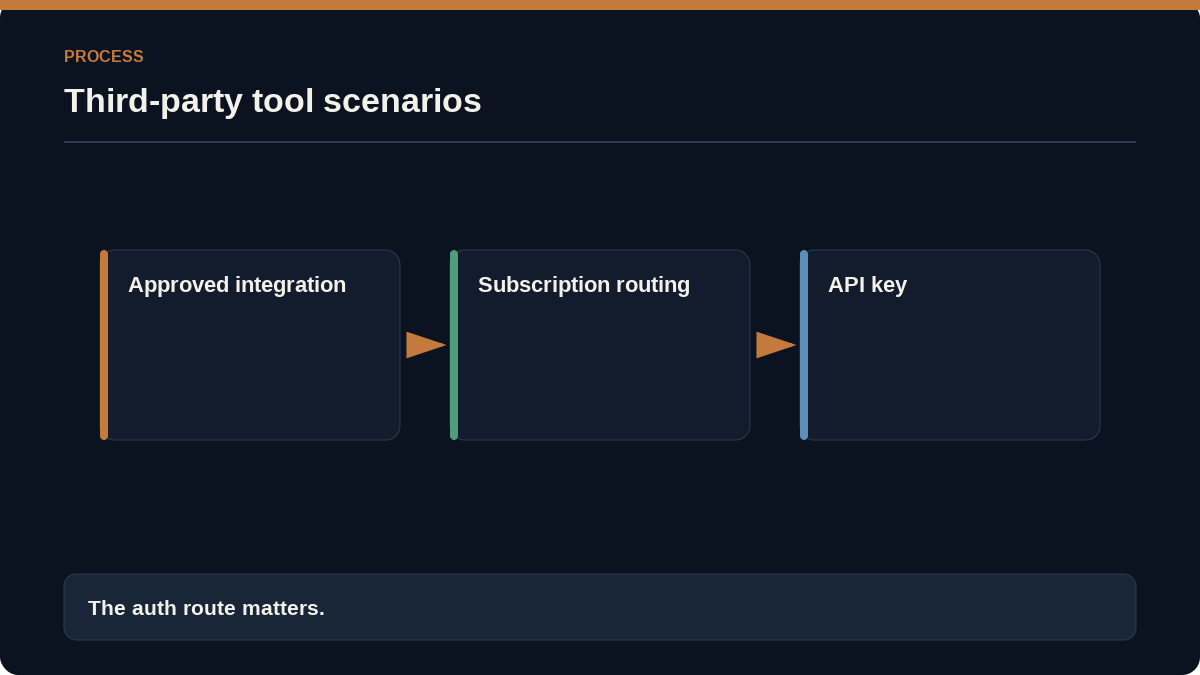
The OpenAI versus Anthropic API format guide explains why a client can be well made and still incompatible with a route. A format mismatch is a technical problem. A subscription-routing restriction is a policy problem. Solve them separately.
The Claude Code custom API base URL guide is relevant when the endpoint changes. Claude Code uses the Anthropic Messages format and a base URL without a trailing /v1. An OpenAI-format agent uses a different endpoint shape. A successful response from one does not validate the other.
The wrapper case deserves extra scrutiny
A wrapper can hide important behavior. It may rewrite the client identity, batch requests, retry through another provider or combine credentials. None of those behaviors is automatically prohibited, but each can affect the routing and limit rules.
Ask for a simple data-flow diagram: client, wrapper, endpoint, credential owner and billing path. If the team cannot explain the path, it is not ready for production review. A black box that happens to return code is not a compatibility assessment.
The Claude Code harness security boundary adds the security question. A third-party process that receives a credential or tool output expands the trust boundary. Use least privilege and keep secrets out of the wrapper’s logs.
What changed, and what the record cannot establish
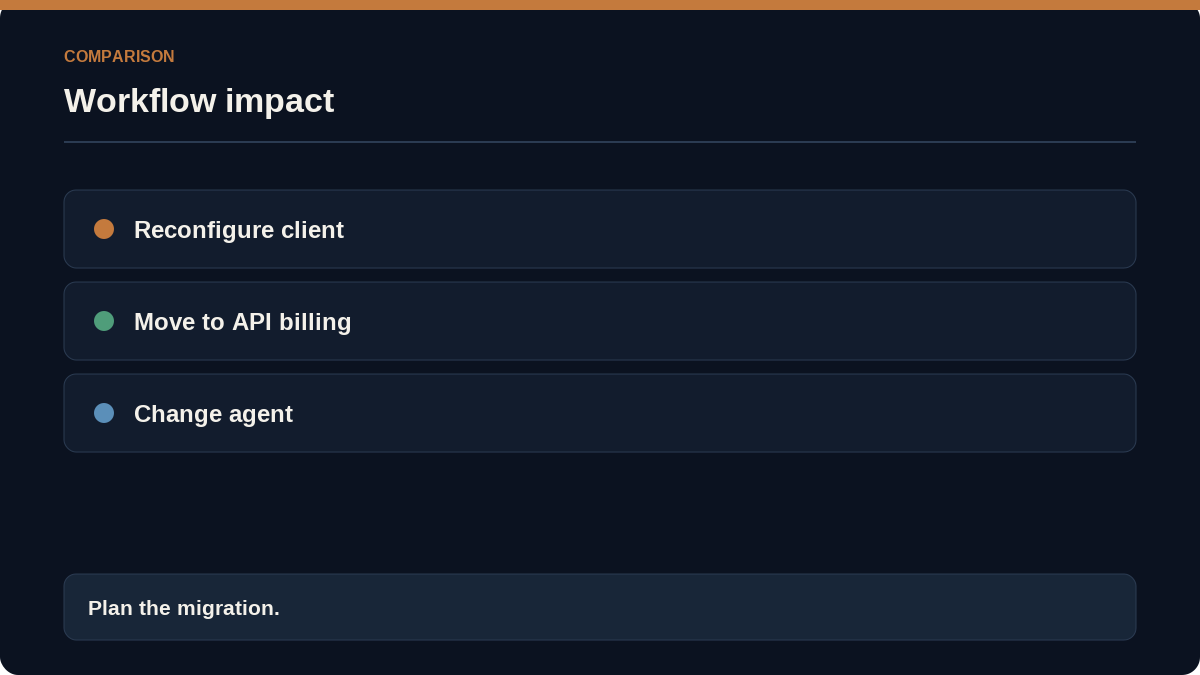
The current guidance changes the workflow in three practical ways.
- Client identity must be reviewed. A tool cannot be treated as transparent merely because it speaks the same API.
- Subscription routing needs a explicit check. A credential should not be used to route traffic against plan limits.
- The authentication route must be documented. Subscription login, API-key billing and gateway routing are different paths with different limits.
Unknown: the fact pack does not establish when the current wording first appeared, which client versions were reviewed, how enforcement notices are issued or how often a particular scenario is rejected. Do not fill those gaps with a story about a secret crackdown or a general ban.
The honest response to that gap is procedural. Keep the policy link, record the review date and recheck before a major client upgrade. The Claude Code exit-plan checklist is useful because a team should not need to invent a new route during an access interruption.
A future update should add official dated guidance and a compatibility matrix published by the client or provider. Until then, the policy text and the actual request path are the evidence.
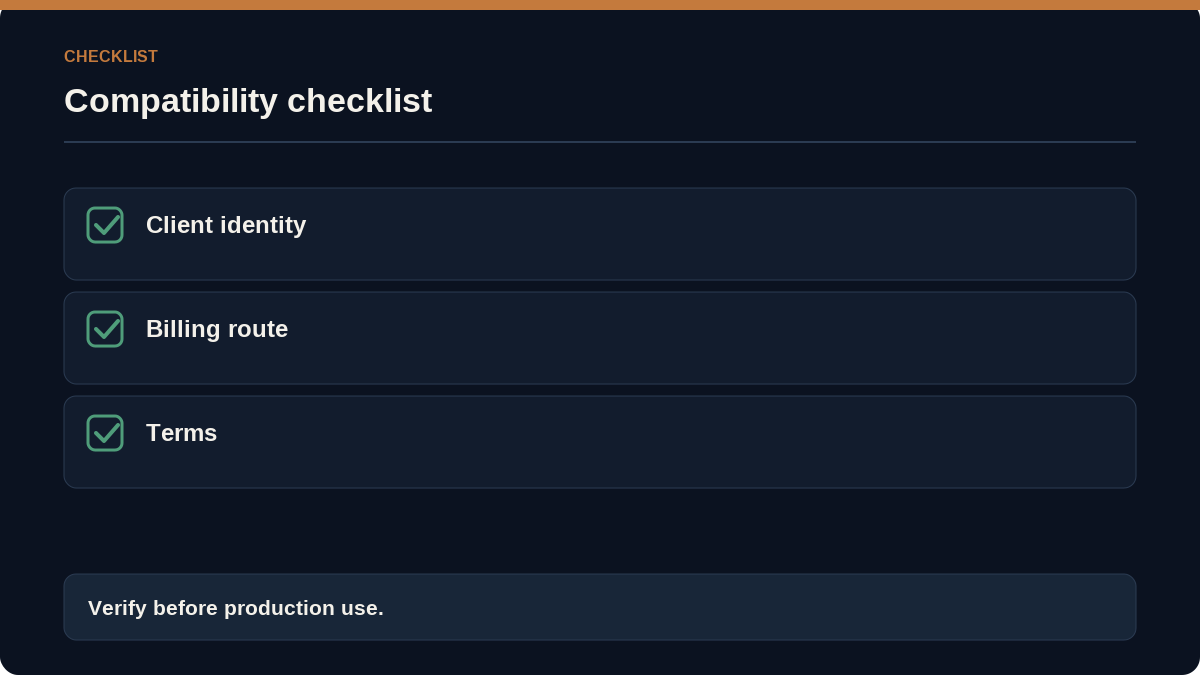
Compatibility checklist before production use
Run this checklist when adding a third-party harness, changing its version or moving a subscription workflow behind a proxy.
| Check | Pass condition | Evidence |
|---|---|---|
| Client identity | The client and operator are accurately represented | Configuration or vendor documentation |
| Credential type | The route uses the intended login or API key | Redacted credential metadata |
| Endpoint | The base URL matches the client format | Effective configuration |
| API format | Request and response shapes match the route | Sanitized contract test |
| Billing owner | The responsible plan or key is known | Billing record without secrets |
| Limits | The applicable cap and reset are understood | Policy or key settings |
| Terms | The intended use fits current guidance | Dated review note |
| Logging | Secrets are not written to logs or saved settings | Sanitized sample output |
| Rollback | The previous approved route remains available | Tested rollback step |
| Monitoring | Failures are visible and attributable | Alert or usage record |
The Claude Code settings-file secret exposure research is directly relevant to the logging check. Secondary research: the Cloud Security Alliance note and Aviatrix summary report 1,379 distinct secrets in public Claude Code settings files. A broader related sample contained 2,539 credentials across 1,994 repositories. The populations are different, and the primary Apiiro page was not accessible in the research pass.
The per-project API key and spend-limit guide provides a useful pattern for the billing check. A dedicated key with a cap and expiry reduces the blast radius of a misconfigured client. The console keys, usage and billing guide can help trace which key produced a request.
Do not store the key in the checklist. Record a key label or fingerprint that the team can map back to the console.
A safe test sequence
Start with a read-only or non-destructive request. Confirm the endpoint, format and credential type. Then run one representative task with a sandbox dependency. Capture the status code, sanitized response and usage record. Finally, test the failure path with an invalid permission or expired test credential.
The Claude Code false-success analysis explains why the failure path matters. A wrapper can turn an upstream error into a misleading success response. The test should verify the final external state, not only the wrapper’s exit code.
The Claude Code proof-of-work packet gives the reviewer a place to record the result. Keep the policy review and the technical test in the same change record so neither is forgotten.
Alternative routing: use the format that works today
The gateway’s documented Claude Code route is not active. All four Claude IDs were marked unavailable on 2026-11-27: claude-sonnet-5-5, claude-sonnet-5, claude-opus-5-5 and claude-haiku-4-5. Do not list them as backups.
The active route is an OpenAI-format agent using https://api.oneaiapikey.com/v1, one key and the 46 live free model IDs. First-party: the models page displayed 76 listed models and 46 available-now free IDs across 22 families on 2026-11-27. All listed models use the OpenAI format; four also accept the Anthropic Messages format. The free IDs are OpenAI-format only.
| Route | Client | Endpoint | Status | Limit boundary |
|---|---|---|---|---|
| Claude Code via gateway | Anthropic Messages client | https://api.oneaiapikey.com |
Four Claude IDs unavailable | Not a live conversion path |
| OpenAI-format agent via gateway | OpenAI-format client | https://api.oneaiapikey.com/v1 |
46 free IDs live | 100 requests and 5,000,000 tokens per day per account |
| Direct Anthropic plan | Claude Code or Claude surfaces | Anthropic-controlled route | Plan-dependent | Shared five-hour and weekly usage rules |
The free lane resets at 05:30 IST, which is 00:00 UTC. Accounts can have up to three API keys, with one request in flight per key on free models. These are first-party limits, not an unlimited service.
The multi-model OpenAI-agent setup shows the active architecture. The 46 free AI model IDs guide explains the format boundary. Neither guide makes the free IDs compatible with Claude Code.
Reviewing a wrapper or client upgrade
A third-party harness is not a static dependency. Its identity string, routing logic, retry behavior and upstream providers can change between versions. A compatibility review should therefore attach to a specific client version and configuration, not to the product name alone.
Start by diffing the old and new configuration. Look for a new endpoint, a changed credential source, an added proxy or a different default model. A minor version bump can alter the effective route even when the visible interface stays the same. Record the effective base URL and format from the running client, with secrets removed.
The Claude Code custom API base URL guide explains why the effective route matters. A shell variable, settings file and saved login can point to different destinations. The review should identify which one the process used, not which one the team intended.
Ask what the wrapper changes
A wrapper can rewrite more than the transport. It may add a system prompt, choose a model, retry failures, batch requests or combine several upstream accounts. Each behavior can affect identity, limits and cost.
Ask the wrapper’s operator for a short data-flow description. It should name the client, the wrapper process, the endpoint, the credential owner and the billing path. If the wrapper selects among models, ask how the selected model is recorded. A cost log that shows only the wrapper’s name is not enough to explain the result.
The model selection guide for coding agents is useful when the wrapper changes models behind the scenes. Run the same acceptance task through each possible route and compare accepted output. Do not assume that a model change is neutral because the prompt stayed the same.
A wrapper that retries can also hide a failed primary request. Preserve the attempt count and the final result. The Claude Code proof-of-work packet provides a place to record commands, exit codes and artifacts. A final success without the retry history is incomplete evidence.
Check the failure path
A compliant-looking success path can still fail policy or security review when the upstream returns an error. Send a controlled invalid request in a sandbox. Confirm that the wrapper preserves the error category, does not retry through an unapproved route and does not print the credential.
The Claude Code false-success analysis explains why the final external state matters. A wrapper can turn an upstream failure into a generic success message. The test should inspect the authoritative resource or provider log, not only the wrapper’s response.
Also test a permission failure. A key that can read but not write should not be able to perform a destructive action through the wrapper. The Claude Code harness security boundary provides the broader trust-boundary checklist.
Review the logs before sharing them
A support packet is a common place for secrets to escape. Save the request shape, status code and sanitized response. Remove authorization headers, cookies, tokens and personal data. If a log contains a credential, rotate it before posting the log anywhere.
The Claude Code settings-file secret exposure research is a useful warning. Secondary research: the two summaries report 1,379 distinct secrets in public Claude Code settings files. A broader related sample contained 2,539 credentials across 1,994 repositories. The populations are different and the primary page was unavailable in the research pass. The practical response is to scan saved settings and treat support artifacts as sensitive.
Recheck limits and billing after the upgrade
A client upgrade can change request size, retry count or model selection. Those changes can alter quota consumption even when the task is identical. Compare the usage record before and after the upgrade on a fixed task.
Official: Claude’s standard five-hour window starts with the first message, weekly limits reset at a fixed account time, and usage is shared across claude.ai, Claude Code and Claude Desktop. Verified Ultra accounts do not have the standard five-hour cap, but a weekly limit still applies. A wrapper that adds requests can reach the limit sooner; it does not create a separate allowance.
Billing controls should be part of the review. Official: users can set a monthly spending cap, receive usage alerts and configure auto-reload. The per-project API key and spend-limit guide describes a useful way to isolate a client experiment. Record the key label, not the secret.
The Claude Code agent-team token analysis is relevant if the wrapper launches multiple agents. Vendor estimate: Anthropic says agent teams can use approximately seven times more tokens than standard sessions when teammates run in plan mode. A wrapper that adds teammates can therefore change the cost shape as well as the route.
Record a decision, not just a test result
The review should end with one of three outcomes: approved for the documented route, approved with named limits, or not approved. Include the client version, configuration, policy link, test evidence and review date. A future upgrade should trigger a new review when the route or identity behavior changes.
This record is also useful during an incident. The live status page can provide external context, while the gateway popularity rankings cannot establish whether a request was correct or permitted. Keep the decision with the code or architecture record so the next engineer can find it.
Honest losses and evidence gaps
A compatible third-party client may be more convenient than a direct subscription workflow. Moving to an API-key route can change billing, limits and features. An OpenAI-format agent is not a drop-in replacement for every Claude Code behavior.
There is also a policy-review cost. A team must document identity, route, billing and terms before it can trust the setup. That work is real, especially when the client is a wrapper with several upstream providers.
Unknown: the frozen record does not provide a complete list of approved clients, a universal enforcement procedure or a dated history of the current guidance. It also does not prove that every third-party tool is banned or that every successful request is compliant. The article therefore makes neither claim.
A future update should add official compatibility guidance and a dated policy history. Until then, keep the claim narrow: verify the documented route, respect the identity and routing restrictions, and do not use unavailable models as a fallback.
Practical response: test a documented OpenAI-format route
If your current harness does not fit the subscription rules, move the experiment to a documented API route rather than trying to disguise the client. One AI API Key offers 46 live free model IDs for OpenAI-format agents. Use https://api.oneaiapikey.com/v1, one key and a selected free ID. The free lane allows 100 requests and 5,000,000 tokens per day per account, shared across the free IDs, with a reset at 05:30 IST.
The Claude Code route remains unavailable: all four Claude IDs were marked unavailable on 2026-11-27. Free IDs do not work in Claude Code’s Anthropic-format route. Start with the 46 live free model IDs, follow the OpenAI-format quickstart, and review the per-key controls before running the compatibility checklist. The live status page can provide incident context, while the gateway popularity rankings are not a compatibility guarantee.
FAQ
Does Claude ban every third-party Claude Code tool?
No. The official guidance prohibits tools that misrepresent identity or route traffic against subscription limits. It does not say every third-party integration is banned.
Is a successful API request proof that the route is allowed?
No. It proves the request was accepted under those conditions. Client identity, routing behavior, billing path and terms still need review.
Can I use a subscription credential in a wrapper?
Do not assume so. If the wrapper changes identity or routes traffic against plan limits, it conflicts with the guidance. Review the data flow before production use.
Do the 46 free model IDs work in Claude Code?
No. They are OpenAI-format only. Claude Code uses the Anthropic Messages route, and the gateway’s four Claude IDs were unavailable on 2026-11-27.
What should a compatibility checklist contain?
Client identity, credential type, endpoint, API format, billing owner, limits, terms, logging, rollback and monitoring. Keep secrets out of the checklist.
Sources
- Claude account login and third-party tool guidance, official credential restrictions.
- Claude plan pricing and Claude Code inclusion, official plan access and prices.
- Claude usage and length limits, official quota mechanics.
- Gateway API format and endpoint reference, first-party format matrix and key controls.
- Coding-agent API key compatibility and Claude Code status, first-party route status.
- Gateway quickstart and supported API formats, first-party setup reference.
- Free model catalogue and daily limits, first-party free-lane count and limits.