Direct answer
Claude Code’s tight Anthropic workflow is both its advantage and its lock-in. The integration can make daily work feel direct, while the exit cost sits in configuration, habits, quota and tooling rather than in one API call. Model portability reduces that risk, but it does not make migration free.
The practical question is not whether Claude Code is “good” or “bad.” It is whether your team can leave without losing the knowledge and controls that make the workflow useful. Inventory the prompts, hooks, context files, permissions, test commands and billing route before you depend on them. Then test a portable path on real tasks.
Route status matters. The documented Claude Code route through the gateway is unavailable: all four Claude IDs were marked unavailable on 2026-11-27. The active route is an OpenAI-format agent using one key and 46 live free model IDs. Those free IDs do not work inside Claude Code’s Anthropic-format route.
Workflow advantages: the integration is real
A tightly integrated coding agent can reduce friction. The tool knows the project’s conventions, invokes commands, reads results and keeps a working thread. That continuity is valuable when the task is ambiguous and the codebase is large.
The advantage is not magic. It comes from a stack of decisions that fit together: the client, the model family, the tool protocol, the permission model, the subscription and the team’s learned prompts. Each decision can be useful alone. Together they create a workflow that is faster to adopt than a loose collection of interchangeable parts.
The Claude Code security harness boundary explains why the surrounding tool configuration matters. The model is only one layer. Permissions, tool access and host controls determine what the agent can actually do.
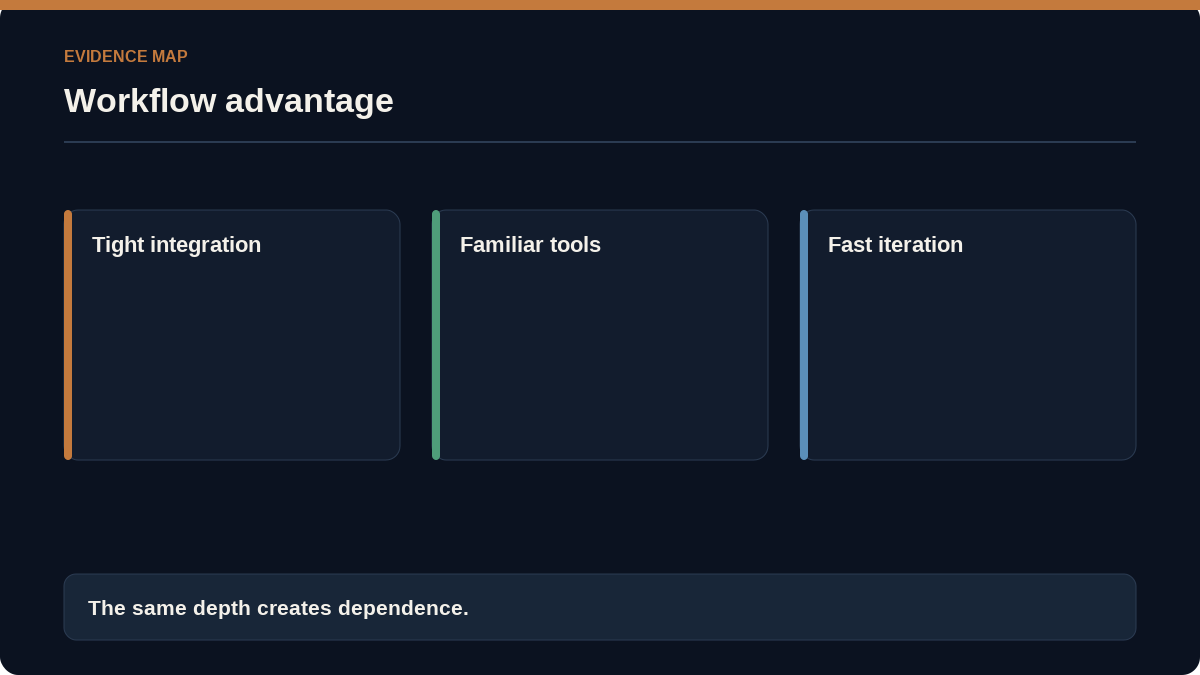
A concrete win is a team that has encoded its conventions in project files, uses a stable review process and gets accepted changes quickly. A concrete loss is the same team discovering that those conventions exist only in Claude Code-specific syntax, hooks or session habits.
The Claude Code cost per verified change keeps the advantage honest. Count accepted changes, not the number of confident sessions. A workflow earns its integration cost when it produces verified value with manageable review effort.
Where lock-in actually lives
Lock-in is often described as a single API endpoint. In practice, it is spread across several layers. Some are easy to export. Others are learned behavior that takes time to rebuild.
| Lock-in mechanism | What becomes specific | Exit cost | Portable substitute |
|---|---|---|---|
| Client configuration | Settings, aliases and tool permissions | Recreate and test each control | Versioned configuration outside the client |
| Project context | Rules, conventions and file layout | Rewrite into the new client’s format | Plain Markdown or structured project docs |
| Hooks and scripts | Lifecycle commands and local automation | Replace unsupported behavior | Repository scripts with explicit commands |
| Prompt habits | Slash commands and repeated instructions | Re-express intent in a portable format | Task templates and acceptance checklists |
| Model behavior | Tone, tool use and planning style | Re-evaluate on your task set | A small model comparison suite |
| Quota and billing | Subscription limits and credit routes | Rebuild budgets and alerts | Per-key limits and usage logs |
| Team knowledge | Who knows which workaround | Document and transfer | Runbooks and review ownership |
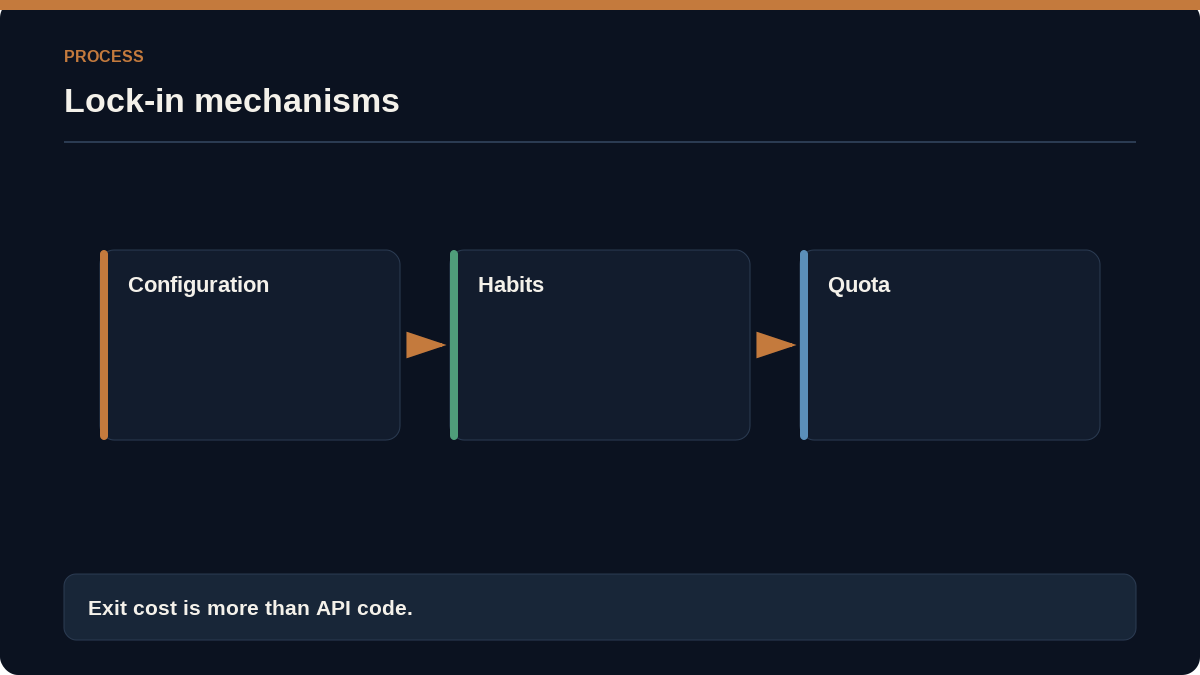
The Claude Code context-portable migration guide turns this inventory into a cutover plan. Start there before changing a base URL. A migration that preserves the key but loses the project’s decisions is not a migration; it is a restart with extra steps.
Quota is part of the dependency
A workflow can become dependent on a plan’s limits as well as its model. Official: Claude Code is not included in the free Claude plan. Pro costs $20 monthly or $17 per month with annual billing, Max costs $100 per month and Ultra costs $200 per month. Claude Code is included in all paid plans, but the plans do not have identical limits.
Official: the standard five-hour window starts when the user sends the first message and resets five hours later. Weekly limits reset at a fixed time assigned to the account. Usage across claude.ai, Claude Code and Claude Desktop counts toward the same usage limit. Verified Ultra accounts do not have the standard five-hour cap, but a weekly limit still applies.
The Claude Code five-hour and weekly limit explainer is essential reading before standardizing a team on one plan. A quota interruption can force a migration at the worst possible moment if no alternative path has been tested.
Billing controls soften the risk. Official: users can set a monthly spending cap, receive usage alerts and configure auto-reload. Usage credits are billed at standard API rates. The Ultra API credits versus Claude Code usage analysis explains why monthly API credits and interactive Code usage are separate balances.
Lock-in grows when a team treats a subscription allowance as a fixed engineering resource. A portable budget records the plan, the expected usage, the reset behavior and the backup route.
The exit-cost worksheet
An exit-cost worksheet should be filled before the emergency. It does not need to be elaborate. It needs to name what must move, who owns it and how the team will know the move worked.
| Item | Current location | Portable form | Owner | Parity test |
|---|---|---|---|---|
| Project rules | Claude Code context files | Plain Markdown plus loader | Tech lead | New agent follows the same constraints |
| Repeated prompts | Slash commands or saved snippets | Task templates | Developer | Same acceptance criteria produced |
| Hooks | Client lifecycle settings | Explicit repository scripts | Build owner | Command runs before and after the same event |
| Permissions | Client settings | Least-privilege policy | Security owner | Forbidden action is still blocked |
| Test commands | Session history | CI and local scripts | Reviewer | Clean checkout passes the suite |
| Usage limits | Plan and account settings | Per-key caps and alerts | Operator | Cap triggers as expected |
| Incident notes | Chat or memory | Versioned runbook | On-call owner | New teammate can recover without the old session |
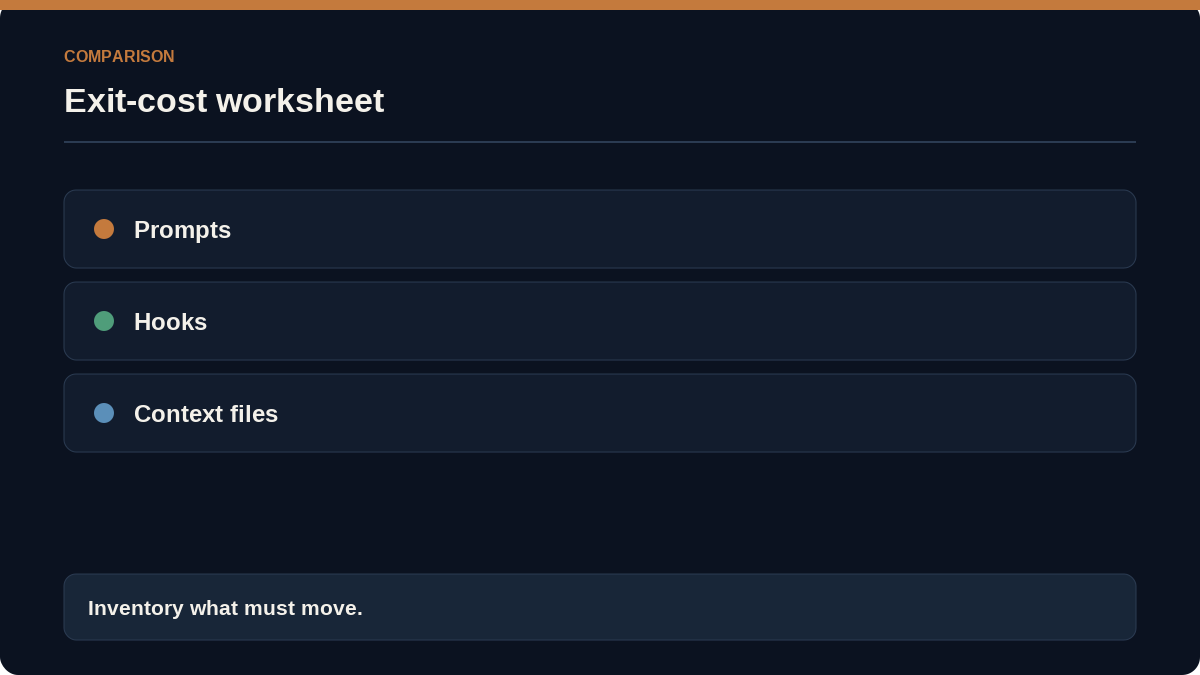
The Claude Code proof-of-work packet is a useful parity test. Run the same task through the old and new workflows, then compare changed files, test output and external-state evidence. A similar final paragraph is not enough.
The Claude Code false-success analysis explains why. A migration demo can pass while the real integration is broken. Keep the hidden acceptance test constant across both paths.
Claude Code route status and OpenAI-agent alternative
The route comparison must start with what works today. The gateway documents a Claude Code-compatible Anthropic Messages route, but all four Claude IDs were marked unavailable on 2026-11-27. The IDs are claude-sonnet-5-5, claude-sonnet-5, claude-opus-5-5 and claude-haiku-4-5. None should be presented as a live fallback.
The documented Claude Code base URL is https://api.oneaiapikey.com with no trailing /v1, because the client appends the Messages path. That technical detail does not make the route available. A correct endpoint with unavailable model IDs is still a dead path.
The active alternative uses an OpenAI-format agent, https://api.oneaiapikey.com/v1, one key and the 46 live free model IDs. All listed models use the OpenAI format; four also accept the Anthropic Messages format. The free IDs are OpenAI-format only.
| Route | Client format | Endpoint | Model status | Safe claim |
|---|---|---|---|---|
| Claude Code via gateway | Anthropic Messages | https://api.oneaiapikey.com |
Four Claude IDs unavailable | Documented, not active |
| OpenAI-format agent via gateway | OpenAI format | https://api.oneaiapikey.com/v1 |
46 free IDs available | Active free lane |
| Direct Anthropic subscription | Claude Code client | Anthropic-controlled route | Plan-dependent access | Separate billing and quota path |
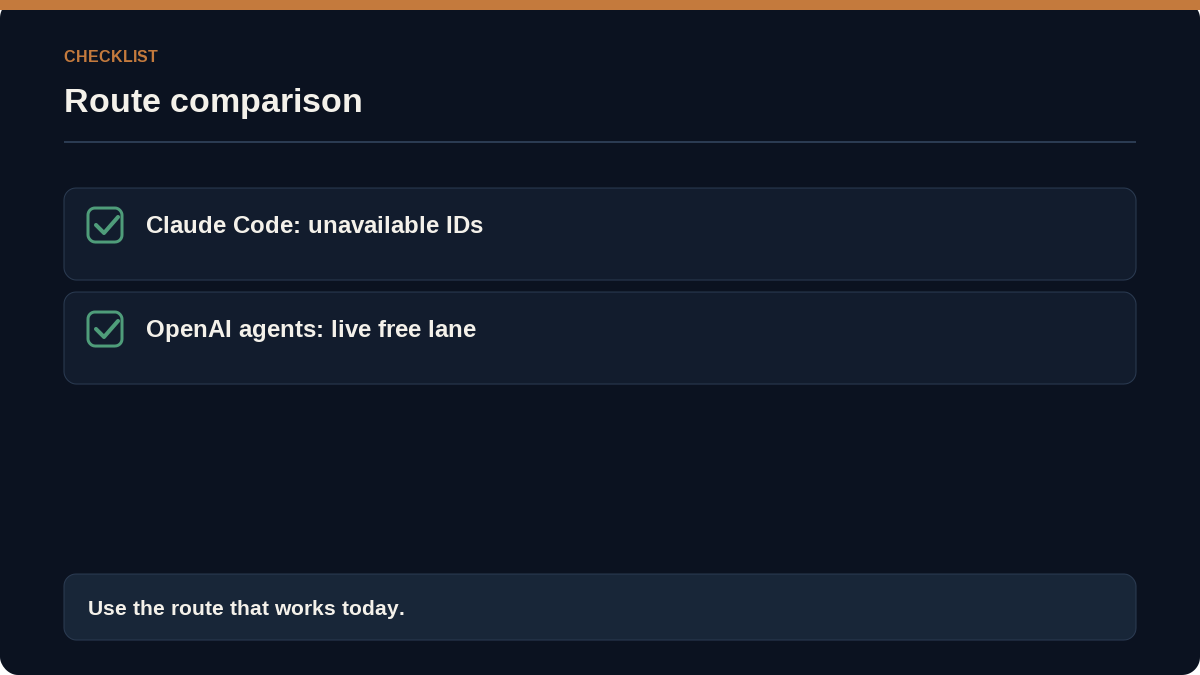
The coding-agent API key compatibility guide and the OpenAI versus Anthropic API format guide explain the client boundary. Do not point an OpenAI-format client at the Claude Code route or assume a free ID will work inside Claude Code.
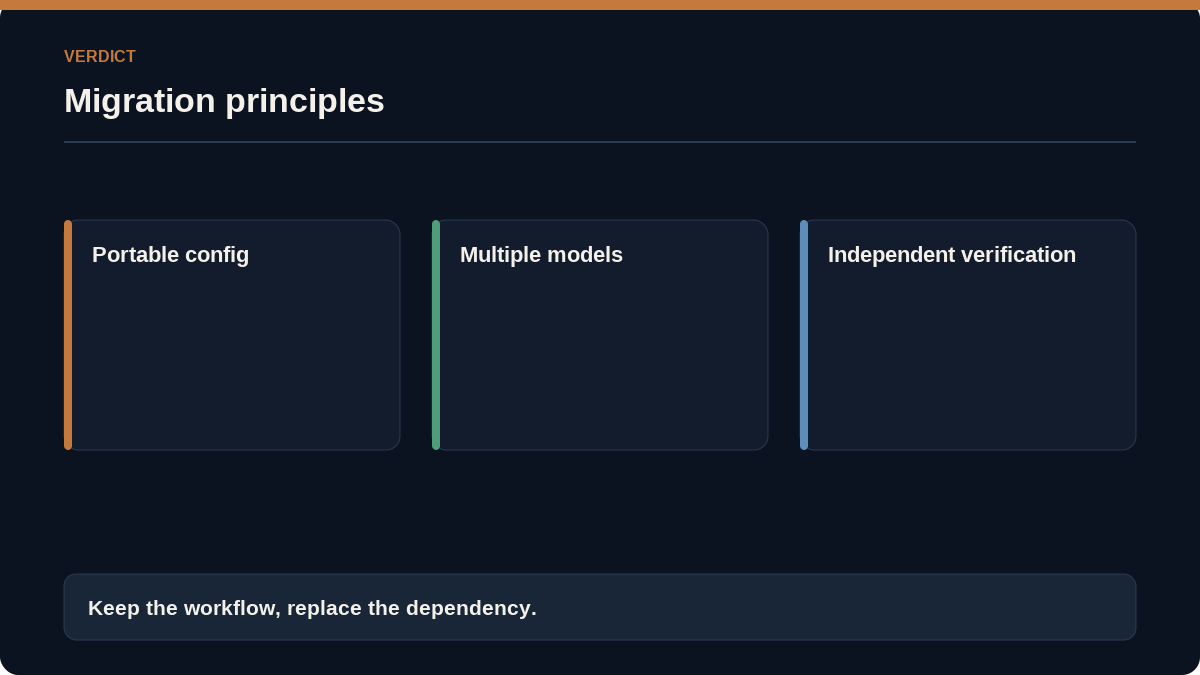
Migration principles that preserve the workflow
A good migration keeps the useful parts and replaces the dependency. It does not attempt to copy every client-specific detail.
Separate knowledge from syntax
Project rules should express decisions in plain language: architecture constraints, test commands, forbidden directories, naming conventions and known failures. The destination client can receive the same knowledge through its own context mechanism.
The Claude Code context versus memory guide explains why written task state matters. A migration should preserve decisions, not just file paths.
Make hooks explicit
A hook that runs automatically in one client may need an explicit command in another. Move the underlying script into the repository and document when it should run. Then test both the success and failure paths.
The Claude Code harness security boundary is a useful checklist for permissions. Portability should not mean giving the new agent broader access than the old one.
Keep acceptance independent
The test suite, hidden acceptance cases and external-state checks should survive the move unchanged. That is how the team compares workflows rather than comparing demos.
The Claude Code verification packet provides the format. The Claude Code April 2026 postmortem shows why version and configuration belong in the record. Official: Anthropic dated three changes, reverted or fixed them, and says the fixes landed in v2.1.116 with usage limits reset on 2026-04-23.
Budget the transition
A parallel run costs money and attention. Keep it bounded: one representative task set, one review owner and a decision date. The monthly LLM API cost worksheet helps separate transition cost from steady-state cost.
The budget should include the less visible work: rewriting context files, replacing hooks, reviewing both paths and documenting the decision. A migration plan that counts only token spend understates the engineering effort. Record those hours separately so the team can compare the true cost of staying with the true cost of leaving.
Third-party harness rules affect the exit path
A migration is not only a technical change. It can also change which credentials and clients are permitted. Official: Claude’s third-party login guidance prohibits tools that misrepresent identity or route traffic against subscription limits. It does not say every third-party tool is banned.
The Claude Code third-party harness rules explains the distinction. Check client identity, billing route and terms before moving a subscription workflow. Do not design a migration around bypassing a restriction.
The Claude Code data usage documentation is another portability consideration. Official: consumer users can allow data to be used for training; non-opted-in consumer data has 30-day retention; commercial API, Team, Enterprise and Government data are not used for training by default. A new route can have different data handling even when the prompt and model behavior feel similar.
A worked exit-cost example
Consider a small team that has used Claude Code for a year. The team has project rules, three repeated prompts, two local hooks, a shared test command and a habit of starting long sessions without writing down the acceptance criteria. The subscription is familiar, and most days work well.
The team does not need to migrate because a blog post says lock-in is bad. It needs a portable path because a quota interruption, account problem or model change should not erase a day of work. The example below is illustrative. It contains no measured switching time or customer result.
Inventory the knowledge before the client
The first step is to copy the project’s decisions into plain files. The file should explain the architecture, the test command, the forbidden directories, the deployment boundary and the known failure modes. It should not depend on a slash command or a client-specific directive to make sense.
The Claude Code context-portable migration guide provides the broader inventory. For this team, the repeated prompts become task templates: one for a bug fix, one for a feature and one for a migration. Each template names the expected result and the evidence required for acceptance.
This step has a concrete win: the knowledge becomes reviewable by the whole team. It also has a loss. Plain files do not reproduce every convenience of the old client, and someone must keep them current.
Turn hooks into repository commands
The local hooks should become scripts with explicit names. If a hook formats files before a command, the repository script should do the same thing. If a hook blocks a dangerous path, the script should return a nonzero exit code and explain why.
The Claude Code harness security boundary helps preserve the permission model. Portability should not silently widen access. Test the replacement from a clean checkout and confirm that the forbidden action is still blocked.
The per-project API key and spend-limit guide is useful for the billing side. Give the portable experiment its own key and cap. That separates the test from the production subscription and makes the usage easier to attribute.
Choose a destination by accepted work
Do not choose the destination by a single demo. Use a small task set: one bug, one feature, one refactor and one integration check. Run the same acceptance tests through each candidate. Record changed files, test output, external-state evidence and review time.
The model selection guide for coding agents provides a starting framework, but the team’s repository is the real test. A model that plans well may still need more integration help. A faster model may need more turns. The useful comparison is cost and effort per accepted result.
The Claude Code false-success analysis is the guard against a polished demo. Keep one hidden acceptance case that the visible tests do not contain. If the destination workflow passes only the demo, the migration is not ready.
Run a bounded parallel period
Keep the old workflow available while the new one handles a limited set of tasks. Give the parallel period a decision date. Without an end point, the team can accumulate two workflows and call the second one a backup even though nobody uses it.
The Claude Code proof-of-work packet makes the comparison consistent. Require the same fields from both paths. The Claude Code April 2026 postmortem shows why version and configuration belong in the record. Official: Anthropic dated three changes and says the fixes landed in v2.1.116 with usage limits reset on 2026-04-23. A fair comparison needs the same discipline.
Record usage in a place the team can audit. The console keys, usage and billing guide can help locate request and cost records. The acceptance decision still belongs in review, not in a usage dashboard.
If the portable path fails because of an external incident, preserve the failure and rerun after the incident. The live status page can provide context. The gateway popularity rankings cannot establish correctness. Popularity is not a parity test.
Decide with a rollback trigger
The team should decide in advance what would send it back to the old workflow: a quality drop, a tool failure, a cost spike or an unresolvable permission gap. The Claude Code context-portable migration guide treats rollback as part of the cutover plan, not an admission of defeat.
A rollback trigger is useful only if the old path still works. Leave the old configuration available during the parallel period, but do not keep production credentials in the portable repository. Store secrets through the team’s normal secret mechanism.
The worked example ends with a decision, not a slogan. The team may keep Claude Code, use the portable path for overflow, or move routine work to the new client while retaining the old one for a specific task. All three outcomes can be rational if the evidence supports them.
What not to migrate blindly
Some artifacts should be redesigned rather than copied. A prompt that relies on a client-specific tool name may need a new instruction, not a find-and-replace. A hook that depends on an internal lifecycle event may need a repository script. A permission rule that was never tested should be treated as a hypothesis.
Do not migrate secrets with the project files. Inventory credential names and storage locations, then create new credentials for the destination where appropriate. Revoke the old ones according to the cutover plan. The Claude Code settings-file secret exposure research is a reminder that saved settings can contain literal commands and credentials. Secondary research: the two summaries report 1,379 distinct secrets in public Claude Code settings files, while a broader related sample contained 2,539 credentials across 1,994 repositories. The populations are different and the primary page was unavailable in the research pass.
Do not migrate an untested assumption about data handling either. The destination may have different retention, training or subprocessor terms. The Claude Code privacy and retention rules provide a useful comparison checklist. Official: standard commercial retention is 30 days, and zero data retention exists for qualified Enterprise accounts and eligible products with exceptions. A portable workflow still needs a data decision.
Finally, do not migrate the review process itself unless that is an explicit goal. The acceptance criteria, hidden tests and external-state checks should remain stable while the client changes. That stability is what makes the exit-cost comparison meaningful. A new client should have to earn trust against the same standard as the old one.
Honest losses and evidence gaps
Leaving a tight workflow has a real cost. The old client may handle a lifecycle event, permission prompt or context convention better than the replacement. A portable setup can be more explicit and less convenient.
The evidence also cannot quantify your exit cost. Unknown: the fact pack contains no measured switching-time benchmark, no general migration failure rate and no controlled comparison of Claude Code-specific configuration with portable equivalents. The worksheet is a management tool, not a predictive model.
A future update should include a completed migration example with a before-and-after inventory, parity tests and measured review time. Until then, the honest claim is narrow: portability reduces dependence, but it requires engineering work. The worksheet is most valuable when it exposes a dependency early enough to test it, rather than during an account lock or quota interruption. Assign one owner to each unresolved item, and review the inventory whenever the client or model changes. A dependency that is written down can be tested, replaced or accepted deliberately. This is the practical value of an exit-cost worksheet, and it is why the inventory belongs in the repository.
Practical response: build a portable lane before you need it
Maintain the current workflow if it is producing verified value. Add a portable path alongside it, then test that path on a small task set. Preserve project knowledge in plain files, keep acceptance tests independent and record the effective model and route for each run.
If you want to test the active multi-model route, One AI API Key provides 46 live free model IDs for OpenAI-format agents. Use https://api.oneaiapikey.com/v1, one key and a selected free ID. The free lane allows 100 requests and 5,000,000 tokens per day per account, shared across the free IDs, and resets at 05:30 IST.
The Claude Code route remains unavailable: all four Claude IDs were marked unavailable on 2026-11-27. Free IDs do not work inside Claude Code. Start with the 46 live free model IDs, follow the OpenAI-format quickstart, and use the cost calculator to compare accepted work. The point is not to abandon a useful workflow. It is to avoid letting one provider own every layer of it.
FAQ
Is Claude Code lock-in only the model API?
No. Configuration, project context, hooks, permissions, prompt habits, quota and team knowledge can all create switching costs. The API endpoint is only one layer.
Can I move Claude Code context files to another agent?
You can preserve the knowledge, but not every file format or behavior will map directly. Move rules into plain documents, load them through the new client and test parity on real tasks.
Does the gateway’s Claude Code route work today?
No. All four Claude IDs were marked unavailable on 2026-11-27. The documented route should not be presented as a live fallback.
Do the 46 free model IDs work in Claude Code?
No. They use the OpenAI format and work through OpenAI-format agents. Claude Code uses the Anthropic Messages route, whose four gateway IDs are unavailable.
What is the first migration step?
Inventory what must move: prompts, hooks, context files, permissions, test commands and billing controls. Assign an owner and a parity test to each item before changing the client.
Sources
- Claude plan pricing and Claude Code inclusion, official plan access and prices.
- Claude usage and length limits, official window, weekly and shared-usage rules.
- Claude account login and third-party tool guidance, official credential restrictions.
- Claude Code data usage, official training and retention scope.
- Gateway API format and endpoint reference, first-party format matrix and key controls.
- Coding-agent API key compatibility and Claude Code status, first-party route status.