Direct answer
Claude Code has no free tier. The free Claude plan cannot run Claude Code sessions, and the cheapest paid plan that includes Claude Code is Pro at $20 per month. Annual billing lowers the advertised monthly equivalent to $17, but you pay $200 up front. Max costs $100 per month and Ultra costs $200 per month. All paid plans include Claude Code, though their limits are not identical.
That is the entry-price answer. It is not a token price, a promise of unlimited use, or proof that Pro is the right plan for every developer. The useful buying question is whether your accepted, verified work justifies the subscription after review, rework and quota interruptions. The Claude Code cost per verified change model gives you a way to answer that without pretending a monthly fee equals an API rate.
What the free Claude plan includes
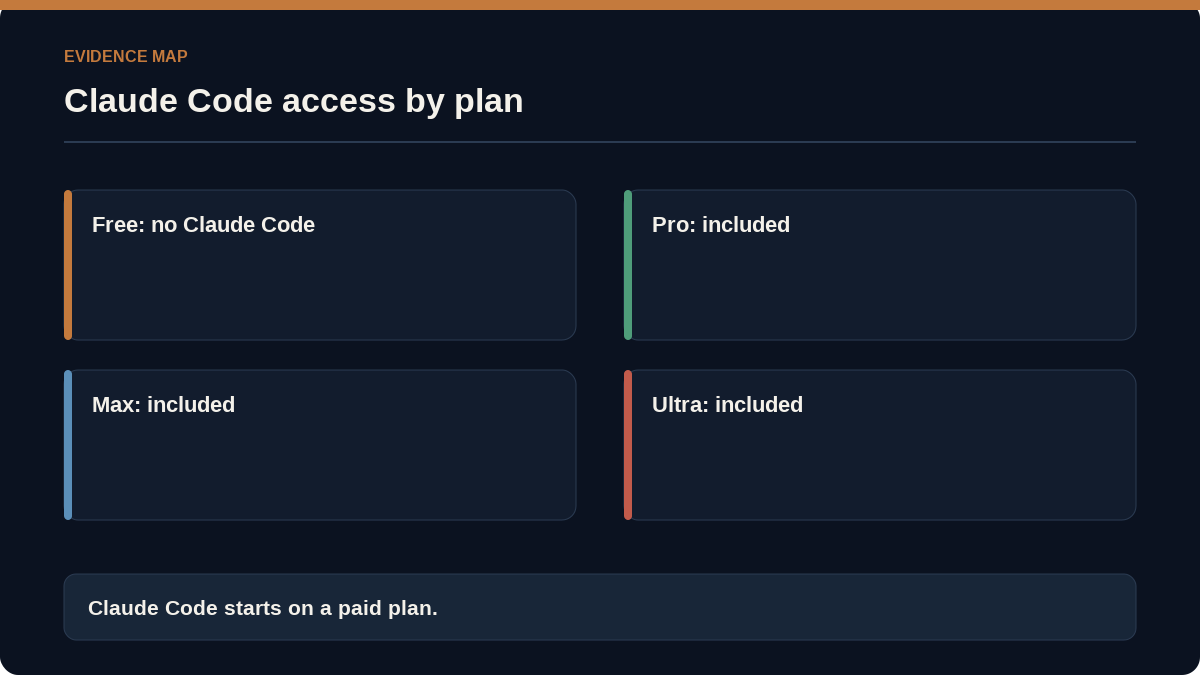
The free Claude plan is a Claude product, but it is not a Claude Code entitlement. Official: Anthropic’s pricing page marks Claude Code as unavailable on Free and included on Pro, Max and Ultra. A free chat plan therefore cannot be treated as a free coding-agent seat.
This distinction matters because the two products can look adjacent in a browser tab. You might use Claude for a question, then expect the same account to open a repository-wide coding session. The plan matrix says otherwise. The free plan stops at the boundary of Claude Code access.
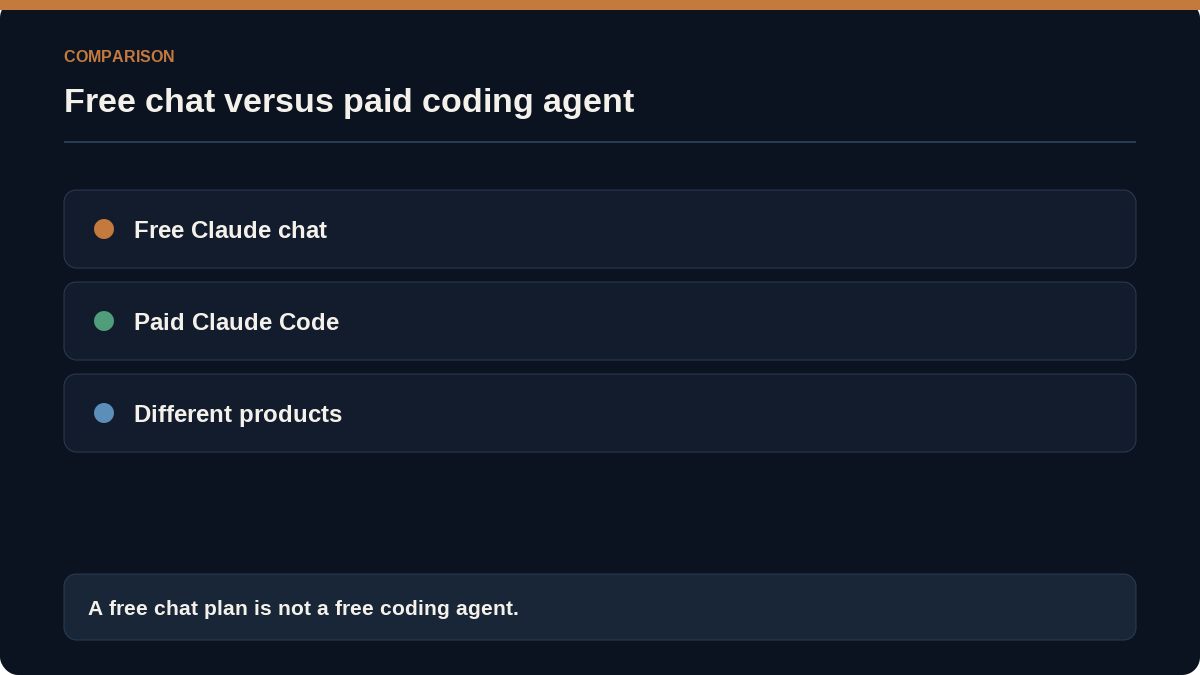
For a buyer, that boundary is useful. It prevents a common budgeting mistake: counting a free chat subscription as though it already covers terminal work, repository context, tool calls and multi-step agent sessions. The decisions differ. If your workload is mostly short questions, the free plan may be enough for that workload. If your workload requires Claude Code, the free plan contributes no usable Claude Code access.
The same logic applies to trials and shared accounts. A colleague’s paid account does not create a free tier for you. A team cannot price five developers by counting one paid plan and four free chat accounts when all five need coding sessions. Each person who needs Claude Code access needs a plan that includes it.
There is also a measurement trap here. The absence of a free tier does not mean every paid session delivers the same value. One developer may finish a focused change in a short session. Another may spend the same fee on long loops that still require substantial review. The Claude Code proof-of-work packet is a better acceptance tool than the size of the generated diff. Price the outcome you keep, not the activity you see.
What Claude Code requires
Claude Code requires a paid Claude plan. Pro is the entry plan at $20 monthly or $200 billed annually. Max is $100 per month. Ultra is $200 per month. Official: the pricing page includes Claude Code on all three paid plans.
Included does not mean identical. The standard five-hour usage window and weekly limit still matter, and the limits differ by plan. The Claude Code five-hour and weekly limits explain the reset mechanics. The Claude Ultra five-hour exception explains why verified Ultra accounts are a specific exception rather than proof that every paid plan works the same way.
Do not turn a subscription allowance into a made-up token price. A Pro subscription is a flat access purchase with usage limits. It is not an official conversion of dollars into a fixed number of input or output tokens. If you need API arithmetic, use published API rates instead. The Fable 5.2 agent-loop pricing math starts from official per-million-token rates and keeps that calculation separate from subscription quotas.
The plan also does not erase account or policy risk. Access can depend on location, account standing and terms. The Claude Code suspension notice gaps cover the official grounds and the limits of public evidence. A paid receipt is not a guarantee that an account will never be restricted.
For privacy-sensitive work, the plan name is only the first question. Consumer and commercial products have different training and retention defaults. Read the Claude Code privacy and retention rules before putting sensitive repository material into any service. Paying for Claude Code does not automatically create zero retention. The Claude Code zero-data-retention limits explain the qualified Enterprise scope and its exceptions.
The plan access matrix
| Plan | Monthly price | Annual price | Claude Code included | Buying note |
|---|---|---|---|---|
| Free | $0 | $0 | No | Useful only if you do not need Claude Code |
| Pro | $20 | $200 up front | Yes | Lowest paid entry point |
| Max | $100 | Not stated in the frozen fact pack | Yes | Higher plan, different limits |
| Ultra | $200 | Not stated in the frozen fact pack | Yes | Verified Ultra has no standard five-hour cap, but a weekly cap remains |
The blank annual cells are deliberate. The frozen evidence supplies Pro’s annual price, not a verified annual price for Max or Ultra. Filling those cells from memory would make the table look complete while weakening the buying advice.
Pro annual versus monthly math
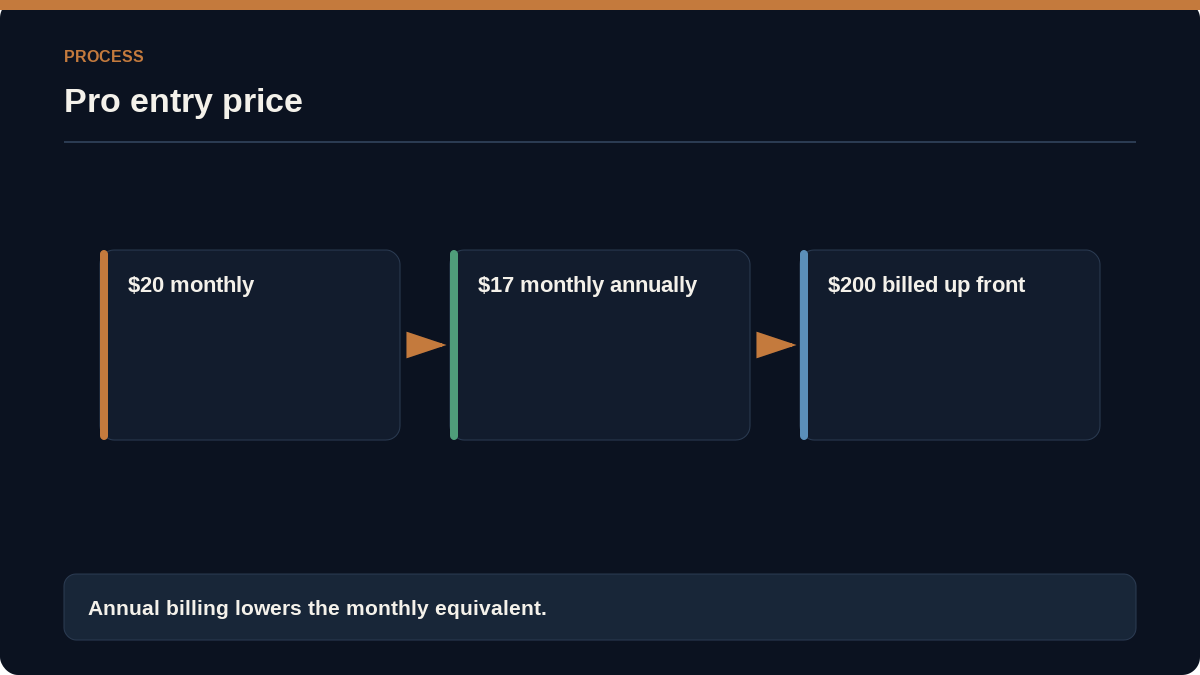
Pro costs $20 per month on monthly billing. Annual billing costs $200 up front and is advertised as $17 per month. Derived: $200 divided by 12 is $16.666…, which rounds to about $16.67 per month. The advertised $17 figure is a rounded monthly equivalent, not a separate monthly charge.
The annual saving against twelve monthly payments is straightforward. Twelve payments of $20 equal $240. The annual plan costs $200. The difference is $40 per year.
Derived formula: ($20 × 12) - $200 = $240 - $200 = $40 saved.
| Billing choice | Cash due | Twelve-month cost | Monthly equivalent | Main trade-off |
|---|---|---|---|---|
| Monthly | $20 each month | $240 | $20 | Lower commitment, higher yearly total |
| Annual | $200 up front | $200 | About $16.67 | Lower yearly total, earlier cash outlay |
| Difference | $40 more cash at signup for annual | $40 saved over 12 months | About $3.33 lower | Annual only wins if you keep the plan long enough |
The break-even framing is simple because the annual plan is already cheaper over a full year. If you expect to use Pro for twelve months, the annual plan saves $40. If you expect to cancel after two months, monthly billing costs $40 while the annual plan has already cost $200. The annual discount is real, but it is not a reason to prepay for a workflow you have not tested.
A sensible sequence is to pay for one month, run representative work, and record accepted changes. If the workflow earns its place, annual billing can reduce the yearly cost. If it does not, you have learned that for $20 rather than $200. The monthly LLM API cost worksheet is useful for API work, but keep it separate from this subscription calculation.
Who should pay for Pro
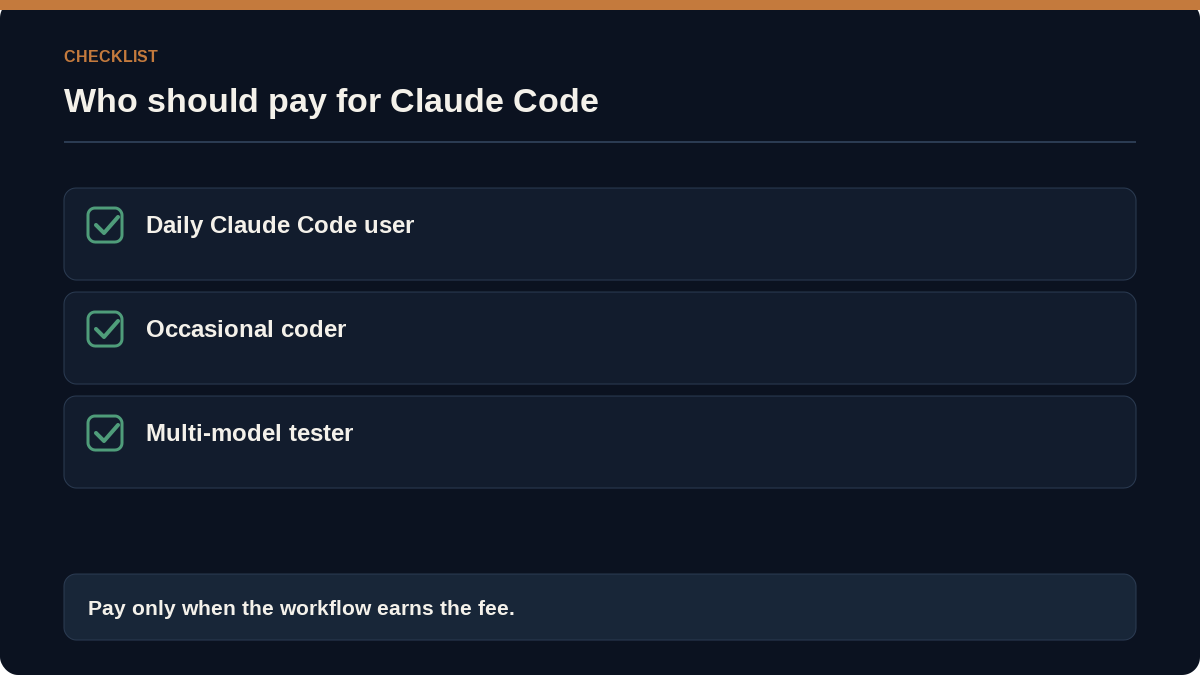
Pro makes sense when Claude Code is part of a repeatable workflow and the subscription is small beside the value of the work you accept. A daily user who can point to completed changes, passing checks and manageable review time has a clearer case than someone who subscribes because coding agents feel productive.
Start with the work, not the plan badge. Choose a small set of real tasks: a bug fix with a regression test, a refactor with existing tests, a feature with clear acceptance criteria. Record how long review takes and how much rework remains. The Claude Code verification scorecard helps turn those observations into a cost per accepted change.
Heavy users should read the quota rules before choosing a plan. The standard five-hour window begins with the first message, not at signup or midnight. Weekly usage resets at a fixed time assigned to the account. Usage across claude.ai, Claude Code and Claude Desktop shares the same limit. A developer who uses Claude chat during the day may therefore reach the coding limit earlier than expected.
Budget discipline still matters on paid plans. Anthropic documents usage credits, monthly spending caps, usage alerts and auto-reload. The Ultra API credits versus Claude Code usage guide explains why those controls and balances need separate tracking. Paying for Pro does not mean every possible overage is impossible, and it does not mean there are no controls.
Pro is a weaker fit when you only need occasional help, when your work cannot be reviewed properly, or when account access is a hard dependency. In those cases, a cheaper or more portable workflow may be worth testing before you prepay for a year. The Claude Code lock-in and exit costs covers configuration, habits and quota dependence that a low entry price can hide.
A decision table for the entry price
| Your situation | First move | Why |
|---|---|---|
| You need Claude Code most workdays | Test Pro monthly | The $20 entry fee is easier to justify with repeated accepted work |
| You expect a full year of use | Consider annual Pro after the test | $200 is $40 below twelve monthly payments |
| You only need short chat answers | Do not buy Claude Code for that | The free Claude plan is a separate product boundary |
| You need long sessions without the standard five-hour cap | Review verified Ultra carefully | Ultra is $200 monthly and still has a weekly cap |
| You want model choice before committing | Test an OpenAI-format agent route | Keep the evaluation separate from a Claude Code subscription |
The honest loss in the $20 answer
The entry price is clear, but clarity is not the same as value. A $20 subscription can be excellent for one workflow and poor for another. The public fact pack does not contain an individual developer’s acceptance rate, review time or monthly task volume. Those remain Unknown until you measure them.
There is also a quota loss. Pro includes Claude Code, but inclusion does not promise uninterrupted access. The April 2026 Claude Code postmortem is a dated example of how defaults, caching and prompt changes can affect quality and usage. It does not prove that the same problems persist today. It does show why a plan purchase should be paired with version notes, reproducible tests and a backup path.
Annual billing adds a second loss: flexibility. The $40 saving is useful only if you keep the plan. Monthly billing costs more over twelve months, but it preserves the option to stop after a workflow disappoints. For a first purchase, that option has value.
Finally, the free-tier search itself can distract from the real question. A developer does not need a free Claude Code tier to run a useful evaluation. They need a safe task set, a way to verify output and a route that matches the agent format. The next section keeps that test practical without implying that free models run inside Claude Code.
A one-month buying test
A month is long enough to see ordinary work and short enough to limit a bad purchasing decision. Start with monthly Pro rather than annual billing. The purpose is not to prove that Claude Code is good in general. The purpose is to find out whether it earns $20 inside your workflow.
Choose tasks before the month begins. A useful set includes one bug fix, one refactor, one feature with a clear acceptance condition, and one investigation where the correct answer may be that more evidence is needed. Keep the repositories representative. A toy task can teach you the interface, but it cannot tell you how much review a real change requires.
For each task, write the expected result before the agent starts. Then record what changed, which checks ran, and what you accepted. If the agent produces a plausible summary but you cannot reproduce the result, the task is not complete. The Claude Code proof-of-work packet gives you a compact format for those receipts.
Track review time separately from generation time. A change that appears quickly but takes an hour to review has not saved an hour. Rework belongs in the same record. If you rewrite most of the agent’s patch, count the accepted portion rather than the generated diff.
At the end of the month, calculate cost per verified change. The cost-per-change worksheet includes subscription cost, API spend, review and rework. Divide by changes that met your acceptance criteria. This is Derived decision arithmetic, not a productivity benchmark.
The test should also record interruptions. Note whether a five-hour reset, weekly limit, account issue or model behavior stopped the work. The Claude Code single points of failure guide separates those failure domains. A subscription can be good value while still being a poor single point of dependence.
What the $20 price does not tell you
The Pro fee answers an access question. It does not answer a quality question, a retention question or a portability question. Those require separate evidence.
On quality, the frozen fact pack contains no individual acceptance rate for Claude Code. It also contains no promise that a paid session will finish a task without review. The April 2026 postmortem is useful because it documents specific regressions and fixes, not because it proves a permanent defect. Use your own task results for the buying decision.
On data handling, identify whether the work belongs under consumer or commercial terms. Consumer training is optional, while commercial API, Team, Enterprise and Government data are not used for training by default. Standard commercial retention is 30 days, and qualified Enterprise zero-data-retention coverage has exceptions. The privacy and retention rules and zero-data-retention limits are required reading before sensitive work.
On portability, a low entry fee can still hide exit costs. Prompts, hooks, context files and team habits may need work before another agent can reproduce the workflow. The Claude Code lock-in and exit costs guide turns those hidden costs into a checklist. A monthly subscription is easier to leave than an annual one, but the workflow can still be dependent on one provider.
None of these gaps cancels the $20 price. They define what the price excludes. A buyer who keeps the categories separate can compare plans without asking one number to answer every question.
A purchase checklist you can reuse
Before paying, write down the tasks that justify the tool. Be specific enough that another developer could recognize a finished result. “Help with code” is not a purchase criterion. “Fix the failing checkout test without changing the public API” is.
Next, define the evidence you will accept. A passing test is one signal. A reviewed diff, a manual check of the affected path and a record of external side effects are stronger. The Claude Code verification checklist helps you ask for the right proof when the agent says a task is complete.
Set a review budget before the month starts. Decide how much time you can spend inspecting generated changes and correcting mistakes. If review consumes the time you expected to save, the subscription has not earned its price yet. This is not an argument against agents. It is a way to keep the evaluation honest.
Record the billing route as well. A Claude subscription, monthly API credits and interactive Claude Code usage credits are different balances. The Ultra credit separation guide explains the distinction. Do not assume that a credit included with one plan pays for every kind of usage.
Finally, decide what would make you stop. The trigger might be low acceptance, high review time, repeated quota interruptions or a policy requirement you cannot meet. Write the trigger down while you are calm. The Claude Code exit-plan checklist turns that decision into a prepared next step instead of an emergency rewrite.
A good purchase record does not need to be elaborate. One page per month is enough: tasks attempted, tasks accepted, review time, interruptions and the decision to continue, change plan or stop. The point is to make the next renewal a review of evidence rather than a habit.
Compare subscription and API billing without mixing them
A subscription and an API balance answer different questions. The subscription buys access to Claude Code under a plan. API billing pays for requests made through an API route. The Ultra API credits versus Claude Code usage guide explains why the balances should not be treated as interchangeable.
For a subscription comparison, use the plan fee and the work accepted during the billing period. For an API comparison, use the published per-token rates and the request shape. The Fable 5.2 agent-loop pricing math shows how repeated context changes that second calculation. Do not divide a subscription allowance by a guessed token count to make the two systems look comparable.
A fair evaluation can still use both routes. Run the same small task set through each, record the interface differences, and verify the output independently. The OpenAI versus Anthropic API format guide explains why the client format matters. The goal is not to force one billing model into the shape of the other. It is to choose the route that produces accepted work at a cost you can explain.
Keep the comparison narrow enough to finish. One repository, one branch and a fixed set of acceptance checks will teach you more than a broad tour of every model. Save the exact prompts and settings so the test can be repeated after a provider change. Repetition turns a promising afternoon into evidence you can use at renewal time.
Data gaps and future updates
Several facts remain Unknown in the frozen record. The pack does not provide a universal token allowance for Pro, a measured monthly acceptance rate for individual subscribers, or a verified annual price for Max and Ultra. It also does not establish how often any particular developer will hit a quota boundary.
Those gaps affect the recommendation. If Anthropic publishes plan-specific allowances or changes the Ultra exception, the plan comparison should be updated. If new retention terms appear, the privacy section should be revised. If a gateway route changes availability, the conversion boundary should be checked again before publication.
For now, the durable buying rule is narrow: Claude Code starts on a paid plan, Pro is the entry price, annual billing costs $200 up front, and usage limits still apply. Everything beyond that should be tested against the work you actually accept.
Who should test an OpenAI-agent gateway instead
If you want to compare workflows before committing to a Claude subscription, One AI API Key has an active multi-model route through OpenAI-format agents. The 46 live free model IDs are accessed with one key at https://api.oneaiapikey.com/v1. The endpoint quickstart shows the base URL and first request. Use an OpenAI-format agent such as OpenCode or Cline, then choose a listed free ID from the current model catalogue.
That route is not Claude Code. The free IDs use the OpenAI format, while Claude Code uses the Anthropic Messages format. The documented Claude Code route runs at https://api.oneaiapikey.com, but all four Claude IDs were unavailable on 2026-11-27: claude-sonnet-5-5, claude-sonnet-5, claude-opus-5-5 and claude-haiku-4-5. Do not plan a working Claude Code conversion around those IDs today.
The free lane has explicit limits: 100 requests and 5,000,000 tokens per day per account, shared across the 46 free IDs. Accounts can have up to three API keys, with one request in flight per key on free models. The daily reset is 05:30 IST, which is 00:00 UTC. Those facts make the lane suitable for a measured trial, not an unlimited production promise.
Run the same task set you would use to justify Pro. Save the prompts, repository state and acceptance checks. Compare accepted changes, review time and interruptions. The per-project API key guide explains how to separate evaluation traffic, and the console keys and billing guide shows where to inspect usage. If you later need paid capacity, review the prepaid gateway pricing rather than assuming a subscription is the only billing model.
The loss is real: an OpenAI-format agent is a different interface, and model behavior will differ. Porting prompts and hooks takes work. The multi-model OpenAI-agent setup gives a starting architecture, while the OpenAI versus Anthropic API format guide explains why the client choice matters. Treat this as a comparison, not a drop-in Claude Code replacement.
FAQ
Is there a free Claude Code tier?
No. The free Claude plan does not include Claude Code. Pro is the lowest paid plan that includes it.
How much is Claude Code per month?
Pro starts at $20 per month. Annual billing is $200 up front, advertised as $17 per month. Max is $100 per month and Ultra is $200 per month.
Does the $20 Pro plan include unlimited Claude Code?
No. Paid plans include Claude Code, but usage limits apply. The standard five-hour window and weekly limit are separate mechanics, and verified Ultra is the specific five-hour exception.
Is annual Pro worth it?
If you will use Pro for the full year, annual billing saves $40 against twelve monthly payments. If you may cancel early, monthly billing preserves flexibility.
Can free gateway models run in Claude Code?
No. The 46 live free IDs use the OpenAI format and work through OpenAI-format agents. Claude Code’s documented gateway route uses the Anthropic format, and all four Claude IDs were unavailable on 2026-11-27.