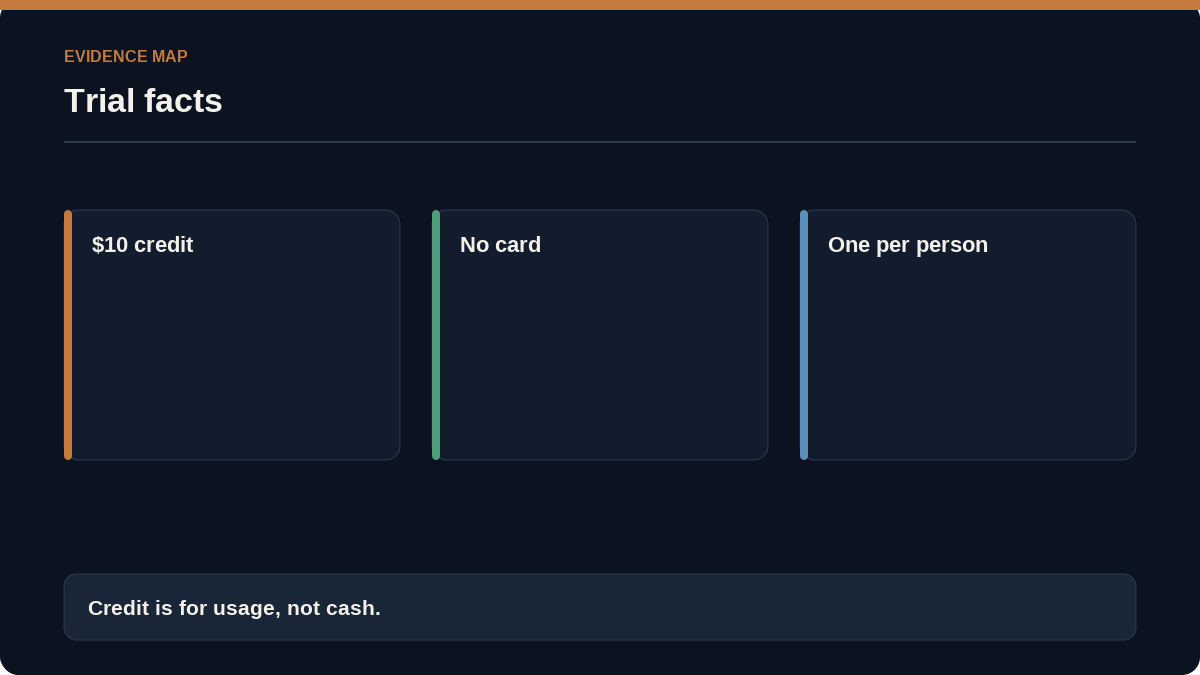
New accounts receive $10 of credit with no card. That credit is for API usage, not cash, and it does not make every model free. A sensible trial is a seven-day evaluation with a fixed task set, a cost and quality scorecard, and a decision rule written before the first request. Use an OpenAI-format agent for the active free lane. The free IDs do not work inside Claude Code, and the four Claude IDs on the separate Anthropic route were all unavailable on 2026-11-27.
The trial should answer one question: can this route complete the work you care about at a cost and review burden you accept? It should not try to prove that a gateway is universally better than Claude Code. Keep the primary workflow available, run bounded tasks through the alternative and record accepted results. If the trial succeeds, you have evidence for a larger test. When it fails, you have a specific reason rather than a vague impression.
Trial terms: credit, billing and the fine print
Official: new accounts receive $10 of credit with no card. Billing is prepaid, and the pricing page says there is no subscription or seat fee. Starter is $10, Builder is $50 and Team is $200. Online checkout was closed at the audit time, with top-ups handled by email through support. Those facts define the trial more accurately than the word “free.”
| Trial fact | Frozen value | What it means | What it does not mean |
|---|---|---|---|
| Signup credit | $10 | Usage credit for a new account | Cash, a refund or a recurring payment |
| Card requirement | None for signup credit | Lower barrier to a bounded test | Every future top-up is automatic |
| Billing model | Prepaid | Usage draws from a balance | A flat coding subscription |
| Subscription or seat fee | None stated on the pricing page | No seat fee in the frozen pricing facts | Every upstream or model is free |
| Online checkout | Closed at audit time | Top-ups require support email | Instant self-service top-up |
| Per-person limit | Not verified in the frozen fact pack | Treat repeat signup as unproven | A documented enforcement rule |
The credit gives you room to run real requests without entering a card. It does not remove the need for a budget. A long agent loop can consume tokens quickly, and a multi-model comparison can sprawl into dozens of calls. Write down the maximum number of trial requests and the task list before you start. The cost calculator can help estimate usage for priced models, while the free lane has its own daily request and token limits.
The free lane allows 100 requests and 5,000,000 tokens per day per account, shared across the 46 free IDs. That is a separate constraint from the $10 credit. A trial can use free IDs without drawing heavily on credit, or it can test priced models to measure cost per accepted task. Keep those two experiments distinct so the results remain interpretable.
Set up the trial account safely
Create the account with a name you can identify later, then create a project key rather than using one credential for every experiment. Official: accounts can have up to three keys, and per-key controls include a spending cap, expiry date and allowed-model list. Those controls turn the trial into a bounded environment. Set the cap and expiry before the first request, not after a surprising bill appears.
Keep the key out of the repository. Use the agent’s secret field or an environment variable, and avoid pasting it into a terminal command that will remain in shell history. The per-project key and spend-limit guide explains the separation pattern. The console keys and usage guide shows where to inspect key activity and usage.
Review the data you plan to send. The gateway’s privacy and retention policy says it does not train on prompts, files or outputs and does not sell them. It also describes separate retention periods for troubleshooting captures, opt-in prompt logs, usage metadata and security logs. That is a first-party policy statement, not an independent audit. Use synthetic or non-sensitive code for the first pass if the trial involves customer data.
Choose an OpenAI-format agent and set the base URL to https://api.oneaiapikey.com/v1. Select an available ID from the live free page. Do not begin with a full repository and broad command permissions. A minimal request followed by one read-only task gives you a safe checkpoint before the agent can change files.
Seven-day plan: test the work you actually do
A seven-day plan is long enough to include a repeat task and a failure recovery, but short enough to finish. Each day should produce an artifact: a diff, a test log, a request log, a cost note or a decision. Avoid open-ended exploration that cannot be scored.
| Day | Focus | Task | Evidence to keep |
|---|---|---|---|
| 1 | Baseline | Run one known task through the primary workflow | Expected result, actual result and review time |
| 2 | Focused coding | Fix a small bug through the alternative agent | Diff, targeted test and request log |
| 3 | Longer context | Explain and modify a module with several files | Context notes, accepted changes and missed constraints |
| 4 | Tools | Use a harmless command and verify its side effect | Proposed command, output and independent check |
| 5 | Recovery | Introduce a controlled failure and recover | Error, diagnosis and restored result |
| 6 | Cost and privacy | Review usage, keys and data handling | Token totals, key controls and policy notes |
| 7 | Decision | Repeat the baseline and apply the scorecard | Continue, adjust or stop with reasons |
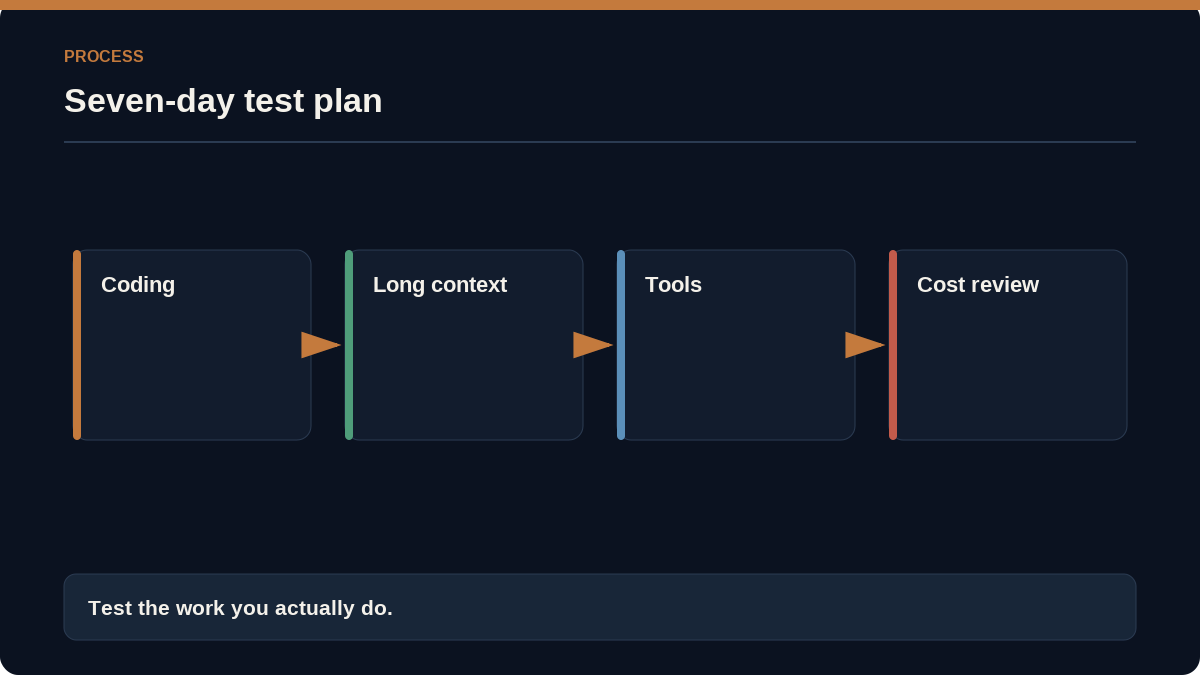
Day 1 matters because it gives the alternative a fair comparator. Use the same task, repository state and expected result that you would use on the primary route. Record the review time, not just whether the agent finished. A fast answer that requires a long rewrite is not a clear win.
Days 2 through 5 should stay bounded. A small bug is better than a three-day rewrite. A harmless command is better than a production deployment. A controlled failure can be an invalid test input or a disposable directory, not a broken customer system. The goal is to observe behavior without putting real work at risk.
Day 6 is where many trials skip the obvious. Review the key’s cap, expiry and allowed-model list. Check the request log for unexpected models or token use. Read the privacy policy for the data you sent. A trial that produces good code but leaves an over-privileged key or an unreviewed data path is not a complete pass.
Task set: five tasks with clear evidence
The task set should be small enough to repeat and concrete enough to score. Vague tasks such as “build something cool” produce demos, not comparisons. Each task needs an expected result and a way to verify it without relying on the agent’s summary.
| Task | Expected result | Verification | Common false positive |
|---|---|---|---|
| Focused bug fix | Minimal diff and passing targeted test | Inspect diff and run the test independently | Test passes because the assertion is weak |
| Refactor | Behavior preserved | Run the existing suite and review changed interfaces | Code looks cleaner but behavior changes |
| Explanation | Accurate map of a module | Check claims against the files | Confident prose with invented details |
| Tool use | Correct harmless side effect | Inspect the file or command output | Mocked tool result with no real change |
| Recovery | Work restored after a controlled error | Re-run the task from the saved state | Agent claims recovery without evidence |
The false-success verification post explains why a passing demo can hide a broken integration. The proof-of-work packet provides a reusable request for changed files, actual output and one independent check. Use both during the trial. They keep the evaluation focused on accepted work rather than generated text.
Keep prompts and repository state consistent across routes. If the primary route gets a detailed instruction and the alternative gets a vague one, the comparison is not fair. Where one route runs against a different branch, the diff is not comparable. Write the task brief once and reuse it, changing only the agent and model route.
Cost and quality scorecard: count accepted work
The scorecard should combine quality, reliability, review effort and cost. A single number can hide a serious weakness, so record the components before applying a total. The weights below are a suggested starting point, not an objective standard. Adjust them to match your work, but decide before seeing the results.
| Dimension | Suggested weight | What to record | Strong result | Weak result |
|---|---|---|---|---|
| Correctness | 35% | Accepted tasks and failed requirements | Tests and independent checks pass | Demo passes while the real path fails |
| Review effort | 25% | Minutes spent reviewing and reworking | Small, readable diff | Large rewrite or unclear changes |
| Reliability | 20% | Completed attempts, errors and recovery | Predictable tool use and recovery | Repeated failures or silent gaps |
| Cost | 20% | Credit used, tokens and requests per accepted task | Bounded spend for accepted work | High spend on rejected output |
A simple acceptance rate is useful: accepted tasks / attempted tasks. Pair it with review minutes and cost per accepted task. Derived: if a route accepts 14 of 20 attempted tasks, its acceptance rate is 14 / 20 = 70%. Those numbers are illustrative, not measured. Replace them with your trial results.
Cost per accepted task is more informative than cost per request. A cheap request that produces rejected code can be expensive once review and rework are included. A slightly higher-cost request that produces a verified change may be better value. The cost per verified change post develops that idea for Claude Code, and the same arithmetic applies to the trial.
Avoid scoring style preferences as correctness. If two diffs are both correct, reviewability can still matter, but it should be recorded as review effort rather than disguised as a quality fact. Keep the raw notes so a future reader can see why a score was assigned.
Compare with the primary route without moving the goalposts
The primary route is a comparator, not an opponent. Run the same task brief against both workflows and keep the repository state, test command and expected result fixed. If the primary route uses a different level of detail in its instructions, the trial measures prompt quality as well as model quality. That may be useful, but it should be named.
Record the full cost of each route. For a subscription, use the subscription cost over the period you are comparing. For API usage, use the actual credit or billed amount. Add review minutes and rework. Do not divide a monthly subscription by generated lines of code and call the result a token price. The cost per verified change framework is a better comparison because it counts accepted outcomes.
Save a separate note for features that the alternative does not reproduce. If the primary workflow depends on a specific hook, permission mode or account feature, record the gap instead of forcing it into the quality score. A route can be cheaper and still fail a hard requirement. The decision rules should allow that requirement to override an average.
Finish with a short written verdict: what passed, what failed, what remains unknown and what you will do next. That paragraph is the trial’s real output. The credit is only the resource that made the test possible.
Decision rules: continue, adjust or stop
Write the decision rule before the trial. Otherwise it is easy to move the goalposts after a surprising result. A practical rule has three outcomes. Continue when the route completes the required tasks within the cost and review limits. Adjust when the route is promising but a specific configuration, model choice or task scope needs change. Stop when the route fails a requirement that the alternative cannot reasonably fix.
| Outcome | Evidence required | Next action | What not to do |
|---|---|---|---|
| Continue | Required tasks accepted, cost bounded, review effort acceptable | Expand to a parallel run on real work | Switch all traffic immediately |
| Adjust | A specific bottleneck is identified | Change model, prompt, permissions or task scope | Rewrite the scorecard after seeing results |
| Stop | A required capability fails or risk exceeds tolerance | Keep the primary route and record the gap | Hide the failure behind an average score |
| Pause | Evidence is incomplete | Run the missing task or wait for availability | Treat missing data as a pass |
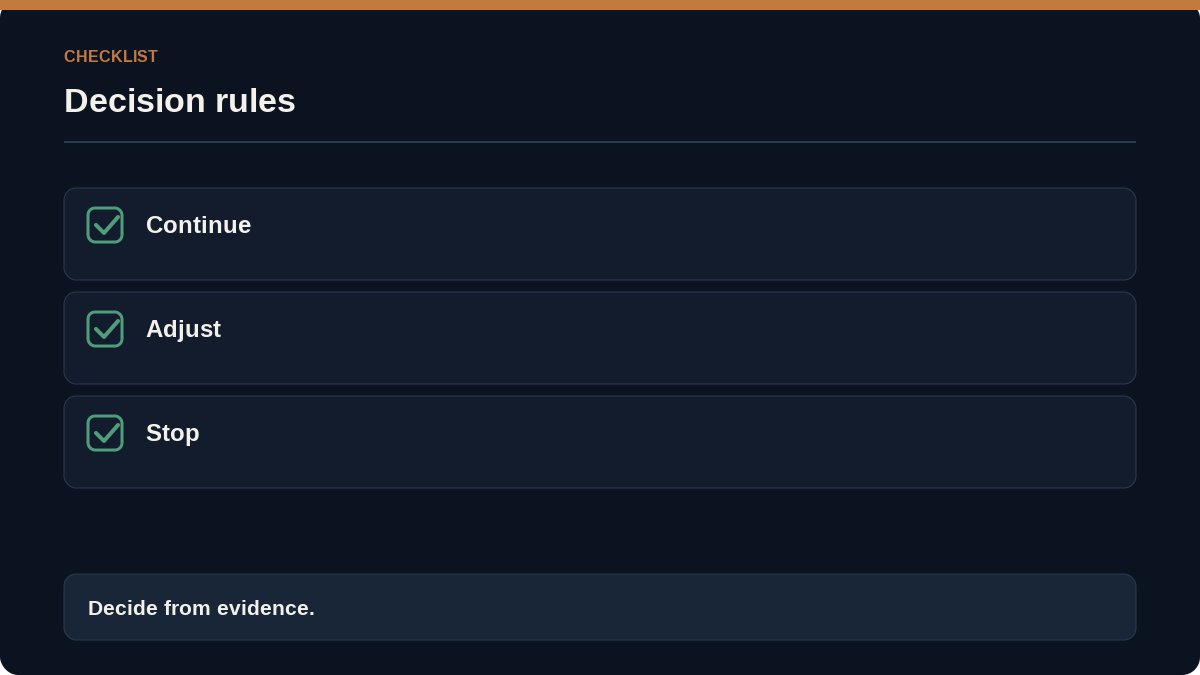
A continue decision does not require a full migration. Move one project or one task class into a parallel run and keep the primary route available. An adjust decision should name the bottleneck. For example, if tool calls fail but text edits are accepted, test a different agent configuration or model rather than abandoning the whole route. A stop decision should name the unmet requirement, such as Claude Code compatibility, which the free lane does not provide.
Worked example: a bounded trial review
Suppose you attempt 20 tasks over seven days: eight focused fixes, four refactors, four explanations and four tool-use tasks. This is an illustrative plan, not a benchmark. You accept 15 tasks, reject three and leave two unresolved. Derived: the acceptance rate is 15 / 20 = 75%, and the unresolved share is 2 / 20 = 10%.
Now add review and cost. Suppose the accepted tasks require 180 minutes of review and the trial uses $6.40 of credit. Derived: review time per accepted task is 180 / 15 = 12 minutes, and credit per accepted task is $6.40 / 15 ≈ $0.43. The approximation is arithmetic from invented trial inputs, not a published price or expected result.
The decision depends on the requirement. If the primary route accepts similar work with less review, the alternative has not earned a larger role. When the primary route is unavailable and the alternative completes the required fixes within the review limit, the backup has value even with a lower acceptance rate. The scorecard makes that trade visible instead of hiding it inside a single “better” label.
Record the failures by category. A format error, a weak test oracle and a model mistake require different responses. Fixing the endpoint will not improve a weak oracle. Changing the model will not fix a duplicated /v1. The trial is most useful when it separates those causes.
Honest loss: the credit is not the product
The concrete win is a low-risk way to test a different model layer. The concrete loss is that $10 of credit does not guarantee a good fit. It does not make every model available, does not remove daily limits and does not turn an OpenAI-format agent into Claude Code. It also does not eliminate the need to review output or protect credentials.
The frozen pricing facts say online checkout was closed at the audit time. This makes the trial useful for evaluation but awkward as a long-term self-service buying path. Top-ups were handled by email through support. Do not describe the trial as a subscription with automatic renewal or as a cash refund. It is prepaid usage credit with the constraints stated on the pricing page.
Model quality remains unmeasured. The fact pack does not provide a benchmark comparison for the free IDs or a controlled comparison of OpenAI-format agents. A seven-day trial can produce your own evidence, but it cannot establish a universal ranking. Limit the scope while keeping the claims proportional.
Data gap and future update
The fact pack verifies the $10 credit, no-card signup, prepaid model and audit-time checkout status. It does not verify a per-person enforcement rule, trial conversion rates or the quality of any model on a shared task set. The visual’s “one per person” label should therefore be read as an unverified brief label, not a documented guarantee.
A future update should recheck the pricing page, the free lane and the API reference. If checkout reopens or the credit terms change, replace this article’s facts with the new first-party values. When a reproducible trial is published, add the method, date, agent version, model IDs and raw results. Do not replace the scorecard with an unattributed success story.
Cluster guide
The surrounding posts provide the evidence needed to design a fair trial and interpret the result.
- Cost: Claude Code free-tier entry price establishes the subscription cost being compared.
- Quota: Claude Code five-hour and weekly limits documents quota behavior.
- API math: Fable 5.2 agent-loop pricing math explains repeated-context cost.
- Billing: Ultra API credits versus Claude Code usage separates credit types.
- Value: Claude Code cost per verified change supplies the accepted-work arithmetic.
- Account: Claude Code suspension notice gaps covers account-standing risk.
- Travel: Claude Code travel and regional ban risk explains location eligibility.
- Teams: Claude Code regional restrictions for teams extends the review to distributed teams.
- Exception: Claude Ultra five-hour exception keeps the exception precise.
- Appeal: Claude Code appeal evidence packet prepares the official appeal route.
- Privacy: Claude Code privacy and retention rules compares consumer and commercial defaults.
- Retention: Claude Code zero-data-retention limits explains qualified Enterprise coverage.
- Legal: AI government-request policies keeps legal claims evidence-based.
- Secrets: Claude Code settings-file secret exposure shows why approval text needs scanning.
- Security: Claude Code harness security boundaries maps tool authority.
- Incident: Anthropic April 2026 Claude Code postmortem documents a dated regression.
- Context: Claude Code context versus memory separates capacity from retained state.
- Compaction: Claude Code compaction retention test scores what survives a summary.
- Verification: Claude Code false-success verification tests the oracle behind a demo.
- Receipts: Claude Code proof-of-work packet defines receipts for completed work.
- Token use: Claude Code agent-team token overhead keeps the plan-mode condition attached to the estimate.
- Lock-in: Claude Code lock-in and exit costs inventories migration work.
- Credentials: Claude Code third-party harness rules explains credential restrictions.
- Migration: Claude Code context-portable migration preserves prompts, hooks and context.
- Failure domains: Claude Code single points of failure maps quota, region, account and model risk.
- Setup: Multi-model OpenAI-agent setup shows the active architecture.
- Free lane: 46 free AI model IDs for OpenAI agents documents the free lane and its limits.
- Exit: Claude Code exit-plan checklist prepares a fallback before an incident.
- Architecture: Claude Code alternatives and model-layer ownership synthesizes the two-layer design.
Practical response: run the seven-day trial
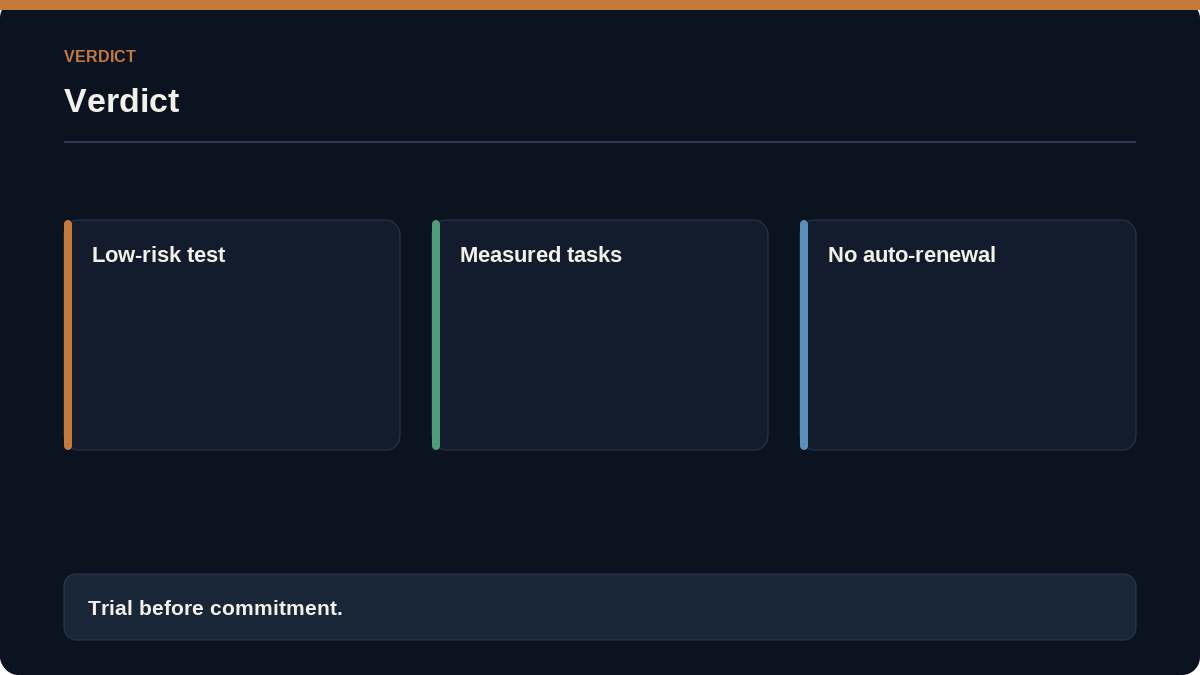
Create a trial account, set a request budget and write the five-task brief. Use an OpenAI-format agent, choose live IDs from the free page and keep the primary workflow available. Record accepted tasks, review minutes, errors, token use and credit use. On day 7, apply the decision rule you wrote on day 1.
One AI API Key’s active route is an OpenAI-format agent using https://api.oneaiapikey.com/v1, one key and the 46 live free model IDs. The pricing page documents the $10 signup credit and prepaid billing, the quickstart shows the first request, and the per-key controls help bound the test. Claude Code’s Anthropic-format route is documented, but all four Claude IDs were unavailable on 2026-11-27. The free IDs do not work in Claude Code.
The win is evidence before commitment. The loss is the time required to run and review the trial. The practical implication is to treat the credit as a test budget, not as a reason to skip measurement.
FAQ
Is the $10 credit a cash refund?
No. It is usage credit for a new account. The frozen pricing facts describe prepaid billing and no card for signup credit, not a cash payment or refund.
Can I use the trial with Claude Code?
Not through the free lane. The free IDs use the OpenAI format. Claude Code’s separate Anthropic route had four Claude IDs, all unavailable on 2026-11-27.
Does the trial renew automatically?
The frozen pricing facts say there is no subscription or seat fee and describe prepaid billing. They do not describe an auto-renewing trial. Treat the credit as a bounded usage balance.
What should I measure during the seven days?
Measure accepted tasks, review time, errors and recovery, requests, tokens and credit used. A successful demo without an independent check is not enough.
What if online checkout is closed?
The audit-time pricing page said top-ups were handled by email through support. This makes the trial useful for evaluation, but it is not a promise of instant self-service top-up.