Direct answer
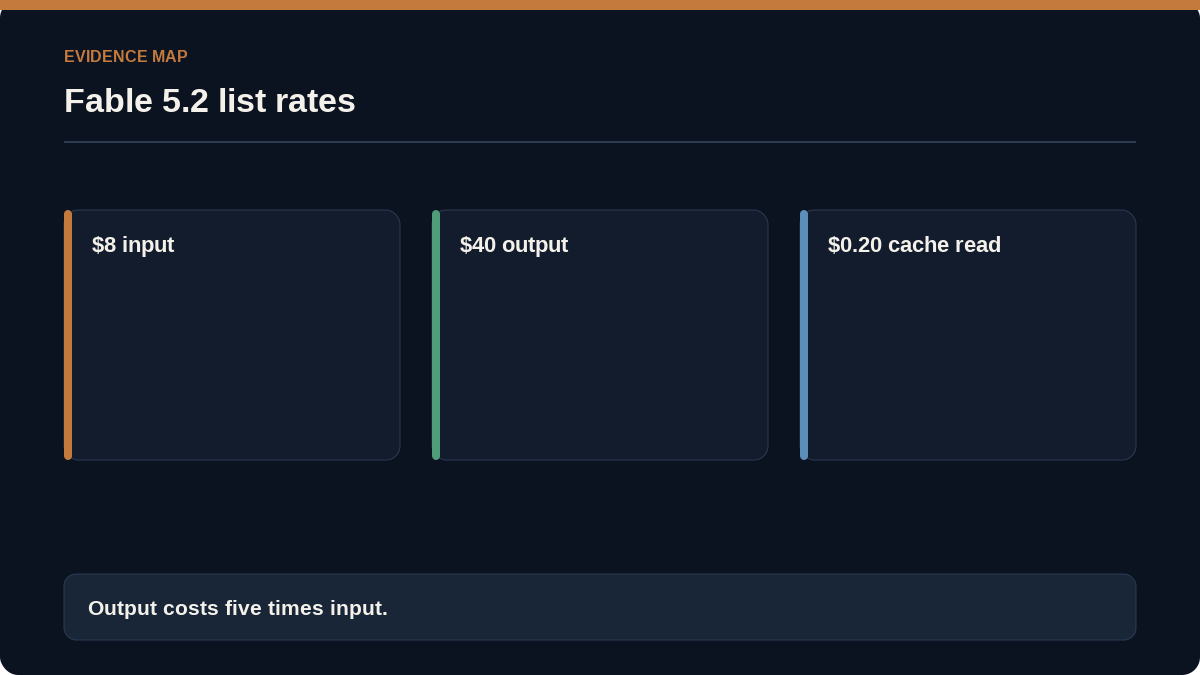
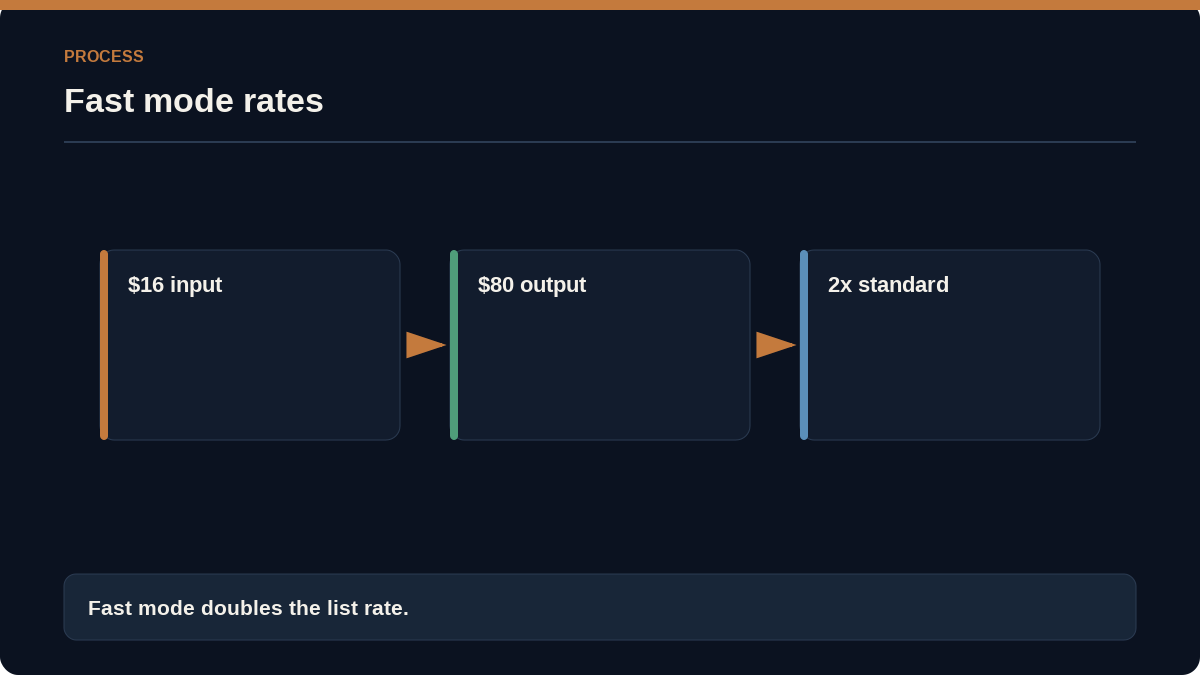
Fable 5.2 lists at $8 per million input tokens and $40 per million output tokens on Anthropic’s official API. Cache reads cost $0.20 per million tokens. Fast mode doubles the standard list rates to $16 input and $80 output per million tokens.
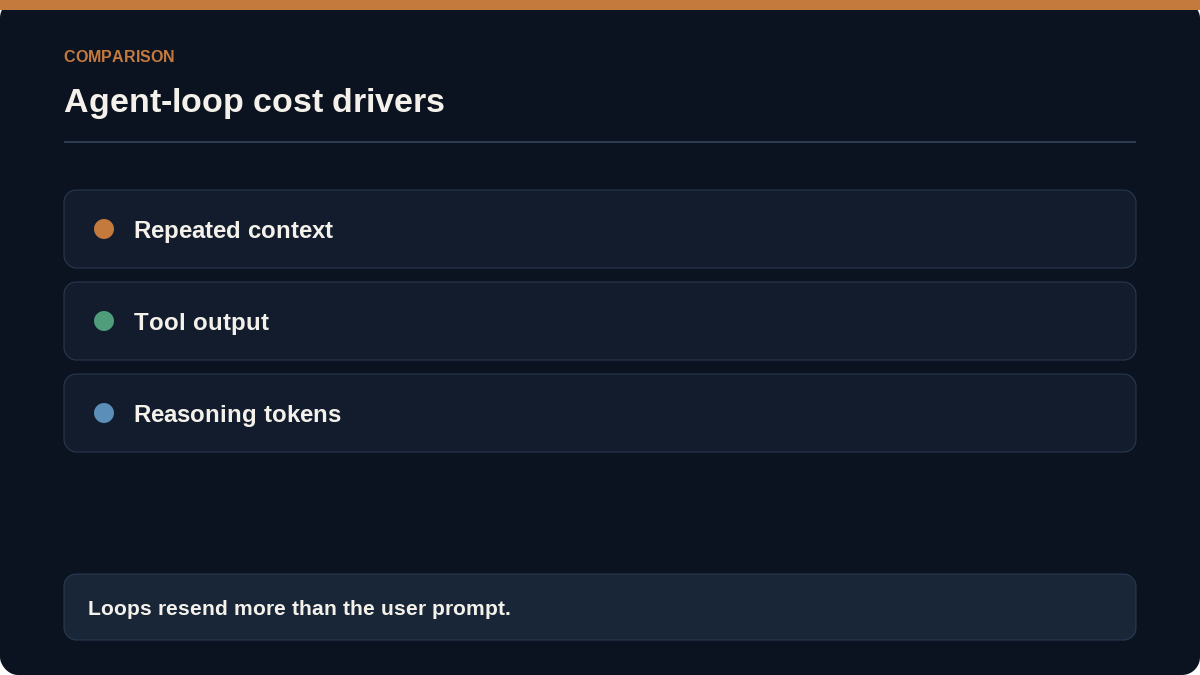
The agent-loop catch is repeated context. A coding agent does not send only the user’s latest prompt. It can resend instructions, file contents, tool results and earlier turns. Derived: cost equals input tokens divided by one million, multiplied by the input rate, plus output tokens divided by one million, multiplied by the output rate. A loop with more turns can therefore cost much more than one request with the same visible prompt.
Why the loop changes the bill
A single request is easy to price. You know the input, you know the output, and you apply two rates. An agent loop adds a sequence. Each turn can carry more context than the last, and each tool result can add text that must be sent again.
That does not make the list price wrong. It makes the list price incomplete as a budgeting method. The useful number is the cost of the whole task, including repeated context and output, divided by the result you accept.
Anthropic’s Claude Code costs documentation says agent teams can use approximately seven times more tokens than standard sessions when teammates run in plan mode. The condition matters. It is a vendor estimate about a specific setup, not a multiplier for every agent loop.
For an individual buyer, the practical question is simpler: how many input and output tokens does the task consume before a human accepts the change? The Claude Code cost per verified change model puts review and rework in the denominator. Token arithmetic is one input to that model, not the whole value calculation.
Official price table
The rates below come from Anthropic’s official Fable 5.2 page. They are API list prices, not a Claude subscription quota and not a gateway quote.
| Charge | Fable 5.2 rate per 1M tokens | Billing note |
|---|---|---|
| Standard input | $8 | Fresh input at the standard rate |
| Standard output | $40 | Output is five times the standard input rate |
| Cache read | $0.20 | Applies when input is read from cache |
| Fast input | $16 | Twice the standard input rate |
| Fast output | $80 | Twice the standard output rate |
Fable 5.2 launched on 2026-11-09, according to the same official source. That date matters when you compare articles or screenshots. A price captured before launch is not evidence about the current list rate.
The frozen fact pack does not provide a cache-write price for this article’s calculations. It provides the cache-read rate. That boundary is important. A cached request can still require a cache write, and a read-only example must not be presented as the total cost of building and using a cache.
What the rates do not include
The table excludes subscription fees, usage-credit mechanics, human review, rework, tool charges, taxes and provider-specific terms. It also excludes retries. A failed request can consume tokens without producing an accepted change.
Do not convert a Pro or Max subscription into a token price. The Claude Code free-tier entry price explains plan access, while the Claude Code rate limits explain quota timing. Neither source publishes an official method for turning a subscription allowance into a fixed number of Fable tokens.
Cache reads: cheap input, but not a free loop
A cache read costs $0.20 per million tokens. Derived: 100,000 cached input tokens cost 0.1 × $0.20 = $0.02. One million cached input tokens cost $0.20.
That is 2.5% of the $8 standard input rate. The arithmetic is $0.20 / $8 = 0.025, or 2.5%. The discount is large on the read side, but it does not erase output charges or the work required to create a reusable cache.
A loop with stable instructions and a large repeated prefix may benefit from cache reads. A loop that rewrites the prefix every turn may not. The useful measurement is the cache-read share of actual input tokens, not an assumption that all repeated context is cached.
The honest loss is missing cost data. The frozen record does not supply cache-write rates, cache expiry rules or a measured hit rate for your workload. This article therefore shows read-side arithmetic only. It does not claim a total cached-request price.
The prompt-caching and context guide explains why retained context and task state are different concerns. A cache can reduce billed input, but it does not guarantee that the model remembers the right constraint.
Fast mode doubles the list rate
Fast mode lists at $16 per million input tokens and $80 per million output tokens. Both are exactly twice the standard rates.
Derived: for 150,000 input tokens and 10,000 output tokens, Standard costs 0.15 × $8 + 0.01 × $40 = $1.20 + $0.40 = $1.60. Fast costs 0.15 × $16 + 0.01 × $80 = $2.40 + $0.80 = $3.20.
The Fast premium on that request is $3.20 - $1.60 = $1.60. The percentage increase is 100% because both rates double.
Fast mode is a price choice before it is a quality claim. The frozen fact pack does not provide a measured latency improvement for your workload. If lower latency saves human waiting time, the premium may be worthwhile. If it does not, Standard is the lower list-cost choice on the same token shape.
A budget should name the mode explicitly. “Fable 5.2” is not enough. Standard and Fast produce different bills for identical token counts. Record the mode with the model ID in your test log.
Agent-loop worked example
The following example is Derived from the official rates. It is illustrative, not a benchmark and not a claim about how many tokens Claude Code always uses.
Assume a five-turn task. The input tokens sent across the five turns are 20,000, 25,000, 30,000, 35,000 and 40,000. Each turn produces 2,000 output tokens. All input is billed at the Standard input rate, with no cache reads and no Fast mode.
Worked request math
| Turn | Input tokens | Output tokens | Input cost | Output cost | Turn total |
|---|---|---|---|---|---|
| 1 | 20,000 | 2,000 | $0.16 | $0.08 | $0.24 |
| 2 | 25,000 | 2,000 | $0.20 | $0.08 | $0.28 |
| 3 | 30,000 | 2,000 | $0.24 | $0.08 | $0.32 |
| 4 | 35,000 | 2,000 | $0.28 | $0.08 | $0.36 |
| 5 | 40,000 | 2,000 | $0.32 | $0.08 | $0.40 |
| Total | 150,000 | 10,000 | $1.20 | $0.40 | $1.60 |
The formula is:
Total input cost = (total input tokens / 1,000,000) × input rate
Total output cost = (total output tokens / 1,000,000) × output rate
For Standard, that is (150,000 / 1,000,000) × $8 + (10,000 / 1,000,000) × $40 = $1.20 + $0.40 = $1.60.
A single request with 20,000 input tokens and 2,000 output tokens would cost $0.24. The five-turn loop costs $1.60, or 6.67 times the single-request cost. Derived: $1.60 / $0.24 = 6.67. That ratio comes from the assumed token shape, not from a universal agent-loop multiplier.
Why the same visible prompt can cost more
The visible prompt is only one part of the input. An agent may include system instructions, repository rules, file excerpts, previous tool results and earlier assistant turns. Those tokens can be billed again when the context is sent in a later request.
Tool output is a common amplifier. A search that returns a large file can make the next turn more expensive even if the user types nothing new. Reasoning tokens can also contribute to output billing when the API counts them as output. The safe budgeting move is to inspect actual usage rather than estimate from the chat text alone.
The Claude Code agent-team token overhead guide covers a specific vendor estimate: about seven times more tokens when teammates run in plan mode. Do not apply that number to every loop. Use it as a warning that parallel contexts need their own measurement.
What the math excludes
The worked example is deliberately narrow. It excludes cache writes, cache reads, Fast mode, retries, refusals, tool fees, subscription costs and human review. It also excludes taxes and provider-specific terms.
Those exclusions are not defects in the arithmetic. They define the question it answers: what does this illustrative sequence of Standard input and output tokens cost at the published list rates?
A complete task budget needs more lines. Add measured cache writes and reads if you use caching. Add Fast rates if you select Fast. Add retries that produced billable tokens. Add human review time in a separate value model. The monthly LLM API cost worksheet provides a structure for that broader forecast.
The Ultra API credits versus Claude Code usage guide explains another exclusion. Monthly API credits and interactive Claude Code usage are different billing routes. A Fable API calculation should not be mixed with a subscription credit balance unless the official terms say the request qualifies.
How to reduce cost without hiding rework
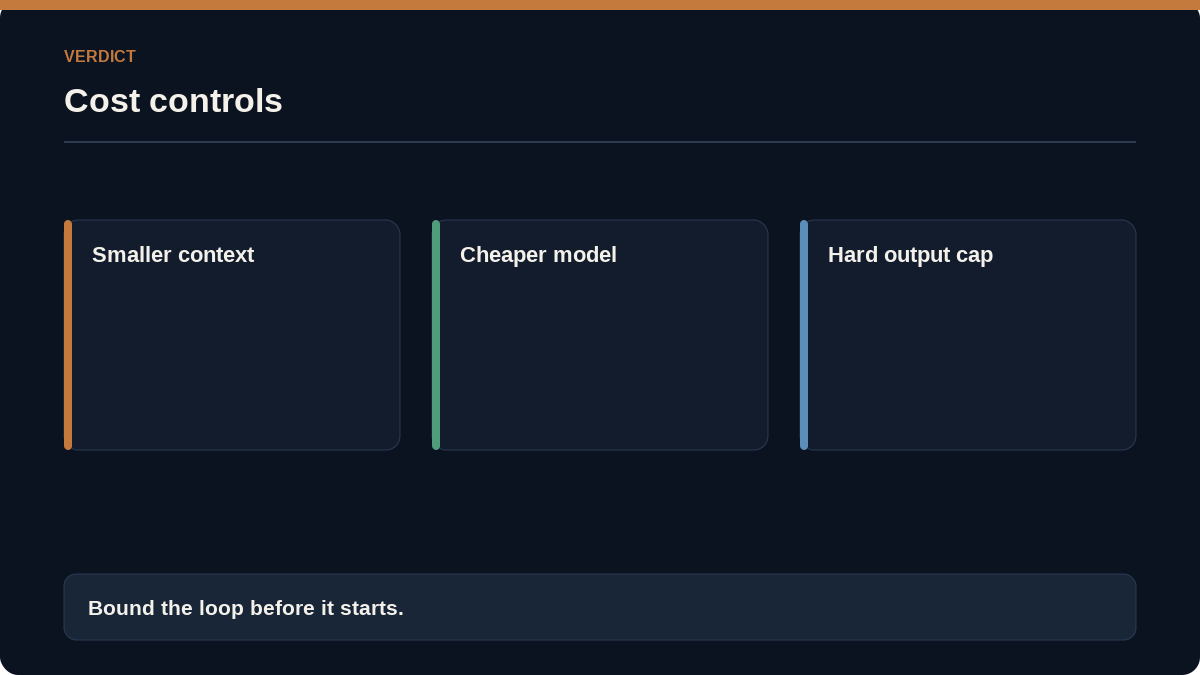
Cost control works best when it changes the task shape. A smaller, well-defined request can avoid a long detour. A hard output cap can prevent one turn from producing far more text than the task needs. A stop condition can prevent a loop from repeating after the useful result is already available.
The following matrix ties each control to the cost it addresses and the loss it can introduce.
| Control | Cost addressed | Practical use | Honest loss |
|---|---|---|---|
| Smaller context | Repeated input tokens | Send only files relevant to the next decision | May omit a constraint the model needs |
| Shorter task scope | Loop length | Split broad refactors into verified steps | More coordination for the human |
| Hard output cap | Output tokens | Bound verbose answers and reasoning output | Can truncate a useful response |
| Cache reads | Repeated stable input | Reuse a stable prefix when the workload supports it | Cache writes and hit rate need separate measurement |
| Standard mode | Fast premium | Use Standard when latency is not the constraint | May increase waiting time |
| Cheaper model evaluation | Per-token spend | Compare official rates on the same task set | Quality and tool behavior may differ |
| Early verification | Wasted loops | Run a focused check before expanding the task | Adds a human checkpoint |
The model selection guide for coding agents helps frame the quality side of that last row. A lower token price is not a win if the model needs more retries or produces changes that fail review.
A controlled cost test
Run the same task set with Standard and Fast. Keep the repository, prompts and acceptance checks fixed. Record input tokens, output tokens, cache reads, retries and accepted changes. Then calculate cost per accepted change.
This is Derived decision arithmetic. It does not require a benchmark leaderboard. It requires a clear acceptance rule and a record of what you kept.
If Fast reduces waiting time but does not change the accepted result, the premium is a convenience cost. If Standard produces more rework, the lower list rate may not win. The Claude Code cost per verified change guide shows how to keep those outcomes in one scorecard.
Read the usage record before changing the model
A token estimate is a hypothesis. A usage record is evidence. Before switching models or modes, inspect the requests that made the task expensive. Look for repeated large inputs, long outputs, retries and turns that added no new information.
The useful unit is the request, not the conversation. A single session can contain many API calls. Each call has its own input and output count. If one call dominates the bill, find out why. It may contain a large tool result, an unexpectedly verbose answer or context that should have been trimmed.
The console keys and billing guide explains where per-request model, token and cost logs appear. The per-project key guide shows how to separate evaluation traffic from other work. Separate keys make the test easier to attribute, but they do not change the underlying token math.
Keep a small ledger for each task: model, mode, input tokens, output tokens, cache reads, retries and accepted result. This is Unknown until you collect it, but it turns a vague cost concern into a specific engineering problem. If output tokens are high, cap or shorten the answer. If repeated input dominates, reduce context or measure cache reads. If retries dominate, fix the failure before shopping for a cheaper rate.
A usage record also protects you from a false conclusion. A model can look expensive because it handled the hardest task in the set. Compare like tasks before declaring a winner. The Claude Code proof-of-work packet helps keep the accepted result attached to the spend.
Budget a month of loops, not a single request
The five-turn example costs $1.60 at Standard under the stated assumptions. A monthly budget needs the number and shape of those loops. Multiply only after you know the task mix.
Suppose a developer completes 40 similar five-turn tasks in a month. Derived: 40 × $1.60 = $64.00 in Standard API charges. If every task used Fast on the same token shape, the total would be 40 × $3.20 = $128.00. The difference is $64.00.
Those numbers are illustrative. They assume that every task has exactly the same token shape, no caching and no retries. Real work will vary. The point is to make the assumptions visible so they can be replaced with measured values.
A simple monthly worksheet has four lines: expected tasks, measured tokens per task, selected mode and retry allowance. Add human review separately. The monthly LLM API cost worksheet gives a broader structure, while the Claude Code cost per verified change model keeps accepted work in the denominator.
Do not hide weak tasks inside an average. If one large refactor costs more than twenty small fixes, it deserves its own line. A single outlier can distort the monthly forecast and lead to the wrong plan or model decision.
Verification is a cost control
Every unverified turn is a risk of paying for work you cannot keep. A short acceptance check can stop a loop before it repeats a mistake across several turns.
Start with the expected result. Then ask for the changed files, the test output and one independent check of the affected behavior. The Claude Code false-success verification guide explains how mocks and weak test oracles can make incomplete work look finished.
Verification does not need to be slow. A focused test, a diff review and a manual check of the external side effect may be enough for a small change. A migration or billing change needs stronger evidence. Match the proof to the consequence of being wrong.
The budget benefit is practical. Catching a bad assumption after one turn is cheaper than catching it after five. The quality benefit is larger: the accepted-change count rises when rework falls. The reason is that verification belongs in a pricing article rather than in a separate process document.
A practical cost test with an OpenAI-agent gateway
If you want to compare model routes before committing to a Claude workflow, One AI API Key offers an active OpenAI-format lane. The 46 live free model IDs run through https://api.oneaiapikey.com/v1 with one key. Use an OpenAI-format agent such as OpenCode or Cline, and follow the quickstart for the first request.
The free lane allows 100 requests and 5,000,000 tokens per day per account, shared across the 46 free IDs. It resets at 05:30 IST, which is 00:00 UTC. Accounts can have up to three API keys, with one request in flight per key on free models. Those limits make it suitable for a measured comparison, not an unlimited production substitute.
Do not use the free IDs in Claude Code. They are OpenAI-format only. The documented Claude Code route uses the Anthropic Messages format at https://api.oneaiapikey.com, but all four Claude IDs were unavailable on 2026-11-27: claude-sonnet-5-5, claude-sonnet-5, claude-opus-5-5 and claude-haiku-4-5.
For the test, save the exact task set and acceptance checks. Record the agent, model ID, token usage and review time. The multi-model OpenAI-agent setup provides the architecture, and the 46 free AI model IDs guide explains the compatibility boundary. Use the cost calculator for paid-rate scenarios and the per-key controls to cap evaluation traffic.
The loss is interface and behavior difference. An OpenAI-format agent is not Claude Code, and a free model is not Fable 5.2. Compare accepted work, not brand names. The Claude Code alternatives and model-layer ownership guide explains why separating the agent from the model layer can make that comparison easier.
Data gaps and future updates
The frozen record leaves several cost questions open. It does not provide cache-write rates for the calculations in this article, a measured cache-hit rate for your workload, or a customer-specific latency gain from Fast mode. It also does not provide a universal token count for a Claude Code task.
Those gaps should remain visible. A future update can add official cache-write terms, a measured Fast latency comparison or a published quota conversion if one becomes available. Until then, the article uses Standard input and output arithmetic, read-side cache arithmetic and clearly labeled assumptions.
The vendor’s agent-team estimate also needs careful handling. Anthropic says teams can use approximately seven times more tokens when teammates run in plan mode. This is not a measured result for every team, and it should not be used as a blanket budget multiplier. The Claude Code agent-team token overhead guide keeps the condition attached to the number.
Finally, list price is not invoice total. Retries, refusals, tool charges, taxes and provider terms can change the final amount. The official rate card is the starting point. Your usage record and accepted-change count are the evidence that turns it into a buying decision.
Review the expensive request
When a task costs more than expected, resist the urge to change everything at once. Pick the most expensive request and inspect its shape. Compare its input count with the visible prompt. If the input is much larger, the extra context is the place to look.
Common sources include a large file pasted into the conversation, a tool result that returned more text than needed, and earlier turns that keep getting resent. None of these is automatically wrong. The question is whether each block of context changed the next decision. If it did not, the loop may be paying for noise.
Output deserves the same review. A verbose answer can cost five times as much per token as Standard input. If the task needed a short patch but the model produced a long explanation, a tighter instruction or output cap may reduce the bill. Measure the result before assuming the cap helped, because a truncated answer can create rework.
Retries need their own line. A retry after a network failure may be unavoidable, but a retry after a malformed request is a fixable defect. Separate the two in your ledger. Otherwise, a prompt or integration bug can look like a model-pricing problem.
The Claude Code verification checklist helps you decide whether the expensive output was actually accepted. A cheap request that produces an unusable change is not a saving. A slightly higher request that completes the task with less review can be the better buy.
Keep the review small. One expensive request, one likely cause, one change and one repeat run. The sequence produces evidence you can attribute. It also avoids the common mistake of changing the model, prompt, mode and context length together, then guessing which change helped.
Cost concentration deserves a separate check. If one provider or one model handles every stage of the workflow, a quota interruption or account problem can stop work regardless of the token price. The Claude Code single points of failure guide separates quota, region, account and model risks. A cheaper route that cannot be used when you need it may not be cheaper in practice.
This does not mean every task needs multiple providers. It means the cost model should record availability as well as tokens. A backup route has value when it preserves accepted work during an interruption, but it also has a testing cost. Keep that trade-off visible instead of treating resilience as free.
FAQ
How much does Fable 5.2 cost per million tokens?
Standard API pricing is $8 per million input tokens and $40 per million output tokens. Cache reads are $0.20 per million tokens. The fast mode is $16 input and $80 output.
Why does an agent loop cost more than one request?
Later turns can resend instructions, files, tool results and earlier context. The repeated input tokens are billed again, and each turn can add output tokens.
Is Fast mode worth it?
The frozen evidence does not measure the latency gain for your workload. The fast option doubles both list rates, so the premium needs a concrete time-saving or quality reason.
Can I turn a Claude subscription into a Fable token price?
No official conversion is provided in the frozen fact pack. Keep subscription access, API credits and per-token API billing separate.
Do the 46 free gateway IDs work in Claude Code?
No. They use the OpenAI format and require an OpenAI-format agent. The documented Claude Code route uses the Anthropic format, and all four Claude IDs were unavailable on 2026-11-27.