Use Claude Fable 5.2 as a task-tiered direct-API model, not an always-max router. Start with low or medium for bounded extraction and formatting, use high for routine agent work, and reserve xhigh or max for branches that fail a clear validation gate. Keep instructions, schemas, tools and examples in a stable prefix. Put changing facts near the end. Cache a prefix only when it will repeat: each checkpoint needs at least 512 tokens, the limit is four checkpoints, and the TTL is five minutes or one hour.
Most important, a refusal can return HTTP 200 with stop_reason: "refusal". Treat that as an incomplete task. The fallback-credit beta uses the fallback-credit-2026-07-01 header, but not every refusal carries a token. Only Opus 5 and Opus 4.8 are eligible fallback models. Fable and Opus 5.5 are not. Fallback credits are constrained, and a retry can still incur cache-read charges. This article covers the official direct API. It does not claim that Fable 5.2 is available through the gateway.
This is for engineers who run structured workflows, tool-using agents, or long-context document pipelines. The goal is a routing policy that can be tested against a schema, a cache ledger and a refusal log. It is not a promise that more thinking always produces a better result.
The routing contract in one screen
A production route needs three separate decisions. First, choose the effort for the task. Second, decide whether the prompt prefix is stable enough to cache. Third, define what counts as completion. A successful HTTP status belongs to transport. It does not answer the third question.
| Stage | Required action | Completion gate |
|---|---|---|
| Before the call | Select effort explicitly and estimate the input, output and cache budget | The branch has a task class, a ceiling and a validator |
| Prefix assembly | Place stable policy, schema, tools and examples before variable context | Prefix hash matches the cached checkpoint |
| Response handling | Inspect stop_reason, tool results and content |
Output passes schema and task-specific checks |
| Failure handling | Separate validation failure, replay error, transport error and refusal | No blind retry or ineligible fallback |
| Accounting | Record cache status, billed categories and fallback use | Cost is attached to the final task outcome |
The Fable 5.2 launch details establish the official model ID, claude-fable-5-2, the 1,000,000-token context window and the 128,000-token maximum output. Those limits do not make every request cheap or every branch reliable. A large context can hold more evidence, but it can also hold more unstable text that defeats a cache checkpoint.
Set effort in application configuration. Do not infer it from the model name. The reasoning controls guide is the place to align application settings with the effort semantics you intend to expose to operators.
Choose effort with a validation gate
Anthropic lists five Fable 5.2 effort settings: low, medium, high, xhigh and max. Adaptive thinking is always on and cannot be disabled. That makes effort a routing input, not an on/off switch for reasoning.
There is a documented default conflict. The launch announcement says Medium. The models overview and the AWS Bedrock model card say High. Set the value explicitly in production so a documentation change cannot silently alter behavior. Also keep the source and date of your chosen default in the deployment record.
The ladder below is an operator policy, not an Anthropic task map. The frozen evidence does not provide a controlled result for each effort on your schema, tools or document set.
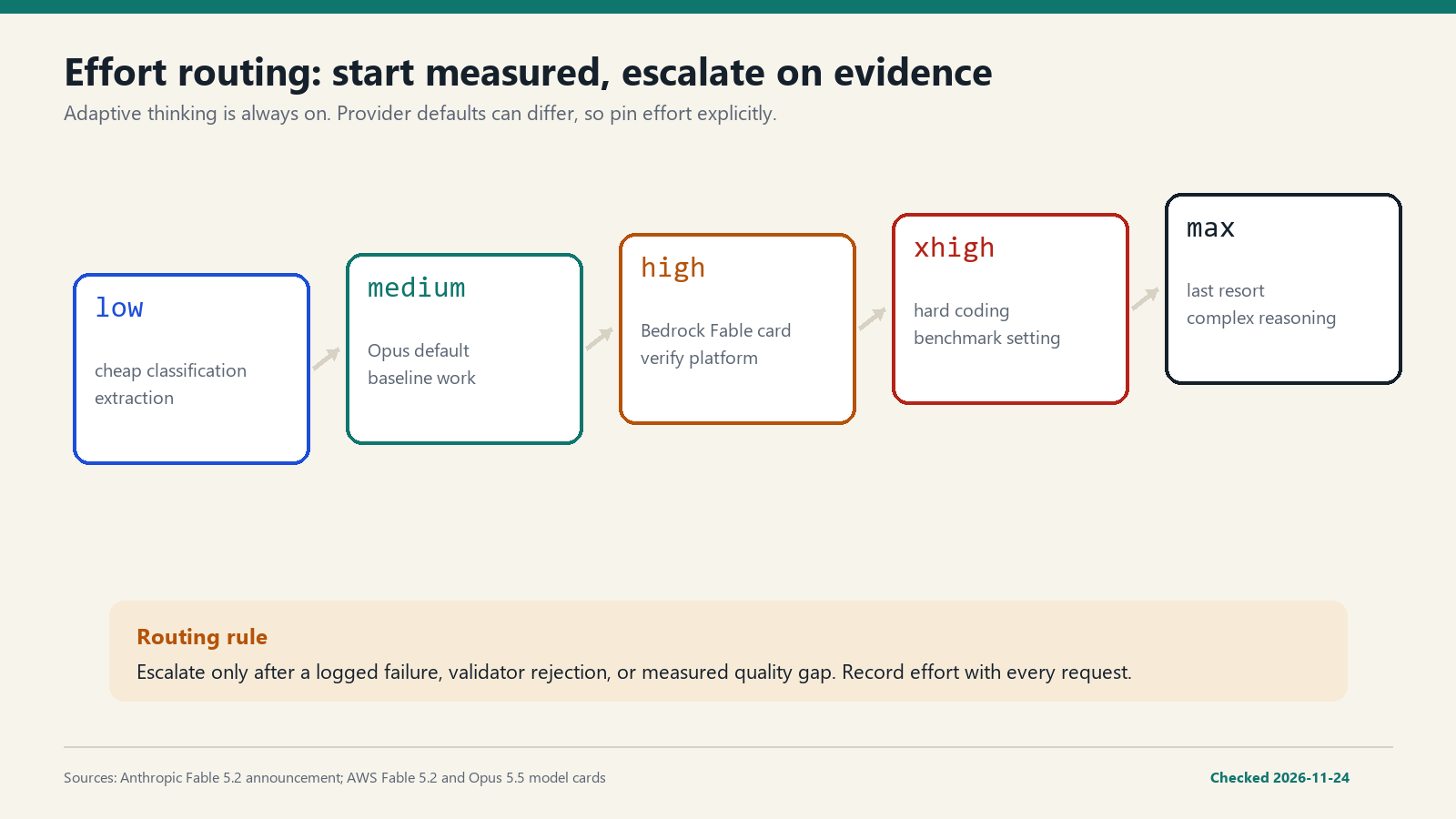
A practical escalation policy looks like this:
- Low: bounded extraction, label selection, format conversion and other tasks with a narrow answer space.
- Medium: routine structured requests with enough instructions and examples to constrain the output.
- High: the starting point for multi-step tool use, document synthesis and tasks with several interacting constraints.
- Xhigh: a second attempt after a concrete validation failure, not an automatic response to any exception.
- Max: a small set of high-impact branches with a human review step, a cost ceiling and a measured reason for escalation.
The escalation trigger should name the failure. Examples include a missing required field, an invalid tool argument, a failed consistency check between two extracted values, or a citation that does not support the claim. A timeout is not evidence that the model needs more effort. A refusal is not evidence that the model needs more effort either. Route those failures to their own handlers.
Artificial Analysis provides an independent reference point, not a per-task guarantee. Its earlier Fable 5.2 snapshot, date-stamped 2026-11-24, reported an Intelligence Index of 65 at Max under Intelligence Index v5.0.1. A later fetch reconfirmed High as the default, the 1M context and the $8/$40 price, but did not reproduce the score or evaluator version in extracted text. Keep that reproduction caveat attached to the number. The Fable 5.2 review separates those independent results from vendor-reported benchmark claims, while the Artificial Analysis model page records the evaluator snapshot.
For structured workflows, log the effort used on every attempt. Compare pass rate, output tokens, elapsed time and cost per accepted result. Without that ledger, escalation becomes a habit rather than a policy. The cost calculator can model candidate token budgets before you run an experiment, but only your validator can define a successful result.
A 200 response is not a completed task
Structured output needs a completion gate after the model returns. Check the stop reason, parse the payload, validate the schema and verify any task-specific evidence. Tool calls also need receipts. If an agent claims it updated a record, the application should confirm that the tool result exists before reporting success.
The structured-output guide covers schema-oriented integration. Add a domain validator beside it. A JSON Schema check can prove that a field is an integer. It cannot prove that the integer matches the invoice total in the source document. The second check belongs to your application.
Streaming introduces another failure mode. A client can receive content before the final stop reason arrives. Keep the stream open until the terminal event, then run the same validator you would use for a non-streaming response. The streaming guide explains the transport pattern; it does not replace the completion gate.
Use this small TypeScript pseudocode as a control-flow model. It deliberately does not name an endpoint or invent a gateway model ID. The transport, credit extraction and validator are integration-specific functions.
type Effort = 'low' | 'medium' | 'high' | 'xhigh' | 'max';

interface RoutingInput {
effort: Effort;
messages: unknown[];
schemaVersion: string;
}

interface ProviderResponse {
stopReason: string;
content: unknown;
}

type CallProvider = (
model: string,
input: RoutingInput,
options: { fallbackCreditBetaHeader: string }
) => Promise<ProviderResponse>;

const FABLE_API_ID = 'claude-fable-5-2';
const FALLBACK_HEADER = 'fallback-credit-2026-07-01';
const ELIGIBLE_FALLBACKS = ['Opus 5', 'Opus 4.8'] as const;

async function routeStructuredTask(
call: CallProvider,
input: RoutingInput
) {
const first = await call(FABLE_API_ID, input, {
  fallbackCreditBetaHeader: FALLBACK_HEADER,
});

if (first.stopReason !== 'refusal') {
  const valid = validateTaskOutput(first.content, input.schemaVersion);
  return { status: valid ? 'complete' : 'invalid', response: first };
}

// Extraction is provider-integration-specific. A refusal may have no token.
const credit = extractFallbackCredit(first);
if (!credit || !fallbackPermittedByPolicy(input)) {
  return { status: 'refused', response: first };
}

const target = chooseApprovedFallback(ELIGIBLE_FALLBACKS);
const retry = await call(target, input, {
  fallbackCreditBetaHeader: FALLBACK_HEADER,
});

const valid = retry.stopReason !== 'refusal'
  && validateTaskOutput(retry.content, input.schemaVersion);
return {
  status: valid ? 'complete' : 'incomplete',
  response: retry,
  usedFallback: true,
};
}
The policy around the code matters as much as the branches. Permit at most one fallback attempt for a task. Require an approved data route before sending the prompt to another model. Never rewrite a refused request to evade the safeguard. If the fallback also refuses or fails validation, return an incomplete result to the workflow. Do not present partial content as a completed extraction.
Design the cache around a stable prefix
Explicit caching on Fable 5.2 has hard boundaries. A checkpoint needs at least 512 tokens. A request can use no more than four checkpoints. The TTL is either five minutes or one hour. A checkpoint is a reusable prefix boundary, not a discount applied to any repeated sentence buried in a changing document.
Order the prompt from most stable to least stable:
- System policy, safety constraints and output rules.
- The response schema and tool definitions.
- Few-shot examples and formatting instructions.
- Tenant or workflow instructions that change rarely.
- Retrieved documents, conversation state, timestamps and other variable material.
The first four positions are candidates for checkpoints, but only if each candidate reaches the 512-token minimum and actually repeats. Padding a short prompt just to reach the minimum adds input work. If the prefix changes for every request, skip the write and pay the normal input rate.
Keep volatile values out of the cached region. A request ID, current time or random nonce near the beginning changes the prefix hash. So does reordering tool definitions or rewriting a system paragraph. Version the prefix deliberately. Store a hash with the prompt template version, model, effort, checkpoint position and TTL so a cache miss can be explained.
Thinking blocks need separate care. They are bound to the model and conversation prefix. Altered replay can return HTTP 400. Store returned thinking blocks without editing them, and preserve their association with the exact conversation prefix. If you change that prefix, start a clean block chain instead of patching an old one. A replay error is a cache-integrity failure, not a reason to escalate effort.
The Opus 5.5 context-caching analysis covers the same stable-prefix problem across the two Claude models. The prompt-caching guide is the implementation reference for checkpoint placement and lifecycle.
Cache break-even is an input-side calculation
Fable 5.2 list pricing is $8 per 1,000,000 input tokens and $0.20 per 1,000,000 cache-read tokens. A five-minute cache write costs $10 per 1,000,000 tokens. A one-hour write costs $16 per 1,000,000. These are official rates from Anthropic pricing, checked 2026-11-24.
The five-minute write costs 1.25 times an uncached read of the same prefix. Two cache reads plus the write cost 2.5 uncached reads. The write therefore breaks even after approximately two reads. The one-hour write costs 2 times an uncached read. Three cache reads plus the write cost 3.6 uncached reads, so that write breaks even after approximately three reads.
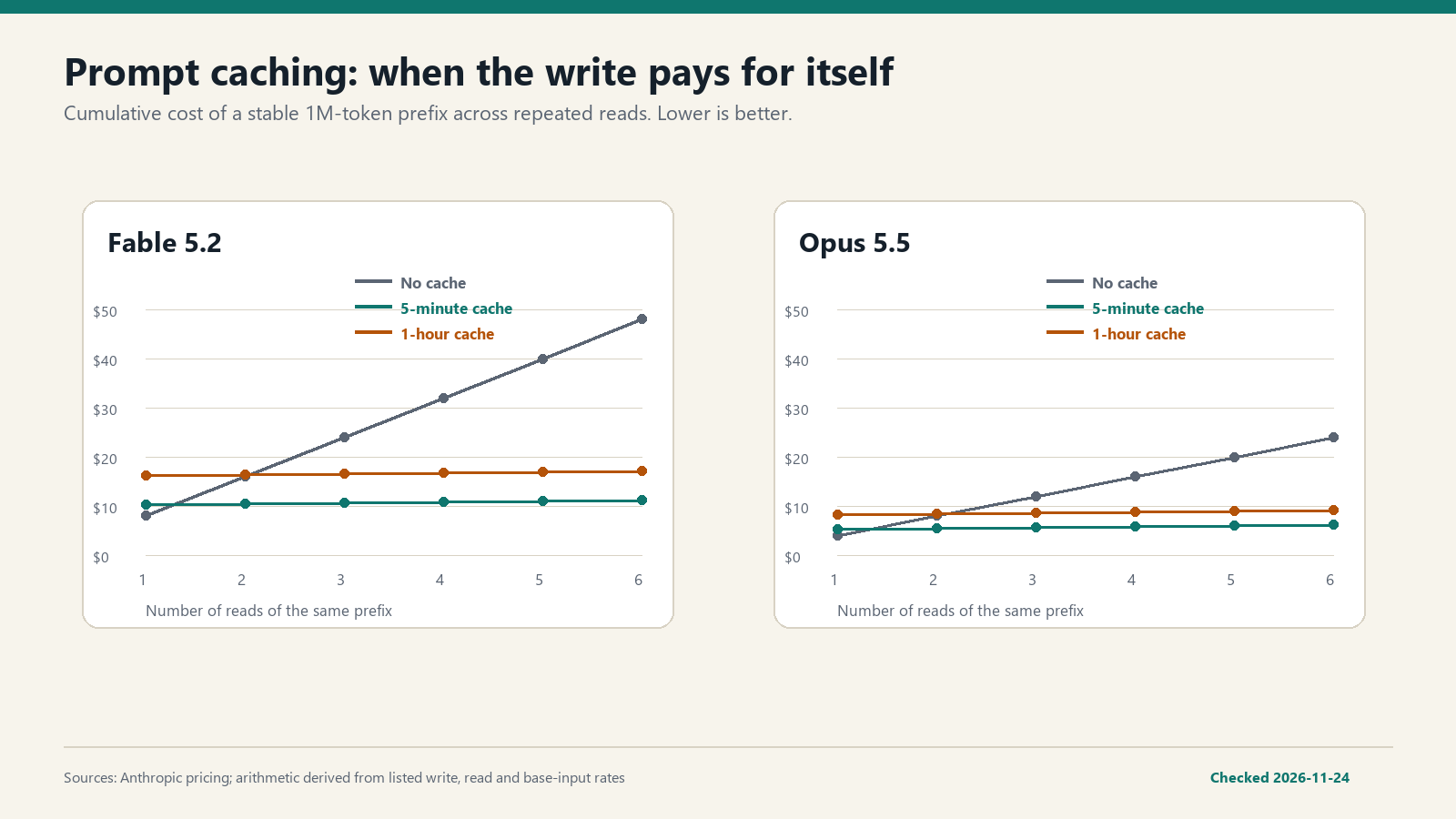
Choose the TTL from the reuse interval. Five minutes suits a burst of requests against the same workflow prefix. One hour can make sense when the same prefix returns across a longer session, but only when the expected reuse clears the higher write cost. If traffic is sporadic, a one-hour write can lose money even when later requests hit the cache.
Use a cache ledger to record requested and observed behavior: prefix hash, checkpoint index, TTL, write attempt, read hit, token count and task outcome. Alert on a sudden fall in hit rate. That usually points to prompt churn, not model quality.
The Fable 5.2 pricing breakdown covers the full rate table. The Opus 5.5 pricing comparison is useful when a lower-rate model fits the same validated task. Neither comparison makes a cache write free.
Long context does not remove these rules. Anthropic lists no separate above-200K surcharge for Fable 5.2 in the checked pricing material. The safe statement is that no such surcharge is listed, not that the bill cannot change. Output, thinking, cache writes and endpoint choice still affect the final charge. Fast mode applies across the full context window. Batch receives a 50% discount, but Fast mode is unavailable with Batch.
Test the policy on a fixed task set
Build a task contract before comparing effort settings. The contract should name the input fixture, allowed evidence, tool set, output schema, domain validator, data route and spending ceiling. It should also define what the workflow returns when the model cannot finish. Without that last field, a refusal can leak into the application as a vague error or, worse, as partial output marked complete.
Freeze the template and fixtures for a comparison run. Change one routing input at a time. If you test effort, keep the prompt order, tools, retrieval set and cache TTL fixed. If you test caching, keep effort fixed and compare a consistently cold prefix with a consistently warm one. Mixing those conditions produces a number that cannot guide production.
Replay the same cases across the effort ladder and record accepted results, rejected results, output tokens, cache status and elapsed time. Include easy cases as well as difficult ones. A policy that improves the hardest branch but wastes effort on routine extraction may raise total cost without improving the workflow. Report cost per accepted task beside pass rate so the trade-off stays visible.
Keep benchmark scores out of the routing threshold. An Intelligence Index result describes an evaluator, not your invoice parser or support-ticket agent. Vendor benchmark claims can identify promising capabilities, but the acceptance gate has to run against your schema and evidence. The independent GPT-6 Astra review is a useful reminder that evaluator results and task behavior need separate measurements.
Test refusal cases in a controlled fixture set as well. Include requests that should be refused and confirm that the workflow stops cleanly when no usable credit exists. Confirm that an eligible fallback still passes the same validator. Do not use prohibited production content as a test fixture. The purpose is to verify control flow, not to probe safeguards.
Promote a routing change only after the fixed task set meets a gate declared before the run. Keep the previous configuration available for rollback. Record the template hash, model ID, effort, cache TTL and fallback policy with the result. That record lets another engineer reproduce the decision without guessing which prompt version was live.
Handle refusals as a separate control plane
Anthropic and the AWS model card document a refusal body that can arrive with HTTP 200. The body includes stop_reason: "refusal" and may include stop_details.restriction_category. Billing depends on the refusal category and whether output started. Inspect the body before your application records success.
A refusal means the requested task hit a safeguard boundary. It does not mean the service was unavailable, and it does not mean the same request should be retried at a higher effort. Preserve the request and response needed for review, subject to your data-retention policy. Record the restriction category when present, without exposing sensitive content in routine logs.
The fallback-credit beta is narrow:
- Enable it with the
fallback-credit-2026-07-01header. - Do not assume every refusal carries a fallback token.
- Use only Opus 5 or Opus 4.8 as fallback models.
- Do not use Fable or Opus 5.5 as eligible fallback targets.
- Expect a retry to bill a cached prefix at cache-read rather than cache-write rates where caching applies.
- Treat the credit as constrained capacity, not a promise of a free or unlimited retry.
The last point is the honest loss in this design. Fallback credits do not provide a general reliability net. Some refusals cannot use the path at all, eligible targets are limited, and charges can still occur. A workflow that depends on fallback for routine completion will remain fragile.
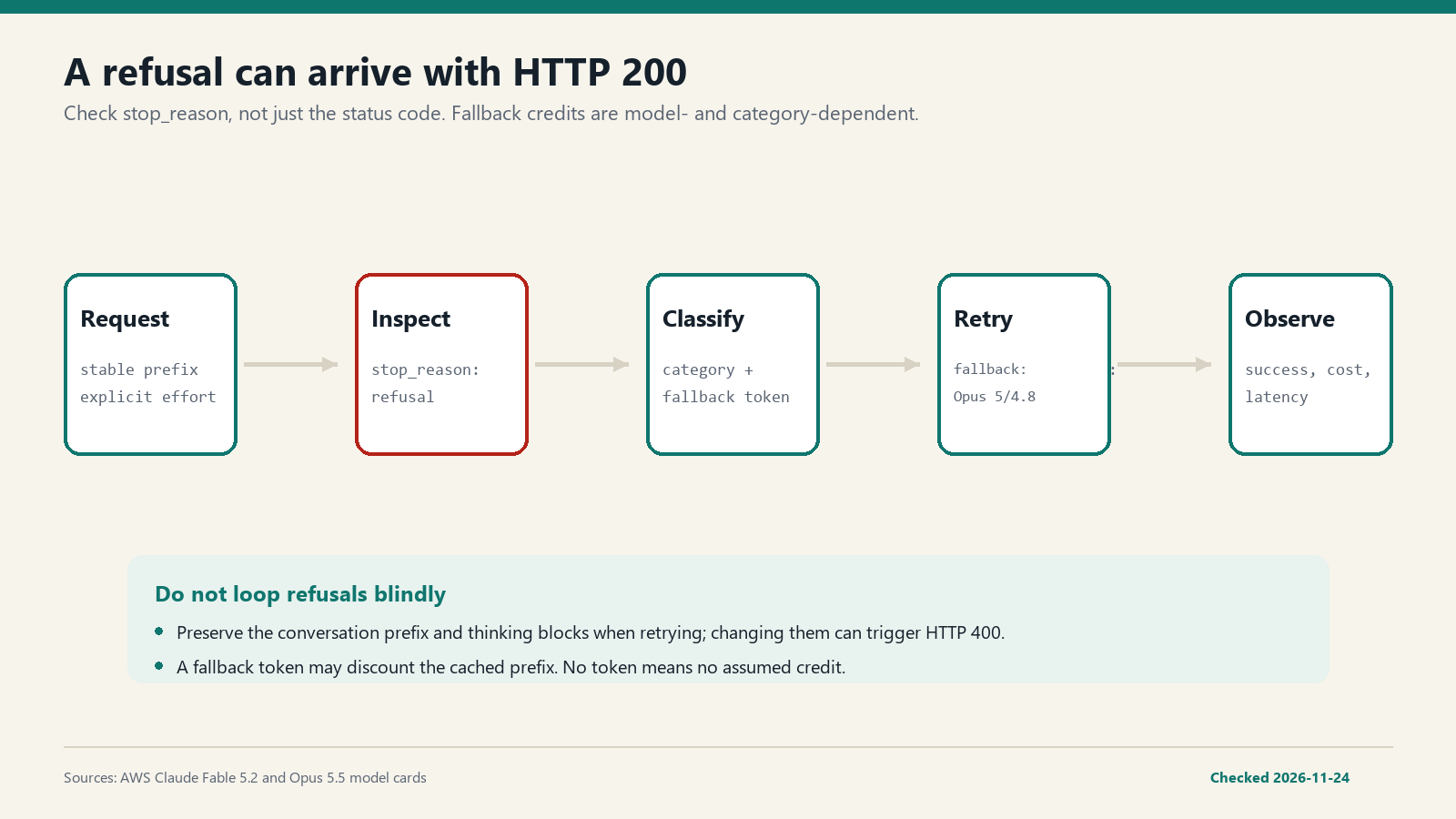
Apply the routing and privacy controls before a fallback leaves the original processing boundary. A second model can change where data is processed and which provider sees the prompt. The fallback decision therefore needs both a safety check and a data-routing check. The rate-limit considerations belong in the same operational review because retries add traffic.
A safe fallback sequence is:
- Detect
stop_reason: "refusal"even when the HTTP status is 200. - Mark the task incomplete and capture the operational metadata.
- Check for a usable fallback token. If none exists, stop the automatic path.
- Confirm that the approved target is Opus 5 or Opus 4.8.
- Confirm that policy and data-routing rules permit the transfer.
- Retry once with the same validated task contract.
- Run the completion gate on the fallback output.
- Record the final outcome, credit use and charges.
Do not route a refused Fable request to another Fable ID or to Opus 5.5 and label it an eligible fallback. Opus 5.5 has its own fallback-credit beta, also limited to Opus 5 and Opus 4.8, but that does not make it a valid target for a Fable refusal. The Opus 5.5 review and model alternatives cover selection decisions outside this constrained credit path.
Keep direct API and Bedrock claims separate
Fable 5.2 is an official direct-API model. The checked site catalogue does not show a Fable 5.2 gateway model page. Nothing in this article should be read as a callable gateway route or a gateway price. Use the model documentation for integration references and the current model catalogue to check which hosted options are actually listed.
Bedrock is a separate access path with its own identifiers and constraints. The Fable 5.2 Bedrock IDs are anthropic.claude-fable-5-2, us.anthropic.claude-fable-5-2 and global.anthropic.claude-fable-5-2. There is no in-Region option for the bare Fable ID. Geo routing covers US and Canadian source Regions. Global routing is not a data-residency guarantee.
Fable 5.2 on Bedrock requires retention mode aws_review. It supports Standard only. Priority, Flex, Reserved and Batch are unsupported. Those limits matter to the routing policy: a Batch cost plan cannot be copied directly from the official API to Bedrock, and a Fast-mode latency plan is not available there. The Bedrock routing comparison explains the Opus 5.5 profiles and Mantle differences without implying that every feature transfers to Fable.
If your workload needs regional processing or a managed cloud route, review the endpoint before promising a location. Applicable regional and multi-region endpoints carry a 10% premium over global endpoints in the official pricing material. Do not generalize that premium to every US customer or every Bedrock request. Name the endpoint and scope in the cost model.
Operate the policy with outcome metrics
A routing dashboard should join each model attempt to the task result. Count accepted outputs, schema failures, tool failures, refusals, replay errors, transport errors and abandoned branches. Split each count by effort, prefix version, cache status and fallback use.
The primary metric is cost per accepted task, not cost per request. A cheaper call that fails validation can cost more after a retry. A higher-effort call can be economical if it removes a second pass, but that has to be measured on your workload. The GPT-6 Astra pricing analysis and independent review show why rate comparisons need a task denominator and dated evidence.
Set separate alerts for three conditions:
- Completion rate falls: inspect schema drift, tool changes and effort distribution before increasing effort.
- Cache hit rate falls: inspect prefix hashes, template versions, TTLs and checkpoint placement.
- Refusal rate rises: inspect task categories and policy changes. Do not treat the increase as a latency incident.
Keep a rollback path for every routing change. Record the previous effort, prefix version and fallback configuration. A clean rollback is more useful than an emergency prompt edit made during an incident.
For cross-provider planning, the GPT-6 Sol versus Opus 5.5 comparison keeps model versions and task economics separate. No single frontier model wins every branch. Route by measured acceptance, cost and data constraints.
What the public data does not show
The frozen sources do not provide a controlled latency or output-token distribution for each Fable 5.2 effort on structured workflows. They also do not show a cache-hit distribution for a representative agent workload. Those values need your own traces.
The fallback-credit material confirms the header, eligible models and the possibility of a 200 refusal. It does not quantify the total credit allowance, issuance frequency or every eligible refusal category in the checked pack. Do not build capacity assumptions around an unknown quota. Treat fallback as an exception path with a hard attempt limit.
The independent Intelligence Index snapshot has a reproduction caveat. The earlier fetch supplied 65 and evaluator v5.0.1 at Max. The later fetch did not reproduce those fields in extracted text. That is an unresolved evidence gap, not a reason to replace the score with a newer unstated number.
This section will be updated when dated effort-level traces, a fuller fallback-credit specification or an independent reproduction of the evaluator snapshot becomes available. Based on the named sources checked on 2026-11-24, the current state is a five-setting effort ladder, bounded explicit caching, a documented 200-refusal path and a narrow fallback exception. That is what is confirmed, not a prediction.
How to use this without overbuying
Start with explicit High effort for general agent work, a stable four-part prefix where each checkpoint earns its write, and a strict completion validator. Move down to Medium or Low when your traces show those settings pass the same gate. Move up to Xhigh or Max only for a named failure class with a measured benefit.
Keep refusal handling outside the normal escalation loop. A refusal goes to policy review and, only when eligible, one approved fallback. A validation failure goes to repair or effort escalation. A 400 thinking-block replay error goes to prefix reconstruction. A timeout goes to transport handling. Separating those paths prevents one generic retry function from making all four problems worse.
For hosted alternatives, browse the model catalogue, review gateway pricing and estimate a workload with the cost calculator. Fable 5.2 itself is not presented here as a gateway option. The production pattern still applies: select effort deliberately, protect the prefix, validate the result and account for every fallback.