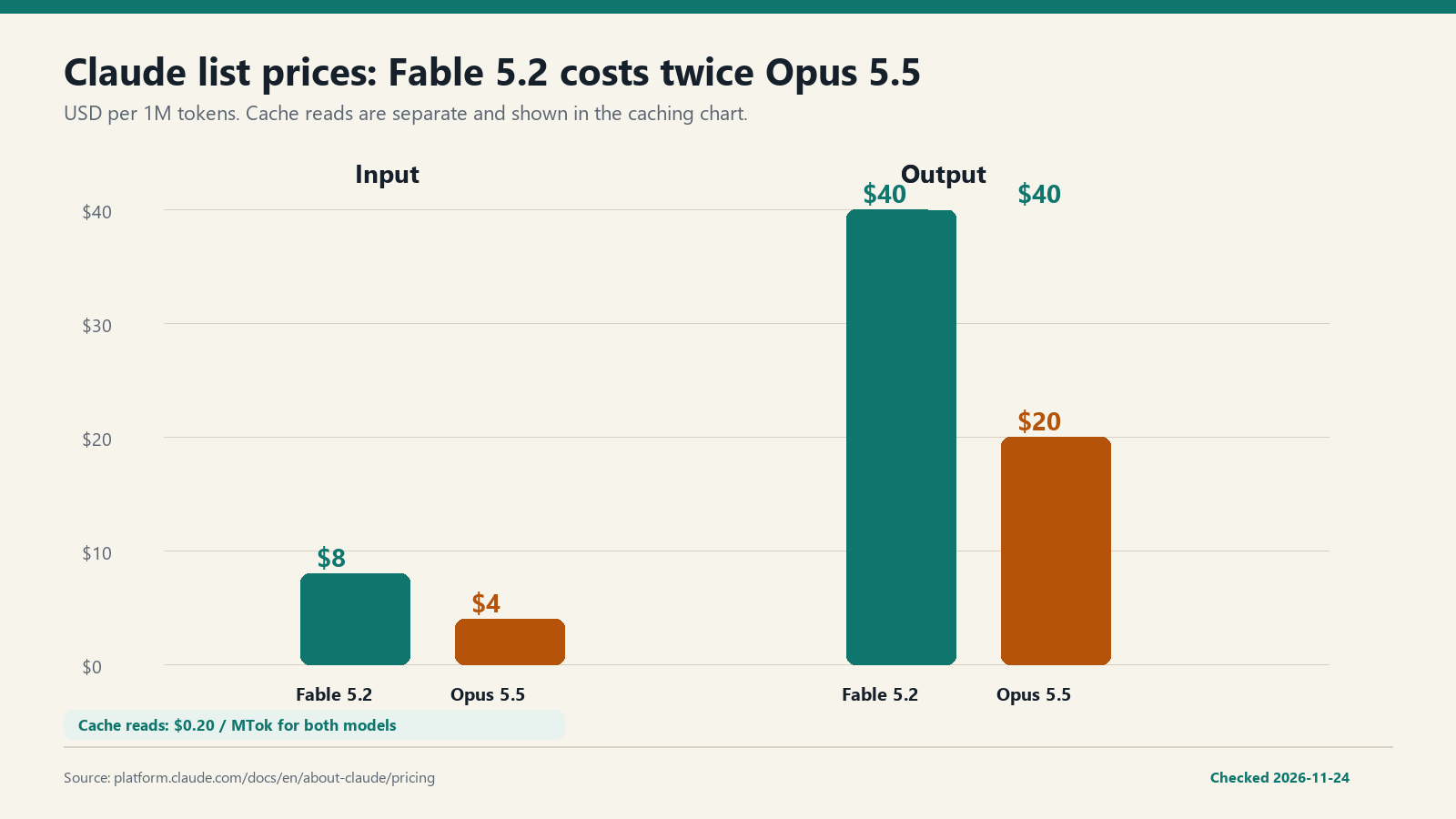
There is no verified all-purpose alternative to Claude Opus 5.5 in the November 24, 2026 evidence set. The defensible choice depends on the task. Fable 5.2 costs more per token, at $8 input and $40 output against Opus 5.5’s $4 and $20 per million, but Anthropic reports a higher FrontierSWE v2 score. GPT-6 Sol lists at $2 input and $10 output. GPT-6.2 Sol lists at the same short-context rates. Gemini 4 Neon lists at $3 input and $15 output. None of those rate differences proves a lower cost per successful task.
The missing ingredient is a shared, independent task-success benchmark that includes every candidate under the same harness, effort setting and cache conditions. No such benchmark appears in the frozen sources. Treat the recommendations below as a routing framework, not a universal winner. Record success on your own tasks, count every billable attempt, and compare the resulting cost per accepted result.
This article is for teams deciding whether Opus 5.5 still earns its place in a production stack. It separates vendor claims, independent snapshots and arithmetic. It also separates an official API from gateway availability. The current gateway catalogue and model status page, checked on 2026-11-24, are the access record, not a vendor announcement.
The short answer
- What changed: Fable 5.2, GPT-6.2 Astra and Sol, and Gemini 4 Neon added credible alternatives at different price and capability points.
- Who it is for: Operators of coding agents, document workflows, extraction pipelines and long-context services.
- Main win: Opus 5.5 offers a 1M context window, a Medium default effort setting and lower list rates than Fable 5.2.
- Main loss: Opus 5.5 scores below Fable 5.2 on Anthropic’s reported FrontierCode 2.0 and FrontierSWE v2 rows, and below GPT-6 Astra on Anthropic’s reported AutomationBench row.
- Availability: Claude Opus 5.5 and GPT-6 Astra have gateway model pages. Fable 5.2, GPT-6 Sol and GPT-6.2 Sol do not.
- What is missing: A common independent success benchmark, matched retry data, matched cache hit rates and a verified Qwen comparison in this evidence set.
Start with cost per success, not cost per million
A token price is a rate. A successful task is an outcome. A rate cannot tell you the outcome price until you know how many tokens each attempt consumes, how often an attempt fails, and how many attempts are needed to produce an accepted result.
Use this definition:
cost per successful task = total attempt cost / number of successful tasks
That total includes fresh input, cached input, cache writes, output and reasoning tokens. It includes failed attempts and partial attempts that your application rejects. It may also include tool calls, retrieval charges and other service costs when those are part of delivering the task. Keep those components separate before combining them, so a cache discount does not hide a tool-cost increase.
For one model, under a stated tier and endpoint, calculate:
attempt cost = (fresh input tokens / 1,000,000 × input rate) + (cached input tokens / 1,000,000 × cached rate) + (cache write tokens / 1,000,000 × write rate) + (output tokens / 1,000,000 × output rate)
Anthropic’s official API pricing supplies the Claude rates in that equation. OpenAI’s API pricing supplies the GPT-6 and GPT-6.2 tiers. Google’s Gemini API pricing supplies Neon’s Standard, Batch, Flex and Priority rows.
If c is the average cost of an attempt and p is the probability that an attempt produces an accepted success, the simple expected cost is c / p. The formula assumes independent attempts with a stable success probability and stable cost. Those assumptions often fail. A model may generate more tokens when it struggles, and a retry after extra context may cost more than the first call. A measured total divided by measured successes avoids forcing those assumptions.
The denominator needs a definition. “HTTP 200” is not enough. A Claude refusal can arrive with HTTP 200 and a stop_reason of refusal. A coding response can also be syntactically valid but fail its tests. An extraction response can parse correctly but miss a required field. Count success at the boundary your product accepts, not the boundary your client library accepts.
The cost-per-success routing decision belongs beside the rate table, while spend controls determine what happens before an expensive retry escapes. The objective is not the cheapest API call. It is the cheapest accepted result with the required latency and safety properties.
Worked example: retries erase a token-rate advantage
Here is an illustrative model, not a benchmark result. Every token count and success rate in this example is an explicit assumption.
Assume a 100-task evaluation set. Model A costs less per attempt. It succeeds on 70 of 100 tasks in one attempt, then requires one retry on the 30 remaining tasks. Those retries succeed on 15 tasks and fail on 15. Model B costs more per attempt and succeeds on 85 of 100 tasks without retries.
Both models receive 20,000 input tokens and generate 8,000 output tokens per attempt. Assume no cache reads, no cache writes, Standard short-context pricing, and identical handling overhead. Use GPT-6.2 Sol’s published short-context Standard rates for Model A: $2 per million input and $10 per million output.
- Input cost per attempt:
20,000 / 1,000,000 × $2 = $0.04. - Output cost per attempt:
8,000 / 1,000,000 × $10 = $0.08. - Attempt cost:
$0.12. - Expected attempts:
100 + 30 = 130. - Total token bill:
130 × $0.12 = $15.60. - Successful tasks:
70 + 15 = 85. - Cost per success:
$15.60 / 85 = $0.183529…, or about$0.184.
Use GPT-6.2 Astra’s published short-context Standard rates for Model B: $8 input and $40 output per million.
- Input cost per attempt:
20,000 / 1,000,000 × $8 = $0.16. - Output cost per attempt:
8,000 / 1,000,000 × $40 = $0.32. - Attempt cost:
$0.48. - Attempts:
100, with no retries under this assumption. - Total token bill:
$48.00. - Successful tasks:
85. - Cost per success:
$48.00 / 85 = $0.564705…, or about$0.565.
Model A remains cheaper on every token and on the assumed retry path. That does not demonstrate a general rule. Change one assumption: give Model A a 50% first-pass success rate and one equal-cost retry on every failure. Its expected attempts become 200, its expected successes become 75, and its expected cost per success becomes $24 / 75 = $0.32. If a retry produces more output, or costs twice as much, the result rises again.
Now make Model B succeed on 90 of 100 tasks. Its cost per success becomes $48 / 90 = $0.533. Model A still wins this particular scenario, but the rate advantage no longer settles the decision. Add a hard requirement for 90% task completion, and Model A fails the requirement at any price.
A stronger erasure case keeps Model B at 85 successes but uses Opus 5.5 list rates: $4 input and $20 output per million. Its attempt cost becomes $0.08 + $0.16 = $0.24, and its cost per success is $24 / 85 = $0.282. Model A needs about 2.36 equal-cost attempts per success to reach the same result. If its retry path requires three attempts per success, its cost is 3 × $0.12 = $0.36. The lower-rate attempt now costs more per accepted result. If Model B reaches 90 successes, its cost per success falls to $24 / 90 = $0.2667.
The lesson is specific. A rate advantage survives only while success and token use remain within bounds. Measure both. The cost calculator can price an uncached input-and-output scenario, but it does not model cache events or retries and cannot supply a success rate that your application has not recorded.
Claude Opus 5.5: the baseline to beat
Anthropic lists Opus 5.5 at $4 input, $20 output, $5 for a five-minute cache write, $8 for a one-hour cache write and $0.20 for a cache read per million tokens. Batch input and output are $2 and $10. Fast mode is $8 and $40. Those are official list rates, not a statement about a gateway rate or a subscription allowance.
The model launched on 2026-09-22. It has a 1,000,000-token context window, a 128,000-token maximum output, and low, medium, high, xhigh and max effort settings. The official default is Medium. Adaptive thinking is always on. Text and image input are supported; output is text. Anthropic states an end-of-life date no earlier than 2027-09-22.
The practical attraction is balance. Opus 5.5 is cheaper than Fable 5.2 on the listed uncached input and output rates for Standard, Batch and Fast. Its default effort is Medium, while the Fable default has conflicting documentation. It also has a gateway model page today. That makes it a concrete baseline for an existing routing stack rather than a paper alternative.
The limitations matter just as much. Anthropic’s own FrontierCode 2.0 table reports Fable 5.2 at 49.1% and Opus 5.5 at 45.5%, with Fable at xhigh and the comparator effort not fully disclosed. FrontierSWE v2 reports 69.9% for Fable 5.2 and 62.3% for Opus 5.5. These are vendor-reported rows. They do not become independent evidence because both models come from the same vendor.
Artificial Analysis separately snapshots Opus 5.5 at Intelligence Index 59 at Max effort, evaluator v5.0.1, checked on 2026-11-24. That composite score is not a success rate for your coding agent. The Artificial Analysis Opus 5.5 page is the source for that independent snapshot. Anthropic’s Opus 5.5 announcement is the source for the official launch facts and vendor benchmark rows. Use the Opus 5.5 pricing breakdown for cache and endpoint charges, and the Opus 5.5 review for the difference between Anthropic’s Terminal-Bench result and the independent index.
Anthropic also reports Terminal-Bench 4.0 at 66.4% for Opus 5.5 at xhigh, against a 55.8% Fable 5.1 comparator. This is a vendor-reported terminal task result, not the same metric as the 59 Intelligence Index. It supports testing Opus 5.5 on terminal work. It does not establish that Opus wins every coding task. The AutomationBench row goes the other way: Anthropic reports Opus 5.5 at 40.0% and GPT-6 Astra at 41.4%.
Cache math can change the Claude comparison
Anthropic’s cache prices create a clear input-side trade-off. A five-minute cache write costs 1.25 times an uncached input read. Two cache reads plus the write cost 2.5 uncached reads, so the write breaks even after approximately two reads. A one-hour cache write costs twice an uncached input read. Three reads plus the write cost 3.6 uncached reads, so the write breaks even after approximately three reads.
Those break-even points are derived comparisons of input charges only. Output is separate. Prefix stability is also separate. A cache is not a discount for sending nearly the same prompt. It depends on reusing a stable prefix and on the provider recognizing that reuse. Test hit rate rather than assuming it.
The Opus 5.5 context-caching guide covers checkpoints and replay constraints. The gateway’s prompt-caching documentation is the implementation reference for a gateway route. When a repeated prefix carries a large policy, tool schema or retrieval block, cache economics can matter more than the uncached input-rate gap between two models.
Claude Fable 5.2: pay more only when success improves
Fable 5.2 is the most direct Claude alternative in this evidence set. Anthropic lists it at $8 input and $40 output per million. Five-minute and one-hour cache writes are $10 and $16; cache reads are $0.20. Batch input and output are $4 and $20. Fast input and output are $16 and $80.
Its official API ID is claude-fable-5-2. It launched on 2026-11-09, has a 1M context window, a 128,000-token maximum output and low, medium, high, xhigh and max effort settings. Adaptive thinking is always on. Anthropic states an end-of-life date no earlier than 2027-11-09.
There is a real documentation conflict. Anthropic’s launch article says the default effort is Medium. The models overview and AWS Bedrock model card say High. Artificial Analysis’ earlier direct fetch, date-stamped 2026-11-24, also lists High as the default. Set effort explicitly in an evaluation. Otherwise two runs can differ before the first token is billed.
Artificial Analysis’ earlier Fable 5.2 snapshot gives Intelligence Index 65 at Max, evaluator v5.0.1. A later fetch reconfirmed default High, 1M context and pricing but did not reproduce the score and version in extracted text. Keep the earlier snapshot date-stamped. Do not present the later fetch as an independent reproduction. The Artificial Analysis Fable 5.2 page is the independent source named in the register; the reproduction caveat remains part of the result.
Fable’s strongest official rows are relevant to agentic work. FrontierCode 2.0 is 49.1%, against Opus 5.5 at 45.5%. FrontierSWE v2 is 69.9%, against 62.3%. RoboDojo Sim is reported at 64.9%, against GPT-6 Astra at 29.8%. These are Anthropic-reported results, not a shared independent evaluation across this article’s full candidate set. FrontierCode 2.0 names Fable at xhigh and leaves Opus effort not fully disclosed; the other accessed rows do not provide a common matched effort.
The buying question is whether those gains reduce failures enough to offset a list input rate twice Opus 5.5’s and an output rate twice as high. If Fable and Opus consume the same tokens on your task set, Fable costs twice as much at list. If Fable needs materially fewer retries, the outcome comparison can move. If both succeed at the same rate and use similar tokens, the higher rate has no compensating win in that workload.
The mechanism and limits come from Anthropic’s Fable and Mythos 5.2 announcement and its models overview. They describe the launch, effort settings and safeguards. They do not provide a matched cost-per-success result for your workload. That still requires a local evaluation.
Fable also changes the safety boundary. It blocks high-risk cybersecurity and most research-biology tasks. Mythos 5.2 is the same underlying model with different safeguards and access, and it requires Cyber Verification or Life Sciences Verification. No verified standalone Mythos API ID appears in the pack. A refusal can return HTTP 200, so the application must inspect the response body before recording success.
The Fable 5.2 launch guide explains the access model. The Fable 5.2 pricing analysis covers Fast and Batch constraints. The Fable 5.2 review separates vendor scores from independent evidence, and the Fable 5.2 production-routing guide covers refusal handling and fallback eligibility. Fable 5.2 has no gateway model page in the frozen catalogue, so this article does not offer it as a callable gateway model.
GPT-6 Astra: measured task economics, with a hallucination loss
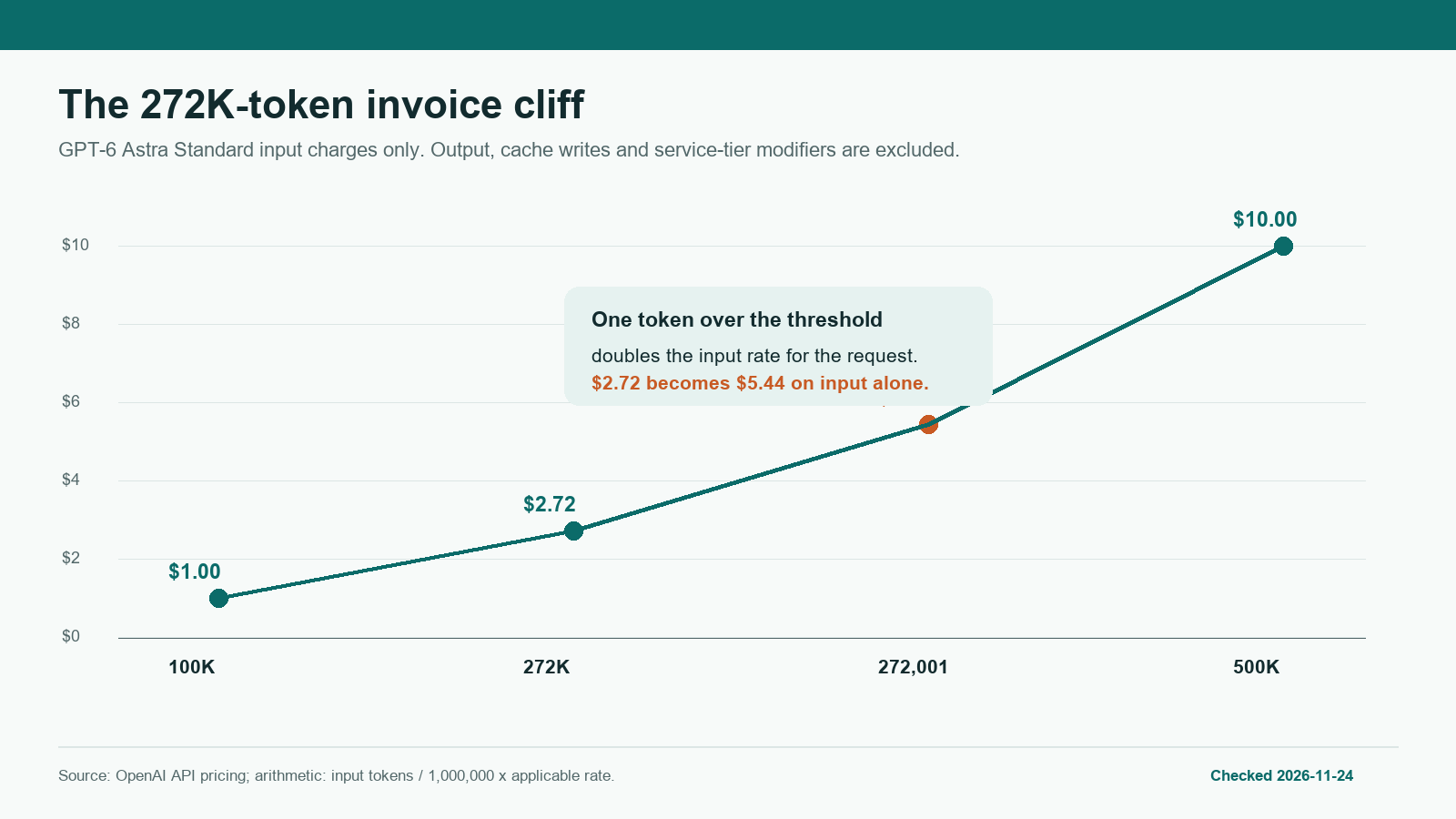
GPT-6 Astra lists at $10 input, $1 cached input and $50 output per million tokens for Standard requests at or below 272,000 input tokens. Above 272,000 input tokens, those rates become $20, $2 and $75. The higher tier applies to the whole request once input exceeds the threshold. It is a rate cliff, not a surcharge on the last few tokens.
That cliff deserves its own budget line. A Standard request with 100,000 uncached input tokens costs $1.00 in input charges. At 272,000 tokens it costs $2.72. At 272,001 tokens it costs about $5.44. One additional token changes the input rate for every input token in the request. Output remains separate. A retrieval pipeline that trims context close to the threshold needs deterministic chunking and token counting, not an approximate character limit.
Artificial Analysis’ September 9, 2026 snapshot measured GPT-6 Astra at Max effort on its own harness. It reports Intelligence Index 53, cost per Intelligence Index task of $3.26, about 27K output tokens per task, Coding Agent Index 62, cost per coding task of $7.09, and a 51% hallucination rate. It also reports Terminal-Bench v4.0 at 59%, AutomationBench-AA at 69% and GDP.pdf at 31%.
Those numbers make Astra more than a rate-table alternative. They provide independently measured token volume and task cost for one evaluator’s workload. They also provide a clear loss. A 51% hallucination rate is a warning for fact-sensitive work, and a cost-per-task figure is not a success guarantee. The fetched article did not state the Intelligence Index evaluator version, so this article does not label it v5.0.1.
A later November figure attributed to eesel gives 57 and $6.24 per task. The frozen pack identifies this as a different snapshot from the September Artificial Analysis result. Do not blend the two or present either as a current rank. The GPT-6 Astra review keeps the September measurement and the hallucination caveat together. The GPT-6 Astra pricing guide works through the 272K tier boundary.
Artificial Analysis’ GPT-6 Astra benchmarking article is the source for the September task-cost and hallucination snapshot. Its missing evaluator version is an evidence gap, not a label to infer from another model’s page.
For routing, Astra is a candidate when independent task economics matter more than the lowest list rate. Its gateway model page exists. Its measured 51% hallucination rate means retrieval grounding, verification and a strict acceptance test remain part of the task cost. “The model answered” is not the same as “the answer was correct.”
GPT-6 Sol: a lower-rate candidate with narrower evidence
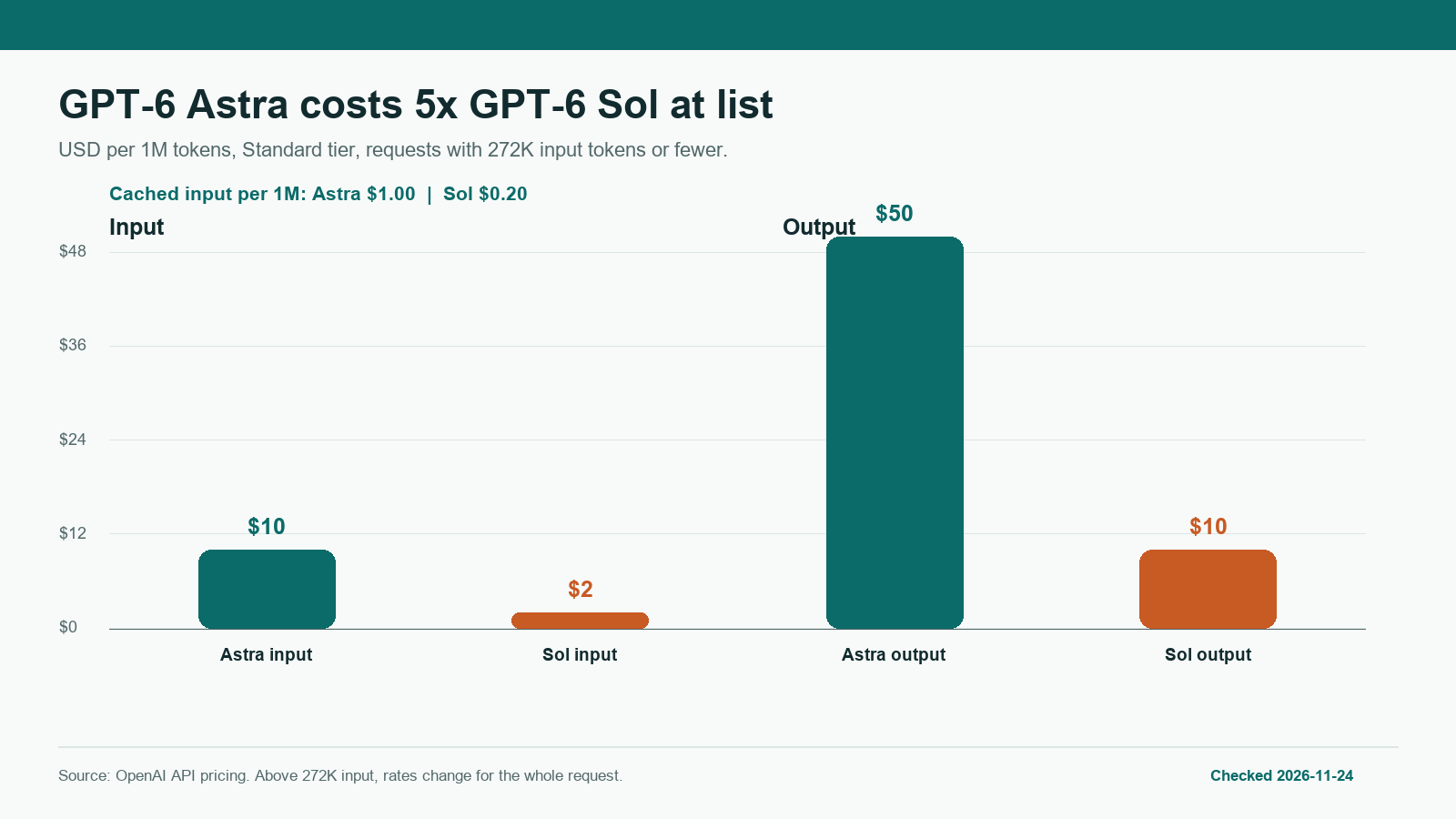
GPT-6 Sol is not GPT-6.2 Sol. Keep the version in configuration, logs and evaluation reports. The frozen evidence gives GPT-6 Sol Standard short-context rates of $2 input, $0.20 cached input and $10 output per million tokens. Above 272,000 input tokens, the rates are $4, $0.40 and $15. Batch and Flex halve Standard rates. Fast doubles them.
Artificial Analysis lists effort settings max, xhigh, high, medium, low and non-reasoning. Its snippet gives Intelligence Index 44 at Max. OpenAI reports AutomationBench at 33.2% at xhigh with an official cost per task of $0.27. It also reports Agents’ Last Exam v1 at 56.4% at max, DeepSWE v1.1 at 68.8% at max and OSWorld 2.0 offline at 60.5% at xhigh.
The $0.27 figure is useful but limited. It is an OpenAI-published cost per task for AutomationBench, not an independent measurement and not a promise for your workload. The official limits, knowledge cutoff and snapshot aliases for GPT-6 Sol were not verified in the accessed pack. Leave them unknown rather than borrowing a spec from a related model.
A low rate makes Sol a reasonable candidate for high-volume work with a measurable acceptance test. It does not establish that Sol is the least expensive successful result. A lower-quality answer that needs human repair can cost more than a higher-quality answer delivered once. Count review time if it is part of the workflow’s operating cost, and keep it separate from token spend if finance needs a clean API bill.
The GPT-6 Sol versus Opus 5.5 comparison is the focused version-specific read. The Anthropic models overview documents Opus 5.5’s verified limits and effort settings. OpenAI’s GPT-6 Sol and Luna announcement supplies the official benchmark and per-task claims. The Artificial Analysis GPT-6 Sol page supplies the effort list and Intelligence Index snippet. GPT-6 Sol has no gateway model page in the frozen catalogue. This article therefore treats it as an official direct-API candidate, not a callable route here.
GPT-6.2 Astra and Sol: new rates, unresolved snapshots
GPT-6.2 Astra Standard short-context rates are $8 input, $0.40 cached input and $40 output per million tokens. GPT-6.2 Sol Standard short-context rates are $2, $0.10 and $10. Above 272,000 input tokens, Astra moves to $16, $0.80 and $60, while Sol moves to $4, $0.20 and $15. Batch and Flex are half of Standard. Fast is double. Astra and Sol also have Ultrafast tiers with dated prices that change on 2027-03-01.
Explicit cache writes add another input-side charge. For GPT-6.2 Astra, the listed Standard 30-minute/12-hour write pairs are $10/$20 and $20/$40 per million tokens. For GPT-6.2 Sol, they are $2.50/$5 and $5/$10. A cached-read discount is not the whole caching cost. Include the write, the read and the expected number of reuses.
The independent evidence has a visible conflict. Artificial Analysis’ launch article gives GPT-6.2 Astra 65 and Sol 57 at Max. Its live Astra snippet gives 62 at Max or Xhigh, 60 at High, 57 at Medium and 46 at Low. The 65-versus-62 difference is snapshot-dependent and unresolved. The pack also records eesel figures of Astra 62 at $4.00 per task and Sol 57 at $1.01 per task. Those figures are not a substitute for a shared success benchmark across all candidates.
Effort still changes the comparison. The live Astra ladder shows the same model moving from 62 to 46 across settings. A cheap low-effort run can save tokens and fail the acceptance test. An expensive max-effort run can spend more than the task needs. Evaluate at the setting you will deploy, then test whether a lower setting changes success or token use on your tasks.
GPT-6.2 Astra has a gateway model page, but it is marked unavailable in the frozen record. GPT-6.2 Sol has no gateway model page. Do not use a callable gpt-6.2-astra:free CTA. OpenAI’s GPT-6.2 Astra and Sol announcement is the official launch source. Artificial Analysis’ GPT-6.2 launch analysis records the launch snapshot that differs from the live model page.
The GPT-6.2 Astra pricing guide has the full tier structure, the GPT-6.2 Astra versus Fable 5.2 analysis examines the snapshot conflict, and the November frontier shortlist places the new tiers beside the established ones.
Gemini 4 Neon: multimodal reach and a slower measured run
Gemini 4 Neon lists at $3 input, $15 output and $0.15 cached input per million tokens in Standard mode. Batch and Flex are $1.50, $7.50 and $0.075. Priority is $5.40, $27 and $0.27. Google shows implicit caching only; no explicit-cache storage price appears in the accessed pricing page.
Neon supports text, images, audio, video and PDF input. Its thinking levels are low, medium, high and xhigh, with High as the official default. Thinking tokens are billed. The official page renders “1M unified tokens.” The exact 1,048,576 figure was not visible and remains unverified. Output is 64K by default, with 1M long decode offered under an eligibility threshold that was not verified in the pack.
Artificial Analysis’ November 18, 2026 snapshot reports Intelligence Index 61 at xhigh, cost per task of $6.44, runtime of about 21 minutes per task and speed of about 110 output tokens per second. It reports Coding Agent Index 59 at xhigh on Antigravity CLI, at $6.86 per task. GDP.pdf is 33.4% at High but 28.0% at xhigh. That row is a useful reminder that more effort does not improve every benchmark.
Eesel’s 59.6 at High is not directly comparable to Artificial Analysis’ 61 at xhigh. Keep the effort labels attached. A lower score at a different setting is not proof that one evaluator is wrong. It is proof that the setting belongs in the result.
Neon is a candidate for multimodal ingestion and workflows that can tolerate its measured runtime. It is not automatically the cheap choice merely because its input rate is below Astra’s. The measured $6.44 per task on Artificial Analysis’ harness is higher than Astra’s September $3.26 on a different harness. Those figures cannot be ranked against each other as if the tasks were identical. The Gemini 4 Neon pricing analysis covers the rate table, and the Neon versus Opus 5.5 comparison examines the capability split.
Gateway access is unavailable in the frozen record. The free promotion ended on 2026-11-20, and the model page is marked unavailable. gemini-4-neon:free is not a current callable CTA.
Google’s Gemini 4 Neon model documentation supplies the official modalities, thinking levels and output description. Artificial Analysis’ Gemini 4 Neon intelligence analysis supplies the independent task-cost, runtime and speed snapshot. The Gemini 4 Neon pricing analysis covers the rate table, and the Neon versus Opus 5.5 comparison examines the capability split.
Qwen4-Max: a candidate, not a filled comparison cell
Qwen4-Max is the evidence boundary in this article. The production pack establishes that an official API exists and that no current oneaiapikey.com catalogue row was found in this research. It does not supply the verified rates, independent success measurements or matched benchmark rows needed to place Qwen in the same cost-per-success calculation.
Do not fill those cells from memory or from an older comparison. A rate without a source class is not evidence, and a benchmark without matched effort is not a controlled result. The existing Qwen4-Max versus Opus 5.5 coverage can provide background, but its numbers are not imported into this frozen comparison. This article makes no gateway ID claim for Qwen and no price claim.
That leaves a practical next step rather than a recommendation. If Qwen is under consideration, obtain the current official rates and run the same task set used for the other candidates. Record success, attempts, token classes and wall-clock time. Until then, Qwen remains a candidate to test, not a row that can honestly be declared cheapest or most successful.
Cache hit rate is a workload property
A cache hit rate is not a model feature in isolation. It is a property of the request stream, the prefix design and the provider’s caching behavior. Two teams can send the same model the same nominal task and get different input bills because one preserves a stable system prompt and tool schema while the other rewrites them on every call.
Measure the cache hit rate on input tokens, not on requests. If 90% of requests reuse a prefix but that prefix is only 10% of input tokens, the token-weighted hit rate is about 9%, not 90%. Also measure cache writes. A cache-read discount can look attractive while repeated writes consume the savings.
For Anthropic’s five-minute cache, the derived break-even is about two reads after the write. For the one-hour cache, it is about three. These are input-side comparisons, not full-task break-even calculations. Output, retries and prefix changes can move the result.
For OpenAI’s GPT-6 family, the standard cached-input price is 10% of the corresponding uncached input rate in the published short- and long-context tiers. GPT-6.2 adds explicit write charges for 30-minute and 12-hour retention. Gemini 4 Neon shows implicit caching with no separate storage price in the accessed page. Do not force these mechanisms into one assumed cache model. Price the mechanism each provider documents, then validate it with logged token classes.
The gateway’s cost-control documentation and model comparison tool help turn those measurements into a routing policy. Neither can infer a cache hit rate that the provider did not report. If the usage record lacks a token class, treat it as unknown rather than allocating it optimistically.
Effort is part of the price and the success rate
Effort settings change how much reasoning work a model performs before it answers. That can change output volume, latency and task success. Comparing two models at their defaults is not necessarily a controlled test when their defaults differ or when the default itself is disputed.
Opus 5.5 has an official Medium default. Fable 5.2 has a documented conflict between Medium in the launch article and High in the models overview and AWS card. GPT-6 Astra’s independent snapshot is at Max. GPT-6 Sol has official results at xhigh and max, depending on the benchmark. GPT-6.2 Astra has a published effort ladder with snapshot conflict at the top. Gemini 4 Neon’s independent snapshot is at xhigh, while its official default is High.
A fair production evaluation therefore fixes the acceptance test and compares a small set of relevant settings. Run the same prompt set, preserve the same retrieval context, and log token use and latency for each setting. If a lower effort setting keeps success within the required margin, it may reduce cost. If it increases retries or human repair, the apparent token saving can disappear.
The reasoning documentation explains the gateway-side controls. The model catalogue documentation is the place to confirm a current model ID before configuration changes. Do not copy an effort name from one vendor into another vendor’s API without checking that provider’s accepted values.
Availability: official API does not mean gateway access
The access boundary is narrow and specific as of 2026-11-24:
| Model | Official API | Gateway model page | Allowed gateway claim |
|---|---|---|---|
| Claude Opus 5.5 | Yes | Yes | Listed; link to its model page |
| GPT-6 Astra | Yes | Yes | Listed; link to its model page |
| Claude Fable 5.2 | Yes | No | Official direct-API model only |
| GPT-6 Sol | Yes | No | Official direct-API model only |
| GPT-6.2 Astra | Yes | Yes, marked unavailable | Do not use a callable free CTA |
| GPT-6.2 Sol | Yes | No | Official direct-API model only |
| Gemini 4 Neon | Yes | Yes, marked unavailable | Promotion ended; no callable free CTA |
| Qwen4-Max | Yes | No current catalogue row found | Do not invent a gateway ID |
This distinction matters for a buying decision. A model can be available from its vendor and still unavailable through the gateway. A model can have a model page and still be marked unavailable. A historical free ID can remain in documentation while no longer accepting traffic.
Use the full model catalogue for current paid listings and the free model catalogue for current free options. Check live status before a migration. A rate comparison does not grant access, and an expired promotion does not become a discount when the window closes. The source register’s oneaiapikey.com model catalogue, free catalogue and status page are the frozen external records behind those local links.
For AWS deployments, the routing constraints are different again. Opus 5.5 supports Bedrock Standard only, with Messages, Converse and Invoke on bedrock-runtime. Responses and Chat Completions are unsupported there. The bare Opus ID permits in-Region inference only in eu-west-2 London. Mantle has its own Regions, Marketplace billing and feature gaps. The Opus 5.5 Bedrock routing guide covers those constraints. Deployment requirements can disqualify an otherwise attractive price before token economics begin.
A routing framework for the first production test
Do not start by replacing Opus 5.5 everywhere. Start with a task family that has a machine-checkable or reviewer-checkable success condition. Then run a staged comparison.
- Freeze the task set. Include ordinary cases, hard cases, long-context cases and known failure modes. Keep the same retrieval data and tool permissions for every candidate.
- Fix the success definition. Write the acceptance rule before seeing model output. Separate content success, schema validity, safety refusal and infrastructure failure.
- Pin model version and effort. Record the exact model ID, effort setting, tier, endpoint and evaluation date. Do not compare an unversioned alias with a snapshot.
- Log every token class. Record fresh input, cached input, cache writes and output. Keep tool and retrieval charges in a separate column.
- Count attempts. Include retries and responses that the application rejects. Record whether a retry reused a cache prefix and whether it received additional context.
- Measure latency and repair time. A successful result that arrives after a deadline is not a production success. Human repair is not a token charge, but it belongs in the operating-cost view.
- Calculate cost per success. Divide total measured cost by accepted successes. Report the number of tasks, the success count and the confidence interval or observed range.
- Set a guardrail. Define the maximum attempts, output budget and spend per task before enabling unattended traffic.
For extraction and structured tasks, begin with a lower-rate candidate only if its schema and field-level accuracy pass. For long-context code work, compare Opus 5.5 with Fable 5.2 on the actual repository and test harness. For multimodal document ingestion, test Neon’s supported input types and runtime. For latency-sensitive loops, use the measured wall-clock result, not output tokens per second alone.
The side-by-side model comparison and published gateway pricing support that test plan. The API quickstart covers a working integration path. None of those tools supplies the missing cross-model success benchmark. Your evaluation has to produce it.
What the public data does not show
No shared independent task-success benchmark in the frozen sources spans Opus 5.5, Fable 5.2, GPT-6 Astra, GPT-6 Sol, GPT-6.2 Astra, GPT-6.2 Sol, Gemini 4 Neon and Qwen4-Max. The available numbers mix vendor benchmark tables, independent composite scores, independent task-cost snapshots and official per-task claims. Their harnesses, effort settings and dates differ.
Several specific gaps remain:
- Opus 5.5 and Fable 5.2 lack an independent cost-per-task figure in this pack that can be compared directly with Astra’s September $3.26.
- GPT-6 Sol’s official context limits, knowledge cutoff and snapshot aliases remain unverified in the accessed sources.
- GPT-6.2 Astra’s 65-versus-62 Intelligence Index conflict remains unresolved across snapshots.
- Gemini 4 Neon’s exact unified-token count and long-decode eligibility threshold remain unverified.
- Qwen4-Max lacks the verified rates and matched measurements needed for this comparison.
- No candidate has a matched retry distribution or cache hit rate for a common external task set in the pack.
This article will need updating when a common benchmark or a corrected official specification appears. Based on the named sources checked on 2026-11-24, the supported conclusion is a routing framework. It is not a universal winner, and it is not a forecast of which model will lead a future leaderboard.
How to use this without overbuying
Keep Opus 5.5 as the baseline where its gateway access, context window and current task performance already meet the requirement. Test Fable 5.2 where its vendor-reported coding gains might reduce expensive failures. Test Astra where independent task economics, automation and coding-agent behavior matter. Test Sol variants where volume is high and acceptance can be measured cheaply. Test Neon where input modalities justify it and runtime fits the product. Add Qwen only after obtaining the missing evidence.
The next purchase should follow a measured result. Price the token mix you actually observed, including cache writes and retries, then compare the cost of accepted tasks at the same quality bar. Use the live rankings as context, not as a replacement for workload evidence. Confirm access in the catalogue, check status, and use the cost calculator to estimate only the uncached input-and-output portion of the bill.
Opus 5.5 and GPT-6 Astra have model pages today. Fable 5.2, GPT-6 Sol and GPT-6.2 Sol do not. Expired free IDs are not a current route. If you need to test the listed models through this gateway, create an API key and choose a current ID from the catalogue. For every other candidate, use its verified direct API and bring the measured results back into the same cost-per-success table.
More Claude Opus 5.5 alternatives coverage
- GPT-6 Astra pricing: the 272K input cliff and measured task costs
- GPT-6 Astra review: the September snapshot and hallucination loss
- Claude Fable 5.2 launch: access, safeguards and effort conflict
- Claude Fable 5.2 pricing: cache writes, Fast and Bedrock constraints
- Claude Fable 5.2 review: vendor results versus independent evidence
- Claude Fable 5.2 production routing: refusals and eligible fallbacks
- Claude Opus 5.5 pricing: list rates and endpoint scope
- Claude Opus 5.5 review: official benchmarks and the independent index
- GPT-6 Sol versus Claude Opus 5.5: version-specific trade-offs
- Claude Opus 5.5 context caching: stable prefixes and break-even math
- Claude Opus 5.5 Bedrock routing: London, Mantle and billing