If you have been running Claude Opus 5.5 through your stack, the Qwen4-Max launch raises one practical question: is it time to switch? We run a gateway that meters both families, so we are going to answer it the way we answer every model question: with the published numbers, the published prices, and a clear list of what nobody has measured yet.
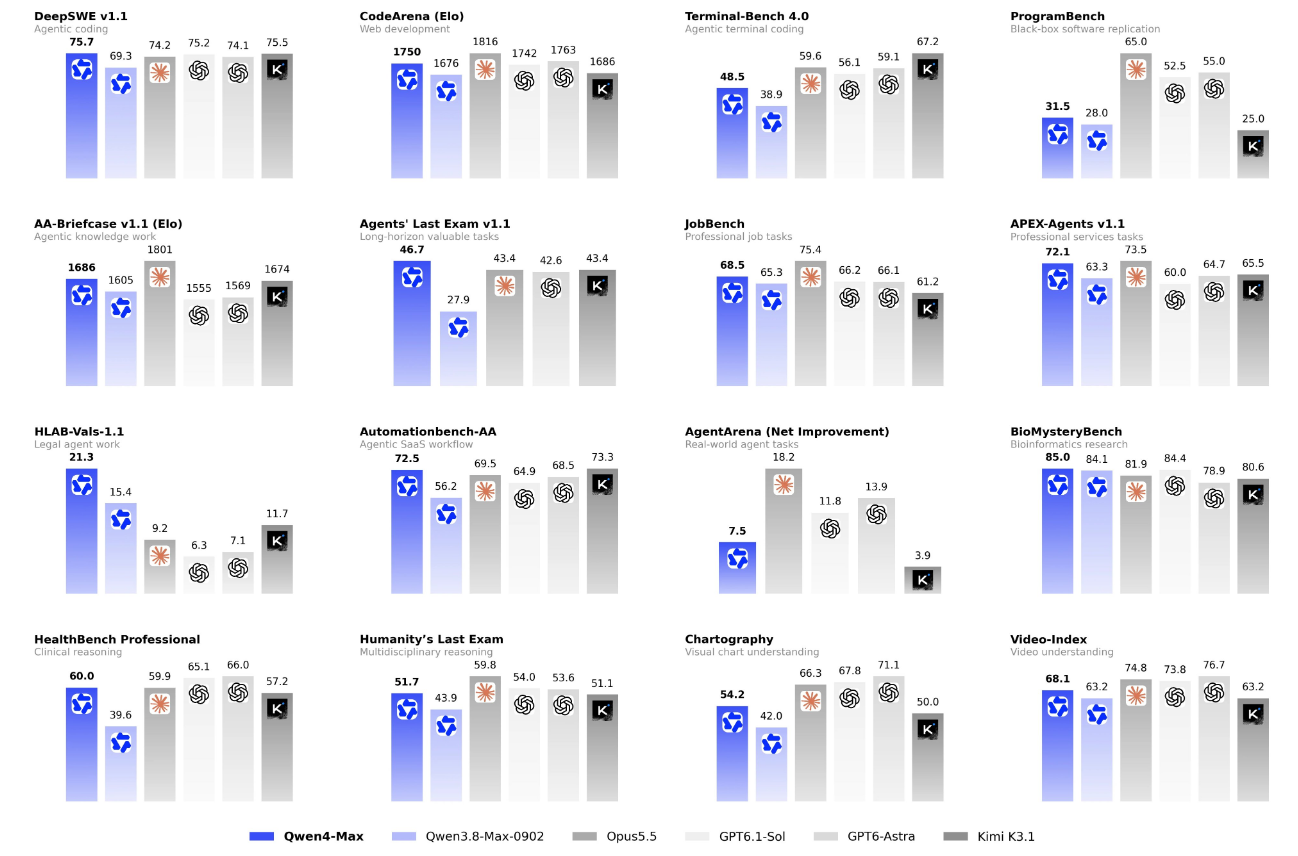
The short version. Qwen4-Max beats Opus 5.5 on eight of the sixteen benchmarks in Alibaba’s launch table, ties within two points on three more, and loses the rest. It is also priced at $1.50 per million input tokens against Opus 5.5’s $4.00 list, and $4.50 output against $20.00 list. On raw cost per token the new model is a quarter of the price. On capability the answer is split by workload, and the split is interesting: Qwen4-Max leads the long-horizon agent, legal and bioinformatics rows; Opus 5.5 keeps the Elo boards, terminal coding, clinical reasoning and the visual benchmarks.
Everything below was checked against Alibaba’s launch material on 2026-11-16. The benchmark table is Alibaba’s own, so we label it that way everywhere it appears. No third party, not Artificial Analysis and not LMArena, has published an independent Qwen4-Max score yet, and we say that out loud rather than implying otherwise.
What each model is
Claude Opus 5.5 is Anthropic’s top reasoning tier, served on our gateway at $2.80 per million input and $14.00 per million output, already below Anthropic’s $4 / $20 list. It takes text and image input, carries a 1M token window, and it is the model our heaviest agent customers run when the task needs long chains of careful steps.
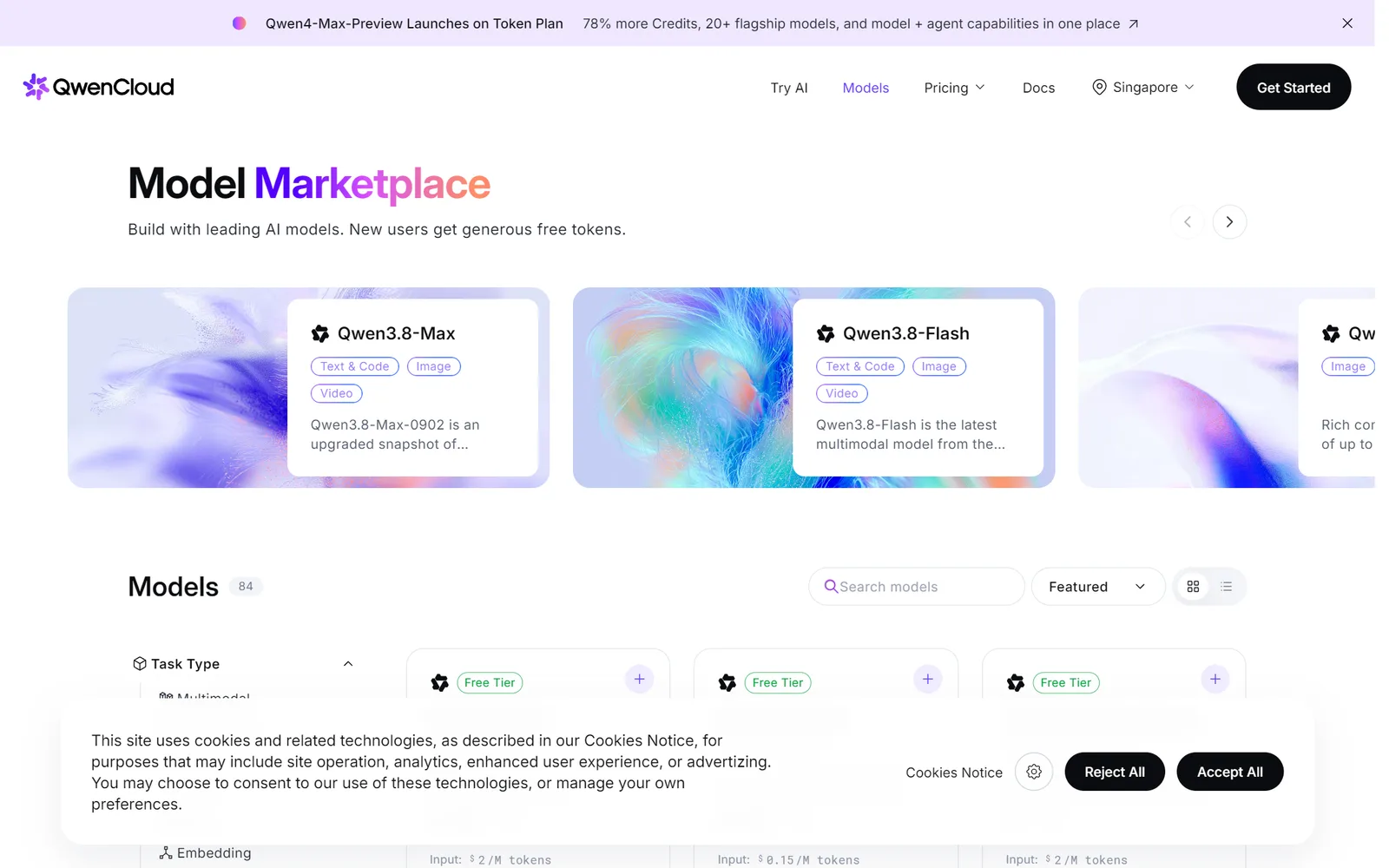
Qwen4-Max is Alibaba’s flagship, live on Qwen Cloud as of launch day. It is a new mixture-of-experts architecture with native vision and a 1M-token context window, and it is the first Qwen tier priced below its own predecessor at launch: $1.50 input, $4.50 output, $0.075 implicit caching. The API is live, and the model also sits inside Qwen Studio, QwenWork and Qoder.
| Spec | Qwen4-Max | Claude Opus 5.5 |
|---|---|---|
| Vendor | Alibaba / Qwen team | Anthropic |
| Architecture | Mixture-of-experts | Not published |
| Context window | 1,000,000 tokens | 1,000,000 tokens |
| Input modalities | Text, image (native vision) | Text, image |
| Open weights | No | No |
| List price input $/M | $1.50 | $4.00 |
| List price output $/M | $4.50 | $20.00 |
| Cached input $/M | $0.075 implicit | Not published |
| On One AI API Key | Queued, no date promised | Live at $2.80 / $14.00 |
One naming trap before the numbers. Alibaba ran a Qwen4-Max Preview for days on the Token Plan, id qwen4-max-preview, and the general availability model is qwen4-max. OrcaRouter wrote a whole piece on the naming overlap. Pin the exact id in your config, because a preview id and a GA id can behave differently, the same way qwen3.8-max and qwen3.8-max-0902 do on our model catalog.
The sixteen benchmarks, row by row
Here is the whole table with the winner marked, then the interpretation. Every number is from Alibaba’s launch table; the Qwen3.8-Max-0902 column is in there because the generational jump is part of this story.
| Benchmark | What it measures | Qwen4-Max | Opus 5.5 | Winner |
|---|---|---|---|---|
| DeepSWE v1.1 | Agentic coding | 75.7 | 74.2 | Qwen4-Max |
| CodeArena (Elo) | Web development | 1750 | 1816 | Opus 5.5 |
| Terminal-Bench 4.0 | Agentic terminal coding | 48.5 | 59.6 | Opus 5.5 |
| ProgramBench | Black-box software replication | 31.5 | 65.0 | Opus 5.5 |
| AA-Briefcase v1.1 (Elo) | Agentic knowledge work | 1686 | 1801 | Opus 5.5 |
| Agents’ Last Exam v1.1 | Long-horizon valuable tasks | 46.7 | 43.4 | Qwen4-Max |
| JobBench | Professional job tasks | 68.5 | 75.4 | Opus 5.5 |
| APEX-Agents v1.1 | Professional services tasks | 72.1 | 73.5 | Opus 5.5, by 1.4 |
| HLAf-Vals-1.1 | Legal agentic work | 21.3 | 9.2 | Qwen4-Max |
| Automationbench-AA | Agentic SaaS workflow | 72.5 | 69.5 | Qwen4-Max |
| AgentArena (Net Improvement) | Real-world agent tasks | 18.2 | 11.8 | Qwen4-Max |
| BioMysteryBench | Bioinformatics research | 85.0 | 81.9 | Qwen4-Max |
| HealthBench Professional | Clinical reasoning | 60.0 | 59.9 | Tie |
| Humanity’s Last Exam | Multidisciplinary reasoning | 51.7 | 59.8 | Opus 5.5 |
| Chartography | Visual chart understanding | 54.2 | 66.3 | Opus 5.5 |
| Video-Index | Video understanding | 68.1 | 74.8 | Opus 5.5 |
Eight wins, one tie, seven losses, and two of those losses are the Elo boards where Opus has always been hard to beat. That is not a rout in either direction, which is the honest headline.
Where Qwen4-Max wins, and why it matters. Agents’ Last Exam v1.1 is the standout: 46.7 against Opus 5.5’s 43.4, and against Qwen3.8-Max-0902’s 27.9 it is an 18.8-point generational jump. That benchmark measures long-horizon tasks with real value attached, the kind of work where agents either earn their keep or burn your money. HLAf-Vals-1.1, legal agentic work, is the widest gap in the whole table: 21.3 against 9.2, more than double. Note that every score there is low, which means the test is genuinely hard and nobody is near a ceiling, but doubling the field on a hard legal benchmark is a real result. AgentArena’s net improvement row, 18.2 against 11.8, says the same thing in change terms: on real-world agent tasks Qwen4-Max improves outcomes more than the Opus row does. Automationbench-AA, an agentic SaaS workflow, goes 72.5 to 69.5, and BioMysteryBench, bioinformatics research, 85.0 to 81.9 in a tight cluster where GPT-6.1 Sol is 84.4 and Qwen3.8-Max-0902 is 84.1.
Where Opus 5.5 wins, and by how much. CodeArena is an Elo rating for web development: 1816 against 1750, a 66-point gap. AA-Briefcase v1.1, agentic knowledge work on Elo, is 1801 against 1686, a 115-point gap, the largest Elo margin in the table. Terminal-Bench 4.0, agentic coding inside a real terminal, is 59.6 against 48.5. ProgramBench, black-box software replication, is the blowout: 65.0 against 31.5, more than double. If your agent’s job is to take an existing system apart from its behaviour and rebuild it, this row says Opus 5.5 is not close. Humanity’s Last Exam, the hardest multidisciplinary reasoning pool, goes 59.8 to 51.7. Chartography and Video-Index, the visual rows, go 66.3 to 54.2 and 74.8 to 68.1.
The row that is a tie. HealthBench Professional, clinical reasoning, is 60.0 against 59.9. A tenth of a point is noise. GPT-6 Astra actually leads that row at 66.0, so neither of these two wins it; the practical read is that clinical work needs task-specific testing regardless of which flagship you pick.
Price per token, and price per task
List prices, per million tokens:
| Route | Input $/M | Output $/M | Cached input $/M |
|---|---|---|---|
| Qwen4-Max, Qwen Cloud pay-as-you-go | $1.50 | $4.50 | $0.075 implicit |
| Claude Opus 5.5, Anthropic list | $4.00 | $20.00 | Not published |
| Claude Opus 5.5, One AI API Key | $2.80 | $14.00 | Prompt caching supported |
| Qwen4-Max, One AI API Key | Not live here yet |
On a pure per-token basis Qwen4-Max costs 37.5% of Opus 5.5’s list on input and 22.5% on output. Alibaba’s launch claims compound that: up to ~50% fewer tokens used per task, and average cost per task down over 60% in its internal evaluation. Those two claims are vendor internal evaluation with an unpublished workload, so we do not treat them as bills, but they point the right way given the published rates.
A worked example, with the caveat that your mileage is your mileage. A coding agent sending 8,000 input and receiving 2,000 output tokens, fifty runs a day, is 400,000 input and 100,000 output tokens daily, about 12.4 million tokens a month. On Opus 5.5 list that is roughly $74 a month; on our gateway $46. On Qwen4-Max list rates it is about $23. Add Alibaba’s implicit caching at $0.075 per million on repeated context, which is 70% below Qwen3.8-Max’s $0.25 cached rate, and an agent that re-sends the same repo context all day gets cheaper still. None of that is a reason to switch by itself, because the ProgramBench and Terminal-Bench rows say the models are not interchangeable on every task.
Opus 5.5 is live here, metered, below list
Run your own Qwen4-Max vs Opus 5.5 eval on the models you can actually meter today: Opus 5.5 at $2.80 / $14.00 on One AI API Key, Qwen3.8 Max at $0.577 / $1.73 on the same key.
What Artificial Analysis, LMArena and the community are saying
As of 2026-11-16 there is no independent score to report, and we would rather say that than invent one. Artificial Analysis publishes independent quality, price and speed columns, and it has no Qwen4-Max row yet. LMArena has no public Qwen4-Max leaderboard entry we can cite. BenchLM’s Qwen4 Max spec page currently reads that there are no source-displayable benchmark rows yet, only documented specifications, pricing, context and evidence gaps. The eesel review of the Qwen3.8 generation made the same point in July: the ranking then rested entirely on Alibaba’s internal evaluation.
What people are actually talking about is narrower and real. The Pandaily’s launch thread highlights the Agents’ Last Exam score of 46.7 and the price cut, which matches the table above. MindStudio published hands-on impressions covering animation generation, 82-language naming, satellite image reasoning and visual safety judgment, which are qualitative but are at least third-party runs. Kie.ai’s deep dive flags the same evidence gap we do. And on the arena rumor mill, a GPTunnel piece from October discussed an unconfirmed arena score of 53 while the model was still training; Alibaba never confirmed it, and it is not a data point.
The practical translation: the sixteen-row table in this post is the best available evidence, it is vendor-published, and it is the only thing anyone can cite today. When Artificial Analysis and LMArena post real rows, our rankings page and this post get updated, because those are the numbers that settle arguments.
When to pick which
Pick Qwen4-Max if your workload is long-horizon agentic tasks, legal document work, bioinformatics research, SaaS workflow automation, or high-volume coding where the per-token math dominates and the benchmark rows that matter to you are the ones it wins.
Pick Opus 5.5 if your workload is terminal automation, black-box replication, professional job tasks, multidisciplinary reasoning at the hardest end, or visual chart and video understanding, where it leads or ties on every row.
Run both if the task is expensive enough to matter, which is cheaper than guessing: our side-by-side comparison puts prices and windows in one table, choosing a model for coding agents walks the trade-offs, and the cost calculator does the arithmetic on your own token counts.
How to call both models today
Opus 5.5 is on our gateway now, OpenAI-compatible, one key:
curl https://api.oneaiapikey.com/v1/chat/completions \
-H "Authorization: Bearer sk-YOUR-KEY" \
-H "Content-Type: application/json" \
-d '{
  "model": "claude-opus-5-5",
  "messages": [{"role": "user", "content": "Refactor this function for readability."}]
}'
Qwen4-Max is on Qwen Cloud now, same OpenAI-compatible shape:
curl https://ap-southeast-1.maas.qwencloudapi.com/compatible-mode/v1/chat/completions \
  -H "Authorization: Bearer $QWEN_API_KEY" \
  -H "Content-Type: application/json" \
  -d '{
    "model": "qwen4-max",
    "messages": [{"role": "user", "content": "Refactor this function for readability."}]
  }'
The base URL above is Qwen Cloud’s documented sample host; copy the exact host from your own console, because regional hosts have varied before. A 401 means the key is wrong or the account is not entitled; a 404 on the model usually means a misspelled id, and qwen4-max versus qwen4-max-preview are different models. When Qwen4-Max lands on One AI API Key it gets a published rate below list, per-key limits and usage metering like every other listing, and the switch becomes one model-id change on the same code.
Mistakes to avoid
- Treating the launch table as independent. It is Alibaba’s own material, with no methodology card, no error bars and no version stamps on the suites. Re-run your workload.
- Comparing Elo to points. CodeArena and AA-Briefcase are Elo ratings; the other rows are percentages. A 66-Elo gap and a 66-point gap are not the same thing.
- Assuming the price cut makes it cheaper everywhere. It is a quarter of Opus list per token, but ProgramBench and Terminal-Bench say the models trade places by task. Cost per finished task is the number, not cost per token.
- Ignoring the cache row. Implicit caching at $0.075 per million, 70% below Qwen3.8-Max’s cached rate, changes the math for any agent that re-sends context. Read our prompt caching guide before budgeting.
- Confusing preview with GA.
qwen4-max-previewandqwen4-maxare different ids with different behaviour. Pin one, log responses, re-run evals on any announcement. - Trusting arena rumors. The October arena chatter was never confirmed by Alibaba. Wait for Artificial Analysis or LMArena rows, and treat anything else as opinion.
FAQ
Is Qwen4-Max better than Claude Opus 5.5?
On Alibaba’s table it wins eight of sixteen rows, ties one and loses seven. It leads Agents’ Last Exam 46.7 to 43.4, HLAf-Vals legal work 21.3 to 9.2, BioMysteryBench 85.0 to 81.9 and AgentArena net improvement 18.2 to 11.8. Opus 5.5 leads CodeArena 1816 to 1750 Elo, Terminal-Bench 59.6 to 48.5, ProgramBench 65.0 to 31.5, AA-Briefcase 1801 to 1686 and Humanity’s Last Exam 59.8 to 51.7. Split by workload, not by headline.
How much cheaper is Qwen4-Max than Opus 5.5?
On list rates, about 63% cheaper on input ($1.50 vs $4.00 per million) and 78% cheaper on output ($4.50 vs $20.00). Opus 5.5 runs $2.80 / $14.00 on our gateway, still 87% below Anthropic list on output, but Qwen4-Max’s list is below that on both lines. Credits versus tokens make the Token Plan comparison indirect until Alibaba publishes burn rates.
Has Artificial Analysis or LMArena scored Qwen4-Max?
Not as of 2026-11-16. Artificial Analysis has no Qwen4-Max row, LMArena has no public entry we can cite, and BenchLM documents the evidence gap explicitly. The only published table is Alibaba’s launch material, transcribed in full above.
What is the API model id and base URL?
qwen4-max on Qwen Cloud’s OpenAI-compatible endpoint, with the base URL copied from your own console. The preview id was qwen4-max-preview; the two are not interchangeable.
Does Qwen4-Max beat Opus 5.5 at coding?
It depends on the coding. DeepSWE agentic coding goes to Qwen4-Max 75.7 to 74.2. CodeArena web development Elo goes to Opus 1816 to 1750, Terminal-Bench terminal coding 59.6 to 48.5, and ProgramBench black-box replication 65.0 to 31.5. If your agents live in terminals or rebuild systems from behaviour, Opus 5.5 is the safer pick on this table.
Is Qwen4-Max on One AI API Key yet?
Not yet. It is queued for the model catalog the day upstream API access opens to resellers, at a published rate below list, the same playbook as every Alibaba flagship. Until then Qwen3.8 Max is live at $0.577 / $1.73 per million with the same 1M window, and qwen3.8-max:free runs on the free lane.
What about the claims of 50% fewer tokens and 60% lower cost per task?
Both are from Alibaba’s internal evaluation with an unpublished workload. Directionally consistent with a 25% list-price cut plus cheaper caching, but not a bill. Measure your own prompt and completion counts before you budget on them.
The bottom line
Qwen4-Max vs Opus 5.5 is not a verdict, it is a workload decision, and the launch table is good enough to make it. Qwen4-Max takes the long-horizon agent, legal, bioinformatics and SaaS-workflow rows and undercuts Opus list by roughly 60 to 78% per token. Opus 5.5 keeps the Elo boards, terminal coding, black-box replication and the visual benchmarks. Neither sweeps, which is itself the story: the flagship market has real competition again. Until independent scores land, run your own eval on the rows that match your work, meter it, and switch on evidence. Opus 5.5 is live and metered today; Qwen4-Max is live upstream and queued here. When it lands, your key keeps working and the upgrade is one model-id change.
Keep reading: Qwen4-Max API pricing explained, Qwen4-Max vs GPT-6.1 Sol and GPT-6 Astra, all sixteen benchmarks explained, and the cheapest way to run Qwen4-Max.
More Qwen4-Max coverage
The Fable comparison, added 2026-11-16:
The rest of the cluster, and the pages every comparison links back to:
- Qwen4-Max 1M context guide: what a million tokens holds, and the chunking that keeps it honest
- Qwen4-Max API pricing: every rate, the $43 Token Plan Pro and what a call actually costs
- Qwen4-Max API quickstart: the id, the base URL, streaming, max_tokens and the $43 plan
- The cheapest way to run Qwen4-Max: free routes checked, and the $3 plan that beats them all
- Run Qwen4-Max in your coding agent: base URL, model id, concurrency tiers and budget guards
- Qwen4-Max prompt caching: the $0.075 implicit cache, break-even math and cache-break probes
- Qwen4-Max vision and video benchmarks: what native vision actually scores against GPT-6 Astra and Opus 5.5
- Qwen4-Max vs every flagship launched this quarter: the full scoreboard, price per million and who serves what
- Qwen4-Max vs Gemini 4 Argon: multimodal routes, 1M context and what each actually costs
- Qwen4-Max vs GPT-6.1 Sol and GPT-6 Astra: benchmarks, pricing and the split
- Qwen4-Max vs GPT-6 Astra: sixteen benchmarks, the price gap and where each model wins
- Qwen4-Max vs Grok 4.7: flat flagship prices against the 2x long-context surcharge
- Qwen4-Max vs Kimi K3: sixteen benchmarks, terminal coding and the price per million tokens
- Qwen4-Max vs Qwen3.8-Max-0902: the 16-benchmark sweep, the price cut and a migration checklist
- The model catalogue
- The model comparison tool
- API pricing and plans
- The cost calculator
- Live rankings and throughput
- The changelog