Qwen4-Max has two price surfaces and a gap between them. The first is pay-as-you-go: $1.50 per million input tokens, $4.50 per million output tokens, $0.075 per million for implicitly cached input. That is Alibaba’s own list, checked on the Qwen Cloud pricing pages on 2026-11-16, and it is 25% below the Qwen3.8-Max list on input and output and 70% below it on cached input. The second surface is the Token Plan, a monthly subscription that grants credits usable across 20+ models, with Qwen4-Max inside the list carrying a “Limited-Time 80% Off” tag. During the launch event, new users get Lite at $3 a month.
This post is the pricing post. Every published number, the tier table, the cost math on real workloads, why the $43 Pro tier is the one developers keep asking about, what credits do not tell you, and how the whole thing sits next to the metered prices you actually pay on One AI API Key.
Pay-as-you-go: the published per-token rates
| Route | Input $/M | Output $/M | Cached input $/M |
|---|---|---|---|
| qwen4-max, Qwen Cloud list | $1.50 | $4.50 | $0.075 |
| qwen3.8-max, Qwen Cloud list | $2.00 | $6.00 | $0.25 |
| qwen3.8-max, One AI API Key | $0.577 | $1.73 | $0.25 |
| qwen4-max, One AI API Key | Not live here yet |
The generation-over-generation cut is clean: input from $2.00 to $1.50, output from $6.00 to $4.50, cached input from $0.25 to $0.075. The caching line is the one that changes agent economics, because agent loops resend the same system prompt, tool schemas and conversation history on every turn. At 70% off the cached rate, a stable prefix stops being a cost center. The prompt caching guide covers the mechanic; here the rate is what matters, and the rate is Alibaba’s.
Two things the list does not include. First, the launch claims of roughly 50% fewer tokens used and over 60% lower average cost per task come from Alibaba’s internal evaluation with no published workload, so they are direction, not a bill. Second, the pay-as-you-go table on the API pricing page does not list qwen4-max-preview, the preview id from last week; the launch id is qwen4-max, and the Token Plan is the marketed route. Confirm the exact id and the current rates in your console before you budget.
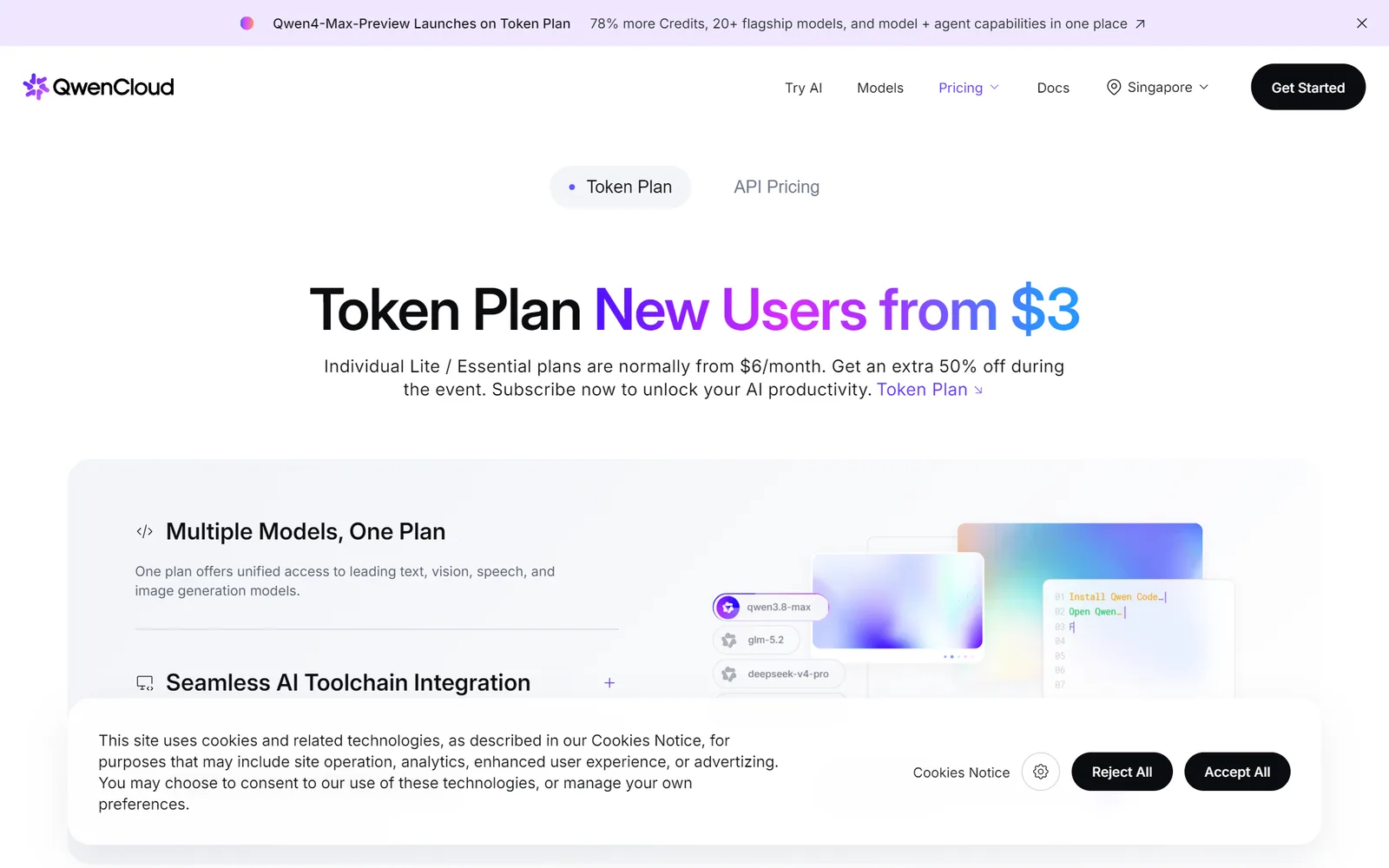
The same page, framed. The tier cards below it are what the launch banner points at, and the “78% more credits” claim rides along the top of it.
The Token Plan, tier by tier
Individual, monthly, launch prices as published on the page above:
| Tier | Launch price | Regular price | Credits / month | Concurrent agents |
|---|---|---|---|---|
| Lite | $3 | $8 | 20,000 | 1-2 |
| Essential | $5 | $16 | 45,000 | 2-3 |
| Standard | $18 | $25 | 80,000 | 3-4 |
| Pro | $43 | $51 | 200,000 | 6-8 |
What is solid: the prices, the credit grants, the concurrent-agent column, the “Limited-Time 80% Off” tag on the model inside the plan, and the claim of 78% more credits than the previous generation. What is not solid: the conversion. The plan page does not publish how many credits a call to qwen4-max burns, so no tier can be turned into dollars per million tokens yet. Any table that shows you a per-token equivalent of a credit is inventing the exchange rate.
The page also has Individual and Team tabs and Monthly, Quarterly and Yearly toggles. Longer terms lower the effective monthly price. Some models carry “40% Off Nights” tags. And Alibaba notes the checkout price after login is the one that counts, which is the polite way of saying the page you see logged out is the page you may not pay.
The $43 Pro tier, honestly
The Pro tier is the one developers ask about, because $43 a month for a flagship sounds like the deal of the quarter. Here is what $43 buys: 200,000 credits a month, 6-8 concurrent agents, access to the 20+ model list that includes Qwen4-Max, and the 80% off launch tag. Here is what it does not buy: a known token allowance.
Run the thought experiment with the only numbers that exist. If a credit were a token, 200,000 credits would be 200,000 tokens, which is one long-context call, and the plan would be terrible. If a credit were a thousand tokens, 200,000 credits would be 200 million tokens, which at list rates would cost thousands, and the plan would be the best deal in the market. Both readings are absurd, which is exactly why the burn rate has to be published before anyone calls Pro a bargain. Our position is the one we hold for every subscription: measure your workload against the quota for a week, then choose the tier. The cost calculator and our guide to estimating monthly LLM API cost show the metered math to bring into that measurement.
Who Pro fits, on what is known: teams running several concurrent agents across several models, who would otherwise pay list per-token on each. Who it does not fit: solo developers with one steady workload, who are better served by the metered gateway prices on our rate table until Qwen4-Max lands here with a published rate.
What the workload actually costs at list rates
Credits unknown, tokens known. Four real workloads at Qwen Cloud list:
| Workload | Input / M | Output / M | Monthly at list |
|---|---|---|---|
| Chat helper, 50 calls/day, 8K in 2K out | 12 | 3 | $31.50 |
| Same, half input cached | 12 | 3 | $22.95 |
| Code review agent, 200 calls/day, 40K in 8K out | 240 | 48 | $576.00 |
| Long-doc summarizer, 10 calls/day, 500K in 50K out | 150 | 15 | $292.50 |
The cached column assumes half the input repeats, which is the agent-loop case. The code-review row is the one that hurts: $576 a month at list, and it is a modest agent by production standards. That is also the row where Alibaba’s ~50% fewer tokens claim, if it holds outside internal evaluation, does the most work: fewer tokens per task at a lower list rate compounds.
Against our gateway, the shape changes. The same first workload on Qwen3.8 Max here costs $12.11 a month at $0.577 / $1.73, and on Kimi K3 it is $21.25 at $0.353 / $5.67. Qwen4-Max’s list rate is not the cheapest per-token route to a capable model; it is the cheapest route to this specific model, and only inside Alibaba’s own pricing. When Qwen4-Max lists on our gateway, the same below-list treatment applies, and this table gets a fifth row with a real number.
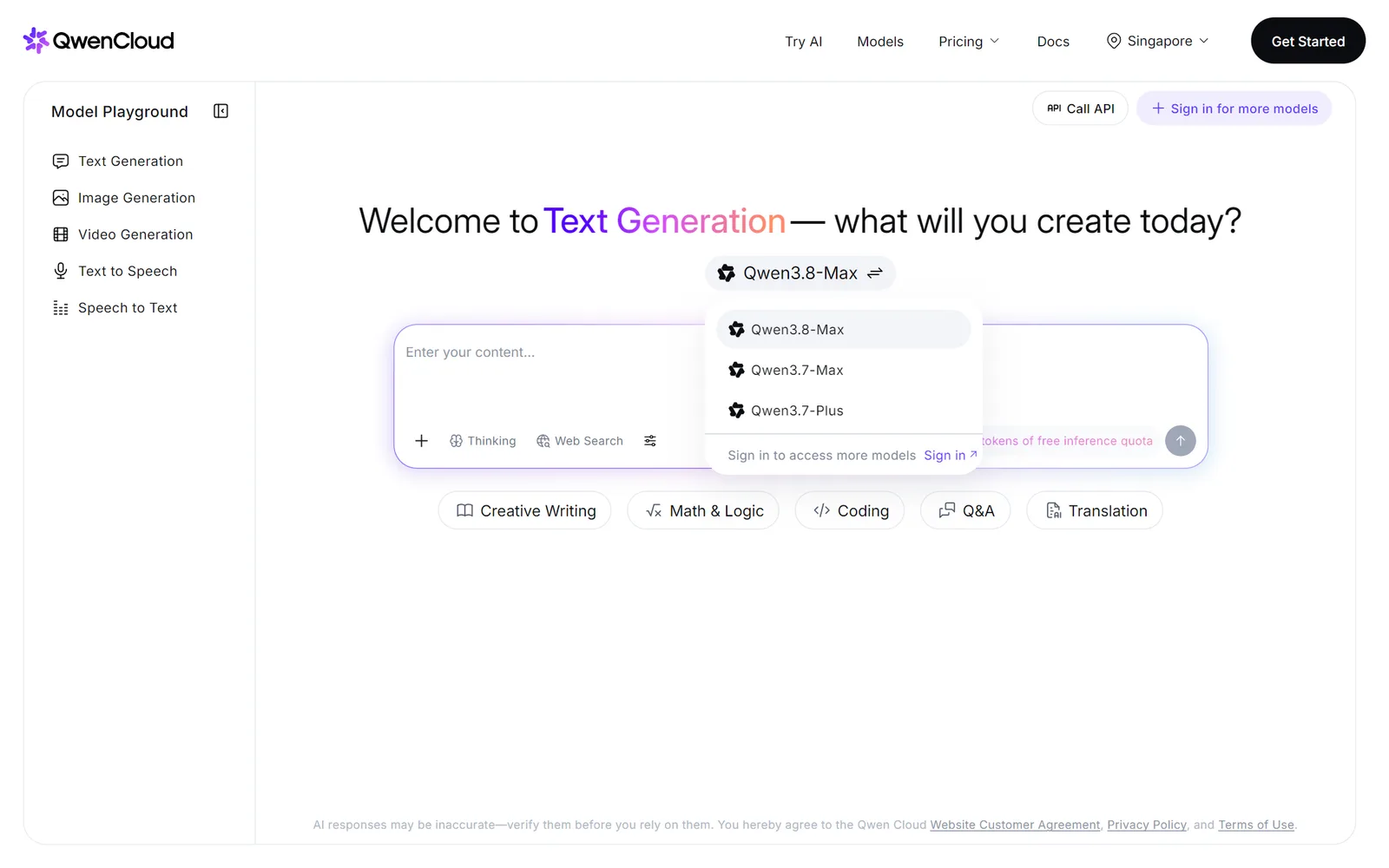
The free route that exists but does not cover this model. The Try AI playground grants 1M free tokens after sign-in, and its anonymous picker shows Qwen3.8-Max, Qwen3.7-Max and Qwen3.7-Plus with a “Sign in to access more models” gate. Qwen4-Max is not in the anonymous list, and Alibaba markets it as a Token Plan launch. Do not budget the free quota against this model.
The other free routes, checked
Free-route status on 2026-11-16, because pricing posts attract bad information:
| Route | Status | What it covers |
|---|---|---|
| Try AI playground, 1M free tokens | Live | Older models only; Qwen4-Max gated |
| Token Plan Lite, $3 launch | Live | Credits across 20+ models incl. Qwen4-Max |
| Qoder Qoduck free window | Closed Nov 11 | Mystery model, identity unconfirmed |
| One AI API Key free lane | Live | Qwen3.8 generation at $0, not Qwen4-Max |
The Qoduck window is the launch-week ghost: Qoder ran a mystery model free for four days, the rumor mill called it Qwen4, and it closed the morning of November 11. Our Qoduck post has the full trace. It is not a pricing route for Qwen4-Max and should not be budgeted as one.
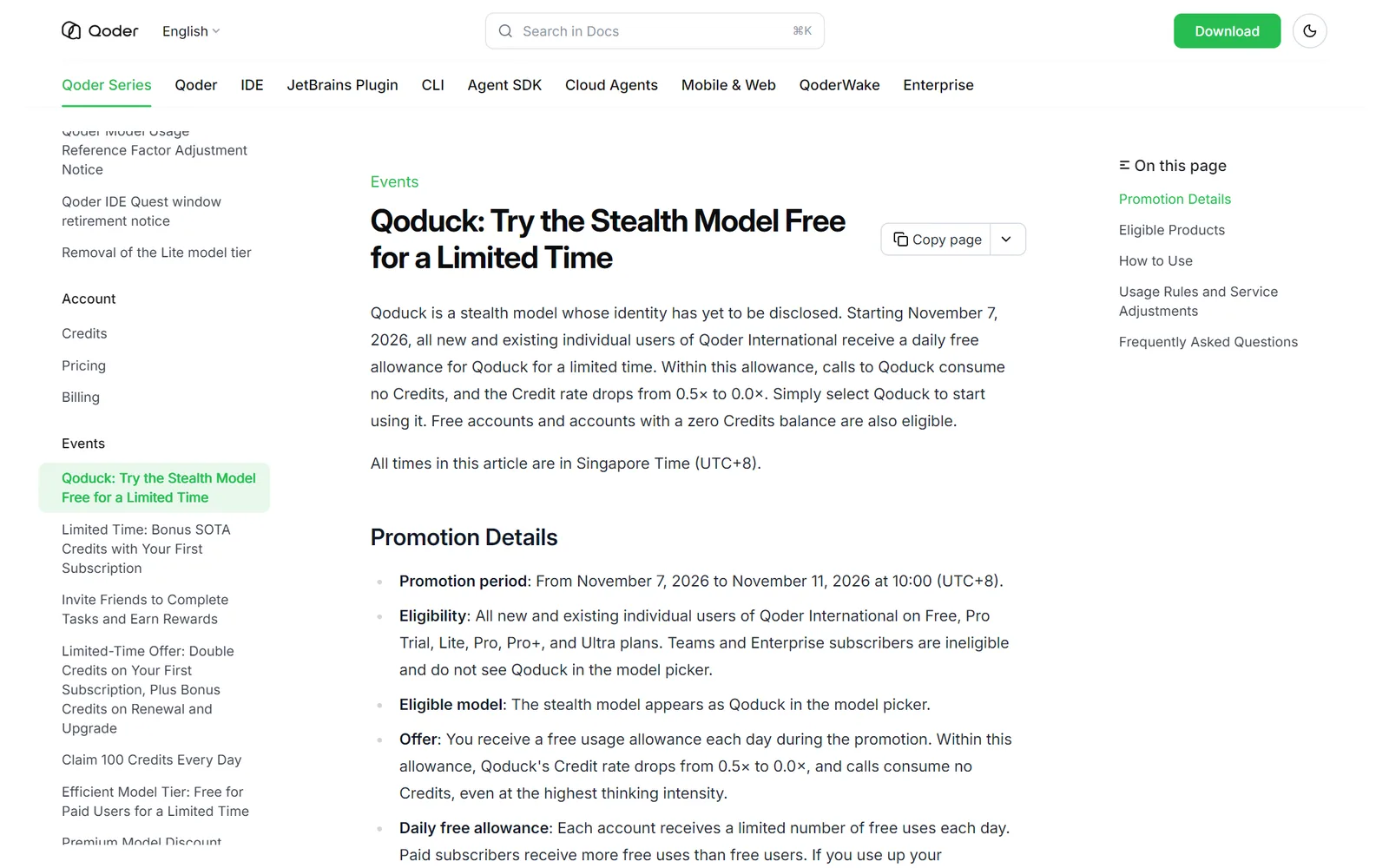
The Qoduck promotion page as captured while it was live. The window has closed. The page matters here for one reason: it is the source of most “free Qwen4” claims floating around launch week, and it says nothing about Qwen4-Max pricing.
What Artificial Analysis, LMArena and the community are saying about cost
The cost conversation and the quality conversation are in the same hole: as of 2026-11-16 there is no independent cost-per-task measurement of Qwen4-Max anywhere. Artificial Analysis and LMArena have no Qwen4-Max row, and benchlm.ai documents the evidence gaps plainly: no source-displayable benchmark rows yet, which means no independent cost-per-task either, since cost per task is score divided by spend.
What exists is vendor material and arithmetic on top of it:
- Alibaba’s launch blog with the $1.50 / $4.50 / $0.075 rates and the internal-evaluation claims of ~50% fewer tokens and over 60% lower cost per task.
- The Token Plan page with the tier table, the 80% off tag and the 78% more credits claim.
- Community threads doing what this post does: converting the tiers into guesses, because the burn rate is not published.
- apidog’s walkthrough, which shows a client defaulting to a 32,768 max_tokens and a 983,616-token context. Those are one integrator’s defaults, not vendor limits, and they say nothing about price.
The honest sentence is short: the per-token rate is published and competitive, the subscription is published and unpriced per call, and the only true cost-per-task number will come from your own metered week.
How to call the model while the pricing picture fills in
Qwen Cloud’s compatible endpoint, OpenAI SDK style:
curl https://ap-southeast-1.maas.qwencloudapi.com/compatible-mode/v1/chat/completions \
  -H "Authorization: Bearer $QWEN_API_KEY" \
  -H "Content-Type: application/json" \
  -d '{
    "model": "qwen4-max",
    "messages": [{"role": "user", "content": "Refactor this function for readability."}]
}'import os
from openai import OpenAI
client = OpenAI(
api_key=os.environ["QWEN_API_KEY"],
base_url="https://ap-southeast-1.maas.qwencloudapi.com/compatible-mode/v1",
)
resp = client.chat.completions.create(
model="qwen4-max",
messages=[{"role": "user", "content": "Explain this stack trace."}],
)
print(resp.choices[0].message.content)The base URL is region-pinned to ap-southeast-1; other regions may differ. The model id is qwen4-max. Log the token counts on every call: the input, the output and whether the cached-input rate fired, because at $0.075 versus $1.50 the cache is most of your bill, and the only way to catch a cache miss is to meter it.
The discount layer, decoded
The Token Plan page does not run one price; it runs a launch event on top of the price. Three discounts stack in the fine print, and they are the reason two people can quote different numbers for the same tier:
- Launch versus regular. Lite is $3 against a regular $8, Essential $5 against $16, Standard $18 against $25, Pro $43 against $51. The launch column is the event price, not the forever price, and the event window is not dated on the page we captured.
- Term length. Monthly, Quarterly and Yearly toggles change the effective monthly price, with longer terms lower. The tier table in this post is Individual monthly, the column the launch banner quotes.
- Model tags. Some models in the marketplace carry “40% Off Nights” tags, and Qwen4-Max carries the “Limited-Time 80% Off” tag inside the plan. A tagged model is a model whose credit burn the vendor wants to steer; the tag is not a rate, and it is not a guarantee.
One more line from the page, quoted because it ends every launch-week argument: Alibaba notes the checkout price after login is the one that counts. Budget from the checkout screen, not from this post, not from the banner, and not from a screenshot that is already a week old.
Three more workloads, priced at list
The first table covered chat-scale traffic. Three production shapes, same rates, no credits:
| Workload | Input / M | Output / M | Cached share | Monthly at list |
|---|---|---|---|---|
| RAG pipeline, 500K queries, 4K in 800 out, stable prompt | 2,000 | 400 | 60% | $1,476.00 |
| Support bot, 2M turns, 1.5K in 400 out | 3,000 | 800 | 30% | $3,982.50 |
| Code completion copilot, 10 seats, 2K suggestions/day, 3K in 300 out | 180 | 18 | 80% | $359.55 |
The RAG row is where implicit caching earns its keep: sixty percent of input at $0.075 instead of $1.50 is $1,080 of difference on that row alone. The copilot row is the cheapest per seat and the most cache-sensitive, because a stable codebase prefix is the whole product. And the support row is the warning: high volume, low cache share, output-light, and it still bills like a small car payment. None of these numbers survive contact with your traffic, which is why the usage log and the cost calculator exist.
What we charge for the models that overlap this family, for the shape of the discount our side applies: Qwen3.8 Max at $0.577 / $1.73 against Alibaba’s $2 / $6 list, Gemini 4 Argon at $0.525 / $2.625, and the Qwen3.8 free lanes at $0. When Qwen4-Max lists here, the same below-list pattern applies, and this post’s list column gets a sibling column with our rate in it.
Mistakes to avoid
- Budgeting credits as tokens. No published burn rate means no tier math. A week of metered usage picks the tier, not the banner.
- Comparing subscription to per-token directly. $3 Lite versus $1.50 per million input are different units. Convert your workload to both before choosing.
- Ignoring the checkout note. Alibaba says the logged-in checkout price is the one that counts. Launch prices move.
- Missing the cache rate. $0.075 cached against $1.50 fresh is a 20x difference. Stable prefixes are where the plan lives or dies.
- Treating apidog’s config as a limit. 983,616 context and 32,768 max_tokens in that guide are defaults, not vendor ceilings.
- Assuming our gateway price exists. Qwen4-Max is queued, not listed. The metered Qwen route today is Qwen3.8 Max at $0.577 / $1.73.
FAQ
How much does Qwen4-Max cost per million tokens?
At Qwen Cloud list: $1.50 input, $4.50 output, $0.075 implicitly cached input. There is no per-token price on the Token Plan; it bills credits, and the per-model burn rate is unpublished.
Is the $43 Pro plan the best deal?
It is the largest grant: 200,000 credits a month, 6-8 concurrent agents, at $43 launch price against $51 regular. Whether it is the best deal depends on the burn rate, which Alibaba has not published. Heavy multi-agent users are the intended buyer; light users should start at Lite and measure.
Is Qwen4-Max cheaper than Qwen3.8-Max?
At Alibaba’s list, yes, by 25% on input and output and 70% on cached input. On our gateway, Qwen3.8 Max already runs below Alibaba’s Qwen4 list, so the gateway comparison reverses until Qwen4-Max lists here.
Does the Token Plan include Qwen4-Max?
Yes. The supported-models table inside the Token Plan lists qwen4-max-preview with the 80% off tag, and the launch banner announces Qwen4-Max on the plan. Confirm the exact id in your console; the preview and launch ids are different strings.
Is there any free Qwen4-Max?
Not confirmed on 2026-11-16. The playground’s 1M free tokens cover older models, and Qoder’s Qoduck window closed on November 11. The cheapest confirmed route is Lite at $3 during the launch event.
What does a call cost at list rates?
A full-window call, 610,000 input tokens and 390,000 output tokens, is $0.915 input plus $1.755 output, about $2.67 at list, before caching. With half the input cached it drops to about $1.84.
When will One AI API Key list Qwen4-Max?
When it passes the same live checks every model passes here. It is queued. Sign up on the pricing page for the current rates and watch the changelog for the listing.
The bottom line
The published pricing is genuinely aggressive: $1.50 / $4.50 list, $0.075 cached, 25% under the previous flagship, and a Token Plan that starts at $3 during launch with a $43 Pro tier for 6-8 concurrent agents. The unpublished pricing is everything credits-based: no burn rate, no per-task cost, no independent verification. Buy the subscription if you are already inside the Alibaba stack and your workload fits a quota you can measure for a week. Buy metered if you want a bill you can audit today, on Qwen3.8 Max or any of the other served models, until Qwen4-Max lands here with a published rate.
Keep reading
-
Qwen4-Max benchmarks, explained — what the $1.50 / $4.50 buys in scores
-
Qwen4-Max vs Claude Opus 5.5 — the price column against the Elo leader
-
Qwen4-Max vs Kimi K3 — the input-price comparison that flips the story
-
Qwen4 Max Preview: free, pricing, providers and specs — the launch-day master post
-
Estimate your monthly LLM API cost — the metered math to bring to any subscription
-
Prompt caching guide — why $0.075 changes agent loop economics
More Qwen4-Max coverage
The Fable comparison, added 2026-11-16:
The rest of the cluster, and the pages every comparison links back to:
- Qwen4-Max 1M context guide: what a million tokens holds, and the chunking that keeps it honest
- Qwen4-Max API quickstart: the id, the base URL, streaming, max_tokens and the $43 plan
- The cheapest way to run Qwen4-Max: free routes checked, and the $3 plan that beats them all
- Run Qwen4-Max in your coding agent: base URL, model id, concurrency tiers and budget guards
- Qwen4-Max prompt caching: the $0.075 implicit cache, break-even math and cache-break probes
- Qwen4-Max vision and video benchmarks: what native vision actually scores against GPT-6 Astra and Opus 5.5
- Qwen4-Max vs every flagship launched this quarter: the full scoreboard, price per million and who serves what
- Qwen4-Max vs Gemini 4 Argon: multimodal routes, 1M context and what each actually costs
- Qwen4-Max vs GPT-6.1 Sol and GPT-6 Astra: benchmarks, pricing and the split
- Qwen4-Max vs GPT-6 Astra: sixteen benchmarks, the price gap and where each model wins
- Qwen4-Max vs Grok 4.7: flat flagship prices against the 2x long-context surcharge
- Qwen4-Max vs Kimi K3: sixteen benchmarks, terminal coding and the price per million tokens
- Qwen4-Max vs Claude Opus 5.5: sixteen benchmarks, token prices and the honest split
- Qwen4-Max vs Qwen3.8-Max-0902: the 16-benchmark sweep, the price cut and a migration checklist
- The model catalogue
- The model comparison tool
- API pricing and plans
- The cost calculator
- Live rankings and throughput
- The changelog