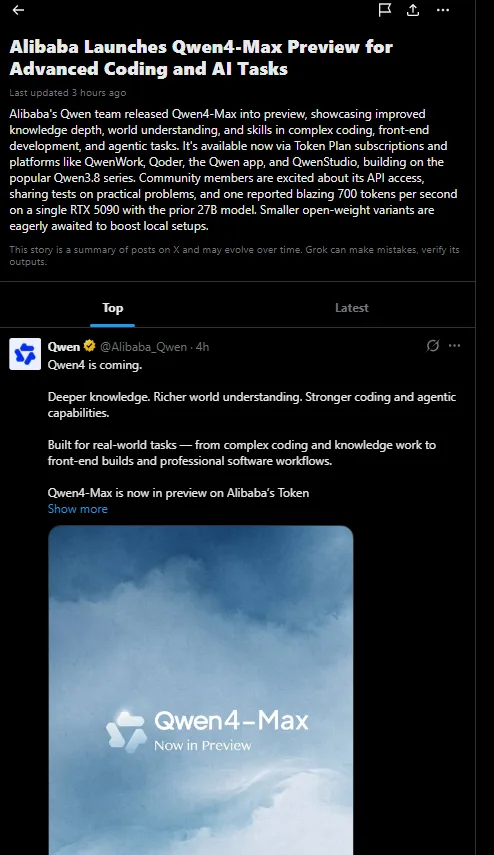
Eight flagships shipped in eight weeks. Google announced Gemini 4 Carbon on October 28, and Gemini 4 Argon, GPT-6.1 Sol, Grok 4.7, Claude Fable 5.1 and Claude Opus 5.5 all arrived inside the same window, with Qwen4-Max landing on the Token Plan on November 16. The comparison posts on this site go pairwise; this one is the scoreboard: all sixteen benchmarks, every published price, which models our gateway actually serves, and the routing matrix that falls out of both.
One naming note up front, because it keeps coming up: there is no Claude Fable 5.2 anywhere we can verify. Our board lists Claude Fable 5.1, and every Fable number in this post is 5.1. If a 5.2 exists in some vendor’s internal roadmap, it has not reached a catalog, a price page or a benchmark table we can source. Same discipline as always: no number without a source.
The full scoreboard
All sixteen rows from Alibaba’s launch table, plus the served-model prices from the One AI API Key catalog, all checked 2026-11-16.
| Benchmark | What it measures | Qwen4-Max | Qwen3.8-Max-0902 | Opus 5.5 | GPT-6.1 Sol | GPT-6 Astra | Kimi K3.1 |
|---|---|---|---|---|---|---|---|
| DeepSWE v1.1 | Agentic coding | 75.7 | 69.3 | 74.2 | 75.2 | 74.1 | 75.5 |
| CodeArena (Elo) | Web development | 1750 | 1676 | 1816 | 1742 | 1763 | 1686 |
| Terminal-Bench 4.0 | Agentic terminal coding | 48.5 | 38.9 | 59.6 | 56.1 | 59.1 | 67.2 |
| ProgramBench | Black-box software replication | 31.5 | 28.0 | 65.0 | 52.5 | 55.0 | 25.0 |
| AA-Briefcase v1.1 (Elo) | Agentic knowledge work | 1686 | 1605 | 1801 | 1555 | 1569 | 1674 |
| Agents’ Last Exam v1.1 | Long-horizon valuable tasks | 46.7 | 27.9 | 43.4 | 42.6 | 42.6 | 43.4 |
| JobBench | Professional job tasks | 68.5 | 65.3 | 75.4 | 66.2 | 66.1 | 61.2 |
| APEX-Agents v1.1 | Professional services tasks | 72.1 | 63.3 | 73.5 | 60.0 | 64.7 | 65.5 |
| HLAf-Vals-1.1 | Legal agentic work | 21.3 | 15.4 | 9.2 | 6.3 | 7.1 | 11.7 |
| Automationbench-AA | Agentic SaaS workflow | 72.5 | 56.2 | 69.5 | 64.9 | 68.5 | 73.3 |
| AgentArena (Net Improvement) | Real-world agent tasks | 18.2 | 7.5 | 11.8 | 13.9 | — | 3.9 |
| BioMysteryBench | Bioinformatics research | 85.0 | 84.1 | 81.9 | 84.4 | 78.9 | 80.6 |
| HealthBench Professional | Clinical reasoning | 60.0 | 39.6 | 59.9 | 65.1 | 66.0 | 57.2 |
| Humanity’s Last Exam | Multidisciplinary reasoning | 51.7 | 43.9 | 59.8 | 54.0 | 53.6 | 51.1 |
| Chartography | Visual chart understanding | 54.2 | 42.0 | 66.3 | 67.8 | 71.1 | 50.0 |
| Video-Index | Video understanding | 68.1 | 63.2 | 74.8 | 73.8 | 76.7 | 63.2 |
Read the whole thing once and three facts survive. Qwen4-Max beats its own predecessor on all sixteen rows, which is the cleanest signal in the table. Opus 5.5 still owns the two Elo boards, CodeArena and AA-Briefcase, and ProgramBench by a margin that is not close. And GPT-6 Astra owns the visual rows, Chartography and Video-Index, plus HealthBench Professional. Qwen4-Max’s wins are real but specific: agentic coding by a hair, long-horizon tasks by a wide margin, legal work by a mile, bioinformatics by a lead.
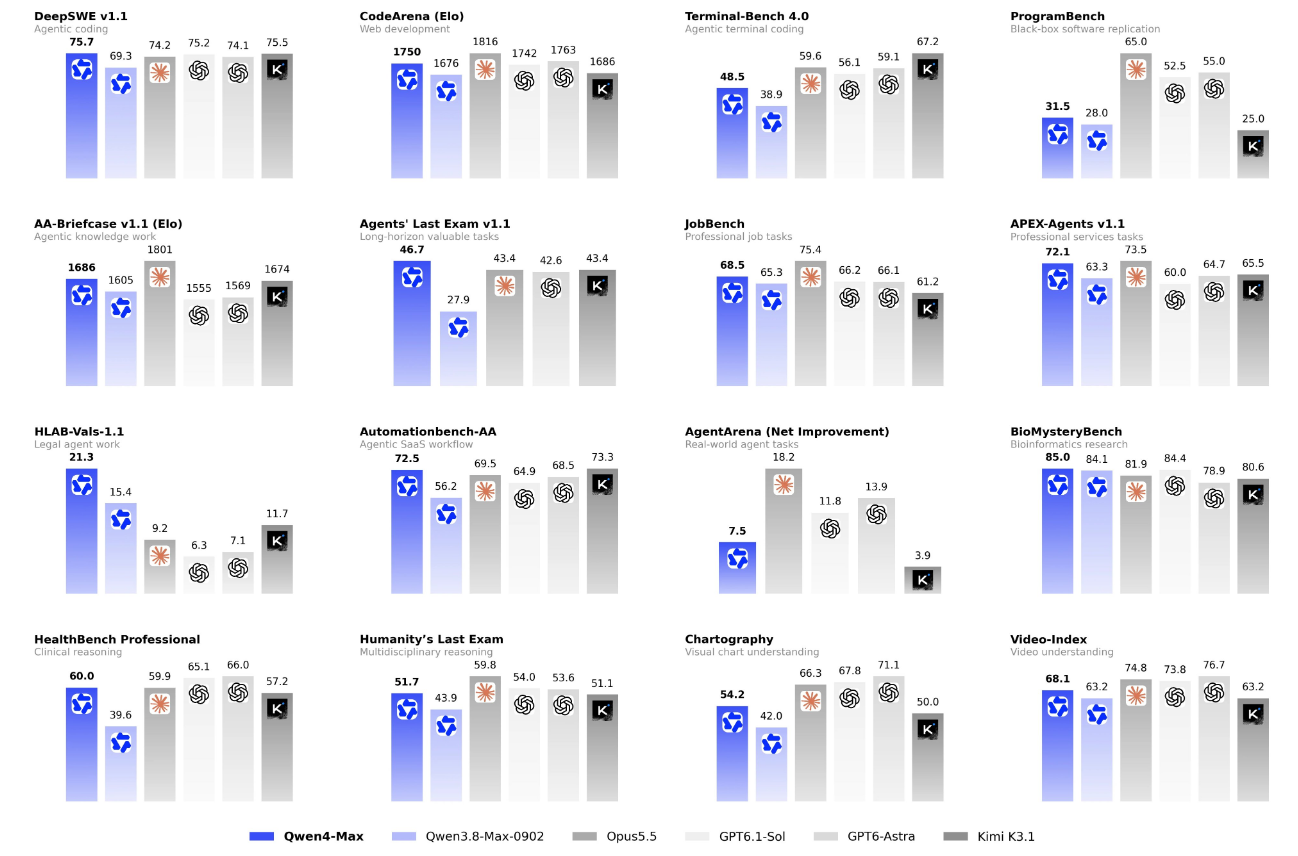
The banner behind the table. It is the most detailed official spec sheet in existence for this model, and it is still a banner: architecture, modality and credits claims, no methodology, no error bars, no independent run.
Prices, contexts and who serves what
List prices are the vendor’s official per-token rate. The One AI API Key column is what we charge, below list on every served row, which is the standing pattern here.
| Model | Context | Input modalities | List $/M (in / out) | One AI API Key $/M (in / out) | Served here? |
|---|---|---|---|---|---|
| Qwen4 Max Preview | 1,000,000 | Text, image | Token Plan from $3/mo; list $1.50 / $4.50 | Queued | No |
| Qwen3.8 Max | 1,000,000 | Text, image, video | $2.00 / $6.00 | $0.577 / $1.73 | Yes |
| Claude Opus 5.5 | 1,000,000 | Text, image | $4.00 / $20.00 | $2.80 / $14.00 | Yes |
| Claude Fable 5.1 | 1,000,000 | Text, image | $10.00 / $50.00 | $7.00 / $35.00 | Yes |
| GPT-6.1 Sol | 1,050,000 | Text, image | $2.00 / $10.00 | $0.70 / $3.50 | Yes |
| GPT-6 Astra | 1,050,000 | Text, image, file | $10.00 / $50.00 | $3.50 / $17.50 | Yes |
| Gemini 4 Argon | 1,000,000 | Text, image, audio, video | $2.00 / $10.00 | $0.525 / $2.625 | Yes |
| Gemini 4 Carbon | 1,048,576 | Text, image | $2.00 / $10.00 | Not served yet | No |
| Grok 4.7 | 500,000 | Text, image | $2.00 / $6.00 | $1.40 / $4.20 | Yes |
| Kimi K3 | 1,048,576 | Text, image | Not published in our sources | $0.353 / $5.67 | Yes |
Three honest notes. Grok 4.7 bills every token at 2x once the prompt passes 200K tokens, so its 500K window is not flat-rate. The regularly priced Fable is 5.1 at $7 / $35 against a $10 / $50 list. And Qwen4-Max’s “list” is two surfaces: pay-as-you-go at $1.50 / $4.50 and the Token Plan in credits, which cannot be converted to a per-token rate because the burn rate is unpublished.
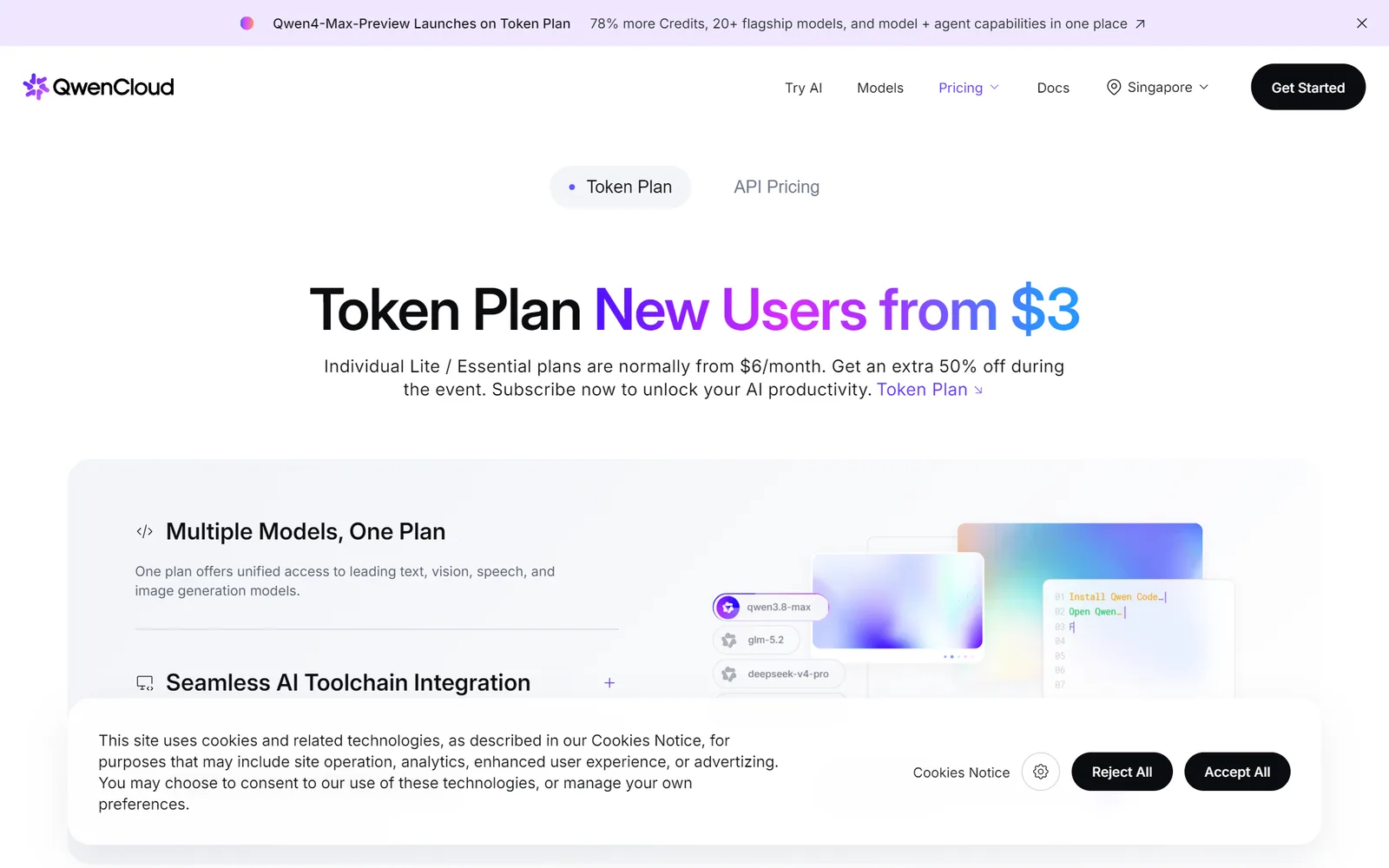
The subscription surface for Qwen4-Max: Lite $3, Essential $5, Standard $18, Pro $43, launch prices against regular prices of $8 / $16 / $25 / $51, with the concurrent-agent column running 1-2 up to 6-8. No other flagship on this board sells access this way, which is the structural difference the price rows cannot show.
The routing matrix
Price and scores together, as routing advice:
| Workload | Best published score | Cheapest metered route today | Watch for |
|---|---|---|---|
| Agentic coding, repo issues | Qwen4-Max 75.7 DeepSWE | Qwen3.8 Max at $0.577 / $1.73 | Qwen4-Max queued |
| Terminal automation | Kimi K3.1 67.2 Terminal-Bench 4.0 | Kimi K3 at $0.353 / $5.67 | Harness differs from Kimi’s own card |
| Web dev, general Elo | Opus 5.5, 1816 CodeArena | Opus 5.5 at $2.80 / $14.00 | Elo, not percentages |
| Black-box replication | Opus 5.5, 65.0 ProgramBench | Opus 5.5 | Qwen4-Max at 31.5, weakest row |
| Long-horizon valuable tasks | Qwen4-Max 46.7 Agents’ Last Exam | Qwen3.8 Max until listed | Vendor table only |
| Legal agentic work | Qwen4-Max 21.3 HLAf-Vals-1.1 | Qwen3.8 Max | All scores low; hard test |
| Bioinformatics | Qwen4-Max 85.0 BioMysteryBench | Qwen3.8 Max | Domain reasoning, not pixels |
| Clinical reasoning | GPT-6 Astra 66.0 | Astra at $3.50 / $17.50; Sol $0.70 / $3.50 cheaper | Sol close at 65.1 |
| Charts and dashboards | GPT-6 Astra 71.1 Chartography | Sol at $0.70 / $3.50 | Qwen4-Max trails by 16.9 |
| Video understanding | GPT-6 Astra 76.7 Video-Index | Qwen3.8 Max takes video input | Video input unpublished on Qwen4 |
| SaaS workflow automation | Kimi K3.1 73.3 Automationbench-AA | Kimi K3 | 0.8 gap, not a lead |
| Multimodal breadth | Gemini 4 Argon, four modalities | Argon at $0.525 / $2.625 | Carbon not served yet |
The matrix is the honest version of “best model”: best at the row you run, at the price you can meter, on the route that is live. On that test, today, the Qwen family answer is still the 3.8 generation on our gateway, and the Qwen4-Max answer is queued with a published list rate to beat.
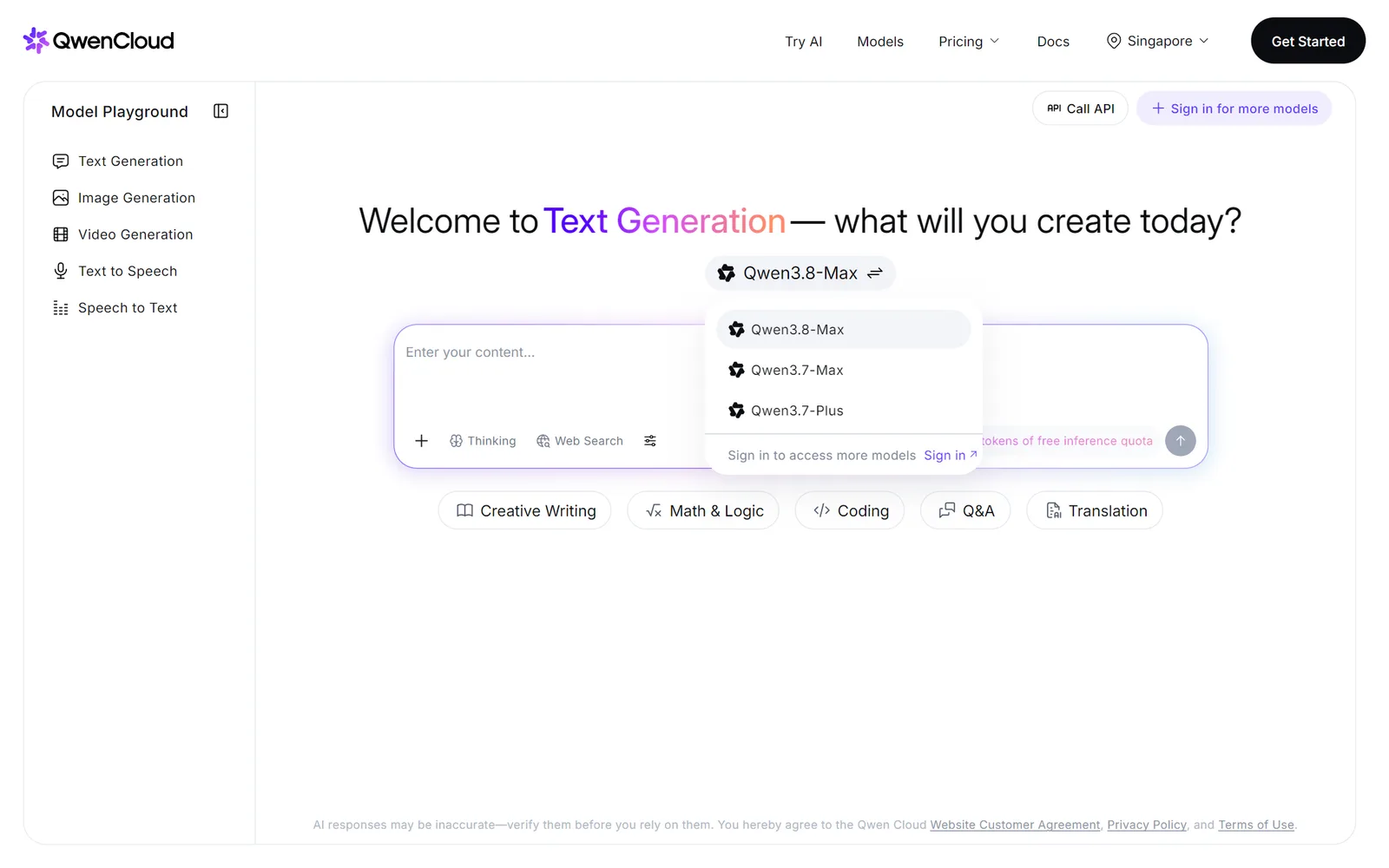
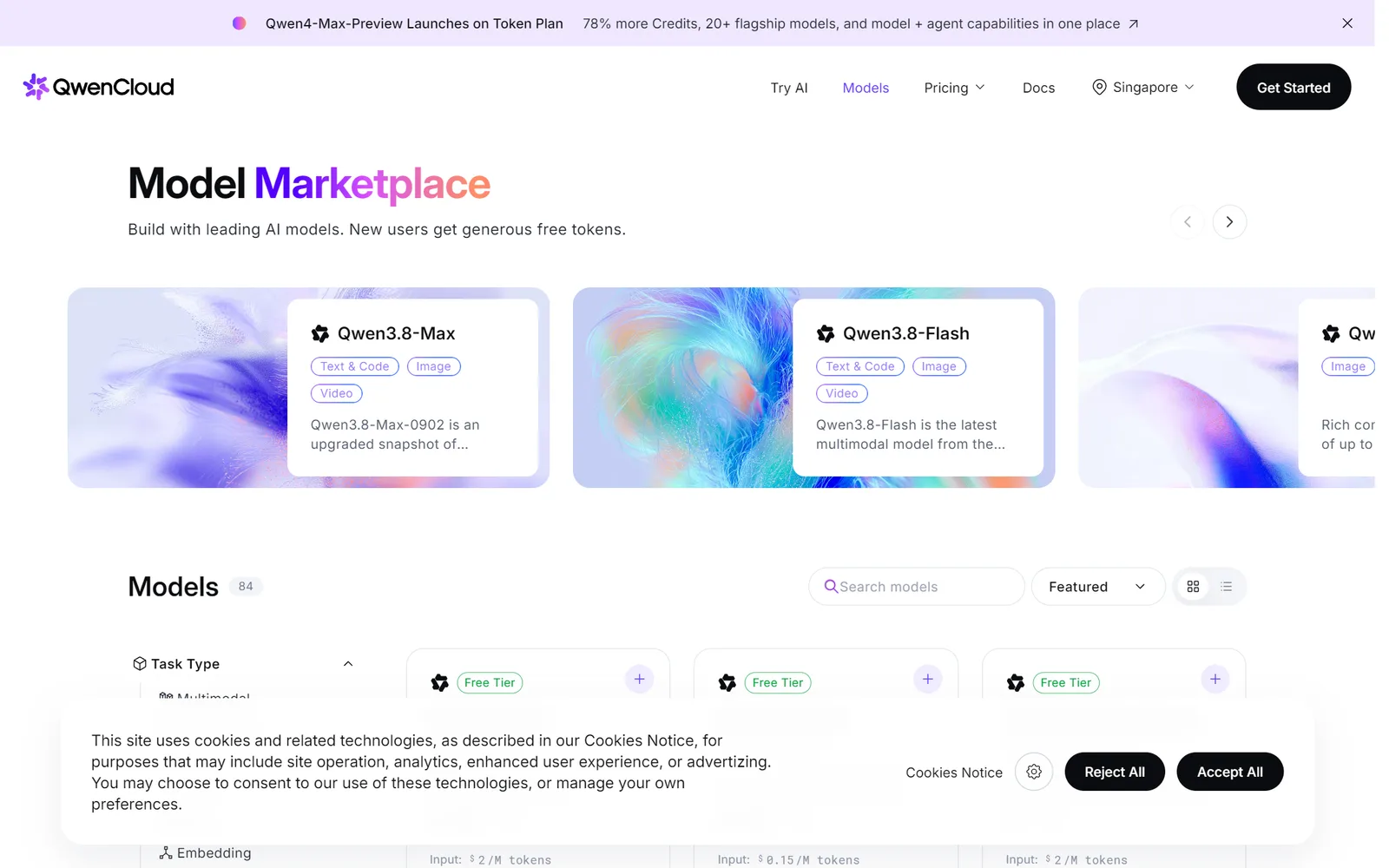
The playground, where the comparison starts for most people. Its anonymous picker covers the 3.8 and 3.7 generations, which is also the honest picture of free access across the whole family: the current generation is paid, the last generation is free.
What Artificial Analysis, LMArena and the arena crowd are saying
As of 2026-11-16: no Qwen4-Max row on Artificial Analysis, none on LMArena, and no independent arena Elo for any of the launch-week flagships in this table beyond what their vendors publish. benchlm.ai documents the same evidence gaps we do. The community conversation is thePandaily’s launch thread on the Agents’ Last Exam score and the price cut, MindStudio’s hands-on with animation generation and satellite-image reasoning, apidog’s client-config walkthrough, orcarouter’s naming piece on the Qwen4 family structure, and the gptunnel October arena rumor, a score of 53, unconfirmed and predating launch.
None of that is bad faith; it is launch week. The pattern from the 3.8 generation held again: vendor tables first, independent boards weeks or months later, and the metered evidence on a gateway like ours in between. Our rankings page is where the third kind lands, and it currently says nothing about Qwen4-Max because we do not serve it yet.
Calling Qwen4-Max on the published route
Qwen Cloud’s compatible endpoint, OpenAI SDK style, while the gateway listing is queued:
curl https://ap-southeast-1.maas.qwencloudapi.com/compatible-mode/v1/chat/completions \
  -H "Authorization: Bearer $QWEN_API_KEY" \
  -H "Content-Type: application/json" \
  -d '{
    "model": "qwen4-max",
    "messages": [{"role": "user", "content": "Refactor this function for readability."}]
}'import os
from openai import OpenAI
client = OpenAI(
api_key=os.environ["QWEN_API_KEY"],
base_url="https://ap-southeast-1.maas.qwencloudapi.com/compatible-mode/v1",
)
resp = client.chat.completions.create(
model="qwen4-max",
messages=[{"role": "user", "content": "Explain this stack trace."}],
)
print(resp.choices[0].message.content)Every other model in the scoreboard that is served here runs through the same OpenAI-compatible surface at https://api.oneaiapikey.com/v1, with the model strings in the catalog table above.
The arena question
The most-asked question about any flagship is its arena Elo, and the honest answer for Qwen4-Max is that none exists. LMArena has no row, Artificial Analysis has no row, and the only arena-flavored number in circulation is an October gptunnel rumor of a score of 53, unconfirmed and predating the launch. Arena scores would add what the launch table cannot: blind votes, style-controlled, with no vendor choosing the prompts. Until they exist, the Elo rows in Alibaba’s table (CodeArena, AA-Briefcase) are vendor-run ratings, and the community’s arena is silence.
How we keep this table honest
Method, stated so it can be checked: every score was transcribed from Alibaba’s launch table on 2026-11-16, with no averaging across Elo and percentage units; every price was read from the vendor’s pricing page or our own catalog on the same day; served status was verified against the model catalog, not against marketing; and every claim that lacks a source is labeled unconfirmed or left out. Where our own numbers appear, they are our metered rates, and where Alibaba’s internal evaluation appears, it is labeled as such, including the ~50% fewer tokens and 60% lower cost per task claims.
What would change this post: an independent board row for Qwen4-Max, a published Token Plan burn rate, our own metered data the day the model lists, and any vendor correction to the launch table. The changelog carries the listing news; this post carries the numbers.
Mistakes to avoid
- Reading one row as a verdict. Qwen4-Max leads DeepSWE by 0.2 and trails ProgramBench by 33.5 against Opus 5.5. Both are true; neither is the model.
- Mixing Elo and percentages. A 74-Elo gap and a 74-point gap are not the same unit, and the table shares columns.
- Pricing the subscription in tokens. Credits have no published burn rate; Pro at $43 is not comparable to $1.50 per million until it exists.
- Ignoring served status. The best paper model is not a route. Eight of the ten rows here are metered on our board today; the gaps are Qwen4-Max, queued, and Gemini 4 Carbon, not listed.
- Chasing Fable 5.2. It is not published anywhere we can source. Fable 5.1 is the model, at $7 / $35 here against a $10 / $50 list.
- Skipping the 2x clause. Grok 4.7 doubles past 200K tokens of prompt; its 500K window is not flat-rate.
One number we will not publish
A composite score. Sixteen rows, three unit systems (percentages, Elo ratings, net-improvement deltas) and a vendor column order that is not a ranking. Averaging them produces a number that is arithmetically valid and semantically empty, and every “best model” headline of launch week is that average with extra steps. The routing matrix above is the honest version of the same data: best at the row you run, at the price you can meter, on the route that is live.
FAQ
Which single model should I pick?
None, from a table. Pick by your top three rows in the matrix, confirm the route serves them, and re-run the choice when independent boards post Qwen4-Max rows.
Does the Qwen4-Max price beat every list here?
Against vendor lists, the input rate is competitive and the cached rate is the best published in this table. Against our metered rates, it is not, and that distinction is the whole reason the served column exists.
Is Qwen4-Max the best flagship?
It leads the long-horizon, legal and bioinformatics rows and sweeps its own predecessor, but Opus 5.5 owns the Elo boards and ProgramBench, GPT-6 Astra owns the visual rows, and Kimi K3.1 owns terminal coding. The factual answer is: best at four things, mid-pack at six, and behind at six, on the vendor’s own table.
Which flagship is cheapest per million tokens?
Among served flagships on our board, Kimi K3 at $0.353 input, then Gemini 4 Argon at $0.525, then Qwen3.8 Max at $0.577, then GPT-6.1 Sol at $0.70. Qwen4-Max’s $1.50 list is competitive against other vendors’ lists, not against our metered rates. The cheapest card launched the same day is not a flagship at all: Tencent’s Hy4 flash lists $0.070 input and $0.281 output with a 64K output cap, the volume lane to this post’s frontier lane, tracked in our Hy4 flash cluster.
Which flagship has the widest modalities?
Gemini 4 Argon: text, image, audio and video. Qwen3.8 Max adds video to text and image. Qwen4-Max publishes text and image.
Where does Fable 5.1 stand?
Mid-pack on coding rows, second on AA-Briefcase behind Opus 5.5’s 1801 with Qwen4-Max’s 1686 close behind, and priced at $7 / $35 here against a $10 / $50 list. It is the knowledge-work alternative when Opus’s Elo premium is too much.
Is any of this independently verified?
No. The table is Alibaba’s, the other vendors’ numbers are their own lists, and the independent boards have no Qwen4-Max rows yet. Everything here is published facts plus arithmetic, labeled as such.
When does the scoreboard update?
When Qwen4-Max lists on our gateway, the rankings page starts metering it, and the independent boards land rows. Watch the changelog.
The bottom line
Eight flagships, one table, no referee. Qwen4-Max’s launch position is specific and defensible: best-in-table on long-horizon, legal and bioinformatics rows, a clean generational sweep, list pricing 25% under its predecessor, and a subscription entry at $3 that no other flagship vendor matches. Its gaps are just as specific: terminal coding, chart reading, video understanding, and the Elo boards. The flagship to buy today depends on the row you run and the route that serves it; the flagship to watch is this one, queued here, with the metered evidence to come.
Keep reading
The other nine posts in this cluster, one angle each:
- Qwen4 Max Preview: free, pricing, providers and specs — the launch-day master post
- Qwen4-Max benchmarks, explained — every row of the table above, benchmark by benchmark
- Qwen4-Max vs Claude Opus 5.5 — the Elo-board owner
- Qwen4-Max vs GPT-6.1 Sol — the value flagship
- Qwen4-Max vs Kimi K3 — the terminal-coding owner
- Qwen4-Max vs Qwen3.8-Max-0902 — the generational sweep
- Qwen4-Max API pricing decoded — every rate surface
- Qwen4-Max 1M context guide — the window, honestly
- Cheapest way to run Qwen4-Max, free routes checked — the free-lane map
More Qwen4-Max coverage
The Fable comparison, added 2026-11-16:
The rest of the cluster, and the pages every comparison links back to:
- Qwen4-Max 1M context guide: what a million tokens holds, and the chunking that keeps it honest
- Qwen4-Max API pricing: every rate, the $43 Token Plan Pro and what a call actually costs
- Qwen4-Max API quickstart: the id, the base URL, streaming, max_tokens and the $43 plan
- The cheapest way to run Qwen4-Max: free routes checked, and the $3 plan that beats them all
- Run Qwen4-Max in your coding agent: base URL, model id, concurrency tiers and budget guards
- Qwen4-Max prompt caching: the $0.075 implicit cache, break-even math and cache-break probes
- Qwen4-Max vision and video benchmarks: what native vision actually scores against GPT-6 Astra and Opus 5.5
- Qwen4-Max vs Gemini 4 Argon: multimodal routes, 1M context and what each actually costs
- Qwen4-Max vs GPT-6.1 Sol and GPT-6 Astra: benchmarks, pricing and the split
- Qwen4-Max vs GPT-6 Astra: sixteen benchmarks, the price gap and where each model wins
- Qwen4-Max vs Grok 4.7: flat flagship prices against the 2x long-context surcharge
- Qwen4-Max vs Kimi K3: sixteen benchmarks, terminal coding and the price per million tokens
- Qwen4-Max vs Claude Opus 5.5: sixteen benchmarks, token prices and the honest split
- Qwen4-Max vs Qwen3.8-Max-0902: the 16-benchmark sweep, the price cut and a migration checklist
- The model catalogue
- The model comparison tool
- API pricing and plans
- The cost calculator
- Live rankings and throughput
- The changelog