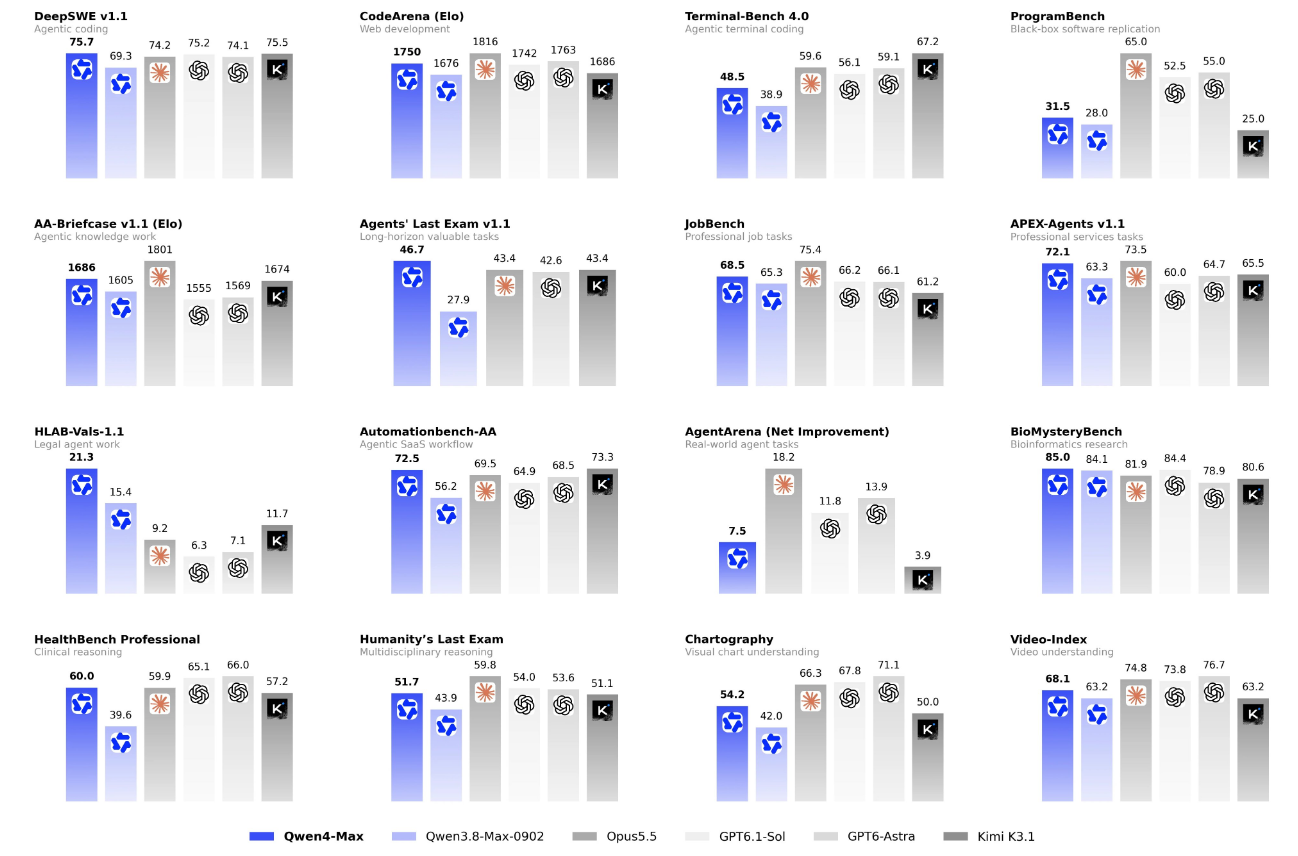
Every flagship launch invites the same question: does the new model beat the quality tier it is priced against? For Qwen4-Max, Alibaba’s mixture-of-experts flagship that went live on 2026-11-16, the honest comparison is not against the cheap OpenAI tier. It is against GPT-6 Astra, the model OpenAI sells as its best, and the one our gateway meters at $3.50 input and $17.50 output per million tokens. Alibaba’s launch table scores both. That table is the spine of this post: sixteen benchmarks, two price lists, and a split that is wide enough to matter to your wallet.
The verdict up front. Qwen4-Max takes nine of the sixteen rows, including the four biggest agentic gaps: Agents’ Last Exam 46.7 to 42.6, APEX-Agents 72.1 to 64.7, HLAf-Vals legal work 21.3 to 7.1 and Automationbench-AA 72.5 to 68.5. GPT-6 Astra takes seven, and they are the rows that decide visual and hard-reasoning work: Chartography 71.1 to 54.2, Video-Index 76.7 to 68.1, HealthBench Professional 66.0 to 60.0, Humanity’s Last Exam 53.6 to 51.7, Terminal-Bench 4.0 59.1 to 48.5, ProgramBench 55.0 to 31.5 and CodeArena 1763 to 1750. On list price, Qwen4-Max is a fraction of Astra: $1.50 input and $4.50 output against $10 and $50. There is no overall winner. There is a workload map, and the rest of this post is that map.
What the two models are
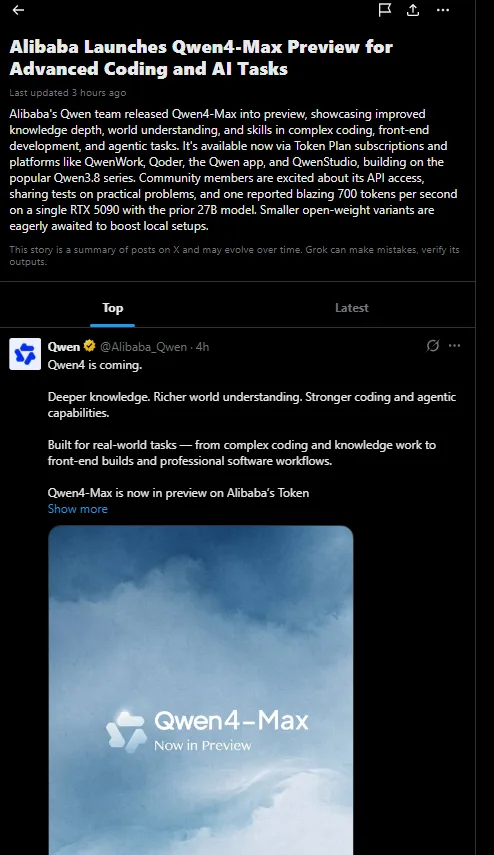
Qwen4-Max is Alibaba’s new flagship: mixture-of-experts, native vision, a 1,000,000-token context window, text and image input, launch pricing of $1.50 input, $4.50 output and $0.075 implicit caching, live on Qwen Cloud and inside Qwen Studio, QwenWork and Qoder. The Token Plan sits on top, from Lite at $3 a month up to Pro at $43.
GPT-6 Astra is OpenAI’s top of the GPT-6 family on our board: a 1,050,000-token window, text, image and file input, 128,000 max output, vendor list $10 input and $50 output, sold through our gateway at $3.50 / $17.50 with cached input at $1.00, and it is a featured model today. It is OpenAI’s deep-research and long-agentic tier, per its own model docs.
| Spec | Qwen4-Max | GPT-6 Astra |
|---|---|---|
| Context window | 1,000,000 | 1,050,000 |
| Input modalities | Text, image (native vision) | Text, image, file |
| Max output | 393,216 on the preview, per eesel.ai’s review | 128,000 |
| List input $/M | $1.50 | $10.00 |
| List output $/M | $4.50 | $50.00 |
| Cached input $/M | $0.075 implicit | $1.00 list, $1.00 on our gateway |
| On One AI API Key | Queued | Live $3.50 / $17.50 |
Two rows need footnotes. Qwen4-Max’s max output is from eesel.ai’s review of the preview build, which lists 393,216 tokens shared between thinking and answer; the launch table we transcribed does not restate it, so treat it as preview-era, not GA. And Astra’s file input matters if you send PDFs or documents: Qwen4-Max’s published input modalities are text and image only.
The sixteen rows, two models, no composites
The full six-model table lives in our sixteen-benchmark explainer. Here it is cut to the two models in this article, winner in bold, exactly as Alibaba published it.
| Benchmark | What it measures | Qwen4-Max | GPT-6 Astra |
|---|---|---|---|
| DeepSWE v1.1 | Agentic coding | 75.7 | 74.1 |
| CodeArena (Elo) | Web development | 1750 | 1763 |
| Terminal-Bench 4.0 | Agentic terminal coding | 48.5 | 59.1 |
| ProgramBench | Black-box software replication | 31.5 | 55.0 |
| AA-Briefcase v1.1 (Elo) | Agentic knowledge work | 1686 | 1569 |
| Agents’ Last Exam v1.1 | Long-horizon valuable tasks | 46.7 | 42.6 |
| JobBench | Professional job tasks | 68.5 | 66.1 |
| APEX-Agents v1.1 | Professional services tasks | 72.1 | 64.7 |
| HLAf-Vals-1.1 | Legal agentic work | 21.3 | 7.1 |
| Automationbench-AA | Agentic SaaS workflow | 72.5 | 68.5 |
| AgentArena (Net Improvement) | Real-world agent tasks | 18.2 | Not listed |
| BioMysteryBench | Bioinformatics research | 85.0 | 78.9 |
| HealthBench Professional | Clinical reasoning | 60.0 | 66.0 |
| Humanity’s Last Exam | Multidisciplinary reasoning | 51.7 | 53.6 |
| Chartography | Visual chart understanding | 54.2 | 71.1 |
| Video-Index | Video understanding | 68.1 | 76.7 |
Counting rows: Qwen4-Max leads on nine, Astra on seven. But the count is not the story. Astra’s seven include the two widest gaps in the whole comparison: ProgramBench, 55.0 against 31.5, and Chartography, 71.1 against 54.2. Qwen4-Max’s nine include the only row where it doubles its rival, HLAf-Vals at 21.3 against 7.1, and the only row Astra does not appear in at all, AgentArena.
Where Qwen4-Max wins. The agentic and professional cluster. Agents’ Last Exam 46.7 to 42.6 is the long-horizon test, tasks that take many steps and stay valuable. APEX-Agents 72.1 to 64.7 is professional services work. AA-Briefcase is an Elo rating for agentic knowledge work and Qwen4-Max sits 117 points clear, 1686 to 1569. JobBench 68.5 to 66.1, Automationbench-AA 72.5 to 68.5, BioMysteryBench 85.0 to 78.9, DeepSWE 75.7 to 74.1 and HLAf-Vals 21.3 to 7.1 complete the set. If your agents chain many steps over documents, spreadsheets, legal text or life-science material, this cluster is the argument for the Alibaba model.
Where GPT-6 Astra wins. The visual cluster, the clinical row and the hard coding edges. Chartography 71.1 to 54.2 and Video-Index 76.7 to 68.1 are wide, 16.9 and 8.6 points. HealthBench Professional 66.0 to 60.0 is clinical reasoning, and Humanity’s Last Exam 53.6 to 51.7 is the hardest reasoning pool in the table. Terminal-Bench 4.0 59.1 to 48.5 and ProgramBench 55.0 to 31.5 are shell-level and black-box coding, where Astra is far ahead. CodeArena 1763 to 1750 is an 13-Elo edge, small but real.
What the split means for real workloads
Charts, dashboards and video. If your product reads charts, screenshots or video frames, Astra’s 71.1 and 76.7 against Qwen4-Max’s 54.2 and 68.1 are not rounding errors. Qwen4-Max has native vision and accepts images, but on the two visual rows in this table it is third of the three models Alibaba listed. For visual work the honest pick on this evidence is GPT-6 Astra, or Gemini 4 Argon if you also need audio input, since Argon takes text, image, audio and video input on our gateway.
Legal and life-science text. HLAf-Vals-1.1 is legal agentic work and every score is low, which is the point: it is a hard suite. Qwen4-Max’s 21.3 triples Astra’s 7.1. BioMysteryBench goes the same way, 85.0 to 78.9. Law firms and biotech labs reading this table should weight these two rows heavily.
Terminal and black-box coding. Agents that live in shells, or that rebuild software from observed behaviour, face the widest gaps against Qwen4-Max: Terminal-Bench 59.1 to 48.5 and ProgramBench 55.0 to 31.5. On this evidence, GPT-6 Astra or GPT-6.1 Sol is the safer tool for that job, and Sol does it for $0.70 / $3.50 through us.
Long-horizon knowledge work. Agents’ Last Exam, APEX-Agents, AA-Briefcase and JobBench all favour Qwen4-Max. If your agents chain many steps over documents and professional workflows, this is the strongest argument for the Alibaba model, and it is the argument our cost calculator cannot make for you: only your own tasks can.
The pricing math
List rates per million tokens:
| Route | Input $/M | Output $/M | Cached input $/M |
|---|---|---|---|
| Qwen4-Max, Qwen Cloud list | $1.50 | $4.50 | $0.075 implicit |
| GPT-6 Astra, OpenAI list | $10.00 | $50.00 | $1.00 |
| GPT-6 Astra, One AI API Key | $3.50 | $17.50 | $1.00 |
| Qwen4-Max, One AI API Key | Queued, not live yet |
Per token, Qwen4-Max list is 15% of Astra’s input price and 9% of its output price. Our gateway already sells Astra below its list, which is the number most launch-day comparisons miss: the cheapest published rate is not the rate you pay, it is the rate your gateway charges. When Qwen4-Max joins our model catalog it gets the same treatment, and until then Qwen3.8 Max at $0.577 / $1.73 is the cheapest 1M-context flagship we sell.
A concrete task, one year, fifty agent runs a day at 8,000 input and 2,000 output each. Monthly volume is about 12.4M input and 3.1M output tokens. On Astra list that is $279 a month. On Astra through us it is about $98. On Qwen4-Max list it is $32.55. On our gateway it is unknown until the queued listing publishes a rate, and we do not guess rates before they exist.
Caching tilts it further. Take the same workload with 80% of input hitting cache. Qwen4-Max’s implicit cache at $0.075 per million costs $0.74 for 9.92M cached tokens; Astra’s $1.00 cached rate costs $9.92 for the same tokens. Full-month totals at 80% cache hit: Qwen4-Max list about $18.41, Astra on our gateway about $72.85. The cache row is why our prompt caching guide exists: any total that ignores it is a list price, not a bill. Sol’s cached rate through us is $0.10, and kingy.ai’s head-to-head records Qwen4-Max cache reads at $0.075 against Sol’s $0.10 via OpenRouter, with Sol also billing $2.50 per million cache writes while Qwen4-Max billed none.
Want the Astra numbers metered, or the Qwen4-Max listing the day it lands? GPT-6 Astra is live today at $3.50 / $17.50 with per-key limits and per-request metering, and Qwen4-Max is queued for the same treatment.
What Artificial Analysis, LMArena and the community are saying
The third-party picture is the same as every Qwen4 launch this week: vendor table first, independent rows later. Artificial Analysis and LMArena have no public Qwen4-Max rows as of 2026-11-16, and no independent Astra-versus-Qwen4-Max run exists that we can verify. BenchLM documents the gap directly: specifications, pricing, context and evidence gaps, no source-displayable benchmark rows. MindStudio’s hands-on piece is qualitative, covering animation generation, 82-language naming, satellite image reasoning and visual safety judgment. The Pandaily thread on X leads with the Agents’ Last Exam score of 46.7 and the caching price cut, both consistent with the table above.
The closest thing to an independent measurement is kingy.ai’s Qwen4-Max versus GPT-6.1 Sol run via OpenRouter, published 2026-11-15: on their Vals Index v2.2, Qwen4-Max scored 63.20% against Sol’s 63.94%, at $9.33 per test against $3.61, with a wrong-figure rate of 6.4% against 1.6% across 125 questions, and first-attempt durations of 15.67 minutes against 6.29. That is Sol, not Astra, and it is one synthetic repetition with unblinded AI grading, as the post itself states. It is direction, not verdict. What is worth watching: once Artificial Analysis posts quality, price and speed columns for Qwen4-Max, the speed column matters as much as the scores, because a model that is cheaper and three times slower is not automatically the better deal for an agent under latency budget. Our rankings page tracks real gateway throughput for every model we serve, and we will update this post when independent rows exist.
How to call each model today
Qwen4-Max is live on Qwen Cloud, OpenAI-compatible:
curl https://ap-southeast-1.maas.qwencloudapi.com/compatible-mode/v1/chat/completions \
  -H "Authorization: Bearer $QWEN_API_KEY" \
  -H "Content-Type: application/json" \
  -d '{
    "model": "qwen4-max",
    "messages": [{"role": "user", "content": "Refactor this function for readability."}]
  }'
GPT-6 Astra is live on our gateway with your existing key:
curl https://api.oneaiapikey.com/v1/chat/completions \
-H "Authorization: Bearer $ONEAI_API_KEY" \
-H "Content-Type: application/json" \
-d '{
  "model": "gpt-6-astra",
  "messages": [{"role": "user", "content": "Read this chart and summarize the trend."}]
}'
Copy the Qwen base URL from your own Qwen Cloud console rather than trusting any blog’s host, including this one. A 401 means the key or entitlement is wrong, a 404 on the model usually means the id, and qwen4-max is not qwen4-max-preview. Enable streaming so long reasoning arrives token by token, and set max_tokens deliberately: a reasoning model can spend its output budget thinking before it answers, which our reasoning docs cover. Watch rate limits on both routes, and read errors before you retry, because a 429 on one gateway is not a 429 on the other.
Mistakes to avoid
- Reading one row as a verdict. Astra beats Qwen4-Max on seven rows, some by wide margins. Pick by your workload’s rows, not by the count of nine.
- Comparing list price to gateway price. Astra at $3.50 / $17.50 through us is a third of its list; Qwen4-Max’s $1.50 / $4.50 is list, not our rate. Compare the rate you actually pay.
- Assuming native vision means best vision. Qwen4-Max takes images, but Chartography and Video-Index both go to Astra. Test your visual tasks specifically.
- Ignoring the Elo rows. CodeArena and AA-Briefcase are ratings; the rest are percentages. Mixing them in an average is meaningless.
- Treating AgentArena as comparable. Astra is not listed in that row, and net improvement measures change, not absolute quality.
- Pinning a moving id. Preview ids and GA ids behave differently; the 3.8 generation proved it. Pin, log, re-run evals, as our API key per project guide argues.
FAQ
Is Qwen4-Max cheaper than GPT-6 Astra?
On list rates, by a wide margin: $1.50 / $4.50 per million against $10 / $50. On our gateway, Astra is $3.50 / $17.50 today, which is below its list but still above Qwen4-Max’s list. Until Qwen4-Max has a published rate here, Astra through us is the only metered option of the two.
Does Qwen4-Max beat GPT-6 Astra?
On nine of sixteen rows it beats Astra, including Agents’ Last Exam 46.7 to 42.6, APEX-Agents 72.1 to 64.7 and HLAf-Vals 21.3 to 7.1. Astra keeps the visual rows, HealthBench, Humanity’s Last Exam, Terminal-Bench, ProgramBench and CodeArena. Split by workload.
What is the context window of each?
Qwen4-Max lists 1,000,000 tokens, Astra 1,050,000. Both are in the same tier, and neither number tells you recall quality across the window, so test your own long prompts with the probes in our 1M context guide.
Has Artificial Analysis scored Qwen4-Max yet?
No. As of 2026-11-16 neither Artificial Analysis nor LMArena publishes an independent Qwen4-Max row. BenchLM documents the evidence gap explicitly. The only published table is Alibaba’s, and kingy.ai’s Sol run is the only independent measurement of the model we have seen.
Is Qwen4-Max on One AI API Key?
Not yet. It is queued for the catalog at a published rate below list, the same as every Alibaba flagship. Qwen3.8 Max is live today at $0.577 / $1.73, and qwen3.8-max-0902-uncensored:free runs on the free lane.
What about Claude Fable 5.2?
There is no Claude Fable 5.2 anywhere we can verify. The live Fable id is Claude Fable 5.1 at $7 / $35 through us. Every Fable number in our posts is 5.1.
The bottom line
Against GPT-6 Astra, Qwen4-Max is far cheaper at list and better on long-horizon, legal, professional and bioinformatics rows, while Astra is clearly better on vision, clinical reasoning, hard reasoning and terminal coding. The honest recommendation is the boring one: match the rows to your workload, run your own eval on the two or three that decide your use case, and meter the result. Astra is live and metered today; Qwen4-Max is live upstream at Qwen Cloud and queued here, and your key will switch it on with an id change, not a migration.
Keep reading: all sixteen benchmarks explained, Qwen4-Max vs GPT-6.1 Sol, the value tier, Qwen4-Max vs Claude Opus 5.5, Qwen4-Max vs Kimi K3, Qwen4-Max vs Gemini 4 Argon, the multimodal map, Qwen4-Max prompt caching guide, the $0.075 math, Qwen4-Max vs Grok 4.7, the cheap fast tier, and Qwen4-Max API quickstart.
More Qwen4-Max coverage
The Fable comparison, added 2026-11-16:
-
Qwen4-Max vs Claude Fable 5.1: the real price gap, output ceilings and when Fable earns its rate
-
Qwen4-Max benchmarks explained: 16 tests against Opus 5.5, GPT-6.1 Sol, GPT-6 Astra and Kimi K3.1
-
Qwen4-Max vs Qwen3.8-Max-0902: the generational jump, row by row
-
Qwen4-Max vs Claude Opus 5.5: sixteen benchmarks and the honest split
-
Qwen4-Max API pricing: list rates, the $43 Token Plan and the cost math
-
Qwen4-Max 1M context guide: recall probes and the full-window bill
-
Qwen4-Max coding agents setup: Claude Code, Cursor, Codex and Qoder
-
Qwen4-Max vision and video benchmarks: what native vision actually wins
-
Qwen4-Max API quickstart: ids, base URLs, streaming and max_tokens
-
Qwen4-Max prompt caching guide: the $0.075 implicit cache math
-
Qwen4-Max vs Kimi K3: harness differences and the honest numbers
-
Qwen4-Max vs Gemini 4 Argon: multimodal routes, prices and gaps
-
Qwen4-Max preview speed test: what we measured before launch