Every model family has one comparison that is actually easy to read: the new one against the old one, same vendor, same bench. Qwen4-Max versus Qwen3.8-Max-0902 is that comparison, and Alibaba published the whole thing: sixteen benchmarks, and Qwen4-Max wins all sixteen. The price moves too, in the direction you want: $1.50 input and $4.50 output per million tokens against the 3.8 generation’s $2.00 and $6.00, with implicit caching down from $0.25 to $0.075, which is the 70% the launch claims.
But “wins all sixteen and costs less” is a vendor sentence, and this post is not a vendor. So here is the full delta table, the cost math on both the Alibaba list price and the price you actually pay through One AI API Key, the three places migration can bite you, and the checklist we would run before moving a production agent from the 0902 snapshot to the new flagship.
The two models
Qwen3.8-Max-0902 is the dated snapshot of the 3.8 flagship. Our board serves it two ways: the standard qwen3.8-max listing at $0.577 input and $1.73 output per million tokens, and the 0902 uncensored free lane at $0, which counts against the free-lane daily allowance. The 3.8 generation is a 1M-context family with text, image and video input on the Max tier, and it is the model most of our coding-agent traffic runs on today.
Qwen4-Max is the next generation: mixture-of-experts, native vision, 1,000,000-token context, live on Qwen Cloud at $1.50 / $4.50 / $0.075 per million for input, output and cached input, and inside the Token Plan for subscription buyers. Alibaba claims roughly 50% fewer tokens used and over 60% lower average cost per task against its predecessor, from an internal evaluation whose workload is not published.
| Spec | Qwen3.8-Max-0902 | Qwen4-Max |
|---|---|---|
| Generation | Qwen3.8, dated 0902 snapshot | Qwen4, flagship tier |
| Architecture | Not published as MoE in our catalog data | Mixture-of-experts, per Alibaba |
| Context window | 1,000,000 | 1,000,000 |
| Input modalities | Text, image, video | Text, image (native vision) |
| Max output | 128,192 on our listing | About 390,000 per Alibaba developer docs |
| API route | Our gateway, OpenAI-compatible, live | Qwen Cloud, live; queued on our gateway |
| Input $/M | $0.577 here, $2.00 Alibaba list | $1.50 list |
| Output $/M | $1.73 here, $6.00 Alibaba list | $4.50 list |
| Cached input $/M | $0.25 | $0.075 |
The modality row deserves a flag before anyone migrates a video pipeline: our 3.8 Max listing takes video input, and Alibaba has published text and image for Qwen4-Max. Native vision is real, but video-in parity is not on the spec sheet. If your agent consumes frames, that is the first thing to test, not the last.
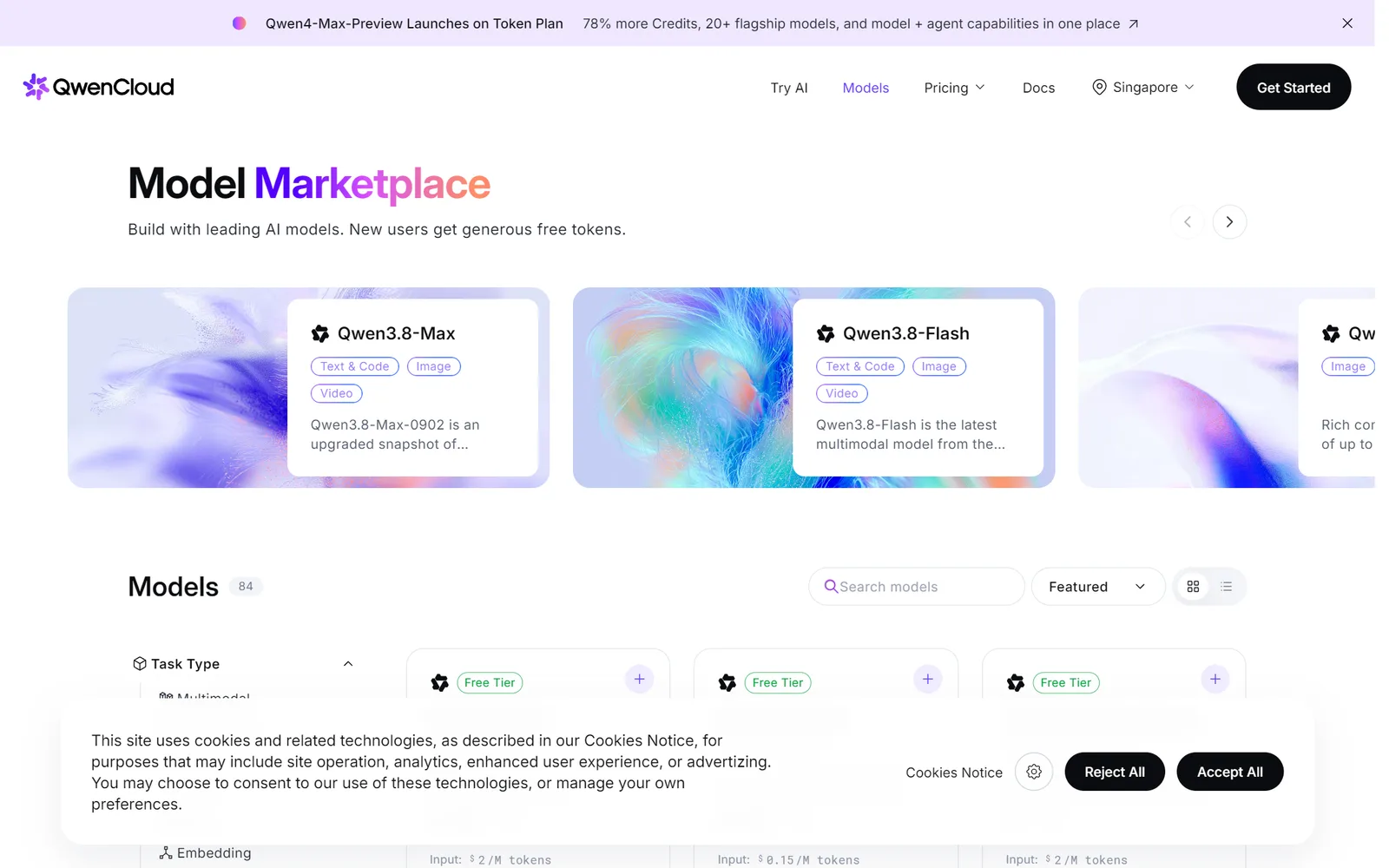
The launch banner on the Model Marketplace. Behind it sits the id that matters operationally: the launch generation is qwen4-max, while the preview generation rode qwen4-max-preview. Those are different ids with different behavior, and the 3.8 family already showed the pattern, with qwen3.8-max and qwen3.8-max-0902 behaving differently in production. Pin the exact id or your eval results will not reproduce.
The full delta table
All sixteen rows, both columns, and the delta. Bold marks the better score, which on a same-vendor generational table is always the new one.
| Benchmark | What it measures | Qwen4-Max | Qwen3.8-Max-0902 | Delta |
|---|---|---|---|---|
| DeepSWE v1.1 | Agentic coding | 75.7 | 69.3 | +6.4 |
| CodeArena (Elo) | Web development | 1750 | 1676 | +74 |
| Terminal-Bench 4.0 | Agentic terminal coding | 48.5 | 38.9 | +9.6 |
| ProgramBench | Black-box software replication | 31.5 | 28.0 | +3.5 |
| AA-Briefcase v1.1 (Elo) | Agentic knowledge work | 1686 | 1605 | +81 |
| Agents’ Last Exam v1.1 | Long-horizon valuable tasks | 46.7 | 27.9 | +18.8 |
| JobBench | Professional job tasks | 68.5 | 65.3 | +3.2 |
| APEX-Agents v1.1 | Professional services tasks | 72.1 | 63.3 | +8.8 |
| HLAf-Vals-1.1 | Legal agentic work | 21.3 | 15.4 | +5.9 |
| Automationbench-AA | Agentic SaaS workflow | 72.5 | 56.2 | +16.3 |
| AgentArena (Net Improvement) | Real-world agent tasks | 18.2 | 7.5 | +10.7 |
| BioMysteryBench | Bioinformatics research | 85.0 | 84.1 | +0.9 |
| HealthBench Professional | Clinical reasoning | 60.0 | 39.6 | +20.4 |
| Humanity’s Last Exam | Multidisciplinary reasoning | 51.7 | 43.9 | +7.8 |
| Chartography | Visual chart understanding | 54.2 | 42.0 | +12.2 |
| Video-Index | Video understanding | 68.1 | 63.2 | +4.9 |
The sweep is real in the sense that every row moved up, and the size of the moves is not uniform. The big jumps are the agentic and professional rows: Automationbench-AA up 16.3, HealthBench Professional up 20.4, AA-Briefcase up 81 Elo, Agents’ Last Exam up 18.8 points, which is the single largest gain on the sheet and lands on the benchmark that best matches the long-horizon agent work Alibaba is marketing. The small jumps are the already-strong rows: BioMysteryBench up 0.9 from 84.1, where the old model was already near the top of the family table.
Two honest limits. First, this is still one vendor’s table: no methodology card, no error bars, no prompt details, and no independent run anywhere. Our benchmark explainer transcribes the full six-model version of this table with every row explained, and our no-benchmarks-yet post documents what was vendor material and what was rumor during preview week. Second, the 0902 column here is the dated snapshot as Alibaba labeled it; our free lane serves an abliterated build of that snapshot, and we have no evidence either way about how an abliteration pass moves benchmark scores.
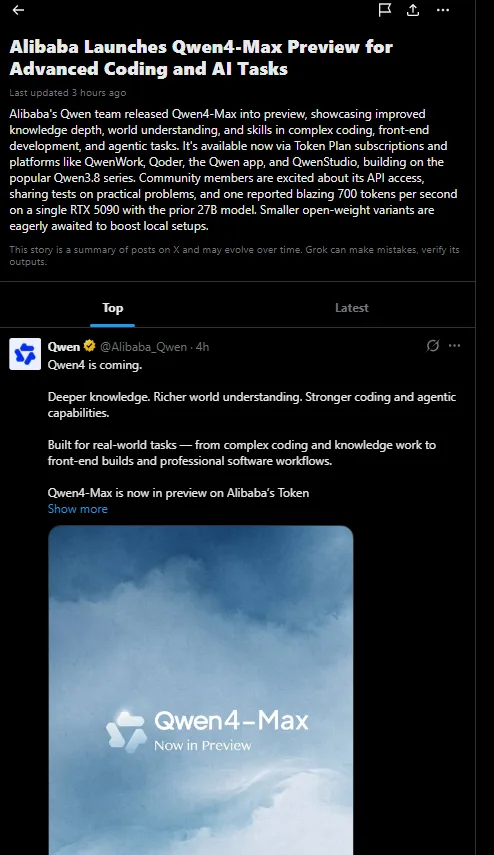
The announcement post that started the preview week. The claims that matter for a migration decision are the capability direction, the 1M context and the pricing. The score claims, including ~50% fewer tokens and over 60% lower cost per task, are internal evaluation numbers: direction, not a bill.
The price cut, and what it actually saves
List prices, Alibaba pay-as-you-go:
| Route | Input $/M | Output $/M | Cached input $/M |
|---|---|---|---|
| qwen3.8-max, Alibaba list | $2.00 | $6.00 | $0.25 |
| qwen4-max, Alibaba list | $1.50 | $4.50 | $0.075 |
| qwen3.8-max, One AI API Key | $0.577 | $1.73 | $0.25 |
| qwen4-max, One AI API Key | Not live here yet |
Input down 25%, output down 25%, caching down exactly 70%. Against Alibaba’s own list, the new model is the cheaper model, which is unusual at flagship launch time.
Now the part our traffic cares about. The same workload on our gateway: 8,000 input tokens and 2,000 output tokens, fifty calls a day, thirty days. That is 12 million input and 3 million output tokens a month.
| Route | Input cost | Output cost | Monthly total |
|---|---|---|---|
| qwen3.8-max, Alibaba list | $24.00 | $18.00 | $42.00 |
| qwen4-max, Alibaba list | $18.00 | $13.50 | $31.50 |
| qwen4-max, Alibaba list, half input cached | $9.45 | $13.50 | $22.95 |
| qwen3.8-max, One AI API Key | $6.92 | $5.19 | $12.11 |
Read that last line twice. Through our gateway, the 3.8 generation already runs at $0.577 / $1.73, which is below Alibaba’s own list for Qwen4-Max. The generational price cut is real at the vendor, but the discount we apply on top of it is realer: when Qwen4-Max lands here, it gets the same below-list treatment, and only then does the comparison the launch table implies actually hold on our bills. Until that day, staying on Qwen3.8 Max is the cheaper route for metered traffic, and the 0902 uncensored free lane at $0, or the Unlimited plan at a flat $$25 a month, is cheaper still if your workload fits the free-lane caps.
The Token Plan changes the shape rather than the rate. Lite at $3 launch price buys 20,000 credits a month, Essential $5 buys 45,000, Standard $18 buys 80,000, and Pro at $43 launch price buys 200,000 credits with 6-8 concurrent agents. Credits are not tokens, and the burn rate per model is not published, so no monthly total can be computed from the tier table alone. The plan that fits is the one your own week of metered usage picks, not the one the banner picks.
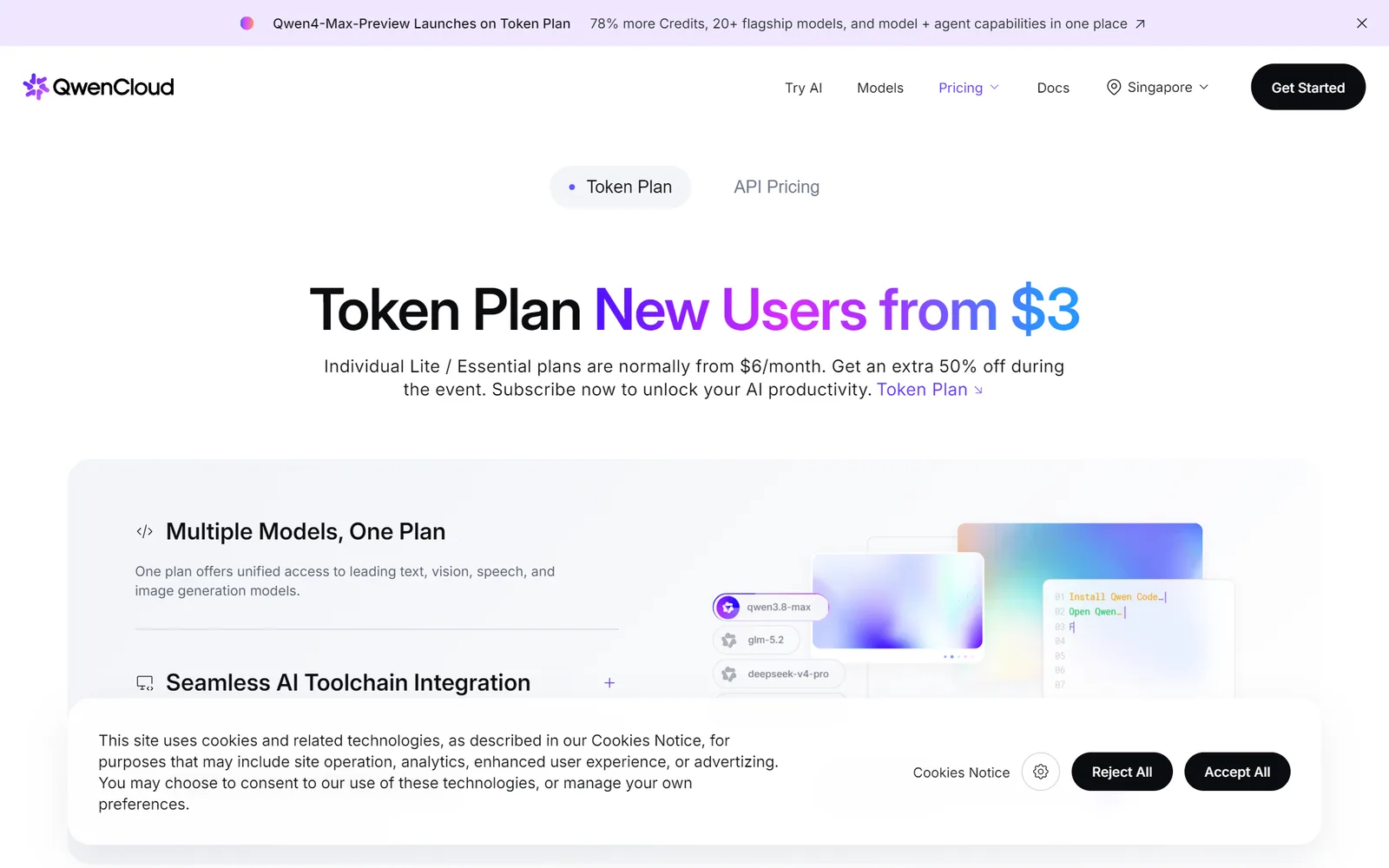
The Token Plan page as captured on launch day. Individual, monthly, launch prices: Lite $3 against a regular $8, Essential $5 against $16, Standard $18 against $25, Pro $43 against $51. The page also has Team tabs and Quarterly and Yearly toggles that lower the effective monthly price, and Alibaba notes the checkout price after login is the one that counts.
What moves and what does not
A migration is not a find-and-replace. Four things change, three do not.
What changes:
- The model id.
qwen3.8-maxorqwen3.8-max-0902-uncensored:freebecomesqwen4-max, and the preview idqwen4-max-previewis a different string that may not behave like the launch id. Confirm the exact id in the Qwen Cloud console. - The bill shape. If you move from our gateway to Qwen Cloud directly, you move from per-token metering to either Qwen Cloud list rates or Token Plan credits. Two different accounting systems, and the credits one has no published burn rate.
- The cache economics. Implicit caching at $0.075 per million is 70% below the 3.8 generation’s $0.25, which changes the value of stable prefixes in agent loops. Our prompt caching guide explains the mechanic; the rate is Alibaba’s.
What does not:
- The context window. Both are 1M class. Your chunking and retrieval discipline from the 1M context guide still applies, including the part about testing recall at the depths you actually use.
- The protocol. Qwen4-Max speaks OpenAI-compatible and Anthropic-compatible endpoints per the Token Plan tools list, so clients, SDKs and the wiring in our coding tools post carry over with a base URL swap.
- The reasoning toggle. This is a reasoning model, so the thinking-mode pattern in our reasoning docs applies, and thinking tokens count against your budget the same way.
Migration checklist
Run this before you cut a production agent over:
- Re-run your own evals on the new id. Vendor tables are hypotheses. Your tasks are the measurement.
- Pin the exact id in code and config, and log the model field from responses so a silent id swap shows up in metrics.
- Test video input explicitly if you send frames. Published modalities are text and image on Qwen4-Max, text, image and video on 3.8 Max.
- Budget output, not just input. The new generation’s docs list roughly 390,000 tokens of max output, which is headroom, not a target. Long-generation tasks truncate silently at any ceiling.
- Meter one week on credits before choosing a Token Plan tier. Lite’s 20,000 credits and Pro’s 200,000 are meaningless until you know your burn rate.
- Keep a fallback route. The free lane and the standard 3.8 listing are live now. A preview-generation model can change rate limits, snapshots or ids without notice.
- Watch the 429s. Rate limits for the new id are not published; start conservative on concurrency and raise after a week of success data.
Our own launch artwork from preview week, kept here because the message is still the operating truth: the free lane runs the 3.8 generation, and Qwen4-Max is queued. The cheapest route to the new model today is the Token Plan, not a free key.
What Artificial Analysis, LMArena and the community are saying
As of 2026-11-16 there is no independent confirmation of the sweep. Artificial Analysis has no Qwen4-Max row, LMArena has no Qwen4-Max row, and benchlm.ai documents exactly that gap: no source-displayable benchmark rows yet, evidence gaps listed plainly. The generational-delta claims in this post are therefore Alibaba’s claims, transcribed, not replicated.
What the community conversation actually contains:
- The launch thread from the verified Alibaba Qwen account with the capability direction and the pricing.
- Launch-week reporting on the Qoduck mystery model, a free stealth model in Qoder that people guessed was Qwen4 and that remains unconfirmed.
- OrcaRouter’s naming piece on the family structure: Max shipped, Flash, Plus and 27B are names without release dates.
- The Cellcog release tracker listing the preview on the Token Plan plus early access inside QwenWork, Qoder, the Qwen app and QwenStudio.
The useful takeaway is not that the community has scored the model. It has not. The useful takeaway is that nobody independent has contradicted the sweep either, because nobody independent has run it. That is the same position the 3.8 generation was in during its preview week, and it resolved the same way: with metered evidence, not with launch tables.
Mistakes to avoid
- Migrating on one benchmark row. The 18.8-point Agents’ Last Exam jump is the biggest number on the sheet and the least like your workload. Run your own tasks.
- Comparing list price to gateway price. Alibaba’s cut is 25% against its own list. Our 3.8 price is already far under list, so the gateway-side savings are different math.
- Assuming video parity. Published modalities for Qwen4-Max are text and image. Video-in is a 3.8 Max feature on our board.
- Forgetting the id drift.
qwen4-max,qwen4-max-preview,qwen3.8-max,qwen3.8-max-0902: four strings, three behaviors. Pin and log. - Treating credits as tokens. No published burn rate means no per-call cost on the Token Plan. Measure yours before committing to a tier.
- Dropping the fallback. Preview generations move: snapshots swap, limits change, ids rename. Keep the 3.8 route warm until the new one earns its place.
FAQ
Is Qwen4-Max better than Qwen3.8-Max-0902?
On Alibaba’s published table, yes, on all sixteen rows, with the biggest gains in agentic and professional work. There is no independent replication yet, and the 0902 column is the dated snapshot as labeled by the vendor.
Is Qwen4-Max cheaper than Qwen3.8-Max?
At Alibaba’s list rates, yes: 25% off input and output, 70% off cached input. Through our gateway the question is open, because Qwen4-Max is not listed here yet and Qwen3.8 Max already runs below Alibaba’s Qwen4 list price.
Will Qwen4-Max replace Qwen3.8 Max on One AI API Key?
We do not replace listings on launch hype. Qwen4-Max is queued; when it passes the same live checks every model passes, it gets a listing with a published rate and per-key limits. The 3.8 listing and the free 0902 lane stay until traffic says otherwise.
What is the max output of Qwen4-Max?
Alibaba’s developer docs list roughly 390,000 tokens of output inside the 1M window, against 128,192 on our 3.8 Max listing. For long-generation agents that ceiling is the more important half of the spec.
Does the 1M context window change?
No. Both generations publish a 1,000,000-token window. The quality of recall across that window is a separate question, and the context window post covers the chunking patterns that keep it honest.
What about the free 0902 uncensored lane?
Unchanged. It stays free at $0 against the daily allowance, or flat $$25 a month on the Unlimited plan with no daily cap. It is a different product from the new flagship: uncensored and free versus flagship and metered.
Should I migrate this week?
Only if your workload matches the rows that moved most and you can run your own evals. Otherwise wait for the listing here, where the price will be metered and the id pinned.
The bottom line
Qwen4-Max is the clean generational step the 3.8 line promised: sixteen of sixteen rows up on the vendor’s own table, a 25% list-price cut, caching down 70%, and a published output ceiling roughly triple the old one. None of it is independently confirmed, the video-input question is open, and the credits math has no published burn rate. The rational move this week is to keep running Qwen3.8 Max on our gateway, where the metered price already undercuts the new model’s list, queue Qwen4-Max for the moment it lands, and migrate on your own evals rather than on a sweep you did not run.
Keep reading
- Qwen4-Max benchmarks, explained — the full six-model table behind the delta above
- Qwen4-Max vs Claude Opus 5.5 — the Elo-board comparison
- Qwen4-Max vs GPT-6.1 Sol — the value-flagship comparison
- Qwen4 Max Preview: free, pricing, providers and specs — the launch-day master post
- Qwen4 Max Preview context window guide — chunking and truncation patterns at 1M
- Qwen3.8 Max 0902 Uncensored, free — the free lane this model succeeds
- Qwen4 Max Preview family and local 27B — the rest of the Qwen4 family tree
More Qwen4-Max coverage
The Fable comparison, added 2026-11-16:
The rest of the cluster, and the pages every comparison links back to:
- Qwen4-Max 1M context guide: what a million tokens holds, and the chunking that keeps it honest
- Qwen4-Max API pricing: every rate, the $43 Token Plan Pro and what a call actually costs
- Qwen4-Max API quickstart: the id, the base URL, streaming, max_tokens and the $43 plan
- The cheapest way to run Qwen4-Max: free routes checked, and the $3 plan that beats them all
- Run Qwen4-Max in your coding agent: base URL, model id, concurrency tiers and budget guards
- Qwen4-Max prompt caching: the $0.075 implicit cache, break-even math and cache-break probes
- Qwen4-Max vision and video benchmarks: what native vision actually scores against GPT-6 Astra and Opus 5.5
- Qwen4-Max vs every flagship launched this quarter: the full scoreboard, price per million and who serves what
- Qwen4-Max vs Gemini 4 Argon: multimodal routes, 1M context and what each actually costs
- Qwen4-Max vs GPT-6.1 Sol and GPT-6 Astra: benchmarks, pricing and the split
- Qwen4-Max vs GPT-6 Astra: sixteen benchmarks, the price gap and where each model wins
- Qwen4-Max vs Grok 4.7: flat flagship prices against the 2x long-context surcharge
- Qwen4-Max vs Kimi K3: sixteen benchmarks, terminal coding and the price per million tokens
- Qwen4-Max vs Claude Opus 5.5: sixteen benchmarks, token prices and the honest split
- The model catalogue
- The model comparison tool
- API pricing and plans
- The cost calculator
- Live rankings and throughput
- The changelog