Qwen4 Max Preview is Alibaba’s new flagship model, live since November 11, 2026 on the Qwen Cloud Token Plan from $3 a month for new users. There is no confirmed free API tier for it yet. The official playground’s free tokens cover older models, and Qoder’s Qoduck free window closed this morning. Below: why everyone is talking about it, the published specs, the real pricing, a factual comparison against the other flagships launched this month, the free routes that still work, and the code to call it.
We run an LLM gateway, so we check the provider’s live model list before the announcement thread. Every price and page here was checked live on 2026-11-11, and we label which numbers are Alibaba’s, which are other vendors’ published rates, and which are community reports.
What is Qwen4 Max Preview?
It is the preview of the next generation after Qwen3.8, and the top tier of it. The Qwen team’s official X account put it this way: “Qwen4 is coming. Deeper knowledge. Richer world understanding. Stronger coding and agentic capabilities.” The same post says Qwen4-Max is in preview on the Token Plan, aimed at complex coding, knowledge work and front-end builds.
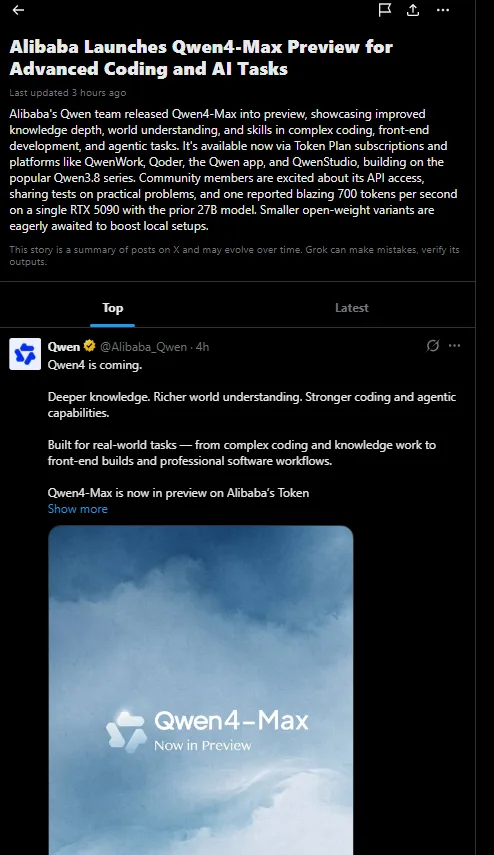
If you have used the Qwen3.8 Max model page for coding or long documents, or the open-weight Qwen3.8 27B for cheap bulk calls, this is the tier above both. Release-date tracker Cellcog lists the preview on the Token Plan plus early access inside Alibaba’s own apps: QwenWork, Qoder, the Qwen app and QwenStudio. The API route, the one you call from your own code, is the Token Plan.
OrcaRouter’s launch analysis frames Qwen4 as a four-tier family: Max, Flash, Plus and a 27B variant. Only Max has shipped, described there as a 15-day preview; the other three are names without a release date. That matches Alibaba’s pages, which show one preview id and no family rollout yet. “Qwen4” today means this single Max preview, not a full lineup.
Cellcog also traces the design to Qwen3.8-Flash-Next, an open-weight mixture-of-experts model previewed in late August with 125B total parameters and roughly 6B active. Read that as lineage, not a spec sheet for Max: it says the family is moving toward sparse MoE with long-context machinery, but tells you nothing about Max’s window, speed or price, none of which are published.
One name to keep straight: QwQ-Max-Preview is not Qwen4-Max-Preview. QwQ is Alibaba’s earlier reasoning-preview line. SourceForge’s comparison page lists QwQ-Max-Preview as a separate, free model slated for an Apache-2.0 open-source release with no API, and still calls Qwen4 “currently in training”. That is out of date: Qwen4 Max Preview went live on the Token Plan on November 11. Any table calling Qwen4 still in training was written before this week.
Two cautions. This is a preview of a proprietary flagship: no model card, no open weights, no benchmark table. And the Grok summary above the official post in that screenshot mixes confirmed facts with community reports. The Token Plan preview is confirmed by Alibaba’s pages; the app list and speed figures are leads, not specs.
Why is there so much hype around Qwen4 Max Preview?
Four reasons, and only some are about the model itself.
It is the flagship tier, and the last one was already good. Qwen3.8 Max earned a reputation for long-context coding at a fraction of Western flagship prices. A generation jump above that, pitched at agentic coding and front-end builds, is the upgrade path many agent builders waited for. Alibaba’s “stronger coding and agentic capabilities” targets the hottest workload in the market.
The price is the story. Flagship reasoning models elsewhere bill per token at rates that make long agent runs expensive. Alibaba opened Qwen4 Max Preview behind a $3 launch subscription with an 80% off tag. Even if credits are not tokens, that entry price reframes what flagship access costs, and it is why “Qwen4 Max Preview free” and “Qwen4 Max Preview pricing” are trending this week.
The stealth-model buzz. Qoder ran a mystery model called Qoduck free for four days (more below). A free stealth flagship from Alibaba during Qwen4 launch week sent people hunting for a free Qwen4 API, and the guess that Qoduck was Qwen4 spread fast. The hype is real even though the connection is unconfirmed.
The architecture promises efficiency. The Flash-Next lineage (sparse MoE, ~6B active of 125B) is the trick that made fast, cheap long-context models possible. If Max inherits it, the speed and cost hype has a technical basis, not just marketing.
The honest counterweight: none of this is a measured result yet. Alibaba has published no benchmark table for Max, so “deeper knowledge” and “stronger coding” are vendor direction, not scores. Treat the excitement as a reason to test it on your own tasks, not to migrate production today. Our rankings page tracks real gateway throughput for the models we serve, the evidence we wait for before calling a model great.
Qwen4 Max Preview specs: what Alibaba has published
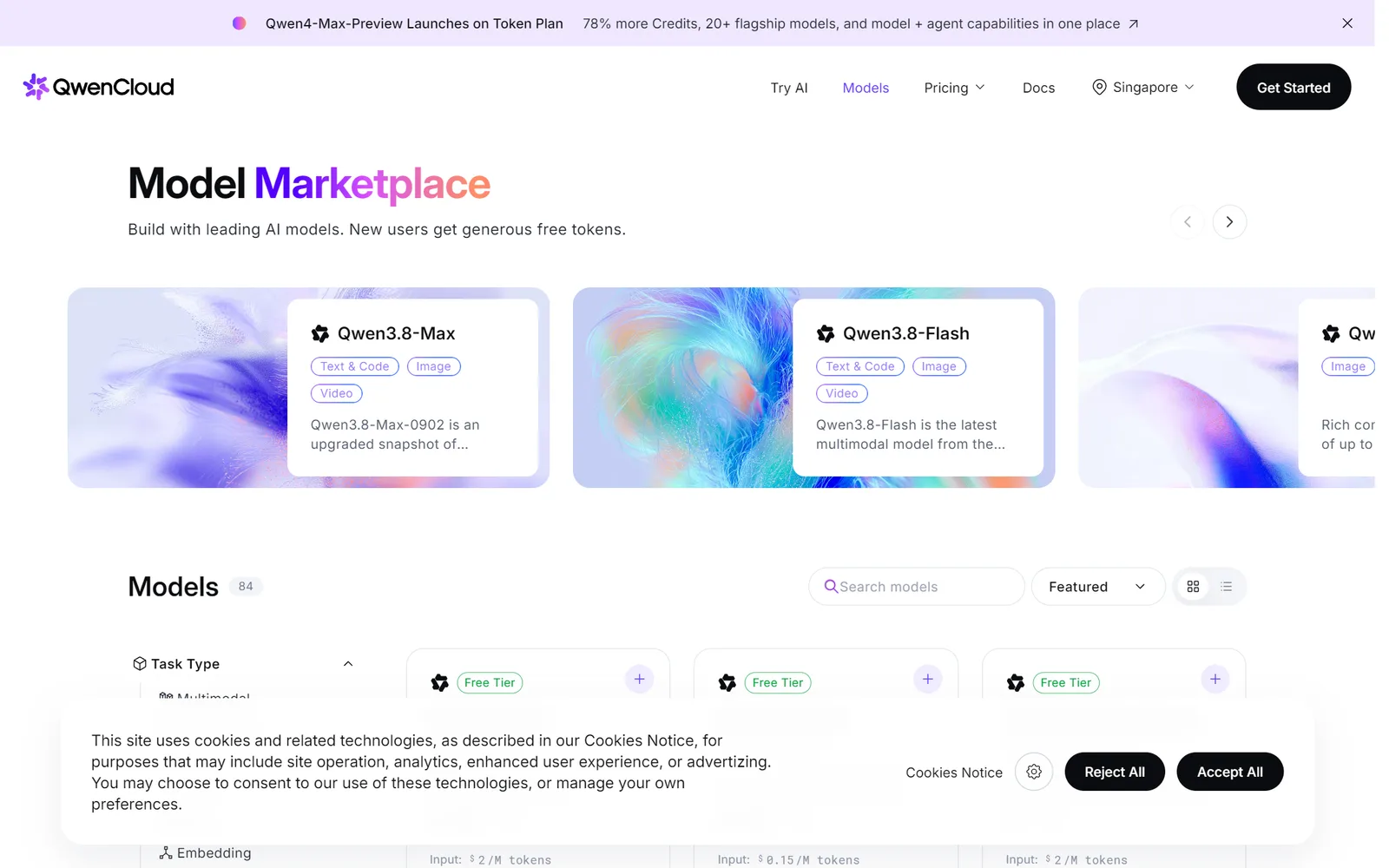
The launch banner on the Qwen Cloud Model Marketplace reads “Qwen4-Max-Preview Launches on Token Plan”, and the Token Plan’s supported-models table lists the exact id: qwen4-max-preview. That table is the most detailed official spec sheet in existence.
| Spec | Published value |
|---|---|
| Model id | qwen4-max-preview |
| Capabilities | Text generation, reasoning, visual understanding |
| Context window | Not published |
| Max output | Not published |
| Open weights | No |
| API access | Token Plan subscription only, no pay-as-you-go rate |
| Protocols | OpenAI and Anthropic compatible, per the Token Plan tools list |
| Launch offer | Tagged “Limited-Time 80% Off” inside the Token Plan |
The context window is the gap that matters most. The Qwen3.8 generation ships a 1M token window, and the open-weight Qwen3.8 27B is the model behind the 700 tokens per second on an RTX 5090 figure circulating on X. That speed belongs to the small open model, not Max. Do not assume the preview inherits either figure until Alibaba prints them. Chunk long inputs defensively and watch for truncation on your longest prompts.
Third-party walkthroughs fill the gap with guesses, so label them as such. apidog’s guide shows a sample client defaulting max_tokens to 32,768 with a 983,616-token context in its config. Those are one integrator’s defaults, not an Alibaba spec: the official window and max output are unpublished, and a config value is not a vendor limit.
“Visual understanding” means the model accepts images, so plan payloads as for any vision-capable endpoint. It is listed as a reasoning model, which usually means a toggleable thinking mode, the pattern in our reasoning docs. Expect tool calling, since Alibaba markets the Token Plan at concurrent agents, but the per-model tool schema is unpublished too.
“Preview” also means moving target: Alibaba can change rate limits, swap the snapshot or rename the id without notice. The 3.8 generation shows the pattern, with qwen3.8-max and a dated sibling qwen3.8-max-0902 that behave differently. Pin the exact id, log the responses you care about, and re-run evals after any announcement.
How much does Qwen4 Max Preview cost?
Here is the part most coverage gets wrong. Qwen4 Max Preview has no per-token price. You reach it through the Qwen Cloud Token Plan, a monthly subscription granting credits usable across 20+ models. During the launch event new users get Lite for $3 a month. The banner advertises regular entry pricing from $6, while the monthly Lite card lists $8, so $3 is the deepest discount on the page. The plan claims 78% more credits than the previous generation.
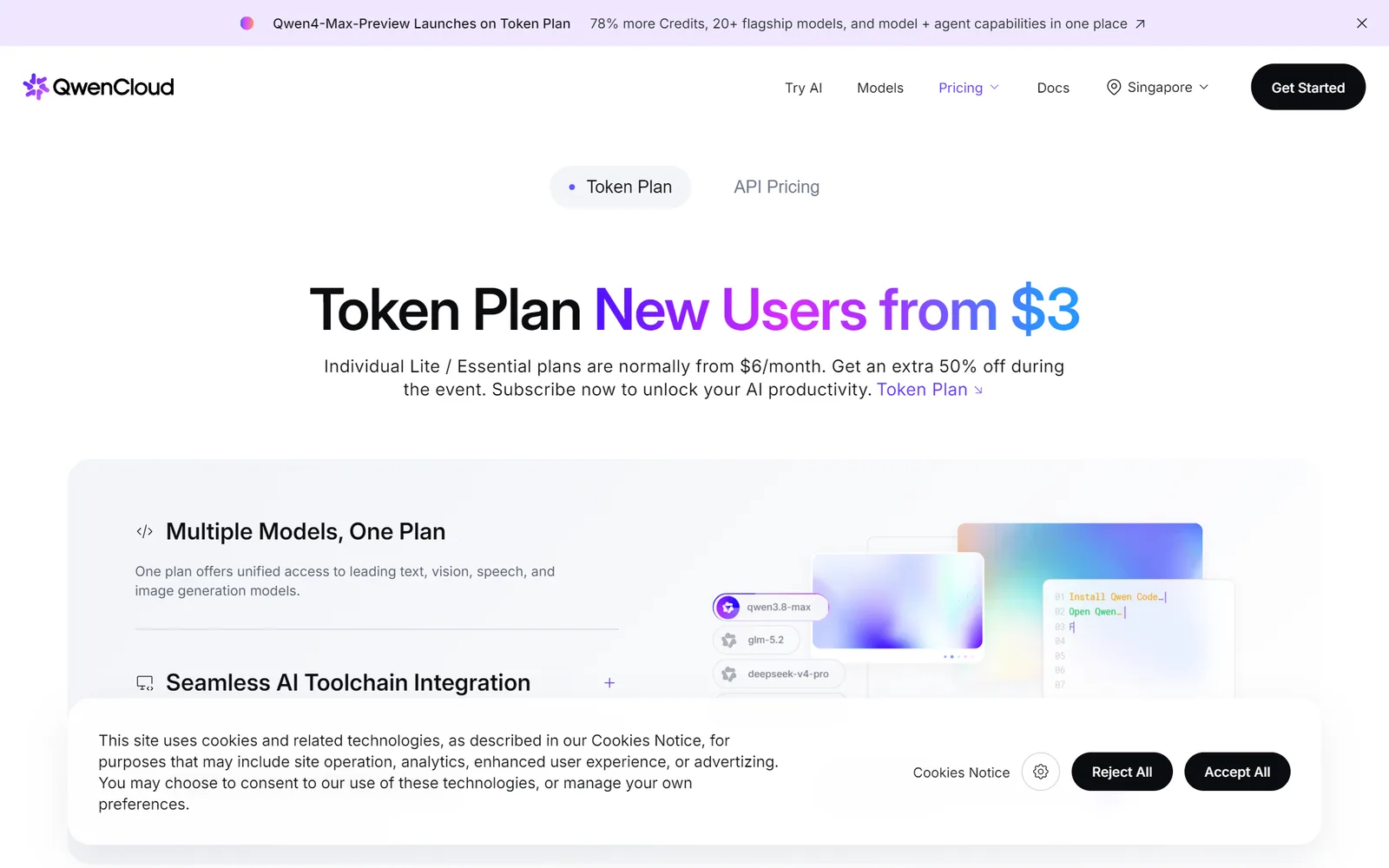
| Plan (individual, monthly) | Launch price | Regular price | Credits / month | Concurrent agents |
|---|---|---|---|---|
| Lite | $3 | $8 | 20,000 | 1–2 |
| Essential | $5 | $16 | 45,000 | 2–3 |
| Standard | $18 | $25 | 80,000 | 3–4 |
| Pro | $43 | $51 | 200,000 | 6–8 |
For $3 you get 20,000 credits and the model list that includes qwen4-max-preview with its 80% off tag. Cheap for flagship access. The catch: credits are not tokens. The plan page does not publish how many credits each model burns per call, so run your own workload for a week before choosing a tier. Our cost calculator and how to estimate your monthly LLM API cost show the math for token-billed APIs; the same discipline applies here.
A concrete example. A coding agent sending 8,000 input tokens and receiving 2,000 output, fifty times a day, is half a million tokens a day. On Alibaba’s pay-as-you-go qwen3.8-max rates that is about $1.40 a day, or $42 a month. The $3 Lite plan caps you at 20,000 credits instead, and the 80% off tag stretches them. If your month fits the quota, the subscription wins by an order of magnitude; if not, you get nudged to the $18 Standard tier. Measure first.
Compare pay-as-you-go. Alibaba’s API pricing page lists qwen3.8-max at $2 per million input tokens and $6 per million output, cached input $0.25. Qwen4 Max Preview is absent from that table, confirming it is subscription-only for now. If a per-token rate appears later, expect it above the 3.8 tier, the way qwen3.7-max ($2.5 / $7.5) sits above qwen3.7-plus.
| Route | Input $/M | Output $/M | Cached input $/M |
|---|---|---|---|
| qwen3.8-max, Alibaba pay-as-you-go | $2.00 | $6.00 | $0.25 |
| qwen3.8-max, One AI API Key | $0.577 | $1.73 | $0.25 |
| qwen4-max-preview | Token Plan credits only, from $3/month |
The page has Individual and Team tabs and Monthly, Quarterly and Yearly toggles; the table above is Individual monthly launch prices. Longer terms lower the effective monthly price, and Alibaba notes the checkout price after login is the one that counts. Some models carry “40% Off Nights” tags, and prompt caching drops repeated input to a fraction of the rate. Check the discounted models list and our published rate table before committing to any subscription.
How Qwen4 Max Preview compares to other new flagships
The launch lands in a crowded month. Google announced Gemini 4 Carbon on October 28, and Gemini 4 Argon, GPT-6.1 Sol, Grok 4.7, Claude Fable 5.1 and Claude Opus 5.5 all arrived within the last eight weeks. Here is the honest side-by-side. Every served-model number comes from the One AI API Key catalog, checked 2026-11-11. Gemini 4 Carbon’s numbers come from Google’s announcement and OpenRouter; it is not on our gateway yet. Qwen4 Max Preview has no published context window or per-token price, so its cells say that rather than guess.
| Model | Context | Input | List $/M (in / out) | One AI API Key $/M (in / out) |
|---|---|---|---|---|
| Qwen4 Max Preview | Not published | Text, image | Token Plan only, from $3/mo | Coming soon |
| Gemini 4 Carbon | 1,048,576 | Text, image | $2 / $10 | Not served yet |
| Gemini 4 Argon | 1,000,000 | Text, image, audio, video | $2 / $10 | $0.525 / $2.625 |
| Claude Fable 5.1 | 1,000,000 | Text, image | $10 / $50 | $7 / $35 |
| GPT-6.1 Sol | 1,050,000 | Text, image | $2 / $10 | $0.7 / $3.5 |
| Claude Opus 5.5 | 1,000,000 | Text, image | $4 / $20 | $2.8 / $14 |
| Grok 4.7 | 500,000 | Text, image | $2 / $6 | $1.4 / $4.2 |
| Qwen3.8 Max | 1,000,000 | Text, image, video | $2 / $6 | $0.577 / $1.73 |
List prices are the vendor’s official per-token rate; the One AI API Key column is what we charge, below list on every served row. Grok 4.7 bills every token at 2x once the prompt passes 200K tokens, so its 500K window is not flat-rate. The regularly priced Fable is 5.1 at $7 / $35 against a $10 / $50 list.
Three things stand out. On price, the cheapest flagship per-token rates here are Qwen3.8 Max and Grok 4.7 at $2 / $6 list; Argon, Carbon and GPT-6.1 Sol sit at $2 / $10; Opus 5.5 is $4 / $20 and Fable 5.1 is $10 / $50. Qwen4 undercut them all on entry cost with a $3 subscription, but you cannot compare a credit quota to a per-token rate until Alibaba publishes the burn rate. On context, everyone except Grok is at roughly 1M tokens, and Qwen4 is the only one that has not said. On modalities, Gemini 4 Argon is widest with text, image, audio and video; Qwen3.8 Max adds video; most others take text and image.
This table compares access and price, not quality: no model has a published head-to-head benchmark against Qwen4 Max Preview. For a measured pick today, our side-by-side model comparison and choosing a model for coding agents walk the trade-offs on models we can meter. When Qwen4 lands here, it joins the same table with a real rate.
Is there a free Qwen4 Max Preview API?
Not today, and this is where the internet is currently wrong. We checked every free route we could find on 2026-11-11.
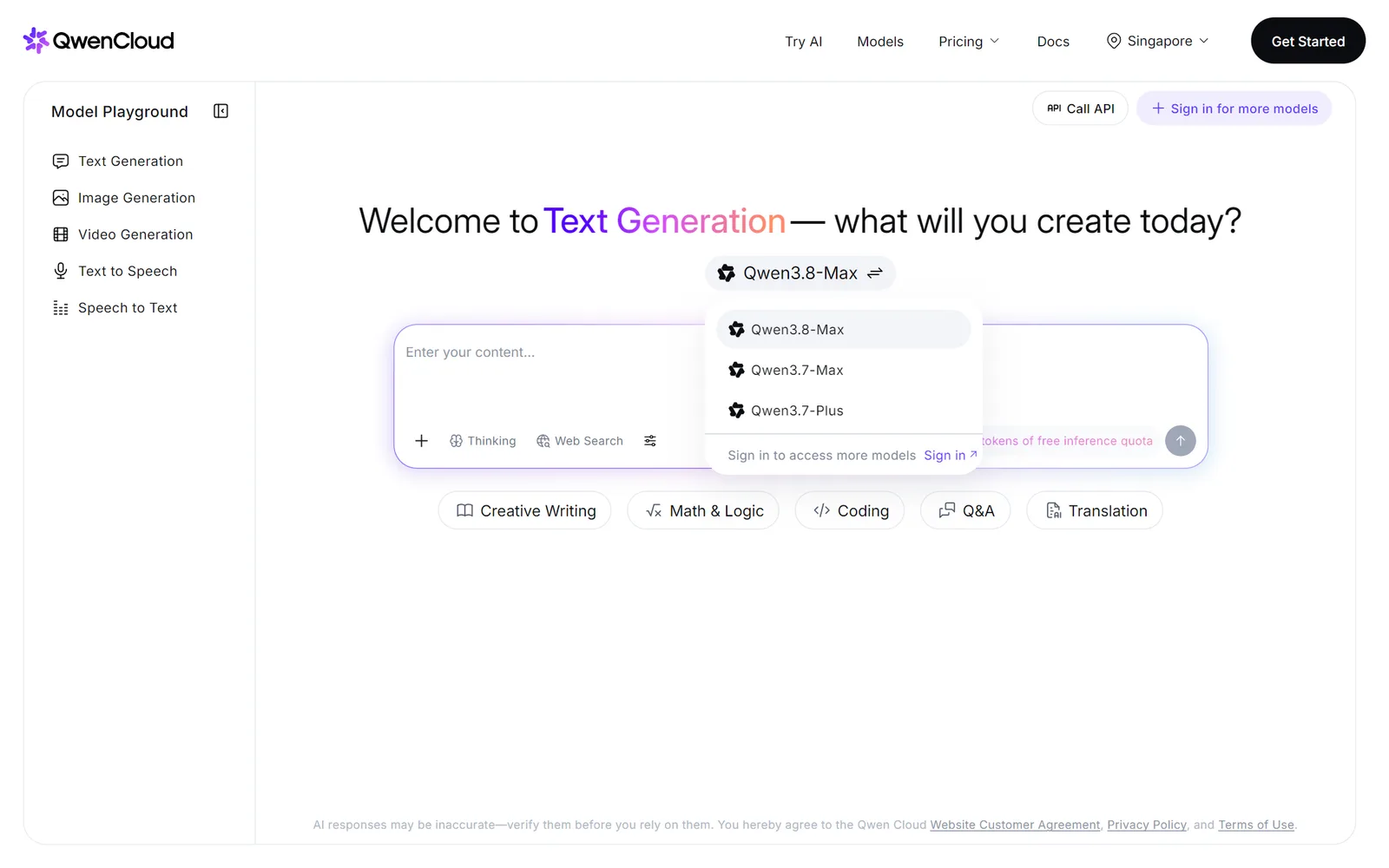
The official playground gives 1M free tokens, but not for this model. Qwen Cloud’s Try AI playground offers “1M tokens of free inference quota” after sign-in, and its Call API panel hands you a working base URL and key. We opened the picker: Qwen3.8-Max, Qwen3.7-Max and Qwen3.7-Plus, with a “Sign in to access more models” gate. Qwen4 Max Preview is not in the anonymous list, and Alibaba markets it as a Token Plan launch, so do not count on the free quota covering it. The Call API panel shows the exact endpoint and sample code for whichever model you pick, so it doubles as a quick integration reference.
OpenRouter does not have it yet. We pulled OpenRouter’s live Qwen catalog and found no qwen4 ids at all, free or paid. That may change within days, but today there is nothing to call. Our OpenRouter comparison covers how the two gateways differ once a model lands on both.
| Free route | What you get | Qwen4 Max Preview? | Status 2026-11-11 |
|---|---|---|---|
| Qwen Cloud playground | 1M tokens after sign-in | Not in the picker | Works for 3.8 / 3.7 models |
| Qoder Qoduck promo | Daily free uses, 0.0× credits | Unconfirmed identity | Window closed Nov 11, 07:30 IST |
| OpenRouter | :free variants |
No | No qwen4 ids in the live API |
| One AI API Key free lane | 100 requests/day, $0 | Coming soon | Live for qwen3.8-max:free |
The practical free play today is the Qwen3.8 generation. On our free models lane, qwen3.8-max:free and qwen3.8-max-0902:free let you call the flagship from the $10 sign-up credit, inside a shared allowance of 100 requests a day that refills at 00:00 UTC. No card required; the rate limits docs spell out the caps. For a model that stays $0 after the credit runs out, qwen3.8-27b:free bills zero per token and keeps its daily requests, the same open-weight 27B behind the RTX 5090 speed reports.
Start free on One AI API Key while Qwen4 Max Preview is queued
$10 sign-up credit, 100 free-lane requests a day, no card. Your key keeps working when Qwen4 Max Preview lands, so the upgrade is one model-id change.
You can check any provider yourself in under a minute: most aggregators publish a live model list endpoint, OpenRouter’s is /api/v1/models. If the id is not in the live list, the marketing page does not matter. Bookmark the endpoint and re-check the morning you plan to ship.
Whatever free endpoint you use, assume your prompts are logged and may be used for training. Keep keys and customer code off free tiers, and read API key security for AI apps before pasting a key into any third-party tool.
Qoduck: the free stealth model whose window just closed
If you searched “Qwen4 free API” this week, you probably landed on Qoduck. Qoder, Alibaba’s agentic coding product, ran a stealth model named Qoduck from November 7 to November 11, 2026 at 10:00 UTC+8 (07:30 IST). Within a daily free allowance, calls consumed no credits: the rate dropped from 0.5× to 0.0×, even at the highest thinking intensity. Paid subscribers got more free uses per day, and the allowance reset daily. Past it, Qoduck billed at its standard 0.5× rate.
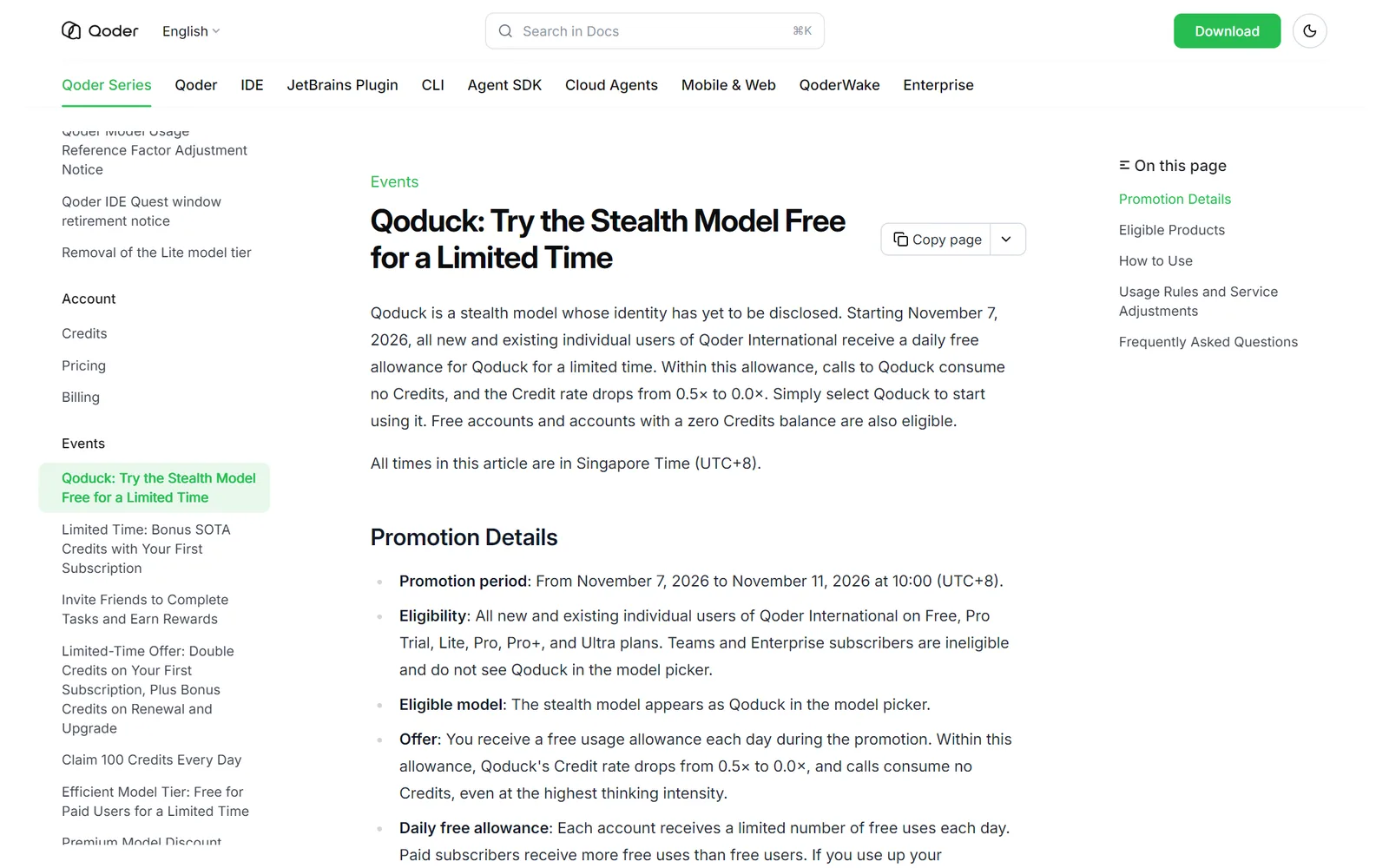
The eligibility rules were narrow. Individual Qoder International accounts on Free, Pro Trial, Lite, Pro, Pro+ and Ultra qualified; Teams and Enterprise never saw Qoduck in the picker. It did not cover Qoder IDE, the JetBrains plugin or Qoder CLI, and the docs say Qoduck is removed when the promotion ends. The window has closed, so treat any “Qoduck free” tutorial you find today as expired.
Is Qoduck Qwen4? Officially, nobody knows. Qoder calls it “a stealth model whose identity has yet to be disclosed” and asks users to judge it on their own tasks. The community connects it to Qwen4 because Qoder is Alibaba’s and the timing lines up with launch week; Cellcog lists Qoder among the early-access platforms. A reasonable guess, not a confirmation. Nothing about Qoduck was an API offer: no base URL, no key, no model id you could call from code. It was a free taste inside one product, and it is over.
How to get an API key and call qwen4-max-preview
The official route takes about five minutes. Alibaba’s docs confirm the OpenAI-compatible endpoint, and the Token Plan FAQ describes the same flow:
- Subscribe to the Token Plan on the pricing page. Lite at $3 is enough to start.
- Open the API Keys page in your Qwen Cloud account and copy the base URL and key.
- Point any OpenAI-compatible client at the base URL. Our quickstart shows the pattern and authentication covers the header format.
- Set the model to
qwen4-max-previewand send a chat completions request.
curl https://ap-southeast-1.maas.qwencloudapi.com/compatible-mode/v1/chat/completions \
  -H "Authorization: Bearer $QWEN_API_KEY" \
  -H "Content-Type: application/json" \
  -d '{
    "model": "qwen4-max-preview",
    "messages": [{"role": "user", "content": "Refactor this function for readability."}]
  }'
Prefer Python? The official SDK pattern works unchanged, since the endpoint is OpenAI-compatible. Keep the key in an environment variable, never in the repo:
import os
from openai import OpenAI

client = OpenAI(
    api_key=os.environ["QWEN_API_KEY"],
    base_url="https://ap-southeast-1.maas.qwencloudapi.com/compatible-mode/v1",
)
resp = client.chat.completions.create(
    model="qwen4-max-preview",
    messages=[{"role": "user", "content": "Explain this stack trace."}],
)
print(resp.choices[0].message.content)
A note on the base URL, because sources disagree. The samples above use ap-southeast-1.maas.qwencloudapi.com, the host the live playground’s Call API panel handed us. apidog documents a different host, token-plan.maas.qwencloudapi.com, with an Anthropic-style path at /apps/anthropic, and keys prefixed sb-sp- issued in Singapore. The base URL that matters is the one in your own Qwen Cloud console: copy it exactly rather than trusting any blog, including this one. A 401 means the key is wrong or not on a Token Plan account; a 404 on the model usually means a misspelled id or a plan that excludes it.
One licensing caveat before you build. apidog reads the Token Plan terms as scoped to interactive development, with production automation, batch and background jobs excluded, and credits non-refundable. We have not confirmed that reading against Alibaba’s current terms, and it sits oddly beside Alibaba marketing the plan at concurrent agents. If you plan unattended production agents, read the live license yourself, and keep a metered pay-as-you-go key for anything customer-facing.
The Token Plan officially supports Qwen Code, Cline, Claude Code, Cursor, OpenCode, Codex, Kilo CLI and OpenClaw, over both OpenAI and Anthropic protocols. If you are unsure which protocol your tool speaks, read OpenAI-compatible vs Anthropic-compatible APIs first. Moving an app over is usually a two-line change, covered in switch an OpenAI SDK app to a different base URL.
We keep current setup guides for Claude Code, Cursor, Cline, OpenCode, Codex CLI and Kilo Code; the config generator writes the config file for you. Enable streaming so long reasoning traces arrive token by token, and keep the error codes reference handy: a 429 on a subscription usually means you hit the plan’s concurrency or quota ceiling, not a bug.
Qwen4 Max Preview on One AI API Key: coming soon at the cheapest price
Qwen4 Max Preview is coming to One AI API Key as soon as upstream capacity allows, at the cheapest per-token price we can publish. Same playbook as the 3.8 generation: the day Alibaba’s API opens the model, it goes into the model catalog with a published rate, per-key limits and usage metering. No subscription required.
When it lands, the model gets its own page with the rate, context window and per-key limits, like every other listing. If Alibaba opens a free tier upstream, expect a :free twin in the free lane too. We will note the launch on the status board and in the product updates feed, so you do not have to poll this post.
Until then, the closest thing is already live here. Qwen3.8 Max runs $0.577 per million input tokens and $1.73 per million output, against Alibaba’s $2 / $6 list, with a 1M context window and text, image and video input. Test it in Chat before writing code, check throughput on the rankings page, and watch upstream health on the status board.
For a daily driver, choosing a model for coding agents compares the tiers and the side-by-side model comparison puts prices and windows in one table. Set spend caps per key with cost controls so a runaway agent cannot drain the balance. Create a free account now: $10 sign-up credit, 100 free-lane requests a day, no card. When Qwen4 Max Preview lands, your key already works.
Mistakes to avoid
- Expecting a per-token price. Qwen4 Max Preview is Token Plan only. Budgeting it like
qwen3.8-maxpay-as-you-go will be wrong until Alibaba publishes a rate. - Assuming a 1M context window. That figure belongs to the 3.8 generation. Max Preview’s window is unpublished, so chunk long inputs defensively.
- Confusing it with QwQ-Max-Preview. QwQ is a separate, older reasoning preview with no API. Tables that still call Qwen4 “in training” are stale.
- Building on an expired free promo. Qoduck’s window closed November 11 and the model is removed with it. Query the provider’s live model list before wiring anything into production.
- Pasting sensitive code into free tiers. Free endpoints commonly log prompts for training. Use a paid, metered key for client work.
- Ignoring concurrency caps and license terms. Lite runs one or two agents at once, and the Token Plan may be scoped to interactive development. A ten-agent swarm on a $3 plan produces 429s, not savings.
FAQ
Is Qwen4 Max Preview free?
No confirmed free API tier exists yet. The official playground’s 1M free tokens cover Qwen3.8 and 3.7 models, OpenRouter has no qwen4 ids, and Qoder’s Qoduck free window closed on November 11. The cheapest official access is the $3 Lite Token Plan during the launch event. On One AI API Key it is queued for the free lane; today the free lane runs Qwen3.8 ids.
What is the API model id and base URL?
qwen4-max-preview, called over an OpenAI-compatible base URL with a Token Plan key. The live playground gave us https://ap-southeast-1.maas.qwencloudapi.com/compatible-mode/v1; apidog documents token-plan.maas.qwencloudapi.com. Copy the exact host from your own Qwen Cloud console. It does not appear on the pay-as-you-go pricing page.
What is the context window of Qwen4 Max Preview?
Alibaba has not published it. The Qwen3.8 generation offers 1M tokens, but do not assume the preview matches. apidog’s sample client shows 983,616 tokens and a 32,768 default max output; those are integrator defaults, not official limits. Test your longest prompts and watch for truncation before relying on it.
Is QwQ-Max-Preview the same as Qwen4 Max Preview?
No. QwQ-Max-Preview is a separate Alibaba reasoning preview, listed as free and slated for an Apache-2.0 open-source release with no API. Qwen4-Max-Preview is the new proprietary flagship on the Token Plan. Some comparison pages still describe Qwen4 as “in training”, which was out of date the moment the preview launched on November 11.
How does it compare to Gemini 4 Carbon, Argon and Claude?
On published access and price, not quality. Gemini 4 Carbon and Argon both list at $2 / $10 per million tokens with a 1M window; Claude Fable 5.1 is our priced Claude flagship at $7 / $35. Qwen4 Max Preview is cheaper to enter at $3/month but has no published context window or per-token rate, and no benchmarks against any of them. The comparison table above has the full numbers.
Can I use it in Claude Code or Cursor?
Yes. The Token Plan supports Claude Code, Cursor, Cline, OpenCode, Codex, Kilo CLI, Qwen Code and OpenClaw over OpenAI and Anthropic protocols. Enter the base URL and key in the tool’s provider settings; our setup guides show the exact fields.
When does it leave preview, and when is it on One AI API Key?
No general availability date is published; Cellcog’s tracker lists the same gap, along with unreleased weights and family members, and OrcaRouter describes a 15-day preview window. On our side it is queued as a coming-soon model at the lowest per-token rate we can offer, with no date promised. Meanwhile Qwen3.8 Max is live at $0.577 / $1.73 per million tokens. More answers live in our FAQ.
The bottom line
Qwen4 Max Preview is the most interesting flagship launch of the week because of what it does to price, not because of unpublished benchmarks. If you need it now, buy the $3 Lite Token Plan and test your workload against the credit quota before scaling up. If you can wait, run Qwen3.8 Max cheaply on One AI API Key today and switch when per-token access opens. Create a key now so the upgrade is one model-id change, not a migration.