“Visual understanding” is one line in Alibaba’s spec table and a whole quadrant of the launch benchmarks. Qwen4-Max takes text and image input natively, and the launch table scores it on four multimodal-flavored rows: BioMysteryBench, HealthBench Professional, Chartography and Video-Index. The split result is the story. Qwen4-Max leads BioMysteryBench at 85.0, sits mid-pack on HealthBench Professional at 60.0, and trails the visual reasoning rows: Chartography 54.2 against GPT-6 Astra’s 71.1, Video-Index 68.1 against Astra’s 76.7.
So the honest version of “native vision” is: the model sees, it reasons over bioinformatics imagery better than the published field, and it is not the model you buy for charts or video. This post is the multimodal angle: the four rows, the modality trap, the API shape, and what the community has actually run.
The four multimodal rows, in context
All scores from Alibaba’s launch table, transcribed in full in Qwen4-Max benchmarks, explained:
| Benchmark | What it measures | Qwen4-Max | Qwen3.8-Max-0902 | Opus 5.5 | GPT-6.1 Sol | GPT-6 Astra | Kimi K3.1 |
|---|---|---|---|---|---|---|---|
| BioMysteryBench | Bioinformatics research | 85.0 | 84.1 | 81.9 | 84.4 | 78.9 | 80.6 |
| HealthBench Professional | Clinical reasoning | 60.0 | 39.6 | 59.9 | 65.1 | 66.0 | 57.2 |
| Chartography | Visual chart understanding | 54.2 | 42.0 | 66.3 | 67.8 | 71.1 | 50.0 |
| Video-Index | Video understanding | 68.1 | 63.2 | 74.8 | 73.8 | 76.7 | 63.2 |
BioMysteryBench is the win. Qwen4-Max’s 85.0 leads the whole six-model table, 0.9 above its predecessor and 4.4 above Kimi K3.1. Bioinformatics is also the least “vision-board” of the four: it is domain reasoning over biological data, where the model’s training shows more than its pixel pipeline.
HealthBench Professional is the mid-pack row. 60.0 against Astra’s 66.0 and Sol’s 65.1, and a 20.4-point jump over the 0902 snapshot’s 39.6, which is the single biggest gain on the sheet after Automationbench-AA. Clinical reasoning is a domain where being 20 points better than yourself still leaves you third.
Chartography is the gap. 54.2 against Astra’s 71.1, a 16.9-point hole, and only 4.2 above the 0902 snapshot. Reading a chart is not the same as reasoning about a bioinformatics figure, and this row says the model knows that.
Video-Index is the second gap. 68.1 against Astra’s 76.7, 4.9 above the predecessor. And this row carries the modality trap, next section.
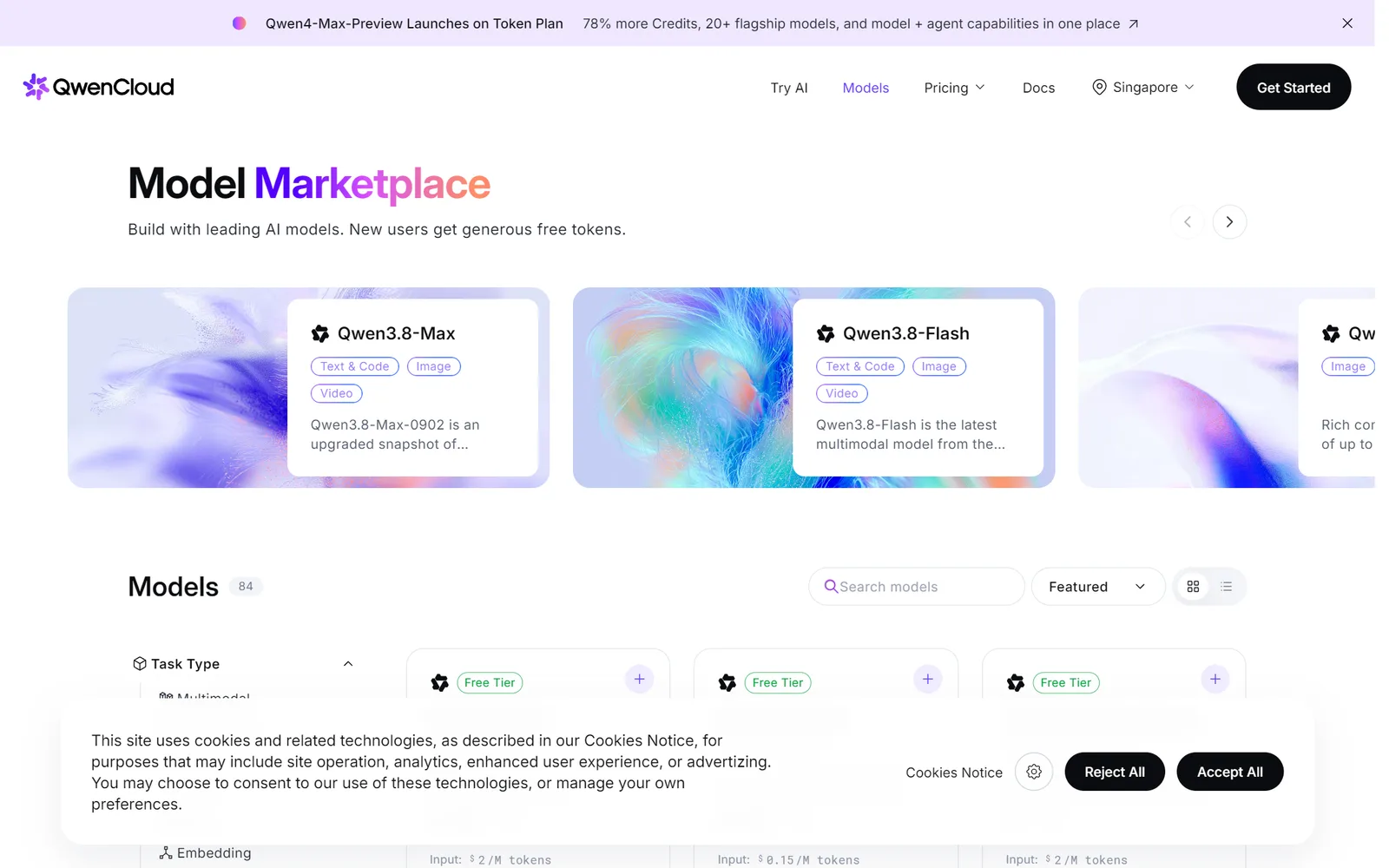
The marketplace banner lists the capability trio: text generation, reasoning, visual understanding. Note the absence: no video input claim. The Video-Index row scores video understanding, which is not the same as accepting video as an input modality, and the spec table says text and image.
The modality trap
Two different claims get merged in most launch coverage, and they are not the same:
- Video understanding, as scored by Video-Index: reasoning over video content, however the benchmark feeds it.
- Video input, as a live API modality: sending frames or a file to the endpoint.
Alibaba published text and image input for Qwen4-Max. Our board lists the previous generation, Qwen3.8 Max, with text, image and video input. So the one modality fact you can bank on is that video-in is a 3.8 feature on our board and an unpublished feature on Qwen4-Max. If your pipeline ships frames, do not migrate on the Video-Index score. Test it first.
The same trap covers the “82 languages” and satellite-image demos in the MindStudio hands-on: naming across languages and reasoning over satellite imagery are demonstrations of what the model does, not specifications of what the API accepts. Treat every demo as a lead, and every payload decision as yours.
Calling the vision API
The compatible endpoint takes OpenAI-style content arrays, so image input rides the same request shape as text:
curl https://ap-southeast-1.maas.qwencloudapi.com/compatible-mode/v1/chat/completions \
  -H "Authorization: Bearer $QWEN_API_KEY" \
  -H "Content-Type: application/json" \
  -d '{
    "model": "qwen4-max",
    "messages": [{"role": "user", "content": [
      {"type": "text", "text": "What does this chart say about latency?"},
      {"type": "image_url", "image_url": {"url": "https://example.com/chart.png"}}
    ]}]
}'import os
from openai import OpenAI
client = OpenAI(
api_key=os.environ["QWEN_API_KEY"],
base_url="https://ap-southeast-1.maas.qwencloudapi.com/compatible-mode/v1",
)
resp = client.chat.completions.create(
model="qwen4-max",
messages=[{"role": "user", "content": [
{"type": "text", "text": "Read the labels and the trend in this image."},
{"type": "image_url", "image_url": {"url": "https://example.com/screenshot.png"}},
]}],
)
print(resp.choices[0].message.content)What is not published, and therefore not in the example: how images tokenize, what a page of charts costs in tokens, whether cached input covers repeated image prefixes, and any per-image resolution cap. The vision docs cover the general pattern on our side; Qwen4-Max’s own numbers arrive with the model card that Alibaba has not shipped. Budget image payloads the way you budget long text: meter the first week, assume nothing.
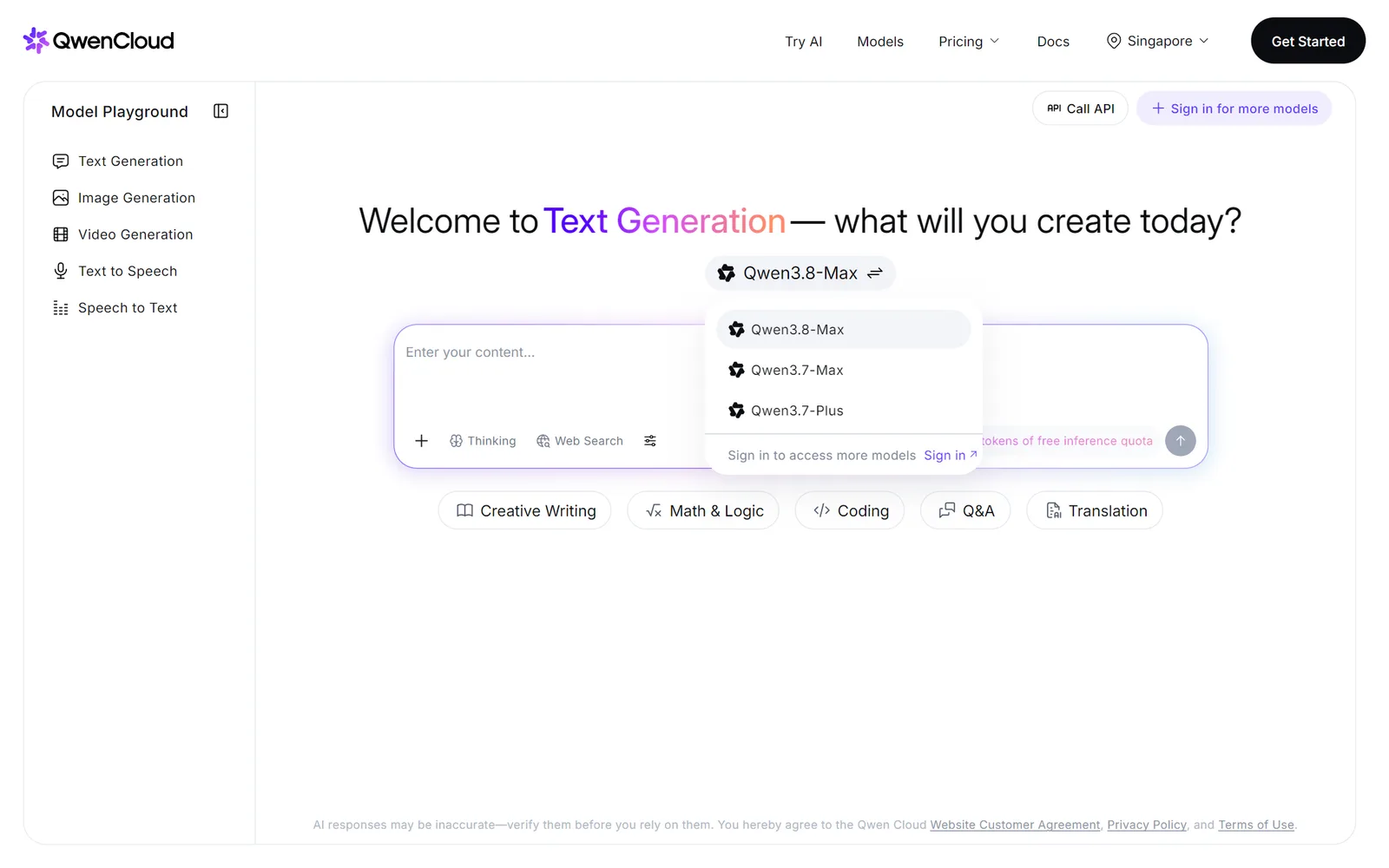
The playground is the cheapest place to run the two calls above against real images before any migration. Its free quota covers older models and gates Qwen4-Max behind sign-in, but the Call API panel hands you a working base URL and key, which is exactly what the vision request shape needs.
What the visual rows say about architecture
Alibaba attributes the generation to a mixture-of-experts design with native vision, and the family post traces the lineage to the sparse MoE lineage of the 3.8 generation’s Flash-Next preview. The benchmark split is consistent with that story: strong on domain imagery where reasoning dominates, weaker on chart reading where visual parsing dominates. That is a hypothesis, not a mechanism, because there is no model card, no open weights and no ablation. It is also the hypothesis to test with your own charts before you route document work at this model.
The safety angle deserves one line: MindStudio’s hands-on includes a visual safety judgment task, and the launch blog’s healthcare and finance use cases imply the same surface. We have no independent safety evaluation of Qwen4-Max. If your workload is uncensored-adjacent, the only free, metered option on our board today is the Qwen3.8 Max 0902 uncensored lane, which is a different model generation with a different capability set.
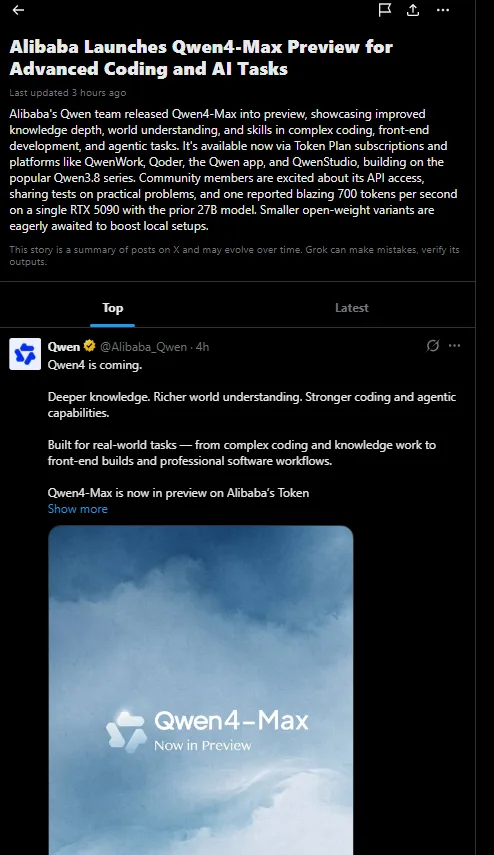
The announcement post. “Richer world understanding” is the line the visual rows put to the test, and the test result is: bioinformatics yes, charts no, video unknown-as-input.
What Artificial Analysis, LMArena and the community are saying
As of 2026-11-16, no independent board carries a Qwen4-Max row. Artificial Analysis and LMArena have not listed it, which means no third-party vision scores, no arena votes, no independent multimodal Elo. benchlm.ai documents the gap directly: no source-displayable benchmark rows yet, evidence gaps listed.
What the conversation contains instead:
- The launch table itself, where the four multimodal rows live, vendor-published.
- MindStudio’s hands-on with animation generation, 82-language naming, satellite image reasoning and a visual safety judgment, which is demonstration-grade evidence.
- The apidog walkthrough, whose 983,616-token context and 32,768 max_tokens are client defaults, not vision specs.
- The Qoduck mystery, which produced zero vision evidence and should stay out of modality decisions.
The community is not wrong to be excited; it is wrong to quote the demo as the spec. The spec is two modalities, four rows, and a 16.9-point hole on the chart row.
When vision routes to Qwen4-Max, and when it does not
Route it here:
- Bioinformatics and scientific figures, where the 85.0 leads the published field.
- Clinical-adjacent triage, where 60.0 is third but 20 points above the prior generation; verify against your own cases either way.
- Document and screenshot understanding inside long agent loops, where the 1M window plus caching at $0.075 beats a smaller window, and where the Agents’ Last Exam lead of 46.7 is the strongest long-horizon signal in the table.
Do not route it here:
- Chart-heavy dashboards, where Chartography says Astra and Sol own the row.
- Video-in pipelines, until video input is published, and where Grok 4.7 or the 3.8 Max listing cover the modality today.
- Anything needing an independent safety score, because none exists.
Vision payload engineering
Native vision means images ride the same request as text, which means the same disciplines apply: stable prefixes cache, variable images do not, and every pixel you send is a token you pay for. Three practices, all yours, none published by Alibaba:
- Pin the image order and the text around it. A stable prefix is what the $0.075 cached rate rewards; a re-ordered image list breaks the prefix.
- Send the image the task needs, not the image you have. Downsample dashboard shots before they go in; a 4K chart read at 1M context is a bill for resolution you did not need.
- Batch by similarity. Same-type images in one call share the prompt overhead; mixed batches do not.
A multi-image call, same shape as the single-image example above:
import os
from openai import OpenAI

client = OpenAI(
  api_key=os.environ["QWEN_API_KEY"],
  base_url="https://ap-southeast-1.maas.qwencloudapi.com/compatible-mode/v1",
)
content = [{"type": "text", "text": "Compare these two charts. Which line fell faster, and by how much?"}]
for url in ("https://example.com/chart-a.png", "https://example.com/chart-b.png"):
  content.append({"type": "image_url", "image_url": {"url": url}})

resp = client.chat.completions.create(
  model="qwen4-max",
  messages=[{"role": "user", "content": content}],
  max_tokens=1024,
)
print(resp.choices[0].message.content)
A chart-reading eval you can run
Chartography is the row Qwen4-Max loses by 16.9 points, so test your own charts before you route dashboard work at it. Ten images from your own product, three questions each (read the value, compare the trend, find the anomaly), score exact-match against the known answers, and repeat at three image orders to catch position bias. The whole eval is an afternoon, and it converts the vendor’s 54.2 into your number.
import os
from openai import OpenAI

client = OpenAI(
  api_key=os.environ["QWEN_API_KEY"],
  base_url="https://ap-southeast-1.maas.qwencloudapi.com/compatible-mode/v1",
)

CASES = [
  ("https://example.com/latency-p99.png", "What was p99 latency on March 12?"),
  ("https://example.com/cost-by-region.png", "Which region cost the most, and by how much over the next?"),
  ("https://example.com/error-spike.png", "Where does the error rate spike, and when?"),
]

for url, question in CASES:
  r = client.chat.completions.create(
      model="qwen4-max",
      messages=[{"role": "user", "content": [
          {"type": "text", "text": question},
          {"type": "image_url", "image_url": {"url": url}},
      ]}],
      max_tokens=256,
  )
  print(question, "->", r.choices[0].message.content)
Log the tokens per call while you run it. That number, divided by your answer accuracy, is the only chart-reading metric that matters for your budget, and no launch table will ever print it.
Video pipelines today
Video understanding is scored (Video-Index 68.1) and video input is unpublished, so video work has three honest homes on our board right now:
- Gemini 4 Argon takes text, image, audio and video input at $0.525 / $2.625 per million, the widest modality set we serve.
- Qwen3.8 Max takes text, image and video input at $0.577 / $1.73, the same family as Qwen4-Max with the published video modality.
- The free lane runs the Qwen3.8 generation at $0 against the daily allowance, video included on the 3.8 Max listing.
None of them is Qwen4-Max. When Alibaba publishes video input for the new id, the migration post gets the update, and the eval you ran on charts transfers to frames.
The safety surface
MindStudio’s hands-on includes a visual safety judgment task, and the launch blog’s healthcare and finance use cases imply the same surface: the model will be asked to look at medical images, legal exhibits and identity documents. None of that has an independent evaluation, and a benchmark row is not a clearance. The operating rules are the same as for any flagship: human review on high-stakes reads, logged prompts for audit, and no clinical or legal output shipped as advice. For uncensored-adjacent visual work, the only free metered route on our board remains the 0902 uncensored lane, a different generation with a different capability set, and our uncensored hub is where those trade-offs are documented.
Mistakes to avoid
- Reading Video-Index as video input. It scores video understanding; the published input modalities are text and image.
- Treating the demo as the spec. Satellite images and 82-language naming are demonstrations, not limits.
- Ignoring the Chartography hole. 16.9 points behind the leader is not a rounding error.
- Assuming image tokenization. No published per-image cost; meter the first week.
- Migrating video workflows on continuity. The 3.8 Max listing takes video input; Qwen4-Max’s published set does not include it.
- Quoting vendor rows as independent. Every score above is Alibaba’s, and the boards have not run it.
Where the four rows come from, and what they are not
The multimodal rows are Alibaba’s launch material: same table, same caveats, no independent replication, no model card, no error bars. Chartography 54.2 and Video-Index 68.1 are points on a vendor chart; BioMysteryBench 85.0 is a lead on the same chart. None of them is a guarantee about your screenshots, your figures or your footage. What would move them: an Artificial Analysis vision column, an LMArena multimodal row, or our own metered evals the week the model lists on the gateway.
One more house rule, because it applies to every capture in this post: images we ship carry alt text and a caption with the source and the capture date. If you republish vendor screenshots in your own docs, do the same. It is the difference between evidence and decoration, and it is the reason the frames above name their sites.
FAQ
Does native vision mean the best vision model?
No. Native means images are accepted natively, not through a separate OCR stage. The Chartography row says Astra and Sol read charts better on the published evidence.
Can I send video files to the API?
Not published. Video-Index scores video understanding, not video input. For video-in today, use Qwen3.8 Max or Gemini 4 Argon, both served on our board.
What is the cheapest way to test vision workloads this week?
Run them on Qwen3.8 Max at $0.577 / $1.73 through the gateway, or free on the daily allowance, and keep the eval outputs. They transfer to Qwen4-Max the day it lists.
Do images count against the 1M window?
Yes. Image payloads consume context like text, and the 1M context guide covers the budgeting discipline for exactly this.
Does Qwen4-Max accept images?
Yes. Text and image input are the published modalities, and the compatible endpoint takes OpenAI-style image content blocks, as in the examples above.
Does it accept video input?
Not published. The Video-Index row scores video understanding, which is a benchmark, not an input modality. The prior generation’s listing on our board includes video input; verify per model before migrating.
Which model wins the visual rows?
GPT-6 Astra leads Chartography at 71.1 and Video-Index at 76.7. Qwen4-Max leads BioMysteryBench at 85.0. HealthBench Professional goes to Astra at 66.0 with Qwen4-Max at 60.0.
Is the vision capability independent of the 1M context?
No. Images consume context like text, and a page of high-resolution charts is not free tokens. The 1M context guide covers budgeting, and the caching rate of $0.075 per million applies to cached input, with image-prefix caching unpublished.
What does vision cost?
At list rates, tokens: $1.50 per million input, $4.50 output, $0.075 cached input. How images tokenize is not published, so an image-heavy workload has no computable bill yet.
Is Qwen4-Max on One AI API Key?
Queued, not listed. The metered vision-capable Qwen route today is Qwen3.8 Max, text, image and video at $0.577 / $1.73.
The bottom line
Native vision is real and it is not uniform. Qwen4-Max publishes two input modalities, leads the bioinformatics row, jumps 20 points on clinical reasoning over its predecessor, and trails by 16.9 on chart reading. Buy it for scientific and document imagery inside long agent loops; do not buy it for dashboards or video pipelines on this evidence. The multimodal story will change when an independent board runs it, and until then the four rows above are the entire factual picture.
Keep reading
-
Qwen4-Max benchmarks, explained — all sixteen rows, not just the visual four
-
Qwen4-Max 1M context guide — budgeting long multimodal prompts
-
Qwen4-Max API pricing decoded — the rates behind the vision bill
-
Qwen4-Max vs GPT-6.1 Sol — the chart-row owner, head to head
-
Qwen4 Max Preview family and local 27B — the open-weight lineage behind the architecture
-
Vision docs — the general pattern on our gateway
More Qwen4-Max coverage
The Fable comparison, added 2026-11-16:
The rest of the cluster, and the pages every comparison links back to:
- Qwen4-Max 1M context guide: what a million tokens holds, and the chunking that keeps it honest
- Qwen4-Max API pricing: every rate, the $43 Token Plan Pro and what a call actually costs
- Qwen4-Max API quickstart: the id, the base URL, streaming, max_tokens and the $43 plan
- The cheapest way to run Qwen4-Max: free routes checked, and the $3 plan that beats them all
- Run Qwen4-Max in your coding agent: base URL, model id, concurrency tiers and budget guards
- Qwen4-Max prompt caching: the $0.075 implicit cache, break-even math and cache-break probes
- Qwen4-Max vs every flagship launched this quarter: the full scoreboard, price per million and who serves what
- Qwen4-Max vs Gemini 4 Argon: multimodal routes, 1M context and what each actually costs
- Qwen4-Max vs GPT-6.1 Sol and GPT-6 Astra: benchmarks, pricing and the split
- Qwen4-Max vs GPT-6 Astra: sixteen benchmarks, the price gap and where each model wins
- Qwen4-Max vs Grok 4.7: flat flagship prices against the 2x long-context surcharge
- Qwen4-Max vs Kimi K3: sixteen benchmarks, terminal coding and the price per million tokens
- Qwen4-Max vs Claude Opus 5.5: sixteen benchmarks, token prices and the honest split
- Qwen4-Max vs Qwen3.8-Max-0902: the 16-benchmark sweep, the price cut and a migration checklist
- The model catalogue
- The model comparison tool
- API pricing and plans
- The cost calculator
- Live rankings and throughput
- The changelog