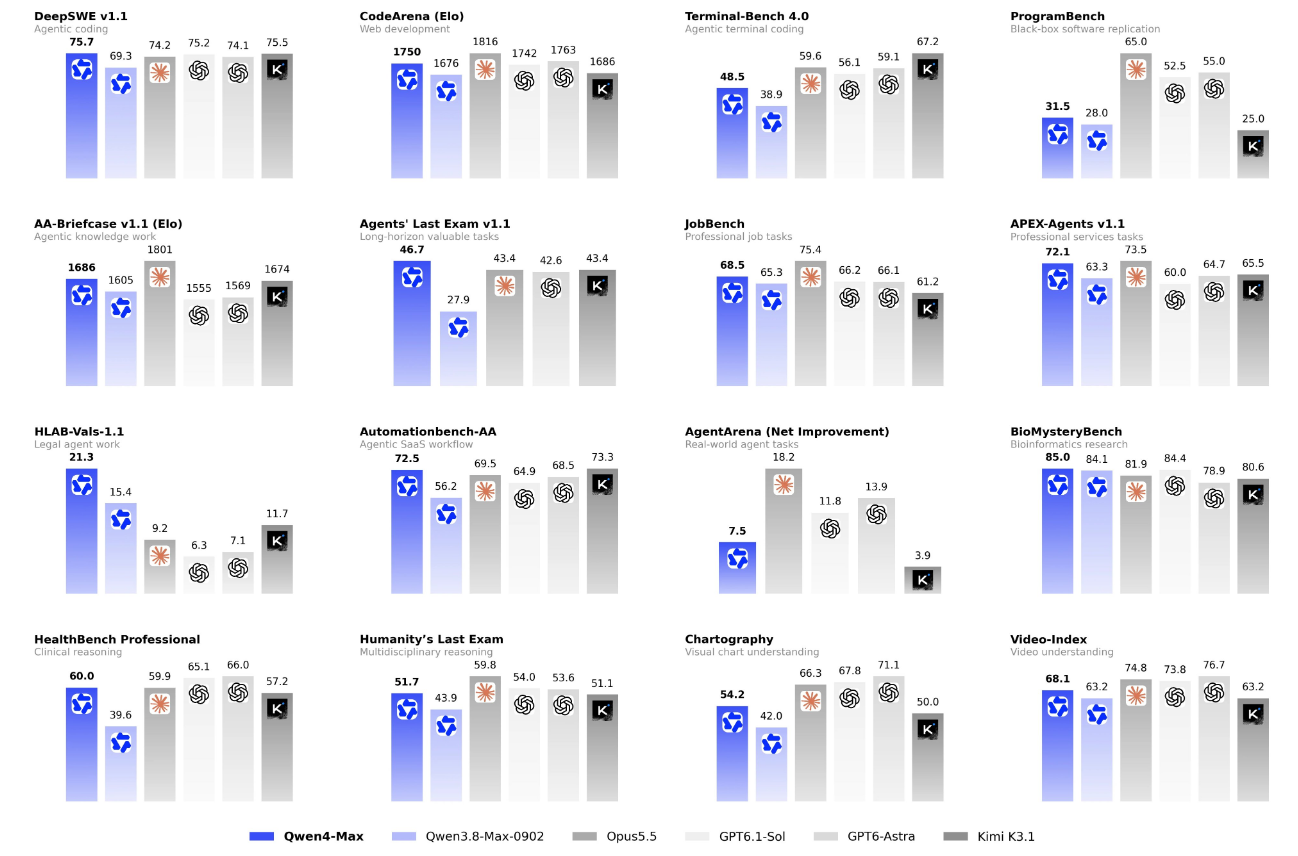
Every flagship launch gets compared to the GPT row, and Qwen4-Max is no exception. The useful comparison is not Qwen against “GPT” in the abstract, it is Qwen4-Max against two different products: GPT-6.1 Sol, the cheap fast tier at $0.70 input and $3.50 output on our gateway, and GPT-6 Astra, the top tier. Alibaba’s launch table scores all three, which lets us settle it with numbers instead of launch-day noise.
The verdict up front. Against GPT-6.1 Sol, Qwen4-Max is the better model on almost every row and the more expensive one per token, so the question is whether the quality gap is worth roughly 2x the input price. Against GPT-6 Astra, Qwen4-Max is much cheaper and wins the agentic, legal and bioinformatics rows, while Astra owns the visual benchmarks, clinical reasoning and Humanity’s Last Exam. There is no single winner, and the split by workload is the whole article.
What the three models are
GPT-6.1 Sol is OpenAI’s value flagship: a 1,050,000-token window, text and image input, $2 / $10 list, and $0.70 / $3.50 on our gateway. GPT-6 Astra is the top of the same family, strongest on the hard visual and reasoning rows. Qwen4-Max is Alibaba’s new mixture-of-experts flagship with native vision, a 1M-token window, and launch pricing of $1.50 input, $4.50 output, $0.075 implicit caching, live on Qwen Cloud and inside Qwen Studio, QwenWork and Qoder.
| Spec | Qwen4-Max | GPT-6.1 Sol | GPT-6 Astra |
|---|---|---|---|
| Context window | 1,000,000 | 1,050,000 | 1,050,000 |
| Input modalities | Text, image (native vision) | Text, image | Text, image, file |
| List input $/M | $1.50 | $2.00 | $10.00 |
| List output $/M | $4.50 | $10.00 | $50.00 |
| Cached input $/M | $0.075 implicit | $0.10 | $1.00 |
| On One AI API Key | Queued | Live $0.70 / $3.50 | Live $3.50 / $17.50 |
The launch date itself is a data point: API Master had Qwen 4.0 expected on November 16, and the API is live today, which makes this the launch-day comparison rather than a preview piece.
The sixteen rows, three ways
The full table with all six launch models is in our sixteen-benchmark explainer. Here it is cut to the three models in this article, winner in bold.
| Benchmark | What it measures | Qwen4-Max | GPT-6.1 Sol | GPT-6 Astra |
|---|---|---|---|---|
| DeepSWE v1.1 | Agentic coding | 75.7 | 75.2 | 74.1 |
| CodeArena (Elo) | Web development | 1750 | 1742 | 1763 |
| Terminal-Bench 4.0 | Agentic terminal coding | 48.5 | 56.1 | 59.1 |
| ProgramBench | Black-box software replication | 31.5 | 52.5 | 55.0 |
| AA-Briefcase v1.1 (Elo) | Agentic knowledge work | 1686 | 1555 | 1569 |
| Agents’ Last Exam v1.1 | Long-horizon valuable tasks | 46.7 | 42.6 | 42.6 |
| JobBench | Professional job tasks | 68.5 | 66.2 | 66.1 |
| APEX-Agents v1.1 | Professional services tasks | 72.1 | 60.0 | 64.7 |
| HLAf-Vals-1.1 | Legal agentic work | 21.3 | 6.3 | 7.1 |
| Automationbench-AA | Agentic SaaS workflow | 72.5 | 64.9 | 68.5 |
| AgentArena (Net Improvement) | Real-world agent tasks | 18.2 | 13.9 | Not listed |
| BioMysteryBench | Bioinformatics research | 85.0 | 84.4 | 78.9 |
| HealthBench Professional | Clinical reasoning | 60.0 | 65.1 | 66.0 |
| Humanity’s Last Exam | Multidisciplinary reasoning | 51.7 | 54.0 | 53.6 |
| Chartography | Visual chart understanding | 54.2 | 67.8 | 71.1 |
| Video-Index | Video understanding | 68.1 | 73.8 | 76.7 |
Counting rows: Qwen4-Max leads GPT-6.1 Sol on nine of sixteen and GPT-6 Astra on seven. But the rows Astra wins are the visual and clinical cluster, and the rows Qwen4-Max wins include the four biggest agentic gaps.
Against GPT-6.1 Sol, Qwen4-Max’s wins are wide where they count: Agents’ Last Exam 46.7 to 42.6, APEX-Agents 72.1 to 60.0, HLAf-Vals legal 21.3 to 6.3, Automationbench 72.5 to 64.9, AgentArena 18.2 to 13.9, BioMysteryBench 85.0 to 84.4, DeepSWE 75.7 to 75.2, AA-Briefcase 1686 to 1555 Elo, JobBench 68.5 to 66.2. Sol takes the visual rows (Chartography 67.8 to 54.2, Video-Index 73.8 to 68.1), HealthBench 65.1 to 60.0, Humanity’s Last Exam 54.0 to 51.7, Terminal-Bench 56.1 to 48.5 and ProgramBench 52.5 to 31.5. CodeArena is a 8-Elo rounding error, 1750 to 1742.
Against GPT-6 Astra, the map flips on vision. Astra takes Chartography 71.1 to 54.2, Video-Index 76.7 to 68.1, HealthBench 66.0 to 60.0, Humanity’s Last Exam 53.6 to 51.7, Terminal-Bench 59.1 to 48.5, ProgramBench 55.0 to 31.5 and CodeArena 1763 to 1750. Qwen4-Max keeps Agents’ Last Exam 46.7 to 42.6, APEX-Agents 72.1 to 64.7, HLAf-Vals 21.3 to 7.1, Automationbench 72.5 to 68.5, AgentArena 18.2 with no Astra row listed, BioMysteryBench 85.0 to 78.9, DeepSWE 75.7 to 74.1, AA-Briefcase 1686 to 1569 and JobBench 68.5 to 66.1.
What the split means for real workloads
Coding agents that live in terminals. Terminal-Bench 4.0 and ProgramBench both go to the GPT rows, Astra at 59.1 and 55.0, Sol at 56.1 and 52.5, Qwen4-Max at 48.5 and 31.5. If your agent’s core job is shell-level automation or rebuilding software from black-box behaviour, the OpenAI tiers are ahead on this evidence, full stop.
Long-horizon knowledge work. Agents’ Last Exam, APEX-Agents, AA-Briefcase and JobBench all favour Qwen4-Max, some by wide margins. If your agents chain many steps over documents, spreadsheets and professional workflows, this is the strongest argument for the Alibaba model.
Legal and life-science text. HLAf-Vals 21.3 against 6.3 and 7.1, BioMysteryBench 85.0 against 84.4 and 78.9. Legal work is low-scoring for everyone, which makes the gap more interesting, not less: on a genuinely hard suite Qwen4-Max doubles the field.
Anything visual. Chartography and Video-Index go to Astra, with Sol close behind. Qwen4-Max has native vision and takes image input, but on these two rows it is third of the three. If charts and video are your workload, the honest pick on this table is GPT-6 Astra, or Gemini 4 Argon if you need audio and video input too.
Clinical reasoning. HealthBench Professional goes Astra 66.0, Sol 65.1, Qwen4-Max 60.0. Not close, and not a tie this time.
The pricing math
List rates per million tokens:
| Route | Input $/M | Output $/M |
|---|---|---|
| Qwen4-Max, Qwen Cloud | $1.50 | $4.50 |
| GPT-6.1 Sol, OpenAI list | $2.00 | $10.00 |
| GPT-6.1 Sol, One AI API Key | $0.70 | $3.50 |
| GPT-6 Astra, One AI API Key | $3.50 | $17.50 |
| Qwen4-Max, One AI API Key | Not live here yet |
Per token, Qwen4-Max list is 75% of Sol’s input and 45% of Sol’s output. But our gateway already sells Sol at $0.70 / $3.50, which is below Qwen4-Max’s list on both lines. That is the number most people miss in launch-day comparisons: the cheapest published rate is not the rate you pay, it is the rate your gateway charges. When Qwen4-Max lands here it gets the same treatment, and until then Qwen3.8 Max at $0.577 / $1.73 is the cheapest 1M-context flagship we sell.
A concrete task, one year, fifty agent runs a day at 8,000 input and 2,000 output each. Monthly token volume is about 12.4M input and 3.1M output. On Sol list that is roughly $56; on Sol through us, $20; on Qwen4-Max list, about $33. On Astra list it is more, and on our gateway the number moves again. The ordering flips depending on which column you read, which is why the cost calculator exists: put your own token counts in, not launch-day assumptions.
Caching tilts it back. Qwen4-Max’s implicit cache at $0.075 per million is 70% below Qwen3.8-Max’s $0.25 cached rate, and agents that re-send the same system prompt and repo context all day spend most of their input at cache prices. Sol’s cached rate on our board is $0.10 per million and Astra’s is $1.00, which tilts the stable-prefix math further toward the OpenAI tiers on long agent loops. Read our prompt caching guide before you trust any total that ignores the cache row.
The rows that decide it, by workload
| If your agent mostly does | Lean on this evidence |
|---|---|
| Repo issue fixing, PR review | Qwen4-Max or Sol, DeepSWE 75.7 vs 75.2, a 0.5 gap |
| Terminal and shell automation | Sol or Astra, Terminal-Bench 4.0 at 56.1 and 59.1 vs 48.5 |
| Long document chains, multi-step professional work | Qwen4-Max, Agents’ Last Exam 46.7 vs 42.6 |
| Charts, dashboards, video understanding | Sol or Astra, Chartography 67.8 and 71.1 vs 54.2 |
| Legal extraction | Qwen4-Max, HLAf-Vals 21.3 vs 6.3 |
| Clinical notes | Sol or Astra, HealthBench 65.1 and 66.0 vs 60.0 |
| Bulk cheap completion | Sol through our gateway at $0.70 / $3.50 |
Five of those seven rows do not need a flagship at all, and that is the point of a routing table over a leaderboard. The same gateway can send legal extraction to Qwen3.8 Max at $0.577 / $1.73 today, terminal work to Sol, and visual work to Astra, and the model comparison tool exists for exactly that arithmetic. When Qwen4-Max lists here, the same rules apply with one more row and one more price.
Speed, the column nobody published
The launch material gives no latency or throughput number for Qwen4-Max, and neither does the Token Plan page. Our preview-week speed post recorded one early report, roughly 20 tokens a second on a long prompt, which is a single data point from a model hours old and proves nothing. The 3.8 generation is the only prior: fast enough for interactive use, slowed by context size like any 1M-window model. Until Artificial Analysis posts a speed column and we meter it here, treat “cheaper per token” and “faster per task” as unrelated claims, and if your agent has a latency budget, test the tail, not the average.
What people are saying
The third-party picture is the same as every Qwen4 launch this week: vendor table first, independent scores later. Artificial Analysis and LMArena have no public Qwen4-Max rows yet. BenchLM documents the gap directly: no source-displayable benchmark rows, only specifications, pricing, context and evidence gaps. MindStudio’s hands-on piece tests animation generation, 82-language naming, satellite image reasoning and visual safety judgment, which is the closest thing to independent impressions published so far, and it is qualitative. The Pandaily thread on X leads with the Agents’ Last Exam score of 46.7 and the caching price cut, both consistent with the table above.
One independent run exists, and it is the closest thing to a third-party measurement of the launch: kingy.ai’s Qwen4-Max versus GPT-6.1 Sol head-to-head via OpenRouter, published 2026-11-15. Five tasks, first attempts 4 of 5 accepted on both models, Qwen at $0.4617 against Sol at $0.3135, then a mandatory self-review stage that lifted Sol to 5 of 5 while Qwen stayed at 4 of 5, for combined costs of $0.9513 against $0.6582. Per accepted task that is roughly 23.8 cents against 13.2 cents in Sol’s favour, with Qwen burning 2.56 times the output tokens, 48,887 against 19,085, billing 296,704 cache reads against zero writes while Sol wrote 42,343 cache entries, and taking 15.67 minutes per first attempt against Sol’s 6.29. Their Vals Index v2.2 row from 2026-11-15 has Sol at 63.94% and Qwen4-Max at 63.20%, at $3.61 against $9.33 per test, with wrong-figure rates of 1.6% against 6.4% across 125 questions. One synthetic repetition, unblinded AI grading, no settled invoice: direction, not verdict. But it is the only measured evidence outside Alibaba’s table, and it cuts both ways. Sol is cheaper, faster and more accurate on figures; Qwen4-Max holds the quality rows on Alibaba’s own board.
What is worth watching, not quoting: once Artificial Analysis posts quality, price and speed columns for Qwen4-Max, the speed column matters as much as the scores, because a model that is 20% cheaper and three times slower is not automatically the better deal for an agent under latency budget. We will update this post when independent rows exist, and our rankings page already tracks real gateway throughput for every model we serve.
How to call Qwen4-Max today
The API is live on Qwen Cloud, OpenAI-compatible:
curl https://ap-southeast-1.maas.qwencloudapi.com/compatible-mode/v1/chat/completions \
  -H "Authorization: Bearer $QWEN_API_KEY" \
  -H "Content-Type: application/json" \
  -d '{
    "model": "qwen4-max",
    "messages": [{"role": "user", "content": "Refactor this function for readability."}]
  }'
Copy the base URL from your own Qwen Cloud console rather than trusting any blog’s host, including this one; regional hosts have varied before. A 401 means the key or entitlement is wrong, a 404 on the model usually means the id, and qwen4-max is not qwen4-max-preview. Enable streaming so long reasoning arrives token by token, and set max_tokens deliberately: a reasoning model can spend its output budget thinking before it answers, which our reasoning docs cover.
When Qwen4-Max joins our model catalog, the same code works with the base URL swapped for ours and the key you already have. Every model here gets a published rate, per-key limits and per-request metering, and the usage log shows exactly what you burned, which is how you catch a launch-day price surprise before the bill does.
Mistakes to avoid
- Reading one row as a verdict. Sol beats Qwen4-Max on six rows, Astra on seven. Pick by your workload’s rows, not by the count.
- Comparing list price to gateway price. Sol at $0.70 / $3.50 through us is below Qwen4-Max’s $1.50 / $4.50 list. Compare the rate you actually pay.
- Ignoring the Elo rows. CodeArena and AA-Briefcase are ratings; the rest are percentages. Mixing them in an average is meaningless.
- Assuming native vision means best vision. It takes images, but Chartography and Video-Index both go to Astra. Test your visual tasks specifically.
- Budgeting on the 60% cost claim. It is from an internal evaluation with an unpublished workload. The published rates are real; your burn is not.
- Pinning a moving id. Preview ids and GA ids behave differently; the 3.8 generation proved it. Pin, log, re-run evals.
FAQ
Is Qwen4-Max cheaper than GPT-6.1 Sol?
On list rates, yes: $1.50 / $4.50 per million against Sol’s $2.00 / $10.00. On our gateway, Sol is $0.70 / $3.50 today, which is below Qwen4-Max’s list. Until Qwen4-Max has a published rate here, Sol through us is the cheaper flagship per token.
Does Qwen4-Max beat GPT-6 Astra?
On nine of sixteen rows it beats or ties Astra, including Agents’ Last Exam 46.7 to 42.6, APEX-Agents 72.1 to 64.7 and HLAf-Vals 21.3 to 7.1. Astra keeps the visual rows, HealthBench, Humanity’s Last Exam, Terminal-Bench and ProgramBench. Split by workload.
What is the context window?
1,000,000 tokens, per the launch material. Sol lists 1,050,000. Both are in the same tier, and neither number tells you recall quality across the window, so test your own long prompts.
Has Artificial Analysis scored Qwen4-Max yet?
No. As of 2026-11-16 neither Artificial Analysis nor LMArena publishes an independent Qwen4-Max row. BenchLM documents the evidence gap explicitly. The only published table is Alibaba’s.
Is Qwen4-Max on One AI API Key?
Not yet. It is queued for the catalog at a published rate below list, the same as every Alibaba flagship. Qwen3.8 Max is live today at $0.577 / $1.73, and qwen3.8-max:free runs on the free lane.
What is the model id and base URL?
qwen4-max on Qwen Cloud’s OpenAI-compatible endpoint, base URL copied from your own console. The preview id qwen4-max-preview is a different model.
Does the Token Plan beat Sol per token?
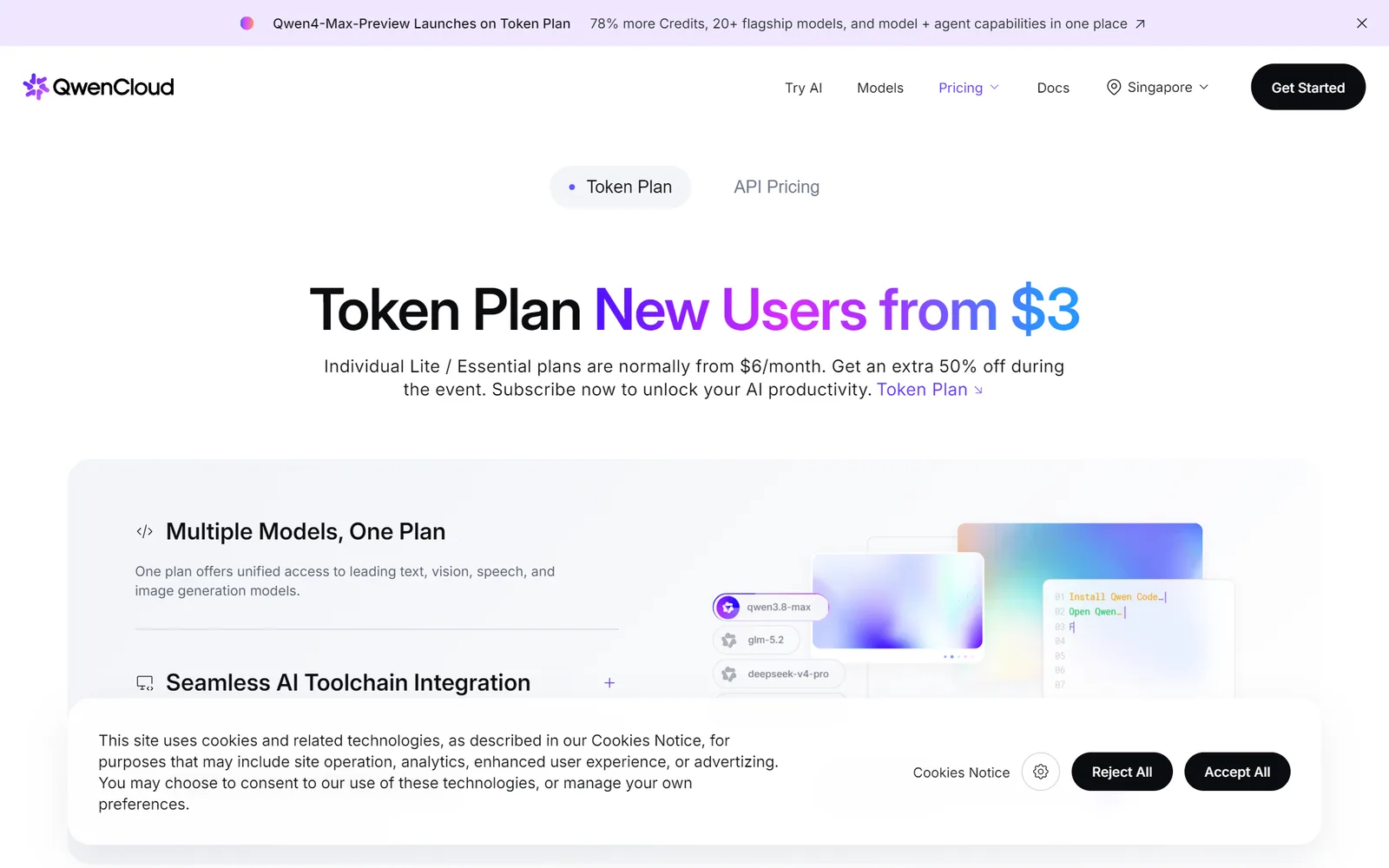
It cannot be computed yet. Lite at $3 buys 20,000 credits with no published burn rate, while Sol bills $0.70 / $3.50 per million through us. A subscription with an unknown exchange rate is not a per-token price; measure a week on each before calling it.
Which GPT-6 tier is the fair comparison?
Sol, for cost-per-task work. Astra, for visual and clinical work. Qwen4-Max splits them on this table: ahead of Sol on nine rows, behind Astra on seven, and the rows it loses are the ones Astra buyers usually care about.
The bottom line
Against GPT-6.1 Sol, Qwen4-Max is the stronger model on most agentic rows and the pricier one per token at list, though Sol through our gateway undercuts it. Against GPT-6 Astra, Qwen4-Max is far cheaper and better on long-horizon, legal and bioinformatics work, and clearly worse on vision, clinical reasoning and terminal coding. The honest recommendation is the boring one: match the rows to your workload, run your own eval on the two or three that decide your use case, and meter the result. Sol and Astra are live and metered today; Qwen4-Max is live upstream and queued here, and your key will switch it on with an id change, not a migration.
Keep reading: all sixteen benchmarks explained, Qwen4-Max API pricing and the $43 plan, Qwen4-Max vs Claude Opus 5.5, and Qwen4-Max vs Qwen3.8-Max, the generational jump.
More Qwen4-Max coverage
The Fable comparison, added 2026-11-16:
The rest of the cluster, and the pages every comparison links back to:
- Qwen4-Max 1M context guide: what a million tokens holds, and the chunking that keeps it honest
- Qwen4-Max API pricing: every rate, the $43 Token Plan Pro and what a call actually costs
- Qwen4-Max API quickstart: the id, the base URL, streaming, max_tokens and the $43 plan
- The cheapest way to run Qwen4-Max: free routes checked, and the $3 plan that beats them all
- Run Qwen4-Max in your coding agent: base URL, model id, concurrency tiers and budget guards
- Qwen4-Max prompt caching: the $0.075 implicit cache, break-even math and cache-break probes
- Qwen4-Max vision and video benchmarks: what native vision actually scores against GPT-6 Astra and Opus 5.5
- Qwen4-Max vs every flagship launched this quarter: the full scoreboard, price per million and who serves what
- Qwen4-Max vs Gemini 4 Argon: multimodal routes, 1M context and what each actually costs
- Qwen4-Max vs GPT-6 Astra: sixteen benchmarks, the price gap and where each model wins
- Qwen4-Max vs Grok 4.7: flat flagship prices against the 2x long-context surcharge
- Qwen4-Max vs Kimi K3: sixteen benchmarks, terminal coding and the price per million tokens
- Qwen4-Max vs Claude Opus 5.5: sixteen benchmarks, token prices and the honest split
- Qwen4-Max vs Qwen3.8-Max-0902: the 16-benchmark sweep, the price cut and a migration checklist
- The model catalogue
- The model comparison tool
- API pricing and plans
- The cost calculator
- Live rankings and throughput
- The changelog