This is the launch-day setup post. The preview-week wiring guide, Use Qwen4 Max Preview in Claude Code, Cursor, Codex and Cline, is still the canonical reference for the per-tool screens, so this one does not repeat it. This one covers what changed on November 16: the launch id, the published pay-as-you-go rates next to the Token Plan, the concurrency column that decides which tier your agent fleet fits, and the four budget guards that stop a flagship from eating a month of credits in an afternoon.
Short version: Qwen4-Max speaks both protocol dialects the agentic world already uses, OpenAI-compatible and Anthropic-compatible, per the Token Plan tools list. Your existing client config survives; only the base URL and the model string change.
What changed since the preview
| Item | Preview week | Launch day |
|---|---|---|
| Model id | qwen4-max-preview |
qwen4-max |
| Access | Token Plan preview, gated | Token Plan plus pay-as-you-go list rates |
| Input price | Unpublished per-token | $1.50 / M |
| Output price | Unpublished per-token | $4.50 / M |
| Cached input | Unpublished | $0.075 / M implicit caching |
| Context | 1,000,000 published | 1,000,000 published |
| On One AI API Key | Not listed | Queued, not listed yet |
The id change is the one that breaks builds. The preview generation rode qwen4-max-preview; the launch id is qwen4-max. The 3.8 family already showed the pattern, with qwen3.8-max and a dated sibling qwen3.8-max-0902 that behave differently. Confirm the exact id in your Qwen Cloud console before you paste it into config, and log the model field from responses so a silent swap shows up in metrics.
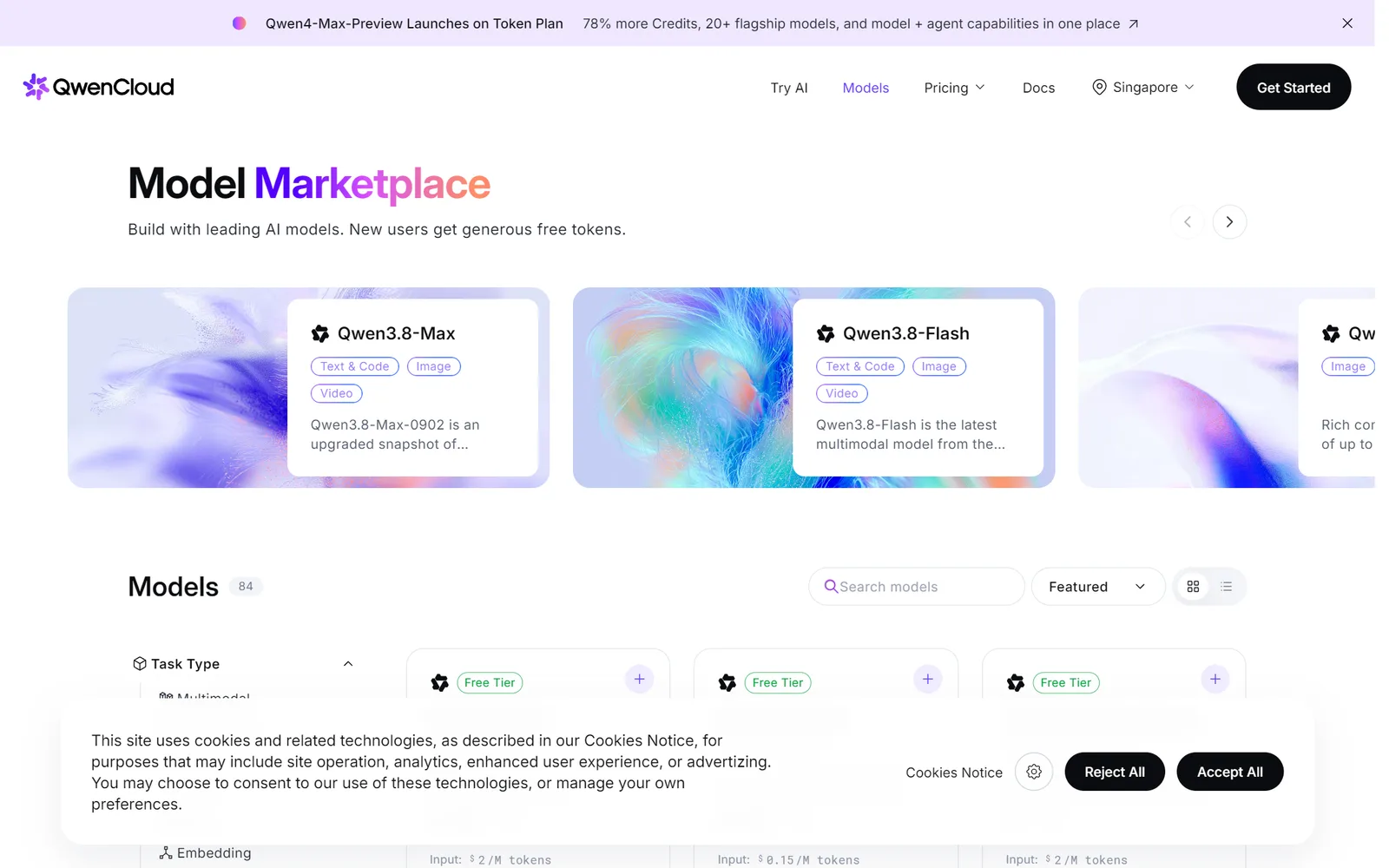
The marketplace banner from launch day. It is also the source of the supported-models table row that carries the exact preview id, which is why the id drift above matters: the marketplace and the billing console can disagree for a stretch after a launch.
The wiring, per tool
The mechanics are in the preview wiring post and have not changed: point the tool at the compatible base URL, paste the key, set the model string. What changes today is the string and the budget. The quick reference:
| Tool | Protocol | Base URL | Model string |
|---|---|---|---|
| Claude Code | Anthropic-compatible | Qwen Cloud compatible endpoint | qwen4-max |
| Cursor | OpenAI-compatible | Qwen Cloud compatible endpoint | qwen4-max |
| Codex CLI | OpenAI-compatible | Qwen Cloud compatible endpoint | qwen4-max |
| Cline | Either, per provider setup | Qwen Cloud compatible endpoint | qwen4-max |
| OpenCode | OpenAI-compatible | Qwen Cloud compatible endpoint | qwen4-max |
| Kilo CLI | OpenAI-compatible | Qwen Cloud compatible endpoint | qwen4-max |
| Qwen Code | Native | In-app picker | qwen4-max |
The two base-URL traps that cause most 401s, from the preview week and still true: the region-pinned host (ap-southeast-1.maas.qwencloudapi.com in the examples here) is not the same string as the console’s generic endpoint, and the Anthropic-compatible path is a different route than the OpenAI one. If your agent connects but 401s immediately, the key is fine and the base URL is wrong nine times out of ten.
A smoke test before you wire anything:
curl https://ap-southeast-1.maas.qwencloudapi.com/compatible-mode/v1/chat/completions \
  -H "Authorization: Bearer $QWEN_API_KEY" \
  -H "Content-Type: application/json" \
  -d '{
    "model": "qwen4-max",
    "messages": [{"role": "user", "content": "Refactor this function for readability."}]
}'import os
from openai import OpenAI
client = OpenAI(
api_key=os.environ["QWEN_API_KEY"],
base_url="https://ap-southeast-1.maas.qwencloudapi.com/compatible-mode/v1",
)
resp = client.chat.completions.create(
model="qwen4-max",
messages=[{"role": "user", "content": "Explain this stack trace."}],
)
print(resp.choices[0].message.content)Concurrency: the column that picks your tier
The Token Plan’s concurrency column is the one developers skip and then regret. Launch prices, individual monthly:
| Tier | Launch price | Regular price | Credits / month | Concurrent agents |
|---|---|---|---|---|
| Lite | $3 | $8 | 20,000 | 1-2 |
| Essential | $5 | $16 | 45,000 | 2-3 |
| Standard | $18 | $25 | 80,000 | 3-4 |
| Pro | $43 | $51 | 200,000 | 6-8 |
An agent fleet that runs four parallel sessions on Lite is not a plan problem, it is a queue problem: the tier gates concurrency, and the launch banner’s 80% off tag does not widen the gate. Count your concurrent sessions before you count your credits. If your fleet is two agents and one interactive session, Essential’s 2-3 is the honest fit. If you run CI fans, Pro’s 6-8 is the only tier that fits without redesigning the loop.
The same page carries Individual and Team tabs and Monthly, Quarterly and Yearly toggles; longer terms lower the effective monthly price, and Alibaba notes the checkout price after login is the one that counts.
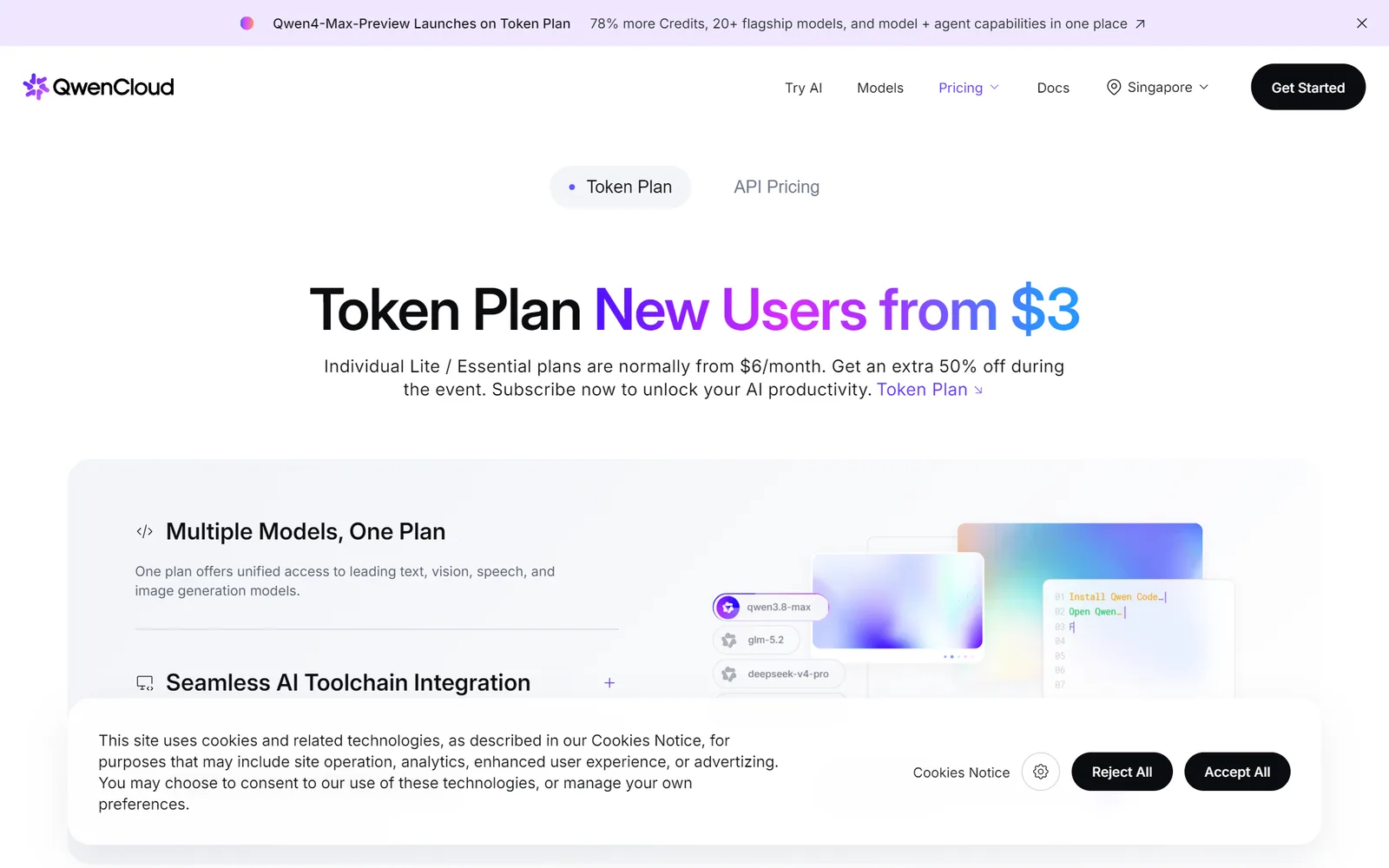
The tier cards as captured. The 78% more credits claim rides the banner, the 80% off tag rides the model row, and the concurrent-agents column rides quietly at the right edge, where the plan fits are decided.
Four budget guards
Guard one: meter the burn. Credits have no published conversion, so your first week on the Token Plan is a measurement week. Log tokens per call; the input, the output and whether the cached rate fired. At $1.50 against $0.075 the cache is most of the bill.
Guard two: cap the loop. Agent loops retry, and retries re-send context. A 400K-token context re-sent on a failed call costs the same as the first send. Put a per-task token ceiling in code, not in hope.
Guard three: pin the id and the snapshot. Preview generations move: rate limits change, snapshots swap, ids rename. Pin the exact id, re-run evals after any Alibaba announcement, and keep the rankings habit of trusting metered evidence over launch tables.
Guard four: keep a fallback route. The free lane and the standard Qwen3.8 Max listing at $0.577 / $1.73 are live now, and the 0902 uncensored lane is free at $0 against the daily allowance. When the flagship queue clears on our gateway, Qwen4-Max gets the same below-list treatment with a published rate and per-key limits. Until then, the fallback is not optional.
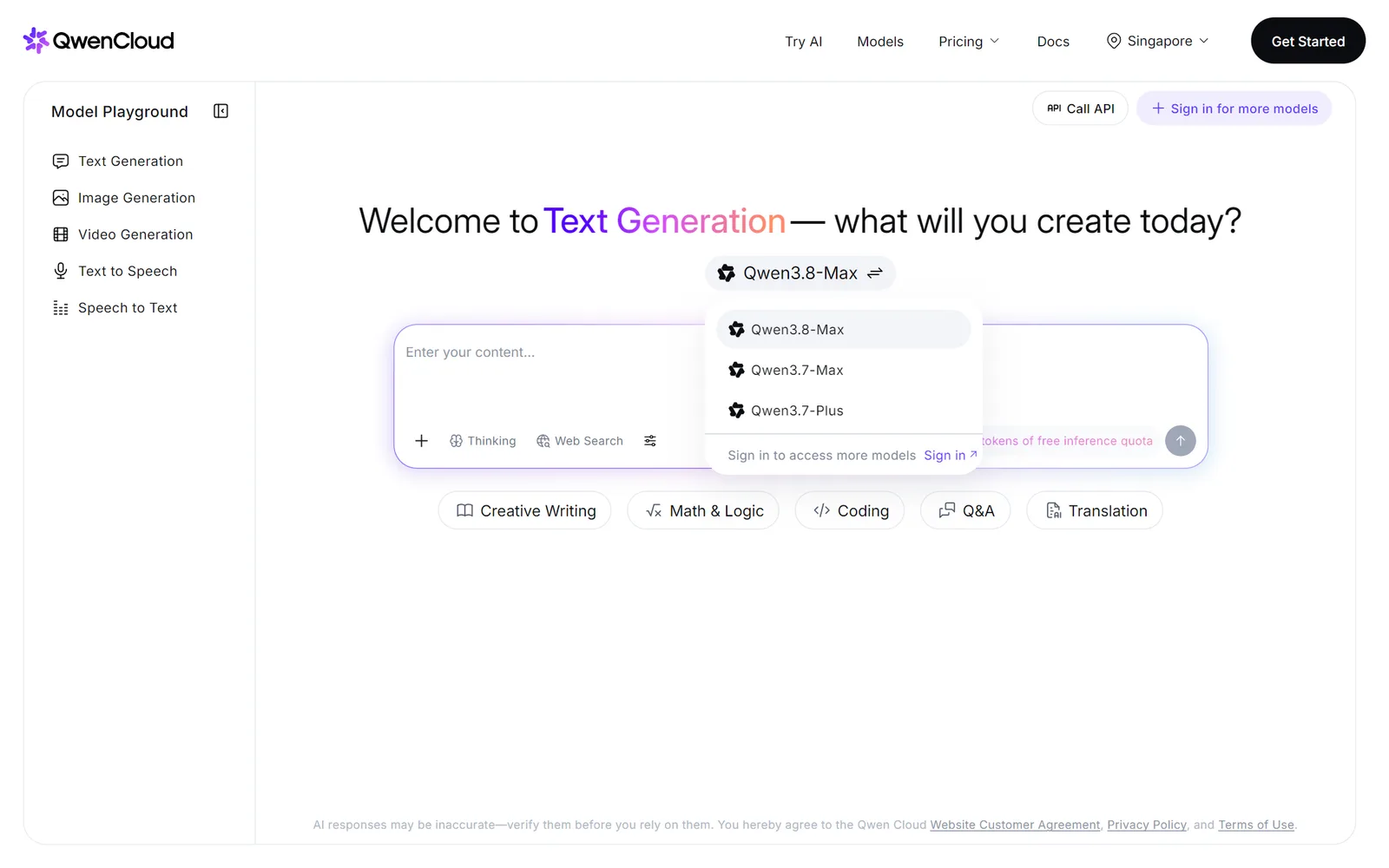
The playground’s Call API panel is the fastest way to validate a base URL and key before the agent wiring. Its free quota covers older models and gates Qwen4-Max behind sign-in, so use it for smoke tests, not for budgets.
What the benchmarks say about agent use
The launch table’s agentic rows are the ones this setup is for: Qwen4-Max at 75.7 on DeepSWE v1.1 agentic coding, 46.7 on Agents’ Last Exam long-horizon tasks, 72.1 on APEX-Agents, 18.2 net improvement on AgentArena, all from Alibaba’s own table, transcribed in full in Qwen4-Max benchmarks, explained. The honest caveats are the same ones: no methodology card, no error bars, no independent run, and benchlm.ai documents the evidence gaps plainly. The numbers are a reason to test, not a reason to migrate production today.
The community signal that matters for setup is practical, not statistical: the apidog walkthrough shows a client defaulting to 32,768 max_tokens against a 983,616-token context. Defaults, not limits. Set your own ceilings, which is guard two.
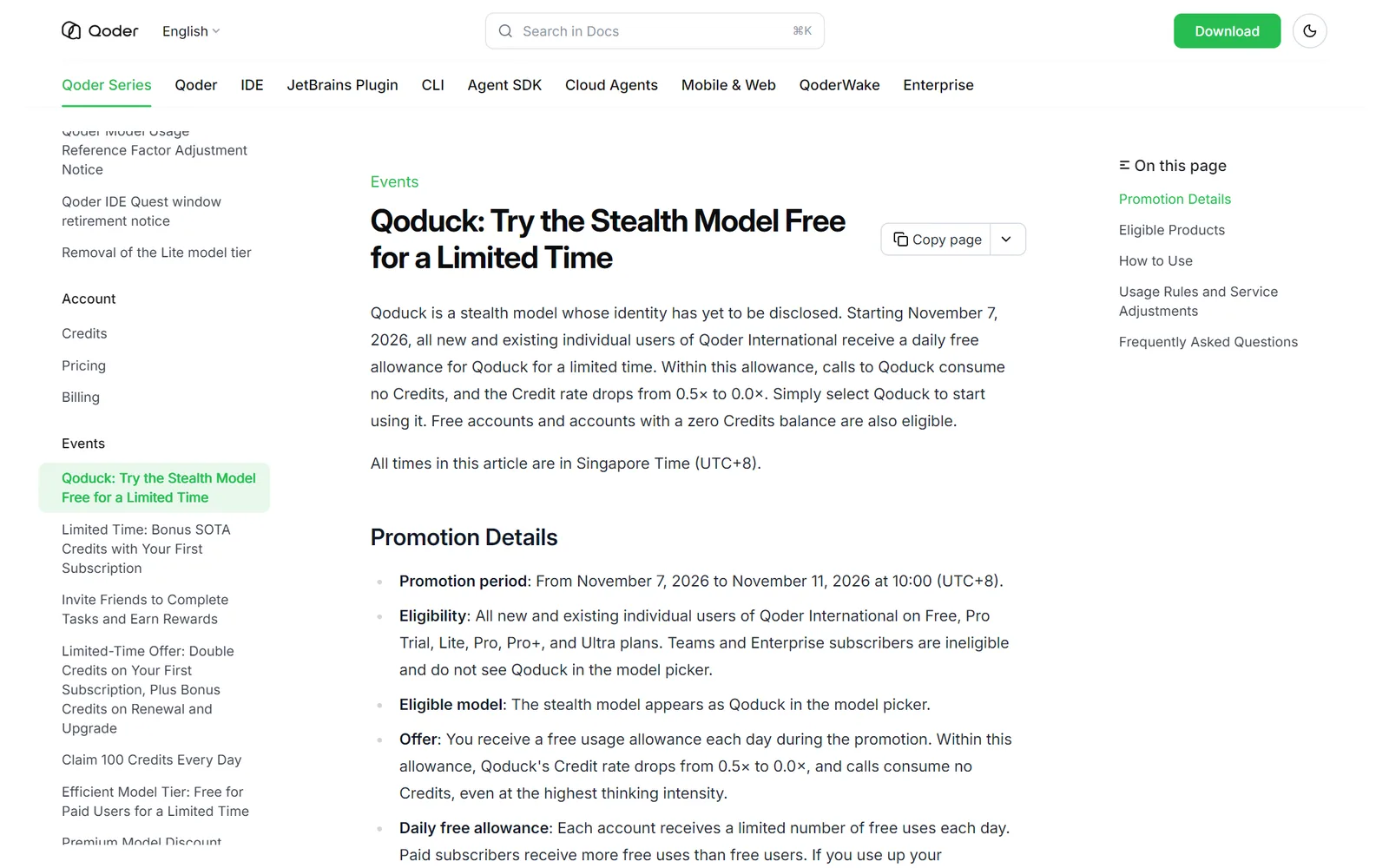
The Qoduck page, captured while its free window was still open. If your agent stack lives inside Qoder, the launch-week pattern was real: a mystery model, four free days, and a closed window. Treat any future free-window announcement the same way: verify the model id, verify the end date, and do not build the quarter on it.
Wiring beyond the big names
The seven tools in the table above cover most agent stacks. The rest of the ecosystem is SDK-level, and the config is the same three fields everywhere: base URL, key, model string.
| Framework | Field to set | Value |
|---|---|---|
| LangChain / LlamaIndex | base_url on the OpenAI client |
Qwen Cloud compatible endpoint |
| Vercel AI SDK | baseURL on the provider |
Qwen Cloud compatible endpoint |
| AutoGen, CrewAI, any OpenAI client | base_url / api_base |
Qwen Cloud compatible endpoint |
| Anthropic-protocol tools | base_url on the Anthropic client |
Qwen Cloud compatible endpoint |
The reason both protocol rows exist is the Token Plan’s tools list, which publishes OpenAI-compatible and Anthropic-compatible surfaces. A stack already speaking one of them needs no translation layer. A stack speaking neither needs one, and that is a sign to move the stack, not the model.
Fleet arithmetic, before you pick a tier
Worked example, six parallel agent sessions, fifty turns each per day, twenty thousand tokens per turn on average, split eighty twenty input to output:
- Daily: 6 x 50 x 20,000 = 6,000,000 tokens, of which 4,800,000 input and 1,200,000 output.
- Monthly at list: 144M input x $1.50 = $216.00, plus 36M output x $4.50 = $162.00, total $378.00.
- Monthly with 60% of input cached at $0.075: $64.80 + $18.00 on the cached split plus $108.00 fresh input, plus $162.00 output, total $352.80.
Now hold that against the tiers: Lite’s 20,000 credits, Pro’s 200,000 credits, burn rate unpublished. A fleet this size cannot be planned from the tier table; it can only be planned from a metered week. What can be planned is the shape: six sessions is already past Standard’s 3-4 concurrent-agent line, so the tier decision is made by the concurrency column before the credit column matters.
Thinking budgets and output ceilings
This is a reasoning model, so two knobs decide cost per task before any prompt engineering does. The first is the thinking toggle, the pattern in our reasoning docs: thinking tokens are generated tokens, and generated tokens bill at $4.50 per million at list. A workflow that does not need chain-of-thought, such as classification or extraction, should run with the toggle off; a workflow that does, such as the legal and bioinformatics rows where this model leads, should budget for it.
The second is max_tokens. apidog’s walkthrough shows a client defaulting to 32,768, which is a default, not a limit, and the published output ceiling is about 390,000. Set the ceiling per task: a refactor agent needs a different cap than a summarizer, and a cap set by hope produces either truncation or waste. Log where generation actually stops; a stopped-at-cap answer that ships as complete is the most expensive bug in any agent fleet.
Observability, the launch-week version
Three fields in every log line, or the evals are opinions:
- The model field, verbatim, because
qwen4-maxandqwen4-max-previewwill both appear in early traffic and they are not the same model. - Cached versus fresh input tokens, because $0.075 against $1.50 is a 20x spread and your cache hit rate is your real price.
- Retries per task, because agent loops retry, and a retry re-sends the whole context. A task with four retries costs five tasks.
Alert on any single call crossing a token budget you set, and on cache hit rate dropping week over week. The usage log on our side already meters this shape for every served model, which is the habit to import here before the model arrives: when Qwen4-Max lists on the gateway, the same per-key limits and per-request metering apply, and the bill looks like every other bill you already audit.
What the independent boards say about agents
As of 2026-11-16, Artificial Analysis and LMArena carry no Qwen4-Max row, so no third party has measured its agentic or tool-use quality; the sixteen launch benchmarks are Alibaba’s own evaluation. The hands-on walkthroughs that exist, like the MindStudio test, document setup and defaults rather than scores. Treat the tier table above as the real constraint: concurrency, not benchmark lore, is what an agent fleet feels first, and it is the one column you can verify with your own key before you scale.
Mistakes to avoid
- Pasting the preview id into launch configs.
qwen4-max-previewandqwen4-maxare different strings with different behavior. Pin and log. - Ignoring the concurrency column. Credits do not buy parallelism past the tier gate. Count sessions first.
- Skipping the smoke test. A 60-second curl before the wiring saves an hour of 401 archaeology.
- Leaving retries unbounded. Agent loops re-send context on every retry. Cap attempts and tokens per task.
- Assuming our gateway rate exists. Qwen4-Max is queued here, not listed. The metered Qwen route today is Qwen3.8 Max.
- Budgeting credits as tokens. No published burn rate means no per-call math. Measure week one.
What to do while the listing is queued
Four things, in order:
- Run the smoke test on Qwen Cloud with the curl and Python blocks above, so your prompt templates are proven before the id swap.
- Meter the same workload on Qwen3.8 Max through the gateway at $0.577 / $1.73, and export the log. That export becomes your before-and-after evidence the day the listing lands.
- Set the alert thresholds now: tokens per task, cache hit rate, retries per task, and a cost ceiling per key. The rate limits docs cover the caps we enforce; your own ceilings are the ones that catch launch-week surprises.
- Keep the cheap lanes warm for bulk work: the 0902 uncensored lane and the Groq 27B lane absorb the low-stakes traffic while the flagship gets measured.
The cadence to expect is the one the 3.8 generation set: id confirmed, rate published, limits published, then traffic. Nothing about that order changes because the launch banner is loud.
FAQ
Can I use Qwen4-Max in Cline today?
Yes, on Qwen Cloud, through the Anthropic-compatible route, with the wiring screens in the preview guide. On our gateway it is queued; Cline against our base URL runs the 3.8 family until then.
Why does the concurrency column matter more than credits?
Because a tier that gates parallelism turns a fleet into a queue, and a queued agent is a slow pipeline no matter how large the credit grant is.
How do I catch a silent id swap?
Log the model field from every response and diff it against your config. The 3.8 family shipped two ids with different behavior; the Qwen4 family will ship more.
What is the first budget number to watch?
Cache hit rate. At $0.075 cached against $1.50 fresh, the spread is 20x, and a broken prefix is the only bug that bills you silently.
Which base URL does Qwen4-Max use?
The compatible-mode endpoint, region-pinned; the examples here use https://ap-southeast-1.maas.qwencloudapi.com/compatible-mode/v1. Confirm your region in the Qwen Cloud console.
Does it work with Claude Code and Cursor?
Yes, through the Anthropic-compatible and OpenAI-compatible routes the Token Plan lists. The per-tool screens, including the exact env vars and provider menus, are in the preview wiring post, and they still apply.
Is there a free way to run this in an agent?
Not confirmed for Qwen4-Max on 2026-11-16. The playground’s 1M free tokens cover older models, and Qoder’s Qoduck window closed November 11. The cheapest confirmed route is Lite at $3 during the launch event. For free agent traffic today, the free lane runs the Qwen3.8 generation at $0.
How many parallel agents can I run?
The tier gates it: Lite 1-2, Essential 2-3, Standard 3-4, Pro 6-8 concurrent agents. Above that you queue, and a queued agent is a slow pipeline.
When will it be on One AI API Key?
When it passes the same live checks every model passes here. The changelog is where the listing lands first.
What is the first thing to measure after wiring?
Tokens per task, cached versus fresh input, and retries per task. Those three numbers turn the launch claims, ~50% fewer tokens and over 60% lower cost per task, into a bill you can audit.
The bottom line
The wiring is easy because the model speaks both dialects; the discipline is hard because the billing is credits, the concurrency is tiered and the preview generation taught everyone that ids move. Wire the tool, run the smoke test, pin the id, meter week one, and keep the 3.8 fallback warm. Do that, and the launch table becomes a hypothesis you can test on your own tasks, which is the only test that pays.
Keep reading
- Use Qwen4 Max Preview in Claude Code, Cursor, Codex and Cline — the per-tool wiring screens
- Qwen4-Max API pricing decoded — every rate surface, including the $43 Pro tier
- Qwen4-Max benchmarks, explained — the agentic rows behind the setup
- Qwen4-Max vs Qwen3.8-Max-0902 — the migration checklist
- Qwen4 Max Preview: free, pricing, providers and specs — the launch-day master post
- Prompt caching guide — cache mechanics for agent loops
More Qwen4-Max coverage
The Fable comparison, added 2026-11-16:
The rest of the cluster, and the pages every comparison links back to:
- Qwen4-Max 1M context guide: what a million tokens holds, and the chunking that keeps it honest
- Qwen4-Max API pricing: every rate, the $43 Token Plan Pro and what a call actually costs
- Qwen4-Max API quickstart: the id, the base URL, streaming, max_tokens and the $43 plan
- The cheapest way to run Qwen4-Max: free routes checked, and the $3 plan that beats them all
- Qwen4-Max prompt caching: the $0.075 implicit cache, break-even math and cache-break probes
- Qwen4-Max vision and video benchmarks: what native vision actually scores against GPT-6 Astra and Opus 5.5
- Qwen4-Max vs every flagship launched this quarter: the full scoreboard, price per million and who serves what
- Qwen4-Max vs Gemini 4 Argon: multimodal routes, 1M context and what each actually costs
- Qwen4-Max vs GPT-6.1 Sol and GPT-6 Astra: benchmarks, pricing and the split
- Qwen4-Max vs GPT-6 Astra: sixteen benchmarks, the price gap and where each model wins
- Qwen4-Max vs Grok 4.7: flat flagship prices against the 2x long-context surcharge
- Qwen4-Max vs Kimi K3: sixteen benchmarks, terminal coding and the price per million tokens
- Qwen4-Max vs Claude Opus 5.5: sixteen benchmarks, token prices and the honest split
- Qwen4-Max vs Qwen3.8-Max-0902: the 16-benchmark sweep, the price cut and a migration checklist
- The model catalogue
- The model comparison tool
- API pricing and plans
- The cost calculator
- Live rankings and throughput
- The changelog